Every two weeks, the business development tactics top lawyers use are free at therainmakingmagazine.com
----------------------------------------
Most law firm mergers fail to deliver on their promise. Not because the financials were wrong — but because nobody did the cultural due diligence.
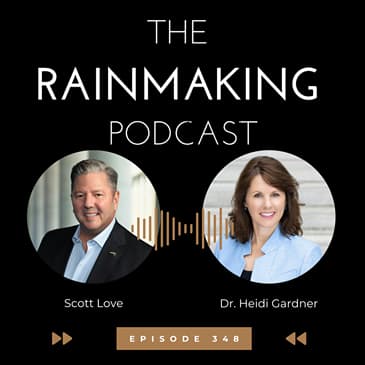
Dr. Heidi Gardner is a Distinguished Fellow at Harvard Law School, former Harvard Business School professor, McKinsey consultant, and author of two best-selling books — Smart Collaboration and Smarter Collaboration — both published by Harvard Business Press. She leads Gardner & Co., a research and advisory firm that helps professional services leaders turn collaboration into client growth. In this episode, Dr. Gardner joins Scott Love to break down exactly why post-merger trust and collaboration fail — and what leaders must do differently before, during, and after a combination.
What you'll learn:
- Why mergers fail more often than not — and what "working" actually means from a client's perspective
- The cultural due diligence most firms skip entirely — and the data you should be asking to see before signing
- The two flavors of trust that are both essential for collaboration: competence trust and character trust
- Why homophily — the instinct to affiliate with your own tribe — is the silent killer of post-merger integration
- How to use data to identify collaboration leaders vs. islands — before and after a merger
- Why "not every dollar is a good dollar" — and what a sticky, strategic dollar actually looks like
- The difference between leading and lagging indicators of merger success — and which ones to track quarterly
- Why hero-worship success stories backfire — and the less sexy story that's actually more valuable to tell
- What the Smarter Collaboration Profile psychometric reveals about partnership blind spots and bifurcated cultures
- Why law firms absolutely do not invest enough in leadership development — and what that costs them
- 3 action steps: visit SmartCollaboration.com, get curious about your clients, and examine your collaboration network
Visit: https://therainmakingpodcast.com/
YouTube: https://youtu.be/td3QJm__7Ig
---------------------------------------- If you are a successful law firm partner or law firm founder and want to hear about other options, please book a time on Scott Love's calendar here: https://attorneysearchgroup.com/schedule Or email Scott to connect with him at: scott@attorneysearchgroup.com ----------------------------------------
This podcast is sponsored by SurePoint Legal Insights (formerly known as Leopard Solutions)–turning legal intelligence into opportunity.
For a free demo, visit this link: https://surepoint.com/legal-insights/ ----------------------------------------
About Dr. Heidi Gardner:
Dr. Heidi Gardner authored two best-selling books Smart Collaboration and Smarter Collaboration, published by Harvard Business Press. A Distinguished Fellow at Harvard Law School, she was previously a professor at Harvard Business School, a consultant at McKinsey & Co., and manager at P&G. She presently leads the research and advisory firm Gardner & Co., and has lived and worked on four continents. She helps professional service firm leaders turn collaboration into client growth and sustained performance.
Links:
https://www.linkedin.com/in/heidi-k-gardner-ab5b825/
Learn more about your ad choices. Visit megaphone.fm/adchoices
[00:00:10] You're listening to The Rainmaking Podcast, hosted by legal dealmaker, author, and professional speaker, Scott Love. You're listening to The Rainmaking Podcast, and my name is Scott Love. Thank you for joining me on the show.
[00:00:31] Our special guest today is Dr. Heidi Gardner, and our topic title is this, After a Merger, How to Build Trust and Collaboration. Let me tell you about Heidi Gardner. Dr. Gardner has authored two bestselling books, Smart Collaboration and Smarter Collaboration, both published by Harvard Business Press. A distinguished fellow at Harvard Law School, she was previously a professor at Harvard Business School,
[00:00:56] a consultant at McKinsey & Company, and manager at P&G. Heidi presently leads the research and advisory firm Gardner & Company and has lived and worked on four continents. She helps professional services firm leaders turn collaboration into client growth and sustained performance. This is going to be an exciting topic, and we get into the weeds on this, and I know you're going to get a lot of value from it. Let me tell you a few other announcements before we get into our conversation with Heidi.
[00:01:24] The show is sponsored by SharePoint Legal Insights, formerly known as Leopard Solutions, turning legal intelligence into opportunity. The show is also sponsored by The Rainmaking Magazine, with over 40 authors contributing their best ideas and client development. It's absolutely free. Visit therainmakingmagazine.com. Also, if you're a transactional partner for law firms, you do corporate
[00:01:49] deals, you're a finance partner, real estate deals, and if you want ideas that can help you maximize your deal flow, then attend our live half-hour webinar events where I interview a different author or business development coach for lawyers each month. It's usually the third week of the month, and it's a half hour, and it's recorded over Zoom with live Q&A. These are really good. Check it out. Just go to rainmakingseminars.com
[00:02:15] to get on the list. Your info won't be shared with anyone outside of my organization. I promise you that. I hope you get some really good ideas from my conversation with Heidi. Check out the show notes. You can connect with her directly. We also have some other resources that she talks about that you'll be able to get on the show notes directly. Thank you so much for listening and for making this show a success. And now here's my conversation with Dr. Heidi Gardner. Hey, this is Scott Love with The Rainmaking Podcast. Our special
[00:02:44] guest today is Dr. Heidi Gardner, and we're talking about after a merger, how to build trust and collaboration. Heidi, thank you for joining me on the show today. Pleasure indeed, Scott. I'm excited to have you here. And so we know what happens. Two entities come together, and sometimes it works and sometimes it doesn't. And let's talk about... More often than not. That's right. That's right. So let's talk about that. Let's talk about those situations where it doesn't work and there's no trust, there's no collaboration. Let's kind of dig into that.
[00:03:11] And why do you think, starting off, why do you think sometimes those mergers don't take that they don't work off the long-term, Heidi? So I think there are a number of reasons why mergers don't work. And when we talk about work versus don't work, what do we actually mean, right? The merger thesis, more often than not, is actually what I call smarter collaboration, right? So the last 20 years at Harvard, I have researched this topic of collaboration. How do you get people to work together across divides,
[00:03:38] whether that's practice groups or offices or, you know, the client service people, you know, the lawyers versus the support functions. And indeed, in a merger situation, getting people to work together across legacy firms is absolutely vital. And the merger thesis is generally, we will be stronger at serving clients, we'll be more differentiated, we'll have a more complementary
[00:04:04] base of experts and jurisdictions as a joined up firm than we do as two separate firms. So when we talk about does it work, did they actually accomplish that? Are they serving clients in a more fulsome way that clients truly value? And is that measurably better and different for a client experience than before the merger? And so, you know, you can see a lot of firms that still keep the names of all of
[00:04:30] the merged entities, but I wouldn't call them success stories necessarily, unless in the eyes of the client, they believe that it really was truly differentiating. And indeed, that many of the people who were in that merged firm agree and have stuck around and continued to be successful and bring up the next generation. Right. So let me ask you this. Let's say going back to before merger happens, what do you think
[00:04:57] law firm leaders or the leaders of organizations that want to do a combination or tie up or a merger or an acquisition, what do you think they should do from the very beginning that can really mitigate the risk of it not working out in terms of trust? Where do you think they should start? And what do you think they should do, Heidi? They need to do far more cultural due diligence. Right now, the diligence is focused so much on the financials, on comparing lists, on maybe figuring out conflicts and are they
[00:05:26] truly going to be additive in a client portfolio sense? And then a bunch of the, you know, real mechanical stuff, some of the back office and are they going to save costs and what are they going to do with duplicative offices and so forth? There's so much time spent on that. And to be blunt, that's not where client value comes from. Right. What we need to think about is what kind of culture exists in a
[00:05:50] firm such that people will fulfill the merger thesis, i.e. want to willingly jump in and engage with a partner from, you know, the other legacy firm in order to team up and serve clients on some of the most sophisticated issues. Because increasingly, you know, I'm sure we'll get into AI at some point because which conversation doesn't these days. But increasingly, law firms are not brought in as, you know, expensive
[00:06:19] external counsel in order to serve clients on routine bread and butter stuff. Right. That is maybe what a number of clients want from lower cost firms. But when you're talking about more, you know, Amlaw 100 firms, even Amlaw 200, they've got to be focused on moving up the value chain because the lower end of
[00:06:45] that is going to get bid out and become so cost pressured that that's not where they want to go. So back to your question, what do leaders need to do? They need to figure out, is this firm that I'm considering marrying? Do they share my values when it comes to creating the context where partners are motivated and capable of engaging in that kind of cross-practice, cross-jurisdiction work that allows them to serve clients in a differentiated way?
[00:07:15] So let me ask you this then. You talked about that due diligence from a cultural perspective, from a values perspective. How do you think they can get their arms around that? How do you think they actually make that happen prior to the merger taking? Yeah, I think there are a number of ways to do it. And when I say culture, I am not talking about, you know, squishy, soft culture. I really think we need to get into measuring what are the attributes that would demonstrate whether that culture is in place or
[00:07:42] not. Because culture, like collaboration, is a nice to have unless it leads to positive outcomes. And when we look at what are the benefits associated with the kind of culture, environment, systems, leadership, where collaboration thrives, we should be able to see pretty measurable differences. I would ask, you know, for example, if I were in this position, I would ask to see statistics around
[00:08:10] the proportion of the portfolio that's served by multiple practice groups, by multiple offices, by multiple partners. And what percentage of the portfolio has been served in that way over time? And is it growing? Well, that's a lot of data that they have to dig and get, right? Yeah, absolutely. And, you know, indeed, that's the kind of data that we are encouraging and helping firms look at on a day to day basis. So, you know, much of what we're talking about right now is in the
[00:08:39] merger context. But frankly, it's in the performance context for any firm that wants to succeed, you know, going forward. I think they need to be doing this as well. But it's vital before placing a massive bet on combining with another firm. That's right. So how do you do that, especially when these are two entities where there's a chasm of the Atlantic Ocean between them? Two entities where they maybe never worked together before,
[00:09:05] and here they are, and it's a brand new firm. And we want you and you to trust each other. Go. How do you think they can get teams together before to at least start trust, which eventually hopefully leads to collaboration after the merger? So the T word is a really big one, right? Trust is absolutely vital. And when we talk about collaboration, we have identified through our decades of research at Harvard and beyond that trust comes in two vital flavors for collaboration. One is confidence trust. So people need to
[00:09:35] believe that the other person's going to deliver high quality work on time, on budget, that their client service skills are at least as good as mine, right? Because we all hold ourselves up as a benchmark. So we have to have confidence in somebody else's capabilities, but we also have to have complete trust in their character. Are they high integrity? Are they kind of person that will try to steal somebody else's client relationship or undermine it in some, you know, jerk kind of way?
[00:10:02] Right. And so both of those kinds of trust are essential. Neither alone is sufficient. And in a post-merger environment, everybody's looking across the aisle, as it were. And by definition, half the partners from the other firm are below average. They just don't know which ones, right? And so unfortunately, there is this built-in skepticism about who should I collaborate with and should I
[00:10:29] collaborate with anyone at all? Or should I protect my client relationships? So leaders have a bit of an uphill task here. Part of this is role modeling. Part of it is goal setting. And then it's holding people accountable. Again, I'm going to come back to data. You know, I'm a nerd, but I work well with lawyers because lawyers, like me, prefer to base their decisions on evidence. So where is the evidence that
[00:10:56] somebody is trustworthy? Well, I could look at the history of collaboration that they've got and maybe discover that they have collaborated with somebody that I already work with myself, right? And I can reference them. I can do some due diligence on those individuals, right? I should be looking at other kinds of data to determine whether somebody's trustworthy. If they're an island unto themselves that
[00:11:21] have never essentially drawn other people into their client relationships, it's going to be a big red flag for me. That's good. Sue, let me ask you this. Do you think that our own bias that we have, when we look at individuals, we judge them, where do they go to school? I don't like the way he parts his hair, you know, things like that. Do you think that might come into play when a merger takes place? I mean, it'd be crazy to say that that doesn't affect people because ultimately, whether we've merged or
[00:11:49] not or whether we're lawyers or not, we're still human, right? And the psychological term is homophily, right? H-O-M-O-P-H-I-L-E, homophily, right? It's the natural human tendency for people to affiliate with, trust, like people whom they perceive sometimes instinctually as their in-group. And, you know, I think that is something that we should all take into consideration because
[00:12:13] whether we are aware of it or not, those cues as to whether somebody's part of my tribe or not will influence our decision to collaborate with them. And so, you know, yes, bias like that will affect us. I think we can overcome that in many ways by creating a sense that we're in the same group together. You know, I'm, you and I are on the same team. Leaders have a strong job to do there
[00:12:42] in terms of role modeling. We worked recently with, and we're still working with one of the firms that executed a big transatlantic merger. And we see a marked difference amongst leaders in that firm, people who have titles but don't necessarily act like leaders in terms of how much they are collaborating with people from the other legacy firm, right? And what signals are they sending if
[00:13:06] indeed, you know, all of their clients service teams that they're organizing or participating in are from the old tribe? Like that is something that people notice. And I think role models emerge either from people who have titles and leadership roles, but mostly from people who act like leaders. And I think stepping up and engaging in the way you want your fellow partners to behave is
[00:13:34] truly vital. Absolutely right. Let's kind of bring it back to data. As a merger takes place, what should law firm leaders do in terms of looking at the data to make sure this is working? What changes do we need to make? Are there any issues we need to head off that now the data is telling us there's issues related to trust and collaboration? What do you think about that, Heidi? Yeah, absolutely. So I think it comes back to, I mentioned goal setting earlier. What are we trying to accomplish here? And when we went into this
[00:14:01] partnership, did we believe that there were certain practice groups that would team up more naturally in order to serve clients and provide the highest value? So if you merged in part because you, you know, we're trying to bring together complementary practice groups, setting those goals in advance, communicating to the client relationship partners or lead partners who are serving those clients that that's what the expectation was, getting their commitment and buy-in that they were going to make
[00:14:30] active efforts to do this. You know, that that's where it starts. What are we trying to accomplish? And being clear on at least a quarterly basis, whether those actions are really taking place. You know, we often talk about leading and lagging indicators. So leading indicators are the, are the interim actions that people can take that will predict whether ultimately some of the big goals
[00:14:55] will come to fruition. Right. So leading indicators might be joint meetings, joint pitches that people across legacy firms are having together. Are those happening? If they are at some time in the future, we'll be able to see it show up in the matter files, in the revenue, in the billing data, right? That people are actually succeeding and winning those pitches. Early on, people need to have evidence that folks are on the right track and they're taking the steps that will lead them there.
[00:15:25] It's just thinking of that word, as you said it, they need to have the evidence. They need to show that we have proof of concept here. We have our precedent. It's working. And so do you think leaders, should they tell stories of successes in their organization? And if so, how should they do that? Yes. With some caveats. The, the risk is that stories often take on a hero worship quality, right? You know, here's this rainmaker and he, sometimes she did this thing, like they want a
[00:15:54] new client. Okay. Well, let's unpack that. Did they do it on their own? If they did, that's actually more problematic than it sounds like, right? You know, is this a sustainable relationship? Are they going to go around talking about quote unquote, my client when it should be the firm's client? Who was behind them? Are they the kind of person who gives credit to those who supported them in, in winning that client? And then lastly, is that even a new client that we want? Not every dollar
[00:16:20] is a good dollar, right? And all too often the stories are about, you know, brand new logos, or we stole this client from the competitor, but that might not be the best story to tell. The less sexy story and the ones that get far less attention are the ones that are oftentimes far more strategic, sustainable, and profitable, right? Winning, you know, the 15th piece of work from an existing
[00:16:43] client that now introduces partners from the newly merged firm. Brilliant. That's exactly the kind of story people should be telling, but too often the default is the other kind. Let me ask you what you mentioned. Not every dollar is the best dollar. What does that mean when you say, when you say that exactly, Heidi? Yeah, absolutely. So imagine two partners and they each generate
[00:17:06] X million. You know, if that's a, whatever, $5 million book, some of these partners have $5 million books that churn really, really fast. Their cost of sales is really high. The amount of pressure they're putting on the BD team, on their marketing budgets, on conflict checking, all that kind of stuff, that adds up and it's not the most profitable dollar and it's probably not the most strategic
[00:17:31] dollar. A better dollar, a more valuable dollar is the one that enhances that client relationship such that it becomes really sticky. The client values this firm more because of this additional matter far above and beyond what that matter in and of itself does. It's because it creates a set of relationships there that are harder for the competition to replicate. That's a better dollar. That's interesting. So, so let me, let me kind of talk about leadership, something else that you
[00:18:00] mentioned. And when I got into legal, I had no preconceived ideas. I used to be a leadership trainer when I was on active duty after I was on a ship. And so I came into the legal world seeing, well, this is all messed up. There's no leadership development here and doing recruiting. I hear firsthand from hundreds of people every year. I don't want to stay here. Why is that? And there's always an emotional context associated with that. And if you put people moving into one of two buckets,
[00:18:25] these are strategy issues or leadership issues. And I think that the leadership is what is the glue that keeps organizations together. It's that trust factor that you said. Do you think law firms do enough in actually training their partners, not just firm leaders, not just practice leaders, but partners on leadership, how to be effective leaders? No, absolutely not. Absolutely not. I mean, you ask a yes, no question. I was just being cheeky
[00:18:52] and giving you one answer. But no, absolutely. They do not do enough because right now what we see is a tremendous dearth of leadership capability. For people to engage the way that we're talking about, they need both the will and the skill, right? They need to be willing to spend time introducing their colleagues, whether those are long-term colleagues or part of a merger. They need the
[00:19:19] willingness to do that. And so leaders need to create an environment where people are motivated to do that. And not everyone is motivated by the same thing, right? You know, we have, we had a fantastic session last week. My colleagues at Gardner & Co. were running a session for about 50 general counsel. And one of the ahas that came out as we were leading this session is that people have
[00:19:43] wildly different motivations. And it's not money for everybody. Shock of all shocks, right? It is not merely money for, you know, as the reason that I want to take on a different kind of work or a stretch assignment or change direction a little bit or collaborate with somebody. Now, for some people, it's about legacy. You know, maybe they're toward, you know, toward the later stages of their career and they're really thinking about what am I leaving behind? For other people, it's opportunities and
[00:20:12] it really is the ability to stretch themselves and develop new capabilities that are going to keep them fresh for, you know, the next 40 years of practice. And leaders need to find ways to motivate people that are far more sophisticated than just dangling cash in front of people because that's the most easily replicated form of motivation on the planet. And then you just get into bidding wars.
[00:20:35] But there's the skill element, too. And leadership is a, for sure, learned ability, right? You know, the great man theory of leadership went out in something like the 1950s, right? And yet some firms still act as if it's true that people are born leaders. That's nonsense, right? And investing, and I would go way further than you just did. It's not just investing in people with formal titles.
[00:21:03] It's not just investing in the partnership. Leadership is something that begins early. You know, when I was at McKinsey prior to going back for my PhD, I had incredible leadership experiences, both internally and on the client front from, you know, the first six months that I was there. That is very, very, very powerful. I had strong mentorship. I had formal training. I had on-the-job training, lots of people taking me under their wing. It was incredibly developmental and challenging
[00:21:33] set of experiences, which go hand in hand. Increasingly, what we see is law firms either choosing or maybe being forced into spending some training dollars on their non-lawyer partnership as well, right? And I'm using that word deliberately, right, to provoke some people. It's not a term I love, non-lawyer. But what we've been engaged to do is work with some of the technology groups, for example,
[00:22:01] in some of the more sophisticated law firms. They're bringing in really, really strong talent from tech co's and other places, and they have no clue how to operate successfully inside a law firm. And they're getting trained on, you know, leading, you know, leadership might be leading other people. It might be leading projects such that they don't just create new technologies, they shepherd
[00:22:25] them through to really strong adoption across the firm. And that does take leadership, and it's a very different kind of skill to do that inside a law firm than it is in a range of other places they may have come from. Absolutely right. Tell me a story of a firm that you worked with. You don't have to mention their name, obviously. Maybe it was a firm that did a combination, or maybe they had some trust and collaboration issues. What was it like before they started working with you? What did you suggest, and what actions did they take, and what were the results? How long do you have, my friend?
[00:22:56] This is a 90-minute podcast episode today. Yes, exactly. Exactly. Let me pick one. It springs to mind. And you've got three minutes. Yeah, there you go. This is a firm. It was a domestic firm. That's all I'm going to say. They were suffering from some very, very strong headwinds in the sense that they had had a number of departures, and they did not feel like they were on very solid ground.
[00:23:26] They had extreme trust issues and stemming from some leadership challenges that we won't go into. But, you know, I think a bunch of people are nodding their heads thinking they know which firm I'm talking about. It's because there are so many firms out there that, you know, could fit the bill. But we went in to work with them and had, you know, this tremendous opportunity to work with
[00:23:52] sort of an increasingly, you know, bigger set of concentric circles until we worked across the partnership that remained and helped them really figure out where some of the friction was coming in. We used one of our tools, which is the Smarter Collaboration Profile. It's a psychometric tool. It's grounded in real data and science, I hasten to add, because so many psychometric tools out there are like voodoo. But this is a real one based on math and science.
[00:24:20] And the psychometric helps to dimensionalize collaboration, how people typically collaborate, what their strong preferences are. And when we bring that into a group setting, not only are people more reflective and more open to thinking about people who operate differently from them, but in a group setting, what we're able to do is help them see where they have major blind spots or where they have
[00:24:44] a bifurcated partnership such that half the people operate kind of, you know, in this way of working with others and the other half, you know, look quite different. And how does that generate a lot of miscommunication, finger pointing, lack of trust, etc. And so this was a many month engagement with them, really the better course of a year.
[00:25:09] But we did get them on a much stronger path where they had better belief in where they were headed. They, through other work that we did with them, they really identified and establish a range of shared goals in a way to measure those back to data. So they weren't just relying on who blew their own trumpet the loudest, but they really had data behind who was generating value for the firm in ways
[00:25:35] that didn't always get captured in the, you know, in the typical way of, you know, just who has the biggest book of business. And then lastly, you know, we were able to work with the leaders on creating the context where this kind of behavior thrived and where they were able to hold people accountable if they, you know, colored too far outside the lines. Right, right. And, you know, happy ending in this case, they did end up with a merger that wasn't initially the
[00:26:03] plan, but they became much stronger. They joined forces with a firm that had really been a mere aspiration at the beginning of this journey together. And so they're thriving at this point. That's great. Well, good job to you, Heidi, and thank you for sharing that story with us. And so as we bring our conversation to an end, as you know, I like to end everything with three action steps because nothing happens until people take action. So if somebody wants to implement some of
[00:26:32] these ideas, where would you suggest they start? What are three action steps you'd give them to really start this journey of building trust and collaboration? Well, I mean, I have to send somebody to our website, smartercollaboration.com. Step one. In part, because I think we're pretty generous about sharing a lot of our ideas there. Right. You know, we have written, I think I've authored or co-authored more than a hundred book chapters and books and case studies and so forth. And we put as many of those as publishers will allow up on our
[00:27:01] site and give people access to a lot of the different kinds of research that underpins what we do. I think beyond that, I'd really encourage people on a practical level to do, you know, two interrelated things. One is to become more curious, right? My co-author Ivan Matviak and I are writing the next book in our trilogy. I think, you know, I've begun to say the first one was smart collaboration
[00:27:27] and smarter collaboration. Well, you know, fill in the blank. What's the third one? We'll wait and see. But we're talking about habits that people need to grow and develop and practice regularly in order to become better at collaboration. And the first one is curiosity. And there are lots of practical things that people can do. I would say every time you glance at your phone and see, you know, a headline, whatever crazy stuff is popping up now, make sure you're asking yourself,
[00:27:56] which of my clients is going to be most affected by this in which way? And how am I going to get that message to them that really resonates? I think that that curiosity about how do, whether it's, you know, world events or a small regulatory change or a personnel move, right? Whatever you're hearing, get curious about what that means to your clients and what it might mean to your fellow partners, because that's the source of getting better at all this. I think the third step I would say is
[00:28:26] critically examine your own network. Who are you collaborating with? Is it optimal for what you're trying to achieve? Do you have the right mix of practice groups, of, you know, geographic diversity? Are you collaborating with people with, you know, different tenures inside the firm? You know, it's great to team up with newbies who see things really differently. And in my old firm, you know, those stories, they can be really eye-opening, but make sure you've got some long-term partners in
[00:28:52] there as well, because they're going to be culture carriers. So critically examine your network and make sure that you have identified ways to dynamically update it, refresh it, so that you are as strategic as you can be about the goals you want to achieve. Well, thank you for sharing that with us, Heidi, and thank you for being on the show. And before we leave, you mentioned some of the things that you do, but why don't you give us a fulsome overview of your offerings and the things that you do
[00:29:18] for our listeners today, Heidi? And we'll put your link on the show notes and any other links that you have where they can look at some of your other content as well. Yeah, thanks, Scott. I appreciate the opportunity. So at Gardner & Company, that's the research and advisory side of our house. And so we are working with law firms and other professional firms. And honestly, we're working with a lot of big legal departments as well and across, you know, the top of some major corporations. So I tend to joke
[00:29:44] with a lot of lawyers that their clients are also my clients. And we're doing advisory work to help embed the behaviors and the context and the systems and structures so that collaboration results in those kinds of outcomes that we mentioned before, revenues and profits and growth and talent retention and better integration of lateral hires, which is a super hot topic. We also have a technology side of
[00:30:08] the house and our technology helps to build these behaviors at scale. So the psychometric tool that we mentioned, we have a Smarter Collaboration 360. We have a collaboration analytics platform that with the click of a button can visualize all of these analytics and really help people with an AI overlay pinpoint in natural language where they have the biggest opportunities and where they should invest. Great. Well, that's fantastic, Heidi. Thank you so much for being on our show. And I'd love to have
[00:30:36] you back on in the future. Thank you so much, Scott. Best wishes to you as well. Thank you for listening to the Rainmaking Podcast. For more information about our recruiting services for international law firms, visit our website at attorneysearchgroup.com. To inquire about having Scott speak at your next convention, conference, sales meeting, or executive retreat, visit thebrainmakingpodcast.com.