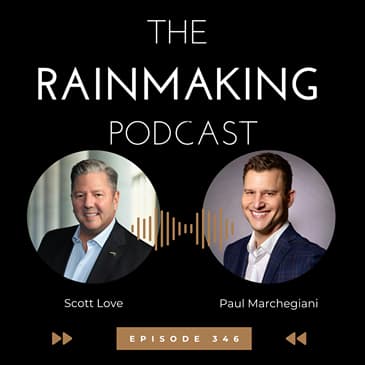
Every two weeks, the business development tactics top lawyers use are free at therainmakingmagazine.com
----------------------------------------
You can have the best legal mind in the room and still lose the pitch. What separates the attorneys who win business from those who don't often has nothing to do with the quality of their work — and everything to do with how they show up.
Paul Marchegiani is the founder and CEO of Vox Vera®, a performance skills consultancy that trains lawyers, executives, and public figures in presence, voice, and spoken communication. A former BigLaw litigator, 15-year Hollywood dealmaker at Warner Bros., NBCUniversal, Miramax, and Amazon Studios, trained opera singer, actor, and the only U.S. lawyer to hold a P.R.A. teaching certification from Patsy Rodenburg, Emeritus Director of Voice at the Royal Shakespeare Company — Paul brings a perspective on communication that no one else in the legal world can.
What you'll learn:
- Why legal training produces brilliant writers and analytical thinkers — and what it costs them in a pitch room
- What clients are actually evaluating when law firms present (it's not just the law)
- Why introvert vs. extrovert is the wrong frame — and what to think about instead
- What Paul learned negotiating 1,000+ deals in Hollywood that applies directly to legal business development
- How tensions in the body become credibility leaks — and how to spot and release them
- What presence actually is (and why the Royal Shakespeare Company's approach changes everything)
- Why getting in your head about how you're coming across is the worst thing you can do while speaking
- The CEO nonprofit case study: one session, one board presentation, and feedback they'd never received before
- Why poetry has a place in the practice of law — and how working with heightened language makes you a better communicator
- 3 action steps to start developing your Rainmaker's voice right now
Visit: https://therainmakingpodcast.com/
YouTube: https://youtu.be/XRXsJ_maA7Y
---------------------------------------- If you are a successful law firm partner or law firm founder and want to hear about other options, please book a time on Scott Love's calendar here: https://calendly.com/scott-736/half-hour-phone-meeting-with-scott Or email Scott to connect with him at: scott@attorneysearchgroup.com ----------------------------------------
This podcast is sponsored by SurePoint Legal Insights (formerly known as Leopard Solutions)–turning legal intelligence into opportunity.
For a free demo, visit this link: https://surepoint.com/legal-insights/ ----------------------------------------
About Paul Marchegiani:
Paul Marchegiani ("mar-keh-JAH-nee") is a Los Angeles-based performance coach, former in-house entertainment lawyer and BigLaw litigator, and Founder/CEO of Vox Vera® — a premium performance skills consultancy that trains lawyers, executives, and public figures in presence, voice, and spoken communication. Prior to launching Vox Vera, Paul worked for over 15 years in Hollywood as a client-side studio executive at Warner Bros., NBCUniversal, Miramax, and Amazon Studios. He began his legal career as a litigator at Orrick and Morrison & Foerster after receiving his J.D. from U.C. Berkeley. Paul is an experienced stage performer and the only U.S. lawyer and senior business executive to hold a P.R.A. teaching certification from Patsy Rodenburg, Emeritus Director of Voice at the Royal Shakespeare Company. He teaches communication skills at Stanford Law School, Berkeley Law, and the University of Chicago Law School.
Links:
https://www.linkedin.com/in/paulmarchegiani/
Learn more about your ad choices. Visit megaphone.fm/adchoices
[00:00:10] You're listening to The Rainmaking Podcast, hosted by legal dealmaker, author, and professional speaker, Scott Love. You're listening to The Rainmaking Podcast, and my name is Scott Love. Thanks for joining me on the show. I'm really excited about today's topic. Our title is The Rainmaker's Voice, and our expert is Paul Markigiani.
[00:00:37] Paul is a Los Angeles-based performance coach, former in-house entertainment lawyer and big law litigator, and founder and CEO of Voxvera, a premium performance skills consultancy that trains lawyers, executives, and public figures in presence, voice, and spoken communication. If those things are interesting to you, then listen to my conversation with Paul, where he will help you find your Rainmaker's Voice.
[00:01:06] This is going to be an insightful conversation with some practical action steps. And make sure you connect with Paul directly. We put all of his contact info on the show notes. This podcast is sponsored by SharePoint Legal Insights, formerly known as Leopard Solutions, turning legal intelligence into opportunity. And also, the show is sponsored by The Rainmaking Magazine, the largest free publication of content and ideas for rainmakers.
[00:01:30] Visit therainmakingmagazine.com to set up your free access and chart your course to greater rainmaking success. Thanks for listening. I hope you get some great ideas from my conversation with Paul today. Hey, this is Scott Love with The Rainmaking Podcast. Our special guest today is Paul Markigiani, and we're talking about the Rainmaker's Voice, how professionals turn expertise into trust. Paul, I'm excited about having you here on the show today. Scott Love with The Rainmaker, Ph.D.: God, I'm really excited to talk and see what we can share with your guests.
[00:02:00] Scott Love with The Rainmaker, Ph.D.: Absolutely right. And I like the fact that you've had the time on the client side, and you know what they think about in terms of law firms and who gets hired and all that stuff. But let me ask you this. What do you think? And I always like to start with, what are the impediments? What are those blocks? What are those things that you think keep professionals from turning expertise into trust? Let's kind of start with that question right there.
[00:02:24] It's such a fundamental question, Scott, because I work with a lot of high-profile analytical people. So whether that's lawyers, it's business professionals, it's leaders, and we're in our heads a lot. So that is the biggest impediment. How do we get people that are trained to analyze problems really accurately, really quickly to turn that off when they're in a room with other people and just breathe and connect? So that is our challenge, and that's what I set out to do.
[00:02:51] Scott Love with The Rainmaker, Ph.D.: Yeah. So tell me about the training that, especially lawyers, that they receive. How does that hold them back as rainmakers? Scott Love, Ph.D.: So a lot of law school education and a lot of, frankly, college and professional school is about the written word. So we spend a lot of time learning exactly the right way to structure an argument, exactly the perfect word to use in our brief. And that gets us trained to be semantically perfect and correct and accurate.
[00:03:17] Scott Love, Ph.D.: And so what happens if we spend a lot of our time doing that is when we get up in front of a group, whether it's you're arguing a motion in court, whether you're negotiating a deal, if you're a CEO and you're presenting to shareholders or a CFO, maybe even more appropriately, you have exactly what the facts and figures are, you know what the law is, and it's difficult to take a step back.
[00:03:38] Scott Love, Ph.D.: It's difficult to zoom out and use words that are maybe less precise, but that connect more and that carry more emotional weight or persuasive weight. And so that's, it's just a different skill set that we need to, as I say with my law students that I teach at Stanford and Berkeley, stretch the rubber band in the other direction.
[00:03:55] Scott Love, Ph.D.: Remind ourselves that yes, we can be, we can be brilliant and analytical and have the right answer and have our expertise, but also we need to know how to connect that expertise to any situation that comes up.
[00:04:08] Scott Love, Ph.D.: Right, right. And what I want to do, I kind of, I want to look at, let's say the different venues, the different opportunities where a professional, a lawyer, whoever it is that's looking to make rain, where they would actually have to perform, where it's not written work, it's voice, it's presence, showing that executive presence, that gravitas, but still earning the trust of people in the audience.
[00:04:29] Scott Love, Ph.D.: And maybe we can kind of go over these together. So you've got the panels at conferences, right? Speaking presentations. What are other modalities or other opportunities where lawyers, other professionals are actually having to perform this way through the vocal, through speaking and all that? Scott Love, Ph.D.: Yeah, let's talk about pitching. So I work with a lot of law firm partners and business development teams that are putting together a brilliant PowerPoint deck for their clients.
[00:04:56] Scott Love, Ph.D.: And maybe it's, you know, it could be a beauty show or it could be just you're the only one called in, but you still need to prove that you're going to be able to handle the matter better than anybody else. So you have your deck, you've spent a lot of time really making sure all the information is correct in the deck.
[00:05:13] Scott Love, Ph.D.: And a lot of times when I come in, if they call, if they call me to work with them, the deck is going to read like a beautiful CLE presentation on the state of the law in whatever regulatory area they're working in. And it doesn't really connect to the client's immediate needs. Scott Love, Ph.D.: So again, like I see a lot of a lot of wonderful preparation put into the work. So analytically, you know how you're going to handle the matter.
[00:05:39] You know what the lay of the land is in terms of the law, the regulations, the market dynamics. But we're not connecting it to the client's immediate needs and the questions that they're going to get in the room. So partly what I bring is my 15 years of client side experience to think, OK, let's really boil it down. What is the client looking for in that moment? If I'm a client and I'm hiring a law firm, I want you to be absolutely correct in terms of the law. I want you to know the law better than I do and better than anybody else does. But that's just the beginning. I want you to know the industry.
[00:06:09] I want you to be able to see around corners that I can't see around. That might mean you have a view of the market and market trends that are useful for me to know about and for me to know that you're keeping an eye on all the time, 24-7 or somebody at your firm is. I might want to know that your firm has capabilities to handle matters that might come up beyond just the one that I'm currently interviewing you for.
[00:06:34] I also might want to know whether you have relationships that will help my deal get done or that will help resolve a litigation matter. Maybe you've litigated against this other law firm before, if it's litigation. Maybe you've closed a deal with this other party before. And so you have a shorthand with them. So those kinds of things don't usually come through in that first draft of the PowerPoint deck. And we can help with that. And let's kind of keep talking about this pitch opportunity.
[00:07:03] That's everybody listening to this. These are the meetings that they want. They want to get invited in to make that pitch. What do you think about the idea of storytelling? Is that something that you coach people on? I do. I think it's so important. And the way that, and I'll talk a little bit about my training and what brought me to this work as well. Sure. At some point. But the way that I view and my team views storytelling is if you're a lawyer and you're a leader, I don't want you in your head about the perfect story structure.
[00:07:33] You should understand that. You should have practiced that. But what I want is I want a real human being who understands the stakes, explaining to me what the consequences of something happening are. So, again, if it's litigation, I want somebody who's going to be able to tell my story. What went wrong? Or what's my defense for somebody else's claim that something went wrong?
[00:07:52] And so the ability to really zoom into the right level of detail for a jury or for a judge and look at something from a lot of different angles, which is what a great storyteller does. A great storyteller can go into great detail about the quality of the light around a campfire if you ask them to. Yeah, right. Or they can tell you what somebody's aware, like who you haven't even thought about yet, who's standing in the corner.
[00:08:17] Right. So really being able to zoom in and zoom out of a situation is what we can help storytellers with. And then there's the delivery part, which is huge. So your voice, your presence, your body, your gestures, your movement, all of that comes into play as well. So do you think people, maybe they're not performers like you that you've done in acting? They're introverts. And I'm not saying you're not an introvert. I know that most high performers, I found, they become introverts because they need to recharge.
[00:08:46] But then again, the extroversion helps give them energy too. And that's not really where I'm going with this. But those people that might not have the natural inclination to be a thespian and be theatrical, do you think those people have an advantage where they really have to study how to communicate this? What do you think about that? Oh, I love it. Okay, well, first of all, I'm going to push back on this idea of introverts and extroverts.
[00:09:10] And I know this is controversial, but I think most of us, I don't think it serves us to put ourselves in that bucket and tell us that story. Because I think most of us are introverts in certain situations. Maybe some of us are introverts in more situations. But I bet there's a relationship. Maybe it's your spouse or your kids or a best friend, a mentor, where you can have a pretty free and open conversation. And so maybe you're extroverted in that situation. So I like to think of it as a dynamic thing. In certain situations, I show up in certain ways.
[00:09:40] And so part of what we train is the ability to become a little bit more present and stop retreating in a situation if we're feeling introverted. And maybe if we're feeling really extroverted and it's not serving us and we're pushing too much and blustering our way through a meeting and taking up all the oxygen in the room, maybe we can give you a way to calibrate that so that you're breathing and you're setting the tone in the room. So we work on introversion and extroversion on that kind of a scale.
[00:10:06] But if you are naturally introverted or you want to use that word shy, I think it comes with advantages. You're noticing. You're noticing a little bit more. Whereas if you're the person that talks your way through every situation, you might not be noticing what the dynamics are in a room. So use that to your advantage. That's great. So let's kind of go back over the different, I wouldn't call them themes, but different opportunities to deliver these types of presentations or speeches. So you've got a speech, a panel, a pitch.
[00:10:36] Are there any other places that you think this type of performance can help a professional really build trust with the market? I think a negotiation call, a sales call can be great. So beyond the pitch stage, you're actually negotiating a deal. And part of my background was after I spent five years in large law firms doing litigation, I switched sides and became a dealmaker in Hollywood.
[00:10:59] So I got one of those great in-house jobs, worked at several major studios for 15 years, rose through the ranks, eventually going to the business side. And I negotiated over a thousand deals as part of my time in Hollywood. And those were actor deals, writer deals, licensing deals, all sorts. And when I was doing that, I was still performing. So I'm a trained opera singer. I'm an actor. I was doing improvisation. I was just curious about performance.
[00:11:24] And I began to employ some of these presence methods that I'm talking about, this idea of are you retreating? Are you pushing? I began to explore that in my negotiations because sometimes I would get on the phone with a very powerful agent in Hollywood, very powerful entertainment lawyer. And sometimes, and me as a little junior director or VP, they would literally threaten my job if I didn't give them what they wanted for their client. They're like, I can call the studio and you'll never work in this town again.
[00:11:53] So when that's thrown at you, and similar things can happen in any kind of a legal environment, especially, or a business environment, right? So somebody has weight, they have power, and sometimes they use it. And how do you deal with that, though? How do you respond to it is key. So I learned how to stand up to a bully. And look, sometimes I was bullying too. And so when I'm bullying somebody, when do I take a step back and really listen?
[00:12:17] So again, taking that time to have give and take in a conversation, to really be listening to what the other side's saying without just advocating for your predetermined solution, which was often no on the studio side. How do you balance that and keep the relationship going while also signaling where you think the deal can go? Yeah. So I love doing that in negotiations. And those are things that you coach people on, right? That's right. I do. And my company.
[00:12:47] So here's the story of how I founded VoxFera and how I got into this work. So dream job in Hollywood for 15 years. Really, really wonderful. But again, still performing. And all that I was curious about was, what is this thing that happens when people get into a room together? What is this thing called presence? And can we teach it? Can I train it? And I just decided to put together a class for the University of Chicago Law School. And it was during pandemic. So it was all on Zoom in 2020. And the class was presence, performance skills for lawyers.
[00:13:16] And it was my first opportunity to really bring together all these theories and see if I could teach it. And after that class, the evaluations were amazing. I loved doing it. The students really found it useful. They kept inviting me back. And eventually I was teaching it in person there. And then the last step of that journey was deciding to study with an expert who could teach me how to coach it. And that expert was still my mentor today. Her name is Patsy Rodenberg.
[00:13:42] And she is the former head of voice for the Royal Shakespeare Company in the U.K. And she, like Ian McKellen, Judi Dench have written forwards to her books. She's trained world leaders. She's worked with huge actors, the biggest actors on the planet. And she trains them on presence, on voice, on speech, and your connection to words as you say them. And so it was great.
[00:14:04] I got to study with her for two summers doing poetry, really learning about how the body responds to stress and learning how to coach it. So I took that training, quit my job in Hollywood, started my business. And now I have a team of two associates in New York and one in L.A. that work with me. And we train lawyers, large law firms. We train law students. We train CEOs, business leaders, business teams, and also some leaders and politicians and public figures. That's fantastic. We love it. Thank you for sharing that.
[00:14:34] And that leads me to another question about how we define what presence is. So, gosh, it's such a controversial term, right? Executive presence. We've all heard it a million times. Even leadership presence. It's become one of those corporate buzzwords that people are rightly skeptical of. And what I view as presence is very much what Patsy Rodenberg taught me, which is think about it this way. We're all born as babies incredibly present. We don't hold our breath.
[00:15:02] When we cry, we cry for hours and we don't lose our voice. You're in tune with what's around you. And so what I believe to be true is that as we go through life, as we go through training and jobs, we learn to manage our presence in certain ways that are helpful but also unhelpful. And so what happens is literally tensions form on our bodies and habits form like holding your breath in certain situations, like maybe tensing up your jaw.
[00:15:29] If you're on a call with somebody you really don't like, maybe it's locking your knees when you speak. So those tensions pop up over time as reactions to stress. So a lot of what we and they inhibit our presence. They inhibit our ability to connect, which is to answer your question, finally, what I think presence is. So what we train is we train how do you stay with your audience, breathe, release those tensions that want to crop up and just practice doing that.
[00:15:59] Practice really being with people, even if you're not speaking. So tell me about somebody that you worked with. You don't have to mention their name, of course, but what was their situation like when you first connected? What did you advise that person to do? What did they do and what were the results that they experienced after working with you, Paul? Sure. So it's so funny when we get intake calls and people coming to us, a lot of times people have a little sense of shame around performance anxiety or maybe something. What do you think that is?
[00:16:29] Well, we don't talk about it a lot. And I think we're such perfectionists. We're such perfectionists. And thankfully, in the last few years, there's been a movement away from perfectionism. But we're still we're still trained that way. We're still trained to not make any mistakes in front of other people because that can have consequences. And so when you're trained not to make mistakes, what do you think that's going to do to tension? Yeah. They make you more tense. So there's a little bit of shame around it still less than I would have seen five years ago or 10 years ago.
[00:16:56] But they're coming to us because they're not they notice that maybe they're not really connecting or their words aren't landing or they're over talking in a meeting. So those are common situations. And one specific typical situation, we had the CEO of a nonprofit, large, large nonprofit come to us. Not because anything was going wrong necessarily, but they just felt like they weren't connecting with the board in in board meetings, board presentations.
[00:17:22] They felt like when they were doing fundraising pitches, they weren't as dynamic and as great storytellers about the organization as they could be. So literally with just a few hours intensive in-person sessions, one session actually here in New York where I'm at right now, we worked together on movement, on breath and on how that leader inhabited language. So all we did was introducing themselves. What's their elevator pitch?
[00:17:49] Introducing themselves and their organization, the mission statement of their organization. And can when they say that mission statement, are they generalizing the words or does each word have a specific, real, impactful meaning that they can picture? So a little bit of that is the acting training, but also it's how what's our relationship as speakers to words, to English, our tool. And it's so it's light enlivening that aspect of communication and really just getting people breathing and connecting to words. Yeah. How did that work out for that?
[00:18:19] How did that work out? Yeah, we got one of those lovely, wonderful testimonial emails back unsolicited the next week about how they had a board presentation and then a fundraising dinner. And the feedback they got was that they were really wonderful in the room and they personally had felt that they were more present and delivered better than they ever had in their life. So it's this stuff can be really impactful if you're ready to do this kind of work. That's right.
[00:18:46] What do you think keeps people from really making that effort to try to grow in that area? Well, a lot of people are. They are making that effort increasingly so. And so like we're we're getting a lot of calls, which is great. But still, culturally, it can be difficult, right? If we're if we're going into a large law firm with glass conference rooms and they're not quite sure what we're doing, we need to we need to really set the scene and make sure that culturally at that firm,
[00:19:11] they're going to be OK if somebody walks down that hall and sees them walking around that that room, releasing their knees and standing in front of a group of people. Right. So this is physical. We don't talk about our bodies a lot in business and in law. And to do this work, to be a public speaker, you have to be seen. You have to really practice getting up in front of other people and having physical adjustments so it can feel people can get self-conscious about it. Yeah, right. Right. Have you seen people make the assumption that the more they do it, the more comfortable they are?
[00:19:40] And then they actually look forward to those types of opportunities. Is that something you've seen also, Paul? For sure. And with with the lawyers and the leaders that we work with, a lot of times we love language. Some of us are English majors or we came into the law because we love working with the English language. Right. Or whatever language you're you're working in. And so sometimes we'll do poetry. Sometimes we'll do the kind of great elevated heightened language that lawyers get to speak in an opening statement or a closing statement.
[00:20:09] So we can work with with all that great stuff, finding the poetry of lawyering, the poetry of leadership, as James Marsh said at Stanford. Right. Leadership is both plumbing and poetry. So we work with them on the poetry and on the fun of of storytelling. And what I don't think a lot of partners know, because I talk to them every day as a niche legal recruiter, I recruit corporate and finance partners and do law firm mergers. So I'm in that space all the time.
[00:20:33] I just don't think they realize how potent those opportunities are to stand in front of a crowd, to sit on a panel. And if you look at scaling trust, if you sit in front of an if you stand in front on a stage in front of 150 executives, if you do it well and if you do it right, that moves the ball forward in terms of how people think about you, in terms of how receptive they are to receiving your call, in terms of giving you the work. What do you think about that, Paul? Paul It's so true, Scott.
[00:21:02] And last week I was training a group of law firm leaders on exactly that. So as a leader, sometimes you have to say really difficult things while also maintaining a relationship. There are difficult truths as a leader that come up. And so part of what we did was we practiced saying those one sentence truths that you might need to tell your executive committee or you might need to tell the entire firm at a town hall. And again, we can practice in a safe space just for a couple hours.
[00:21:30] What does saying that do to you physically that makes you either bluster your way through it or retreat from it and hedge? And either of those are leaks of credibility. So credibility happens when the words that you're saying match your body language, your gestures, your emotion, your tone, all that stuff. And again, the most authentic way to be credible is not to put something extra on top of that to make it not to put a smile on top of it.
[00:21:58] It's to actually get rid of all those tensions that are tells. Like if you're playing poker, it's a tell that you're not being completely there with them. So we help you manage that and see when it comes up and see if there's a way to say something that doesn't come across as tense and hiding. I would say that the most challenging audience for a professional in terms of delivering any sort of presentation or whatever it is are partners in their own firm. Because these are people that know them.
[00:22:27] Is there trust there? Maybe there is. Maybe there isn't. But they're making a judgment based on how they communicate, like what you talked about. And the words could be absolutely perfect and aligned, but the delivery could be misaligned. And as you know, in legal, optics are everything. People make decisions based on signals and based on optics. They make life-changing decisions based on, I don't like that guy. You know, based on whatever it was. What do you think about that, Paul?
[00:22:55] I think you're right about the way that people make decisions. And then the trick, though, is should I, as the person being judged, then worry about how I'm appearing? And the horrible trick of it is you can't do that because that gets you in your head. And that gets you self-conscious and self-monitoring. So while it's true that the way that you come across in the optics are how you will be perceived, all those little cues, the worst thing to do is to try and manage that while you're speaking because that comes across as authentic.
[00:23:23] So it's practicing. It's practicing showing up in difficult situations where you have to be vulnerable and you have to be judged. Because as a leader, as a law firm partner, as a rainmaker, you are going to be judged. And we have to get comfortable with that as leaders. Well, Paul, I want to thank you for being on the show and for talking about something that's important and useful to those listening. And as we end our conversation, if you could share with us three action steps people can take to get started.
[00:23:53] Could you do that for us, please? Sure. So first thing I'll ask is to notice. Notice how you show up in situations, in difficult situations. That's the first step with all of this. And don't judge yourself harshly because guess what? We all show up with tensions. We all show up with tendencies that get in the way sometimes. So do I. That's why I work on this every day. But notice. Notice what your habit is. Notice if you hold your breath around certain people or in certain situations.
[00:24:21] And then once you do that, the second thing I'll say that's core to a lot of what we do is what I just said. Breath, surprisingly. Letting yourself take a real low breath, which means that your ribs are expanding, your diaphragm's going down, your lower back's released, your hips are released. And the breath is really able to move freely. That's a subconscious signal to your audience, by the way, that you're calm and in control and breathing. And then that'll help fuel the language, too. Because you're speaking English as a very rhythmic language.
[00:24:50] And so when you're speaking on the breath and your natural speech patterns match breath, that kind of trains the audience how to listen to you. And so then they're more with you. So breath is the other thing to work on. And then lastly, call us. Reach out to us. We are here to help. If this sounds interesting to you, if you're interested in exploring the embodied side of communication, which is different from a lot of other conventional communications coaching.
[00:25:14] If you're interested in what we're talking about, reach out to us or other coaches like us and we can help you. That's great, Paul. Thank you. And tell us more. I know you shared a little bit about what you do, but what else would you like our listeners to know about what you offer for them? And by the way, for everybody listening, we're going to put Paul's contact info in the show notes. Thank you, Scott.
[00:25:34] So what we love to do, what my coaches and I really love to do is to get in a room with high-performing executives and lawyers and do a real physical workout. So we're going to get you breathing. We're going to get you moving around the room. We're going to get you exploring exactly what we talked about, which is how you show up in high-pressure situations. So it's interactive. It's pretty rigorous and intense.
[00:25:58] We just did 120 law student training at a law school up here in the Northeast in four hours. And our goal was to give every one of those first-year law students individual coaching time with all of our coaches. And we did it. So this stuff can happen, but you need to work hard. It's rigorous and you have to be there with us. And so that's what we love doing.
[00:26:20] So retreats, we can come in for what we call performance labs, which are three- to four-hour intensives for smaller cohorts. And then we have private coaching packages as well. So if you have a specific hearing coming up, if you have a specific board presentation or shareholder meeting, we can help with that with usually four- to five sessions that are well-structured. So all those ways, and we're here for you. Well, this is great. I'm really glad you were on the show, Paul. I think you've shared some important things. I'd love to have you back on in the future.
[00:26:50] We can talk more about this and other things, too. But thank you so much for being here today, Paul. Thank you, Scott. My pleasure. Take care. Thank you for listening to The Rainmaking Podcast. For more information about our recruiting services for international law firms, visit our website at attorneysearchgroup.com. To inquire about having Scott speak at your next convention, conference, sales meeting, or executive retreat, visit therainmakingpodcast.com.