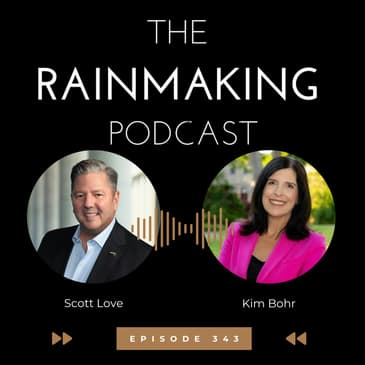
[00:00:10] You're listening to The Rainmaking Podcast, hosted by legal dealmaker, author, and professional speaker, Scott Love. You're listening to The Rainmaking Podcast, and my name is Scott Love. Thank you for joining me on the show. Last week on my solo cast, I talked about trust. I tried to look at concepts and challenge those. If you haven't listened to it, go back and listen to last Thursday's show.
[00:00:40] And then I even talk about the concept of, is it possible to scale trust? Today, we're going to keep on that theme and talk about trust. And the question I'm asking you, that I'll be asking our guest today, is, can trust be measured? Our special guest is Kim Bohr. She's the president and CEO of Spark Effect, where she leads the firm in helping Fortune 1000 companies and emerging enterprises navigate disruption without fracturing trust.
[00:01:08] With over 25 years of executive experience, Kim and her team partner with leaders, boards, and CEOs on strategy, talent, and organizational performance. Kim is a published author. She's the host of the Courage to Advance podcast, and she's a sought-after keynote speaker, whose talks draw directly from Spark Effect's proprietary research on the state of organizational trust. And in fact, we're going to have a link where you'll be able to get that report.
[00:01:35] And she talks about that in our conversation today. Just go to the show notes and you'll be able to access that, as well as connect with Kim directly. As always, this show is sponsored by SharePoint Legal Insights, formerly known as Leopard Solutions, turning legal intelligence into opportunity. And the show is also sponsored by The Rainmaking Magazine for the intellectually driven and results-focused professional who wants to be the number one professional services provider in their niche.
[00:02:02] Start your free subscription today. Visit therainmakingmagazine.com to set up your free access and chart your course to create a rainmaking success. And I also wanted to thank all of our contributors, most of whom are past guests on the show. We have over 40 contributors, and it's growing, providing their content for our absolutely free publication. You can read it. You can press the button on there and listen to the machine tell you what the article says. We even have a few videos that we're uploading there as well.
[00:02:31] Anyways, thanks for listening. I hope you get some great ideas for my conversation with Kim today. Hey, this is Scott Love with The Rainmaking Podcast. Our special guest today is Kim Bohr. And today we're talking about trust in organizations, can it be measured, and other things about that and how it can help you in your work as a rainmaker. Kim, thanks for joining us on the podcast today. Oh, I'm so happy to be here, Scott. Thank you. This is interesting. I don't talk to a lot of experts who have specialized expertise in the area of trust, but that's critical.
[00:03:00] Especially with rainmakers, they have to earn the trust from their prospective clients, from their current clients, even from their colleagues. Kim, tell me about this. Let me just start with this question. Is trust something that is tangible? In other words, can it be measured? The short answer is it absolutely can, yes.
[00:03:18] We were able to prove that through this research we've done now in its second year and really be able to show that it's not only just measurable, but you can do it really relatively easily if you're really committed to it. Yeah. And it seems like the way you've done the research from what I read that you sent me, it's a tangible asset, so to speak. It absolutely is. And one of the things that we were able to show is that it directly impacts revenue, reputation, and retention.
[00:03:47] And that is something that any rainmaker should be wanting to impact positively. Yeah. And what's interesting, me being on the recruiting end of it, I talk to partners all the time and I hear when a partner moves from one law firm to another, it's usually one of two issues, or I'd say two buckets, so to speak. You've got leadership issues and you've got strategy issues. And the leadership issues, I think, are really where trust is. And when people move, they're either actively moving or maybe they're just moving to achieve a goal.
[00:04:17] But a lot of times when they have an issue, there's emotional context to it. So let's talk about that. For example, in some of the reports that you sent me that I read, you talk about if there's any sort of disruption and the team goes through a disruption. Sometimes trust can actually grow. Is that correct? It's true. It really can. And one of the things that we were finding was that, you mentioned some of the different reasons people move. One of the key dimensions we looked at was strategic clarity.
[00:04:44] How well is the strategy of that organization defined and how, you know, down into the frontline teams and everywhere in between. And that is a real big factor around trust of, you know, do we get a sense of why we're doing the work we're doing? It can be measured through literally the actions we take. One of the things that was really clear to us is that there are very clear actions that are trust builders and trust destroyers.
[00:05:12] And as common as people may talk about trust and how important it is, we literally have observed the opposite of actions happening right after those types of statements are made. And so what we know is that things like really open and honest communication, and especially during times of change, is really critical as a trust builder. Fair treatment and empathy towards employees, really understanding if we have to make difficult decisions, why are we having to make them? And what are the standards we're using behind that?
[00:05:41] So there's a series of things that we know you can measure because we can see in how we're doing that, whether that's at an organizational level or down to individual teams. Right. So let me let me ask you, what did you call those five? What did you call those again? So there are five dimensions or excuse me, five domains that are specifically focused that make up what we term the trust performance index.
[00:06:04] And so strategic clarity is one of those psychological safety, relational continuity and cultural belonging is the third technology and systems. Trust is the fourth. And then the fifth is fairness and change impact perception. So do we, you know, when something is happening, does it feel like it's it's happening for a fair, you know, it's that it's fair and how those decisions have been made?
[00:06:28] So where do you think which of those five domains, where do you think most executives, leaders of organizations, people in legit authority or even someone that has their own small team within an organization, where do you think they can get their arms around that the most and make the biggest difference? So I think it depends on where they've where they're at in their maturity of their organization and in their in the leadership. So certainly AI is a huge disruptor.
[00:06:56] You know, as we're going through the second round of research, it continues to be a huge disruptor. It's not necessarily the biggest breaker of trust, though. So how leaders handle these types of disruptions is where the make or break is. So, you know, you might have something like we all say that AI is really important and we just have to figure out how to use it and then not really have a plan.
[00:07:21] Or perhaps we decide, you know, decisions around promotions are made without real clear objections around how do those get made? You know, we've had all have probably heard of those situations where, you know, somebody was given a special project because they thought it would, you know, that it was for the benefit of the other person who maybe had a young family and didn't want to put in those kind of hours, but yet never had the conversation with them. So there's just a lot of the trust is so critical.
[00:07:48] And one of the things that really stood out to us was that the trust is the tightest between a direct leader and, you know, their direct reports, regardless of where they're at in the organization. But it fractures the greatest when disruption is mishandled. So when you think about the fact that this manager is ill-equipped or, you know, we all think about our managers having our backs, you know, and being ready to really advocate for us within the organization.
[00:08:13] And so when it comes really, it becomes really clear that they are, that's not the case, that trust shatters. And that is really critical to the retention and reputation of an organization because there's a lot of observers around that are being impacted by what's happening and where they, what their perception is for the organization as they move forward. Right. So tell us about this research. I'm curious, how did you go about doing this? What was kind of your general process with that?
[00:08:40] Yeah. So we really wanted to focus it. We kept it from a national lens. We actually partnered with a very close colleague of ours who is a, has a PhD in workplace anthropology. And we wanted to understand what was happening. Originally, we thought about just AI, but then we pulled back and we said there's, the reality is that there's disruptions of varying kind right now. There's a whole set of personal disruptions people are dealing with and professional. And the reality is the two, you don't separate them when you're coming into your workplace anymore.
[00:09:09] And so we asked everybody to really select all that apply. And so what we were finding, and in the second year of research, 85 percent of people have had a disruption in the last 24 months. That is really significant. And what we also found is that many leaders just aren't equipped to actually deal with the disruptions. A lot of organizations take, you know, risk mitigation from a larger, larger scale disruption.
[00:09:36] But the reality is micro disruptions are happening every single day inside teams. And that's where we saw the big gap of leaders being ill prepared. What's an example of a micro disruption, Kim? So from a, you know, we can think about it from a, you know, child care, elder care issues that emerge, you know, from organizations that have had return to work policies and made those timelines very short to happen. We've seen individuals that then are scrambling to figure out, well, what do I do? Do I have to leave the workforce to be able to?
[00:10:04] Because, you know, child care isn't, it's not like all of a sudden there's so many child care spots open that you have easy access around this country. So there's things like that that are happening. We also see things where, from an implementation standpoint, where AI is being brought into organizations and it's told just to, like, figure it out. And teams are trying to understand, well, what does this mean to my own job? And that's happening on a daily basis.
[00:10:29] Those are things that even a miscalculation of a manager about how they respond to somebody who's maybe suddenly been showing up late for work, but it's not something that they've been known to constantly do and how that gets handled. Down to even, you know, do you even understand what's going on with your team, right? These are all these micro things that are happening that I think a lot of leaders have assumed, like, well, you know, you keep your personal stuff outside of work. But the reality is that it's just everything's blending together anymore.
[00:10:59] Yeah, it is. It is. I'm going to get to some of the ways you help people solve those challenges. But one question I have for you is this. What's something that surprised you the most that came out of your research on this? Yeah, there's a couple things that really jumped out to us. So one was that the gap continues to widen between organizations that do, that approach, you know, that do something when disruption happens to those that don't. And one of the things we saw was that doing nothing is really bad. And there are a lot of organizations that do nothing.
[00:11:29] Doing something increased the impact on trust, but doing something well significantly increased it. So one of the, just for example, one of the findings we saw around customer reputation was that for those organizations that had high trust, they had 91% effectiveness around the customer representation through those that took the research survey versus somebody who only had 30% if you were in a low trust organization.
[00:11:58] That is a significant gap and something that people should be very much concerned with when it comes to how your customers are thinking of you and how you're handling these situations. That was one that stood out. Another one that stood out to us was that there was an increase in trust above the baseline of those that have reported no disruption at all that made a significant difference.
[00:12:23] So that told us that instead of mitigating risk to the degree that many organizations do, actually equip your leaders and your managers with the tools to handle not just the big risk or not just the big disruptions, but these types of micro disruptions we're talking about. Yeah, that's really interesting. And so when you went through and you did this report, you're looking for ways that trust can be measured. How can organizational leaders, how can they actually measure trust? Is it something we talked about this earlier? Can it be measured?
[00:12:53] And if so, what are key performance indicators or things like that that you look for? Yeah. So we start with those five trust domains we were talking about. And underneath those are very specific statements. We also have the ability and we give this information to our clients too around how do you structure that dashboard. And so basically you can have it at a level of an executive leadership team, you know, and the different team levels down.
[00:13:19] And so much of it is even about how are we connecting on those week-to-week basis that if we then go and measure through the structure that we did in the research, people will be able to respond. And so the report lays out very much how we did it and gives people the opportunity to replicate that or to, you know, certainly engage us to help them. So what was your sample size? Like how many organizations did you all look at in your research? Yeah.
[00:13:45] So our sample size was in this year it was 400 organizations across. And so it was split evenly between representation of individual contributors and people leaders. Got it. Interesting. Wow. That's quite thorough. So let's go to solutions. Let's say you coached an executive team with an organization. Now I want you to tell me a story. You don't have to mention them, of course.
[00:14:11] But what were the challenges that they had that your research brought out to them to show them, without a doubt, here are the facts. What actions did they take as you coached them and consulted to them? And then how did their organization improve in terms of trust? So there was a team in particular we were working with for a few years. And they continued to have engagement survey scores that really pointed to the executive leadership team not seeming trustworthy.
[00:14:37] And even within the team, there was a lot of division around very much some of the things we've already said. How were resources allocated? How were why were people getting some portions of roles and not others? And it felt like it was happening in a black box, even amongst the leadership team. So what this research was able to show and what we brought into was the first thing was, could they all agree that trust was a problem?
[00:15:00] Because if we can't agree that that's the underlying cause, then we're going to have a much harder time of facing the facts of what is that we need to do to strengthen trust. And it really, in their case, started with trust amongst themselves. And then when we were able to get them to see, yes, these things that were expressing are really foundation of trust,
[00:15:21] then we were able to start to bring this data in and show them how different actions that they were doing that they thought were maybe for the good of the organization were actually counterproductive. So things like being able to make sure that the CEO was actually engaging with the people inside the organization in a way that felt more approachable and authentic.
[00:15:44] And one of the things that was happening prior to the work was that people would raise their hands in these all company settings and asking questions. And the CEO would respond in a way that was very dismissive or shutting down the organization or just really relying on data. That was justifying the reason that he had made the statement. And that was completely destroying trust.
[00:16:07] And so after with the research that we brought forward and really had them seeing that many of their actions were counterproductive and were laid out in this paper, was that they were then starting to realize having more training around, well, how do we allow that information to come in? And who's the right person to answer some of these questions? And how do we allow it to not be a singular individual? But the whole team starts to show that they have the ability to have authority in how we're having the conversations, but also the trust building.
[00:16:36] It took some time. You know, they were in a very low trust setting and it took really consistent work on their end. And frankly, having to change some of their leadership in order to get the momentum they needed. And they're on an upswing now with their engagement surveys. That's great. So the engagement surveys, that's how you can measure it, how they're improving in those factors? It's a piece of it. So what we do, we've worked with organizations who say, look, here's the engagement survey we have.
[00:17:05] And we say, okay, great, look at what we have in this report and let's build in the pieces that are missing. Because engagement surveys actually are a very incomplete process, most of them. They're all over the board. They vary widely. And they really don't necessarily measure trust. They might tell you where things stand, but they don't actually tell you the story behind it. And that's what you really need to get into.
[00:17:27] And so what we say is the way we've structured it and these five dimensions and the type of statements that are behind it are things you want to be incorporating. So you can do this aside from an engagement survey. You can enhance your engagement survey. But really what you want to do is keep those metrics in more of that dashboard and then really start to say, well, what do we need to do to move these different pieces? What tends to happen is engagement surveys tend to come back and say things like, well, gosh, we're not communicating enough.
[00:17:57] So we need to put out extra newsletters. That is not what we're talking about here. That is not a trust-building activity. And so it's really more about the behavioral side of how do we need to show up consistently in ways that support what our research was showing. I think that somebody has to have a high level of self-awareness to be able to accept the fact that the data shows we have a low-trust organization to accept your advice on these are the things that I need to change. I need to change my colleagues, et cetera.
[00:18:26] What do you think about that concept in terms of self-awareness? I completely agree with you. One of the things that was also interesting to us that really helped support the launch of this work was we kept hearing people saying they had trust issues or words that were equating to trust issues. And then saying things like, gosh, I wish we could measure it. It's unfortunate we can't. And we were like, but actually you can. And so that's what we went out to prove it. So to your point, the self-awareness goes to the next level of it.
[00:18:54] There is some lift that you need to do to shift how people are thinking about trust and the fact that when we literally say you should take it on as a KPI, we mean it and we show you why. And the reality is that it is measurable. But you need people to believe that they're willing to hold themselves accountable to it and they're willing to also, you know, apologize when they've made the mistake. And so I completely agree with you. It absolutely self-awareness is a huge component.
[00:19:22] The other reason we wanted to do this to that point is that we wanted something that was very data rich so that for all the different types of people who are taking in information, this makes a really strong business case. This isn't just a squishy like it's a nice thing to do. This is actually like, no, this is really relevant into your organization in really tangible ways.
[00:19:44] And that should help, you know, hopefully help make those conversations have more depth and weight to them than maybe they have previously. It's interesting. Something I've seen that I think is actually a trend in the legal industry in which I work is that I think people are more self-aware now than when they were years and years ago when I got into it. And I think the reason they are is because they've seen that economically they should be because people are leaving. Clients are leaving. They're not coming back.
[00:20:12] And so I think what you provide is a solution so an organization can see exactly where are those areas they need to improve and action steps they can take to improve that. I think that's exciting, actually, when you can bring this to them as a solution that has huge ramifications all over the organization and beyond. So let me just say to that point real quick, Scott.
[00:20:33] The one thing that was really driving us, too, was that because there's so much change happening, you know, AI is certainly a big piece of that, but it's so constant and it's not stopping. We also were having this not just sense, but taking in data that was telling us that people feel like things are out of control. So a lot of this research was to give people agency in areas that they actually can drive and control.
[00:20:56] And so that was a really big factor, too, that I think I don't want to have missed because things are not slowing down. Business is going to continue to move quicker. Technology is going to continue to move quicker. And somehow we have to be able to ground in it and do something that's really positive and trust building. I think the most encouraging part of the report that I read was the fact that an organization can go through a significant disruption and, in fact, grow closer in terms of trust.
[00:21:24] And I believe that I've seen that when I was on active duty. Here we are getting ready to go into a war. There was a huge amount of change and we grew closer together. And I think that's because we had a clear vision. I think there's good leadership on the ship. And I see within organizations that are going through change that word leadership. And I think I had an advantage because I used to be a leadership trainer when I was on active duty after my ship trip. That's something I looked for in the legal industry. And I just didn't see a lot of real leadership effectiveness because I'm a lawyer.
[00:21:53] Yeah, I know you're smart. I know your kids are beautiful. But, you know, you still need to grow in self-awareness. And I've seen this train where people, I think, are. Just because there's a lot of people that are doing coaching, they're talking about that. But I think you're really on to something. And I hope that people in the legal industry listening to this can take on to some of your ideas and really implement them. Let me ask you this as we bring our conversation to a close, Kim.
[00:22:18] If somebody wanted to improve their organization in terms of trust, what would be three simple action steps you'd recommend that they would start with? Well, I'd really recommend them downloading this report and really taking that and starting to read it through their executive leadership team and their partners. Because I think there's a lot there to gain. And so that it will be accessible to your listeners for free at sparkeffect.com forward slash brainmaking. So I want to make sure they know that's there for them.
[00:22:45] The other thing is really there's some five everyday practices we encourage people to do that are just really easy and actually are really fantastic trust building. And those are things like, you know, translating the big picture of what's going on into how it's impacting our individual team members and how are we, you know, approaching things that are very fair and transparent in why we're giving work to different people.
[00:23:10] So think about those as, you know, I would encourage them to and we'll also provide this information I'm mentioning now in another guide that they'll have access to. So translating the big picture, be fair and transparent, model openness, show up consistently and invest in connection. And those are really, they sound simple. And yet in practice on those days when we're feeling drained, they're, they could be hard to do and they're really important. So that would be the second one.
[00:23:37] And the third one I would say is just really step back and start to think about your organization and what trust means to your, not just to your partners into those in your, into your firm, but also to the clients you serve. Because there are a ton of competent competitors out there. And we really believe that trust in this way is a real differentiator. And it's something to be looked at differently than maybe in the past. This is great, Kim. I want to thank you for that.
[00:24:05] And tell our listeners more about your firm, your organization and the things that you do that could possibly help them. Why don't you tell us about that, Kim? Absolutely. So Spark Effect is a national organization with international reach. We focus in on that continuum of work around trust that threads through everything we do. So we work with executive leadership teams and teams throughout organizations on how do they understand where the trust building needs to happen, what they're doing well and what they need to do to strengthen it.
[00:24:33] So we bring in an assessment that can absolutely work on the trust building factor. We also have some tactical things that are also come support trust building work, such as if there needs to be separations that happen. We have outplacement and career transition services that are really highly effective and support the reputation and retention inside the organization. We also do executive coaching that is very much around from a growth perspective, but also helping people when maybe they're challenged.
[00:25:03] We do work around CEO evaluations and board advisory work. So really helping to assess those really two important factors in organization. And then we have a specific 16-module leadership development series that snaps together and is very appropriate for senior leaders onto frontline managers as well. So that's our sweet spot. And we love having conversations to figure out what is appropriate and really meeting people where they're at in the moment inside their organizations.
[00:25:33] That's great, Kim. Thank you so much for being here. And for everybody listening, go to the show notes. You'll be able to connect directly with Kim. Also, you'll be able to download that report that she referenced in our conversation. Kim, thanks so much for joining us on the show today. Scott, thank you for having me. I've enjoyed the conversation. Thank you for listening to the Rainmaking Podcast. For more information about our recruiting services for international law firms, visit our website at attorneyssearchgroup.com.
[00:26:01] To inquire about having Scott speak at your next convention, conference, sales meeting, or executive retreat, visit therainmakingpodcast.com.