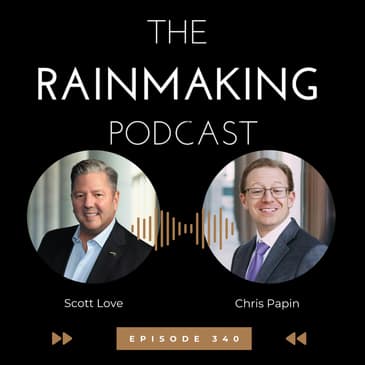
Most professionals hate the idea of selling. What if you didn't have to? Chris Papin has built a thriving multi-discipline practice as a JD, CPA, and insurance producer — without ever feeling like he's pitching. The secret is the trust economy: a system of intentionality, authenticity, and regularity that builds steady deal flow without pushing harder.
Chris Papin is a licensed attorney, certified public accountant, and insurance producer who works with small business owners and entrepreneurs across every stage of their business lifecycle. He's also the author of 168 Hours: A Startup Business Guide That Respects Your Time. In this episode, Chris joins Scott Love to break down exactly how professional services providers can stop relying on hustle and start building the kind of credibility that brings clients to them.
You'll learn:
- Why deals are driven by emotion — and what that means for how you build trust with prospects
- How to use a 90-second anecdote to open doors at any networking event without pitching
- The "step zero" mindset shift that separates professionals who get results at conferences from those who just survive them
- Why showing up with a QR code instead of a business card is a trust signal — not just a tech flex
- How to use AI to data mine a conference attendee list and identify your top 10 targets in 30 minutes
- The two biggest pitfalls that destroy deal flow — and how to avoid both
- What a client "funnel" actually looks like for transactional professionals (lawyers, CPAs, consultants)
- Why regularity matters more than intensity — and how to build consistency into your BD rhythm even during busy seasons
- The "Think, Document, Do" framework: the three-step system that turns good intentions into actual pipeline
- 3 action steps to start building steady deal flow through trust — starting today
Visit: https://therainmakingpodcast.com/
YouTube: https://youtu.be/CNP3rUgqQSo
---------------------------------------- If you are a successful law firm partner or law firm founder and want to hear about other options, please book a time on Scott Love's calendar here: https://calendly.com/scott-736/half-hour-phone-meeting-with-scott Or email Scott to connect with him at: scott@attorneysearchgroup.com ---------------------------------------- 🎙️ The Rainmaking Magazine helps lawyers, consultants, and professional service providers build thriving practices through smarter business development.
📖 Subscribe to Rainmaking Magazine — free complimentary subscription: https://www.rainmakingmagazine.com ---------------------------------------- This podcast is sponsored by SurePoint Legal Insights (formerly known as Leopard Solutions)–turning legal intelligence into opportunity.
For a free demo, visit this link: https://surepoint.com/legal-insights/ ----------------------------------------
About Chris Papin:
Chris Papin is a multi-talented professional with an impressive array of qualifications that give him a unique, holistic perspective as an advisor – a licensed attorney, a certified public accountant, and a life, accident, and health insurance producer.
Chris holds a Bachelor's and Master's degree in accounting from the University of Oklahoma. He earned his Certified Public Accountant designation in 2007, followed by a Juris Doctor degree from Oklahoma City University School of Law in 2008. Admitted to practice before the United States Tax Court in 2010, Chris has garnered recognition for his achievements, including being chosen for the 2009-2010 Leadership Academy Class by the Oklahoma Bar Association and receiving the 2010 Trailblazer honor from the Oklahoma Society of Certified Public Accountants. In 2017 Chris' firm received the Recipient Thomson Reuters Innovation Award, a customer superstar award in the Thomson Reuters community, for doing the most to innovate, invigorate, and grow its practice for the benefit of its clients.
In 2022, Chris won the Top Emerging Firms of the Year, an award that celebrates innovative and forward-thinking companies that have made a significant impact in their respective industries. This prestigious award recognizes emerging firms that have demonstrated exceptional growth, financial performance, and a commitment to sustainability and social responsibility. It serves as a testament to the recipient's dedication to innovation, customer satisfaction, and business excellence.
Links:
https://www.linkedin.com/in/chrispapin/
Order Chris Papin’s book here:
https://www.amazon.com/dp/B0GL8P2PJD
Learn more about your ad choices. Visit megaphone.fm/adchoices
[00:00:10] You're listening to The Rainmaking Podcast, hosted by legal dealmaker, author, and professional speaker, Scott Love. You're listening to The Rainmaking Podcast, and my name is Scott Love. Thank you for joining me on the show today. What would it be like for you if you were able to earn more trust with your clients and client prospects and didn't feel like you had to push harder?
[00:00:39] Well, that's music to my ears. How about yours? Well, we're going to talk about that today. And our topic title is The Trust Economy, Turning Credibility into Steady Deal Flow Without Pushing Harder. And our special guest is Chris Papin. Chris is a talented professional with an array of qualifications that give him a unique, holistic perspective as an advisor. He works with small business owners and entrepreneurs in all different phases of their companies and their life cycle.
[00:01:07] He works as a licensed attorney, as a certified public accountant, and also as an insurance producer. His book, and this is a book I'd recommend to those people who are entrepreneurs, you have your own company or you want to start a company, you're wanting one if you're an attorney to company owners, I'd recommend getting this book for them. It's called 168 Hours, The Startup Business Guide That Respects Your Time, written by our guest, Chris Papin.
[00:01:34] I hope that you reach out to Chris directly. We put all of his contact information on the show notes as well as the link to order his book. As always, this podcast is sponsored by SharePoint Legal Insights, formerly known as Leopard Solutions, turning legal intelligence into opportunity. And the show is also sponsored by The Rainmaking Magazine.
[00:01:54] Now this free online digital magazine helps the intellectually driven and results-focused professional who wants to be the number one professional services provider in their niche. Start your free subscription today. Go to therainmakingmagazine.com to set up your free access and chart your course to greater rainmaking success. Thanks for listening. I hope you get some great ideas from my conversation with Chris today.
[00:02:20] Hey, this is Scott Love with The Rainmaking Podcast. Our special guest today is Chris Papin. And today we're talking about building steady deal flow, how the trust economy can help you grow your practice. Chris, thanks for joining me on the show today. Scott, it's a pleasure. I appreciate the opportunity and hopefully we can share some nuggets of wisdom along the way. I think we can. I think we can. So let's get right into it. I know that the concept of trust, people know they need to get that.
[00:02:47] They know they need to study that. Is that something that you think we can pick apart and really dive into and really kind of find out how we can build trust with our prospects and our clients? Absolutely. Yeah. So the way I like to set this up, whether it's clients or team or other professionals, whatever it may be, is we got to start at the beginning, right? Deals are based on money. Money is attached to emotion. Therefore, deals are attached to emotion.
[00:03:16] And that's where trust comes from, because I think people will buy in a few scenarios, but it's basically three scenarios. Need, the other extreme is want, or there's this mysterious something in between where we feel like I'm not getting everything I need to get. And I think this is kind of where professional services land to some extent. I'm able to buy a commodity or buy a product, buy a tool, buy a solution for my life, but it's not really solving all the problems. So where do I look to expand that?
[00:03:46] And oftentimes in professional services, you're selling the invisible, which is hard. And people kind of have to buy into, okay, this guy or gal knows what they're talking about. If they perceive they know what you're talking about, that's where trust starts to build. And then how you build that, the personality you show to people, all these different things matter. We can unpack as we go through, but deals, emotion, and trust, regardless of the money that's at play, I think drive consumer behavior.
[00:04:15] And that's really the space we want to be in, talking to folks and helping them solve for whatever their need is. I like that. I like the fact that you yourself have a sophisticated professional services business that has a lot of nuance to it, whether you're doing the legal side or accounting or the consulting and other things that you're doing. You mentioned selling the invisible. Let's kind of break that down a little bit. Let's kind of give an example here.
[00:04:40] Let's say that one of our listeners is at a conference where clients and client prospects are. And as they're putting a shrimp on a plate, they see a client prospect. Where are you from? I'm from Fort Lauderdale. Where are you from? How do you get to that point with this brand new person? You're there hearing the same things from the speakers. And this is the appropriate place where you can hopefully build some sort of rapport where they know that you're there to pitch work. How do you think you can kind of start to build trust in that scenario?
[00:05:09] Let's kind of use that as an example, Chris. So frequently what has worked for me is somewhere in that introduction, you know, hey, what do you do? Who are you? And I'm like, well, I'm a JDCPA. That's rare. So tell me about what you do. And then it's a little bit of a long loop, but it's, hey, we can do estate planning. We can do legal formations. We can do buying and selling of assets. We do pretty much anything that's on paper before you go to the courthouse. That resonates with some folks.
[00:05:38] But then you've got to throw an example. For example, last week we were helping someone negotiate the finer pieces of selling a business. One of the things that popped up is a personal guarantee on a lease. Getting the leases assigned are a condition to the sale. If we can't get the lease signed, we can't get the deal done. But landlord is asking for a personal guarantee from the seller and the seller wants to be done. How do you navigate that? Have you ever had somebody that says, I don't want to personally guarantee something?
[00:06:08] Usually that resonates with folks because they're going, oh, yeah, I had a first-time brand-new business owner that has zero business credit. They had to give a personal guarantee. How do you overcome that conversation? And this gets all back to the emotional components. The sarcasm in a personal guarantee is if the buyer is so certain that they're not going to default, why aren't they willing to put cash in place that proves they won't default? So it's kind of these competing, rational things. But just something that quick.
[00:06:37] I mean, what do we do? Maybe 90 seconds worth of an example here gives the other person to say, okay, well, I had a scenario like, or hey, what are your thoughts on? And there has to be some candor in there about I'm not going to solve all the world's problems. But in this specific instance, we came up with two or three alternatives that ultimately got the deal done. And that's kind of what it's all about. So I have found, I'm going to say, like showing some of the cards, really just talking about what you've done.
[00:07:05] And then do it in a persona that is you. Don't try to sell it. Don't try to polish it. Just be you. And that authenticity, I think, really starts to get people to understand your style. I'm not for everybody. You know, East Coast is notorious for fast, fast, fast, fast. West Coast is notorious for relatively laid back personalities. And you got everything in between. That's okay. You don't have to be all things to all people.
[00:07:30] But kind of getting those key components of like who you are, what you do, and ways you're helping solve people's problems. Usually it goes back to this trust where people will opt in individually. And I'm sure you experience the same thing along the way, right? Absolutely right. And something that you mentioned, something I do, I want to kind of bring to our listening audience. You started with what's distinct about me is this. And I think, and you clearly, JDCPA, you just don't, I even told you before we started recording.
[00:07:59] I recruit lawyers and I just don't see that very often. And that makes you not just different, but distinct. Within my practice, I'm not just a recruiter. I'm a legal recruiter. I just do partners. I don't do in-house, but it's outbound efforts are corporate and finance partners with heavy emphasis within finance and M&A. And so that's something that's distinct. So if we could kind of take our anecdote here and kind of play it back block by block. Number one, show your distinction.
[00:08:27] Number two, now you're starting to give a nod to your expertise by telling an anecdote, by giving an example. For example, we had somebody with this problem that we're able to solve. And I think that kind of opens up the door to further discussion with that prospective client. What do you think about that kind of being a framework, so to speak, Chris? You got to read the room, too, because sometimes the anecdotes don't matter or people don't want to hear it.
[00:08:53] You know, we've all been at the cocktail party and somebody starts to go down the complaining road is the way I will say that. I mean it with a lot more color than that. But I like the pillar, like if you kind of think through what's your intentionality. But something I might set up as step zero is why are you at the place you're at? Because sometimes you're just the willing participant and it's something to do and you don't care to sell your services there. That's fine. You can be there for not that reason.
[00:09:21] But are there opportunities on the table that you're just blind to because you didn't flip the switch on? You're in a room with people. It's a networking opportunity. You have the opportunity to sell yourself, pitch, network, meet other folks, whatever the objective may be. So I think I'd add that step zero in there, too. That's good. Let's talk more about that step zero. And let's kind of use, as this is being released around the conference season timeframe, people are going to conferences. What do you think professionals should do at step zero?
[00:09:48] They know they're going to a place where client prospects will be. What do you think they should do to be ready for that? At a minimum, you've got to show up with kind of a brand package in hand. And brand package can mean a lot of things to a lot of people. But for me, very, very, very common in the accounting industry for people to want to deal in paper of a certain generation. Well, that creates an administrative backlog. That means my team has to do more steps.
[00:10:18] We have to take custody of the file. We have to scan it. We've got to log it. We've got to jump through all those hoops. So my digital package, and hear me when I say this, like I show up and people say, oh, do you have a business card? Yes. Here's my business card, which is a QR code. Immediately, I am setting the tone. I don't want to touch paper. So it's setting this up because we can do so much more with digital information than we can with paper information, especially in the age of AI.
[00:10:43] So you've got to think about who you are and what persona do you want to hold out there. Then secondarily, a lot of folks will go to conferences for continuing education and maybe to meet some vendors. Well, what better testimonial for a vendor than someone else's who is using that vendor? So you've got to think your way through what your ask is, is I'm looking for a vendor that solves for problem X.
[00:11:08] Well, I probably need to find seven firms that are using that vendor so I can pressure test because I'm, you know, everybody can resonate with this. But a salesperson says the software will solve all the things in the world. Then you start to use it and figure out using this software. I have to go through a longer process than I do with my existing software to get to the end result. It solves the problem, but it doesn't make my life better. So examples there of who are you, what are you trying to set up, and then what's your ancillary purpose?
[00:11:35] So to answer your question directly, I know I've gone a long way on this, which kills, but I think the perspective matters because we all get lost in this. If you are present with other professionals, there are opportunities. Maybe you're the person in your region and somebody needs somebody to do work in a specific state. You know, it's very common for lawyers to run into licensing issues because they're not licensed in a state. You need colleagues in other states to help your clients achieve those objectives.
[00:12:03] So at a minimum, you're creating a Rolodex of contacts just in case I need A, B, or C. So I think if you go with those intentions, even if it's just, hey, I'm going to meet three people. For the introverts in the room, I'm going to meet three people that are not in my state that are in my area of influence. There's little things like that before you go.
[00:12:22] You could sketch that out on the plane, but now you're showing up with an intentionality to execute on something rather than just blindly surviving the day and meeting the person next to you in the meal line that happens to live somewhere that you don't care about and you're never going to talk to again. Great conversation, but never talk to them again. Is that really worth your investment? What do you think about getting the list of attendees in advance if you can?
[00:12:45] When allowed, I know a lot of conferences are kind of mindful of spam email there. Some of them give you all of it. If you're going to do it, I would tell people to data mine what you can on it. With the advent of AI, you can ask an AI tool, hey, look up these email addresses and tell me who you think I should talk to out of the list of 100. Give me the top 10. I think if you do just a little bit of work there, I mean, what would that take?
[00:13:12] 20, 30 minutes and then follow up maybe another hour or something like that. That's not too much to ask of folks, but I like the idea. I just think you have to be intentional with it. Don't just take the whole list and start spamming everybody. Even though your intentions are pure, why is it you're reaching out? What's the personal connection? How can I help that other person as well as them help me? Because we tease about this too. The world doesn't revolve around you. It revolves around the sun. And I think people notice that. And getting back to the title, that's how you build trust. It's not just about you. It's about them.
[00:13:42] And so let me ask you this then. What are the pitfalls most professionals need to avoid if their goal is to build trust, build that deal flow? What do you think the main pitfalls are they need to avoid? So I see two. One is showing up without that intentionality. Like sometimes people get on stage and you see athletes, you see politicians, you see a lot of people do it. Like the microphone's in front of them and they don't answer the question.
[00:14:09] And then you walk away and it's like, okay, so the question presented was what can I do to improve deal flow? And I started talking about a tax return. Nobody cares. I mean that's going to blow your trust up immediately because nobody wants the side story. The second piece to that is I think you've got to be regular about the way you're going to show up in whatever your funnel looks like. If it's digital, let it be digital.
[00:14:32] If it is in-person face-to-face networking events and all the extremes in between, you have to be regular about what that is. Otherwise, you're going to have the peaks and valleys that kind of follow. Tax and accounting land. We have seasons. In spring and fall, I do less networking. It's just a function of the time, which is fine. I just can't expect the deal flow to be the same in May coming out of a window where I didn't go full bore for networking in between.
[00:15:01] If you recognize those trends and recognize those efforts, the rest starts to accumulate over time. And whether that's a six-month or a 12-month or 18-month window, I have no idea. I just know that the regularity equates to the results that people want if you'll do the work. And two things you mentioned. You talked about a funnel and you talked about being regular. For those people listening, maybe they've heard about a funnel. They haven't thought about it. I'm too busy. I'm trying to solve my client's problems, but I need to grow my book of business. How should they consider a funnel?
[00:15:30] And then when you said be regular, what does that mean exactly? Yeah, great questions here. So I think through law and accounting a lot as transactional pieces. And for a client that comes to me and says, hey, I need you to form an LLC or draft an estate plan. Once that task is over, what are the other things that I would do for them as a recurring client?
[00:15:56] I mean, we might update the estate plan on a regular basis, but I'm not going to make my living on that client for the next however many weeks of the year. Right. So you need more people if you have one-off type engagements like that. Or I'm going to flip over to CPA firm for a minute. A lot of folks want us to file the tax return, but as a result of the tax return, there's a pain point.
[00:16:19] Well, that pain point can lead us down a road of what are the things we could do during the year to minimize that pain point? What tools do we have available like financial statements or management reports or AR reports so that we can pull the appropriate lever to achieve the objective? At a minimum, let's talk about it. So you've got to look through the different types of deals, and everybody's going to have a different space on this. But there is a life cycle to whatever that client engagement is.
[00:16:49] And whatever that life cycle is, it's going to tail down at some point until you maybe file another tax return or whatever the model is. But think HVAC companies for a minute. They're offering monthly service or annual service charges to where they'll come out, they'll maintain, so that you're first on their roster when it breaks. Because they don't want to miss the big transaction. So they're coming up with ways to stay in front of people and be relevant.
[00:17:16] Free newsletters, webinars, podcasts, whatever it may be. Those are your regular pieces of that. How can I be present? And I'm not a guy that wants to be crammed down your throat. I, all the time, have clients tell me one side or the other, oh, will you review my estate plan that I had another attorney draft? I'm like, yeah, but that's kind of condescending when I could have drafted it for you. Oh, I completely forgot. I get it because they're looking at me through a specific lens.
[00:17:43] But I will take the opportunity to remind, why did you use them instead of me? What else is going on there? I think just asking those questions and staying present is helpful. So I know the intentionality piece is a little gray there. But regular, to me, it doesn't matter what you regularly do as long as you regularly do it and then assess against it. You know, I went to a bank networking event. I met 15 people. I followed up with those 15 people via email, and it yielded three potential contacts.
[00:18:13] That's what I'm talking about, making sure you follow up and track. Whether they turn into revenue or not is more tracking mechanisms. But it's little things like that. Don't just get the cards and send the email and go, oh, well, I think I got one one day. Actually write it down somewhere. And that's what your CRMs or AI or anything can help you go do. I think what you're all talking about are systems that people can follow. If one person can do something, so can somebody else. If one person can be successful in business development, so can somebody else. I think the biggest pitfall I see is people don't execute.
[00:18:43] They're busy. They're chasing. They're solving existing clients. And before you know it, they're approaching a certain point of their career where I don't want to say it's too late, but it might be too late. Although it's never too late. How do you think people should start in terms of building a plan, a business plan, if they don't have one? Is that something people should actually do? And if so, what would your recommendation be to put it all on, quote unquote, paper, so to speak? Well, shameless plug.
[00:19:09] I got a book, 168 hours, Small Business Owner's Guide That Respects Your Time. But it's designed to help people do this. Openly, all the answers do not lie in the book. They're not designed to have every answer for every person. But it pulls from real-life experiences on exactly this. So think about like an SBA business plan for a minute. And that is kind of a template that I think a lot of people might be familiar with. If not, Google it. It'll give you some examples.
[00:19:35] It's going to come up with like 25 or 30 things that a business needs inside of it. And candidly, that's too many for most businesses. You need to distill it down to like the top three, top five, and focus on those. In some instances, there's opportunities to delegate pieces. And again, my role with a lot of people is not to make the business owner the financial expert. That's my role.
[00:20:00] It's to make sure that the business owner has enough presence that they know they deposited $200,000 last month. If they have that perspective and net income doesn't represent something that is representative of those deposits, there's a direct correlation there. And that's in the beginning, somebody is not going to know. That's not going to be there. As we evolve, that's going to create an expectation.
[00:20:23] So little things like that of, okay, tax accounting, finance, I don't have to be the expert, just need to be present, have delegated that. What are my top five? What are the top five I can control internally? Advertising and marketing. You're going to outsource a lot of those things because they are not most small business owners' technical expertise. But you own some of those like networking and face-to-face and, I don't know, choosing your colors or how you show up online.
[00:20:49] So it all comes back to what are the things that you can control? Three to five is usually the way I ask people to look at it. And then of those things you can control, what are the ones that are going to either drive revenue, drive the funnel, drive the bottom line? Like you've got to figure out what your objective there is. But what are the direct, most direct paths? And that is what you go do. It sounds like you're using game theory in your business analysis.
[00:21:15] To some extent you are because you do get stuck in a lot of chicken and egg scenarios. Like if then, and I get it because tons of professionals, you said it earlier, I'm stuck all day every day just answering the phone and solving my client's problems. Correct. But if that client is not there next week, what are you going to do? And you are the business owner. It is your responsibility to do that. And to everybody listening, we're going to put the link for Chris's book on the show notes. You can just go there and order that directly.
[00:21:42] And Chris, I want to thank you for being here today and sharing your insights. It's very helpful for me and I know it is for our listeners also. If you could distill, summarize three action steps people listening can take to really do what you've talked about in terms of building that steady deal flow with trust, what would those three action steps be? Yeah. So the three action steps that I like to give most people, and I'm going to give a little context on this, but it's think, document, and then do. Pretty easy.
[00:22:11] The catch is you've got to do them in three separate steps. Type A's like to think and document at the same time. Typical response here. You're asking me to think for 15 minutes? What if I come up with a great idea and I forget it? I've got to write it down on the fly. My point is if it's such a great idea you can't remember it in 15 minutes, that's noise. Cut it loose and move on.
[00:22:35] So think for 15, document for 15, and then script out how much time it's going to take you to do those things so that you can hold yourself accountable to what that timeline might look like. It's okay if the timeline changes. You just have to show up and make sure that you're doing it. That's great, Chris. Thank you. Thank you for sharing that. Thank you for being here today. And before we go, tell our listeners what is it that you do, what do you have that you'd like them to know about? And we'll put all of those resources on the show notes so people can connect with you directly.
[00:23:01] Yeah, so I am a lawyer, a CPA, a carrying insurance license. We do a lot of things, but it distills down to we represent small businesses and small business owners. We use the compliance-based conversations to get in front of people and then illustrate what we're good at, which is the longer-term planning, the soft or the invisible stuff. And oftentimes we can put ourselves shoulder to shoulder with somebody and say, hey, guess what? You want to sell your business? We've sold businesses before. Have you? No, I've never done that.
[00:23:31] How do I do that? So we start to help frame out those steps to get there. Easy way to get in touch with me is PappinSpeaks, P-A-P-I-N Speaks.com. It kind of funnels to all the different directions. And then for those that want to just kind of learn stuff, we put all kinds of stuff on LinkedIn. So if you search my name, Chris Papin, on LinkedIn, you can just follow, absorb, listen. Have a podcast called Blabo. Behave like a business owner. That's a good opportunity to listen here, too.
[00:23:58] Doing similar conversations to Scott, you know, talking about the real stuff that helps people get things done. Well, thank you so much for being here, Chris. Thanks for sharing your wisdom. And I look forward to staying in touch with you and having you back on the show in the future. Appreciate the opportunity to the audience. Please think document do. Please, please, please do something. Because if you don't, no one's going to. Sounds great. Thank you, Chris. Thank you for listening to The Rainmaking Podcast.
[00:24:24] For more information about our recruiting services for international law firms, visit our website at attorneysearchgroup.com. To inquire about having Scott speak at your next convention, conference, sales meeting, or executive retreat, visit therainmakingpodcast.com.