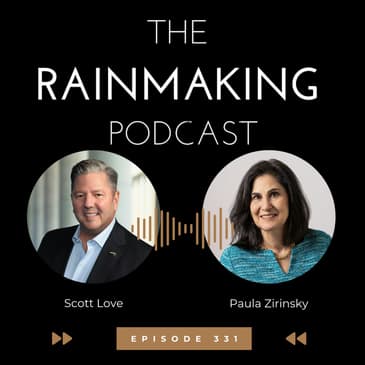
You think you know your brand. Your clients experience something else entirely — and that gap is costing you business.
Paula Zirinsky is the founder of Zirinsky Strategy LLC and a marketing strategist with over four decades of experience helping law firms, professional services organizations, and global companies discover what their brand actually is — not what they assume it is. In this episode, Paula joins Scott Love to unpack brand intelligence, strategic listening, and the brand discovery process that reveals the hidden stories, emotional differentiators, and unexpected insights that separate the best firms from everyone who sounds exactly like them.
You'll learn:
- What brand intelligence actually is — and why emotional differentiation matters more than rational differentiation
- Why "we know our brand" is the most dangerous thing a law firm can say
- The single most powerful question to ask a client that unlocks the stories behind your brand
- How the pause after "tell me a story" often produces the most valuable insight of any interview
- What the "triage" story reveals about finding a hidden differentiator hiding in plain sight
- Why process can be as powerful a brand story as personality
- How brand discovery interviews actually strengthen client loyalty — sometimes just by asking
- What blocks organizations from implementing brand work successfully (it's not budget)
- How strategic listening applies to lateral recruiting and partner development — not just marketing
- 3 action steps any firm can take right now to start listening differently — even without a consultant
Whether you're a managing partner, chief marketing officer, or a solo practitioner trying to stand out in a crowded market — this episode will change how you think about what your brand actually is.
Visit: https://therainmakingpodcast.com/
YouTube: https://youtu.be/auqwyRY0NeQ
---------------------------------------- If you are a successful law firm partner or law firm founder and want to hear about other options, please book a time on Scott Love's calendar here: https://calendly.com/scott-736/half-hour-phone-meeting-with-scott Or email Scott to connect with him at: scott@attorneysearchgroup.com ---------------------------------------- 🎙️ The Rainmaking Magazine helps lawyers, consultants, and professional service providers build thriving practices through smarter business development.📖 Subscribe to The Rainmaking Magazine — free 30-day trial: https://www.rainmakingmagazine.com ---------------------------------------- This show is sponsored by Leopard Solutions Legal Intelligence Suite of products, Firmscape, and Leopard BI. Push ahead of the pack with the power of Leopard. For a free demo, visit this link: https://www.leopardsolutions.com/index.php/request-a-demo/ ----------------------------------------
About Paula Zirinsky:
Paula Zirinsky, the founder of Zirinsky Strategy LLC, is a seasoned marketing professional who excels in tackling marketing challenges and problem-solving through branding, thought leadership, and intentional marketing initiatives. With over four decades of experience, she possesses a proven track record in identifying growth opportunities for global companies and has a knack for building the necessary infrastructure and teams to drive strategy, branding, thought leadership, marketing, and business development. Paula is also well-versed in content creation, communications, digital programs, and the implementation of technology platforms.
Links:
https://www.zirinskystrategy.com/about
https://www.zirinskystrategy.com/contact
Learn more about your ad choices. Visit megaphone.fm/adchoices
[00:00:10] You're listening to The Rainmaking Podcast, hosted by legal dealmaker, author, and professional speaker, Scott Love. You're listening to The Rainmaking Podcast, and my name is Scott Love. Thank you for joining me on the show. I'm excited about this episode because this is going to give you deep insights into finding out what is different about you compared to your competition.
[00:00:35] Our guest today is Paula Zirinsky, and our topic title is Brand Intelligence Through Strategic Listening. Paula is a consultant in the areas of marketing and branding for organizations, including large law firms, all sorts of professional services firms, and other organizations. She's worked in that industry in her entire career. One of the things we're talking about is how she works with her clients to listen to their clients and referral sources to find out what's different from the business.
[00:01:05] Paula Zirinsky, and the reason why she works with her clients is the same. Paula Zerinsky, and the reason why she works with them is the same. Paula Zerinsky, and the reason why she works with them, and finding the emotional context that ties loyalty to certain organizations. This is going to be an insightful episode that I promise is going to help you. You can reach Paula directly on her website. Just go to the show notes of the show, and we put all of her contact information and other resources where you can connect with Paula directly. Pak,! This podcast is sponsored by SurePoint Legal Insights, formerly known as Leopard Solutions, turning legal intelligence into opportunity.
[00:01:35] The show is also sponsored by The Rainmaking Magazine. For the intellectually driven and results-focused professional that wants to be the number one professional services provider in their niche, start your free 30-day subscription today with nearly 40 contributing authors, business development coaches, and consultants providing curated content on business development. Visit therainmakingmagazine.com today to chart your course to greater rainmaking success.
[00:02:03] Thanks for listening, and I hope you get some great ideas from my conversation with Paula today. Hey, this is Scott Love with The Rainmaking Podcast. Our guest today is Paula Zerinsky, and our topic title is Brand Intelligence Through Strategic Listening. Paula, thank you for joining me on the show. Thank you, Scott. I'm excited to hear about this show because I've got a feeling that this is something that's going to be really helpful to all of our listeners today. And tell us first, I want to find out two things. First, what is brand intelligence?
[00:02:33] And secondly, what is strategic listening? What does that mean? So start with brand intelligence. What does that mean exactly, Paula? Okay, I want to go back to what branding is and what a brand really is. So a lot of people think of brand in terms of an identity and an image. And I like to think of it in those terms as well as the rational dimension and the emotional dimension of a brand. So the rational dimension, those are your differentiation points. Law firms are really good at that, right? They're fast. They're efficient. They're less costly.
[00:03:02] Whatever it is, they have the expertise. But it's the emotional differentiation that I think is incredibly important. And that's what we listen for when we come up with brand intelligence. The emotional side is the vision you have in your head when you hear the name of a brand, of a company, of a person. And you think of that and that's what's embedded in your mind and in your persona.
[00:03:25] So when we're doing brand listening and we're looking at strategic intelligence, we really want to get at the emotional side more so than the rational side. That sounds very deep. Where should we dig in? Where do you think are the best places to start talking about this, Paula? Well, you know what? I did do this article with Acuogen on client feedback.
[00:03:48] And I think if we look at something that law firms are very used to doing, which is client feedback, and then explaining what the differences are when they're looking at brand discovery. Because that's a good starting point, I think, for this conversation. Right. So what does that mean when you say brand discovery? What does that mean exactly? So when we start working with any kind of professional services company, whether it be a law firm or accounting firm or corporate investigations firm,
[00:04:16] we want to find out what it is that their clients think of when they hear the name of their company. It's what clients experience about you versus what you say about yourself. And so we look at that to say, you can't decide what your brand is. I've had lawyers say to me, we know our brand. We don't need to do any brand discovery.
[00:04:39] And they're thinking very much from an insider's point of view, but they're really not thinking of what others on the outside say about them, feel about them, experience about them. And that's what brand discovery brings to the forefront. So I'm willing to guess that every listener here, maybe it's a leader in an organization or somebody that's a professional services rainmaker, whatever business they're in, their goal is, I'm going to have a brand so that people feel like they trust me and they want me to solve their problems.
[00:05:08] That's probably a given, right? How do we connect the dots? How do we get our clients to have those feelings about us in our brand? How do we get to that point, Paula? Okay, so what you said is really, really important because that would sound like every other firm out there, right? Everybody says that. Everybody has lines. I'll give you an example. I'll tell you a story. And storytelling is very important in what I do. I went through the brand discovery process for a client and they thought we were a great firm. We gave great service.
[00:05:37] We did great work. And they worked a lot for individuals as well as companies. They were B2C and B2B. And I'm doing an interview with one of their clients. And the client commented that the chairman of the firm came to visit her. And when the chairman came to visit her, he brought her books on a specific topic that they had talked about. And she was so wowed that he had remembered that topic.
[00:06:02] And she said, what I really think of about this firm is that they're humans. They have human qualities. They really are thoughtful people. I know they're great at what they do. Every law firm I work with is great at what they do. But they bring a quality that's one-on-one where they're really listening to me and they're really engaged with me. And that's what made the relationship so strong. That's a great anecdote.
[00:06:28] So I guess our job is to get those stories, those themes, if you will, to the surface that get people to think about us in that sort of way. Is that correct? Mm-hmm. So what do you think, as we're learning about, and I want to find more about strategic listening here in a second, but what do you think are the main pitfalls that you've seen for organizations that really want to take this brand intel through strategic listening and make changes?
[00:06:55] What do you think the big pitfalls are, the biggest pitfalls are, that they need to watch out for as they go through this type of work? So initially, there's always someone that says, I know the brand. I don't need to do this, right? That's number one. And you have to turn that person around. But then sometimes you find out information that's a little bit sensitive, that you have to pose correctly, that they have to confront correctly. Sometimes you find out things that they didn't really realize the clients were thinking.
[00:07:24] Like, you're of an age where you may retire. I love doing business with you. You're my first phone call. Who's shadowing you so that I have someone else to call? And so we find out things that make them think about what they need to do in the future.
[00:07:39] And that person that says, I know the brand, when you reveal what the interviews tell people, the interviews with the other partners, the associates, the administrative staff, the referral sources, the clients, they usually come around because they're pleased at what they hear. They know they're a great lawyer. They know that they have great client service. They know that they focus on this in a big way.
[00:08:05] What they don't know are the little gems that really make people adore them. And that's why they want to hire them over and over again. That's interesting. That's a key point. I like that a lot. Tell me then, what does strategic listening mean and how can we incorporate that in our work to do these things that you're talking about? So strategic listening really starts with the magic words of connection. Tell me more. Tell me a story.
[00:08:31] When I do any interview, I go through a list of my interview questions. I'm very organized. And at the very end, I ask, tell me a story about this firm. Tell me a story about something that happened that is indicative of what it's like to work with them. And there's a pause. And I let the pause go. A little white space and listening is a good thing. And then they talk and they tell me things. And I listen. I don't stop them.
[00:08:59] Sometimes I probe a little bit more at the end. But it means really getting at what it is that's important to them. And sometimes the things that they say in their stories are about the lawyer that they call because they know they'll pick up the phone on a Friday night.
[00:09:17] Or the lawyer they'll call who will stay on late in the evening with them because they could hear in their voice the tension, the emotion, that they're a little bit fragile and they're not going to rush them off. It's stuff like that that comes out with strategic listening. I like that. Are you able to compile those and see sort of themes that come out of those stories? Yeah, that's incredibly important.
[00:09:42] So when I deliver reports on things like this, first of all, I play back what everyone has said for the regular questions. And all my interviewing is open-ended. It's not a survey where they check a box. So I'm able to play back and see what the themes are. I'm able to look at... It's funny. Certain words come up over and over again so that you really do have themes. And then I'm able to break it apart by the type of person I spoke to. Is it a client?
[00:10:12] Is it a referral source? And see the differences. And that's where the magic happens. It's seeing the differences, what your associates say, what your legal assistants say, what your partners say. Sometimes it's totally different. I think what you're talking about aligns very well with recruiting, not just client development, but recruiting. And if you think about... And I'm talking about partner recruiting in firms. You bring in someone over that has not just the book of business, but those trusted relationships. And that trust starts on day one.
[00:10:42] And so I think I see a lot of recruiting leaders that just don't think of this as much compared to people in marketing where they're doing direct business development. Do you think that the concepts you're talking about impact the recruiting teams and organizations also? Yes.
[00:10:59] I think that recruiters within organizations need to make sure that anyone they have out there is reflecting the firm and how it should be best reflected and be consistent on strategy and messaging and positioning points. And I think that if they do any kind of discovery with who they're recruiting with, they could get a better feel for what happened in those interviews that they send people on.
[00:11:29] And I think there's lots of opportunities there. I think it's a great opportunity. I think what you're doing is fantastic. And that's key. I do something very similar where I'll find out from just the recruiting perspective, not necessarily the client development, but the recruiting perspective. Tell me a story of someone that joined your firm. And within two to four years, it improved their condition. And it's interesting when you ask people to describe culture, they'll give you an adjective.
[00:11:55] And if you think one culture, well, that might be the same as the others. But through stories, I'm able to get not just what's different, but what's distinct. What are key points of distinction? What do you think about those concepts, Paula? I think key points of distinction are everything. Because at the end of the day, when you're looking at brand discovery, you don't want to sound like everybody else. You want to sound authentically like you. And authentically like you is how people experience you and how people experience your brand.
[00:12:22] And your brand is experienced through your people because your brand walks into a room on two feet. And it needs to be consistent. I love it. Your brand walks into a room on two feet. That's fantastic. That's a powerful quote, Paula. Thank you. And so what's interesting, I have a new client that talked with the chairman last week. He's telling me in terms of culture, things I've heard from other organizations before, almost identical. But the stories that he had and the way and the nuance of that culture, that was distinct.
[00:12:53] And that helps me to build what I call storyboards and my pitches of that firm to other organizations. Let me ask you this. Tell me a story of an organization you worked with. You don't have to mention their name, of course. But what were the problems that they had before? What was the work that you did with them? And what was the end result? How did that improve that organization's condition, Paula? Sure.
[00:13:15] I worked with one firm a while ago that was a litigation boutique and had a full breadth of services and pretty much sounded like everybody else. And they weren't. And what I learned through my interviewing with them is that they started each engagement the same way. And they kept using one word over and over and over again that they do triage, they do triage, they do triage.
[00:13:43] Nowhere was this on their existing website. Nowhere was this on their materials. And then they would explain it to me. And I've worked with litigators for a long time, but this was very specific stuff. And I went back to them and I said, this is you. This is what separates you from the competition. This is what separates how you do your work. This is your receipts. This is the example of how you do it. You could say that you have your partners engaged.
[00:14:12] But this process that you're describing is so specific that we need to really focus on that in a bigger way. And that's exactly what they did. That's interesting. So sometimes process can be a story point in itself. Definitely. That's great. What are some of the common trends from organizations that have done this well? Are there any common themes in how they went through discovery, how they made changes? Anything that you've seen are certain patterns among those that have done really well with this concept.
[00:14:42] So generally they like to really follow it through beyond just what we're working on in terms of defining their brand. So it has to be in all their messaging and all their collateral, in all of their training with people. Like they take it at one point and then it has to sprinkle out throughout the organization and be everywhere. And that's incredibly important. And it also needs to be from the top down. Your leadership team needs to be on board, obviously.
[00:15:11] And if they're totally on board, then it'll dribble down as well. And everybody will really be in sync with what you're doing. I had one situation where a firm started doing website work and the firm itself engaged me separately to do the brand discovery work. And I came on after they started and the leadership team liked what we were doing and everything had to switch back to where I was going from.
[00:15:41] The NetResults was a much stronger brand, a much stronger, more persuasive website and agreements throughout the organization. In fact, I was told that when there was a meeting and they had presented the brand at a partner meeting, they all chanted the new tagline in the van back to the hotel where they had presented the new brand over dinner. So it can be very rewarding, but it needs to be throughout the organization and all pieces of the puzzle.
[00:16:11] Yeah, that's great. So one of the things you mentioned, leadership support. My next question is this. What are those things that keep organizations from reaching the desired goal? Number one, like you mentioned, a lack of leadership support. What are some other things that have kept the work that you've done or other people have done or a firm's intention to do this work? What's really kept it from achieving the results that you think they could achieve otherwise?
[00:16:40] Sometimes it's within the organization of the law firm itself. It's within the departments. You know, I was inside big law for a really long time. I know how departments can be siloed and they do their own thing. But when you do brand discovery work, it's everywhere and it needs to be integrated everywhere. So another example, I was in a company and we were doing brand discovery work. This is before I was out on my own and they were working on a new intranet. And my team was not doing the intranet.
[00:17:10] IT was doing the intranet. And the IT team brought me something that didn't reflect not just the new brand logo, but the new brand in total. And you can't say, oh, it will cost you more money to do it that way. No, no, no, no, no, no, no. It's going to cost you more money if you don't do it correctly. And so you need to get every team in line with you. It's not just the leadership, but every department needs to be on board and they need to understand how they can do it as well. And that means training throughout the organization.
[00:17:37] And without proper training, you won't have it throughout the organization. So that's a key part of what we insist that our clients really do as well. Right, right. Let's say somebody wants to do this on their own. They're a small firm. They don't have a budget to hire a consultant. What advice would you give to that person as they're doing this brand discovery through strategic listing with clients, referral sources, people like that? So there are action steps that everybody could take.
[00:18:05] These are my action steps for the end of our interview, but I think it's... Yeah, we can talk about it now. Let's do it now. Exactly. So, you know, when you're talking with clients, replace one closed-end question with an open-ended one. Don't just say you're happy with our work. Ask them, you know, what happened that made you bring us on? What's changed since we've done our work? What was it that we said to you that made you bring us on to do the work? And listen, don't interrupt them as they give you their answers.
[00:18:33] And then instead of a story, listen for the story. Don't just listen for a compliment. If they say, you're great, everything was great, that's not going to give you any insight as to how you could stay great and be great for others. So ask the question, you know, how did it feel when this happened? What happened next so that we can keep that feeling going? And then compare what you believe with what your clients believe.
[00:19:02] So if you come up with three to five words that describe you, kind of figure out how you're going to ask them, do those three to five words really describe me? And you may be surprised. I would say out of five words, three might be yes and two, no, not really. Thank you for sharing that. So have you seen firms where here's the research, this is what your clients, referral sources, other significant people have said about you, and the leadership is floored.
[00:19:31] They're like, we never thought of it like that before. Have you seen that before? Yes, definitely. Yeah. And it's not like I'm doing anything that's so like out of the ordinary. There's subtleties that come forward. And it's just how you really marry it together so that it all makes sense. But yes, there are times that they're a little bit surprised. Yeah, right. How has that impacted their ability to do business development?
[00:19:57] Once they've been through this, what has changed in their client development strategy and their goals, things like that, Paula? I believe that they have a little bit more clarity and a little bit more focus because they can get by the stuff that sounds like everybody else and really focus in on what's important and really focus in on how they're going to grow and what they want to grow with. I'll give you another example.
[00:20:21] I had one client that worked in one area but wanted to expand into another. And in reality, after I went through a lot of my work and I also look at financials, I look at operational systems and everything, they were making more money in other areas than they were in the older areas. So it was really important that as they grow and expand, they expand in the right direction. And that's exactly what they really had to focus on.
[00:20:49] Like, what business are we going after? Are we going after big business or small business? You know, that kind of thing. That is a surprise. Did they actually go through and make those changes after that? Yes, they did. They did. And they're doing really well. So have you gotten pushback? Let's say you send an email out to a client. This is our goal. We're working with the firm. And have they given you pushback? Like, no, I don't want to answer those questions. Do you ever get that very often?
[00:21:16] I think the lawyers always think that their clients are not going to answer questions. It's really important to keep your client interview short because they really don't want to impose on them. It can be really long because they just want to talk. Scott, you're looking at my home. I do my interviews from my home. This is where I live. I go on. They see where I live. I'm real. It's not always this neat. Sometimes it's messy. We have a good conversation. It works. That's great.
[00:21:45] Do you think the interviews itself anchor loyalty more so to that firm? Well, I once had a client say that they were so touched that they were asked to be a part of the process, which is kind of crazy. But because you ask permission to talk to a client, you know, they come forward.
[00:22:07] So I think sometimes they just like the client so much they want to make sure that what they like will never go away. They want the secret sauce to continue. That's great. Thank you for sharing that, Paula. So you shared with us the three action steps. I appreciate that. Now, tell us about your offerings. What do you have? What do you do that you like our listeners to know? I know they understand that you do consulting in this area, but is there anything else that you'd like to elaborate on, Paula?
[00:22:33] So, yeah, I mean, within my consulting, I do a full range of marketing because obviously I was a packaged goods marketer originally and then in professional services and in big law. But if the conversation about branding, brand discovery, brand identity, feedback has resonated with you, I'd encourage everybody listening to really start listening differently. My work with law firms and professional service firms uncovers what your clients experience, not what you assume they're experiencing.
[00:23:03] And that's something that everybody can really do. Through strategic listening, we build brand intelligence, and that leads to stronger positioning, more authentic messaging, and more meaningful business development. So if you'd like to learn more or write about this a lot, please look at my Thinking Thought Leadership blog on zirinskistrategy.com and send me a note. So there's contact forms and feedback forms there, and I'd love to hear from you. That's great, Paula. We're going to put, for everybody listening, all of Paula's contact information, including what she mentioned in the show notes.
[00:23:33] So just go to the show notes wherever you listen to this podcast, and you'll be able to connect with her directly. Paula, thank you for sharing your insights. This has been interesting, and I know it's going to help a lot of people listening to this today. Thank you so much for being here. It's been lovely being here with you. Thank you for listening to The Rainmaking Podcast. For more information about our recruiting services for international law firms, visit our website at attorneyssearchgroup.com.
[00:24:02] To inquire about having Scott speak at your next convention, conference, sales meeting, or executive retreat, visit therainmakingpodcast.com. Thank you.