Most professionals know they need more high-value clients. What they don't have is a system to bring them in predictably — without cold pitching, diluting their brand, or spending all their time on marketing instead of client work.
Esther Stewart is a Business Growth Strategist and founder of Cottn Owl. A former Fortune 500 finance associate, she spent eight years inside billion-dollar institutions training 7 and 8-figure executives in white-glove sales, client retention, and institutional-grade growth strategy. After leaving a multiple six-figure corporate career in 2023, Esther built two multi-five-figure per month businesses using one offer, one sales system, and disciplined infrastructure. Her philosophy: premium clients don't buy hype — they buy certainty.
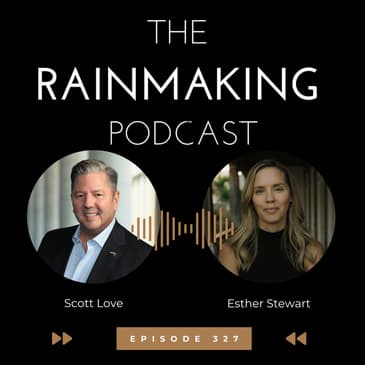
In this episode, Esther joins Scott Love to break down exactly how professional services providers can build a client acquisition funnel that works — simply, intentionally, and at a premium level.
You'll learn:
- What a funnel actually is — and why most professionals massively overcomplicate it
- How the price of your offer determines the length and structure of your funnel
- Why the only thing you need to sell first is a conversation
- The #1 pitfall that stops high-achieving professionals from growing their pipeline (visibility)
- How to overcome the discomfort of showing up online when you're used to being the expert, not the promoter
- Why on-camera ads outperform stock images at premium price points — every time
- How a fractional CFO generated $120K in new pipeline value in her first 30 days
- Why hiring a coach isn't enough — and how to pick the right coach for the right thing
- 3 steps to reverse-engineer your revenue goal into a working funnel
If you're a lawyer, consultant, doctor, or high-level service provider sitting on a strong offer but struggling to fill your pipeline — this episode is your roadmap.
Visit: https://therainmakingpodcast.com/
YouTube: https://youtu.be/PO0Dl5yR5Pc
---------------------------------------- If you are a successful law firm partner or law firm founder and want to hear about other options, please book a time on Scott Love's calendar here: https://calendly.com/scott-736/half-hour-phone-meeting-with-scott Or email Scott to connect with him at: scott@attorneysearchgroup.com ---------------------------------------- 🎙️ The Rainmaking Magazine helps lawyers, consultants, and professional service providers build thriving practices through smarter business development.📖 Subscribe to The Rainmaking Magazine — free 30-day trial: https://www.rainmakingmagazine.com ---------------------------------------- This show is sponsored by Leopard Solutions Legal Intelligence Suite of products, Firmscape, and Leopard BI. Push ahead of the pack with the power of Leopard. For a free demo, visit this link: https://www.leopardsolutions.com/index.php/request-a-demo/ ----------------------------------------
Esther Stewart is a Business Growth Strategist and founder of Cottn Owl, where she architects high-converting paid acquisition systems for founders selling premium offers. A former Fortune 500 finance associate, Esther spent eight years inside billion-dollar institutions training 7 and 8 figure executives in white-glove sales, client retention, and institutional-grade growth strategy. Today, she works with coaches, doctors, consultants, therapists, and high-level service providers who already have strong offers and want predictable, scalable client acquisition without diluting their positioning. After leaving a multiple six-figure corporate career in 2023, Esther built two multi five-figure per month businesses using one offer, one sales system, and disciplined infrastructure. Her philosophy is simple: premium clients do not buy hype, they buy certainty. Esther teaches founders how to build strategic sales systems, refine positioning, and scale through paid traffic in a way that protects brand equity and supports long-term growth.
Links:
Learn more about your ad choices. Visit megaphone.fm/adchoices
[00:00:10] You're listening to The Rainmaking Podcast, hosted by high-stakes headhunter, author, and professional speaker, Scott Love. Hey, this is Scott Love with The Rainmaking Podcast. Thanks for joining me on another episode. Our topic title today is Filling Your Funnel with High-Value Clients, and our special guest is Esther Stewart.
[00:00:37] Esther works with high-level service providers who already have strong offers and want predictable, scalable client acquisition without diluting their positioning. She has some sophisticated ideas that I think are going to help you fill your funnel with high-value clients. Make sure you connect with Esther on LinkedIn and also on her website, and we put all of her contact info on the show notes. No matter where you listen to this show, go to the show notes and you'll be able to connect with Esther today.
[00:01:05] As always, this podcast is sponsored by SurePoint Legal Insights, formerly known as Leopard Solutions, turning legal intelligence into opportunity. The show is also sponsored by The Rainmaking Magazine. This is for the intellectually-driven and results-focused professional who wants to be the number one professional services provider in their niche.
[00:01:28] Start your free 30-day subscription today with nearly 40 contributing authors, business development coaches, and consultants providing curated content all on the topics of business development. Visit therainmakingmagazine.com today to chart your course to greater rainmaking success. You can also find links to our magazine, our YouTube channel, and other resources on the show notes of this show.
[00:01:55] Thanks for listening, and I hope you get some great ideas from my conversation with Esther Stewart today. Hey, this is Scott Love with The Rainmaking Podcast. Our guest today is Esther Stewart, and our topic title is Filling Your Funnel With High-Value Clients. Esther, thanks for joining me on the show today. Thank you, Scott. I'm happy to be here.
[00:02:15] Well, I'm excited to have you here because I think your background and what you've done and the people that you deal with is very closely aligned to the people that those people listening to the show deal with all the time. It's a very nuanced, sophisticated group, and that's the funnel that we have to target with filling those high-value clients. And so let me ask you this, just that topic title, Filling Your Funnel With High-Value Clients. So Esther, let me ask you this question. What's the definition of a funnel? What does that word mean? Yeah, so great question.
[00:02:44] And there's so much confusion around a funnel. I'm going to give you the most simple term, in my opinion. The only purpose of a funnel is to take somebody from just learning about you to becoming a client. That is the sole purpose of a funnel. What happens between them just learning about you and becoming a client is determined by what makes sense for your industry. So this is where a lot of people have gotten really confused, even my own clients, where they've set the wrong funnel in their business because they thought a funnel was this, this, and this.
[00:03:12] They didn't realize that it was actually just the simple process of getting somebody just to learn about them to becoming a client. Oh, that makes it so simple. It takes the pressure off. It does. Yeah, because I think when I hear people talk about a funnel, it means I've got to do six different things and I'm going to move them forward at each step. But I like the way that you simplify that. Yeah. So tell me, what are examples that you've seen from those people that are in your world as sophisticated individuals? What are examples of funnels that people have used before? Yeah.
[00:03:40] So many different ways that you can set up a funnel in your business. And it really starts with, there's a couple of places that I start. One is, what is the price of your offer? And? Because that determines the length of your funnel. Because the more expensive your offer is, for lack of any other way to phrase that, the more expensive your offer is, the more sophisticated your buyer is. And so when that happens, that buyer has to take, they typically take longer to make that initial decision.
[00:04:07] It is very different, as you know, than having a $22 product that you're selling. When you're selling a $50,000 service or a $50,000 offer, it takes longer to have that person say, yes, this is the absolute best fit for me. Let me go ahead and even have a conversation with them. So the funnel has to be matched to not only the price of the service or the offer, but now we also want to look at where is their client currently living, right?
[00:04:33] So does it make sense to have a funnel where your source of your ideal client, your high-value client finding you, is online? Does it make sense that it's more in person? Do you need to be on stages to build authority, credibility based on the price point? So that's where I start, is looking at the price. We look at where their ideal client is, and then you can reverse engineer from that. That's great.
[00:04:56] Regardless though, even if you're in person, you still, I mean, if you're doing a book tour, for example, and you're speaking on stages, and that is a source of your client acquisition, your book by extension is the thing then that they're going to purchase or perhaps you give it to them. And then from there, they still need to have an actionable next step in, and I'm going to argue, in an online space where they can reach out to you. Whether that is a link to your calendar or even a website.
[00:05:22] So there is still a component that is needed, and not everybody wants to hear this, but there is a component that is needed to have an online presence. So you can have it, you know, in person and virtual as well, but it is important to make sure that you do have a place where they can find you online, and then they can engage with you and then take that next step. So within all of that, which is a lot, that's where the funnel gets built. So you said earlier, like seven-part funnels. You might need a seven-part funnel, right? Every business is different.
[00:05:49] There are some businesses that do need a seven-part funnel, depending on what their strategy is and what their price point is. So inside of that, you might have seven steps. You might have six. You might have two. I think it just depends on the person, the offer, the price point, and then where their ideal client is actually living. This is interesting because I see you in that world as an advisor. You see this all the time. The people listening to this show, he might be or she might be a busy finance partner.
[00:06:17] That's really their only concern in life is serving their clients, but they're getting pressure from their leadership to grow your book, grow your book, grow your book. You can't be an equity partner unless you have a big book, but I'm spending all my time serving my clients. How can I build a book? And these are people that just hadn't been trained professionally to think in the way that what you've done. And so I think many of them listening, the word funnel, it might be something they just haven't considered before. So I think let me kind of bring this into our conversation.
[00:06:44] I think what you're describing is in a word intentionality. Yeah. Having a clear intention. Starting with goal. I want to become a rainmaking partner. I want to get from my practice to where I'm building $8 million a year. Or, you know, that's what I want to get to. And so what you're doing, like you said, what is it from where they don't know you to where they do know you? And they say yes, and that's the funnel. So let me kind of segment what you mentioned. You said step one, if we could put these in steps, if that's okay with you, Esther.
[00:07:12] Step one is set up the pricing or determine the pricing. That determines the length of the funnel. Step two is determining where the client is living. Are they online or in person or a combination? And then I think step three might be determining what that next step is after they first hear about you. Is that a correct assessment of what you said so far? Yeah, I love that. Yeah. Okay, good. I like it simple. And when it's simple, people actually do things, right? Yeah, exactly.
[00:07:38] So what would be that next step that the person listening might want that prospect to take with them once they've initially had some sort of engagement, whether it's seeing them speak at a conference or hearing them on a panel, reading a white paper that they wrote, reading an article or seeing a video. What would be next possible steps that you've seen your clients have their prospects take? In a perfect world, it's to get a conversation. So it can be an in-person conversation. It can be a Zoom conversation, right?
[00:08:08] I personally use Zoom because the clients, they're all over the country. So you can't necessarily fly to every single person. So let's have a Zoom conversation and let's see what it would look like and if it makes sense to talk about possibly working together, right? In its simplest form, that's it. To have a one-on-one conversation. And it's, you know, I think the most successful people that do this where they're just having one-on-one conversations, they always say, just get to a no or yes, right? Just get there as quickly as possible.
[00:08:37] And I see a lot of founders overthink this step because they're like, well, what if they say no? Well, that's fine if they say no, right? As long as you're not being rude in your approach, right? Very important. You know, there's a strategy. But if it makes sense and it makes sense for you and it makes sense for them, they will not say no. Yeah. And yes, you are going to hear a lot of no's and you have to be comfortable with that. And so one thing I noticed, especially in the finance world, is they did not like hearing no and they took it very personally.
[00:09:04] And so one thing I have learned in the years of leaving corporate and now navigating this online has been to get really comfortable with hearing no and to not take it personally. And so once I was able to get in that mindset and it didn't take that long, to be honest, because I realized if I really wanted to get to the level I wanted to get to, I was going to have to get really comfortable hearing more no's than yes's. With the goal, of course, to get better in those conversations so I could start to hear more yes's than no's, right? So it is definitely there's a strategy to all of it.
[00:09:32] And in those conversations, it's also it is about selling. And so one thing, and I'm curious what your thoughts are, one thing I really saw in the finance space was the, especially the younger financial advisors that were brand new into this industry who had spent so much time, myself included, in getting licensed and learning all of the rules and the regulations and the investments of what people should invest in, but not ever taking the time to understand client relationships, prospecting relationships.
[00:09:58] And then how do you navigate that conversation so that you're actually selling, but you're selling with white glove intention, right? It's an art. It's not easy. And so I saw daily this disconnect where they had, you know, I'm going to go to these networking events and I'm going to drive these conversations, but they never learned how to take those conversations and actually now sell themselves. So I think it's an interesting dynamic for probably, I would say for a lot of my clients, if not most of my clients, that is the most challenging piece for them.
[00:10:26] They're great at relationships. They're not great at selling and they're not good at selling themselves. So, yeah. And that topic is something I heard just this week at a conference I attended and spoke at called Rain Dance, put on by the Legal Sales and Service Organization. Chief marketing officers, law firm leaders from a bunch of different law firms came. They had 150 people there and they talked about that, just the concept of selling. And I think, especially within the legal industry where I work, that actually used to be illegal. You couldn't sell your services as a law firm.
[00:10:55] In fact, the National Law Review or journal, I can't remember which one it was, but now is part of the American legal media. In the 1990s, they did a survey surveying all the partners in that world in private practice about the state of the industry. And they felt that the state of 80% said the state of the legal industry is in decline because it's less of a profession and now it's a business. I think many of those people have phased out of their career.
[00:11:21] So, people that have been in legal since then didn't have that previous preconceived ideas. So, I think that converging with the sophistication of professional services, especially in the world of business development, I don't think many people have that stigma. But the issue of sales, like you said, that's still a word that people, I mean, there's an emotional charge to it because of preconceived ideas that we had in other scenarios of our lives that we've had a negative experience.
[00:11:51] I don't want to be that guy. You know, I don't want to be that kind of person. I don't want to be pushy. But I think, and that's why a lot of times in legal, we just call it business development. Even though it's the same thing as sales, it's really the same thing. I think the way they get over that from an emotional context of it is looking at it like you're helping people. And if I'm not, and this is something I tell everybody. I told someone today, I was trying to recruit them. I said, if it's not a fit, let's keep, let's say friends. You know, it's not going to hurt my feelings.
[00:12:20] I'm like a realtor having an open house in our conversation. Here's some cookies. It may not go anywhere. But guess what? Everybody I talk to, I stay in contact with them over time. Not by, hey, it's me again. Do you want to move? Hey, it's me again. But here's a helpful resource that can help you, even if you don't leave your firm. You know what I'm saying?
[00:12:39] So I think people like you, where you're in the business of helping professionals that have this awkwardness about the concept itself of asking anybody to do anything that benefits them personally, such as I want money. You have a problem. I can solve it. Pay any money. You know, that in itself can be awkward. So I think what I've done with people is helping them know that you're trying to help them. You're solving a problem. So that's what I think.
[00:13:07] It's a very good time for people to look for you as a resource for them because you get that. You're in that world. You help them connect all those dots and move it forward. So I think that the timing is ripe for those professionals that really want to be intentional about growing their books of business and having specific systems. And I love what you said. A funnel can be a three-step process. You just simplified that, Esther.
[00:13:36] You know, and I commend you for that, that simplicity. You know. Let me ask you this. For people that have realized, I need to be intentional. I need to have a plan in place. What do you think are the biggest pitfalls they face as they go through this change to be more intentional about building this funnel, so to speak? From what I've seen, it's visibility. They are not comfortable showing up specifically online.
[00:14:01] And I will even argue, if you don't want to go and show up visibly online, that's perfectly fine. But then I also see where they struggle to even do in-person networking events because it feels so uncomfortable. Because like you said at the beginning, and we all would love to do this to just focus on our clients and then that's it. But in the world, if you're not focusing on client acquisition alongside of your client base, it's going to be a rocky dynamic, especially if you have that client that leaves.
[00:14:29] Or, you know, in the finance world, they would pass away and then would go to the next generation, right? So the goal, of course, was to build a relationship with the next generation, but that doesn't always work. So I would say that it's getting out of your comfort zone 100%. And nobody wants to hear that. The other is, as part of getting out of your comfort zone, you also have to realize, and I struggled with this myself when I left Morgan Stanley.
[00:14:57] When you get out of your comfort zone, you also realize that while you are really good in this one area, you are not good in this other area. And so, especially the older I get, that is a really hard conversation to have to tell yourself. Because you go so far and you feel so, you know, accomplished some days. Some days you don't feel like you've done anything. But on those days where you feel accomplished and then you realize, wow, I still have so much. This actually happened to me this morning. I still have so much more that I need to improve on.
[00:15:25] And there's still so much opportunity to get better in this one specific area. So it can be really challenging, especially, you know, when you are exceptional in your work and in your service and in your client results. And now you have to get good, great even, depending on your revenue goals, at being in rooms where that's not your strength. That's not your strength.
[00:15:46] Or in doing a carousel, not a carousel, an Instagram reel or a LinkedIn reel where you have never enjoyed or have maybe never even posted anything online before. So it can feel overwhelming. But I would say that's the biggest area where I see all service-based founders, professionals, where they struggle the most is bringing that into a space where they're very uncomfortable and then actually being willing to be uncomfortable for a little while. And, you know, it won't be perfect, right?
[00:16:14] And, again, at the level we're talking about, they have built their business around being not perfect, but their version of perfect, as perfect as they possibly can be. That's why they've gotten the client results that they've gotten. So now it's like, you know, that's a perfectionism that's built your business. And now you have to go do something that is not going to be perfect. And it is going to be clunky. And you're probably not going to, your first networking event, maybe your first 10 are going to be really uncomfortable. And then, you know, the first couple, I would say probably the first 300 reels you record are not going to be what you want them.
[00:16:43] They're not going to look how you want. So it's this interesting dynamic where it's easier to stay where you are. But if you really want to grow your business and have a consistent pipeline and keep it filled with high-value clients that you want to work with, you are going to have to step in at some level to something that's very uncomfortable from what you're currently doing. Because if you want to change what you're doing now, change is a requirement. Because what you're doing right now isn't where you want to be. So you have to change something. And with that change just comes a really uncomfortable growth.
[00:17:13] I mean, you're talking about self-awareness here. Oh, yes. Yeah. And nobody wants to admit that they have limitations, especially the people listening to this show. Because I know all of you are the smartest people in the world and your children are beautiful. But you just don't know everything. You're really good in your practice specialty. And you are number one in the world. And you can solve any problems your client has. But if you can take that and admit that, yeah, you don't know what you don't know.
[00:17:40] And there's more that you don't know about certain parts of the world than what you do know. And you need to talk to people like Esther to learn how to overcome those limitations and overcome those deficits there. And I look at what you're talking about. This is a simple process here. You just have to know what to do. And more importantly, you have to execute on that. You don't even have to know what to do. Just execute and you'll figure it out. Yeah. But you work with people like you. And that really kind of shortens the learning curve there. Let me ask you this.
[00:18:09] Let's just say you're coaching someone that is a very, very good structured finance partner. And they want to become well-known. And they want to get more business from clients and prospective clients. But they just don't feel comfortable being on that stage. They don't feel comfortable talking about themselves. But they know they have to. How would you advise them? What mental framework would you give them?
[00:18:34] Or how would you coach them to feel comfortable to take action on things that they have to do to get that funnel going? Yeah. So I'm very self-aware. And I will tell you that as I built my business, I built myself. And I was not prepared for that when I left Morgan Stanley. I actually don't coach people on this. So what I would tell someone is find a coach based on what you are specifically looking for. And the reason that I'm really about specificity is this.
[00:19:04] If you work with a coach who's very broad, you're not going to refine that one specific thing that you're looking to refine. I'll give you an example. I made three investments into coaches myself at the beginning of this year. And I'm still working with them. And each one was for specific pieces of one was for the actual business. And the other two were for personal growth. So one was to learn the skill of persuasive selling. Very different than any of the sales that I've done.
[00:19:32] But it's a white glove level of selling. Very, very much what you already described, which is this is how I can help you. And if it's a good fit, whether it's now, whether it's never, it doesn't matter. I'm here to give value. Right. It's a very, very different way of selling. The other was to learn how to network and perfect my pitch. Right. So I didn't go broad and find somebody who could help me with all of that. I went out and found the person that I connected with personally and felt like this was the person who was going to be able to teach me this one specific thing.
[00:20:01] So I would say for anyone who is ready to hire a coach, determine first what's the most important thing right now and then find the best coach for that thing. And I will also add where you and you're you already know this in your audience probably does, too.
[00:20:18] But in case not where you are now, that coach that you work with in 2026 in 2028, you are probably going to have the requirement to have another coach that's going to teach you on the principles that you learned in 2026. But they're going to take it to the next level. Right. So I think that personal growth, coaching, having somebody that can guide you to the next step for me personally, at least, it never stops. It never stops. And I could like we all could. I could say, OK, I'm good. I know everything.
[00:20:46] What I know today is enough to keep me going. And quite frankly, yes. But again, I have a really big vision of where I want to be. And so I know that to get there, I have to keep improving myself. I have to keep making the business better. So I would say back to your question, to answer your question, finding a coach specifically for that one thing and focusing on that one thing that you want to look to improve. So maybe that's public speaking. It's a lot of amazing coaches that can help you with public speaking.
[00:21:15] And you can even niche that down further and find somebody who specifically helps you with your voice. Right. I actually found a coach on this and I want to work with him. He's on my list. He will help you not only when you're speaking, but in the inflection of your voice. He works with celebrities to help them when they're preparing for movies. So again, very nuanced. So whatever you are really, really passionate about and you want to you want to change, find that and go really specific. And then once you have that, then find the next coach and just keep going.
[00:21:44] That's great, Esther. Let's say you're working with someone where actually what I want you to do is tell me a story of someone that you've worked with. They didn't have much going in the way of their funnel and they worked with you and you helped them overcome some of the challenges they had and they've achieved success. Kind of walk me through that. You don't have to mention their name, of course, but walk me through what was their situation before they started working with you? What were some of the main things they did and what's the result of where they are today? Yeah, no, I love that question. So I will talk about Jennifer.
[00:22:14] Jennifer was an accountant, CPA and a chief fractional officer. So when she came to me, she had a good solid base, six figure business, was only working on referrals and had a lot of clients in there that weren't currently at the fee that she knew she wanted to increase her prices to. So she was in an interesting dynamic where she knew she was undercharging, but she didn't want to disrupt what she currently had in her business.
[00:22:39] But she wanted to set a new funnel in place to go out and capture a totally different market. And she was really specific in the type of client she wanted to work with because she had a lot of clients that she worked with in the past that she had outgrown. So that's where we started.
[00:23:23] She had paid ads on Instagram and LinkedIn to bring her ideal client to her. So that's what we focused on. But for this funnel, the funnel is they see her in an ad. So and I'll come back to that because that ties into the visibility, which she was very uncomfortable with. So they see her in an ad. They click, they go to a landing page that brings them into her pipeline.
[00:23:42] And then now that's where, you know, the emails went out, the texts went out engaging and they're written in a specific way, intentionally written in a specific way, because you have to be really careful how you engage. We want to build relationships. We don't want to destroy credibility by sending somebody 27 touch points in the first three days, the worst marketing advice ever. And then through that, they would they would get nurtured. They would build a relationship with her virtually and then they would book a call on her calendar.
[00:24:06] And in the first 30 days of setting all this in place in her business, her pipeline value just from that alone, outside of referrals, $120,000 booked on her calendar in new pipeline value. So that's what we set in place. But I want to come back because you brought it up and it's probably of interest to your clients. She did not want to record the ads. She wanted to do maybe just like a photo or like a stock image ad. And this was my advice to her.
[00:24:34] So I'm not a coach, but I did have to coach her through this was this when because her service at the time, and I'm sure it's probably higher now was $60,000 to work with her for 12 months. And that was the low end. She had different tiers. So I told her, I said, when you have an ad, when you are turning on an ad, when you're when you are showing up on LinkedIn or Meta or through an advertisement,
[00:24:58] your ideal client on the other side that is willing to invest at the level that you are asking them to invest with you needs to build a relationship with you before they're even going to take the next step to click to get to the next step to then click to get to the next step in the funnel. So it was it is essential for this for this price point to be on camera. And I will stand by that.
[00:25:21] And if clients and this is actually one of the things before somebody becomes a client, I'm very clear about this, because if that is not what you want, then my work is not for you. Because I know I've tested it through the years, spent a lot of money doing A-B split tests and all the things. If you as the founder and you could have somebody on your team, but it definitely works better if it's the founder.
[00:25:39] If someone is not on on camera speaking and building that virtual relationship where your ideal client on the other side can see how you speak, how you engage the words that you're saying, all of that is painting a picture just the same as if you walk in, have walked into a networking event. So with her, I had to paint that picture for her. And it did take her a little bit longer to record her video ads because she didn't like how they looked. And so she kept re-recording and re-recording and re-recording.
[00:26:08] And finally, I was like, send me what you have. Let me look at it. And I looked at it. I said, these are great. I was like, you know what? In six months, as you get better at this, then if you want to put a new ad up, absolutely. I was like, but this is enough. And these look great. It's like, let's just go with that. And that's what then got, you know, the $120,000 in pipeline value. So I think that answered your question. That sure did. That's a great story. I like that.
[00:26:30] And so as we bring our conversation to a close, our listener here is professional services practitioner whose success is determined by how well they serve their clients and also getting new business coming in. And they say, I need to have a funnel. Yeah. What would be three steps you would give them to really start working on these things? Yeah. Oh, this is such a fun question. Okay. So the first is, where is your ideal client now? That's step number one. You need to identify where they are.
[00:26:59] And Claude, I like Claude at the moment. Whatever AI system you're using can help with this. This is one of the things that I will use it for. I don't like AI for a lot of things, but this is great. So if you use AI and you tell AI, this is my audience, this is my price, this is me. You can even just give it a URL if you already have your website built, and I'm sure your audience already does. You can just give it the URL from your website and Claude and then prompt Claude to tell you where is my ideal client right now? Where is the most likely place for me to reach them?
[00:27:29] And it will tell you whether or not that's in-person events, right? Whether or not that's online, social, organic, whether that's paid advertising, right? It will give you the different steps based on what you input. So that would be step one. And then step two would be, and this is, again, before you even start to build out the funnel, what's your goal for your business? Like, what is your actual revenue goal? And this is one of the things I used to do with the teams at Mortgage Stanley. It's like, what is the vision for the next year?
[00:27:56] Where do I want our revenue to be at the end of this year, right? And so from there, we would determine, okay, with what we're currently doing as a team and looking at what we did last year and the growth of the year before, is it realistic to assume that if we keep doing the exact same thing we've always done very successfully, and this is our revenue goal for this year, can we get there? And if the answer is yes, then I would argue that what you have in place is sufficient, right? You don't necessarily need anything else because it's already working.
[00:28:24] However, if the answer is no, then you need to determine what, so step two is, what's the revenue goal? Does it make sense with what you're currently doing? And if not, okay, now you need a funnel. And then step three is, you're going to take step one and step two, and you are going to have to reverse engineer to figure out how to get there. So what that looks like for me, and what I think is the easiest, is you're probably going to have to do some form of paid acquisition, some sort of paid advertising. And again, it doesn't mean that you have to send them somewhere to sell.
[00:28:53] In fact, nothing I set up for clients is actually selling anything other than a conversation. That's it. We're selling a booked call to see if it's a good fit. So you don't even necessarily have to go that aggressively because, as you said, Scott, some of the industries don't allow you to do that. So if that is the case, that's where you need to know what does your industry allow for online marketing. And it could be something free, and now you're building a relationship. It could be a booked call. That's my favorite. It's just in its simplest form. Let's just have a conversation, right?
[00:29:20] If it's in person, let's say that through your Claude AI, you have determined that you don't need paid ads, but you need to do in-person events. Okay, great. Well, now you or someone on your team should be actively sourcing what events nationwide, and you are going to have to travel. And again, some people don't like to hear that, but you are. What events nationwide have the rooms with the ideal clients that you desire to serve? Sometimes that's the simplest strategy. And yes, it takes work because you have to find those events. And yes, you probably are going to have to pay to be in those rooms.
[00:29:50] But I will argue that if you really want to grow your business, you're going to have to pay either way. So you can do it through paid advertising. You have to pay to be in the rooms or you pay the cost of not doing anything. And then you stay exactly where you are. So either way, you're paying however you want to look at it. But there's a lot of different ways that you can reverse engineer. But again, it's going to probably be something that's either paid online. To me, that's the simplest if it makes sense for the industry. Or again, depending on the price point, sometimes online will not convert when you are at a really high premium price point.
[00:30:19] They're just not online and they're definitely not coming through an online funnel. And that's where you want to look at the events. What events make the most sense to be in that room? And that's where you have your team. And then you have to even reverse engineer again. It's all about testing. Nobody wants to hear me say testing because I don't like it. But then you have to look at, all right, so if I know, and every person's different. This is for online events specifically. But if you know on average that you can go to five events and you can make one to two good connections per event,
[00:30:48] regardless of the size of the room. And you know that. Like, that's your KPI. That's your key performing indicator. And you know that. Then now you get to reverse engineer. Okay, well, if I'm looking for XYZ number of relationships this year, I need to be in this many different rooms. So again, it is testing. And for a lot of people, they probably don't know what that number is, right? So they might have to go a full year of testing. And you might have some events where you go and they're not a good fit. Guess what? You don't go back next year, right?
[00:31:17] You're building your list so that the year after you have a great room that you can keep going back into. These are all fantastic ideas, Esther. And I appreciate you being on the show today. Thank you. And I want to have you on the show in the future. You mentioned something. You said something I've never heard before with over 300 guests on the show. You said you're selling a conversation. Yeah. And I think if we make that as our step in the funnel, and I think that could be the primary step in the funnel.
[00:31:45] If we looked at, forget about having a contract, a retainer, whatever set up. Let's just have the goal, a conversation. I think that takes the pressure off from these professional services providers. What do you think about that? Oh, I agree. Yeah, it takes the pressure off. And if you're your clients, and I'm sure you are the same, I'm also making sure that they're a good fit for me. So I would rather not just go out and sell to anyone. Let's have a conversation and see if it makes sense first, right? Because we're very protective of our businesses.
[00:32:15] Our services are not for everyone, and that's intentional. So that conversation, when you sell just the conversation, allows you to have a conversation and see if it's a good fit before you even get to the selling part. So that you aren't in an awkward dynamic where maybe they want to work with you, but it's just not in their best interest. And now you have to say no. So 100% agree with that.
[00:32:34] And I think that is the common theme that every person listening to this show does, whether they're in an accounting firm, a recruiting company, an investment banker, or a slip and fall attorney, or a sophisticated M&A private equity dealmaker. They all have that as a step in their funnel, a conversation. And I think that's just a brilliant way to kind of close our conversation today. And Esther, tell us about your offerings. What do you have?
[00:33:03] What do you do that you'd like our listeners to know? And we're going to put all your contact information for the show notes. Everybody listening, if you want to connect with Esther, just go to our show notes, and you'll be able to do so right there. So just really quickly, I own a business growth firm, and I'll give you the website. So if you'd like to learn about our services and how we help our clients, because it's many different ways, the website is cottonowl. I'm going to spell it C-O-T-T-N-O-W-L, official, O-F-F-I-C-I-A-L.com.
[00:33:32] And I spell it because Autocorrect likes to come out as cottonowl, the toilet paper, and it is not. It is cottonowl. Oh, great. Good. Well, that's great. I'm going to put that link on the show notes. Esther, thanks for being a guest on our show today. And I'm excited about what you've shared, and I'm excited to have you on our show in the future. Thank you. Thank you for listening to The Rainmaking Podcast.
[00:33:57] For more information about our recruiting services for international law firms, visit our website at attorneysearchgroup.com. To inquire about having Scott speak at your next convention, conference, sales meeting, or executive retreat, visit therainmakingpodcast.com.