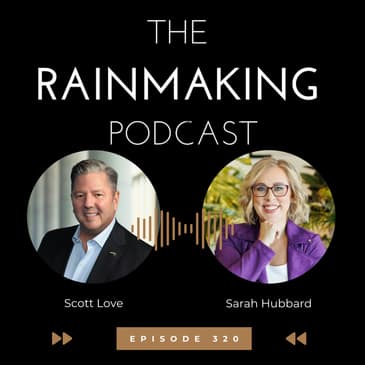
In Episode 320 of The Rainmaking Podcast, Scott Love interviews mortgage entrepreneur and networking strategist Sarah Hubbard on how professionals can boost deal flow through referrals, networking, and relationship-driven business development. Sarah explains why referrals remain one of the most powerful ways to generate trust, shorten sales cycles, and create consistent business opportunities—especially for lawyers, consultants, recruiters, investment bankers, financial advisors, and other professionals operating in the “deal space.” She shares practical strategies for finding the right networking rooms, building authentic relationships, and creating systems that turn conversations into long-term referral partnerships.
The episode also explores Sarah’s MAP Framework for effective networking: Mindset & Intention, Authentic Presence, Precise Messaging, and Purposeful Follow-Through. Sarah discusses how AI tools like ChatGPT can support relationship management, follow-up systems, and networking preparation without replacing authenticity. She also shares why reputation, consistency, curiosity, and simply “doing what you say you’re going to do” remain the ultimate competitive advantages in professional services business development. This episode delivers actionable strategies for professionals who want to grow their pipeline through referrals and meaningful human connections.
Visit: https://therainmakingpodcast.com/
YouTube: https://youtu.be/A5Sa2Xb5TXA
----------------------------------------
If you are a successful law firm partner or law firm founder and want to hear about other options, please book a time on Scott Love's calendar here:
https://calendly.com/scott-736/half-hour-phone-meeting-with-scott
Or email Scott to connect with him at: scott@attorneysearchgroup.com
----------------------------------------
📖 Subscribe to The Rainmaking Magazine
If you’re serious about growing your book of business, you’ll want to check out The Rainmaking Magazine — a monthly digital publication packed with insights, strategies, and real-world advice for professionals in law, consulting, recruiting, and beyond.
💡 Created for results-driven rainmakers who value credibility and substance.
💥 Now live — subscribe today www.therainmakingmagazine.com/info
----------------------------------------
This show is sponsored by Leopard Solutions Legal Intelligence Suite of products, Firmscape, and Leopard BI. Push ahead of the pack with the power of Leopard. For a free demo, visit this link: https://www.leopardsolutions.com/index.php/request-a-demo/
----------------------------------------
Starting as the youngest loan originator at Vertex Financial Group in 2012, I quickly realized that traditional business development methods didn’t align with my strengths. By leaning into authentic relationship building and strategic networking, I transformed my mortgage business to generate 85% of revenue through referrals. My natural ability to connect, teach, and lead has attracted professionals across industries into my network, creating a thriving community of business leaders who support each other’s growth. This success sparked a passion for helping others overcome their networking challenges, leading me to develop workshops and write my upcoming book “The Intentional Networker.” Whether I’m originating loans, consulting, or speaking, my mission remains the same: showing others how to build genuine connections that drive business results while staying true to who they are.
Links:
https://www.linkedin.com/in/sarah-hubbard-flannery/
Learn more about your ad choices. Visit megaphone.fm/adchoices
[00:00:10] You're listening to The Rainmaking Podcast, hosted by high stakes headhunter, author, and professional speaker, Scott Love. Hey, this is Scott Love with The Rainmaking Podcast. Thanks for joining me on today's episode. Are you in the business where getting referrals is important for you in terms of closing deals?
[00:00:35] It doesn't matter what kind of deal that you do. If you're a law firm M&A partner or an IP partner or you're involved in personal injury, it doesn't matter. You want to get referrals. If you're in the recruiting or staffing industry or an investment banker or management consultant and you're in the deal space, you want to boost that deal flow with referrals. It makes it easy for you to earn trust with people. We're going to talk about that and several other ideas in terms of both the strategy and the tactics related to referrals with our special guest today.
[00:01:04] And her name is Sarah Hubbard. Now, Sarah comes out of the mortgage industry where she built a vibrant practice based on, guess what? She's going to talk about different strategies that she's learned and how those can benefit you. If you want to get in touch with Sarah, go to our show notes and you'll be able to connect with her directly. As always, this podcast is sponsored by SurePoint Legal Insights, formerly known as Leopard Solutions, turning legal intelligence into opportunity.
[00:01:31] And the show is also sponsored by The Rainmaking Magazine. Don't lose business to the competition. Read this publication and keep business development top of mind. Visit therainmakingmagazine.com today to chart your course to greater rainmaking success. Thanks for listening. I hope you get some great ideas from my conversation with Sarah Hubbard today. Hey, this is Scott Love with The Rainmaking Podcast. Our guest is Sarah Hubbard.
[00:01:58] And today we're talking about boosting deal flow with referrals. Sarah, thank you for joining me on the show. Thank you for having me. I'm honored to be here. I'm a fan of you and I'm a fan of what we're going to talk about and I'm really anxious to learn more. So let's kind of get right into it then. When you talk about, let's get definitions first, deal flow. What does that mean exactly for those in professional services?
[00:02:21] Yeah, so I think this is a term that in regards to attorneys and different things when you're thinking about what's coming into your pipeline, deal flow for me is thought of as, you know, the constant influx of opportunities and flows that come in to keep your business running and actually making the revenue to keep everything going. Paying the staff, you know, making money for your own pocket, keeping the business afloat.
[00:02:47] So for me, when I think of deal flow, I think of that consistent efforts that are constantly coming in that are opportunities to close business. Yeah. Do you kind of think a good example to think about that as a funnel? I know a lot of people use a funnel to explain it. All day long. Yeah. All day long. And there's various ways when I think of deal flow to fill said funnel. The one that I love the most that aligns with me and that I think aligns with most professionals is the networking aspect.
[00:03:15] I still think you could look at paid ads and you can look at, you know, your actual networking circle. You could look at Google ads or whatever it is that you want to add for your marketing. There's lots of facets. But the one that I feel fuels businesses the most that aligns with the ideal client, the ideal referral partner is through networking. Yeah, that's right. And I think that's the word that everybody hates. I know. It's like a cringy word.
[00:03:42] Oh, I'm going to a networking function. I don't know. I think I'd rather stay at home and watch Apple TV or Netflix or something. You know, I think most people in professional services, they might not see themselves as swashbuckling rainmakers, so to speak. They're not the life of the party, but they love what they do and they love serving their clients. And so I like the word referrals. And I know within your business and mortgage, I think I remember reading that 85% of what you've done is through referrals. Is that an accurate number, Sarah?
[00:04:12] I would actually say it's probably higher right now. But yes, that is 100% accurate. It didn't start that way. It took some time to get here, but that is 100% accurate. The opportunities and referrals that I receive in my mortgage business all have come from networking and connections that I have made. Right. That's great. So let's kind of walk through that then. If we were talking to someone, let's say you're coaching. I know you do coaching. Let's say you're coaching somebody about how they can get more referred work to whatever they do,
[00:04:39] whether they're in the legal industry, management consulting, investment banking, finance, accounting, recruiting, staffing. They want to get more work and they want it to be soft, easy referrals. Where do you think they should start? That's a great question. And I think a lot of this revolves around the person that you are. And if you've actually tracked where your efforts are that you're spending. It's amazing to me when I talk to people and they're like, I'm doing all of this networking or I'm doing all of these meetings and nothing is, no traction is happening.
[00:05:08] And so I always look back because are you suffering from a little bit what I call is recency syndrome, where the last three months there's been nothing. So it feels like all of these efforts that you've put in for the last year or two aren't good or aren't solid. Or is it truly you've put in a year or two and it's probably just not the right fit. So a lot of this I equate it to dating, unfortunately, which is everybody's like second worst thing that they want to ever hear about doing.
[00:05:33] But it's trying and finding rooms that challenge you, that elevate you, and that are probably a little farther along in their businesses and their success. Those are the rooms that you want to be in when you're networking. Yeah, that's interesting. When you're first starting, there's not huge budgets. You know, we don't have thousands of dollars to throw out for these, you know, maybe huge conferences or other networking events. But you still need to stretch yourself because those are the rooms where you're going to meet people
[00:06:01] that their connections are the ones that you want if they're not the one that it is. And what are some possible rooms that you think people should look at? Yes. So I am a huge fan of ProVisors, in my personal opinion. I know Scott and I were talking about this beforehand. Scott has been a part of it. But for me, ProVisors here in Denver, nationwide networking group that is compiled of mostly attorneys and CPAs. But the other professionals that are in there, I'm a business to consumer.
[00:06:29] A lot of them are business to business, business owners. When I walk into that room, the level of professionals that I connect with on a regular basis and where they are in their business is mind-blowing. And this is not just here in Colorado. This is in California, New York, Boston, Florida, Washington. For me, I can do my business in all 50 states. So it works beautifully for me to have that outreach outside of just Colorado. But I know that a lot of attorney friends of mine only can do business in the state that they live in.
[00:06:56] So that outward reach is maybe not as attractive. But for me, that room is just constantly elevating me. And every time I make a connection for somebody in that room, the response time is as quick and as fast as I would treat one of my clients. So that's also huge. If there's a delay, you know, you're not, that person's not as receptive in the trust. Probably not the right either person and or right room. I have been a part of Chambers.
[00:07:25] I have done Business Networking International, BNI, La Tip. There's Success Champions Network. There's a ton of various groups in there. And a lot of it just comes down to vibe of the room when you're in there. Where everybody is, are they going to be able to challenge you or are you here at the top and everybody's kind of taking from you? I always recommend trying to go twice as well to these events to make sure that it's a good fit.
[00:07:51] Because sometimes one and done, you leave with a lot of energy and then you're like, eh, I'm not sure that I'm sorry, Finn. Right. So let me ask you this. I want to get to other rooms here, but I want to kind of go down this path for a little bit. Let's say somebody goes to a formalized networking group that has structure, expectations, an element of accountability. And they do two of them and they see this is, these are my people. They know people that I want to get to know.
[00:08:17] What are best practices, like the top few best practices somebody should really follow if they go into this room more deeply? Yes. So I built a quick framework that I will dabble in here because I think if you can do this framework in any networking room, conference, anything like that, you will have success. It's called the MAP framework, M-A-P-P. First one is mindset and intention. And basically the whole premise behind this is preparation before you walk into the room.
[00:08:45] Preparation on what you want as a business owner, connections that you're looking for, and then new people that you need to connect with in the room. Authentic presence is A. And this, if I could add curiosity here, I would, but doesn't fit the acronym, unfortunately.
[00:09:02] But being yourself as you truly are, because there's magic in all of us, and being curious about the other person that you're having a conversation with and not judging about who they are based off of what they do professionally and your past experiences with those professionals. Precise messaging is learning how to talk about your business simple, concisely, and really just being able, if somebody says, what do you do? Not use terms that are too big for people to not understand.
[00:09:29] It kind of just puts it over their head and it'll take it 10 times longer for somebody to understand what you do if you just don't simplify and pretend you're talking to a 10-year-old. And the last piece that's most important, my friend, is purposeful follow-through. This is the part where you meet people, you had a great connection, you're feeling great about it when you leave that room. You may have one meeting with somebody, but then after that, you may have promised something, that promise doesn't happen.
[00:09:55] You pop them on an automated email list, and there's no other personalized reach-out happening at that point in time. So what types of personalized reach-out do you think we should do? Yes. So people really get hung up on this. They're like, oh, I have to add value, but that value isn't good enough or that doesn't feel strong enough. Well, it all depends on the person and a little bit of the conversation that you've had with them. But for me, sending somebody a podcast episode that I just listened to in this one and be like, hey, I heard this podcast episode last time we talked.
[00:10:25] I know you've been struggling with your network and give it a listen. I think you'll love it. A book, you know, react to something that you saw that they posted on LinkedIn or TikTok and say, hey, I saw this post. I just thought of you. Let's go grab, you know, a bite to eat, a cup of coffee. It's making it a little bit more personalized, and it's not just the automated emails that we have going out. AI is a beautiful tool, and I highly encourage using it. But it's that those informations that you gather, right? Scott, before we jumped on, I know that you're married. I know that you've got a daughter.
[00:10:55] I know that you're traveling right now. So my next connection to you in whatever time I set up for my system is going to be, how was the rest of your time in Vegas? Did you guys have a great time? I'd love to talk more about, you know, this recruitment thing that you and I were discussing or this conference that I heard you were attending and speaking at. And pulling in a little bit of the information that you gathered from that person, that's what makes people stop and go, oh, they heard me. They listened. And now I'm ready to build that relationship farther with somebody.
[00:11:25] Wow. That's absolutely right. I like that. Let me ask you this. One of the things I've done is, and I believe that anytime there's a trend, you can either ride that trend or go opposite the trend. And AI is the new tool. So what I'm doing now is sending more personalized, handwritten hello notes. Maybe not thank you. They haven't done anything for me. But, you know, here's a nice monogram, not monogram, but like has my name embossed on the top. Yep.
[00:11:52] A little four by six card in my handwritten note. And I like a fountain pen. So in my favorite fountain pen, I'll just get a bunch of them. And I've got my staff that does all the physical mailing addresses. They've got to research those sometimes. And sending a note. Jerry, it was great meeting you at DealMax with ACG in Las Vegas. Let's keep in touch. If you come to Richmond, bring your clubs and let's golf or something like that. What do you think about that? It's old school, right? 1995, right? Yeah. I absolutely love it.
[00:12:20] I have been leaning into handwritten cards for my mortgage business a lot where a potential new client comes in and has a realtor that I've never met or worked with before. Before we've even done any work together, I'm sending them a card that's just like, I'm looking forward to working with you. Can't wait to learn more about you. Sometimes I'll throw a $5 Starbucks gift card in there. I've gotten lottery tickets from people that have written me cards. And I was like, you know, just a dollar one. It doesn't have to be this over the top. I love handwritten cards.
[00:12:49] I also try to figure out if somebody is a phone person or a text person. And I will do voice messages on the text. Like, I will actually record my voice and say, hey, Scott, good morning. You know, thought of you this morning. I'm playing golf at Pebble Beach today. I know we talked about that in our last conversation. Would love to catch up with you when I'm back in town next week. Send me your availability for March, whatever. You know, whatever the date is. It just makes somebody feel a little heard, a little seen, and a little recognized.
[00:13:19] And it helps differentiate yourself hugely. That's great. I like that. Let me ask you this. What we've talked about so far, one room. These are networking intentional rooms. People know we're there. And the benefit of that is while you're putting a shrimp on a plate, you can talk quickly with people and have a 15-minute conversation and find out how can I help you? How can you help me? You know, although you want them to say that, not ask for it.
[00:13:48] That's different than some of the other rooms. Let's talk about other rooms where this might not be the game that we're all playing. Tell me about some other rooms that you've encountered in your experience, Sarah. Yeah, I've encountered quite a few of various rooms and even rooms of other mortgage professionals that we all do the same thing. And I'm using myself as a professional, for example. And people would say, why would you ever want to spend time in a room of everybody that does the same thing that you do?
[00:14:16] First and foremost, there's people in that room that do loans in potentially other states that I don't want to do, that I may are outside of my niche. And so I think to myself, well, if I can get in to know them and they do business like I do, it's a great referral. And now I've built trust with that person. Even though I may not have closed the business, I have handed them off to somebody that's as great as I am. And it's a beautiful transaction.
[00:14:42] The other piece that I think people miss when you're in rooms where it's not all about connections, opening up your network, is you are in the same profession. As everybody else in that room. And 10 to 1, you're all struggling with the similar things that are going on in your business that are cycling around. And so sharing and hearing what other people have done to overcome said struggle, overcome the hurdle that they have. And it may not be something that you want to do. It may not be the trend.
[00:15:10] You may be bucking their trend or their ideas. But that co-collaboration goes so far as a business owner because it can feel a little lonely sometimes while you do this. But it also goes along with you kind of have built-in mentors or people that are, you could call and say, hey, have you had this happen before? Can you talk me through what you've done? Oh, that's a great idea. Or take none of it. But those are ways that you can continue to advance yourself when you go into rooms that
[00:15:37] you feel like maybe not be suited for potential referrals or business right away. What else can I be curious about? What else can I learn from these professionals that I can implement into my business to make it better? Maybe not right away, maybe six months or a year from now. But that's huge to have in your arsenal because we're in an information overload, Scott, constantly. I mean, I can go to get all the things on Google, every AI platform. And it's best to get some of that information from a trusted professional first. This is great, Sarah.
[00:16:06] Let me ask you this. You've mentioned when we were talking before about artificial intelligence. How can we use that in boosting deal flow with referrals? Yes. Great question. First and foremost, I don't care what platform you use. You find which one works great for you. I'm a personal lover of Claude and ChatGPT. Those are the two that I wholeheartedly use. You have to train your AI and less is not more with these AI platforms. So like I have a running worksheet on my computer of just about Sarah. And this is stories.
[00:16:36] This is how I talk. I have thrown in recorded conversations, podcasts that I've done. You have to give it information to learn a little bit about you in order for it to work well for you. But AI is a tool and a time saver, but it's not the end all be all. And you can use it to prepare yourself before you walk into rooms. You can use it to help dial in your messaging. You can use it to have icebreaker questions if that feels really weird or uncomfortable for you to do.
[00:17:03] And you can use it to build your system for follow-ups and follow-throughs. So for me, I have my CRM linked to my ChatGPT. So when I would leave a meeting, let's say you and I just had coffee, I would get in my car while I'm driving, open up chat, and I would talk to it. I just met Scott Love. Everything that I could think of. And I would tell it to put it into my Flowdesk CRM. It will pop every note that I verbalized into about you. And I'll tell it. Tell me when my best time to follow up with Scott is. Some talking points for him and I to talk about.
[00:17:33] Remind me to send a handwritten card. Send the task to the team. Whatever it is. And let it delegate for you and brain dump into it. So it's twofold. It's building the systems that you tell it to do. But then it's also continuing to learn more about how you talk, what you heard, and what does that conversation actually look like from your brain versus what it might sound like from an outsider. AI is, for me, it's, I mean, it's robust. I probably am just scratching the surface of all the things that I know that I can do.
[00:18:02] But it can help you in so many ways to cut down preparation time, to cut down, to be intentional with your time on who to talk to, and really just refine systems all the way through your business. This is great. These are ideas that I hadn't even thought of before. I've done some of them before, but I love the ideas that you've given, especially helping it to have you create some icebreaker questions. I've never thought about that. How about that? What do you think are some of the pitfalls as people are looking to be more intentional about referrals?
[00:18:30] They're looking at which rooms they want to test them. They want to look at the data, which rooms give them the most referrals. They've got their map, their mindset and intention, their authentic presence, their precise messaging, their purposeful follow-through. They're ready to go. What are some of the pitfalls you think they need to avoid in really pursuing this? The pitfalls that I would say to, that I have found that people, I would recommend people avoid is if you got a pit in your stomach and you're like, they're saying a lot of good things, but it just isn't a vibe for me. Please follow it.
[00:19:00] Don't ignore it. It's there for a reason. And just because they talk about big numbers or, you know, this is success, success that I had. If it's not flowing for you and it doesn't align, it's not for you. Don't try to force something that's not, that doesn't align. The other pitfall that I would see is that if you have started talking to people in that room and let's say you've made a commitment and you're like, I'll give this a year.
[00:19:24] And that room just starts to feel a lot of people taking and not having that great reciprocation of back and forth. If you need to exit the room or exit the group, don't just stop showing up. Do it in a professional manner of leaving. And I think reputation goes really, really far, even though we are a huge country and there's lots of us that do all the things across the country here in the United States, around the world, actually.
[00:19:52] Your reputation follows you. And if you just start saying that you're going to be somewhere and then you don't show up or you just, you know, there's no conversation to be had. We're all professionals and communication is key. And I'm not saying you got to go in guns a blazing, but I do think that having a professional conversation that, hey, I've been here for six months. This isn't quite what I thought it was going to be. Thank you so much for the opportunity. And move on. It's cyclical. Just like your business is cyclical. Networking is also cyclical.
[00:20:20] So do it in a professional manner so that when somebody, your name comes up in a room six months from now, it's not met with, they just stopped showing up and it just seemed not great. That dings your credibility. Do it in a professional manner with the utmost communication. That's great advice, Sarah. Let me ask you this. Let's just say there's a room. I like the way you call them different rooms. And this is a room that is a room for your clients. But they invite people on the periphery.
[00:20:48] They invite vendors, consultants, coaches, other people to serve those clients. What do you think are best practices for that type of room? Well, in my opinion, those are people that you're interviewing to see if they best align with your clients so you know what your ideal client or clients that you already have look like, feel like. They all have different personalities and different things that suit people better.
[00:21:13] So when you're in a room like that, that could serve your clients, you're looking for and interviewing these people for the right people that would fit somebody that's an engineer, somebody that's an attorney, somebody that's a CPA, and filing them in so they're not in your arsenal to leverage out and make you look like a better professional. But that's how I would go into it is with, tell me about an experience that you've had with a CPA, right?
[00:21:41] CPAs and attorneys, I'll pick on you guys for a minute, great at what you do, but sometimes don't feel really great at people. And so sometimes they need that extra, just a little bit more cushion to have those better conversations. And so somebody that's maybe like all over the place, high energy, and has all the things may not be the best fit for somebody that maybe needs a little bit more direct, a little bit more, you know, black and white first, explain the understanding, and then let's get into some
[00:22:09] of the, you know, maybe cushy or whatever it may look like. Those are the types of things that you're looking for. And when I do this for my clients, I actually tell like financial advisors for a reason. I'm like, put me through what you would do because I want to see what it's like when somebody goes through your initial intake. And people are like, wow, that's a great idea. I've never thought to do that. They could talk a good game, but I want to see how you're actually doing it. And I'd be happy to share how I do it. But that's how you're going to interview those people to see if they are best fit for your
[00:22:39] clients. That's great advice. I like that a lot. But what's one thing that you learned in your career that really surprised you as you grew in your expertise on how to boost deal flow with referrals? Was something that really surprised you that you learned? Somebody said this to me when I switched over the sales side of things about 11 years ago. And it's really simple. Do what you say you're going to do. And I was like, there's no way that this is as easy or the best advice that I have ever heard for people to have success.
[00:23:07] And it turns out that person was not wrong. I've met people that promise something and it never comes and I never hear back or do anything. Even if it's as simple as I'll send this email by 5 p.m. on Monday and it's a week from, you know, that time. Just do what you say you're going to do because that is the credibility builder in all aspects, whether it's a money making activity, your reputation building activity, your community building activity, whatever it is.
[00:23:36] Just don't over promise and under deliver. Set up the proper expectations and deliver it. That's where magic happens very quickly in regards to being professional. And it seems ridiculous to have to say that, but it is what I have seen. Well, that's great advice. So if you could summarize three action steps people can take to really implement some of these ideas, what would those three action steps be, Sarah? Pick your favorite AI tool. I would pay the 20 bucks a month for whichever one you want to do because it secures your information
[00:24:06] a little bit deeper than letting it go to everything because that's how AI learns. Pour into it even for recipes to professionalism. But have your AI ready at your hand and let it help you and assist you on cutting back. Arm yourself with people in your community and lean on their opportunities. So if you're like, I don't know where that room is and I don't know, ask the people where they're spending their time and get invites to those rooms where professionals are spending their time.
[00:24:36] Leverage others that are in your network that are maybe the extroverts or the ambiverts that are all out there. Leverage and they'll want to help you all day long instead of making yourself maybe bridge that uncomfortable and pushing yourself because it's an energy drain for a lot of my introverts. Last, I would just say build a follow-up system just like you have for your paid clients or potential opportunities. Build that also for your network and execute, execute, execute once a week, 30 minutes.
[00:25:06] Spend the time to touch on those because that's what will continue to fuel that funnel first and foremost. This is great, Sarah. Thank you so much for being on the show. And before we leave, tell us about what you do, your offerings, your services that you'd like our listeners to know about. Well, I'm a little bit of a multi-dynamic entrepreneur, but for myself, I run a mortgage business. The company is Vertex Financial Group. I have a team of five. We are a mortgage broker loving to serve first-time homebuyers, veterans, and self-employed business
[00:25:34] owners that are looking to achieve homeownership. I feel like it might be a little too difficult for them. I got a lot of crafty ways to make that happen for you with a lot of pre-planning. I also run my own networking group called The Intentional Network. We meet once a month, virtually, the third Wednesday of every month from 11 to 1. These are all six-figure revenue entrepreneurs, some business-to-business, some business-to-consumer that are looking for tangible tips to actually execute in their business and not just this
[00:26:03] grandiose idea that this sounds good, but tips on AI, hiring, hiring, firing, hiring a VA, website, SEO, you name it, all the things that we have to tackle as business owners. Sometimes it's myself speaking. Sometimes it's somebody that's a professional speaking, but you will meet some amazing quality professionals in there. And then I am looking for speaking opportunities. So I would love to pour my message on networking to other companies, professionals, conferences,
[00:26:32] any of that would be a beautiful recommendation or opportunity for me. This is great, Sarah. Thanks so much for joining us. We're going to put all of your contact information, including the link to order your book, on the show notes so everybody can connect with you there. Thanks so much for joining us on the show, Sarah. Thanks so much for having me. Thank you for listening to the Rainmaking Podcast.
[00:26:56] For more information about our recruiting services for international law firms, visit our website at attorneysearchgroup.com. To inquire about having Scott speak at your next convention, conference, sales meeting, or executive retreat, visit therainmakingpodcast.com.