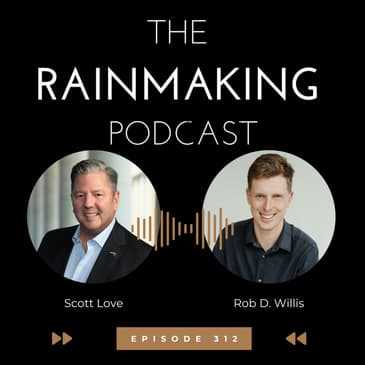
In Episode 312 of The Rainmaking Podcast, Scott Love speaks with storytelling expert Rob D. Willis about how rainmakers can use stories to win clients, build trust, and communicate more effectively. Rob explains why storytelling is deeply wired into human behavior and far more powerful than raw data or bullet points—because stories simplify complexity, create emotional connection, and help clients see themselves in the outcome.
Rob breaks down practical storytelling frameworks for professionals, including how to spot stories in everyday conversations, structure them using simple beginning–middle–end formats, and position your client as the “hero” while you act as the guide. Whether you’re pitching, networking, or leading client conversations, this episode gives you a clear system to move beyond information-sharing and start influencing decisions through compelling narratives.
Visit: https://therainmakingpodcast.com/
YouTube: https://youtu.be/prADCJNmBnA
----------------------------------------
📖 Subscribe to The Rainmaking Magazine
If you’re serious about growing your book of business, you’ll want to check out The Rainmaking Magazine — a monthly digital publication packed with insights, strategies, and real-world advice for professionals in law, consulting, recruiting, and beyond.
💡 Created for results-driven rainmakers who value credibility and substance.
💥 Now live — subscribe today www.therainmakingmagazine.com/info
----------------------------------------
This show is sponsored by Leopard Solutions Legal Intelligence Suite of products, Firmscape, and Leopard BI. Push ahead of the pack with the power of Leopard. For a free demo, visit this link: https://www.leopardsolutions.com/index.php/request-a-demo/
----------------------------------------
Helping leaders transform complex strategies into compelling narratives that drive action. Working with teams at HelloFresh, Babbel, Raisin, and other industry leaders to build trust, engagement, and strategic alignment. Key Focus Areas: - Executive communication strategy and coaching - Strategic presentation development - Team communication workshops and training - High-stakes pitch preparation
Links:
https://www.linkedin.com/in/robdwillis/
https://www.instagram.com/robdwillis/
The Managing Partner Lab, May 14-15, New York City
https://surepoint.com/managing-partner-lab/
What is the MPL The Managing Partner Lab (MPL) is a collaborative two‑day, in‑person workshop designed exclusively for managing partners and executive directors. This is a working session built to help senior firm leaders step away from daily demands and focus on the issues that most directly influence firm performance.
Across two days, participants engage in expert‑led discussions, peer collaboration, and practical workshops that translate industry insight into firm‑specific plans. The MPL brings together nationally recognized thought leaders in law‑firm economics, talent strategy, technology, and client expectations—along with facilitated opportunities to connect with peers facing similar challenges.
Why Attend
Mid‑sized firms are navigating unprecedented pressure: evolving talent dynamics, tightening margins, rapid technology disruption, and rising client expectations. Leaders need time and space to make sense of what’s changing—and determine what to do next.
Learn more about your ad choices. Visit megaphone.fm/adchoices
[00:00:10] You're listening to The Rainmaking Podcast, hosted by high-stakes headhunter, author, and professional speaker, Scott Love. You're listening to The Rainmaking Podcast, and my name is Scott Love. Thank you for joining me on the show. If you want to be good at becoming a rainmaker, you need to learn how to tell good stories. You're talking with a client or prospective client about getting work or getting more work.
[00:00:40] And how you do that is by telling a good story. Today, we're going to talk with a leading credential expert in the area of storytelling, and his name is Rob D. Willis. Now, Rob helps leaders transform complex strategies into compelling narratives that drive action. He works with teams at large global organizations among different industries at the highest levels of leadership to build trust, engagement, and strategic alignment.
[00:01:10] I first came across Rob on Instagram, where he has over 200,000 followers. By the way, I put Rob's contact information, as well as his Instagram link, on the show notes. Connect with him today. There is a whole significant number of ideas that he can present to you that can help you to become an effective communicator. So I hope you're going to get some great ideas from my conversation with Rob today. By the way, on May 14th and 15th, SharePoint is hosting the Managing Partner Lab.
[00:01:38] That's a collaborative two-day in-person workshop designed exclusively for managing partners and executive directors of law firms. Check the show notes out of this podcast, and you'll be able to get more information and register directly. As always, this podcast is sponsored by SharePoint Legal Insights, formerly known as Leopard Solutions, turning legal intelligence into opportunity. And the show is also sponsored by The Rainmaking Magazine. Don't lose business to the competition.
[00:02:04] Read this publication and keep business development top of mind. Visit therainmakingmagazine.com today to chart your course to greater rainmaking success. Thanks for listening. It means a lot to me that you listen to our show. Please share it with other people that you want to see become more effective at their rainmaking skills. And make sure you connect with Rob D. Willis directly on his LinkedIn link and also visit his Instagram page posted on the show notes. I hope you get some great ideas from my conversation with Rob today. Thanks for listening.
[00:02:35] Hey, this is Scott Love with The Rainmaking Podcast. Our special guest today is Rob D. Willis. And if you're not familiar with him, if you don't follow him, you should. And at the end of this session, you'll know why. And our topic title today is How Rainmakers Can Tell Good Stories. Rob, thanks for joining me on the show. Thank you for having me, Scott. You bet. And I'm a fan. I found you on Instagram.
[00:02:55] I think some of the ways you take movies like Margin Call and you pull out, you parse out scenes and you give us, you dissect those and tell us what the different tools are in a storyteller's tool belt. That's fascinating. But let me start with this one question. Why do you think stories are so powerful? I think that stories are intrinsic to who we are as humans.
[00:03:21] I can't remember where I heard this, but I believe that humans have been telling stories for 50,000 years or so. It's literally in our DNA. And everyone, no matter who they are, can both tell a story and also understand things in story form far better than they can in bullet points and raw data. And information. So I think stories are inherent to how we have actually come to understand the world because the world is so complex.
[00:03:50] We use stories as a kind of shorthand to understand it. That's right. That's right. And especially, I think, in a professional services environment where you have sophisticated people trying to get the attention of sophisticated prospective clients and existing clients. Stories. And I think stories can be a good way to kind of capture the attention. What you mentioned, that reminds me, when my daughter was young, she was at the dentist's office. She was maybe five years old. We're in the waiting room. And she's just kind of being antsy and I'm trying to get her attention. And I kept calling her name, Maya, Maya, listen to me, please. And she didn't.
[00:04:20] And then I did this. I said, Maya, once upon a time. And she stopped and she looked at me because she wanted to hear the story. And I noticed there were five other kids in that waiting room that stopped what they were doing and looked at me also because they wanted to hear a story. Yeah. I think we're all like that. And let's kind of frame it then in the professional context. What do you think are the hallmarks of those people, those characteristics of those in a professional world that are really, really good at telling stories?
[00:04:48] The people who are good at telling stories are, first of all, the people who tell stories. You'll find that in the work culture that we have today, that we understand that storytelling is great and people will employ storytelling coaches and do training and all of this sort of thing. Really, at the end of the day, if you tell someone in a business meeting, I'm going to tell you a story right now. People switch off and they think, all right, Mother Goose, just tell us what we want to hear. Get to the point.
[00:05:15] So a great storyteller, first of all, tells stories in the first place. They realize the power of them. They may not say that they're giving stories, but they do actually tell stories. And that, if you start doing that, that's already going to separate you from the vast majority out of the old people in the world. I think the second thing, which is really important, is how curious storytellers are. Because half the game of storytelling, telling a story is not very complicated. You know, it's beginning, middle, end. Everyone's heard beginning, middle, end.
[00:05:44] And that's how, like I said, we understand the world. But the hard part is spotting stories. And if I was to walk into a business meeting and tell some people like, hey, try and tell a story right now. Everyone's going to freak out because they think, I don't have any stories. Of course, you do. You just not got trained in spotting stories. And I think there are various techniques and tools that prompts that you can use to start that habit.
[00:06:09] But the great storytellers, the people who are really good at it, it kind of comes naturally to them. The Steve Jobs of this world, I don't think that he ever had to think about it. I think it just came naturally to him. Right. So let me ask you, what does that mean, spotting stories? What do you mean by that exactly, Rob? Identifying moments that you encounter and noticing the emotion that it creates in you. Because if something's happening or someone's telling you about something and it creates some sort of emotional reaction in you, that's probably a good sign that there's going to be a story underneath that.
[00:06:39] But it's not just that, of course. You know, lots of stuff happens to lots of people. And just because it's happened to you doesn't necessarily mean it's interesting. The third part, I think, to a great storyteller are the people who can relate what they've heard, what they've experienced to the experience of other people. Because relevance is such an important part of a story. If you tell just a random event, and I went to the dentist yesterday, great, you know.
[00:07:06] But if it directly relates to the emotion that someone else is going through, it doesn't have to be a similar event. But if it relates to the emotion that someone else is going through, then that can be very, very helpful. I guess the parallel would be, let's say you're having a hard time and you're talking to your friend. If they were to start talking about their own problems that was completely unrelated, think, why are you so self-absorbed?
[00:07:32] But if they were to start telling a story of a time where they'd felt something similar to you and how they had dealt with it, then that kind of gives you a blueprint to navigate that situation, but also makes you feel validated. Yeah, I like that. I think that something I've done when I'm giving presentations, I'm not going to say, call me today, these are my services.
[00:07:56] But I'll tell a story of I had a client that had a problem with growing a certain practice and I worked with them on a six-month retainer project, and these are the results. So it's almost like you're making an advertisement. And I wouldn't say that, but you're showcasing expertise in a story in a way that's received instead of somebody making a pitch. What do you think about that as a concept, Rob? I think they give you a lot of authority.
[00:08:20] Because if you have an example, then that's far more powerful than an opinion which is unsubstantiated. I'm interested, can I ask you a question, Scott? Sure. Can I ask you a question? Did you always do that? Whenever I present, I do. I try to make a point in my preparation. When can I insert it? And it depends. Sometimes if I'm on a panel, it's off the cuff. Sometimes I've done presentations where these are the three points I'm going to make, and these are the three sub points I'm going to make on each of those.
[00:08:49] And what's a vignette? I can insert here and here and here. And I notice that anytime I tell a story, it might not necessarily be because, hey, I want to pitch something here, but I want to convey a key concept. And for example, when we started our show, I talked about the story of me telling a story to my daughter and everybody else. And I made a point of how powerful stories are without saying, okay, I'm going to make a point on how powerful stories are. I just told a story. And people got that. And they thought, oh, that makes sense.
[00:09:19] I can relate to that. And so what I found, I think, and this is why I'm such a fan of your work, Rob, and why I study you on Instagram, is that I get tactical ideas on how to be a good storyteller. Because I've seen with my own eyes how it brings the walls down. Or if I'm talking to a candidate, a finance or a corporate partner about going to a different firm, I'll tell them a story. Here's someone that was just like you, that had the same concerns about this firm that you're telling me. And this is what happened to them.
[00:09:49] I think, and it's all true. It's all believable. And I think people can identify with that. They can see themselves. And it helps them feel safe, I think, in taking action and going forward. Does that make sense, Rob? It makes perfect sense. It's more than just seeing themselves. It's the people call, I think in theory, it's called narrative transportation. Oh, wow. When someone's telling a story, you literally experience that moment yourself in that particular moment.
[00:10:19] That's a good tip. Let's kind of dig into some of these other concepts that I've heard you talk about on Instagram. And the way you describe them, the way you define them, like what you did just now. Narrative transportation. That makes sense. I've never heard of that before, but I've seen it. I've done it. Now I can define it. I can get my arms around it and now look for opportunities to insert that theme into another situation. What are some other themes or what would you call them? Tactics or tools in the tool belt?
[00:10:47] How do you describe some of these storytelling techniques? Yeah. The danger, I will say, with this is that we tend to overcomplicate some elements of storytelling. And I think just telling stories on its own is very, very powerful. And it can be very easy to get too into tactics and frameworks and neglect the fact that many of these frameworks were designed to analyze stories rather than tell stories. So I did a degree in English literature.
[00:11:15] Analyzing particular post-feminist interpretations of Shakespeare's Twelfth Night is not necessarily going to make me able to tell a story as good as Twelfth Night. But nevertheless, it's very interesting. However, there are definitely tactics that I think people can start employing to start telling more stories. And the first is every time you give an opinionated comment. Back it up with an example and see what comes up.
[00:11:45] That's from a writer called Sean Callahan who wrote a wonderful book called Putting Stories to Work. And it really does put you on the spot. And you'll be astonished how many stories your subconscious actually has inside of it. Because an example is basically a story. It's something that happened in a time and a place. There were people involved in it. There were particular events. So that's one thing that's going to start to get you telling more stories.
[00:12:11] The second thing I would say, and this is a thing that I really struggle to get people to do, is to think in terms of moments. Because the story is not just what happened. What it is, is you're meant to zoom into particular moments that were emotional, that people can connect with, that people can see that are tangible. Because if you just said, you know, a guy was really struggling at work and he found a new way to do something and then it was really much better. It's not a very good story. It's not very interesting.
[00:12:41] We can't really connect with it. What we need to do is be able to see that person and connect with them. And we need to see what was challenging for them, how they felt about it, and then what they tried to resolve it. If there's no struggle again, we can't really connect with it. I see this in a lot of... Yeah, go on. So Rob, let me ask you, is this what we call like, you've got the protagonist, you've got conflict, and it could be man versus man, Batman versus nature. And then what is it?
[00:13:09] The resolution and the climax or something like that. What are the different themes in stories that we should look at? Aaron Sorkin talks about how every story is really a mixture of intention and obstacle. A hero protagonist wants something and then something gets in their way. And the story is, how do they overcome that? But if we're talking about just the general structure, I'm a big fan of three act, beginning, middle, end, because we all have a feeling for what goes in the middle.
[00:13:38] We need to give the context, who are the characters, what's going on. The middle, something happens, that builds to a climax. And then there's a resolution, it turns out somehow. And that resolution must be different to how things were before. If nothing changes, then it's not a story. There's another book, which I recommend to everyone, by George Sanders. I think it's called something like A Swan in the Pond in the Rain. And what he does is he breaks down, I think, seven Russian short stories by masters like
[00:14:07] Chekhov and so on. And I remember one moment that really stuck out to me in that book was he paused in the middle of a story that you read it because you get the story as well. And he paused and said, like, if the story were to stop here, would it be satisfying? And the answer is no, because nothing had changed by that moment. And he shows the need to have kind of some sort of emotional shift or shift in the mind or how things are in order for a story to feel complete.
[00:14:38] That's great. I love that. What are some other books that you'd recommend if people want to really learn more about this? I mean, that book, George Sanders, is magnificent. It's very, very good. Sean Callahan gives, he's very much into, and his book is called Putting Stories to Work, is very much into just tell lots of stories, oral storytelling.
[00:15:00] It doesn't really go too much into structure or any of the deeper elements, I find, and nor should it. I think it works very well as it does. Matthew Dick's Storyworthy. Has an interesting exercise. He's not really coming at it from a professional point of view, but more storytelling events, things like The Moth. If you've ever heard of The Moth, it's a storytelling event. People go and talk about big moments in their lives.
[00:15:27] That's good when you want to talk about these more emotional moments and really kind of how you can connect with people. But it doesn't necessarily help you structure a presentation, I would say. There are elements you can take from it, but it doesn't really necessarily help you structure a presentation. A book that does that, that helps you take an idea and turn it into something which is really easy to understand and to get across.
[00:15:52] I'm probably overly critical, but the books that I find that helped me do that aren't necessarily people talking directly about public speaking. They're people who are talking about marketing or people who are talking about psychology. I found those are more interesting for me. So anything by Dan and Chip Heath, Made to Stick or Switch, all about changing minds. Very, very good. And what was his name again?
[00:16:21] Dan and Chip Heath. They're brothers, I believe. And they're fantastic. And then there's a marketing book, which I guess is more about making websites. But for some reason, it really resonated with me. It's called Building a Story Brand by Donald Miller. Fantastic marketer. But the principles behind it are exactly how we need to think about communication. I'm reading that book right now. And I think it was a new, the 2.0 version of that.
[00:16:49] But I liked how he talked about that every story is about survival. And when I started looking at my own work of how do I make a successful pitch to a partner that's thinking about moving, how can I help them thrive? You know, it's almost like what's the context? And let me kind of bring it to context for our listeners. Let's say a professional services provider has a meeting with, let's say they're doing a pitch, a shootout. They might have three or four other people that are coming in to give a presentation to
[00:17:18] a committee that's going to choose which provider they're going to work with. How do you think they can prepare to tell stories? Let's say they've got a 30-minute presentation or a 20-minute presentation. Should they have a slide deck? Should they use statistics? If they choose to pursue a story route, what do you think they can do to prepare to tell a good story to that board or that committee? It's, yeah. And one thing I loved about that book, which really stuck with me, and I teach to,
[00:17:48] a lot of people when I'm doing training, is how we must perceive ourself as the storyteller, which is as the guide figure, not the hero. The people who we're talking to, so your clients in this case, they are the hero and you are the guide. So therefore, you must understand what is their problem? How do they feel about their problem? What is their obstacle? You know, what are they fighting for survival about?
[00:18:13] And then it's your job then to give them a plan, call them to action, which leads to success and avoids failure. It's a very simple way of thinking about storytelling, which anyone can relate to, but totally grounds you in what's important as a communicator. That's fantastic. That's very insightful, Rob. I like how, remember that we're not the hero. They're the hero in the story. Tell me a story about an organization you've worked with. You don't have to mention their name, of course, or maybe an executive or an entrepreneur. What was their problem?
[00:18:42] What did you do to help them become more effective at storytelling? What was the outcome? Well, if we're talking about the people who I train, the challenge seems to always be the same thing, but they don't look at it always in the same way. Most people who come to me for storytelling training and communication skills training, they're going to talk about confidence. First of all, they don't feel confident and people are not getting what they're saying.
[00:19:10] They think, I thought I was clear about it, but they're just not quite getting it. So that's the kind of pain that they have. The problem is they're doing what I think of as, I call it checklist communication. Imagine you've got a big checklist of bullet points and you're just kind of reading through it with all the data and you know that you're right. So surely if you're right, then everything must work. But it doesn't because data is overwhelming. People don't always see how it relates to them and they can draw the wrong story out of
[00:19:40] the data. So the journey that I need to take them on is to, first of all, think more strategically about communication and storytelling. Like, what are you actually trying to achieve with this? If you're not trying to achieve anything or if you just want to tell someone something, why are you, if you're just venting, why bother? Okay. So what is your objective? What would make you satisfied for this? What actions have to take place? Secondly, deep empathy for the people they're talking to.
[00:20:07] That's another thing that people, I think, struggle with because we're so worried about like, what do I need to say? Then we forget about like, who am I actually serving? And what do they feel about this situation? And what are their questions? And what do they know or don't know quite yet? So once we've grounded everything in what we want to achieve and where the people are, who we're talking to, then we can create a relatively simple story out of that. Again, following beginning, middle, end. Like context, this is what's going on right now. The middle, the complication.
[00:20:36] This is what I'm proposing. This is what we can do. And this is how it's going to solve your problem. And then how things are going to turn out at the end. What's the resolution? What can we expect from this? And then a call to action. Make something happen out of it. That's great. And I can certainly see how you're an effective coach because you're on the outside. You've got expertise in a very narrow area that's very important and significant. And I like how you can take that expertise and help people see things they might not normally see in their own stories.
[00:21:06] So let me ask you this, Rob, as we bring our conversation to a close, which has been very insightful, and I'm sure everybody listening gets a lot of info out of this. If we could give three action steps to our listeners about how can they become more effective at telling stories, what would those three action steps be? First one I'm going to take from earlier. Try just for the next week. If it doesn't work, don't have to do it anymore. Every time you give an opinionated comment, back it up with an example and see how that pushes
[00:21:36] your mind to start thinking about storytelling. The second thing I would do to enhance this is to start taking more opportunities to speak, to communicate, like actively go out there and try to find these opportunities rather than just wait for them to come to you and approach them with an element of curiosity. Because we want to try new things out. And in order to do that, there needs to be a chance of failure.
[00:22:05] But if we allow not doing something well to affect how we see about ourselves, then we won't take the actions that are necessary. So adopt an element of curiosity. And lastly, I would say get better at sitting with problems and asking questions. Too often we're so quick just to jump to a solution. You know, we see this with like our private lives all the time. Someone comes to us with a problem or the challenge and we immediately try and give a solution out of a good place.
[00:22:35] You know, we want to help. But so often that makes the person not feel heard. And maybe we've not fully understood what they're going through because maybe they're not fantastic at expressing what they're going through. Very few people are. So what we need to do is get good at asking open questions. And, you know, I mean, open questions and closed questions, get them to expand upon what they're talking about. And only when we're sure we've understood and can phrase it back to them in a way that they're like, that's it. That's exactly what I'm feeling.
[00:23:05] Then we can start contributing our own story. If we start telling stories too early before we've heard theirs, maybe we're going to be on the wrong track. Rob, this is great advice. This is very rich. I think the people listening are going to walk away after hearing this with some really good ideas that will help them tremendously. And tell us about what your services are, your offerings. What would you like our listeners to know? And for everybody listening, we'll put Rob's contact info linked in, especially his Instagram page. We'll put that on the show notes. Yeah.
[00:23:34] And hopefully my website will be updated by the time this comes out. I'm available for speaking. I talk about the power of storytelling and pitching and why that's important to various organizations as a kind of keynote. I'm available for training in presentation skills, communication and storytelling as well.
[00:23:53] And I work as an advisor to a number of executives going through, usually going through some sort of change or trying to ensure that their project is going to be understood and valued by both their teams and the powers that be, be that investors or bosses or whatever it is. So, advisory, training and speaking. That's terrific, Rob. Thank you so much for being a guest on our show today. I've learned a lot and I'd love to have you back on the show in the future. I'd love to come again.
[00:24:23] Thank you very much, Scott. Thank you for listening to the Rainmaking Podcast. For more information about our recruiting services for international law firms, visit our website at attorneysearchgroup.com. To inquire about having Scott speak at your next convention, conference, sales meeting or executive retreat, visit therainmakingpodcast.com.