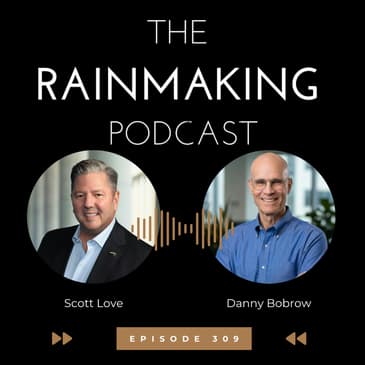
In Episode 309 of The Rainmaking Podcast, Scott Love speaks with Danny Bobrow, creator of the Persuasion Blueprint, about the Three C’s of Persuasive Communication: Caring, Connection, and Collaboration. Danny reframes persuasion as an ethical, non-coercive process focused on influencing outcomes through trust and understanding—not manipulation. He explains why most professionals fail to connect effectively: they assume their expertise is enough, when in reality, people make decisions emotionally and respond to those who demonstrate genuine care and understanding first.
The conversation dives into practical communication strategies, including how to close the “care gap,” ask better questions, and avoid common traps like over-talking, jargon, and premature problem-solving. Danny emphasizes that successful rainmakers slow down, listen actively, and guide conversations collaboratively—so clients feel understood and confident in their decisions. For lawyers, recruiters, and professional services providers, this episode delivers a clear framework to improve influence, build stronger relationships, and convert conversations into lasting business opportunities.
Visit: https://therainmakingpodcast.com/
YouTube: https://youtu.be/SGb6bpeBqYc
----------------------------------------
📖 Subscribe to The Rainmaking Magazine
If you’re serious about growing your book of business, you’ll want to check out The Rainmaking Magazine — a monthly digital publication packed with insights, strategies, and real-world advice for professionals in law, consulting, recruiting, and beyond.
💡 Created for results-driven rainmakers who value credibility and substance.
💥 Now live — subscribe today www.therainmakingmagazine.com/info
----------------------------------------
This show is sponsored by Leopard Solutions Legal Intelligence Suite of products, Firmscape, and Leopard BI. Push ahead of the pack with the power of Leopard. For a free demo, visit this link: https://www.leopardsolutions.com/index.php/request-a-demo/
----------------------------------------
Danny Bobrow is the creator of the Persuasion Blueprint — a proven framework that's helped hundreds of leaders and teams turn everyday conversations into engines of caring, connection, and collaboration leading to success in every facet of life.
He's trained organizations to not only recover lost revenue from poor communication - but to build cultures that win loyalty, drive referrals, and create raving fans.
Danny holds dual MBAs from the University of Chicago and KUL in Belgium. He's also an ultraendurance athlete and mountaineer who brings the same clarity and grit to every stage and boardroom he enters.
Links:
https://www.linkedin.com/in/dannybobrow/
Use coupon TPB30 for 30% off
The Managing Partner Lab, May 14-15, New York City
https://surepoint.com/managing-partner-lab/
What is the MPL The Managing Partner Lab (MPL) is a collaborative two‑day, in‑person workshop designed exclusively for managing partners and executive directors. This is a working session built to help senior firm leaders step away from daily demands and focus on the issues that most directly influence firm performance.
Across two days, participants engage in expert‑led discussions, peer collaboration, and practical workshops that translate industry insight into firm‑specific plans. The MPL brings together nationally recognized thought leaders in law‑firm economics, talent strategy, technology, and client expectations—along with facilitated opportunities to connect with peers facing similar challenges.
Why Attend
Mid‑sized firms are navigating unprecedented pressure: evolving talent dynamics, tightening margins, rapid technology disruption, and rising client expectations. Leaders need time and space to make sense of what’s changing—and determine what to do next.
Learn more about your ad choices. Visit megaphone.fm/adchoices
[00:00:10] You're listening to The Rainmaking Podcast, hosted by high-stakes headhunter, author, and professional speaker, Scott Love. You're listening to The Rainmaking Podcast, and my name is Scott Love. Thank you for joining me on the show. Today's episode is discussing the three Cs of persuasive communication, and our expert is Danny Bobrow.
[00:00:37] Danny is the creator of the Persuasion Blueprint. That's a proven framework that's helped hundreds of leaders and teams turn everyday conversations into engines of caring, connection, and collaboration, leading to success in every facet of life. Danny has trained organizations to not only recover lost revenue from poor communication, but to build cultures that win loyalty, drive referrals, and create raving fans.
[00:01:03] We've put all of Danny's contact information on the show notes, so go there and connect with him today. On the show notes, you'll also find information about SurePoint's upcoming Managing Partner Lab on May 14th and 15th in New York City. The Managing Partner Lab is a collaborative two-day in-person workshop designed exclusively for managing partners and executive directors of law firms.
[00:01:26] This is a working session built to help senior firm leaders step away from daily demands and focus on the issues that most directly influence firm performance. Check it out. I look forward to seeing you there.
[00:02:02] Thanks for listening, and I hope you get some great ideas from our conversation with Danny today. Hey, this is Scott Love with the Rainmaking Podcast. Our guest today is Danny Bobrow, and we're talking about the three Cs of persuasive communication. Danny, thank you for joining me on the show today. Well, thank you for having me, Scott. It's a pleasure. Appreciate it. Absolutely. And I'm selfishly excited to learn about this because I'm in the business of persuasive communication many times.
[00:02:28] Let me get some definitions in order. Let's first get a definition of persuasive communication. Is that something that we should be afraid of? Does it sound manipulative? What's kind of the context of this whole concept that we're talking about here, Danny? Well, I think that's a great way to start, Scott, because the answer is yes, depending on the person you're asking.
[00:02:49] My definition of persuasion is a number of different modalities and mindsets that you use to influence opinions, attitudes, ultimately behaviors, and that you do it in an ethical, non-coercive way. So I think that puts the lie or debunks some concerns that persuasion is somehow manipulative. It's distinctly not.
[00:03:11] In fact, the goal with persuasive communication is to be as honest as you possibly can be, not only honest with your counterpart, but honest with yourself in terms of what your motivations are and what you're trying to accomplish. That's great. I feel really good that we hit that early on because I'm hearing all the people listening to this show right now going, I'm glad that's the approach because there's so many people, you know, so many people in sales.
[00:03:40] I work in the recruiting industry. You get a lot of people like that where it's all about closing, closing, closing instead of really, you know, doing the things that we're talking about. So I appreciate that definition. So let's kind of dig into this. You mentioned the three Cs. What are those three Cs, Danny? The three Cs in the persuasion blueprint are caring, connection and collaboration.
[00:03:59] And it's a sequential process, although you do need to be ready to recalibrate because once you believe or receive the signals that you've established caring, you may need to revert back to that. But caring really is about addressing what I call the care gap between perception and intention. A lot of people fall into a trap. We could also call it the care trap, which is that they believe that their caring is self-evident.
[00:04:29] And in many cases, it's not. You know, we fall into certain cognitive traps that we think that people think the way we do, and they often do not. And so, you know, the key is to recognize, first of all, that people make decisions based on emotion and then they justify it with logic. And that remains true almost whatever level of communication you're talking to, whether you're trying to persuade you to a desired course of action or you're working with high-level, high-stakes negotiations between governments.
[00:04:57] People need to know that they can trust who they're dealing with. And the first step is to establish that caring, to minimize that care gap before moving on to establishing credibility and earning trust. And then finally, moving into the collaboration component, which is building a co-path. Because people believe that, sometimes people believe that others buy expertise, but what they really buy is understanding, a belief and a recognition that you get them.
[00:05:23] Which then opens their mind up to hearing what you have to say in a positive emotional way and employing their powers of cognition so that those two aren't working at cross-purposes. Yeah, wow, that's interesting. Let me kind of go back to the caring one. And I like the depth that you bring to these concepts. I think for many of our listeners, they're intellectually driven people that like to learn things and they want to go deep. So let's go a little bit deeper with the whole caring concept, the care gap and the care trap.
[00:05:52] I like what you mentioned that there are cognitive traps that people have. We just assume they think the way we do. How can we show that we care in a way that people will receive as being not duplicitous, but real congruent with our value system of who we really are? Sure. Well, sometimes it's deceptively simple. It can be as simple as just getting and using the person's name in the right way, confirming the pronunciation and spelling.
[00:06:22] Before I got into Persuasion Blueprint, I was working as a telephone skills mastery coach where we were working with professionals mostly in medical and healthcare. But the analogies to legal or any other high competency expertise industry, the principles are just as appropriate. And what we taught was what we call the TAFI introduction.
[00:06:48] And TAFI, T-A-F-I is short for the art of first impressions, which really is premised on the fact, and I believe it's a fact, that people will decide whether they want to work with you sometimes within the first few seconds of the connection. There was a married couple named Zunin and Zunin who wrote a book called The First Four Minutes. And their contention was that people would decide whether they're going to work with you or not in the first four minutes.
[00:07:13] But what I found is that I could, because the reason I got into this business is that originally my firm was just a marketing firm. I mean, I don't mean just, but our sole focus was on getting the phone to ring or in other ways, generating leads. What we learned fairly early on into the process was by listening to the phone calls that ensued, that people were missing opportunities to convert these high quality prospective clients, customers, patients into solid kept appointments.
[00:07:42] And what we found was that they were getting off on the wrong foot almost immediately. To use an analogy in healthcare, and sadly, I imagine many of your listeners can relate to this, when you call a dental office or a medical office and say, hi, I'm interested in making an appointment. The first thing you're typically going to get, even to this day, although it is improving, is your name. And then if you give me a lot of trust. A lot of trust being established there.
[00:08:11] The next question is date of birth. And then what insurance do you have? Now, these are all, to be sure, important questions that need to be asked. But the fact is that I believe it may have been Henry Ford who said, and I'm going to have to Google this one of these days, but somebody worth listening to said that nobody ever bought, actually, if we're going to do business together, the details can wait. And if we're not going to do business together, the details don't matter.
[00:08:38] So while getting the name, date of birth, and insurance are important questions to ask, they're the wrong questions to ask at the beginning of a conversation. So our Taffy introduction really is somebody calls an office, says, hello, thank you for calling the Getter Law Firm, where our commitment is to your success. This is Danny. How may I help you? So what I've done there is I've introduced my firm, and I've done it with a nice tone, inflection, and resonance. So it's not just thank you for calling the Getter Law Firm.
[00:09:07] And I've given them my name, and I've asked how I can help. I've also shared my tagline. And a tagline is a very important component of a business's branding. And if you haven't gone through that exercise, I would strongly consider that you do so. Because it not only informs the caller who you are, what you do, for whom you do it, and why, but it actually also reminds you every time you answer the phone. We're not all things for all people.
[00:09:33] But if this tagline resonates with you, then maybe it warrants to have further conversation. But getting back to the introduction. So what I've done is I've given my name, and I've asked the caller's name. I've also asked a question. And what you'll probably understand is that whoever asks the questions controls a phone call or any conversation. Now, by control, we go back to the original premise of our conversation today. I'm not talking about manipulation.
[00:10:02] When somebody calls an expert, they really want you to be in control. The critical key is to establish that control in a way that simultaneously establishes rapport and conveys empathy. Now, enthusiasm is another important component of persuasion. But I think a lot of people misuse enthusiasm. They get excited about what they're offering. But the enthusiasm has got to be reactive.
[00:10:31] And it's the one component of communication that you really want to wait to sense enthusiasm from your counterpart. Because if you jump ahead of the game with them, it comes off as inauthentic and as a sales tactic. So we coach our subjects on how to effectively convey enthusiasm in the right way and at the right time. So that's the first statement is introduce yourself, give your name, and ask the caller's name. That's also an example of reciprocity.
[00:10:59] It's one of Cialdini's seven keys of influence, which is I'm not just saying your name, as we specified earlier. I'm giving my name. So now you're more likely to want to give me your name. Now, the next statement after the introduction is after the person gives you their response, which is, hi, I'd like to know what your fees are. I'd like to know how much a crown costs. I'd like to know if you handle this type of work. I'd like to know why the sky is blue.
[00:11:28] In other words, I really don't care what question they're asking. The answer should always be the same. And that is, I can help you with that. My name is Danny. May I ask with whom I'm speaking? So you don't say your name. You say your name again. And some people may listen and say, well, you already gave them your name in the introduction. Why are you doing it again? And you probably know, Scott, the reason is that most people don't listen and didn't hear it the first time. Right. That's right. Yeah, they're trying to figure out how is this related to me, etc.
[00:11:58] I think that's a good idea. Right. So, I mean, the exception of that would be if they said, hi, Danny, this is Bill. Well, then you're not going to say my name is Danny. You do need to have a little bit of improvisation here. But so then the next statement is I can help you with that. That sets the tone for the relationship because you are going to be able to help them. And then you say your name again and say, well, depending on the circumstance, I would say, are you in any discomfort presently?
[00:12:53] I've given an opportunity to impart information. And the information at this early stage in the relationship that I want to impart is that I care about you. Right. Let me ask you this. You mentioned caring, connection, and collaboration. You mentioned that collaboration is building a co-path. What does that mean, Danny? It means not being blinded by your expertise and feeling that, again, that your knowledge and ability to help this person is self-evident.
[00:13:20] Because people really don't, they don't buy expertise as much as they buy understanding. And so it's important that you get them to your side of the table, that it's not a talking at, it's a building with communication. By asking questions and always asking clarifying questions before moving on to your prescription, whatever it may be, we strongly advocate that you ask questions and that you learn to sense resistance.
[00:13:47] The type of resistance or skepticism that your counterpart might be experiencing and that you work to acknowledge it in a respectful but effective manner. So you mentioned this before. I want to go back to this. People do not buy expertise but understanding. I work in the legal industry and I work with big law firms and everybody has impressive profiles. Great schools, magna cum laude. They've done brilliant things.
[00:14:15] They're all very successful, super smart people and their children are beautiful. You know, they've got it all. But you're telling me that's not enough. That expertise isn't enough. Yeah. I am. And really, it's a rather simple exercise. Put yourself in that position. I mean, we've all gone into doctor's offices, attorneys, where you see all the accolades, the diplomas, the certificates, the photos with famous people even.
[00:14:43] Although that form of social proof can be effective. I don't know if you're like me, but I tend to gloss over that. And it's like, okay, this guy knows. That's sort of assumed. This guy or gal, they know their stuff. But do they know me? And so we really work at that.
[00:14:59] And expert override is one of the traps that people fall into, which is they've been doing this for so long that they can pretty much, with 99% reliability, anticipate what this person is thinking and asking and going to ask. And so sometimes I think we convince ourselves that, well, if I tell them what they're going to ask before they ask it, that's going to really impress them with how much I know. But in fact, it's a missed opportunity to show that you care and are listening.
[00:15:29] So we talk about in a face-to-face meeting, establishing eye contact, but maybe even more important, letting them know. I wonder if you'd mind if I take a few notes while we have this conversation so that I can confirm my understanding with you completely. That's great. You know, so this is a nice little tool to use. I think it's even better than eye contact. But asking questions, giving them the respect and opportunity to share what they were wanting to share with you, even if you already know, acknowledging it, that it's important.
[00:15:57] And maybe let them know that this is a commonly expressed concern, and I'm glad you shared it, and let me explain how we're going to address it. And then avoiding jargon, speak in short sentences, stop, pause, confirm understanding before you move on. People love that. Sometimes we think, well, their time is valuable. And I think it's sometimes an excuse for us to recognize that our time is valuable, and we want to get done with this as soon as possible. But I think it's being minute-wise and dollar-foolish.
[00:16:24] When you're talking to somebody who is potentially worth to you, I don't know, it depends on your industry, but, you know, the average dental patient is worth $7,500, the average lifetime value. The average lifetime value of a placement of a candidate in a law firm could be tens of thousands of dollars or more. So it's worth taking all the time necessary, in my opinion, to connect with you. This is great.
[00:16:46] So let me kind of switch it to talking about your expertise and what you've seen, how people have made these changes, the caring, connection, collaboration. What are the pitfalls most people fall into as you're trying to make changes in these areas from your expertise? Oh, well, if they accept to be coached by me, it's a fairly simple process, but it's a lack of practice. It's a lack of repetition.
[00:17:14] And often there's a number of different types of resistance that people experience. And this is whether you're dealing with a prospect, your counterpart, or yourself. Sometimes when I was coaching team members on how to speak on the phone, I would often get feedback and it often wasn't stated. I found out about this after the fact by talking to their employer or their office manager. Was it, well, their feeling is they've been doing this for 30 years already and they don't know why they should change.
[00:17:44] In other words, and this is the most daunting type of resistance to address, and that's identity resistance. By you suggesting that I change my behavior, you're actually impugning my value as a human being. And so we have to really learn and work how to communicate with people in such a way that we address that. And sometimes it's just a matter of asking it. It sounds like this is something that you've been doing the same way for many years and you feel that it's served you well. Is that correct?
[00:18:14] And then get them to state it and then communicate to them that, well, that's great. You've obviously been doing a great job because you've been at it for so many years. But do you want to know what Tiger Woods and Michael Jordan and Serena Williams, and I should probably get some newer athletes in my car. But you know what they all have in common? They're all committed to excellence and they all have a coach. Yeah, that's right. You can't see your own blind spots. I think that's important. We don't know. Absolutely right.
[00:18:43] So think of all the people that you've coached, the people that you taught these concepts, you work with them, you help them avoid certain blind spots, and they've done well. What are the common characteristics among all those people that have done well with these concepts you're teaching, Danny? They've slowed down. They've taken their time. They've recognized the distinction I shared before, which is that people value understanding more than they do expertise.
[00:19:14] I've seen it in so many situations in all industries in which I've worked that people learn that if they want to be interesting, they need to be interested.
[00:19:25] And that even though you're the expert and the person is calling on you for your expertise ultimately to get the job done, there's no substitute for taking time to show interest in that person and to convince them that you get their unique situation, even if it's not particularly unique in your experience. But that's what has really helped people. That's great. What surprised you the most in your journey of working in this area?
[00:19:54] How quickly it works? Now, it's two sides of that coin. Getting people to label an emotion or to ask a question, there's some hesitancy. Because, you know, the other thing about coaching is that if you want to become a better golfer and you hire a coach and they tell you to change your swing and you do change your swing, is your game going to get better immediately? Absolutely not.
[00:20:19] No, it's going to get worse because you're going to need to rewire those neural pathways and try to do something different. So you have to give yourself permission and grace or your employer need to recognize they need to know. And this is what I do when I have a conversation with a group that I'm going to be coaching and I talk to their employer. I say, number one, you need to be present.
[00:20:42] I need you to be there because if you're not and you don't hold them accountable, they're just going to put in their minds that, well, the boss is just, you know, chasing the latest shiny object. And if we wait them out, we're going to get to go back to doing the way we did things in the past. So you need to make that commitment and you need to let them know that it's going to be okay to fail. Now, ideally, it's nice to fail in role play.
[00:21:10] So that's the other thing that didn't surprise me because I encountered it initially. But people bristle at role play, but it's the best, lowest cost in terms of everything and opportunity lost and in terms of expense to learn quickly, to get on a steep learning curve. So those are the things that I've experienced. That's great. Right.
[00:21:31] So, Danny, as we bring our time together to a close, what are three action steps you can give people to where they can really start implementing these ideas, to where they can see some success from what you're sharing with them today? Sure. Well, to repeat, number one, I would, in the introductory conversation, remember the three components of effective communication. And those are verbal, vocal, and visual. Now, on the phone, you don't have the visual, although people do have a mind's eye.
[00:22:00] And I like to say people can hear you smile. But essentially, choose your words carefully. Negatively charged words can shut down the prefrontal cortex. It's neuroscience. And it can stimulate the limbic system. So if you're using negatively charged words, you can shut down their ability to hear the rest of what you have to say. So be very careful in your choice of words.
[00:22:24] In like fashion, use positively charged words, words that will open up somebody and want to hear more about what you have to say. Dale Carnegie said that the person's name is the sweetest sound they'll ever hear. This is old school. But I do advocate that you get and use the person's name. Don't overuse it because that's another tell when someone is trying to sell you. And they're using your name constantly, Scott, when they want you to hear what they're having to say. Right, Scott?
[00:22:54] That's right. You overdo it. So that's where the art in the art and science come in. And then before prescribing, I would always ask clarifying questions. Even if you think you really get it, it's a breath of fresh air for your counterpart when you ask them a clarifying question. And then you get them to say, yes, that's right. Or yes, that's exactly it. In other words, they've just confirmed in their mind that you get me.
[00:23:21] And when you're trying to persuade someone into a course of action and you tell them that they should do something, that's one thing. But when they tell themselves that they should do it, that's everything. Absolutely right. That's great. Well, Danny, thank you for being here today. Tell us about your offerings, your services. What do you have? What do you do that you'd like our listeners to know about? And by the way, everybody, we'll put all of Danny's contact information in the show notes of the podcast.
[00:23:46] Well, you can learn everything about me and the persuasion blueprint at dannybobrow.com. And what we offer initially is for you to gauge where you're at in terms of the three Cs of effective communication, of persuasive communication, caring connection, and collaboration by taking your persuasion scorecard. It's just a series of questions which will evaluate where you are. It helps establish a baseline.
[00:24:13] And then from there, we can follow up and introduce you to the modules. There are seven modules that go through the material we discussed and go into considerable depth. But what I think is nice about it, and I developed this program with me in mind as well as you in mind because I think I'm representative. I don't want to be inundated with a lot of information at a time. So the longest module is about 16 minutes.
[00:24:38] And we do recommend that just as we talked about earlier, repetition is a key to success, that you feel free to listen to them more than one time and that you by all means complete the assignments that are given at the end. But so it's seven modules of about 15 minutes average length with one or two exercises after each module, which realistically should take you 30 minutes to do. I'd find a partner because this is about communication after all.
[00:25:05] And so doing it on your own is going to only offer limited value. But the entire program should take you whatever period of time you want. And the other thing I want to make clear is that if after you've done the program, if you honestly feel you didn't derive value from it, you will receive a complete refund. No questions asked. That's great. Well, Danny, thank you for sharing that. And for everybody listening, we're going to put the link to that on the show notes as well. So you can connect with Danny and then also look at the survey that he has.
[00:25:35] Danny, thank you for joining me on the show. And I really do appreciate you sharing your wisdom today. Pleasure was mine, Scott. Thank you very much. Thank you for listening to The Rainmaking Podcast. For more information about our recruiting services for international law firms, visit our website at attorneysearchgroup.com.
[00:25:58] To inquire about having Scott speak at your next convention, conference, sales meeting, or executive retreat, visit therainmakingpodcast.com.