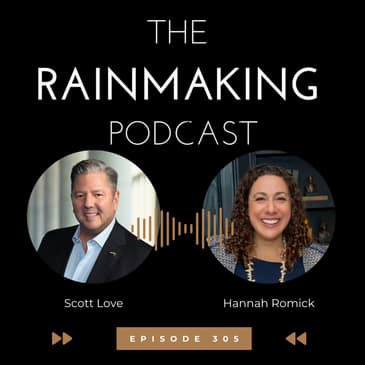
In Episode 305 of The Rainmaking Podcast, Scott Love sits down with Hannah Romick, an expert in performance improvement, change management, and stakeholder engagement, to unpack the growing impact of generational differences in professional services firms. As law firms and advisory organizations navigate shifting expectations around work, communication, and career development, leaders are increasingly challenged to align multiple generations under a shared culture. Hannah explains how generational tension is often misunderstood—and how firms can move beyond labels to focus on performance, accountability, and measurable outcomes.
The conversation dives into practical strategies for driving cultural transformation, leadership alignment, and performance-based decision-making across generations. Hannah shares how firms can build sustainable change by linking leadership development with clear performance metrics, improving communication across teams, and engaging stakeholders at every level. For law firm leaders, partners, and professional services executives looking to strengthen firm culture, retention, and long-term performance, this episode offers a clear roadmap to navigating generational dynamics while maintaining high standards and business results.
Visit: https://therainmakingpodcast.com/
YouTube: https://youtu.be/COM27VFyAAc
----------------------------------------
📖 Subscribe to The Rainmaking Magazine
If you’re serious about growing your book of business, you’ll want to check out The Rainmaking Magazine — a monthly digital publication packed with insights, strategies, and real-world advice for professionals in law, consulting, recruiting, and beyond.
💡 Created for results-driven rainmakers who value credibility and substance.
💥 Now live — subscribe today www.therainmakingmagazine.com
----------------------------------------
This show is sponsored by Leopard Solutions Legal Intelligence Suite of products, Firmscape, and Leopard BI. Push ahead of the pack with the power of Leopard. For a free demo, visit this link: https://www.leopardsolutions.com/index.php/request-a-demo/
----------------------------------------
Hannah is an expert in performance improvement, change management and facilitating stakeholder engagement. Specializing in cultural transformation and performance-based decision-making, she combines leadership development with performance measurements to ensure that any organization-wide change effort is effective and sustainable.
Links:
https://conscientstrategies.com/teams/hannah-romick/
https://www.linkedin.com/in/hannah-romick-307181/
The Managing Partner Lab, May 14-15, New York City
https://surepoint.com/managing-partner-lab/
What is the MPL The Managing Partner Lab (MPL) is a collaborative two‑day, in‑person workshop designed exclusively for managing partners and executive directors. This is a working session built to help senior firm leaders step away from daily demands and focus on the issues that most directly influence firm performance.
Across two days, participants engage in expert‑led discussions, peer collaboration, and practical workshops that translate industry insight into firm‑specific plans. The MPL brings together nationally recognized thought leaders in law‑firm economics, talent strategy, technology, and client expectations—along with facilitated opportunities to connect with peers facing similar challenges.
Why Attend
Mid‑sized firms are navigating unprecedented pressure: evolving talent dynamics, tightening margins, rapid technology disruption, and rising client expectations. Leaders need time and space to make sense of what’s changing—and determine what to do next.
Learn more about your ad choices. Visit megaphone.fm/adchoices
[00:00:10] You're listening to The Rainmaking Podcast, hosted by high-stakes headhunter, author, and professional speaker, Scott Love. You're listening to The Rainmaking Podcast, and my name is Scott Love. Thank you for joining me on the show, and thank you for making this show a success. Today's topic title is Generational Issues in Professional Services Firms.
[00:00:36] If you work in a leadership role in any capacity, whether you lead an entire organization or a group of two or three associates, you've definitely run across these issues. And our guest today is going to give you ideas that I know are going to make an impact for you in that area. Today we're talking with Hannah Romick. Hannah is an expert in performance improvement, change management, and facilitating stakeholder engagement.
[00:01:01] specializing in cultural transformation and performance-based decision-making, she combines leadership development with performance measurements to ensure that any organization-wide change effort is effective and sustainable. Make sure you connect with Hannah. We've got all of her info in the show notes wherever you listen to the shows. You should just go there and you'll be able to connect with her directly. And also another announcement, on May 14th and 15th, if you're in the legal industry,
[00:01:28] SharePoint is hosting the Managing Partner Lab in New York City. Go to the notes where you hear this podcast and you'll be able to get information directly. This is a collaborative two-day in-person workshop designed exclusively for managing partners and executive directors for law firms. I'll be speaking there, so if you attend, say hello. I'd love to meet you in person. Also, this podcast is sponsored by SurePoint Legal Insights, formerly known as Leopard Solutions, turning legal intelligence into opportunity.
[00:01:56] And it's also sponsored by our sister publication, The Rainmaking Magazine. Don't lose business to the competition. Read this digital publication and keep business development top of mind. Visit therainmakingmagazine.com today to chart your course to greater rainmaking success. Thanks for listening. Remember, connect with Hannah directly, and I hope you get some great ideas from our conversation today. Hey, this is Scott Love with The Rainmaking Podcast.
[00:02:26] Our guest today is Hannah Romick, and we're talking about generational issues in professional services firms. Hannah, thanks for joining me on the show today. Thanks so much for having me, Scott. I'm really excited about this topic because you've got all these different generations in the workplace right now. And I know in your work, you've told me that you have people that tell you things like, I can't get people to do what I tell them to do. And I'm sure they're not the only ones that have that experience. So let me kind of start with this question, the question of why.
[00:02:54] Why do you think that is an issue between generations in the workplace? Why is that an issue at all? Well, I think part of the challenge is you have some scarcity and key roles in a lot of different firms. So you have people at various phases of their career, but maybe you're missing some of those certain puzzle pieces within your team. I think that there is the hybrid influence.
[00:03:19] And so when people aren't in each other's faces all day, every day, and you don't get to know and build that trust, you have challenges and how best to relate to other people. And then I think there's in a lot of organizations, you see a lot of generational diversity across leadership and staff. And so you have people's mindset and the way in which their brains have been developed over time is totally different.
[00:03:43] When I think about myself as an almost 50 year old woman, you know, I grew up in an age where we didn't have phones and we didn't have things to distract us through childhood. And then I am managing people who certainly have come up behind me and have a totally different view and how you get work done and what that looks and feels like and the why behind like why we're all here within a work environment.
[00:04:08] And you have people who are even more mature than I am in age and or behavior. And they grew up in a totally different time with other types of standards and cultural norms that just really influence the way in which people relate to each other. The semantics we use that get in the way of communication, not to mention expectations that people have.
[00:04:35] So let me ask you this. Let's say somebody is listening to the show right now. This is a professional that's mid 40s to late 50s that has a team of people and maybe some of those people on the team are three to four year associates. Three to four years of work experience, intelligent, motivated people, but they're frustrated. Things like they're not willing to put the time in, the quality isn't there. Yeah. What advice would you give for that manager?
[00:05:01] What should they keep top of mind when they're communicating to some of these younger people? So what I would probably do is start by asking, have you set annual goals for these for these employees? Do you even have corporate goals that everybody understands they're working to achieve? And then I would ask them, have they created ways in which this individual understands what they're doing day in and day out and how that lends to those goals that you're working to achieve?
[00:05:30] A lot of times those in younger generation, well, I would say all humans really have an appreciation of understanding where they fit in the puzzle. And if you can help relate whatever they're doing on the day to day back to the bigger picture corporate goals, that really helps create that motivation and incentive. So how have you seen clients do that? And I think that's brilliant where you explain to them, this is our vision. These are our goals. And this is why you're significant. This is how you fit in the puzzle.
[00:06:00] How have you seen professionals do this in the past? So I've seen a lot of companies be very successful in a, well, I mean, law firms, you have, you need to get this many hours of work done every year and we need to build this many hours. Okay, great. And are there other ways beyond just hours that they can help achieve?
[00:06:22] So is the, are there certain organizations that, you know, if they go to a certain number of bar association meetings any given year, then that's contributing to the wellbeing of the firm and the continued growth. If they participate in any other sort of networking or cross collaboration. Is there metrics around how much they refer to other, other leaders within outside of their practice area?
[00:06:51] Is that something to really build some of the teamwork and trust across different departments? So those are areas and some of the metrics that I've seen organizations put in place. And when they can see it in like a two to three year, this year we're trying to grow X percent. Next year we're trying to grow Y percent.
[00:07:11] And in three to five years, which PS is when those associates are at that time for promotion, they then have, they're that much more incentivized to participate. That's great. How do you think professionals should interview younger people? Generational differences in the interviews. Let's say they've got a three to four year associate and I'm the practice group leader. Yeah. And I really, really like this person. How do you think they should sell their opportunity?
[00:07:40] I mean, cause that's really what it is in an interview a lot of times. Yeah. How do they sell that to somebody kind of in that demographic? I would highly recommend that practice leaders put together question sets that relate back to the values of the firm, put together scenarios of situations that they've seen other associates trip up during and get a sense of how people would respond to certain situations.
[00:08:07] And I would really encourage questions that around what they're, they're looking for from a firm. Yeah. I think a lot of professional services organizations traditionally have been, there are some professional services organization that to each his own and it's every person for themselves. And you create your own beef them within the organization.
[00:08:32] And then there are many who are starting to evolve and see the benefits of the team and having that diverse group with inputs. As an aside, all data shows that when you have more diverse work groups, your performance is higher because you have that, you don't have that group think in the same way. Right. And so I would encourage those practice leaders to remember that employment is a two-way relation. It is a relationship.
[00:09:00] By definition, that means there is value exchanged and delivered in each direction. And I think that is something that if you take that into account and you get a sense of what that person wants out of a job versus what you can deliver to that person, that really helps hone in on whether that person will be a fit. I think, I think that's brilliant. I have, that's something I've even encouraged.
[00:09:25] I haven't done a lot of training to law firms, but I've done a few sessions and I even encourage the partners to ask these associates and even other partners that they're interviewing, what's important to you? What's the criteria of an opportunity that would help you reach your goals? Right. And now you know what their hot buttons are. So I liked what you said about encouraging questions about what they're looking for in a firm. Yeah. Do you think, can you kind of peg younger people into they only care about non-monetary things, values?
[00:09:52] I mean, can you make assumptions about generations, like what generally they're motivated by? Do you think that's an accurate way to look at people? I mean, we call it work for a reason. There is effort that goes in in order to get the outcome. So I think that's kind of a baseline. And we all are working in, in search of compensation. I think beyond, so I think that's just kind of like a baseline.
[00:10:19] Let's all just acknowledge where we go into work to make money, to create the life that we want. I think that's where some of the generational shifts are start to show up from a compensation package perspective. I think you need to think of it beyond just the numeric. So are there days off that you need to be giving? Are there certain 401k packages that would be more incentivizing than others?
[00:10:48] Are there certain insurance coverages that would be more incentivizing than others? And various other things that really play into people's decision on what organization best meets their lifestyle. Yeah, that's right. I like that these generational issues, people, I think generally they want the same thing. I think different generations are influenced by how they see the world and what their place is in the world. Yeah.
[00:11:13] Let me kind of take it in a different direction in terms of general conflict in the workplace. Let's just say two firms come together or there's a large group that joins a firm and they realize the culture just isn't as aligned as they were hoping to have been. Are those situations that you've seen in the work that you do, Hannah? Yes. Oh, time and time again. Yeah.
[00:11:36] I think it's one of, we do a lot of M&A work and I find that the diligence around behavior patterns is the part that is often forgotten and is part of what drives the degradation of that acquisition thesis.
[00:11:54] And so there are too many times that I can count over the last decade plus that we've had this firm where we've been brought in specifically because that investment thesis didn't take people's abilities or behavioral norms into account. And we've come in and cleaned it up. So let me kind of go a little bit deeper in that. We can unpack that. Yeah, yeah. The diligence around their work and behavior patterns. It hasn't been evaluated. What does that mean?
[00:12:24] Help me get my arms around that. Yeah. So the way we do it, when we can come in earlier in the transaction process, whether it's pre-transaction or right after the transaction, is evaluating what is the culture of this organization. I mean, in simplistic terms, is it a work hard, play hard place? Is it a we balance life and job? We have this bonus structure, whereas the other organization doesn't have any bonus structure or they have a totally different one.
[00:12:54] So it goes beyond, it's all around what's the governance of these organizations? How are decisions made? Is it a very direct organization? Or we've had situations where they're very conflict-averse organizations where people really don't like to have those direct conversations. But rather, there's like a lot of the pre-meetings in order to then get into the meeting so everybody knows what to say in that specific meeting.
[00:13:21] Whereas other people, it's like, I'm just going to tell it to you straight during a meeting because why would I waste time on pre-meetings? Yeah. And that creates an enormous amount of tension. So that very basic, like, here's how we're going to solve problems. Here's how we're going to talk through situations is totally different in two different types of organizations. You then bring them together and fireworks often erupt.
[00:13:45] And so it's from the very nitty-gritty basic, how do we go about our day-to-day to the bigger picture? How do we even set our strategy and set our policies? Yeah. So let's just say there is a merger or a combination or an acquisition, whatever you want to call it, one entity and another entity. There's some sort of combination. And it's not working. And now you start to see people leaving. You know, now it's the press is bad. And, you know, not naming names.
[00:14:15] We see this all the time in professional publications. If we could go back in time, what changes would we make so we wouldn't have these results? Well, we would put together a target criteria list of things to evaluate. So we'd be looking at their values. We'd be looking at some of their operating models. We'd take a look. We'd go beyond the employee handbook and actually talk to some of the employees.
[00:14:40] We go in pre-transaction under the guise of strategic consulting, and we can talk to employees to get a sense of the culture as we're here to evaluate strategic growth opportunities. And luckily, acquisition is part of one of the options for acquisition or for growth. So we have the ability to go in and get some ears on the ground and purely in the spirit of aligning towards transaction.
[00:15:08] I think that's the other thing to keep in mind. A lot of people assume that when you do these assessments, it's to find the no. We do it from the how do we get to the yes and what where do we need to focus our attention post-transaction in order to ensure that we can overcome some of the disparity that we pick up. Yeah, that's interesting. Do people give pushback? Like, I can't believe we're going through an acquisition or a merger. Is it something because this is a change?
[00:15:33] Is that are those some of the challenges that they share with you during your conversations with them? Well, pre-transaction, if they don't know about it, then post-transaction, it's more am I going to lose my job? How do I keep my job? Which we try to get a sense of here's how we can help you keep your job. If you can help us with what information we need to know. And I mean, there are no promises, right?
[00:15:59] But in general, our position is you're on this team for a reason. How do we leverage the strength across both organizations to really catapult a joint offering? Yeah. So how can you ascertain what the culture of a firm is? How do you get your arms around that? Great question.
[00:16:21] Sometimes they have written documents that you can then pull from and see if you see matching behavior patterns in the day-to-day operation. Sometimes it's just by the qualitative interviewing that we do and data collection in terms of matching. We have a set of questions that are pretty standard that we ask each team so that we can have consistent data sets to then report back.
[00:16:48] And we generally evaluate it from a firm maturity level. So we know that there's the evolution of firm maturity is something that is scholarly written about by professors around the world. And so we can then evaluate, okay, here's where you are on a maturity level. Here's where you can go. Here's where you say you want to go. So here are the areas you need to focus on in order to get to where you say you want to go. Got it.
[00:17:16] So are you doing one-on-one interviews, focus groups, surveys? How are you getting your information from people in the firm? D, all of the above. Yeah, right. That's what I thought. That's what I thought. And we do observation. We'll sit in our meetings and we'll understand, are there agendas? Like, are there decisions that are made? Is it just people talking in circles? How focused are things?
[00:17:40] In terms of understanding where there might be challenge and tension versus where there's going to be symmetry. Right. Why do you think working with other people, whether it's generational issues or Team A and Team B come together and it's just not working? Why is that so hard? Why can't we just get in there and be nice? What do you think? What's your theory on that, Hannah? Oh, I think people are wildly afraid by nature, unfortunately. Definitely.
[00:18:08] And it takes a lot of communication and a lot of deliberate actions by leadership to ensure that that fear is dissipated. And I think during these, whether it be generational and or during an integration, fear is high. We don't, when you don't know the other, the fear is high. And so breaking down those walls takes one. It takes time and people are often impatient.
[00:18:36] And we are creatures of comfort as human beings. And change by its very nature shifts that comfort that you've had in your place of business. And so when you have any sort of change, especially in acquisition, it just rise, anxieties rise and we revert back to our bad behavior. Yeah. It's so interesting how it's just, there's an emotional context at work. Always. What I've seen, because with my job, like I've mentioned, I talk to, I make a thousand new friends every year.
[00:19:06] Yeah. The people, the people that love working there, there's always an emotional context. The people that want to leave, there's always an emotional context. And something I learned at a young age when I was a young naval officer is that the way I lead impacts the performance of my team. The harder they work, the more effective they are. Their pay stays the same. They're sailors, they're in government. But I found that if you speak to them in a way that aligns with who they see themselves, the vision of the fleet, of the ship, then you get high performance.
[00:19:34] And I think that's just not really taught within professional services. Why do you think that is? Why do you think that just leadership development isn't really a thing in professional services? That is a great question because it's such a relationship-based industry. When you think about it from the sales perspective, people who are your clients, they have to trust you and they have to trust that you're going to do right by them.
[00:19:57] And so to cultivate that trust from an external perspective, you think it would be very natural to then build that internal. But I think people are so focused on the external, they kind of forget about the internal perhaps. And it takes so much effort and it takes time to do that internally that gets in the way of being able to go produce.
[00:20:22] And so it's a natural tension within the sales cycle and within the nature of the business that takes a bit of a unicorn to overcome. Right. And I think by learning about leadership and studying it, you can improve. Let me ask you this final question. I want to kind of wrap things up here. Let's say that there's a manager that has a team of younger people and they really want to get the most performance out of them.
[00:20:49] What advice would you give from the coaching that you've given other executives to really understand their junior employees' intrinsic motivations? What advice would you give to that person? I think it's exactly what you said. I mean, you need to get to know them at a human level. You need to demonstrate to them you think they matter as human beings, not to mention as a member of the team.
[00:21:12] And then you need to help pull the string on what's going to help them see that what they do and the decisions they make at any given moment throughout the day is going to benefit the team, which then in turn will benefit them. That's great. Thank you. Hannah, this is great. I'm glad you've joined us on the show today. You've shared some wisdom with us. Thank you so much for having me. And if we could kind of bring it into three action steps.
[00:21:42] Yeah. What three action steps would you give to people listening today where they can be better leaders, especially for some of the younger people? I would say, number one, listen. I think when we're all driving fast and moving quickly and our to-do list is 500,000 pages long, taking a few minutes to stop and listen to those underneath us can sometimes be challenging.
[00:22:08] Two, I would think about where am I trying to go as a practice leader and where are they trying to go and how do I align those towards a common end goal? And then communicate, communicate, communicate, communicate. Right. Really be in touch. If you see things that you don't like, give that feedback immediately. Really, really, really, redirect in a way that's productive so that you can then help these people grow but also help your business grow.
[00:22:38] This is great, Hannah. Thank you so much for sharing that. And tell us about your firm. I know you've talked a little bit about the things that you do, but tell us about your company, the things that you'd like all of our listeners to know about. Thanks so much, Scott. Yeah, I'm the CEO of a company called Conscient Strategies. We're a business consulting company that brings expertise in human behavior to our methodology so that the solutions stick.
[00:23:00] So we work with private sector, nonprofit, and federal government on all sorts of merger acquisition work, integration work, organizational structure, turnarounds, and culture and leadership to help everybody thrive. That's great. I'm sure you'll always be busy because there's always going to be challenges in that regard. Thank you so much for being here, Hannah. I'd love to have you back on the show in the future. Thanks, Scott. Looking forward to it.
[00:23:30] Thank you for listening to The Rainmaking Podcast. For more information about our recruiting services for international law firms, visit our website at attorneysearchgroup.com. To inquire about having Scott speak at your next convention, conference, sales meeting, or executive retreat, visit theraanmakingpodcast.com.