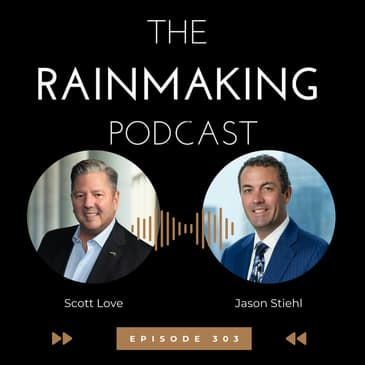
In Episode 303 of The Rainmaking Podcast, Scott Love speaks with Jason Stiehl, Managing Partner of the Chicago office of Crowell & Moring, about a unique perspective on law firm business development: treating networking like theater.
Jason explains why successful rainmakers approach conferences and networking events as a series of interactions over time rather than a quick sales pitch. Preparation, curiosity, and authentic connections are critical to building trust and long-term client relationships.
They also discuss how lawyers can use conferences, presentations, and follow-up conversations to uncover shared interests and create genuine connections that lead to business opportunities.
If you're looking to improve your law firm client development, rainmaking strategy, and professional networking, this episode offers practical insights from a practicing rainmaker.
YouTube: https://youtu.be/Y5hDNsBYDCU
--------------------------
📖 Subscribe to The Rainmaking Magazine
If you’re serious about growing your book of business, you’ll want to check out The Rainmaking Magazine — a monthly digital publication packed with insights, strategies, and real-world advice for professionals in law, consulting, recruiting, and beyond.
Now live — www.therainmakingmagazine.com
--------------------------
This show is sponsored by Leopard Solutions Legal Intelligence Suite of products, Firmscape, and Leopard BI. For a free demo, visit this link: https://www.leopardsolutions.com/index.php/request-a-demo/
----------------------------------------
Jason Stiehl is the managing partner of Crowell & Moring’s Chicago office, where he is a member of the firm’s Litigation and Brand & Technology Groups. Jason is an experienced trial lawyer with a nationwide practice in federal and state courts focusing on complex litigation, consumer class actions and advertising disputes. He serves clients in the retail, food and beverage, pharmaceutical and medical equipment, advertising and technology sectors defending allegations related to consumer fraud, false labeling and deceptive practices and Lanham Act violations. As a leading consumer class action defense lawyer, Jason also defends clients in matters involving the regulatory “alphabet soup”. His experience includes defense and counseling regarding the Illinois Biometric Information Privacy Act, the Telephone Consumer Protection Act, and navigating the myriad varying state consumer protection statutes, including California’s Legal Remedies Act (CLRA) and the California Consumer Privacy Act (CCPA).
In addition, Jason represents clients in complex litigation matters involving corporate espionage, restrictive covenants, trade secrets and other intellectual property claims, general unfair competition and complex disputes over post-acquisition escrows and earnouts.
Links:
https://www.crowell.com/en/professionals/jason-stiehl
https://www.linkedin.com/in/jason-stiehl-22a82b4/
The Managing Partner Lab
https://surepoint.com/managing-partner-lab/
What is the MPL The Managing Partner Lab (MPL) is a collaborative two‑day, in‑person workshop designed exclusively for managing partners and executive directors. This is a working session built to help senior firm leaders step away from daily demands and focus on the issues that most directly influence firm performance.
Across two days, participants engage in expert‑led discussions, peer collaboration, and practical workshops that translate industry insight into firm‑specific plans. The MPL brings together nationally recognized thought leaders in law‑firm economics, talent strategy, technology, and client expectations—along with facilitated opportunities to connect with peers facing similar challenges.
Why Attend
Mid‑sized firms are navigating unprecedented pressure: evolving talent dynamics, tightening margins, rapid technology disruption, and rising client expectations. Leaders need time and space to make sense of what’s changing—and determine what to do next.
Learn more about your ad choices. Visit megaphone.fm/adchoices
[00:00:10] You're listening to The Rainmaking Podcast, hosted by high-stakes headhunter, author, and professional speaker, Scott Love. You're listening to The Rainmaking Podcast, and my name is Scott Love. Thank you for joining me on the show. Before we get into the show, I want to take time to tell you about something and also to thank you for making this show a huge success.
[00:00:36] It's exceeded my expectations when I started it over 300 episodes ago, and I've evolved to where it has real content that people listen to every week, sometimes twice a week. And that means a lot to me. Now, before we get into it, if you enjoy the insights from our guests here, I want to share with you a little bit more about our sister publication that accompanies the show. It's called The Rainmaking Magazine.
[00:01:00] It's a digital online monthly publication where we curate the best ideas on client development from leaders across professional services. You can subscribe at therainmakingmagazine.com today. The subscription rate is $1.99 for the entire year. So it's something that has a tremendous amount of value, and I want to encourage you to check it out. Let's get into our conversation with our guest today. Most of the time, I have experts that teach people on how to do client development.
[00:01:30] And I'm starting to have more guests on here from people who are actually rainmakers. That's what they do. We're hearing their stories. And our guest today is Jason Stiehl. Jason is the managing partner of Crowley and Mooring's Chicago office, and he's got some fantastic ideas that I think you'll learn from and how he looks at business development as theater. It's really interesting, and it's a unique way I've never heard anybody share how they've grown their book by looking at it like that.
[00:01:59] Jason is a member of the firm's litigation and brand technology groups. He's an experienced trial lawyer with a nationwide practice in federal and state courts focusing on complex litigation, consumer class actions, and advertising disputes. I hope you get some great ideas from my conversation with Jason today. By the way, May 14th and 15th, I'm going to be speaking at the Managing Partner Lab.
[00:02:23] That is a collaborative two-day in-person workshop designed exclusively for managing partners and executive directors. All the information is on the show notes here. Check it out. If you're in the legal industry in a leadership role, that's a conference that you definitely need to attend. This podcast is sponsored by SharePoint Legal Insights, also hosting the Managing Partner Lab, formerly known as Leopard Solutions, where they turn legal intelligence into opportunity.
[00:02:50] Thanks for listening. I hope you get some great ideas from my conversation with Jason today. Hey, this is Scott Love with the Rainmaking Podcast. Our guest today is Jason Steele with Crowley and Mooring, and we're talking about client development. Jason, thanks for joining me on the show. It's my pleasure. Thanks for having me.
[00:03:08] Yeah, I like that. And I like your attitude about business development and some of the things we talked about before I want to talk about during our conversation to hear is bringing walls down when you're doing business development and curiosity. And let me ask you this. Let's kind of go right to a scenario. Let's say you're at a conference where some of your clients are and some of your client prospects are, and you're out there networking.
[00:03:32] What's going on in your mind at that conference when you're trying to develop relationships with people that could bring business to you? Wow. You did just jump right in. You know, you're putting out like a terrifying scenario for most people, right? Like that's the think or swim moment. I think if you don't mind, I think I would take it back a step. And I think it's important to talk about all the work that would have gone in before I put myself in that moment, right?
[00:03:58] So, you know, I would hopefully know five or six points about 10 people that I'm either going to go find at that conference or I need to reconnect with at that conference. Yeah, right, right. And so I think, you know, I think I would do some good research. And when I say research, I'm not talking about most likely cases that they've worked on or other firms that they've worked with.
[00:04:19] But I want to learn something about them that's unique to them, whether it's, you know, books they're interested in or music shows or, you know, things that I know that they find interesting that we may connect on outside of kind of the realm of what we do on a daily basis. Yeah, that's interesting. So let me kind of take what you said and let's kind of go into that a little bit. Let's say you're going to a conference. You know that some of your clients are going to be there. Your friendly competitors are going to be there and some prospective clients. Do you look at the attendee list?
[00:04:49] Do you try to get that? A hundred percent. I mean, that's kind of gold, right? If we could get a chance to see who's going to be there. And frankly, also the people that are, you know, competitors, but also colleagues, right? It's also good to sometimes lift up your colleagues when you're in the same space because we're not always competing for the same work. Right. And I think clients like to see that, that, you know, I do. I respect a lot of my colleagues in the same space. And I want to say, no, hey, you know, Scott would be the best for this possible situation. You should talk to him about it, not me.
[00:05:19] Yeah. I think that helps people grow closer to you. Let's like people like a prospective client. Why do you think that is? Why do you think here you are edifying one of your competitions and you look good doing that? What do you think that is? Well, I think it's twofold, right? One is it shows you're not just trying to sell everything to everybody, which I think a lot of people try to do. I mean, I've been at a lot of different places throughout my career. And the one thing that I think where firms fail and where lawyers fail is selling something that they don't have. Right. I've got a tax guy.
[00:05:47] Well, is it the right tax guy? Is it a good tax guy? Right. Or I've got this woman who does real estate. Well, is it right for this client? So that's one. And I think, too, it shows your client that you're being thoughtful. Right. You don't need every job. You don't need to have every case. You want the right case and you want to be the right lawyer for them for that case. Yeah, that's great. So let's go back to that scenario. You're putting your shrimp on a plate at a conference.
[00:06:14] And one of the things I love about conferences is that you meet a stranger and you can go right into it. They know that we're here to network. We're here to talk. Let's say you've done your diligence and there's 10 people that you want to get to know. And by the way, let me kind of go down that path a little bit before. How do you find out this information? How do you go about doing your research based on those people that you know are going to be there where there could be some opportunities? I think it's a couple of things.
[00:06:41] One, obviously, things like LinkedIn, things like Google searches, frankly, just trying to get to know something about these people, again, outside of just the fact that they're a lawyer. But I also like to talk to my colleagues and also my competitors about what are you going to do? Who are you going to meet with? What are you going to what are you looking for? And I kind of what we talked about before. I try to not interfere with other people's lanes.
[00:07:03] And so it's not I think people have seen, at least when I get when I was kind of growing up as a lawyer, is it kind of this like caveman hunting exercise? And it isn't. Right. It's a lot more delicate than that. It's a much more kind of fluid, almost like a like theater. Right. In a way, because like you said, everyone knows why they're there. They're there to network with each other. They're there to learn about each other. And it's not this scary, like let's go hunt and kill. Right. It's not a kill moment. It's a growth moment. Right.
[00:07:33] Right. You know, something you've said I've never heard before. I've interviewed almost 300 people on this show. Half of them are authors. I've read all their books. I've not heard one person say it's like theater. Tell me about that. Why did that come to your mind, Jason? Because it I mean, because it is it's performance. Right. We're all there. We're kind of peacocking in a way. Right. We're all there to be seen. We're all there to to show off our goods and our wares. But it's also there's a bunch of different characters and actors on the stage. Right.
[00:08:02] It's not just me and a prospective client. There are my competitors. There are people providing information, usually in some sort of CLE or seminar type scenario. So there is different kind of acts as well. Right. You show up in the in the first day and you don't want to rush out and meet all 20 clients. Right. It's a long play. You're going to be there for two days. There's likely going to be an event for dinner or drinks afterwards. So you've got to kind of stage out the play.
[00:08:31] Yeah, that's interesting. So let's kind of go down this path here. The other players. It's yourself, your competition, people putting on the CLEs. Who would be the other cast of characters within this theatrical endeavor? I mean, you've got your vendors. Right. There's people probably there selling various tools that everyone's interested in. There's the frankly, the setting you're in. Right. People forget that the settings are characters, too.
[00:08:56] So if you're in a beautiful beach location, you know, going outside to spend some time together is a way to get to connect with one another. I have a good story with a client that I now have that I didn't have at a conference before. I ran into them running. Right. And so we were out jogging and we ran into each other and recognized each other from the conference. And when we got back to the conference, we had coffee together because we now shared a common experience with one another that arose as part of this kind of play. Wow. That's fantastic.
[00:09:26] I mean, there's substance to what you just said. So we can look at the setting and different scenes as part of the players within this theatrical event. And let's kind of go into some of these other players as well. Let's talk a little bit about vendors. Is it important for a professional services provider to spend time getting to know who all the vendors are at the conferences? And why is that? Yeah. I mean, 100% because, I mean, again, everyone's selling something, right, at some point.
[00:09:54] And you want to be knowledgeable about what's there. You know, I think about, you know, I do class action work, right? So there are class action vendors and there's a lot of them. And it's good to know not only what they're selling, but also how good they are at what they do and kind of what we talked about before, what they're not good at as well. So if a client asks me, hey, have you used X, Y, and Z vendor? I can say, if I haven't, no, and here's what I know about them.
[00:10:22] Or yes, and here's my experience with them. So, again, they're part of the story because, to me, it's kind of boring if I just go in and say, I'm a class action lawyer. Give me your business, right? Like, there's 100 class action lawyers at this conference. That's why we're all there. But if I go in and say, I really love your product X, whatever it is, or I really enjoyed your speech on Y, or hey, have you used this vendor? Let's talk about them.
[00:10:48] We have something that we can share and create a kind of new storyline together as opposed to kind of talking at each other. That's interesting. I've kind of looked at people in my world, in different players also, but the two most important are strategic alliance partners, people I'm doing webinars with, I'm sitting on panels with, and then referral partners. People I might not ever do an event with, but they know the people I'm going to get to know. Do you kind of categorize people in those areas?
[00:11:17] Is that something that maybe not even intentionally, but something that you look at as you go to events like this? A hundred percent. I mean, I guess in a way you don't really know who they are necessarily until you get into the moment. I'll give you a really good example that is, to me, amazing. And I really respect this person for doing it. But I'm at a conference. It wasn't at a conference. I was at an ACC event, a corporate council event. And one of my competitors and I were talking. And he's at a large firm.
[00:11:46] And we were talking about what we each did. And I was talking about my, I'm in food and beverage. And I love the space. I was really hyped up about it. And he was like, I've got a best friend who just opened a beverage company. He's the GC of it with, you know, on the executive board. And he's like, we just don't do it. He's like, we have class action lawyers, but we don't have anybody who's in the food and beverage space. Would you mind if I referred him to you? Right. And that to me, it's like, he, first of all, he doesn't really know if I'm good or not.
[00:12:13] I hope he thinks I am because he can look into me, but it's beyond that. Right. He knew my passion for the area. He also recognized that referring him, his client or his friend to a lawyer in his firm would be kind of a dud. Right. Because there's no connection. And it gets more traction from all of us. The client will be happier. I'll be happy and refer things to him on our wheelhouse. And he and I now have a connection, a friendship through this experience. That's great. That's a great story.
[00:12:42] And I think that's why it's always good to be professional and above board in every interaction with people. Because bad news travels faster than the good news. Even people I've talked to where here's a candidate I'm presenting to a firm and they had, they were across the table or they were adjacent. And they just didn't like the demeanor nor the attitude of that person. You know, so I think you've always got to have, you know, got to be thinking in those terms. So let me ask you this. You talked about the different scenes of the theatrical performance.
[00:13:09] We can kind of go back to the conference as a real concrete place that everybody's been to one. They know what that is. What are the different scenes or the different acts we can look at within a conference? Kind of using that as our metaphor here, Jason. Yeah. I mean, I think, again, it starts from the moment. I mean, it probably starts, you know, the practice, right? The rehearsal is what we talked about before. Kind of getting the list of people and looking people up. And then I think it goes into the minute you walk into whatever the conference space is, it begins.
[00:13:39] And so you've got your opening remarks. And I'm sure everyone's looking around the room at everyone's little lanyards to see who's there and where they're sitting and who they're sitting with. And then there's, you know, then you think about the opportunities. You've got your breaks. You have your lunches. You've got your cocktail hour, most likely. You've got your dinner. And then likely have some sort of after cocktail hour at these conferences, right? And so you pick your moments, I think. I think when I was younger, I was hungrier.
[00:14:06] And I would always just kind of like, if I saw something, I'd go sit down at their table and just start up a conversation. No one wants that, honestly. Because it's your first day. You're tired, probably. You're just kind of getting your feet wet at the conference. And so you kind of just, I don't know. It's like I said, it plays itself out throughout the day in these different scenes. And like, you know, you go to one of your clients' presentations and you pay attention, right? You listen to what they're talking about.
[00:14:34] You see people give clues about what's interesting to them. So even if they're in talking about, you know, a merger that they just did, they're most likely going to tell you something about, it happened while I was on vacation and I did X, Y, or Z. Or I did something unique and I, you know, reminded me of a character in a book or whatever, right? And so you get these little clues about who these people are as people. And I think that's where the connections happen. So. Yeah, that's great. I'm going to kind of recap some of the things you mentioned here.
[00:15:03] One of the things I like how you described it, you know, here's the act begins at opening remarks. And even prior to that, we can look at that as a rehearsal where you're doing your research. Who's going to be there? Something I usually do, if I do get the list, I'll highlight. These are all the people that I want to, I want to at least shake hands with. And at some conferences, I know a lot of my clients, prospective clients. At the last one I went to, there were about 42 people that I either shook hands with or waved that I know.
[00:15:31] So I sent every one of those a handwritten note afterwards. Just, it was nice to see you because I think analog is the new digital nowadays, you know, just in terms of building connection with people. Go ahead. What were you saying? No, I was going to say, to me, that's critical. And I'd love to talk about that, that follow-up part because it's, it is the most missed part of what we're talking about here. But keep going. I didn't mean to interrupt you. No, that's okay. Let me tee that up. And I'm going to put that on here with the apps.
[00:15:57] You said you begin with the opening remarks, but then you called the events where you can meet with people, breaks, lunches, cocktail, hour, dinner. You call those opportunities. And I like the way you frame it that way. I never looked at it like that. Myself, I'm naturally an introvert. Okay, that's the time I'm going to go to my hotel room and send an email to someone because I don't want to talk to people. But you know how that is. You have to force it. You have to be out there. You have to face that discomfort to get the things that are going to make you more comfortable in the future.
[00:16:26] But you talked about breaks, lunches, cocktail, hour, dinner, and then even presentations. Are there any other quote-unquote opportunities where you can really connect with people? What do you think about that? Yeah, I mean, honestly, I kind of want to focus on your introvert comment because, you know, obviously we're not all out there shaking hands and, you know, doing shots with people at bars, right? We're not, we're not, we're not rising to party person. And I have a lot of, like, close friends and people who I feel like I've mentored who are introverts, right?
[00:16:52] They look at it and they say, I really love practicing law, but I really hate business development. I hate that moment of shaking someone's hand and I get sweaty or nervous or whatever. And I try to remind people, and again, it kind of goes back to the theater thing. Like, you can be a participant without being on stage, right? So you can sit in a chair in a lobby and watch and just enjoy what's happening. Check out the scenes. See what people are doing. Look at the food.
[00:17:18] Don't be uncomfortable being alone in a moment and just kind of taking it all in because there's a lot of valuable information you can gain just from being part of the, you know, being a, being a bit player, so to speak. Yeah. Right. And so, yeah. So, but I do, don't go back to the hotel room. That is the biggest, you know, miss because, I mean, we're all busy and usually you got to get your work done, but you're there for a reason. And there's plenty of other introverts that are there too, right? That you may run into while you're walking in the beach or whatever.
[00:18:17] Absolutely right. I sell products that I love. And I watched this woman give a presentation about what she kind of does on a daily basis. So it was kind of like a, I don't know, an overview of what it's like to be in-house at food and beverage companies. And she talked about her life more than she frankly talked about her job, right? She talked about coming into work. She talked about, you know, balancing her work life. And so I really got to learn about her.
[00:18:43] And what I learned about her is two things that were valuable to me, which is she had a really similar taste in music because she talked about what she was listening to on the way into work. And she really liked the same kind of books that I did because she talked about down, how she took downtime and read books. And so we, afterwards, I went up to her and I said, hey, great presentation. I am just finished reading a book you referenced. And we've been, since then we've both been really good friends and I've gotten a lot of work with her. So, you know, we became friends first.
[00:19:13] How about that? And you wouldn't have gotten that unless you'd been there in that presentation. Yeah. I like that. I mean, that reframes it for me. And I'm sure a lot of people listening that these aren't time sucks out of your life and away from business. This is important for you to be in that room, listening to that presentation. And that's an opportunity. People give clues as to what they're interested in. That's fantastic. So let's talk about the end of the play. Something I mentioned, too, following up with people.
[00:19:38] What have you done that's worked for you in terms of how you stay connected with people that you've met at these conferences? Yeah. I mean, you mentioned analog versus digital. I think that's key. We're all human beings still. And as much as AI would like to take our jobs away from us, people still want to interact with people. And so my biggest one is visits. I really think it's important to get on a plane or get in a car or walk down the street and put yourself in front of these people, whoever they are, again.
[00:20:07] Because it's the human connection, I think, that frankly makes our job fun. But also, I think, kind of endures yourself to the person you're working with. And so because it shows them that you can take time out for them. So that's my big follow-up. I love the card. A quick story. When I became office managing partner last year, an old colleague of mine who's now at a different law firm set me a handwritten note congratulating me. It was probably the most touching thing I'd ever gotten.
[00:20:37] And so it's those little things, I think, that people forget how important they are. Absolutely right. And I think at the end of the day, we are people. And just building that real human connection with people so that the walls come down. I know when we talked about before, I was thinking about how can we talk about bringing the walls down. And I like this theatrical metaphor because it's all about connecting with people. And I think being part of that story.
[00:21:06] I think people like stories. I think knowing that you're now a part of their life. You met them at a conference. There was a spark. There was some sort of common interest. It might not have had anything to do with business. You might have both had Shiba Inu puppies or something like that. And that was enough to at least connect with them. Oh, what do you do? You know what? We might be having a suit coming up here. We might need somebody to help us, represent us with that. And then the next thing you know, you're getting a fruitcake from them during the holidays every year.
[00:21:34] Or whatever your holiday rituals are. And it's more than just a card. It's maybe an invitation to continue with them. Let me ask you this question, Jason. What would your advice be to a younger attorney that might be thinking about, or younger professional in any professional services environment, that might be thinking about, I need to start getting my business? Where do you think they can really get the most return for their time early on in their business development career?
[00:22:04] Wow. Well, first, I think not to be like too esoteric about it, but I think knowing yourself, right? Getting to know who you are and rounding out you as a person. Because all the things we're talking about, no one wants to talk to a square, right? No one wants to talk to someone who can just say, I practice law. Here is what I do, right? Like that's not interesting to anybody, really. Not to a judge, not to a client, not to anybody. So you really got to figure out what it is that makes you tick.
[00:22:34] Because otherwise it's going to seem unnatural and disingenuous when you're interacting with people. So I think that's the most critical thing. And I think the best way to do that for me has been reading, right? I'm like a voracious reader of fiction and other things. But I just love the Bauer stories. And I keep thinking about this person I've mentioned before, the introvert. His thing is he loves hiking. He loves to go out to national parks, which I'm sure you know from your experience talking to people.
[00:23:02] There is a whole like groupie thing of national park lovers, right? And so he knows that that thing is a thing. And you can pick people out in the crowd pretty quickly. Like, oh, that's definitely a national park lover, right? And so I've taught on that. Like, I'm like, dude, you don't have to be the guy sitting at a bar. You can look for the person who wants to go for a hike after the event. So I think knowing yourself, reflecting on it, and then looking for that in other people, I think is what I would suggest to people. That's great. It's not one size fits all, right?
[00:23:29] Which is, I think, what we're kind of trained to think of like, just like, go out and get it. It's like, well, that's not how it works. Yeah, that's right. And I like kind of using that theatrical metaphor, developing your own character, developing your own persona, you know, developing who you are and how do you want to be seen. I think the one thing I've noticed with professional services, especially legal, is that it's all about optics. It doesn't matter what's happening. It's what are the optics associated with that. That's how people make decisions. This is great, Jason. Thank you for being here today.
[00:23:59] And tell us a little bit about your practice, what you do. And we'll put your contact info on the show notes. If people want to connect with you directly, they'll be able to reach out. But tell us a little bit about your practice and what you're all about, Jason. Yeah, no, I appreciate that. And thanks again for having me. This has been fun. I could talk about this stuff forever. So my practice is kind of a unique one. I do split my time, give or take, if it fluctuates between class action defense and trade secret and restrictive covenant cases.
[00:24:28] And it's just the way I kind of grew up throughout my career. But I love it because it's really two very different ways to practice. Trade secret, restrictive covenant is very like run and gun, right? You've got an employee who's left. He's taken the jewels of the company. And you've got to really deep dive into your and get to know your client, get to know their business. And then go in front of a court maybe in two weeks, a week, maybe three days, right? You've got to just, it's a fire drill. The class action is like the opposite.
[00:24:56] You get to do the deep dive in your client's business, but you know it's going to last years, right? There's going to be discovery. It's going to be drawn out. You've got to manage your client and their expectations. And so it's a really interesting balance that's allowed me to kind of, like I said, it's, you know, there are days when I'm like frantic. And then there's days where I get to reflect and kind of think more about what the trajectory of a case is going to look like. So it's been fun. That's great, Jason. Thank you again for your wisdom and for being here and for sharing these great ideas today. I appreciate it.
[00:25:26] Thank you so much again. Thank you for listening to the Rainmaking Podcast. For more information about our recruiting services for international law firms, visit our website at attorneysearchgroup.com. To inquire about having Scott speak at your next convention, conference, sales meeting, or executive retreat, visit therainmakingpodcast.com.