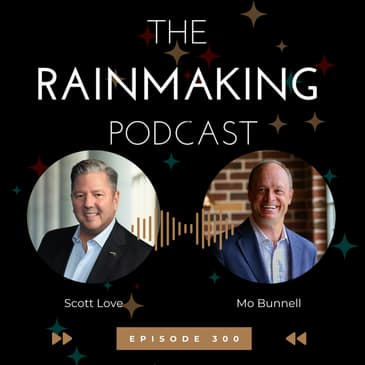
Episode 300 marks the 300th installment of The Rainmaking Podcast, and Scott Love celebrates the milestone by bringing back Mo Bunnell, a leading business development coach and author of Give to Grow, for a practical conversation on the power of consistency in business development. Mo explains that the biggest challenge for busy partners isn’t knowing what to do—it’s staying consistent when client work spikes and results from outreach feel unpredictable. Because BD rewards are “intermittent,” many professionals quit too soon; the winners are the ones who keep making small, repeatable investments over time, letting the law of large numbers work in their favor.
Mo shares a simple operating system: plan quarterly, act weekly, execute daily—so you’re never trying to “decide and do” in the same moment. Quarterly planning focuses on brand visibility (beating obscurity), targeted relationship investment, measurable actions you control, and treating BD like a project rather than “random acts of lunch.” Weekly execution means choosing three BD actions that are BIG: Big impact, In your control (e.g., “invite Jane,” not “have lunch”), and Growth-oriented (proactive, not just “do great work”). Finally, he recommends a weekly accountability question—Did I do everything I could to grow this week?—plus a mindset shift from BD as an on/off switch to a dimmer, where even 15 minutes keeps momentum alive.
Scott mentioned the planner link during this episode, but it’s not available just yet. If you’d like to be the first to know when it launches, fill out the form here (https://bunnell-idea-group-inc.kit.com/cffda756bb) , and you’ll be added to Mo’s email list, where updates are shared first.
Visit: https: //therainmakingpodcast.com/
YouTube: https://youtu.be/lIXpPoyoUUk
----------------------------------------
📖 Subscribe to The Rainmaking Magazine
If you’re serious about growing your book of business, you’ll want to check out The Rainmaking Magazine — a monthly digital publication packed with insights, strategies, and real-world advice for professionals in law, consulting, recruiting, and beyond.
💡 Created for results-driven rainmakers who value credibility and substance.
💥 Now live — subscribe today www.therainmakingmagazine.com
----------------------------------------
This show is sponsored by Leopard Solutions Legal Intelligence Suite of products, Firmscape, and Leopard BI. Push ahead of the pack with the power of Leopard. For a free demo, visit this link: https://www.leopardsolutions.com/index.php/request-a-demo/
----------------------------------------
My team and I help complex organizations grow by scaling business development skills across their organizations and creating a growth-oriented culture. I'm the author of Give to Grow, The Snowball System, and the host of the podcast Real Relationships Real Revenue, and the founder of Bunnell Idea Group (BIG). Our team and I have trained tens of thousands of professionals. BIG’s clients have used Mo and his team’s GrowBIG® training to give their experts a system for growth that creates deep relationships, gives a comprehensive business development framework and dare we say, is fun to use. I started my career as a technical expert, passing all the actuarial exams to earn the highest designation: Fellow of the Society of Actuaries. Today, I love working with hundreds of clients, including some of the largest and most prestigious service-based organizations in the world. On the personal side, my wife Becky and I have been married for over 30 years. We enjoy spending time with our friends and two adult daughters. Outside of work, I love working out, backpacking, and playing ultimate frisbee at both the national and world levels. Becky and I live in Atlanta, Georgia, with our four horses, two cats, a dog, a bird, and a miniature donkey named Louie Hamilton.
Links:
https://www.linkedin.com/in/mobunnell/
https://bunnellideagroup.com/givetogrow/
Learn more about your ad choices. Visit megaphone.fm/adchoices
[00:00:10] You're listening to The Rainmaking Podcast, hosted by high stakes headhunter, author, and professional speaker, Scott Love.
[00:00:23] You're listening to The Rainmaking Podcast, and my name is Scott Love. Thank you for joining me on the show. Ladies and gentlemen, I have a special announcement to make. This is our 300th episode of the podcast. 300 episodes. That's a lot. I started the show back in June of 2020. What was going on in 2020?
[00:00:43] It was a different world back then. I thought, hey, let me just put on a show and see what happens. But you know, I don't know if you knew this. I actually started podcasting way back in 2008. Actually, I was ahead of the curve. Usually I'm so far behind, I end up ahead. But back then I had a training company niched within the recruiting and staffing industry. And I use that podcast as a way to build trust with people. It had been dormant for several years since I sold that company.
[00:01:08] And I decided to dust off that feed and revive it and make it The Rainmaking Podcast, and I'm glad I did. This episode is a special one because our guest is someone you may have heard of before. His name is Mo Bunnell. He's been on this show before, but he is a world-class business development coach. His company, well, I've seen him speak at other conferences. He's at virtually all the LMA conferences.
[00:01:32] If you're in professional services business development, this is someone that you want to know. In fact, he's written two books. I've read both of them, and I'd highly recommend them. And the one I'm most excited about telling you about is his latest book, Give to Grow.
[00:01:47] In fact, we have the link where you can order that book on the show notes, and you can connect with Mo directly on the show notes. Our topic today is the power of consistency. Mo's going to share ideas that you, a practitioner in professional services who's also responsible for getting business, he's going to show you how you can become more consistent in your work at developing your brand, growing your book, and having clients call you.
[00:02:12] My friends, thank you so much for joining me on the journey. If you've got a minute, I have a small ask, a small request. Go ahead and give us a nice five-star review on Apple Podcasts or wherever you listen to this show. And if you can make a nice comment about the show and like it and share it anytime you see it on LinkedIn, reshare it, visit our YouTube channel. We've got over 5,500 subscribers on YouTube. I'd really appreciate your help on that.
[00:02:37] This show is sponsored by SharePoint Legal Insights, formerly known as Leopard Solutions, turning legal intelligence into opportunity, and also by The Rainmaking Magazine. Don't lose business to the competition. Read this publication and keep business development top of mind. Visit therainmakingmagazine.com today to chart your course to greater rainmaking success.
[00:03:00] Thanks for listening. Thanks for making this show a success and for joining me on this journey. And I hope you get some great ideas for my conversation with my good friend, Mo Bunnell. Hey, this is Scott Love with The Rainmaking Podcast. Our special guest today has been with us before, and his name is Mo Bunnell. And we're talking today about the power of consistency. Mo, thanks for joining me on the show again. Yeah, Scott, I have so much fun. I love how you drop right into content, and I know we're ready to do that today.
[00:03:28] Okay. Absolutely. Let's dig into it. So tell us about the power of consistency. What does that mean, and why is that important for partners in any professional services firm to really keep top of mind? Yeah. Well, we work with, as you know, a big chunk of the AMLA 100, some of the top-tier consulting firms around the world, accountants, engineers. I was an actuary in a former life, so I know what it was like to be a billing, somebody that bills time.
[00:03:54] And in training 60,000 professionals in our best-selling books, Noble System, Gift to Grow, things like that, one of the things that we've noticed over 20 years in doing this is that consistency is one of the hardest things to do. Yeah.
[00:04:37] And I think today we'll talk about some practical ways to do that, but it's one thing to know what to do. It's a whole other thing to do it consistently over an entire year or decade. That's right. Why do you think that is difficult for people at that level? Here's high-performing people that know everything. Why is it hard for them to stay consistent? Yeah. I think it's the call of all these other things. One of the things that has some amazing psychologists on our podcast, and one person said something really profound.
[00:05:04] She said, it's intermittent rewards that are the toughest activities to do. Things that get intermittent rewards are the toughest activities to do. So you can imagine that if you know for certain that if I call a client seven times, I'm going to get a matter. And if we just had a wave to magic wand and said, that's exactly how it works every single time for the rest of your life, nobody'd have any problem reaching out for a coffee chat. They'd go, hey, I'm up to three. I can't wait for four. Let's go.
[00:05:31] So it's the problem that we don't know if it's going to be three or seven or 27. We don't know if it's even going to happen or not. We don't know what the size of it's going to be. We can invest in one person, and all of a sudden, they go in-house and become a competitor or go to private practice. We can invest in another person that's a friend from law school. We don't talk to them for 10 years, and all of a sudden, they call, and they bring the biggest matter we've ever had.
[00:05:54] So there's so much randomness to it that in any one instance, we can feel defeated and not put any effort into it. The trick, though, is you show me one lawyer that reaches out to 10 people a year, and you show me another lawyer that reaches out to 1,000 people a year. I'm being a little bit extreme here. Who do you think on average is going to do better? Like it's the person that reaches out to 1,000. So in any one instance, it can work or not work, but it's in the law of large numbers.
[00:06:21] It's in the person that does this consistently over time where all the randomness falls away, and it's the person who does things consistently that actually wins the most work. That's interesting. And so I think that slow and steady wins the race. And I like the fact that you just admit that there is some randomness to this. We just can't make any accurate predictions on where our time invested, which seeds are going to bear fruit, but you have to plan them. And you know that mathematically, something's going to happen.
[00:06:49] And so what are some examples in terms of things professionals can do that can be they're manageable? It's not going to be overwhelming. What are some of the things that you've seen have helped partners and professional services be successful and be able to be consistent in the actions that they take, Mo? Yeah. Well, I can give you a little three-step process. Sure. It's plan quarterly, act weekly, and execute daily.
[00:07:17] And what I mean by that is most law firms have an annual partner plan, an IPP or whatever they call it. And that is great. And I hope everybody does do that. But the problem with annual is you can feel like the first half of the year you have lots of time. So it's really good to step back. I think I plan annually too. So I really love that. But it needs to be augmented with a little bit of quarterly strategic planning. When you look at quarterly, it's far at that perfect level where it's far enough out.
[00:07:46] You can be a bit aspirational. But on day one, you feel like you got to get moving. So quarterly is the perfect time to sort of set some priorities what I'm going to do. Weekly. Weekly is the rhythm of life. It's completely man-made. But by the time you're four or five years old, man, you know what a Friday afternoon feels like when you walk home from preschool. You know what a Saturday morning feels like. You know what a Sunday night feels like. So if we can tap into that weekly ritual, and what we advise there is just pick three things a week. I can go into deeper if we want.
[00:08:16] But just three BD activities a week. There's a specific way to plan for it and all that. And then you slot those into your calendar. The important here is to think about what you do at a different time than the doing of it. What happens there is your subconscious will actually just start doing. It'll start writing the email. It'll start thinking through the script to ask for something in person. It'll start writing the end of the – thinking through what I'm going to say at the end of the speech at the conference, whatever. But you want to separate the choosing what to do weekly from the doing. The third thing is daily execution.
[00:08:45] And that's where you already know at 8 a.m. on Tuesday, I'm writing the email to Jane to ask for a catch-up when I'm over – when I'm in Toronto in three weeks. Well, by the time you get to that, you just do. Your subconscious has already thought it through. But it's in the – if you will, where all this falls apart is where you only do an annual plan. And on Tuesday at 8 a.m., you're trying to figure out what to do and do it all together. It's just like walking through mud. It's just too big of a gap. So let's kind of back up then annually.
[00:09:13] What should be in part of this plan? And what should a partner do quarterly? How would you break that down? What have you seen from successful rainmakers? Yeah. Yeah. So I want to be real careful here, Scott, because I do not want to sound what I'm about to do as a product pitch. And it's not. Okay. Good. But we do have a new product coming up that's going to help with this, and it's called the Big Growth Planner. It's a little paper planner. It's on Amazon. It's amazing. But I'm going to share exactly what's in it right now.
[00:09:41] So if somebody never wanted to buy it, they can get all the value. So that's why it's not a product pitch. So it took like a year to develop this, and it ended up being about 15 or 20 different scientific studies that are underpinnings of this. So if we think about a quarterly plan, there's a couple key elements. And for those that can watch this on video, I can actually just show you there's 16 different questions you want to ask yourself. I'll give you a couple.
[00:10:05] But one is from a strategic plan standpoint, like what's my personal brand? How would I grade that? How can I promote it in the next quarter? What are the things I can do to beat my biggest enemy, which is typically obscurity, is people not knowing about me? How can I get people to know about what I do? The second quadrant is relationship. Some simple questions here. How can I write down my key relationships I want to invest in this quarter? Heck, it might be six or eight people.
[00:10:35] It might be 30. It's not 300. It's like a targeted list. How can I reach out to them in this quarter that's meaningful? Having a list, knowing what to do. The third of the four quadrants is measurement. What kind of measures can I track that I can control? How can I bring the agency back to me? Things like how many outreaches do I want to have in the next quarter? How many investments do I want to make in clients? We call those give-to-gets.
[00:11:03] Those little 30-minute teaching sessions. Those little half-day workshops. Whatever it is. CLEs. And then the last one's consistency. And that is like, how can I make sure I manage this like a project? We want people to think to a business development like, hey, if I just won the most important matter of my life, how would I manage that so I know it's going to get a successful resort? That conjures up image of project management, teamwork, everybody having meetings, seeing how things are going. We know how to do that.
[00:11:33] Let's just port that over to the business development side and think, how can I have a project management so I can avoid random acts of lunch and spits and starts and things like that? Manage this like a project. And just by, now we've got some more complicated or more specific questions, but if people just ask those basic questions of themselves once a quarter, it gives you ideas on what you want to focus on. This is really interesting. And let me give you some context. Each year, I make about a thousand new friends, new partners in law firms, trying to recruit them.
[00:12:03] Amazing. People, they don't want to move. That's fine. I'd say on average, only 10% of them are thriving. And I don't think that it's good for everybody to move. You have to have a good book that's portable. But a lot of people that I talk to, I just don't have a book. And I appreciate them sharing that with me. But I've also met other people that have a thriving $10 million book. Why do you have that? Well, let me tell you about the conferences that I not just attend, but the programs I put on.
[00:12:31] Now, let me tell you about the network that I built through the consistent action of doing this. And the bottom line is that there is a reason why some people are successful rainmakers and why others are not. And I like what you do, Mo, and all the other guests we've had here. But I think what you're delivering with this new tool is something we haven't seen in the professional services industry that solves the problem. Taking action. Yeah. Because when you can solve that problem, everybody can reach their goals and fulfill their potential
[00:13:00] because it's all about the action. Yeah. And I think that's a tool that I hope a lot of people take advantage of. And by the way, for everybody listening, we're going to put the link to that on our show notes. So you'll be able to order that directly. And I know that's going to help you all. Tell me this, Mo. Give me an example of someone that you've worked with. You don't have to mention their name, of course. But somebody that wasn't consistent in their action, what was the arc of their change, of their improvement? And what were the results? What did they do differently to get those results?
[00:13:30] And what were those results, Mo? Yeah. That's a great question. Yeah. So something that comes to mind was a tax controversy lawyer. And he had just gone in from a specialty shop that that's all they did, where he was getting tons of leads all the time, to a major firm. And he was the first person with that expertise in his firm. So again, back to the enemy, a lot of times isn't another firm. It's obscurity. It's people not knowing who you are or what you're doing, right? You're like, get the awareness out.
[00:13:58] So we worked on a plan where we said, okay, step one, who can provide you referrals? Well, obviously, one angle is everybody inside the firm. But because a lot of his work was with high-net individuals that got served a letter by the IRS, a lot of times you don't even know who that is. And because this was a big MLaw 100 firm, they weren't really geared towards working with entrepreneurs or founders or people like that. They do a lot of big corporate work. So he sort of was off on his own.
[00:14:24] So we realized the number one referral source that he could have are accounting firms and not the big four, but everybody from around Grant Thornton or Forvis to like a Jerry Becker, like number 20, 25, Aprio, folks, like great, great firms like that. We want to click further. Who at those firms would be the perfect referral source? And this took a lot of thought. We realized it was the office managing partner at each of those firms and all their offices
[00:14:52] because those are the folks that an individual partner would get a really weird letter from the IRS, didn't know how to handle it, felt like it had a legal issue along with an accounting issue. Well, they would go to the OMP and say, who should I call on this? Aha. So now we can develop a list. So step one, now we've got a list of human beings. Just like we talked about in the quarter planner, you want to have a list. Who am I investing in? Step two, how can I add tons of value in their life where I can beat my enemy, which is obscurity,
[00:15:22] but I'm going to lead with not talking about what I do, but actually showing what I do. Training is the way to winning business. How can I add massive value? So I'm top of mind when the thing happens. So we developed a great thought piece called the seven things you should not do if you get a letter from the IRS. Pretty, pretty clever title. It's great. Got a lot, got a lot of attention. In fact, some of the business chronicles and cities picked it up and ran articles around it. It was great. Build a little CLE around it. Accountants need professional development too.
[00:15:51] And we created this so in a way that they could get their, their version of, of CLE, but for accountants. And then we just sent emails. He just sent emails and he created a rhythm every week. Hey, I'll send, I can't remember now, this is a decade ago, but I think he would send like five emails a week and try to set up calls for the coming weeks. And he would just do one virtual CLE, one hour lunch and learn on this topic per week. And just like rhythm, just slide it in, slide it in, slide it in. That's great. And his acceptance rates was so high.
[00:16:22] Once he got to step three, which is doing the, the continuing learning, he was getting like 80 or 90%. So he had to like throttle back on how many he was offering because he was booked up weeks and weeks in advance. And you were just like Wednesday at noon, whatever it was, did another, did another, did another, man. He had to actually cause our, our pause, our coaching because he was getting so much work. He had another issue, which was now he needed more staff to do the work.
[00:16:46] So it's like, that's not the exact answer for everybody, but somehow creating, you can see the systemization of that. And it was fun. He was leading with value. He was teaching people and he got a high acceptance rate. So it was a lot more fun than low acceptance rate. And he just like rhythm, consistency. It just worked incredibly well for him. That's great, Mo. That's a really good story. I appreciate you sharing that. What are some of the pitfalls that get in the way that keep partners from having this
[00:17:15] daily execution, this consistency? What do you think those pitfalls are? The number, I'd actually be interested in your take on this too, because you talk to so many lawyers. The number one thing I see is the wrong mindset where people view business development as all or nothing. And the words I'll hear, Scott, again, I want to hear your, your thought on this is like, I don't have any time next week to do business development. It's like, like it's a light switch on or off. And we want people to think of it like a dimmer switch.
[00:17:44] Like, Hey, maybe it's true. You're slammed and you don't even know when you're going to eat or go to the restroom. I get it. Those days, those weeks happen, but there's always 15 minutes. So how can we, how can we dimmers think of this as a dimmer switch? Yeah. Next week, we're not going to have much time, but if we're busy, we have access to people. We're talking to our clients. What little ask could we make in person while we're doing the depositions or getting ready for trial or handling the transaction or whatever?
[00:18:12] How could we ask like, Hey, I know we're slammed now, but I'd love to come back to New York and take you to dinner and celebrate our results in March when this thing settles. Little ask like that can take 30 seconds. And there's some research out of Cornell that finds a face-to-face ask has a 34 times more likely chance of a yes than an email ask. So if we can just leverage that access that we have while we're busy to help our future self, it actually doesn't take much time to keep our momentum. Exactly right.
[00:18:41] I'll take those odds any day, Mo. What do you think? Yeah, 34 times. It's crazy. Yeah. What do you, what do you think is the barrier? Cause this is like, this is one of the top things that people should pay attention to. I want to get your view on this. I think a lot of it's emotional, the emotional context of feeling overwhelmed and feeling like all of my time has to go to serving my clients. Well, the best way you can serve your clients is to grow, I think, and get more clients because then you have more opportunities to see different things. And that experience can help other people in the future.
[00:19:11] But I think it's the feeling of being overwhelmed, which goes back to having a plan in place. Dig your well before you're thirsty. Do the work that you need to do before you get really hungry. And gee, I just don't have a book. What should I do? You spend the time planning, like you mentioned. So you're very deliberate and you're very intentional about what my goals are over the next year, the quarter, the week, and every day. And then it comes down to, it's kind of like one of my goals this year was doing at least
[00:19:41] 30 minutes of, on the elliptical or 10 resistance training exercises every day. And it's already a habit now because you get into it and you get used to it. This past Saturday, my wife and daughter and I were driving to go out of town and I actually took the exit to go to my office because it's a habit. And I think rituals and habits are what channel us to perform at a peak level even when we don't feel like it.
[00:20:08] And any endeavor, no matter what it is, if you want to be number one in the world, no matter what it is, if you want to be a professional golfer, a professional guitarist, a professional painter, it's going to be a grind. And you got to put the time and the effort in consistently with intensity of focus and know to back off life balance, et cetera. But you're not going to be number one in the world as a rainmaker if you hit at it with a stick. It has to be what you think about all the time.
[00:20:33] And you have to be smart about that and block out that 15 minutes or even the five minutes of time to do something. Even if it's just sending an email to someone, here's an article I read in the Wall Street Journal. I thought you might find this interesting. Just send it doing something every day. And so even if I don't have 30 minutes to go on the elliptical, even if I don't have time to do 10 strength training exercises, I'm going to go in and I'm going to do one, one or two.
[00:20:59] And I found also that if my goal, and this is how I got through the Naval Academy, Mo, I would say, I'm really having trouble in chemistry. It's Friday night. I want to go out and hang out with my friends, but I'm just going to go and sit at my desk. I'm not even going to sit at my desk. I'm going to stand and I'm going to put the chemistry book in front of me. And all I'm going to do is stand in front of it and look at it. Then I'm going to leave and go see my friends. And I would stand in front of it and I'd say, okay, all I'm going to do is sit down. And then I'm going to leave and go see my friends. And I, okay, I'm sitting down.
[00:21:27] All I'm going to do is open it up to chapter seven and then I'm going to leave. And that was the deal I made with myself. Okay. I'm on chapter seven. All I'm going to do is read the first two paragraphs and I'm going to leave. Okay. All I'm going to do is read the first two pages and now I'm really going to leave. And by the time I'm on the 15th page, I'm like, I'm not bleeding. I'm not hurting. I can do this. That's how I got through the Naval Academy, Mo. I love it. It's the same thing. Yeah. Yeah. Taking that, you know, kind of, it's a game in your head. And that's what I make everything a game, even business development a game.
[00:21:55] If you can game it and reward yourself in the short term by doing something every day, I'm going to send at least one email to a prospective client or an existing client every day this week. And if I do that, this is my reward. Whatever it is, you know, maybe it's a Snickers bar or something, something like that. Yeah. But what do you think, Mo? So have you seen partners kind of do similar things to what I mentioned? Without a doubt. In fact, that made me think of something. I'm going to provide a statistic now to your audience.
[00:22:23] And I guarantee they've never thought of this in their life. And it's one of the most important stats they can measure. And we call this the GrowBig Index. Totally self-congratulatory because our training program is called GrowBig. So when you name a stat or, you know, you come up with a scientific mental heuristic word of, you get to name it. So we named it about ourselves. So here's the stat. And we just gave this to a magic circle firm we were working with a couple weeks ago. And everybody in the room was absolutely blown away. We do it in all of our classes.
[00:22:52] And all you do is take two numbers and divide them. So the numerator or the top number in the division is how much revenue did you help or influence bring into the firm in the last year? So if you have a strict originations formula, you can just go grab that. If you're more of a black box firm, you got to think about it a little bit. But you can think of like, hey, how much money did I influence in some way to bring in the firm? That's the top. And then you just divide that by, and some people have to estimate this because they don't track it,
[00:23:22] but they need to track it over time. How many hours did I spend on business development in the last year? So here's the interesting thing, Scott. Most people think of their value as their billable rate when they bill time. So that's $1,000, $1,500, $2,000 an hour, whatever it is. Usually their GrowBig Index, their value in the marketplace bringing in work is 5 to 10 to 20 times that. So when we're working that magic circle firm, the lowest person in the rooms,
[00:23:51] GrowBig Index was $8,000 an hour. The highest was $50,000 an hour. So knowing your value in the marketplace, let's say it's $20,000, $25,000 an hour. That's pretty typical for a partner at a high-performing firm, probably more for a lot. Well, once you know that sending off that email about the Wall Street Journal article, like you mentioned, somebody can easily think, oh, this isn't that important. I'm just sending in a Wall Street Journal article and they can almost feel defeated. No, that took 20 minutes. That's one third of your GrowBig Index.
[00:24:20] That was just worth $8,000 or $7,000, $9,000 an hour, you know, a third of whatever your GrowBig Index is. Your value in the marketplace, I guarantee audience person listening, watching, is much greater than you think. Calculate that number, know what it is, and that is incredibly motivating to put more time into business development. Because you can start to extrapolate out and say, hey, every more hour I put in this, it's not random acts of lunch.
[00:24:49] I'm just sending the article. I'm staying top of mind. I'm offering value. All those little drips over time are not random. They turn into work. Absolutely right, Mo. Thank you for sharing that. And let's kind of bring it home then in terms of three action steps. If there are three action steps somebody can take listening to this, what are those top three things you think they should start with, Mo? Yeah. So, Scott, there are three things that people need to do. One is this quarterly planning. I want to give a little bit more on that.
[00:25:17] The second is sort of the weekly, you know, what am I actually going to do? And then I want to give a new idea at the end that I'll cover. So that first thing is quarterly planning. Those questions we talked about at the front end of this show. I would add to that one thing, though, that there's an exercise we call cut to climb. It takes about one minute. Scratch piece of paper. You just write down what are the things I'm going to cut out of my life, automate, eliminate, delegate. What can I get rid of? And how many hours can that save me?
[00:25:44] That can really help inform what you're going to focus on in the next quarter. You've got to cut to climb. So quarterly planning. The second thing is that weekly action. Pick three things a week. And some new information I'll give on that is your three things should satisfy three criteria. B-I-G. Make them the biggest impact. Three things you can get 15 minutes. Choose the three things that have the biggest impact in those 15 minutes. I- write them so they're in your control. You don't say have lunch with Jane.
[00:26:14] You say offer lunch to Jane. You always want to have agency. You always want to be able to get three out of three. The only way you can do that is if they're in your control. G means growth oriented. These cannot be things like do great work. I'm assuming you're already going to do that because you're an expert. You have an ego. So you have to be something about advancing an opportunity or relationship. Something that's proactive. Big impact in your control growth oriented. That's the second thing. You're choosing three things a week that satisfy those three criteria.
[00:26:41] The third thing, and this is new, at the end of every week, ask yourself a question. It's yes or no. There's no in between. You either do or you don't. The question is, and we actually have this in the planner in a little weekly rhythm, but you can do it on your own with a post-it note. Did I do everything I could to build my business this week? Did I do everything I could to grow? What's beautiful about that question is things can change.
[00:27:09] An emergency can happen in the middle of the week on Wednesday. But knowing that hook is at the end of the week that you've got to answer that question. Hey, hey, I couldn't get everything done because that big emergency happened on Wednesday and I was up all night Wednesday trying to get the new revisions done by third. Whatever. Those things can happen. But you're just going to ask yourself, did I do everything I could? And if you get a yes, it's time to have that fancy glass of bourbon or that Snickers bar or whatever your reward is.
[00:27:36] But if you get a no, that's incredibly motivated to not have two bad weeks. You get back on the horse and you do it again the next week. So anyway, those three things, quarterly, weekly, and then having some kind of accountability hook on the back end of each week works incredibly well. Well, Mo, this is great. I've always appreciated the simplicity, the way that it's simple. People can do it. People can execute on it. I also appreciate the positivity. I even picked that up in the book that you wrote, Give to Grow. Yeah.
[00:28:04] By the way, for everybody listening, we're going to put Give to Grow, also the link for that book in the show notes, as well as the other resource that you mentioned, Mo. And for everybody listening, tell us a little bit more as we bring it to a close. Tell us about your company. What are your services and your offerings that you'd like our listeners to know about your company, Mo? Yeah, we do business development, training, and coaching for professional services. Law is our biggest sector, but we do a ton of work in consulting. We work with accountants. We work with actuaries.
[00:28:30] We work with anybody where they have one foot in a deep technical expertise and one foot in growth. There's usually methods for people to learn the technical expertise on the job, in the system, in their firm, as you rise up through the ranks of associate partner, senior partner, equity partner, all that. There's usually not robust systems to teach the growth skills. That's what we do. We do it at scale. We can stand up programs with dozens and dozens of partners going through one-on-one coaching. We train, we coach at scale in groups of usually 20 to 30 at a time.
[00:29:00] Incredibly powerful stuff. I'll do it till the day I die, Scott. I just love it. That's great. That's great. Well, Mo, this is great seeing you again. Thank you for being a great guest on the show again, and I'm sure I'll have you back on here in the future. Thank you. Let's do it. Thanks. Thank you for listening to The Rainmaking Podcast. For more information about our recruiting services for international law firms, visit our website at attorneysearchgroup.com.
[00:29:29] To inquire about having Scott speak at your next convention, conference, sales meeting, or executive retreat, visit therainmakingpodcast.com.