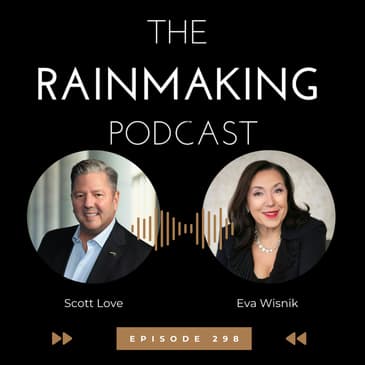
Episode 298 of The Rainmaking Podcast features Scott Love in conversation with Eva Wisnik on how to fit business development into an already hectic schedule—especially for busy law firm partners and associates. Eva explains that many lawyers are trained to “issue spot” (anticipate what can go wrong), which is great for client service but can sabotage rainmaking unless it’s replaced with an opportunity-focused mindset. She reframes BD as “selling through substance”: asking better questions, showing genuine curiosity, and positioning outreach as problem-solving rather than “sales.” Her core message is that most BD resistance is fear (rejection, failure, imposing), and the antidote is shifting from self-focused thinking to client-centered value.
Eva then gets tactical: build a pipeline by staying in touch with intent and consistency, because meaningful business relationships often take 2–5 years to convert. She recommends simple, repeatable habits—“one action a day” (send a thoughtful note, share a relevant article, set a meeting, register for a conference), plus tracking micro-actions to build momentum. Practical examples include handwritten notes, small meaningful gifts, and “thinking of you” outreach tied to something useful. Her three action steps: look backward to identify the clients/relationships you most enjoy and then find more like them, take one BD action daily, and track those actions as wins so the process stays sustainable and you maintain control of your career.
Visit: https: //therainmakingpodcast.com/
YouTube: https://youtu.be/VT4jwamTMtI
----------------------------------------
📖 Subscribe to The Rainmaking Magazine
If you’re serious about growing your book of business, you’ll want to check out The Rainmaking Magazine — a monthly digital publication packed with insights, strategies, and real-world advice for professionals in law, consulting, recruiting, and beyond.
💡 Created for results-driven rainmakers who value credibility and substance.
💥 Now live — subscribe today www.therainmakingmagazine.com
----------------------------------------
This show is sponsored by Leopard Solutions Legal Intelligence Suite of products, Firmscape, and Leopard BI. Push ahead of the pack with the power of Leopard. For a free demo, visit this link: https://www.leopardsolutions.com/index.php/request-a-demo/
----------------------------------------
Eva Wisnik is a career expert and recruiter who has spent three decades shaping the careers of marketing, business development, and communications professionals in the legal industry. As the founder of Wisnik Career Enterprises, Inc., she is a trusted advisor to law firm leaders and CMOs seeking to build and retain top talent that drive business growth.
Eva’s expertise is rooted in her firsthand knowledge of the legal industry. Prior to launching her firm in 1996, she served as the Director of Recruitment and Training for leading firms Schulte Roth & Zabel and Cadwalader Wickersham & Taft. Since then, she has placed over 1,100 professionals in more than 120 AmLaw firms, including CMOs and senior marketing/BD leaders.
A recognized authority on talent and professional development, Eva’s insights have been featured in The New York Times, The Wall Street Journal, and Bloomberg. She is also the author of Your Fairy Job Mentor's Secrets for Success.
Eva has personally conducted over 900 training programs, equipping attorneys with a growth mindset and practical tools to build successful careers.
She holds an M.B.A. in Marketing from Fordham University and a B.A. in Psychology from Barnard College, Columbia University.
Links:
https://www.wisnik.com/about-us/bio-eva-wisnik/
https://www.linkedin.com/in/eva-wisnik/
Learn more about your ad choices. Visit megaphone.fm/adchoices
[00:00:10] You're listening to The Rainmaking Podcast, hosted by high stakes headhunter, author, and professional speaker, Scott Love. You're listening to The Rainmaking Podcast, and my name is Scott Love. Thank you for joining me on the show. So you are a successful practitioner in your work. You're busy serving your clients, but you've also got to bring in business.
[00:00:36] You've got to build a brand that gets the call and also helps you to build trust with people that you don't yet know. So we're going to talk about that and more in our conversation today with Eva Wisnik. Our topic title for today is How to Fit Business Development Into Your Already Hectic Schedule. Now, Eva works in the legal industry. However, if you're not in legal, the concept she talks about today will absolutely apply to what you do, regardless of what professional services that you're in.
[00:01:04] Eva is a career expert and a recruiter for America's most prestigious law firms, as well as the author of Your Fairy Job Mentor's Secrets for Success. She's worked with more than 120 law firms, placed over 1,000 recruitment and marketing professionals in law firms, and conducted over 800 training programs for law firms nationwide.
[00:01:25] This show is sponsored by SurePoint Legal Insights, formerly known as Leopard Solutions, turning legal intelligence into opportunity. And also by The Rainmaking Magazine. Don't lose business to the competition. Read this publication and keep business development top of mind. Visit therainmakingmagazine.com today to chart your course to greater rainmaking success. I hope you get some great ideas from my conversation with Eva today.
[00:01:54] Also, visit the show notes. You'll be able to connect with her directly. Thank you for listening. Hey, this is Scott Love with The Rainmaking Podcast. Our guest today is Eva Wisnick, and our topic is how to fit business development into your already hectic schedule. Eva, thank you for joining me on the show today. Oh, I'm so excited to be here, Scott. Yeah, me too. Me too. And I know that you're a professional, and we'll talk more about your background here in a little bit.
[00:02:20] But I know that you've told me before that business development can be categorized both in mindset and skills. Let me start with the mindset. What would you say is the optimal mindset a law firm partner or up-and-coming associate should have in terms of building their book of business? Yeah, that's a great question. So having worked with attorneys now since 1989, I started in a big law firm in New York City as a recruiter.
[00:02:46] Then the one thing I've observed is that legal training, everything you learn in law school is it surrounds around issue spotting, right, which makes me a great attorney. But issue spotting is also connected with seeing what could go wrong with things. And in order to be a good business developer or a great rainmaker, you have to see what's possible. And so you really need to kind of see where the opportunities are versus what could go wrong.
[00:03:13] And that's a very different mindset than what normally makes somebody an amazing attorney. That's interesting. I've never heard anybody articulate it that way before. And how would you define issue spotting? What does that mean exactly? Well, you know, and to be honest with you, I've been married to a lawyer now for almost 36 years. I met him right before I started law school. And it's one of those cases where it's great because it's very protective and a little bit on the defensive, but sort of like you throw out an idea and somebody says, well, why would somebody want to have lunch with me?
[00:03:40] Like if you say you met this person at a conference, you know, maybe you want to reach out to them and see if you can just sit across from them and find out more about their business. And you're like, why would they do that? Like, why would they want to do that? So it's more that looking for what could go wrong versus what could go right. And I think that serves the client when you have that eye out for them. And so have you seen in the work that you've done, have you seen attorneys that they just hesitate because they say, I didn't get into this to be a salesman?
[00:04:10] A hundred percent. I got into this to be a professional lawyer. What do you think about that? Yeah, I think a lot underneath that is actually fear. I really do. So fear of being rejected, fear of failure, fear of being seen somebody who is imposing on them. And the truth is, you know, a lot of us that we make up in our own heads.
[00:04:28] So what I have observed in 30 plus years of studying lawyers careers and working very closely with them, I've now worked with 120 law firms, I've done over 800 training programs, is that our biggest obstacles, and I think for all of us, not just for attorneys, but for all of us, are inside our own mind. You know, when we start to make excuses, predict the future, not based on fact, meaning like, oh, but they're not going to return my call. So I think it's getting out of that mindset.
[00:04:56] And it's really, really hard, even overthinking. That's what I see even with young lawyers. They will even hesitate to go ask a partner for more information on an assignment they have, which is very similar to a skill of asking a client, you know, what are the issues you're facing? What was great about 2025? What do you see coming up in 2026? Oh, they're too busy for my phone call. Is that truth? Or is that our mind making things up? That's interesting.
[00:05:22] So let's imagine then that you're coaching, let's say it's a partner, somebody made partner within the last year, and they're telling you, I have these issues, or you discover they have them. How would you coach that person? Yeah. So what I say is the best way for attorneys to sell is to sell through substance, right? So you're always going to be more comfortable saying, let's say you were the client, say, Scott, you know, I've so enjoyed working with you in 2025.
[00:05:46] And I'm just wondering, you know, if we could spend maybe 15 minutes chatting, because what I want to understand best is what are the things that are maybe affecting your business or you see that have changed in the last couple of years since COVID? And I just want to kind of really think about the issues so we can maybe preempt them or be ahead of them. But that's very different than saying, hey, Scott, do you have more business for me? Right? That's great. So it's all about, like you said, solving that problem. That's right. That's right. Yeah.
[00:06:14] And putting yourself in your client's shoes, because everybody has things that keep them awake at night. And when we go to experts, whether it's an accountant or a lawyer or a business consultant, we want them to be able to help us with our business problems. I mean, look, you and I both still sell, you know, you're selling the best legal partner talent and business development people into firms. I'm placing business services professionals into law firms. That's what I specialize in and doing trainings.
[00:06:41] And every day you and I wake up and say, how can I be of service to my client? I don't look at it through the lens of how can I sell and how can I make money next year? I say, how can I be of service? And what problems am I hearing consistently that other people that look like them have? And how do I come to them and say, have you thought about this? Or, you know, this law is changing or the regulatory environment is changing or because of the new administration. You know, within change and chaos is incredible opportunity.
[00:07:10] Absolutely right. Yeah. I mean, anytime there is chaos, lawyers are doing well. Yeah. Because they bring that certainty to the client. Problem solving. Yeah. Absolutely. So I think what we do is we don't even start. We just, you know, we think about it in circles. Oftentimes, you know, not the best raymakers, but as you and I know, you know, everybody needs to be thinking about business development today. But some people think, oh, my job is just being an expert lawyer. And I think everybody has to lean into it.
[00:07:37] Because what I love about business development more than anything else, for me personally, it is the ultimate sense of control. Like, right. So I'll tell you again, in 2025, two of the law firms I work with have disappeared. And they ran for a long time. Schulte, Roth, and Zabel, I was there from 89 to 94. They just disappeared into McDermott. Last week, Ken Walder announced that they're going to be emerging with Hogan. The point is, we can't control those kinds of things.
[00:08:06] You could have a great client and then there's a new general counsel where the client gets acquired. But what you can't control is having great business relationships and keeping up and constantly reinventing yourself in terms of what the market needs. Even as a lawyer. That's fantastic. Yeah, that's fantastic. So let me kind of ask you this, and I don't want to go too much into the skills just yet, but what advice would you give to someone that is really hesitating with getting new contacts? Yeah.
[00:08:34] You know, they've done well. They've had good client relationships. They've developed their own work while they've been with the firm. But now it's time for them to go make new connections with people they've never even talked to. How would you advise them? Kind of both the mindset and then the skills of doing those things. Well, there's one thing that I found very, very sobering, to be honest with you. So every year, at the end of the year, I have my accountant who has been with me for years print out who I've worked with and how much money they've paid me.
[00:09:03] And I've noticed that every year, 20% of those clients either disappear or they don't have repeat business. What that means to me, and I remember 29, 30 years ago, I started the business. I started noticing this very early on. If I don't constantly meet new people and fill that pipeline in five years, I will have zero business. That is so motivating, right? So I think, you know, not to scare anybody, but you think about it, you can have a great client, but things change. People retire. They leave the industry.
[00:09:33] All kinds of things happen. So what I say is, if you want to feel in control of your career, investing in this and taking the habits and mindset, it's the ultimate control tool. But I love being in control and I love the freedom of knowing that there will be a pipeline of business, but it has to be really intentional too, right? Yeah, that's right. Now you mentioned a pipeline of business. Tell me about that word. What does pipeline mean to you?
[00:10:00] Pipeline just means to me that, so for example, again, all the statistics have shown that from the moment you meet somebody until they give you business in terms of big law and lawyers and partners, it's going to take on average two to five years, two to five years. It is so unlikely that you're going to be sitting next to somebody at a conference or at a charity event. And like Scott, nice to meet you. And Scott's going to say, oh my gosh, I'm so glad I'm sitting next to you, Eva. I have this business for you. Can you come in on Monday?
[00:10:27] I mean, I've never heard of it actually, but if I sit next to you and I get to know you and I'm asking you really thoughtful questions and I go back to my office on Monday and I send you a link to the article I promised you or put you on my client alert list in a relevant way, not just add you to some list or I say, Scott, I'm actually going to be in Chicago. Is it possible to stop by your office? Make it really easy for them and let me see your space and hear what you're doing.
[00:10:53] If I keep reconnecting with you in a substantive way, in a social way, say, Scott, you know, I'm actually going to be attending this conference. I think you might want to stop by. How about you come as my guest or I'm speaking. Why don't you come into the audience? Or I knew you couldn't make it. So I'm sending you all the articles that I had attached as handouts or a link to the, whoa, I'm like, Scott cares about me. Scott's thinking about how to solve my problems before he's even billing me. Talk about trust, man.
[00:11:24] You know, it's not like Scott's is only going to answer my calls or think about me when he's billing me. We have to build those trusted relationships and we need touch points because the issue today, I think the bigger challenge, even when I started 30 plus years ago, is there was no real internet then, right? There was not even, so we get bombarded by so many things. You have to stay in touch with people. My rule of thumb is every three months to make sure there's something.
[00:11:49] And to make it practical, like I advise, like the training I just did in Chicago that we talked about for one of our mutual client firms, top 20 contacts in my phone. Some of them are existing clients I want to be thinking about. And some of them are people I've met in the last six months, year, and I want them to be on my radar screen. So as I'm reading an article, as I'm on LinkedIn, if I see something like, I thought this would be of interest to you. The subject client says, thinking of you.
[00:12:19] Let me tell you. Very few people don't open an email that says, thinking of you. And then actually give them something that you're thinking of them, right? That's great. You mentioned thoughtful questions. Yeah. What does that mean? What are examples of thoughtful questions? That's a great question. And they're in the training I do. I literally have questions. So again, if I were talking to somebody at the beginning of the year, I'd say to them, you know, when you think back to the last 18 months, what's changed the most in your industry?
[00:12:47] What are issues you're seeing today that maybe you didn't see prior? What are, are there any things that are affecting your business or your pipeline? Because depending who you're talking to, as you might say, we have less deals. We have more deals. What we're seeing is that people are converting commercial space into residential space, whatever industry you're in. You're always looking for the change because you know what's inside the change? Needs. Yeah. I'm asking questions to understand their needs because when I understand their needs,
[00:13:17] and if it's in my, you know, in my ball of, you know, in my universe, if I can help them with, or one of my partners, I could bring that in. I'm always looking for needs. That's great. That's a good way to conceptualize that, to keep that top of mind. I love that. And so let's kind of move to skills. Yeah. Let me ask you this, Eva. What is, what is one specific actionable strategy for turning a networking contact, like we talked about into a valuable professional relationship or client?
[00:13:46] Well, the skill, I want to see skills and habits as related. And the skill is not sales. It's not. I think one of the biggest skills is listening. You know, it's interesting, Scott. I have given the Myers-Briggs type indicator to 7,000 attorneys and the majority of attorneys are introverts, right? And there's this misconception that introverts might not be good rainmakers. I actually think it's the opposite. The biggest skill you need for rainmaking is good listening.
[00:14:15] And introverts tend to be even better listeners than extroverts because they're not talking as much. Now, I know I'm an extrovert. I imagine you might also be, I'm not sure, you know, we've met a few times. 50-50. 50-50. But the truth is, listening. If you're sitting there asking people really thoughtful questions about what, I would even ask it if I met somebody new, I'd say, you know, you've been practicing for 25 years. What do you still enjoy the most about practicing? You learn a lot about their values.
[00:14:44] They might say, you know, what I enjoy most is my team. What I might enjoy most is the problem solving. And once you understand somebody's values, you know how to speak to them too, right? So listening is incredibly important. And the other skill, which I've taught, again, time management was my first class I ever taught. I was trained in the Stephen Covey program 30 plus years ago. And one action a day. I see it as a skill where like every day I'm like, is there something I could send to a client? Is a client I need to reconnect with?
[00:15:14] Like, especially, you know, if it's a holiday period, like my thinking about my clients. I personally, because I practice everything I'm teaching. I really like, if you don't, you're not going to be authentic in what you're teaching. Almost every single Saturday, I say three Saturdays out of the month, I sit there in my kitchen and I have a big box of gifts and notes. And there are different gifts for different people. And I send handwritten notes to my clients saying, thank you so much for trusting me with your attorneys and bringing me in for business development.
[00:15:43] Thank you so much for, you know, trusting us to place somebody with you. I oftentimes find one gift that is like a universal gift, male, female, doesn't matter what age they are. The last two years, it's been an air tag with our name on it. So, and it's what I write in the note is I, I value our relationship so much. I hope this will keep, help you keep track of things you value. I like that theme. That's terrific. And then I send these things out for people who might have young children, you know, it's
[00:16:12] when they get home from a trip, you know, we were both presenting recently at the LMA conference. I send books saying, you know, and people tell me 15 years later, I've had people tell me, Scott, we read that book over and over again. Our kids still mention that book. Thank you for Thanksgiving. So it's that kind of thoughtfulness I find that, that has worked really well. Not, they're not expensive gifts, but they're, they pop in, they, you know, they're sitting on their desk when they get there. I just went to Japan recently. I brought back all these really cool little pictures.
[00:16:42] I'm sending them to clients with notes on them. And it might sound corny, but let me tell you, people really appreciate being thought of. That's, that's the bottom line. I think they do. I think they do. I went to a conference, an LMA conference. I saw probably about 40 to 50 different law firm, internal recruiting people and leaders of firms and people that I'd known. A lot of people, I'm just not working with them right now. Everybody got a handwritten note, hand addressed, because that's just an investment in saying, hey, I saw you.
[00:17:11] I'm glad we waved across the room. Hope we can talk next time. Yeah. We both had that conference in Denver. It was fantastic. It was my first time. Oh yeah, that's right. Yeah. I saw you speak. That's where I saw you speak for the first time. You're fantastic, by the way. Oh, thank you so much. But the investment, that's it. So when I, in terms of habits or skills, I think of you plant seeds, right? Every time you meet somebody who could be a potential client, it's a seed. And then you follow up, you send them relevant information.
[00:17:36] If you see something on LinkedIn, you know, you respond to it in an authentic way. Here's the part that I find is tricky. You never know which seed is going to turn into like a full bloom and this amazing long-term relationship. It's actually hard to predict than you think it is. But you got to be doing that consistently. And the other end of it is for a lawyer, a partner to have a great book of business. How many clients do they actually need? It's not 30 or 40 in those cases.
[00:18:05] I mean, I've seen lateral partner questionnaires where, you know, I see business plans. I've seen it where they've got four clients and they're doing $4 million a year with those four clients that are moving over. That's right. That's it. And that's why I think, you know, it doesn't have, but it has to be consistent. The other end of it, you know, in terms of personal motivation around this, one is I love being in control and I think most attorneys do. So I don't want to wake up and be like, oh man, my entire book of business has dried up,
[00:18:32] even though I had these clients for various reasons beyond my control. But the other part that I love that I find very empowering is, you know, every now and then, I think we all get a client that is just not fun to work with for whatever reasons. Maybe it's a values clash, maybe the way they treat people, including ourselves. And what I love is that it doesn't happen very often, maybe like once every five years. But if I really don't want to work with a client, I don't because I have enough business where I get to choose who I work with.
[00:19:02] And this is not an arrogant statement. This is, you know, being authentic to my own values. You know, if I have a client who's asking me to poach from firms that I won't poach from or, you know, ask me to do something that just really feels like it goes against our values, I say, you know, I still appreciate it, but I'm not going to be able to work with you. And I never feel desperation because I've got this pipeline of other business that I'm going to be okay no matter what. That's great. You know, one thing, and I want to bounce this idea off of you. When I started the podcast, it was right after COVID.
[00:19:31] And the theme I noticed during COVID, especially asking business development coaches, how do you make contact with people during this time of crisis? And they said, curiosity. And I've noticed that that theme carries over. Those people that are truly successful in what we're talking about, they're just curious. What do you think about that, Eva? I love the word curious. To me, like I translate directly to the needs. Like, so I feel like, I mean, I have clients I've been working with literally for, you know,
[00:19:58] 25 to 30 years, but their business has changed. They've opened up new offices. They've expanded new practice areas. So the curiosity goes around, like, tell me how things are changing for you. And how can I be of great help? I end almost every conversation with clients. You know, what's going on? Can I be a resource? Forget about what I personally do for you, training or placement. Is there anything else going on? And they might say, well, actually, my kids are applying to colleges. And you went through that recently with your kids. What advice do you have?
[00:20:27] Or, you know, I saw on LinkedIn that you went to Italy. What are your top restaurant? It doesn't always have to be just work. You know, what I love is when, and Stephen Schulte, who was the founder of Schulte, you often say about the firm I grew up in, I started there when I was 25 years old. He once said this to me, and it was, we're talking 35 years ago. He said, if you can make your friends, your clients, your clients, your friends, your life will be good. And I have to tell you, at this point in my life, the people who I'm closest to in life,
[00:20:55] most of them are my clients. Right. And I don't call it, it's work-life integration. Right. So if I, you know, as soon as I bought my beach house, the first people that came over were people that I've worked with for years, you know, and it's not, it makes it so good. We've, we've raised kids together. We've gone through life transitions together and it's, it just, I don't know, makes life so good. And you see that. That's fantastic. It is. Yeah. I really have seen that. And it's not manipulative.
[00:21:22] It's not, it's, you know, and look, the one thing I feel sometimes women in particular, sometimes have trouble thinking about that. Right. You know, like it feels like it's separated because like, what if it's a male and I'm a female, what are they going to think? Bring an associate with you. Only meet them for breakfast. If there are things that are in our own minds that are barriers that you feel like, I don't know, how's male client going to think about me asking them out for a drink? Put some stuff around that's going to make you feel more comfortable, but don't stop taking action. That's great, Eva.
[00:21:51] Let me, let me kind of bring this to a close here. And I appreciate you being on the show and I want to have you back on and kind of go deeper on some of these topics that we talked about. But if you could summarize and give us three action steps law firm attorneys can take to really start implementing those ideas. What are those three action steps, Eva? So the first thing I would do is look backwards. You know, I think we, if you just even look backwards for the last 18 months and say, who have I most enjoyed working with? It doesn't have to be your client. It could be a client of the firm.
[00:22:21] If you're an associate, be a client of a partner. And what is it about that client? Is it the work? Is it the dynamics? And like literally profile them and see where can I find more of those people? Where do they hang out? I would even ask the client, you know, if it's, let's say it's associate general counsel. So, you know, Scott, what's the main professional association for ensuring people who do what you do? And there's a chance that that client on the other side might say, well, it's blah, blah, blah. And actually I'm on the board. I'm speaking.
[00:22:49] And you might say, do you think I'm coming with you to the next meeting on my own? I'm not going to bill you. I want to learn more about your industry. So profiling what works. One action a day is my second one. An email, a text, registering for a conference, sending that handwritten note. One action a day. I often do it on my way to work. I'll just be, I'm commuting on a, now I commute on a ferry, so commute on Metro North. A quick note, thinking about you, what's going on? Can we meet? I'm going to be in Chicago.
[00:23:19] I'm going to be in DC. I'm going to be in Boston. Can I stop by and say hello? One action a day. And then the other thing I think is the third thing I would say is keep track of those micro actions and don't, don't rank them yet. Just write them down. Because I think when I see that I've already done five things in the last five days, even if I get a piece of news saying somebody's not going to hire me or a candidate didn't get an offer, I'm like, whoa, I already have momentum. I'm going to be fine. So keeping track of those actions. I think we're so great at keeping track of our to-dos.
[00:23:50] We need to keep track of our achievements. And the achievement is not, I landed this big client. The achievement is the process. You don't always have control. Yeah. Yeah. Monday, send an email. Tuesday, I registered for a conference. Wednesday. Yeah, send an article. You know, send a link. Come, yeah. Those are my three pieces of advice. Well, Eva, thank you for being on the show. But really, tell us about what you do. I know you mentioned recruiting and your training. Tell us about your services, what you'd like our listeners to know about. Yeah.
[00:24:18] So this March of 2026 will be 30 years since I started the company after working inside a law firm as a head of recruiting and training. And we placed marketing, recruiting, professional development and practice management people into law firms. Placed about 11, 1200 at this point. And I train lawyers on time management, business development, interview training, the skills they don't learn in law school. So I'm an MBA. I'm not an attorney. And I try to make sure that they have the skills, habits and mindset they need to lead
[00:24:48] the most successful and fulfilling lives. That's great, Eva. Thank you for being on the show. And I look forward to having you back on in the future. Thank you so much for having me, Scott. Great time talking to you. Thank you for listening to the Rainmaking Podcast. For more information about our recruiting services for international law firms, visit our website at attorneysearchgroup.com.
[00:25:14] To inquire about having Scott speak at your next convention, conference, sales meeting or executive retreat, visit therainmakingpodcast.com.