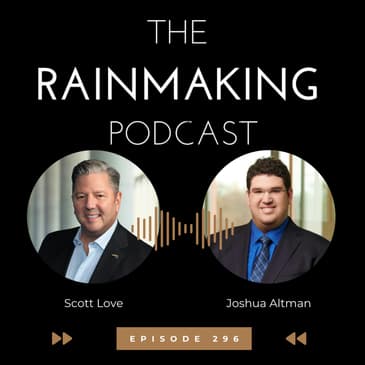
In Episode 296 of The Rainmaking Podcast, Scott Love interviews Joshua Altman, founder of Beltway Media, on how professional services firms can repurpose content to drive business development and brand visibility. Instead of treating webinars, interviews, white papers, or conference panels as “one-and-done” events, Joshua explains how a single piece of thought leadership can be transformed into blog posts, LinkedIn articles, short-form video clips, podcasts, email newsletters, and even white papers. By using a structured content calendar strategy, professionals can multiply their marketing output without constantly creating from scratch.
Joshua outlines a practical framework for modern content marketing built around four engagement pillars: what clients read, see, hear, and experience. He emphasizes planning ahead, avoiding platform dependency, and leveraging existing material to build consistent visibility across channels like LinkedIn, YouTube, email marketing, and professional blogs. For lawyers, consultants, and financial advisors looking to grow their brand and generate inbound business, this episode delivers tactical guidance on scalable content marketing, personal branding, and strategic media repurposing.
Visit: https://therainmakingpodcast.com/
YouTube: https://youtu.be/jghfwLIYgNU
----------------------------------------
📖 Subscribe to The Rainmaking Magazine
If you’re serious about growing your book of business, you’ll want to check out The Rainmaking Magazine — a monthly digital publication packed with insights, strategies, and real-world advice for professionals in law, consulting, recruiting, and beyond.
💡 Created for results-driven rainmakers who value credibility and substance.
💥 Now live — subscribe today www.therainmakingmagazine.com
----------------------------------------
This show is sponsored by Leopard Solutions Legal Intelligence Suite of products, Firmscape, and Leopard BI. Push ahead of the pack with the power of Leopard. For a free demo, visit this link: https://www.leopardsolutions.com/index.php/request-a-demo/
----------------------------------------
Joshua is an experienced storyteller, strategist and creative force with more than two decades of experience shaping how people see, hear and connect with big ideas. Today, he leads beltway.media, a bold D.C.-based communications firm that helps brands and organizations cut through the noise.
Before founding the firm, Joshua was a multimedia journalist at The Hill, diving deep into federal policy including energy and the environment, tax and finance, healthcare, immigration, defense and criminal justice, and covering high-stakes election cycles right from the front lines.
For more than two decades, Joshua’s served as a member of The Telly Awards Judging Council, a select group of past winners who judge each year’s annual competition.
Now he works with everyone from scrappy startups to federal agencies including the U.S. Department of Justice and U.S. Department of Commerce, helping them refine their message, elevate their brand and truly connect with their audience, whether that’s customers, investors or the public at large. From reimagining agency websites to crafting magnetic stories, Joshua’s work has one goal: to make communications clear, compelling, and impossible to ignore.
Education
Georgetown University, M.A., Communication, Culture and Technology
The George Washington University, B.A. Journalism and Mass Communications
Links:
https://www.linkedin.com/in/joshuaialtman/
Learn more about your ad choices. Visit megaphone.fm/adchoices
[00:00:10] You're listening to The Rainmaking Podcast, hosted by high stakes headhunter, author, and professional speaker, Scott Love. You're listening to The Rainmaking Podcast, and my name is Scott Love. Thank you for joining me on the show. Let's say that you're a professional services provider and you've got some media. Maybe you were interviewed over video by a reporter discussing his current event, or maybe
[00:00:38] you did a trade association webinar where all of your prospects can hear your expertise and decide maybe they want to call you. What do you do with those single events in media? Is it one and done or can you repurpose that content? We're going to answer those questions and more in our conversation with Joshua Altman. Our topic title today is Repurposing Content. Let me tell you about Joshua. He is an experienced storyteller, strategist, and creative force with more than two decades
[00:01:07] of experience shaping how people see, hear, and connect with big ideas. Today, he leads Beltway Media, a bold DC-based communications firm that helps brands and organizations cut through the noise. Make sure you connect with Joshua. We put all of his contact info on the show notes of this podcast, so connect with him and learn more about how he can help your organization. And I think you're going to get some really good ideas, real tactical ideas in our conversation today.
[00:01:35] This podcast is sponsored by SharePoint Legal Insights, formerly known as Leopard Solutions, turning legal intelligence into opportunity, and also by the Rainmaking Magazine. Don't lose business to the competition. Read this publication and keep business development top of mind. Visit therainmakingmagazine.com today to chart your course to greater rainmaking success. Thanks for listening, and I hope you get some great ideas from my conversation with Joshua today.
[00:02:08] Hey, this is Scott Love with the Rainmaking Podcast, and our special guest today is Joshua Altman, and we're talking about repurposing content. Joshua, thanks for joining me on the show. My pleasure. Thank you for having me. Yeah, this is great. Thank you so much. And I'm excited about hearing what you have to say, because you're in this world of media, of dealing with professionals and helping them build their brands and things like that.
[00:02:32] And let me ask you this, where do you think most people go wrong in not repurposing content? I think it's that they don't really repurpose. You know, a lot of people think, I'm writing this thing, I'm doing a video, it has to be original every time. I can't repeat topics. I can't repeat ideas. Repeat stuff. It's great. If someone notices, that means they're paying attention and they're engaging with your content.
[00:03:00] So there's nothing wrong about repeating. Yeah, you can build a whole strategy on this, right? Absolutely. And that's what we do with people is we start with one idea. So let's say, you know, it's, you know, the best cities for a law firm, you know, where they're going to make your hubs. Well, then that's, you know, one post is kind of the intro. You have five cities listed. That's five more posts right there. You could scale that way.
[00:03:27] And when you start with a content calendar, you can use Excel. Airtable kind of has actually a built-in content calendar template that you can use. Then you can really start seeing very easily when you're planning this. Okay. So we have our posts with our five cities. Then we have each city has a post about, you know, why we think this is a great hub. And then once you start writing why each one is a great hub, you get three, you know, bullet points out of that three sections.
[00:03:57] Well, then each one of those can become a new post. So every time you're really building on what you have, then you can actually do this in the other direction. You have all of this content that you've kind of broken out. Well, that can become a white paper on a multi-city law firm because now you can assemble in the other direction. It just never ends, right? Yeah. Because every time you kind of start making lists, you know, sections, that section can
[00:04:26] become a post. And maybe it's not totally strong enough to stand on its own. Well, then two of them that are related can become a post. So you really don't have to be constantly fishing for new ideas. It's there. You just kind of have to see what you've done. And if two things seem kind of similar, that's similar to you. You've written them. You've read them. You know them. Most people are not going to see both of them. And like I mentioned, if they do, they're engaged. That's great.
[00:04:54] If they are so engaged, they notice. Wonderful. That's a great idea. So let me kind of pause for a second and kind of go back a little bit because the people listening to this, they're not professionals in communications like you. These are professional services practitioners who also have to get business. Many of them have marketing teams. They might have marketing departments. They've got a budget. But they still have to take their own brand and they're responsible for pushing that out. That's what they have to do. Tell me what this means.
[00:05:24] What is a content calendar? For somebody that's not sure what that is, how would you define that? Just like you have, say, a calendar of your events, of your personal calendar, your business calendar, things that are coming up. Content calendar, pretty much the same thing. It's a list. And it could really be as simple as a list of what you're planning and its current status. So it could be that you have, you know, you're in financial services.
[00:05:50] You could have, you know, all your posts listed by type. You know, and by type, I mean what medium it's going in, the platform, and then also your subject. So you could see, you know, if you're coming up to April, that that might be when you start doing, you know, taxes stuff. You know, that's coming up. People are going to start getting their tax forms pretty soon. So that might be when you start pushing out, you know, in January, February, file taxes
[00:06:20] early. You start seeing your calendar shift to April. Don't miss the deadlines. Here's what you need to do. So it's a really, just like a calendar is a very visual way of seeing what you have going on. The content calendar is the same. It also helps you keep track of its current status. So it's an idea. You know, you have a draft who it's assigned to, and you could really start planning these out a year or more in advance. Obviously, within the month, it gets more specific. Within the quarter, a little less.
[00:06:49] Within six months, you're getting a little more vague. But if you know you have a conference every year or every two years as a conference, well, just put it on there. And you can start planning working back. It might not be. We're writing about this a year out. But you know it's there. And it's one of kind of your, you know, core things that's on your calendar. Just like it's on your personal calendar or business calendar. So you could be, let's just say, an intellectual property attorney.
[00:07:17] And you're attending the Intellectual Property Law Association annual conference in Fort Lauderdale in the spring of next year. You could probably interview some of your clients that are going to be on panels. We already know. You know, I saw that you're going to be on a panel. I actually write a post on this. I'd like to interview you for that. Then you get to know them better. And then, you know, you might have one each month. And then you're actually at the conference. And then you do research on a certain topic. You write a report.
[00:07:45] And then you could have other people that you've met at the conference interview them. And then from each of those, take like a video from that, right? Am I on the right path here, John? That's exactly. And you're talking even with the repurposing. Because that video, you can transcribe it. You can embed it on your blog. That's great. It can go in your newsletter in one form. It goes on LinkedIn in another. So that's now four different pieces, minimum, that you've got in off of one 30-second.
[00:08:14] Let me hold up my phone and record. You know, I always say if you're going to do those little phone interviews, get a better microphone. Get a little light. I was a news producer doing video. You know, that's where I started my career. And light and sound are two things that really get overlooked. And you've got to know people need to be able to see it. People need to be able to hear it. And even if all you're planning on doing is transcribing it later, you need to be able to hear it.
[00:08:44] So that's great, too. Just have a little bit of an external microphone. And the software's gotten better now that, you know, you can tell it, I want to use the microphone. That's only what's in frame. But having that little external that's really helping you out makes it much better for you and your audience. Yeah, indeed it does. So let's kind of go over like a listing of all the different media that we can use. Number one, there's a white paper, right? Yeah. And how would you define that?
[00:09:13] Is that the same thing as a special report? How would you define that? Something a little longer form. It's not totally done. You know, it's the first, not the first draft, obviously, because it goes through drafts when you write it. But it's something that, you know, is still being worked on in the grand scheme of working on it. Now, when we think of, you know, types of media here, what we do is we basically think of there are four ways that people experience media. What they read, what they see, what they hear, and what they experience.
[00:09:43] You talk about the white paper, you know, that's pretty much what they read. It's there. People know it. What they see, that, again, when you're reading, most cases, you're seeing something. But also, you know, you have pictures in it. You have charts. You have graphs. There's more than just the text on the page. What you hear, podcasts, if you're going to be doing those little videos at conferences, that's great. Again, lights, microphone, what you see, what you hear. And the last one is what you experience.
[00:10:11] And people kind of think of this as experiential events, conferences, things you actually experience. And that's half of it. There's another half to it, which is how you experience what you read, see, and hear. Is it that long PDF you're reading on your phone? Is it a short blog post? That's a very different experience. Is it an email newsletter that pings to you? That's a different experience. Is it on your desktop, on mobile, on a tablet? All different.
[00:10:40] In terms of, you know, this podcast, is someone going to listen to it while they're walking the dog like I do? Or are they going to sit and watch the YouTube video? You know, really make it an appointment viewing. They're seeing content. They're hearing the same thing. One seeing, and they're two totally different experiences. Experiences. So that's really what we think about when we think of media. Right. So give me an example of what one of your clients has done. You don't have to mention the name of the client, of course.
[00:11:07] But what were some things, some specific projects you worked with them on where they were able to do the work once, you know, in terms of creating content and repopulate that in different avenues? Yeah. So one thing that, you know, I really believe in is everything you do should be useful. You know, an advertisement for advertisement's sake probably won't get you the same result as an ad that's useful. So we made these, you know, for a managed service provider.
[00:11:36] What they do is, you know, they go into offices. They do a lot virtually. They have, you know, corporate IT help desks for, you know, a number of companies that they support. And they get a lot of people asking, how do I connect to the conference room AV system to show my presentation? How do I troubleshoot that the printer doesn't work? Pretty day-to-day office things that we all deal with.
[00:12:01] Well, we made these help cards that they basically just put in every single room. And they support other companies as well, including co-working spaces. So not everyone is a direct client of theirs. They're kind of, some are people who are in the co-working space as members, some just for the day. So it served also to get those day people to know about this company who they never heard of before. Because they're just in this co-working space for the day.
[00:12:30] And we took each of those, put them online as well, made them their own blog posts. They became email newsletters and social media posts as well. So what was really designed to be a very specific problem solver, we have a lot of people calling to hook up to the, you know, the video conference presentation system. And taking away from, you know, what they were doing to support clients that couldn't be resolved by just, you know, reading the instruction that was put right there in front of them.
[00:13:00] Because that made longer wait times for their help desk. That made people sit on hold and get frustrated. And other time-sensitive things maybe weren't getting resolved as quickly. So this solved a lot of problems on a lot of ends for a lot of people. That's great. So let me start with the white paper.
[00:13:20] If somebody's doing a white paper and they haven't done one before, or they're just not sure how to structure it, what are some tips you can give someone that's looking to write a white paper? Don't start with the white paper. Start with your emails. Start with your, this is where the repurposing can really help. Because if you've been doing all those other things, your content is not necessarily written, but outlined. You know your big themes.
[00:13:48] So if you're, again, talk about doing a multi-city, mid-sized law firm. And that's what you write about. You've got a lot of that written already. Yeah. You've got a lot of that. Or at least outlined that you can use that structure for your white paper. And you don't have to start over. You know, one of the hardest things with content creation is staring at a blank page. You know, we've all done it. No matter what industry you're in.
[00:14:14] If you're in law, you're in finance, you're in healthcare, that blank page can be the hardest thing. This way, you don't have to do that with that white paper. You have something that you can, again, maybe it's not exactly what you want to say. But it's that outline. And it's a lot easier to cross something off and say, well, maybe listing cities isn't the best here. But we can instead tell our story as, you know, cases that are publicized, obviously.
[00:14:43] So because you can't obviously violate that confidentiality. But things that have been in the news, that have been reported on, that are, you know, maybe done already. Right, right. You could tell this story through something people understand, like cases. And that might be a better way than just listing cities. But it's a lot easier to say, cross off city list, insert new idea, than to stare at the blank paper and say, what do I come up with here? Yeah. I like that idea.
[00:15:11] And as you mentioned that, a lot of the white papers I read by attorneys are usually written about some other case that's going on right now. Yeah. They're not involved in it, but it's in the news. People read about that. So they want to learn about that. So they write about that. Another tip I'd heard from somebody I wanted to bounce off you and see what you think is go to the conference websites and look at what are all the breakout panels on. Yeah. And if there's 30 different breakouts in a big conference, that's like 30 different topics that you could use.
[00:15:40] What do you think about that idea? And what are some other similar ideas you've given people? I think that's a great idea that you can use. You know, look at, you know, the conferences, look at the ones you attend, look at the ones that maybe you don't attend. Because don't limit yourself because you can't attend everything. Maybe there aren't conflicting dates. Maybe you've got a wedding that weekend and you can't go. So look at the things that you might want to attend. And again, a content calendar helps with that because you have the conferences kind of on your calendar.
[00:16:09] Look at the breakout settings, but don't be tied to them. You know, if it's, you know, a breakout session and it's on new procedural rules, that might not be the most interesting thing to turn into a blog post. Important, of course. But you might be able to take that idea and make it something that's your own. So don't limit yourself to a one-to-one. Yeah. I like the way you've structured everything. What do people read? What do they see? What do they hear? What do they experience?
[00:16:38] Have you seen many professionals have success with being a guest on a podcast? Like, here's a white paper I wrote, and I'm going to reach out to this podcast host that's in the healthcare industry and see about being a guest on their podcast to discuss what I wrote. Have you seen that as a viable strategy before? It's great. I hear on your podcast talking.
[00:16:59] I recommend podcasting to a lot of clients, both if they're looking to do a personal brand and also if it is for their business. And especially if you are a smaller, mid-sized professional services firm, you know, law, finance, healthcare, any of it. There isn't much of a difference for the branding perspective. People see you. So that's who they're kind of associating with it. So looking at it as the business and the person, not always the easiest to split apart.
[00:17:31] And, you know, definitely, you know, use podcasts. Use, look at, you know, are people that you need to read it? Are they listening to these podcasts? If they're not a podcast audience, if they're an audience that uses something else, then use that. But there are podcasts, as I'm sure you know, on almost every topic. I know. Yeah. That's why I recommend podcasting to people. It's a really great way to just get stuff out. Yeah.
[00:18:01] And you can find a podcast on anything. And what about video? What's the context of video? Is it something that's posted on LinkedIn as a video? Is it YouTube? What are the different ways that professionals have used video to kind of push out some of their content? So there are a couple of different ways, and it depends on the platform. There's Instagram. There's LinkedIn. There's YouTube.
[00:18:26] You know, there's embedding it all on your own channels, you know, on your websites and your emails. So there are a lot of ways. Short form video, very popular. Things like if you're on a podcast, you know, take it, chop it into a 15-second bite, put it up, add the link. That can be a great way to get engagement. I've seen longer things. You get those whole conference panels that could just be recorded, you know, in pretty good quality and put online for people who couldn't go.
[00:18:56] And that's a great way for engagement. Yeah. You know, one of the first pieces of advice I got at my first internship in journalism, I asked our senior producer, you know, how long does this piece need to be? And she said to me, however long it needs to. And I'm like, this has to be broadcast. Like, we have a clock in, you know, our broadcast. How long should it be? It's like, however long it needs to.
[00:19:19] We have, we've built in that flexibility in our intros, in our transitions, that we could have someone who's going to, you know, do that recording, talk a little less, maybe talk a little longer. So you have, you know, the difference was not between two minutes and 12 minutes, but you have some flexibility in that time. So when you're making these videos, don't think of, you know, I was told that I shouldn't have more than a 30 second video on this platform and it must be this.
[00:19:49] And I got to hit these things in that amount of time. Like, that's a good guideline, you know, is going to be industry dependent, of course. But those guidelines are helpful. But if you're told 30 seconds and you're coming in at 34, that's not the end of the world. Just comfortably do, you're 34. If you're coming in at, you know, 17 minutes, 17 seconds, that's fine. Tell it in 17, you don't need to fill. Right.
[00:20:17] So if somebody wants to do more of this, what are some of the pitfalls you think they should avoid? What are the common mistakes you've seen professionals fall into where they can't reach their goals in relation to what they're pushing out in terms of content? Well, in video specifically or just content generally? Just in general. I think one of the first ones is they think everything has to be original.
[00:20:42] That they think they have to write or produce something new every single time. They don't. And there's a lot of stress over that. And you don't have to do it. You know, another big one is that they're not planning in advance. And that's where that content calendar comes in. Yeah. Think about where you need to be and what you need to be doing six months from now. And we come in a lot and people say, well, we're launching this new initiative.
[00:21:12] We're doing our new program, our product in, you know, a month. It's like, how long have you been planning this? A year. That's when you should be talking about your communications. It should be right there as a part of your general planning with your product team, with your finance team. Because it's going to be important. That budget is going to matter.
[00:21:34] And if you start springing it a month before your launch, you are now 11 months behind at least where you need to be for that conversation. So think about it as early as possible. And that's kind of why, you know, we come into a lot of companies is they maybe have a marketing person, but not someone in their leadership. So we come in to fill that leadership gap so they are thinking about it a year or more from the launch date.
[00:22:01] And it's always part of that big strategic conversation. That's great, Joshua. Well, I want to thank you for being on the show and sharing these insights with us. And as always on our shows, we like to end it with three action steps so that people can take action and reach their goals. What would be three action steps you'd like to share with us, Joshua? The first one is definitely block out time to review your website, your other existing communications materials, whatever those are for you personally and for the company.
[00:22:31] So your business LinkedIn page, your personal LinkedIn page, your newsletters. If you have white papers, what's on there? Look at your corporate blog if you have one on your website. When was the last time someone posted something? Because sometimes you have it and just kind of gets forgotten. And that's a great resource because people are going there. The next one is definitely look at a tool or a platform that you can try to avoid becoming locked into something now.
[00:22:59] When we're recording this, you know, it's kind of in the news now that TikTok signed a new deal to be able to stay in the U.S. Well, you go back about a year, they were going to disappear. Right. So, and a lot of people were really panicked because they built their business around TikTok and organic growth on TikTok. And if that went away, that was going to be disastrous for them. You saw big ads that TikTok was putting out about this.
[00:23:26] So avoid becoming locked into a specific platform. When was the last time you checked your MySpace? Platforms go away. And the next one is brainstorm with your team or with an outside consultant if, you know, you're kind of a solo practitioner about the four ways people are experiencing your information. So how, what do they read? What do they see? What do they hear? What do they experience?
[00:23:50] And think about very specifically about your firm, about what you do, because how they experience it for an entertainment company is going to be different from how they experience it for lawyers, for finance, for healthcare. So definitely, you know, look at it broadly. How do people read? Okay. How are they reading specifically our content?
[00:24:15] And then when you get to experience, be sure you think about it in terms of, yes, big things that are experiential, conferences, pop-ups, but also how are they experiencing what people read, see, and hear. That's just all great information, Joshua. I want to thank you for being here and sharing your wisdom. I know this is going to help a lot of people. Before we let you go, though, I want you to tell us about what are your services? What do you do? What do you have that you'd like our listeners to know about? So what we do is we are fractional chief communications officers.
[00:24:44] That means we focus on two big things, you know, shape perception and building and maintaining trust. It's a slightly different role than what people are a little more familiar with, the chief brand officer and the chief marketing officer. You know, what we do as chief communications officers, we come in, we take this integrated big picture view, you know, read, see, hear, and experience about how your messaging impacts reputation, growth, and stakeholder confidence.
[00:25:13] You know, it's a very hands-on role, the communications role. We are making sure that you have consistent storytelling across your internal and external channels. That if you have a newsletter, it's consistent with your LinkedIn. And we're fractional. So we're contractual. We're part-time workers. But we are fully integrated with your team, with your company.
[00:25:38] So if you have an external agency who you use, we can help with that relationship. If you have a marketing strategist, a social media specialist, but no one in that leadership role doing communications, we now take on that leadership role, usually away from a founder, a partner, an operations director, someone along those lines who's doing it because there's no one else. We are that new person who can help you with that. This is terrific, Joshua.
[00:26:06] And for everybody listening, we're going to put all of Joshua's content information, his website, his LinkedIn link on the show notes. So go to the show notes and you'll be able to connect with Joshua today. Joshua, thanks for joining me on the show. And again, thank you for sharing all of your great wisdom with us. Thanks for having me. Thank you for listening to The Rainmaking Podcast.
[00:26:29] For more information about our recruiting services for international law firms, visit our website at attorneysearchgroup.com. To inquire about having Scott speak at your next convention, conference, sales meeting, or executive retreat, visit therainmakingpodcast.com. Thank you.