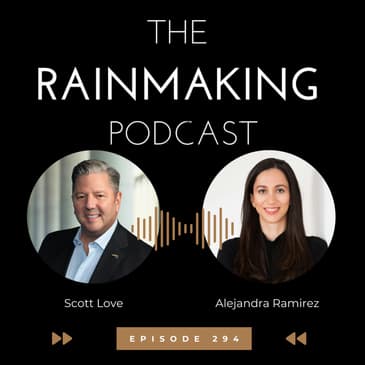
Episode 294 focuses on the gap between “we have great culture” and the day-to-day behaviors people actually experience inside a firm. Scott interviews Alejandra Ramirez, founder of Ready Cultures and a longtime internal communications leader in big law, on what it really means to “walk the culture talk.” Her definition is simple but demanding: culture is credibility—aligning stated values with observable actions. She argues firms should start by auditing whether claimed values (like collaboration or transparency) show up in real behaviors (cross-selling between practices, sharing information with BD teams, etc.). Culture isn’t a slogan; it’s a set of conditions leadership actively creates, and when words and actions don’t match, trust erodes and performance suffers.
Alejandra then lays out how leaders close the gap: clear, consistent, actionable communication; active listening and feedback loops; and tying culture initiatives to measurable outcomes like engagement, retention, risk reduction, and cost savings. She emphasizes that firms recruit laterals on numbers but often lose them on fit—so culture must be evaluated explicitly during hiring through behavioral questions and by ensuring the “recruiting experience” matches the lived experience after arrival. Her three action steps: lead with curiosity (listen and ask questions), audit your internal communication system (tools, messages, measurement), and treat culture as a verb, not a noun—something you repeatedly do through choices, behaviors, and reinforcement. She also offers a practical “3H” framework (Head, Heart, Hands) to help leaders communicate change: facts, why it matters, and what to do next.
Visit: https://therainmakingpodcast.com/
YouTube: https://youtu.be/iwev7mcnzcw
----------------------------------------
📖 Subscribe to The Rainmaking Magazine
If you’re serious about growing your book of business, you’ll want to check out The Rainmaking Magazine — a monthly digital publication packed with insights, strategies, and real-world advice for professionals in law, consulting, recruiting, and beyond.
💡 Created for results-driven rainmakers who value credibility and substance.
💥 Now live — subscribe today www.therainmakingmagazine.com
----------------------------------------
This show is sponsored by Leopard Solutions Legal Intelligence Suite of products, Firmscape, and Leopard BI. Push ahead of the pack with the power of Leopard. For a free demo, visit this link: https://www.leopardsolutions.com/index.php/request-a-demo/
----------------------------------------
Alejandra Ramirez is an internal communications strategist and the founder of Ready Cultures. With nearly 20 years of experience in communications—including 15 years in Big Law and professional services—she helps leadership teams close the gap between what they say and what their people actually hear, especially in high-stakes environments where clarity directly impacts client experience and results.
Her work focuses on executive messaging, crisis communication, and organizational alignment during moments of growth, change, and pressure. By strengthening internal clarity and trust, Alejandra helps firms improve execution, reduce friction, and deliver more consistent, high-quality client service—the foundation of sustainable rainmaking.
Links:
Website: https://www.readycultures.com/
3H Framework: https://www.readycultures.com/3h-framework
LinkedIn: https://www.linkedin.com/in/malejandraramirez/
Learn more about your ad choices. Visit megaphone.fm/adchoices
[00:00:10] You're listening to The Rainmaking Podcast, hosted by high-stakes headhunter, author, and professional speaker, Scott Love. You're listening to The Rainmaking Podcast, and my name is Scott Love. Thank you for joining me on the show. Have you ever heard people talk about how important culture is in an organization, but then you don't see that culture reflected in the actions of people there?
[00:00:38] We're going to dig into that topic today with our expert Alejandra Ramirez. Our topic title today is Walking the Culture Talk. Alejandra is an internal communications strategist and the founder of Ready Cultures. With nearly 20 years of experience in communications, including 15 years in big law and professional services, she helps leadership teams close the gap between what they say and what their people actually hear,
[00:01:06] especially in high-stakes environments where clarity directly impacts client experience and results. I hope you get some great ideas from my conversation with Alejandra today. Visit the show notes for direct links to her and her LinkedIn page and some of the other resources that she mentions on our interview. As always, this podcast is sponsored by SurePoint Legal Insights, formerly known as Leopard Solutions, turning legal intelligence into opportunity.
[00:01:35] And also by The Rainmaking Magazine. Don't lose business to the competition. Read this publication and keep business development top of mind. Visit therainmakingmagazine.com today to chart your course to greater rainmaking success. Thanks for listening, and I hope you get some great ideas from my conversation with Alejandra today. Hey, this is Scott Love with The Rainmaking Podcast.
[00:02:01] Our guest today is Alejandra Ramirez, and we're talking about walking the culture talk. Alejandra, thank you for joining me on the show today. Thank you for having me. It's great to be here. And I'm excited about this particular topic because we hear about culture all the time. When I'm working with law firms about recruiting, they talk about we've got great culture. Everybody's got great culture, but I don't think people are really walking that culture talk. So tell me this. How would you define that?
[00:02:29] What does it mean when we say that somebody is walking the culture talk? How would you define that? That's a great question, and it's something that I see pretty regularly. I would say that to take a quick step back, what I see often is companies, law firms, is where my background is in. And I saw that often when I was in-house, but I also see it in other industries as well, which is companies will list values and send out some kind of email about here's the new values for the year. Here's our new plan with our values.
[00:02:56] But then none of the actions that they take match those values. And so to me, defining walking the culture talk is about aligning words with actions, right? And thinking about what are the behaviors that tie back to the values that you claim, you know, you stand for. And so to me, a culture is a living, breathing thing at a company. And it's something that like in science, when you culture something, you're creating conditions under which you want to grow.
[00:03:25] And that's an essential piece of making sure that when those words and actions are aligned, you are culture, you're building that culture that works for your end goal and your strategic business objectives. Right. Thank you for that. That's really good. And so let's say we're in an organization and we have an idea of what our organization's core values are. And, you know, the three building blocks of an organization values, vision and mission.
[00:03:51] And what's interesting, I found is that at least in the legal world, they might have an idea of what our values should be, but it might not be really articulated among the partnership or the associates. They just haven't really brought that front and center. How do you think a law firm or professional services organizations leader can really get everybody on board with what these values are?
[00:04:13] I would say you need to start by essentially auditing what the values are and which behaviors exist at the law firm or organization that match those. And what I mean by that is if you have a value that says that you are incredibly collaborative and throughout collaboration, then you need to be checking if that's in fact what's happening.
[00:04:38] And you look at that and say, OK, what is cross selling look like at a law firm, for example? Is your, you know, is your tax practice speaking to your finance practice because maybe there's opportunities to cross sell for clients? Are you, you know, sharing information about one client that might help work for another client for another, you know, case? And also thinking about, and that's just collaboration as an example.
[00:05:04] If you claim that you're transparent, are you sharing that information to your PD team who is trying to find opportunities to target more, you know, more business? So I would say starting by auditing is one of the most important things to even make, to make sure if there is alignment. Yeah. So that to me is one of the most essential steps. And you have you seen organizations actually audit? They actually audit their culture within their firm. Yes, I have actually.
[00:05:32] And I think the ones that do it best have a really strong strategic executive team that isn't just practicing, you know, law and helping clients, which is a really important piece. But that executive team has people looking at the strategic objectives and looking at the how those tie to the client work. Yeah, that's interesting. And then how do you think, how do you think leaders can really get everybody on board with their culture?
[00:06:00] Let's say somebody is leading an organization and they've audited their organization and they found that they've got some strength and some deficits in certain areas, but they really want the organization to strive more to fit in within that value system. Or at least they want their behaviors to follow that. How do you think they can get everybody on board? So my background is in communications. I am a word person. I love communicating. I love explaining. I love understanding why things are the way they are.
[00:06:29] And to me, a big piece of that is you need to communicate clearly. I think a big mistake I see often is that leaders assume that because they said something, people are just going to go off and do it or understood it.
[00:06:43] And so a big piece of making sure these things are aligned is clear communication, consistent communication and actionable communication that makes sure that, you know, if you're claiming that this, you know, whatever your value might be, that people are clear on what that looks like and what what collaboration, for example, actually means versus just saying we're collaborative.
[00:07:05] Showing it through stories and saying, hey, here's an example of a team that really collaborated and got us some more business as a result of it or got a really great result for our client. And so it's at its core communicating consistently. Interesting. And so let's kind of frame it with an organization that wants to recruit. Let's say it's a law firm or a big professional services firm that wants to recruit partners with significant books of business to their organization.
[00:07:33] How do you think a firm can really showcase what their culture is to a prospective lateral? To somebody that has business that they really, really want, how do you think that firm can really articulate that and really show them this is what our culture is? So I love this question because I think firms sometimes forget to even show that and they focus entirely on the numbers and they say, OK, great. We have this great potential book of business. Let's, you know, wine and dine this person. And they forget that there's this human element.
[00:08:03] Right. And people, you know, people want to feel connection and people want to feel that they are part of something. And I've, you know, I've seen I've seen good and bad situations where, you know, a firm will invest in, you know, a really big, you know, lateral partner. And it doesn't last after a year or two because it just wasn't a good cultural fit.
[00:08:24] And I've seen it where it is because, you know, the firms and the recruiting teams really took time to look at how that person beyond just the client work is a good fit culturally because they espouse the values that maybe that firm that is trying to recruit them, you know, claims to have. And so to do that, you know, part of it is just implementing that as a part of the process and asking the question, saying, you know, tell us about a time that you I keep going to collaboration as an example.
[00:08:53] But there's, you know, so many other values. That was just a common thing here. Tell us about how you would collaborate to cross sell. Tell us about how and just asking simple questions like that, I think, is a really important piece of the pie. And I think a lot of times it's easy for people to forget that culture isn't just this like rah-rah, you know, soft, mushy thing. It helps drive bottom line results. It helps minimize risks. It reduces costs.
[00:09:21] And when you're looking at recruiting, ideally, you want the experience they have during the recruiting to match the experience they have once they've joined. And you need to make sure that's aligned and you need to be constantly checking what is, you know, what is the turnover like at the partnership level? And even at the staff level that's supporting these, you know, business development rainmaking initiatives. And thinking, okay, are people staying here long? Is our retention good? And if it's not, how much is that costing us?
[00:09:49] And why is that happening? And so those are all pieces that I think really need to be looked at closely through a strategic lens and not just as this words-on-the-wall situation. Right, right. So if an organization's leader is looking to make culture a priority, let's say they have an initiative. They know that they've got some pitfalls within their firm and they need to make some changes to that. They've audited it and they've gotten a real clear picture on what they need to do.
[00:10:17] What do you think the common themes are that those firms that have done it, they've been successful in making that shift in their culture? What's the common attributes or themes that they've had that have helped them to make those changes? I would say it's they communicate clearly. They listen and gather feedback. And they also tie it back to clear, measurable data.
[00:10:46] Because those three things help show a full picture of whether something is working or not. Communication only works if it's a conversation. You know, if you're just throwing information out there and people are receiving it, but then you're not asking for input, you're not going to get very far because you're just basing decisions on assumptions.
[00:11:09] And so those three things to me, I think, are the most important piece to making sure an initiative is successful. It helps ensure alignment. It helps ensure that people are bought in. I mentioned, you know, communication is a big piece of that. I have a worksheet I use or a framework that I refer to as a 3H framework, which stands for head, heart and hands. And I always encourage leaders when they are communicating information.
[00:11:38] In the case you mentioned, where there's some initiative that they're trying to roll out because they're adjusting something that wasn't working. You need to be able to communicate the head, which is, you know, what are the facts that people need to know? You need to communicate the heart, which is why should they care and how does this apply to them? And you need to be able to communicate the hands, which is what do they need to do? And how does their role tie to this bigger picture? Without that, you're not going to get very far. Yeah, that's great. That's a good format.
[00:12:04] And by the way, I went to your website and I saw the form that you offer people on your website. And we'll talk about that where we'll put the link on the show notes for everybody that wants that. But what's an example of how an organization's leadership can really listen, can really communicate? And who should they be listening to? Is it just the senior associates or junior associates, partners, leadership, staff, clients? Who should they be listening to? They should be listening to everyone.
[00:12:30] Because everyone plays a role in a business's success and outcomes. For example, executive assistants. They're the ones seeing where, you know, there might be pain points and ways to improve operations to make something more efficient. You have BD finding connections between, you know, website analytics and client meetings. You have office services seeing that there's maybe a better way to produce information and get it out faster.
[00:13:00] Right? And all of these things, if you're a culture of excellence and you're striving for excellence, you need to be listening to everyone because every single person has a role to play and may have feedback and input that can improve those outcomes. So that's first. Second, you mentioned another, there was another question about it was who should they listen to and... And how should they do that? Are these going to be surveys? Are they going to be conversations, focus groups, things like that? I would say it's qualitative and quantitative.
[00:13:28] When I work with clients, I work on focus groups and listening and asking a series of questions. But I also do a survey that asks a series of questions that measures alignment of a workforce. And it measures it through clarity of message and trust and leadership. And so there's very simple tactical things you can do, like sending out poll survey questions or adding, you know, takeaways after a town hall and an email and, you know, just asking a simple question at the end that says, was this useful?
[00:13:57] I worked with a client that provided a anonymous feedback box in their cafeteria. And people could just write down stuff and put it in or do it through a QR code. And it was anonymous and allowed them to collect insights. Some of them were things as simple as the sushi in the cafeteria is terrible. Please fix it.
[00:14:20] Or it was, you know, hey, I found that, you know, there's this huge opportunity for this client and no one's been listening to me, right? There's the operational and also, like I mentioned, the sushi. But even the sushi feedback is important because if you're the person saying the sushi sucks and then you hear nothing about it, are you going to feel comfortable to give more feedback?
[00:14:43] And so if you can improve the sushi or at least say, hey, we heard that some of you aren't happy with the sushi. We're doing our best to improve that. People are going to feel heard. And so it's a balance. And that's why I say it's a conversation. And it's a mix of qualitative and quantitative. And what happens to the culture when people feel like they're being heard? Well, you get higher engagement. You get less turnover. You get people doing the work you actually want them to do.
[00:15:11] So they're not just chasing their tail and trying to figure out and read between the lines on what the context is that you need them to know. And all of that improves performance. It improves retention. I mentioned earlier risk and cost are big factors, right? If people are more engaged in doing the work they need to, they're not wasting time on work they shouldn't. That's money right there that you are saving.
[00:15:35] If you have high performers who have incredible institutional knowledge and feel engaged, they're less likely to leave. And if they do leave, you've got that's high risk right there because that takes time to replace. That drags performance. And all of those factors cost money. Yeah, wow.
[00:15:53] I've heard it said that an organization, and in my world, I work with law firms, like I mentioned, it takes on the culture, the values of the leadership, those individuals at the top. What do you think about that? Do you think that's true? Do you think it's not true? What do you think about that concept? Oh, absolutely. I think law firms are also unique in that their structure is a partnership model.
[00:16:16] So this idea of a leader, even though you may have a managing partner, partners obviously are seen as the senior most leaders and people look to them for guidance. And how they communicate and how they act is how people are going to read the room and feel like they can either trust or not trust. Yeah. And I've seen many different personalities. You know, I've seen some lawyers who are phenomenal and larger than life and connecting with everyone.
[00:16:45] And, you know, how are you? How was your trip? How's this? How's that? And I've seen, you know, some partners who are maybe just happy at their desk working and don't maybe think about checking in with their teams. And it doesn't necessarily mean it's intentional that they're, you know, not checking in, but it's just not in their nature. And if people don't feel like they're being heard by their leader, it's not going to go very far. Yeah, that's right. I've had some firms that reach out, well, we've got some retention problems.
[00:17:15] You want you to recruit for us and help us solve that? And I'm like, you don't have a recruiting problem. You've got a leadership problem. And it's really at the core. Or it's something I learned when I was a young man, a young naval officer. Here I am. I've got sailors that are really tough sailors. And I'd tell them this is what we're doing. And they'd sometimes, I wouldn't say talk back, but they would tell me, sir, sir, what about this? And I'm like, listen, I heard you. We're not doing that. But I gave them permission to talk to me. Talk to me. Tell me about it. I heard you. We're not doing that.
[00:17:45] This is what we're doing. But I heard you. And I think just by them knowing that I took the time to listen to them, this is my command, but I want your input. Okay, I heard you. We're not doing that, but we're doing this. I think that really helped us grow in trust. And I see that in legal organizations and other large professional services firms, too, where if you do have that trust and that communication, then people don't want to leave. You know, they don't want to leave. I have so many thoughts. Tell me about that. I'm concise. So interesting. You mentioned the Navy.
[00:18:14] And I did a talk recently in front of a group of M&A professionals about the importance of soft skills in leadership and deal negotiation. And as I was doing the research, I found that the term soft skills was actually coined in the late 60s by the U.S. Army to differentiate between skills requiring heavy machinery and skills requiring people management. The latter being the soft skills.
[00:18:36] And I think in the services industry especially, when your people are your product, those soft skills are even that much more important to get right because those people are the ones that are selling your service and selling your brand. And if you can't get that piece right, you're not going to do as well as some of your competitors. That's one. And you mentioned this idea of trust and, you know, feeling heard.
[00:18:59] I have this example that I always think back to, which sort of showcases this idea that people don't necessarily have to agree with you, but they have to trust you. And I remember when I was in-house, I was working with a very senior leader on rolling out a new initiative. And it was a fairly straightforward initiative, maybe a little contentious for some people because it required change and people resist change if they don't feel like it, you know, like they're bought in on it. And this leader sent out an email about it.
[00:19:29] It was the first of many he ultimately sent. And someone replied to him and said, I don't agree with this. This is terrible. Why would you do this? It was this whole, you know, diatribe of emotions. And this leader came to me and said, well, I don't know what to do with this. I don't agree with this person and I don't think I'm going to reply. And I remember saying to him, this is a huge opportunity for you to build trust because if you don't reply, it's going to tell that person that you don't care about them.
[00:19:56] And you don't have to agree with them and you don't have to change your decision, but you do have to let them feel heard. I recommend you reply. So he did. And I forget what the email said. It said something like, thank you so much for your input. I really appreciate your take on this. I'm standing by my decision. But please always feel free to send your feedback and I welcome the conversation. And that person ultimately replied and said, thank you so much. I didn't think you were going to reply. And the person who had sent the email was someone, you know, fairly junior, mid-level staff person.
[00:20:26] And I think probably was like, the senior lawyer is not going to ever get back to me. Like he doesn't know who I am, but he did. And that created a lot of trust. And it was a ripple effect because I'm sure that person said, oh my gosh, this person got back to me. And I felt so heard. And I feel like I'm part of this culture and this organization. So trust is huge. And you can have, like I mentioned, my background is in communication. So clarity of message is huge. You can have the best message ever.
[00:20:56] But if people don't trust you, it's not going to get very far. And vice versa. If people trust you in our room. Exactly right. Yeah. And if people don't trust you, if people trust you, they're willing to run through walls for you. But if you don't have a clear message, they're also not going to get very far. So you need both. And I found what you've said, and we could take that in all different types of context, political context, where I don't agree with this leader's policies, but I feel heard and I trust that person.
[00:21:22] And I think, I don't want to go political, but I think that, I think in the world today, going back to the banking crisis 2008, I think that was the beginning of the end of trust in our society. And I think those in professional services organizations and other organizations have a chance to really build on that, not build on that, but really to claim that trust by choosing how to live.
[00:21:44] And after my ship tour, on my shore duty tour, I actually was a leadership trainer because the Navy in the early 90s had an initiative called Total Quality Leadership derived from Total Quality Management because they realized that some of the traditions in the Navy at that time were not healthy traditions. So you had to have a sweeping change. So I was on the front line of teaching people how to think. And I take those experiences. When I got into legal, I realized that, wow, I'm not an ex-lawyer. I don't have any preconceived ideas. And this industry is kind of messed up.
[00:22:14] And there's just not an emphasis on leadership development. And the things that you're talking about, these are important skills, but it's not rocket science. But you've got to have self-awareness. You can't admit that you know, that you don't know everything. You have to admit that there are things you can grow in.
[00:22:31] And so I think those leaders in significant roles need to have that self-awareness and really admit that they need to learn and improve in these skills and have people like you in their back pocket to help them see the blind spots that they themselves don't see in their organizations. And I'm sure that, and I want to, we're kind of running out of time here. I want to have you back on the show. I had some other ideas and things I want to talk about, like what you mentioned. How can we take these soft skills and help people in their M&A transactions? And so we can kind of have you back on the show and talk about that.
[00:23:01] But I want you to kind of tell us three action steps, Alejandra. Three action steps that people can really start on to implement some of these ideas that you've shared with us today. So this has been fun, by the way. I could talk for days. So happy to be back and tell you all about my thoughts on M&A because there's lots of insights I found when I was researching that.
[00:23:21] The three actions that I think people should start with are, first and foremost, start by listening and asking questions and leading with curiosity because you don't know what you don't know. And having that mindset of asking those questions and listening is a great starting point to understand where the gaps are.
[00:23:44] Secondly, I would say audit your operation, what I call your operational system of communication and how are you communicating? What are you communicating? What are the tools you're using? And how are you measuring that information? And it sounds very tactical, but it's a really important piece to help advance your message and narrative. And if you don't have a really solid framework for that, it's going to fall apart.
[00:24:09] And third, I would say think about culture as a verb instead of a noun and think about it's not this static thing that you just say, yeah, we have a shared set of beliefs. And instead, think about it as what can I constantly be doing to create these conditions under which I want things to thrive or not thrive? Wow. That's insightful. I've never heard that before. Think of culture as a verb, not an noun. That's great.
[00:24:39] Talk more about that document that people can access on your site, the 3-H worksheet. Absolutely. So my background is in law firms, which I know you said in the intro. But about three years ago, I launched my business, Ready Cultures, and it focuses entirely on internal communications and culture alignment. So I help organizations bridge the gap between what leaders say and what employees actually hear and do. And that's usually a really important gap if you want to succeed as a business.
[00:25:08] And I find that primarily people come to me during major transformations, whether it's a merger, digital transformation like AI implementation or just major growth. So that's how I help. And I come in and do assessments. I do build outs and implementation and narrative and training for leaders. And the 3-H framework I mentioned earlier, it can be found on my website. I know it'll be in the show notes as well.
[00:25:34] But it's just a simple worksheet I created to help leaders think about what they want to say and assess whether they're ready to say it. You don't have to have all the answers to communicate. You do have to address the 3-Hs, which are the head, the heart, and the hands. And the head is, what are the facts, right? If you're making changes to something, what is that change, right? People need to know. What is the heart, which is, how does this affect them?
[00:26:03] So, for example, if you're rolling out a new HR onboarding tool, the fact is, hey, we have this new tool and it's launching on this day. The heart is, this is really important because we heard you and you felt that you were wasting a lot of time on this stuff. And we did the math and this is going to save you 3-4 hours a week on the process. People are going to be like, oh, this is great. I want to save time, right? And the third is hands, which is, what do they need to do next with this information?
[00:26:30] And in the example I gave, it's click on this video training and do it before this date so that you can be up to speed on the tool, more information to come. So, it's that simple, but I don't think people realize those three things really need to be addressed to really have people feel like what they're reading or hearing is relevant to them. This is all great content, Alejandra.
[00:26:52] And everybody listening, we will put all of Alejandra's contact info on the show notes, go there, and then also the link to get the 3-H worksheet, which looks really interesting. Alejandra, thank you for being here today. Like I mentioned, I'd love to have you back on the show in the future. Great job today, and I really appreciate you sharing your wisdom with us today. Thanks for having me. Thank you for listening to The Rainmaking Podcast.
[00:27:18] For more information about our recruiting services for international law firms, visit our website at attorneysearchgroup.com. To inquire about having Scott speak at your next convention, conference, sales meeting, or executive retreat, visit therainmakingpodcast.com. Thank you. Thank you.