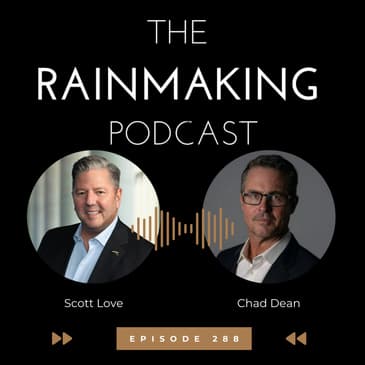
In this episode of The Rainmaking Podcast, Scott Love sits down with Chad Dean, Managing Partner of Integrated Management Resources, to discuss how professionals can avoid common career pitfalls—and recover strategically when missteps occur. Drawing on nearly three decades of experience recruiting senior finance and accounting leaders, Chad emphasizes the importance of slowing down decision-making, understanding true motivations for change, and avoiding reactionary moves driven solely by compensation. He explains why culture, leadership trust, and long-term growth potential are far more reliable indicators of a successful career move than short-term financial gain, and why many professionals benefit from having a neutral sounding board before making major decisions.
The conversation also explores how to navigate career setbacks, including short tenures, leadership mismatches, or ethical red flags, without derailing long-term credibility. Chad offers practical guidance on when it makes sense to exit a role quickly, how to frame career narratives with clarity and confidence, and why mentorship, networking, and disciplined self-care are essential for long-term career resilience. This episode provides thoughtful, grounded advice for professionals who want to manage their careers deliberately, minimize regret, and position themselves for sustained success—even in the face of uncertainty or change.
Visit: https://therainmakingpodcast.com/
YouTube: https://youtu.be/R-EAamsckBQ
----------------------------------------
📖 Subscribe to The Rainmaking Magazine
If you’re serious about growing your book of business, you’ll want to check out The Rainmaking Magazine — a monthly digital publication packed with insights, strategies, and real-world advice for professionals in law, consulting, recruiting, and beyond.
💡 Created for results-driven rainmakers who value credibility and substance.
💥 Now live — subscribe today www.therainmakingmagazine.com
----------------------------------------
This show is sponsored by Leopard Solutions Legal Intelligence Suite of products, Firmscape, and Leopard BI. Push ahead of the pack with the power of Leopard. For a free demo, visit this link: https://www.leopardsolutions.com/index.php/request-a-demo/
----------------------------------------
Integrated Management Resources is an executive recruiting and talent solutions firm delivering executive search, interim/fractional leadership, and project outsourcing for clients nationwide.
We launched in 1990 serving the most selective Wall Street banks and hedge funds, building a reputation for precision and excellence in senior-level recruiting. In 2019, we expanded our model to help VC- and PE-backed SaaS companies scale accounting, finance, revenue operations, and IT teams.
What we do:
• Executive Recruiting — Niche specialists leading to filling positions with
speed and accuracy.
• Fractional & Interim Leadership — Placing proven professionals who can step in immediately.
• Project Outsourcing — Delivering tailored teams for data, finance, and
operations initiatives.
Practice Areas:
• Accounting & Finance
• Revenue Operations & GTM Finance
• Fullstack Engineering / Cloud / DevOps
• Data Engineering & Analytics
Links:
https://www.linkedin.com/in/chaddean/
https://integratedmgmt.com/about/
Learn more about your ad choices. Visit megaphone.fm/adchoices
[00:00:10] You're listening to The Rainmaking Podcast, hosted by high-stakes headhunter, author, and professional speaker, Scott Love You're listening to The Rainmaking Podcast, and my name is Scott Love. Thank you for joining me on the show. Ladies and gentlemen, I've got a special announcement I wanted to share with you. Several months ago, we launched The Rainmaking Magazine, which is content provided by many of our guests on the show.
[00:00:38] The subscription rate at this time is $19 a month, so I don't charge a lot for that. But if you're someone who is motivated by learning things, and you're a person of action, then I'd highly recommend checking it out. It's therainmakingmagazine.com. We recently changed our platform. We had it on Substack for a few months. Not the best platform. A little bit too spammy. This is one that's world-class. I think you'll see a lot of value here. By the way, if you subscribe on an annual basis,
[00:01:07] I will send you a copy of my book, signed, absolutely free, called Rainmaker Confidential, co-written with Henry DeVries and Mark LeBlanc. Anyways, let's get to our guest today. His name is Chad Dean, and he's the owner and managing partner of Integrated Management Resources, which is a recruiting company that focuses within the accounting and finance realm. Now, Chad is an expert on career management, having been in the recruiting industry for quite some time.
[00:01:34] Our topic today is how to avoid career pitfalls and recover from missteps. I hope you get some great ideas from my conversation with Chad today. We put all of his info on the show notes, so make sure you go there and you'll be able to connect with him directly. As always, this show is sponsored by SurePoint Legal Insights, formerly known as Leopard Solutions, turning legal intelligence into opportunity. Also, the show is sponsored by The Rainmaking Magazine.
[00:02:00] For the intellectually driven and results-focused professional who wants to grow their book of business, visit therainmakingmagazine.com today to chart your course to greater rainmaking success. Thanks for listening, and I hope you get some great ideas from my conversation with Chad Dean today. Hey, this is Scott Love with The Rainmaking Podcast. Our special guest today is a good friend of mine. His name is Chad Dean, and we're talking about how to avoid career pitfalls and recover from missteps.
[00:02:29] Chad, thanks for joining me on the show today. Thanks for having me today, Scott. Really appreciate you. Absolutely right. Thank you. And this is what I'm thinking. Our listener today is someone that's on the fence about making a move. He or she doesn't want to have any regrets, but they also think they should play it safe. And so with your expertise as a career professional in recruiting 27 years with finance and accounting people,
[00:02:54] what's kind of your overall theme in terms of advice you give to professionals that are thinking about making a move? Let's kind of start with that question, Chad. Sure. So when somebody contacts me and they say, I'm interested in making a move, the first thing I ask them is about their current situation. So tell me what's going on. Tell me why you are thinking. What's the current reasoning behind that?
[00:03:18] So let's just really dig into that because there's a reason, and it could be the company's doing layoffs. I'm bored. I'm not getting paid enough. There's somebody above me, which is a very common answer. There's no room for growth. I'm underpaid, whatever it is. So let's dig into that and let's really examine why are you looking to make this move? The whole thing we're trying to avoid is going into a similar situation.
[00:03:46] So I honestly try to talk people out of moving. Well, let's play devil's advocate and say, well, maybe the grass isn't greener on the other side. So let's talk about this. And I really want to understand their conviction in moving. Are they really, truly looking to make a move? So I dig into that and let's figure out why. So if we can solve that by moving to another company, let's talk about what that looks like.
[00:04:16] And it really just depends on that specific situation. But what we're trying to avoid is people making a move just to make a move. People want change and sometimes they get so frustrated with their current situation that they don't have the ability to sit back and look at the whole situation and say, well, maybe I'm being a little emotional here. Or, you know, is it really greener on the other side? Because people think they are. It is.
[00:04:43] And they need somebody sometimes like me to be a sounding board and say, no, it's really not. Yeah, right. How many people do you think you've had conversations with in your career about career decisions, career choices? Maybe they decided to stay with their current firm or maybe they decided to make a move. What's your estimation on that number? How many people I've talked to over 27 years? Yeah, what, 50,000? Yeah, tens of thousands. That's a number that I wasn't prepared for. Sure.
[00:05:10] When you're having four to five conversations a day, five days, I generally take Friday afternoons and do preparation for the next week. So let's call it four and a half days. I'm having 20 to 25 conversations a week over 27 years. That's a lot of conversations. And so don't call me an expert because I'm still getting there. But yeah, there's been a lot of conversations.
[00:05:35] So from those people that you've talked to, do you think any of them will decide to stay at their company and end up having regret over that? What do you think about that? It's very rare that somebody will stay at their current situation and regret making a move with the exception of taking a counteroffer.
[00:05:57] But staying at your company gives you time to assess, okay, am I really, especially after they've had a conversation with a professional like me. Okay, let's go into the next day and let's look at this and see if there's anything that I can do to rectify the situation. Now, when you're in the negotiation process and you go back into your boss and you say, hey, I'm leaving and the other company made me an offer I can't refuse and it comes down to money. And then your current company makes you a counteroffer.
[00:06:29] Generally, you're making the move for other reasons. And those people will regret staying there maybe after six months or something like that. And then they're on the market again. So that's really the only time I hear that somebody regrets staying in a situation after they've talked to a professional. Yeah, that's interesting. And I've seen that too, that organizations rarely make changes based on the departing words of an employee.
[00:06:53] You know, and if they just buy them back, so to speak, that doesn't solve the permanent problem. It solves a temporary problem. So let's kind of look into the different motivations. If we could kind of segment the main reasons why people move. What do you think those reasons are, Chad? It's culture. It's lack of upward mobility. And it's a lot of people want to change what they're doing on a daily basis.
[00:07:20] And then others just have a lack of confidence in management. So we can kind of put them into those four areas. Or in that compensation, right? People feel that they're underpaid. So I guess we can kind of put it into those five categories. Yeah, that's interesting. Culture, lack of upward mobility. They want to change what they're doing. A lack of confidence in management. And then compensation. Which of those do you think, if somebody is going to move on, and I know everybody's situation is different.
[00:07:49] When someone tells you one of those five, which of those do you think, I wouldn't call it the best reason to move, but I'd say the one that's the healthiest reason to move. Or does it really depend on the person? Well, I'll tell you the least healthiest reason to move is for compensation. So if I'm talking to somebody and they tell me, and I ask them, why are you looking to make a move? And they say I'm underpaid. And then there's not another factor involved there. That's a really bad reason to make a move.
[00:08:18] Because you're probably going to make a poor decision just to get more money. And then you find yourself going to a company that's paying more. But do you have a cultural fit? Do you have upward mobility, right? So a lot of people just make a move because they see a dollar sign. So that's, number one, the wrong reason to make a move. Culture is a big one. If somebody's not feeling it, if they're being mistreated, if they're not happy and excited going into work every day, that's not a way to live.
[00:08:48] So I would say culture is a great reason to make a move. And then a lack of mobility. You get to a certain point. I think the people that listen to your show are probably mid-career. As you move up, it's a pyramid. And so you're going to get to fewer and fewer positions. And eventually, you're going to hit a roadblock. Whether that's at the director level, at the VP, or at the C level, you're going to hit a roadblock.
[00:09:16] And that's when it's okay to start looking around. But honestly, you should have a relationship with the person that you report to where they want to develop you. And you have the ability to have that conversation like, I want to get to your seat. And I don't know that I'm going to be able to do that here. And you should have that type of relationship with the person that you report to. So let's just say, and this is all really helpful, by the way.
[00:09:44] Let's just say there's somebody listening to this that said, you know, I've been talking to my spouse and other people close to me. I'm just not content with where I'm at in the organization. And I think it might be a combination of me not trusting my leaders and not having confidence in their leadership skills. And also just maybe it's the mobility, but I'm having a hard time processing all this. Let's say they're at that point. They think, I know I need to do something, but I'm not sure why exactly. And let's say you're coaching that person.
[00:10:12] What advice would you give to that person about where they should start discerning whether they should stay or whether they should go? And we'll kind of start with that set of where they are and then kind of build on that. What advice would you give to that person? That's a tough one, right? It's so individualistic and subjective to each individual.
[00:10:33] I think when you're talking to people and they're talking to their spouse about moving, that's serious when you bring the spouse into it because you want the spouse to feel stability. So if you're going to the spouse and you're being honest with them, you're saying, I don't feel comfortable about leadership, the direction that they're taking this, or the culture is not a fit for me. The spouse wants you to be happy. So you've got that going for you. They may not be the best sounding board for you.
[00:11:01] So you should have, and we'll bring this up later on, you should have a good network that you can reach out to. Even if it's not a headhunter, everybody should have a mentor. You have a mentor or you have a peer that you can reach out to and say, this is what I'm experiencing. Can we go have lunch and listen to this and see if I'm being rational?
[00:11:25] Because, again, people get emotional in the situation that they're in, and you want to make sure that you're making an objective decision. So having that ability to bounce your ideas, your situation off other people, otherwise you're sitting there in a box trying to figure out your own problems, and that's generally never a good thing. That's why people have therapists, they have mentors, they have friends, they have spouses.
[00:11:52] But, again, there's a groupthink that can happen with a spouse, and your spouse wants the best for you. So they may not be the best person. Go to your network. Yeah, that's really good advice. And so they talk with several colleagues of theirs, and they say, you know, you really should look at other options. And they've decided, okay, I've decided I want to be open to looking at a small number of options. What do I do next? Where do you think they should begin?
[00:12:18] And unless, I mean, assuming that they're not working with a search firm or a recruiter like yourself, where do you think they should start in their search? So look at companies that you admire. Everybody has an idea of companies that they admire. Well, let's back up a second. Sure. They should be looking at what industry. Let's narrow it down to industry. Size of company. Everybody has a preference.
[00:12:46] They like small companies because they want to see a bigger impact of their work. They like big companies because they like process. They feel comfortable in big companies. You get paid very well in big companies. So people are more geared towards that. So let's look at industry. Let's look at location. And let's look at size of company. And then say, okay, based on my skill set, where do I think I fit in within another organization?
[00:13:17] Again, it's a pyramid. So the farther you go up, you're going to have limited options out there. But by far, you should be looking at that and kind of map out the market on what are my possibilities. If you're in a small town, you might have to move. If you're looking for remote only, they're becoming fewer and farther between. But that's number one. Just try to figure out the company that you think you would like to work for. That's you're mapping out the targets.
[00:13:44] And then you're networking with your community and just putting it out there and saying, hey, what have you heard? That's a big thing. Just kind of dropping that out there, whether it's connections on LinkedIn or you have friends that you could have coffee with. I'm going to keep going back to network because that is so important to people. And they kind of get lost sometimes. And they're so into their job, they forget about the networking aspect.
[00:14:12] But they should be reaching out to their network to see, hey, what are you hearing out there? That's great. Now, you mentioned that before, having that network that you can reach out to. Should they volunteer? I'm on the market. Or should they be a little bit softer and say, I'm kind of curious if you've heard of other options. How forward should they be in revealing their candidacy if they're currently employed?
[00:14:37] If they're currently employed and it's not a secret that the company's having trouble, they went through their fifth riff in 16 months. It's perfectly fine to put it out there that, hey, I'm nervous. And I talked to somebody like that yesterday. And she's like, look, I'm not formally on the market, but I've just managed to ditch or get by through every riff. And I don't know if I got another one in me. So I'm putting my feelers out. That one's OK.
[00:15:05] If you're in a very secure job and you're concerned about your current company, finding out a lot of people are in that situation. Just put it out there. Just talking. There's never anything wrong with somebody having conversations with other people about what's going on. People want to know their worth in the market. Always. You want to know if you're getting underpaid, overpaid, what the options are for growth.
[00:15:32] So it's just a soft drop. Hey, you know, I'm not currently looking, but I'm always curious what's going on out there. What are you hearing? Who's contacting you? Is there anybody I should be talking to? For sure. And then going to networking events within your space. Hands down. Here we are back to networking. But just going out and meeting people.
[00:15:58] And if you're going and you're being nice to people and you're consistently showing up to events, things are going to find you. That's great. One of the things I've seen, kind of a common theme in your LinkedIn posts that you've written, Chad, which are fantastic. And by the way, everybody listening, make sure you follow Chad on LinkedIn because he's got some really dynamic content that's very inspiring. And I learn things every time I read something that you wrote. But you talk about working with people that have had some sort of bad thing happen to them or some sort of black mark in their career.
[00:16:28] And you've been able to help place them in those organizations. What advice would you have to someone that they've made a misstep? Whatever it was, maybe there was some bad press or some inaccurate press or something like that. What advice would you give to that person that may have some career baggage that they're dealing with and they want to move to another organization? Sure. So generally, when somebody's made a misstep, they know pretty quickly.
[00:16:57] I deal with a lot of CFOs. CFOs absolutely 100% need to review the books before they take the CFO seat. That's going to be the first thing you do when you take the job is open up the books. So why not look at the books, sign an NDA, whatever the company wants, but open the books before you take the job? Yeah. That's number one. So to prevent a misstep. Now, let's say you've already made that misstep as a CFO. You get in, you open the books.
[00:17:27] You better have some conversations with management about here's what we need to do to fix that. Good CFOs know what to do. And if you're meeting resistance, which is generally what I see at the CFO seat, hunch out quickly. Yeah. Just say, you know what? This isn't going to be a fit and leave quickly because the longer you sit in there, the longer you have to tell a story to the next hiring company about why you sat in there. Everybody's like, well, I got to stay a year. Not true.
[00:17:55] If it's that bad, if it's that toxic, if you're being, believe it or not, in this day and age, people get asked to do unethical things still. And if you're a CFO and your name's on it and you're going to have to sign things, punch out quickly. Now, that's the CFO segment. There's other situations where people were told one thing and you get into the job and it's something totally different.
[00:18:21] How many times have I heard that story over 27 years? All the time. So, you get told one thing, you get in and it's completely a mismatch. Again, it's okay to punch out really quick. You don't have to sit there for a year because that's an opportunity cost where you could be growing and contributing to another organization. But you're going to sit there and grind out a year because somebody told you that you need to stay at least a year.
[00:18:51] I don't believe in that. Now, if you have three consecutive six-month sits, we're going to have a really deep, serious conversation about your ability to look at new and assess new situations. You need to change your decision process and your analysis. But it's okay to go five years and leave after six months. Five years that the previous company leave, get out. It wasn't a fit.
[00:19:20] But have your story crafted and don't make it a long five-minute diatribe of why it didn't work. Don't talk negatively about the previous company. Just say, I was told it was this one thing. Got in. It was completely different. And it wasn't a match. I decided rather than being a poor performer or an underperformer for the company and hurt and slowing my career down, I decided to punch out. And guess what? I wouldn't have the opportunity to be sitting here talking to you today, and I'm really excited about it. Right.
[00:19:49] So do you think most executives, you've got a CFO, obviously the CEO is going to interview that candidate, maybe some board members as well. If there's a story like what you talked about, how open are they to really hearing and considering that story? Or are they just too risk averse? They're just not going to consider anybody that may have some sort of baggage that they have to deal with. What do you think about that?
[00:20:13] Again, there's a difference between a short stint, complete failure upon landing at a new company, and then a consecutive one year here, one year there, one year, 11 months at the next job. That's harder to explain. If you have one explanation, anybody's willing to listen to one story and give somebody a second chance on that, right? If you have to tell three or four stories, then we've got an issue.
[00:20:44] So it's all, again, it's subjected to the individual. But my recommendation is you really assess the next situation because you don't want to have to make a move in one and a half, two years. You always have to go into a situation and say, am I okay with this comp, with this title for the next three years? I hope to get promoted, but you really want to have a solid work history. And to me, three years is kind of a minimum.
[00:21:14] And you want to show a promotion in that next job. You're promotable. Even if it's just one promotion, then you want to look somewhere else. That's great. But go into a company with the goal of staying there for at least three years and getting one promotion. Yeah, that's good advice, Chad. Good. So when do you think they should tell their current employer that they're leaving or that they're even looking? Should they wait until after they've gotten a signed offer letter? Should they say, well, you know, I owe it to them to at least give them a six-month heads-up?
[00:21:44] Because I know it's going to take a while to find somebody. I think I'm going to just let them know, hey, guys, I'm going to be leaving here in about six months, but it's not official yet. What do you think that person should do? That is the million-dollar question, Scott. So it depends on too many factors. One of the main factors is what's the situation at home? How important is this compensation to you?
[00:22:06] Because know that going in and saying a funny story, and it was somebody junior, more junior in their career. They'd worked at this company for four years. It was their first job. They had all this loyalty to the company. And I said, okay, well, you're going to take my job. You need to give a two-week notice. And they're like, oh, well, actually, I'd like to give a four-week notice because they've been really good to me. So I want to give them this four-week. Do a nice handoff. They go in, they give their notice. They were immediately let go.
[00:22:35] And they came back to me like, I had all this loyalty. There was no loyalty. I'm like, there is no loyalty anymore. So let's look at the situation and say, just realize that once you go in and say, hey, I'm being nice, I'm going to give you six months, they could can you right there. So let's look at the situation on money. Do you really rely on that income? Do you have, hopefully everybody has about a year stowed away for emergency fund?
[00:23:02] And that emergency fund includes looking for a new job, especially in this environment. It's a little bit more difficult. But it's too, you got to assess the situation. If it's super toxic and you have no time, they're working you 80 hours a week. How are you going to find another job? But so it's kind of like, OK, I always tell people finding another job is a full time job. So it's really hard to balance being good in your current job and looking for another job.
[00:23:30] So it's really too specific to give general advice. But you need to consider the fact that when you go in to give that, it could be over that day. Absolutely right. And I've even seen it with people that are expecting some sort of a major distribution or bonus at the end of the year. Well, I think I want to give them a heads up. They'll probably still pay me my bonus. Nope. But that's money that I earned. As soon as you give notice, you're gone. Look at your contract. Read your contract. Exactly.
[00:23:58] If it says it's discretionary and you need to be employed on the day. Generally, you have to be employed on the day that the distribution happens. It's actually meaning the distribution hits your bank account. That's right. Wait. And even then, wait. Here's what you're getting in two weeks. Oh, well, I'm quitting. Well, then you're not getting it. Right. Yeah, exactly right. Well, Chad, thank you for being here.
[00:24:19] And as we bring this to a close, if there are three action steps that you'd share with our listeners about really implementing these ideas and taking control of their career, what are those three action steps, Chad? So the first thing is find a mentor. If you don't have one, seek one out. How do you do that? You go to networking events. You find people. A mentor is somebody that's almost a friend that has our type of relationship where you can just reach out at any time.
[00:24:49] Hey, I'm having an issue with this. Can we jump on a call? And they're going to be there for you. They're not going to say, oh, yeah, I'm available in three weeks. No, that's a priority for that individual to get on the phone with you. And you trust their advice. That's a mentor. They're a little bit ahead of you. So they've seen more speed bumps. They've seen more curves in the road, and they can give you good advice. Everybody needs a mentor. Number two, I harped on it over and over again. Network. Get out to events.
[00:25:18] If you're at a BP or C level, reach out to be a speaker at an event. That always is a great way to increase your network. Go to this C-level award of the year events in your local town or if it's a regional event. Get out and network and meet people and stay in touch with people on LinkedIn. Grab a coffee.
[00:25:44] Make it a goal to have a coffee a month with somebody in another company and also people within your own organization. If you want to be in a different part of the organization, they have to know you to build your network there. And then I asked you if you thought this would be appropriate, but I am really big on exercise. So if you go through some of my posts, every once in a while I'll slip one in there about exercise.
[00:26:13] And to me, exercise allows individuals to be the best that they can be, but it has to be consistent exercise. So I tell everybody, they're like, well, what do you do for exercise? Well, first thing I do is I get up with a three handle in the morning. As in 3.42 a.m., my alarm goes off every day. This morning, I woke up at 3.10. I'm like, well, there's no sense of going back to sleep. Might as well get up and get a start on the day. How do you do that? You go to bed early.
[00:26:42] I go to bed between 8.30 and 9. But what exercise does for me six days a week, it's not long. I'm working out about an hour, maybe an hour and 15 minutes. The energy that it gives me, the clarity that it gives me, the lack of stress. I have come up with some seriously interesting decisions while I'm exercising. So if I want to work on something that is really important to my business,
[00:27:09] or I just want to think about my current situation, I won't have headphones, I definitely won't have music. And I'll just think about the situation as I'm exercising. But I also love to listen to self-help, not self-help, but business podcasts. While I'm out walking the dog, I consider that exercise. Or if I'm running, or if I'm on my exercise bike, I listen to podcasts. Now I'm doing double duty. I'm improving my career.
[00:27:37] I'm improving my thought processes. And I'm getting exercise at the same time. So that's my three pieces of advice. This is all great advice. I want to thank you for being on the show. And then tell our listeners, what are your services? What do you do? What do you have that you'd like everybody to know? Sure. So I'm the CEO of Integrative Management. We've been in business for over 30 years. Myself, I handle VP and C-level finance and accounting positions for publicly traded companies.
[00:28:06] And also, we have a big stint, a big segment in the VC and PE-backed SaaS space. So that's what I do. That's interesting, Chad. Thank you so much for being on the show. And for everybody listening, go to the show notes and you'll be able to connect with Chad directly. And like I said before, check out his LinkedIn profile. Stay connected with him. He's got some really good insights that he shares every week. Thanks for being here on the show, Chad. I really appreciate your time today. Thank you, Scott.
[00:28:38] Thank you for listening to The Rainmaking Podcast. For more information about our recruiting services for international law firms, visit our website at attorneysearchgroup.com. To inquire about having Scott speak at your next convention, conference, sales meeting, or executive retreat, visit therainmakingpodcast.com.