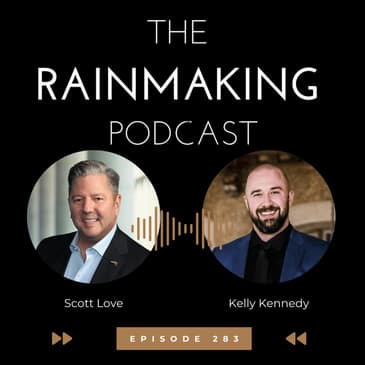
In this episode of The Rainmaking Podcast, Scott Love speaks with Kelly Kennedy, executive business development coach and host of The Business Development Podcast, about what it really means to “open doors for rainmakers.” Kelly reframes business development as the disciplined art of creating interest and securing face-to-face meetings—not closing deals or running marketing campaigns. He introduces his concept of “meeting math”: start with your revenue goal, determine the average value of a new client, estimate your close rate from qualified meetings, and back into the exact number of meetings you need per year and per month. Because meetings are the only part of the sales process a BD professional can truly control, Kelly argues that success should be measured in high-quality meetings, not just revenue, and that this clarity gives rainmakers confidence and focus.
Kelly then walks through how to build a repeatable door-opening system. Instead of chasing only the biggest “tippy-top” companies, he recommends targeting the next tier down and the service providers that support them—often better, stickier clients with more realistic expectations. He urges firms to identify their ideal buyer personas (presidents, procurement managers, operations leaders, etc.), then use tools like LinkedIn to build targeted lists and send personalized connection requests and introductions. Kelly stresses the importance of separating roles—door-opening BD, proposal/sales, and account management—so nothing falls through the cracks, and he closes with three action steps: block 3–5 hours weekly for pure BD, define your ideal buyers by title in each vertical, and make direct contact via phone and email while always asking for the meeting.
Visit: https://therainmakingpodcast.com/
YouTube: https://youtu.be/FJtovnbYvRo
----------------------------------------
📖 Subscribe to The Rainmaking Magazine
For the intellectually-driven and results-focused professional who wants to grow their book of business. Visit www.therainmakingmagazine.com to chart your course to greater rainmaking success.
----------------------------------------
This podcast is sponsored by:
SurePoint Legal Insights (formerly known as Leopard Solutions) –turning legal intelligence into opportunity
Link: https://www.leopardsolutions.com/index.php/request-a-demo/
----------------------------------------
Kelly Kennedy is an Executive Business Development Coach specializing in empowering businesses and professionals to reach their full potential. In this role, he provides high-level strategic guidance tailored to meet the unique needs of each client, whether they’re entrepreneurs, corporate teams, or executives. Kelly’s coaching is built on a foundation of nearly two
decades of expertise in business development, during which he has honed a results-driven approach that focuses on sustainable growth, relationship building, and practical strategies that clients can implement immediately.
Through one-on-one coaching sessions, group workshops, and his Business Development Mastery Program, Kelly guides clients through essential business development concepts such as lead generation, client retention, CRM optimization, personal branding, and strategic planning. His goal is to equip clients with the skills and confidence to make informed, impactful decisions that drive measurable growth. Kelly’s coaching is known for its holistic approach, emphasizing not only business strategies but also personal development, resilience, and adaptability.
In addition to individual progress, Kelly’s role as a coach includes fostering a community of driven professionals who support and learn from each other. His dynamic coaching style and commitment to accountability keep clients engaged and motivated, ensuring they stay on track toward their goals.
Links: https://www.businessdevelopmentpodcast.ca/
https://www.linkedin.com/in/kellykennedyofficial/
Learn more about your ad choices. Visit megaphone.fm/adchoices
[00:00:10] You're listening to The Rainmaking Podcast, hosted by high stakes headhunter, author, and professional speaker, Scott Love. You're listening to The Rainmaking Podcast, and my name is Scott Love. Thank you for joining me on the show. Our guest today is Kelly Kennedy. Now, this is going to be a really good show for you. Our topic title for it is called Opening Doors for Rainmakers. How important is that?
[00:00:39] Now, Kelly has a different background than most of the people we've had here. He's an executive business development coach specializing in empowering businesses and professionals to reach their full potential. He's built a foundation of nearly two decades of expertise in business development that really supports his results-driven approach of coaching. And that helps focus on sustainable growth, relationship building, and practical strategies that his clients can implement immediately.
[00:01:08] He also produces the Business Development Podcast. That's a show you should listen to. I'm going to put Kelly's contact information and also that podcast link on the show notes. So no matter where you listen to the show, make sure you connect with Kelly directly. As always, this show is sponsored by SurePoint Legal Insights, formerly known as Leopard Solutions, turning legal intelligence into opportunity.
[00:01:32] The show is also sponsored by The Rainmaking Magazine for the intellectually driven and results-focused professional who wants to grow their book of business. Visit therainmakingmagazine.com to chart your course to greater rainmaking success. Thanks for listening to the show. And one other thing, if you've got a minute, if this show has made a difference for you, I'd certainly appreciate a nice five-star review on Apple Podcasts and Spotify.
[00:01:59] And if one of our guests said something that made a difference for you, please mention that guest by name. Anyways, thank you so much for listening. And here's my conversation with Kelly Kennedy. Hey, this is Scott Love with The Rainmaking Podcast. Our special guest today is Kelly Kennedy, and we're talking about opening doors for rainmakers. Kelly, thanks for joining me on the show today. Scott, the pleasure is all mine. Thanks for having me.
[00:02:25] This is great. I'm really excited about this from the things that we talked about before, and I want to dig into this. So let's start with a definition. When you say opening doors, what does that mean to you exactly, Kelly? Yeah, like if you look at what business development traditionally is, if you look at it holistically, that's what it is. It's about creating interest that opens doors for organizations to do business, right? I think a lot of times business development gets thrown in with sales and marketing and closing.
[00:02:55] And really, when you look holistically at what business development actually is, it's identifying opportunities. It's identifying the right people who will understand why that opportunity and your opportunity is important to their company. And then it's starting a relationship, right? It's starting a relationship. It's getting that face-to-face meeting where the magic can happen. And, you know, we live in a world now where everyone wants to focus so much on digital marketing, right? Let's put out tons of stuff on social media. Let's pay for all of these ads out there.
[00:03:24] And don't get me wrong, like I'm sure your show has ads, my show has ads too. But we also know that it's so much more about brand awareness. When you look at digital advertising, the focus is so much more on brand awareness. It doesn't always convert, especially in that B2B space, which is where business development comes in. It's still just about creating interest and opening doors. And I'm excited to chat with you all about it today. This is great. Well, let's kind of break this into four different sections here. Because I heard you say it's getting that face-to-face meeting.
[00:03:54] I want to talk about that. You also talked about identifying opportunities. I want to talk about that. You said the right people. I want to talk about that. And then starting a relationship. Maybe we can tee that up also. So let's kind of start with our goal, the face-to-face meeting. And as you said, Kelly, that's where the magic happens. What are some things that we need to keep top of mind and be mindful of about setting these face-to-face meetings, things like that? Yeah. Well, I think in business development, historically,
[00:04:22] a lot of companies, a lot of leaders have sat down with their BD teams and said, and I'm sure you've been in that room, where they sit down and say, you know, Scott, our goal this year is to make a million dollars in new revenue. Business development team, figure it out. Right? But what does that mean? So many companies, I've been in those rooms and it was before I really understood it. And what I would look at that and just say, okay, great. I need to get more meetings. I knew, I think every BD person understands that we're being measured on meetings,
[00:04:48] but how do we know that we're truly being successful? Right? Because you could have five meetings that week and still have no clue if you're even close to achieving your revenue growth number. So what I always teach when I'm sitting down with business development, you know, coaching students for the first time is we have to learn to tie business development to something we can actually control. The only thing that a business development person can control is the amount of meetings that they secure because they can control the effort it takes to secure those meetings.
[00:05:18] So I always say we have to measure success in meetings. And the cool thing about that, Scott, is that not only can we measure success in meetings, if we look statistically, if we look at the numbers of the company, we can actually pretty close understand how many meetings we need to achieve that revenue growth goal. So I always start with something I call meeting math, and I'm going to go through it with you right now. Sure. Meeting math, you said, right? Meeting math. So every company needs to start here.
[00:05:45] When we're doing business development, we need to start with our BD team on something called meeting math. Meeting math is, let's say that we have a million dollars in new revenue required for 2026. Okay. Well, if we know that an average customer is worth $100,000, right? We know that we need 10 new customers in 2026 in order to achieve that revenue growth, right? Well, everyone can figure that math out. That's pretty easy. The next step is, how do we tie that to meeting numbers?
[00:06:14] So you know, and I know that if we get, you know, 10 new customers, we don't know what it takes to get there. So we have to look at it like statistically. We need 10 customers. What is our closure rate on meeting? So if Scott, you meet with a new client, what are the odds statistically that you will close them as a customer in the coming year? If you had to guess, what do you think that number might be? Like 50%, 50-50? 25, something like that. 25%? Yeah. Yeah.
[00:06:41] I find that with a lot of service-based companies, it is actually somewhere around that 50-50 mark. I usually tend to start there and say, if we have to aim a little lower, no problem. But I'm going to go with your number just for today. So if we take that number 10, we need 10 new customers. And we divide that by 0.25, which is the number, the 25% that you gave me. We know that over the next year, we need to have 40 meetings. We need to have 40 meetings, Scott.
[00:07:08] And statistically, we should close our $1 million in new revenue. So what does that mean if we spread that out over the course of a year? If we spread that 40 over 12 months, we need to average three meetings a month. Four, I guess, if you want to be really on point, four. But that's the number. So as a business development person, you need to know this number because if you don't know this number, you never know if you're winning. And I don't know about you, but I like going into a weekend knowing I'm winning. Yeah, that's right.
[00:07:39] And I think what you said makes so much sense because if I know, and it's so funny because talking with my kids about what's the secret of contentment, it's helping other people and having a goal that you see materialize in front of you in small steps. And that's most of it. And so kind of focusing on that, the small steps that we take where we see things happening, we have more control over that, like you said. Do you think what you've mentioned, this is simple. This is what I do in my own business with certain weekly metrics and targets.
[00:08:08] I like to call them weekly targets. Love it. And monthly goals because a target is much more precise like darts or archery. Do you think most people think this way in professional services or areas where they're doing business development? No. And it's funny. And I don't think it's because I don't think it's necessarily because they don't want to. I just think a lot of people don't necessarily know how. They don't know how to measure success, right? They know that revenue is the target, but revenue and making people buy is simply out of most people's control, right?
[00:08:38] The only person who can make a buying decision, no matter how good your bid is, is the customer. And the customer doesn't always buy the best bid. Sometimes they make decisions emotionally based on things that you have zero control over. The only thing that you can somewhat control is statistics. So you know, for instance, in your organization, you made a guess that 25%. So if you meet with a company, there's a 25% chance that sometime in the next year, they're going to buy from you. However, if they do buy from you, you know they're probably going to be a $100,000 client, right?
[00:09:08] So if we use the math, we can take it to something we can control, which is the meeting. So I always say, if we're going to measure success, we have to measure success with things that we have control over. Yeah, I like that a lot. Have you gotten any pushback from organizations with this concept before? The only pushback that I've found isn't pushback, but it's further refinement. So in the case of construction industry, right, they might have a much lower bid win percentage.
[00:09:36] So what they're maybe trying to control more of is, you know, RFP win rate in construction. Like, you know, it works well with like service based companies or like, you know, something like business development services or consulting services. When you start to get to like construction services where the win rate might only be five or 10%, then we have to tie it not only to do we get the RFP, but we have to go an even further step. And we have to identify, OK, well, if we get the RFP, what are our odds of winning the RFP as well? This is great.
[00:10:06] This is so nerdy. I love it. I mean, you're going really deep into real finer points of the nuance associated with this. So I think this is good. We understand about getting that face to face meeting and how we track certain metrics associated with it. You also mentioned it's identifying opportunities and the right people who understand and it's starting relationship. Let's kind of work backwards a little bit. Let's talk about starting a relationship. Let's say we have the opportunity to do that.
[00:10:33] But what have you seen are best practices or things we should be mindful of with starting relationships with prospects? Yeah, yeah. Well, I think the first piece with any prospect and I'm actually going to take this maybe a step further. So once we've identified the meeting numbers we need, we know what we need to target. The next step is we have to identify the industries and locations that we can best serve, right? That's the next step. So let's say, you know, I'm in Alberta, Canada. We're a huge oil and gas province.
[00:11:01] Let's say that I want to work with some of the top oil and gas companies in Canada, right? Most of the time, they're actually not the best customer. So we don't always think about that. We might look at like the tippy top of any industry. You know, let's talk about in retail, we might be looking to work with Walmart or something along those lines, Amazon. Let's say in oil and gas, we want to work with, you know, the Synovuses and CNRLs, which are the Canadian big boys. Or, you know, take your pick of any large scale industry. The problem with trying to work with the tippy top of any industry is they have their pick.
[00:11:31] They have their pick of anybody they want. They have the deal they want pretty much every time because they dictate the deal. They're not always the best customers. And so we have to obviously have our wishlist of, let's say that we want to work with Amazon or we want to work with Walmart. Great. But who's right under that? Because a lot of times I always find, you know, the prime contractor per se right underneath those large scale industry giants tends to be the better option to work for.
[00:11:58] So in services in Canada, that might be the PCL constructions of the world, the floors of the world who build those big mega projects on behalf of those large scale industries. They tend to be the better client to work for. And then we can even take that a step further and go now, who are the service providers that provide service to them who almost always bite off more than they can chew because they're medium-sized business and now they need even more support. So the next step, once we identify how many meetings we need to be getting, we need to
[00:12:27] identify the industries and sub-industries that we might be most effective working with. That's great. And then you're kind of moving out. I like that when we talk about, and this gets us to the right people that you mentioned, and that's something I've never heard of before. Identify that ideal type of industry and who are those service providers that are serving them, and then you can even work it backwards. Who are those service providers that are serving those service providers that are servicing your target client? And you can develop a vertical niche that way. Absolutely.
[00:12:54] And you'll find, you know, I mean, it doesn't take long to make a list of 100 or 200 companies that are going to be perfect for your organization to work with. This is great. The next step that we have to identify is what about the best service locations, right? You know, if you're in, you know, central United States, you might not be able to service the East and West Coast. So maybe your best place is right where you're at, right? And I always say that your best location is where you're most competitive. You're most competitive where your home base is.
[00:13:21] So always start at that home base and start to work out because even if the next city is only 50 miles away, there's somebody local in that city who can probably compete better than you can, maybe in the beginning, maybe not always, but in the beginning. And so I always say start where you're at and work out. So identify those industries, figure out which ones are right where you're at, start there and work out and you're going to find success. That's a quick and easy playbook.
[00:13:47] And in 10 minutes, we've revealed the secrets of the universe to I have Tom and Kelly right here on the show, making history. So let me ask you this question then. What are some of the pitfalls somebody needs to watch out for as they're refining their strategy to open up these doors? What are those main pitfalls that come to your mind, Kelly? Just do it. But talk to people all the time, Scott. And I just say, like, when was the last time you actually wrote out a target list? Never, never.
[00:14:14] Like there's a lot of organizations who might put five companies down and say, we want to target these people. I've sat in many rooms in business development where the leadership group comes down and says, hey, we know this project is coming. These are the companies that are doing it target these people. But that's a reactive approach, right? I think a lot of companies, if they sit down and they do this work once a year and they just write out, OK, what are the targets this year? What are the companies we want to target? Did any new ones come up that maybe we should start building relationships with? Because here's the thing.
[00:14:41] Business development is not a quick fix, right? Anybody who's been in this industry any length of time understands that business development is a long game. We have to be consistently working on it. And when you stop doing it, you're not just hurting yourself today. You're hurting yourself tomorrow. Right. And tell me a story of an organization that you worked with. You don't have to mention them by name, of course, but what was it like when they realized we need to make these changes that Kelly's teaching us? How did they go through it?
[00:15:09] What were the challenges that they faced internally, maybe? And what was the result of that? Yeah, I think maybe some of the challenges that I see pop up with the clients I work with is that once the meetings start coming in, the next step is required. And like I said, a lot of companies are jumbling this all together. So they have salespeople with business development people with account managers. The problem with having your business development people handle account management and maybe even the sales as well is that none of the jobs get done right, right?
[00:15:37] Business development really is a dedicated position. We have to treat it as such. They are your door openers. They're your lead generators. They're the funnel builders. They're the people who are looking for those new opportunities and opening the door. But that does not make us great then at managing the relationship later. That is better done by an account manager. So some of the pitfalls that I find is, you know, it's not really a pitfall, Scott, as much as it is I need to educate them. And usually it doesn't take very long until they realize that the value of hiring an account
[00:16:06] manager is probably 10x the cost of that account manager and they make the decision to bring them on. But it's more so just educating people because like you said, there's not a lot of information specifically on business development. And that's what I set out to change. Yeah, this is terrific, Kelly. What are some of the common trends or common characteristics of organizations that have taken these recommendations you've made and have done really well with that?
[00:16:34] Like, I would say that they do tend to be medium to large size organizations. Like they've been around long enough to learn the hard way, I guess I would put it. But, you know, they typically have, let's call it a business development team, somebody to open the door. Then they typically have somebody at the organization who does the RFPs, who completes the proposals, which I would call your salesperson. And then they typically also have somebody in the account management space to make friends
[00:17:02] with those organizations, to go out to lunch with them, to build true relationship. And the thing about that account manager is it's probably the most important position in your organization. So you got to make sure that it's somebody, it's probably an executive. It's probably somebody that you absolutely trust to go nowhere and that they are going to do a great job representing your organization with those customers. And they're not going anywhere. You got to treat them good. You got to look after them because they really are that bread and butter. And you know, as well as I do, repeat business is always easier to get.
[00:17:31] Statistically, at a lot of the organizations I've worked with, most clients buy about five times a year. So that's it, right? You get that one customer, you don't just get the $100,000. You probably get $500,000. And over the course of three years, they could be a million dollar client free. Yeah, exactly right. Let's talk a little bit about starting that relationship. Yeah. How have you seen the best practices are? I mean, what has to happen to how we start that relationship?
[00:17:57] And how would you usually describe how that starting of a relationship happens? Yeah, well, I'm going to take it just maybe one step further in our list that we're going down with regards to identifying, you know, the ideal customer. Okay. So now that we've got the industries, that's great. The next thing that we have to identify is who gets why your product and service is important. That ideal customer profile, right? And every company's heard this to death. Oh, figure out your niche, figure out who needs your products and services, right? But I'm going to simplify it for you.
[00:18:28] I'm going to make this really easy for everybody listening right now. Who buys? So I want you to look at all of the sales you've done over the past year and identify the people who made the buying decision and try to identify what their position was in the organization. Was it a buyer? Was it a procurement manager? Was it a director of operations? Was it a president? What are the titles of the people who buy your products and services and start to compile a big list of them?
[00:18:55] And I think you will find, and you may have multiple branches of your organization. You might have different verticals and it might be different names for each one. So make sure that we're like getting specific with each vertical of our business as well. What are some examples of that that you've seen when people do this? Yeah. So I'm going to, I'm going to make this really easy for you, Scott. So once we actually have those, once we have those positions, it makes finding the next customer so much easier.
[00:19:22] Because first off, Scott, if you're working in oil and gas or mining or industrial, we can hop right on LinkedIn. We can search, you know, presidents or procurement managers in mining, in your ideal location. And LinkedIn is going to do all the work for you. It's literally going to populate a list of up to, let's call it a thousand people with that title who are in your industry, who are in your location that you can now reach out to you.
[00:19:48] And here's the thing, you know, you know, they understand why your product and service is valuable to them. It's terrific. Yeah. So once you put it all together, it becomes a very easy, repeatable process. And once we do that, so what we do typically with capital, we'll connect with about 50 to 100 of those people on behalf of our clients each week. If we send 50 invites, I would assume we close about 40% of those we'll accept by the next week. We can send them a digital introduction. We attach the brochure.
[00:20:16] The digital introductions are always personal because at the end of the day, what did I say about marketing materials? What did I say? It's about building interest, right? So we're not selling anything through our marketing materials. We're not selling anything typically through our websites. What we're doing is we're building interest in ourselves, our products, our services, so that when we reach out directly, we can book that face-to-face meeting and make the real introduction. And that's where the magic happens. I love it, Kelly. This is really good. You make it sound so simple. Well, I've done it for a few years. It probably sounds simpler than it is.
[00:20:46] Let's bring it even into more simpler terms, shall we? If we could bring three action steps as we bring this to a close, if we could share three action steps with our listeners, how can they get started doing this? What would those three action steps be, Kelly? The first step is to take business development seriously. So, you know, you know as well as I do, your calendar is probably right full, but we have to make sure that at least three to five hours a week in that calendar is dedicated specifically to business development.
[00:21:14] The next step is we have to identify those ideal buying personas, right? Who is that person? Are they a president? Are they a buyer? Are they a procurement manager? Who makes the buying decisions at the organizations that you work with? And then we need to send those connections to them. And then the last step that we absolutely have to do is we have to make direct contact. We can't be afraid of our phones. Phones and emails are still more powerful than ever. I book more meetings over a phone than I ever do via email or any other way.
[00:21:42] Pick up your phone, make the call and make sure that you always ask for what you want, which is that meeting. And if we're getting more meetings, we're going to statistically win. Well, Kelly, you've given me a lot of confidence that people listening to the show are going to statistically win if they implement these ideas. So thank you for being here and sharing that with us. And then tell us more about you. What do you have? What do you do that our listeners would love to know about, Kelly? Yeah, absolutely. So I do a mix of things. I do still do fractional BD leadership for the right companies.
[00:22:13] Typically, we only work with about three or four a year. So it's not like a big offering. The other side of this is we do do business development training, both one-to-one or team training, depending on what you need for your organization. And lastly, I host the business development podcast. So that's where we came together. We're both high up there on the million podcasts, business development podcast list you must listen to. So yeah, I'd appreciate it if you give us a try. That sounds great, Kelly. We're going to put your links and also your podcast link in our show notes.
[00:22:41] So everybody listening to this show, just go to the show notes and you'll be able to connect with Kelly directly and check out his podcast also. Thanks for being on the show today, Kelly. I'd love to have you back on in the future. And great job with sharing your wisdom for us today. Thanks, Scott. It was a pleasure. And I'm looking forward to the next opportunity. Thank you for listening to the Rainmaking Podcast. For more information about our recruiting services for international law firms, visit our website
[00:23:10] at attorneysearchgroup.com. To inquire about having Scott speak at your next convention, conference, sales meeting, or executive retreat, visit therainmakingpodcast.com. Thank you. Thank you.