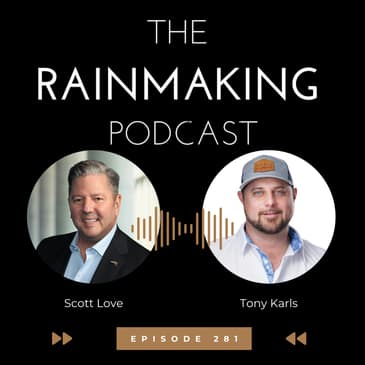
In this episode of The Rainmaking Podcast, Scott Love talks with Tony Karls, co-founder of Sterling Lawyers and president of Rocket Clicks, about using a podcast as a practical business-development engine. Tony explains how his team built Revenue Roadmap, a single show with two recurring formats—growth stories on Tuesdays and how-to education on Thursdays—to balance entertainment with tangible value. The podcast is treated as a cornerstone content asset: every episode is repurposed across video, audio, blogs, and social channels to reach prospects where they prefer to consume. Tony stresses keeping the show unscripted and authentic, niching hard on a clear avatar (for him, family-law firm owners), and partnering with the right communities (e.g., AAML) to book high-quality guests and create “network effects” that turn conversations into relationships.
Tony shares what’s worked—and what hasn’t. With only ~68,000 family-law firms in the U.S. (most with ≤3 attorneys), chasing big vanity metrics is a distraction; serving a small, precise audience with specific problems wins. His playbook: start earlier than you think, accept that your first 40–50 episodes are reps, and move fast with “decision velocity”—ship, measure, iterate. Three takeaways for rainmakers who want to adopt the model: (1) define a narrow ICP and build episodes around their real pains; (2) deliver consistent, authentic conversations (video + audio) and atomize each episode across platforms; (3) calendar guest outreach like a pipeline (aim for 2–3 quality bookings a week), then let data—not ego—guide what you double down on next.
Visit: https://therainmakingpodcast.com/
YouTube: https://youtu.be/W9HP-dx20Ko
----------------------------------------
📖 Subscribe to The Rainmaking Magazine
For the intellectually-driven and results-focused professional who wants to grow their book of business. Visit www.therainmakingmagazine.com to chart your course to greater rainmaking success.
----------------------------------------
This podcast is sponsored by:
SurePoint Legal Insights (formerly known as Leopard Solutions) –turning legal intelligence into opportunity
Link: https://www.leopardsolutions.com/index.php/request-a-demo/
----------------------------------------
As the President of Rocket Clicks I am responsible for integrating our Finance, HR, IT, Sales & Marketing, and Client Service teams. I am also ultimately responsible for building a healthy culture while driving P&L performance.
Links:
https://www.linkedin.com/in/anthonykarls/
https://www.linkedin.com/company/rocket-clicks/
Learn more about your ad choices. Visit megaphone.fm/adchoices
[00:00:10] You're listening to The Rainmaking Podcast, hosted by high-stakes headhunter, author, and professional speaker, Scott Love. You're listening to The Rainmaking Podcast, and my name is Scott Love. Thanks for joining me on the show. Before we talk about our guest and our topic today, I had an announcement. We launched The Rainmaking Magazine several months ago. We're in our second month of publication.
[00:00:38] One of the reasons I started this was because business development has to be top of mind for people all the time. This isn't something that you can delegate to the marketing department. If you're a successful practitioner, you need to be doing this and you need to be thinking about it all the time. We started this in October. We're in our second issue. And every month we're bringing you new ideas and fresh content so that business development can stay top of mind. Check it out at therainmakingmagazine.com.
[00:01:06] Now, let me tell you about our guest today and the topic that we have for you. This is a really innovative idea. Our topic title today is Podcasting as a Business Development Strategy. And our guest is Tony Carls. Now, Tony's worked in the legal industry. He had success in growing his firm, and he started a company called Rocket Clicks. Now, Rocket Clicks is a marketing agency that works with law firms to help them expand their reach. And he's sharing with us some innovative ideas that I think can help you.
[00:01:34] Even if you don't work in the legal industry, if you're working in some sort of professional service, take a listen to what Tony has to say. And I hope you get some great ideas out of our show today. As always, this show is sponsored by SurePoint Legal Insights, formerly known as Leopard Solutions, turning legal intelligence into opportunity. And also by The Rainmaking Magazine for the intellectually driven and results-focused professional who wants to grow their book of business.
[00:02:00] Visit The Rainmaking Magazine to chart your course to greater rainmaking success. Thanks for listening, and I hope you get some great ideas from my conversation with Tony today. Hey, this is Scott Love with The Rainmaking Podcast. And our guest today is Tony Carls. And we're talking about podcasting as a business development strategy. Tony, thanks for joining me on the show. Yeah, thanks for having me, Scott. Absolutely right. And I really like the fact that you are an expert. We're going to talk more about your business in a little bit.
[00:02:29] But you've been able to use podcasting as part of your strategy for getting business. Kind of give us a quick overview. How have you used podcasting? And then we'll kind of dig into how people can kind of follow what you've done and get some ideas out of that. Yeah, sure. So here at RocketClicks, we use podcasting in two ways. So one is we give a lot of basically our playbook away in terms of how to grow your firm and exactly what we do. And those are more educational oriented.
[00:02:59] And then we do growth inspirational story types that are about how other lawyers that not necessarily our clients are not have grown their firm, what it looked like from where they started at the beginnings of their firm all the way through where they are today. And it kind of gives a good balance of interesting stories as well as kind of in-depth technical how to move things forward. Oh, that's interesting. So are these two separate shows then that your company produces? It's one social show.
[00:03:28] So we release every Tuesday and Thursday. Tuesdays are growth stories. So those are our revenue roadmap growth stories. And then on Thursdays are our educational series. Oh, interesting. So one show, but you segment it based on the day for the different theme. Is that correct? Yep, exactly. And what's the name of your show? We'll put that in the show links for everybody listening. It's called Revenue Roadmap. Revenue Roadmap. Got it. Okay, good. So that's great.
[00:03:54] So you have one feed and people listen to one topic on Tuesday, another topic on Thursday. So they understand it's predictable. They know what to expect. And have you always done it with two different themes on one show? That's how we started it. Yeah. So our thought process was some of our educational stuff is like pretty dense. And it's like, it's interesting if you're interested in it. It's not necessarily content that I would say would go viral.
[00:04:19] Growth stories are way more oriented towards like, how do we draw audience in because it's interesting and entertaining. So it's kind of a balance between entertainment and value. And how do we, that was kind of our thought process and positioning so that we can grow our audience and educate our audience and kind of keep that wheel going. That's great. And so what is it that you think? Why do people listen to your show? Think of your ideal prospect. What is that shiny lure that catches their eye that causes them to start listening to your show? Yeah.
[00:04:49] My background is, so I started a law firm in 2013. Grew that, it's called Sterling Lawyers. When I left, it was 16 million in revenue. That's just a family law firm. It's exclusively family law. During that time towards the last, so 22 and 23, I was actually the president of Sterling Lawyers and the president of Rocket Clicks. And what we wanted to do, which is a sister company of ours, what we want to do with Rocket
[00:05:16] Clicks is reorient towards everything that we learned growing our own law firm from not, from nothing to something pretty substantial in the family law space. So when people listen to our podcast, I think what's interesting to them is a lot of family law firms, they're pretty small. You know, they're typically three or fewer attorneys. There's 68,000 family law firms in the United States, just from like, if we want to look at the marketplace, 68,000 family law firms in the United States, 97% of them have three or fewer attorneys.
[00:05:45] So they're all very small businesses. And what we've been able to do is pretty different than what actually exists in the marketplace. So we're actually a model for how to grow. And that's how we go to market. That's great. So how many episodes do you have? Do you track your statistics? Do you have a lot of metrics in place? What's kind of your thought in how you run your podcast? So we think about our podcast as like one part of our content marketing strategy.
[00:06:09] So, you know, our distribution of that idea is done through podcasts, through socials, through a blog, through a lot of different mediums. So our thought process on podcasting is there are people that like to be audio. Some people like to watch a video blog. It gives us access to those people that are different than people that are on socials, people that are on Facebook, LinkedIn, all the other ones.
[00:06:35] And so our thought process on the content that we're producing is where do we where can we distribute it based on what we're how we're producing it, if that makes sense. So that's great. The platform has slightly different needs. So we tailor the needs to the platform. But we create a big piece of content multiple times a week so that we can then kind of trim it down, leave a bag depending on where we're posting it. Yeah. And so what's one thing that you learned in doing this?
[00:07:01] What's something that you learned that surprised you as you started your show to where you are today? I'd say the biggest thing we've learned is just I think the more authentic we are and the less scripted and less edited we are, I think the better we perform because it feels real. It doesn't feel like it's something that is read from script that might not seem actual. So I think people genuinely want to learn from people that have done something.
[00:07:28] And I think subconsciously we can really tell when someone believes what they're saying versus they're just reading something that there is in front of them. Yeah. And there's like a lot of, you know, nonverbal psychology in that, in the tone of your voice, speed of the speed and pattern of your voice, all of those types of things. So do you seek out certain guests or do they usually seek you out? So on our growth stories, we seek out very specific guests that have grown their own law firms.
[00:07:54] So, and we were looking for people that are interested in stories that are in our space. So we work exclusively with family law firms. So we are, we actually have one person that their, their job is to book, book our revenue roadmap guests. So they do a lot of outreach every single week. And their goal is to, to book us podcast appointments. We get about two to three quality bookings a week. And then we work through the editing process. That's great.
[00:08:23] And so promoting your show, let's say outside of LinkedIn, do you target trade associations, other groups to promote your show strategically? How do you really kind of make sure your show is getting to the people that you want to have listened to it? Yeah, I think trade shows are one of the things that we've, we've started leveraging. So we're, we've been investing significantly in the AML group. So it's American association for matrimonial lawyers and that's, they're all our avatar.
[00:08:51] They're the best of the best family lawyers in the United States. It's hard to get into that group. So we've been doing a lot of networking there. We ask for a lot of them to be on our shows because they're, they have some of the best reputations in the States that they're in. And that allows us to grow our network. That's kind of how we've thought about how can we create some network effects of what we're doing. Yeah, that's good. And I found when you have things like that happen, you get to know them. You're doing business with them. There's trust, which leads to, well, let's talk about how we can work together again and
[00:09:19] do more things in a different way or even referrals or even eventually formalize strategic alliances, things like that. Have you targeted vendors that know the people that you want to get to know in terms of sponsorship or other things like that, or even just being guests on your show? Not currently something that we're doing. It's on our roadmap for future opportunities. So we're kind of playing around with what are, what are all the things that we want to go through internal content.
[00:09:46] So when we do our educational series, we pull our subject matter expert for that particular topic, whether it's SEO or we want a program called giant, giant leadership. So we'll pull them in and Tyler and I will interview them that particular topic. And we've got a very long list of things that we want to cover over the next two years. So that's kind of how we thought about what we're doing right now. And we're just kind of letting the data tell us what we should continue doing. Yeah, that's great.
[00:10:14] And I know your business isn't to help people start podcasts, but I think it's interesting seeing what you've done. I've done similar things also. And I've found that when you can build a platform that here's some content, it gets people's attention. I think, you know how it is. People like to do business with those people that they know, like, and trust. And as they hear your voice over and over, they feel like they know you, even though they may not have ever known you. Right. And then they see you at the, they see you at the trade show and like, there's like a,
[00:10:44] you know, it's like the mini celebrity type feeling that actually occurs. And it's like, not like you're going to be a celebrity. Cause the other thing that I would say, you asked me what I learned. Another interesting thing that we've learned is like, we've, we've been really focused on a very 68,000 is not a big audience of potentials of law firm total, but the podcast has been a really good lead generation tool for us, but our audience is very small because we're, we're only talking to very specific types of people and like not obsessing over, like
[00:11:13] just growing the number to grow the number. I think it's important because you're, if you're producing quality, that audience will work with you or they'll listen to you. And they're going to be the ones that are more likely to, to work with you. And then you don't have to split your ICP and like change your business to, okay, now I'm doing all these different things. You can stay focused. Absolutely. Right. Okay. So if you could go back in time from when you started the show to where you are today,
[00:11:40] what would be any big change you would have made or any decision you would have done differently? If you could go back in time and do something differently, what would that be? Uh, start earlier. So it'd probably be the big thing. So I think time is something that's really required to grow an audience that there's not a, there's not a lot of hacks to building trust with a group of people that are going to continually listen to you. So I think the sooner you can start it, the more likely you're going to be successful.
[00:12:07] And I think the other, like, I think the first, you know, call it 40 or 50 episodes. You're pretty bad. Yeah. You continue to get better. And like, you just got to get used to, used to that. Like stop, don't obsess over the fact that like, okay, the first one you did is probably your worst one you've ever done. And then the second one you do is probably gonna be the second worst one you've ever done. And it's just going to continue to build and you're going to get a little better and better and better each time. So, you know, I would start earlier so that I could get to the place where we are today
[00:12:37] faster and wherever that would mean where we are. If we're, if I started three years earlier, I'd be in a very different space now than I am today. So I guess piece of advice I'd give. That's great. I appreciate that. I see a lot of similarities from what I've done and other people that have done shows. It's like, there's a learning curve and sometimes your goal changes. And I realized with my show, maybe about a year ago, that it's not necessarily the listener,
[00:13:03] but my customer, quote unquote, is my guest because they know people that can introduce me to people. And, you know, it's something that if I had done it earlier, I don't know if I would have been as good at really figuring it out. But then again, I mean, hindsight's always 20-20. Are there any associations of podcasts or other resources related to podcasts that helped you to really build your show, whether it was tech resources or marketing resources or
[00:13:31] just strategic ideas related to podcasting? There's nothing super specific. Like I'm a big consumer of podcasts. I haven't for a long time. So like I've subconsciously under, like learned to understand what's going on. Like I think I've been listening to, like I listened to Gary Vee a long time ago, early 2000s. I've been listening to Joe Rogan for a really long time. Like I've been listening to a lot of podcasts for a very long time. And like, that's not our show, but you can learn things just by observation, right? Absolutely right. Yeah.
[00:14:02] So I think that's part of it. And then being in the marketing space, being a digital advertising person myself and running a firm, like I'm pretty familiar with a lot of the distribution paths. So I can't really tell you like this is where I went to figure it out because a lot of it was probably accidentally figured out along the way as I continued to run this space online. Yeah, absolutely right. Have you always done or do you incorporate video into your show or is it just audio?
[00:14:29] So both video and audio because the distribution opportunities is bigger. Like if you just do audio, then you're going to be on it. You can be Apple, Spotify, all of those. If you do video, it gives you more access to more platforms. It gives you different content types to produce on socials. Like there's a lot of benefits to doing both audio and video and distributing it. Sometimes both, sometimes just one. It really depends on the content. Yeah, it's amazing. There's just so many opportunities out there.
[00:14:57] And I assume you have staff that take care of those things for you. Is that correct? Yeah. Yeah. I don't know how you can do it. I mean, some people, they like to tinker with certain things, but we've got a full-time person. That's all she does is manage the show, market it. So I can stay busy doing my recruiting work and speaking at conferences and things like that. But it takes a lot of focus. So when you started your show, did you already have this set strategy in place where we're going to have Tuesday and Thursday different? Or was that something that evolved over time?
[00:15:25] That's something that we decided to start with. And then we've been, so our educational series, we've been watching kind of the which topic sets are working the best. So we've started leaning more into the ones that are working. And then the size and story type or qualification of people that we're trying to get on the show has changed. But those two things have continued to work for us. And not like, you know, another thing that we, I think I've learned is I have a lot of
[00:15:53] ideas and like some of them are good, but good majority aren't good. You know, one of the things I always say to my team is, you know, if you're, if you're right more than 50% of the time, you shouldn't be working here. You should go trade stocks because you're going to make way more money. Right. So I know I have a lot of bad ideas. And I think part of it is being humble enough to like recognize that. It's like, okay, here's our first version of this. Something like there's opportunity to get better. Oh, I really thought this was going to work. It didn't work. Okay. Let's do something different. And just going through that process, I think is important. Yeah, I think so too.
[00:16:22] I think you have to have that, that mechanism in place to look at those mistakes, not get upset by them, but ask yourself, what could I do differently? What did I learn from that? So I think the whole podcast show type strategy where you're putting it on, it can be a heavy lift. I think somebody that does this, they need to have real clear goals and a real clear objective. I've seen a lot of people where they're like, oh, I think I'm going to put on a show. And then they've got six episodes and that was 2021.
[00:16:51] And you just don't see anything after that. And so what would your advice be if we could kind of bring this into three action steps? Let's say as we bring our time to a close, Tony, and you're advising somebody, they want to start their own show and they can be a guest on a show. That's a whole other thing, but they want to really start something to bring business to them and to have that shiny lure of content. If you could give them three action steps to doing this, what would those three action steps be, Tony?
[00:17:20] So first I would really focus on who are you trying to speak to? Like, who is your avatar that you are speaking to and be specific. Like I would be as specific as you possibly can be because it's going to give you what you need for the second step. The second one would be, okay, you know who that person is. What are their problems that you have the information or the network to help them solve? Because now you've created value for them. You've identified who you want to talk to. You've created value for them because now you're talking about something they actually have
[00:17:49] a problem for and you're providing a solution, whether it's your expertise or your network's expertise. That would kind of be the second one is like, how do you give them value? That's a good way to think of that, you know? Yeah. And then I think the third one would be, be okay with the fact that you're going to be wrong on like your ideas. Like you're going to have ideas on where you want to start. Reduce your ego. Quit worrying about what you look like. Quit worrying about your background. Quit worrying about all these things.
[00:18:15] Let the data tell you what you should do differently and like continue to test so that you can actually see the data, measure, you know, measure, analyze, and optimize. That's kind of something that we do here. And like part of making something work is like it's going to be a certain percentage, right? I would say if we're running any project here internally, I like to go fast and do what I call decision velocity. So let's make a decision. Let's move it forward.
[00:18:43] Find out what's, what's not working as fast as possible and then make an iteration. Do it again. Do it again. Do it again. Should do the same thing with podcasts because you're going to have ideas. They're not all good. Lower your ego and listen to the data because sometimes- That's good advice. Beautiful thing that you think is beautiful. Maybe nobody else cares about. And like you're spending a lot of time, energy, and effort on something that isn't moving the needle for you. Absolutely right. That's very good advice, Tony. And so tell us about your company. What do you have?
[00:19:12] What do you do that you'd like our listeners to know about? And we'll obviously put all of your contact info and web links on the show notes. So everybody listening to Tony, you can go to our show notes and connect with him directly. Yeah. Awesome. So I work at RocketClicks. So we are a digital advertising agency and growth consultant for exclusively for family law firms. So we help them grow their businesses through different breakpoints that we've identified in
[00:19:37] their business so that they can go from kind of a solo entrepreneur to an entrepreneur with a small team to not really managing a larger team. And what are the steps in between there that they need to work on, whether it's systems in their business, different marketing channels, implementing intake teams, how do you manage intake teams, all of those types of things. So yeah, visit our site, RocketClicks.com. One of the things that we have on there on our site is a book that I wrote over the things
[00:20:06] I learned over the first 10 years of building the law firm from zero to 16 million. And that was kind of goes through the evolution of all of the failures. It's basically what the book is, is like, here's the list of all the things we did wrong and what we learned and how we're doing it now. So there's a lot of things to offer there so you can not pay for all the mistakes that I've already paid for. That's great, Tony. Thank you for mentioning that. We'll put that book link on the show notes also. And thank you for sharing your wisdom with us today, Tony.
[00:20:35] And yeah, I really appreciate you really pulling the curtain back and letting us see how you weave that magic in your marketing through podcasting. Awesome. Thank you, Scott. Thank you for listening to The Rainmaking Podcast. For more information about our recruiting services for international law firms, visit our website at attorneysearchgroup.com.
[00:21:01] To inquire about having Scott speak at your next convention, conference, sales meeting, or executive retreat, visit therainmakingpodcast.com.