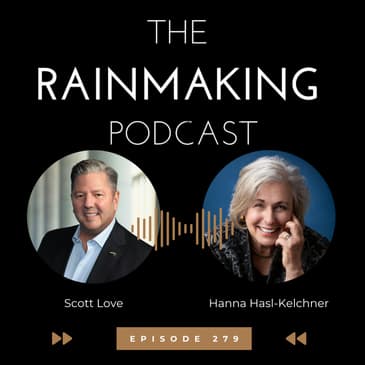
In this episode of The Rainmaking Podcast, Scott Love speaks with Hanna Hasl-Kelchner, attorney, business consultant, and author of Seeking Fairness at Work: Cracking the New Code of Greater Employee Engagement, Retention, and Satisfaction. Together, they explore “The Rainmaker’s Playbook for Managing the Team,” revealing how leadership, empathy, and trust directly impact performance and retention. Hanna explains that leading a team is not a transactional act—it’s a relationship built on an “implied social contract” of good faith and fair dealing. She shares how rainmakers can foster stronger loyalty and productivity by actively listening, showing gratitude, and treating team members as valued contributors rather than interchangeable resources.
Hanna also discusses practical ways to address performance issues with empathy and clarity, emphasizing joint problem-solving over blame. She encourages leaders to take “empathy reality checks,” solicit honest feedback, and model humility—reminding listeners that trust must be earned, not demanded. The conversation concludes with three action steps: listen to your team, invest in communication and coaching skills, and demonstrate genuine appreciation. These principles, she argues, transform high-pressure work environments into loyal, high-performing teams.
Visit: https://therainmakingpodcast.com/
YouTube: https://youtu.be/zwC5paGj0HQ
----------------------------------------
📖 Subscribe to The Rainmaking Magazine
For the intellectually-driven and results-focused professional who wants to grow their book of business. Visit www.therainmakingmagazine.com to chart your course to greater rainmaking success.
----------------------------------------
This podcast is sponsored by:
SurePoint Legal Insights (formerly known as Leopard Solutions) –turning legal intelligence into opportunity
Link: https://www.leopardsolutions.com/index.php/request-a-demo/
----------------------------------------
📌 Resources & Links
Connect with Hanna Hasl-Kelchner: linkedin.com/in/hannahaslkelchner
Get Hanna’s free audiobook: bit.ly/4oer0L3
Visit her site: businessmo.com
Learn more about your ad choices. Visit megaphone.fm/adchoices
[00:00:10] You're listening to The Rainmaking Podcast, hosted by high-stakes headhunter, author, and professional speaker, Scott Love You're listening to The Rainmaking Podcast, and my name is Scott Love. Thanks for joining me on the show. Let's look at your job as a rainmaker. Well, there's actually three components of what you have to master.
[00:00:35] First, the most obvious, you have to master your practice, what you actually do in the work that you do to serve your clients. Second, and this is the whole point of this show, you've got to earn the trust of clients and bring the business in. Third, you have to manage your team and how they do the work and serve your clients. We're going to talk about that third part today. The topic of our show today is the Rainmakers Playbook to Managing the Team.
[00:00:59] And our special guest is Hanna Hasl-Kelchner. Now, Hanna is a former practicing attorney, but really, in recent years, she's a consultant and coach for organizations that wish to affect change and how they engage and retain talent. Her book is called Seeking Fairness at Work, Cracking the New Code of Greater Employee Engagement, Retention, and Satisfaction.
[00:01:22] I'd highly recommend getting this book and reading it. We put the link on the show notes where you can download this book for free and listen to the audio version. Hanna was kind enough to give that to all of our listeners, so make sure you do that. I'd also recommend buying the book from Amazon and reading it. It's a book that I think would help you in that third component that we talked about in how you manage your team.
[00:01:44] As always, this podcast is sponsored by SharePoint Legal Insights, formerly known as Leopard Solutions, turning legal intelligence into opportunity. Also, our show is sponsored by The Rainmaking Magazine. For the intellectually driven and results-focused professional who wants to grow their book of business, visit therainmakingmagazine.com to chart your course to greater rainmaking success.
[00:02:10] Thanks for listening, and I hope you get some great ideas from my conversation with Hanna today. Hey, this is Scott Love with The Rainmaking Podcast. Our special guest today is Hanna Hansel-Kelchner, and we're talking about The Rainmaker's Playbook to Managing the Team. Hanna, thanks for joining me on the show today. Oh, it's a pleasure to be with you, Scott. Thank you. Absolutely.
[00:02:30] And I'm going to first give a shout out and a plug for your book, Seeking Fairness at Work, Cracking the New Code of Greater Employee Engagement, Retention, and Satisfaction. You wrote the book on this, and we're going to kind of dig into what rainmakers need to think about as they're managing their team. And so let me ask you this.
[00:02:48] I know you've met people, you've worked in the legal industry before, you've worked with a lot of high-profile people that have maybe a wee bit of hubris, and they're super smart, but maybe they're difficult to work for, maybe they're difficult to manage. What are some of the things top of mind that you think people should know about as they're managing their team within a legal context or professional services context? Well, I think it's important for professional services legal context, but really any employee-employer relationship.
[00:03:18] You know, in my experience, it's important to remember that it is a relationship and not a transaction. Yeah.
[00:03:56] An implied social contract that requires good faith and fair dealing. Right. And sometimes there's these unwritten rules in the workplace that get in the way. And for people that are rainmakers, that are business developers, that are good at what they do, it's really important that they have the team back at the office that can support and deliver the quality of what they're selling,
[00:04:22] which is why it's so important to have really good, robust, healthy relationships with your team. That's great. And let me kind of dig into when you talk about the implied social contract. I know you talk about in the book the relationships along those lines. How would you define that? What is this implied social contract? Well, for the lawyers that may be listening, you know, they know every good, every contract has an implied covenant of good faith and fair dealing. So putting that in into regular terms, it means being honest.
[00:04:52] Whoa, what a concept. And not getting in each other's way. I mean, if you were ordering something from a vendor, you would have specifications. You would talk about the quality and the quantity of what it is that you're buying. And that's what they need in order to be able to deliver it. When you're talking about services, it gets a little bit fuzzier because you're sort of anticipating and assuming that people have a certain level of professional understanding of what's necessary.
[00:05:20] But especially for young associates in professional services, they're learning. They're learning. They're learning how to communicate. They're learning how to deliver the product in the way that you want it, in a way that's going to make sense. And so being able to bribe them the support in terms of timely information, not having information siloed, but also the technical expertise, the infrastructure for the computers and so forth. How are we going to communicate, knowing what's going to be the best method of communication?
[00:05:50] Somebody sends a text, somebody sends an email and it crosses. And it's like, well, you didn't answer. Well, I'm not looking there. There's just so many little, a million little things where it can go wrong. So, but keeping the big picture in mind about good faith and fair dealing and providing the necessary support so that they can provide what's needed. And so let's say a rainmaker has a team, let's say he's working with a junior partner, maybe a counsel, three or four associates.
[00:06:17] And one of their colleagues just isn't performing at the level that that person needs to. The quality isn't there or they're not meeting deadlines. And this is a rainmaker that's not been trained as a professional manager, but he or she has to manage that team, has to address those issues of performance. Within this context of the implied social contract, how should that rainmaker, what should that rainmaker do in that particular scenario?
[00:06:43] I think that's a very common scenario where people are disappointed with performance and then respond in a way that is somewhat counterproductive. In my experience, what would be more helpful would be to focus on, you know, the specific issue of what's being missed. Is it a deadline? And then, you know, sort of do a postmortem, you know, do a deep dive in terms of saying, all right, well, what happened?
[00:07:10] Why? Let's find out why, you know, and where is the obstruction? Did somebody else not provide the information in a timely fashion? Where is the hiccup? Without pointing blame. I mean, it's about trying to fix processes because you fix the process, then the people fall in place. And if it's somebody that just, oh my God, I just can't work with this person. Well, then maybe you need to go a step further back and say, how did they get here?
[00:07:38] What happened in the recruiting process? You know, did we have the right criteria for what is necessary to be successful in this firm, in this position, in this environment? You know, and I think, you know, this is some of the things that you've experienced, no doubt, in the recruiting process. Are they giving you the information you need? Yeah, and that's a complaint I've seen from a lot of partners where they just don't have the quality of associates that they need. But I sometimes wonder, are those associates being properly mentored by partners? Are there issues that could be resolved?
[00:08:08] So let me bring it back to this scenario again. Let's say a partner has an associate, two deadlines have been missed and they're pretty important. And this partner needs to have a heart-to-heart with that associate. Kind of set the table for us. I mean, think about it this way. What's the best time of day to have that conversation? What should be the tone of the conversation? What should that partner say to really address this issue of subpar performance?
[00:08:31] Well, I think whatever time of day is elected, it should be when the partner is not going to be interrupted with a phone call or a text or, you know, an assistant running in saying, you know, so-and-so needs to talk to you right now. I mean, it has to be clear that that associate is getting their undivided attention and also making it clear that they want them to succeed. Oh, wow. And what is it? How can I help you be more effective?
[00:09:00] Because it could be a professional training issue. You know, I have one example, and this is someone that I had interviewed for the book. She was called into, and she does not just coaching, but instructional design. And she was called in because they were these, you know, senior college students that just weren't doing it. You know, they had the hoodies on and the headsets and they were leading back a computer and they were missing deadlines. They were told, you got to get this done. Just get it done by such and such time.
[00:09:28] I don't care how you do it or when you do it. It just needs to be done by this time. And they missed deadlines. Somehow, they just didn't connect to the fact that they needed to manage their time effectively in order to take these baby steps and cross the finish line. You know, and it could be something similar in the scenario that you've posed where somebody has difficulty managing their time or has difficulty focusing with the hours that they're constrained to. Some people are more morning people.
[00:09:58] Some are night owls. That might be it. You know, ask them, where do you see where we could make an improvement? What would make it easier to meet this deadline? And see what the answers are. It's about joint problem solving. And so I understand how partners might be reticent. It's difficult. You know, there's a fear that, oh my God, this person is going to melt down or they're going to blow up one or the other. But there's going to be this big emotional reaction.
[00:10:25] And if there is, you know, that's okay too, because people have feelings. We're not machines. To say, fine, I understand that this concerns you. And this is upsetting. It's upsetting for all of us. So why don't you take a minute, write down what happened, why you think it happened. And when I come back, then we'll have something to talk about. First of all, it lowers the temperature. And then you'll also have something concrete to focus on.
[00:10:52] And then hopefully come to some kind of resolution jointly where they also have a vested interest in the outcome as opposed to you, you, you. And if this doesn't happen, you know, and then you start marching up the disciplinary chain and out the door. I mean, that's a way to do it too. But keep in mind that other people are watching. That's right. And what kind of tone is that going to be set for everyone else and their willingness to trust and maybe raise a difficult issue, you know? It could even be a personal issue.
[00:11:21] Maybe something's happening at home or in their personal life within their family because you don't always leave it at the door. You know, it comes and goes. We're human. It ebbs and flows. Yeah. I've heard a lot of partners kind of say this. Kids these days, get a haircut, stay off my lawn. Why can't you do what I did when I was your age? And I hear that a lot. And I think this is a different time. It's a different generation. What tips do you think you would give to that partner?
[00:11:46] How can you kind of, I wouldn't say soften up the approach, but how can you really help that person get a little bit more empathy with what's going on with their junior colleague? Well, I think there's three things that they can do. First of all, if the organization does any type of employee engagement surveys, and I know they go by different names, you know, pulse surveys more frequently, whatever it's called. But the employee feedback mechanism, whatever label is on it. Take it seriously.
[00:12:15] Because if an employee has the courage to actually speak out in the form of a survey to give you some feedback. I know you may not like it. I totally get that. But take a beat and figure out what's going on. Don't think you can just ignore it or discount it. That sends another really bad message back to the organization and your team. HR, you can't assign it to it. Now, they may be able to help coach you, which is great.
[00:12:44] That's a form of professional development. But I mean, it's like trying to outsource exercise. No, you have to pump the weights. You can't outsource that. So I think that would be my first thing. And yes, it may be hard to hear. But keep in mind that it's trying to improve your team and your productivity. Because if you have some humility, just even a little bit to say, you know, maybe they have a point. Okay? Being able to say that, to be able to be humble, doesn't mean you're giving away your power.
[00:13:14] If anything, you're bringing them in and expanding your influence. Now you can get more done. So that would be one tip. A second tip would be take an empathy reality check. Put yourself just for five minutes in their shoes. How would you feel? And seriously, how would you feel? And I know the reaction would be, well, you know, I've earned this position. I have this title, I have this, but think about what you're just doing. Okay?
[00:13:40] You're hiding behind your privilege, which you've earned. Granted, do that. But that privilege can also blind you to the impact you're having on other people, which is counterproductive to your team. Now that's one of those hidden, unspoken rules that happen through the dynamics in the workplace. So an empathy reality check, I think would be really, really helpful.
[00:14:04] And the third thing would be to say to yourself, ask yourself, what's keeping me from demonstrating more good faith and fair dealing? Maybe you've got some kind of internal issue in terms of compensation that keeps you from giving somebody the promotion or keeps you from giving them an extra bonus. You know, that's a separate thing. There could be internal speed bumps within the process of the firm.
[00:14:33] You know, but then again, it could be, well, I just don't do that. Well, why not? You know, maybe talk to somebody who could help give you a little different perspective in order to create more awareness of how you could be doing things better, but also awareness of how you may be coming across and you don't realize it. You know? I mean, we don't see our own eyebrows unless we look in the mirror. So find a mirror. Great. That's great. I like that advice.
[00:15:02] And I know you talk about developing empathy in your book also. What do you think from the perspective of the employee? An employee, I'm talking about junior associates, junior partners, people that have a rainmaker that they report to, that's their supervising attorney. What is it that their expectations are in terms of the social contract and fairness at work? What do you think is on their mind? Well, I think what's on their mind, having been in that position at one point in my career, I can identify with it.
[00:15:32] You know, I think they're looking for, Abraham Maslow gave us a roadmap to, you know, human motivation. And I would encourage that anybody in a leadership position, even a junior leadership position, you know, maybe a senior associate that has some people reporting to them or that they're guiding, take that to heart. I mean, on the first instance, they're looking for safety, physical safety, the ability to, you know, meet their bills, which, you know, the folks that are listening to this certainly can provide that for their employees.
[00:16:02] But I think when it comes to the next level in Maslow's hierarchy, that deals with esteem. And recognition. I think that's where there's opportunities for, you know, tremendous improvement. You know, how somebody communicates. I mean, the whole area of communication and communication chemistry, really, you know, there's a million and one ways to connect. And that's what this is all about. Connection.
[00:16:28] To be able to communicate honesty and a feeling of psychological safety and belonging. To say, hey, we're in this together. You know, going back to the other example that, you know, you talked about. That it's joint problem solving, not I'm going to impose it down on you. There's enough of that in these types of professions in terms of court deadlines, in terms of trying to close deals and so on and so forth. So that's already the environment. You don't need more than that.
[00:16:55] If anything, it's to be able to show respect and appreciation. And people don't realize sometimes how they're being disrespectful. Exactly right. Right. And what I've done, because I've been recruiting for 30 years, I've had literally tens of thousands of conversations with professionals trying to recruit them. I pay attention to what is it that causes them to want to stay. And there's an emotional context. I love my team. I feel appreciated. I love this team. I don't think I'm going to leave, even if it's a better opportunity.
[00:17:22] And for those people that are thinking about going somewhere else, I put them in usually one of two categories. One is strategy. I'm conflicted. I need to go to a different platform. Or the other one is leadership. Whether it's leadership, it's something where I don't trust my leadership. And I've actually heard that before. I don't trust my colleagues. Or if it's somebody that's working for a rainmaker, I don't think I'm going to reach my goals because I'm inhibited from doing so for various reasons.
[00:17:50] And I don't feel like I'm really significant here. And I think that rainmaker that does the things you talk about that can show people significance and recognition, that can build that trust with them, that person is honoring their implied contract. What do you think about that, Hannah? Yeah, absolutely. You nailed it, Scott. You know, it's about letting people know that they matter, that they make a difference. You know, they may not have the biggest title and the biggest office and biggest desk. But you know what?
[00:18:20] If they didn't have an important role to play, they wouldn't be there. The job wouldn't even exist. You know, in the theater, there's a saying, there are no small roles. They're only small actors. So, you know, recognize their importance, their significance, you know, let them know they're doing a good job. Like, it doesn't take that much. You know, sometimes they have these employee award things and all this stuff going on, you know, the employee of the month.
[00:18:46] It's like, you know, I think it's a lot more valuable to be able to say, Scott, you know, you brought that in under budget. Thank you. I didn't think it was possible, but you made it work. I don't know how, but that was great. I mean, you know, it's little things like that. The recognition. It doesn't have to be these grand gestures. It just can be hearing and seeing people, letting them know that you're willing to listen and to really listen. I mean, even that's an art.
[00:19:16] I mean, we have speaking courses on how to do public speaking. How many listening courses have you heard of? How do you kind of go down this path in terms of Rainmaker giving recognition to their colleagues, to their associates and junior partners? What are some other things that you think that Rainmaker should be mindful of in terms of how to give them recognition? You know, even being available. I think that's really important to let people know I'm here for you, you know, and to,
[00:19:43] you know, ask them once in a while, what can I do? What do you need from me? How many times have you heard that? Yeah. Right? I think that that goes a long way. That goes a long way. I mean, they may even say, no, I'm good. But just to know that there's that safety net there and there's that word safety. That is important to know. I'm here. I'll catch you. I'm here for you. That is so important to a sense of belonging. It's the whole idea of a team.
[00:20:11] And I think sometimes people in senior leadership roles, because they're so wrapped up in doing their thing, they forget that a big part of their role as leaders is to coach. That's right. And they're thinking, I didn't learn that in law school. Why should I do that? Well, you have to do that. You have to be that person that does coach your team. Otherwise, they're going to be turning their nose and then going somewhere else in another year. Well, there's that or they'll just pull back. Like the turtle in the shell. You know, they'll just give you a little less, a little less.
[00:20:41] I mean, they'll still do acceptable work. But are you really getting that extra bit of horsepower? Are they going the extra mile? And I don't mean in terms of putting hours in at the office, you know, because that is really not the best metric in the world. I mean, it's billable. I get that. But is hour number 10 or 11 as productive as hour number one or two? I know you bill it the same. I've seen those bills. I've gotten those bills. Now, let me ask you this.
[00:21:10] Tell me a story of an organization you worked with that may have had certain challenges of trust internally in the organization. What did those leaders do to really change things and really build more cohesive structure and loyalty from their team? Well, I don't know of an organization that did it across the board, but I can give you an example of a leader that did it within. They were vice president of the in the organization as a whole.
[00:21:37] They had a profitable division and it was the way that they let their people talk to each other and to him. I mean, everybody in the building wanted to work for him. That's how good it was. And it was just amazing because there was this tremendous sense of cohesion and team. Then, yeah, they had their their golf shirts with their logo on it for the vision and all of that, which is which is fun. But that doesn't make it.
[00:22:06] I mean, I've seen situations where they hand out those little that kind of swag and nobody wants to wear it. What did he do? What were some some snippets you can share with us, some insight into what this this leader did that really built that built that loyalty? He listened to people. He listened to people. And one example, it actually involved me because at the time I was still practicing law. And, you know, he had, as you said, an employee where the rest of the team was saying,
[00:22:35] hey, they're not pulling their weight. You know, he's causing problems, this, that and the other. And he knew this person was, you know, basically a good guy. So he comes to me, you know, it's like, well, can I fire him this and that? So we had that conversation, which was fun. But it's like, well, you know, why don't you just talk to him, find out what's really going on? So he did. And he says, look, you know, I understand that, you know, XYZ is happening. This isn't like you. What's the story? You know, talk to me. And he confided.
[00:23:03] He said, I don't know if I really want to stay in this job. And it's not about you. It's just me. You know, I have a change of heart. And so basically he said, OK, that's reasonable. That's fair. I get it. I'll tell you what. I'll see if I can help you find another job within the corporation. And if not, I'm happy to write, you know, a recommendation for, you know, someplace else. Well, that took this tremendous monkey off this person's back. He let the other team know that there's going to be a transition coming.
[00:23:33] So they realized, OK, this extra work we're doing not going to last forever. And it all worked out. That's great, Hannah. So as we bring this to a close, if you could give our listeners three action steps, what are three action steps they can take to really build this trust, to really bring that level of performance and loyalty to a whole other level? What would those three action steps be, Hannah? I think the three action steps is listen to your employees. You know, ask them point blank.
[00:24:01] You know, what could I do better for you? That would be a start. Now, keep in mind, you may not like the answer. They also may be guarded in telling you. And that in itself is a message. In which case, then number two, get more professional development on how to coach people and how you're communicating, get feedback on your communication style. Doesn't mean you have to change yourself. It's not a personality issue.
[00:24:26] But there could be ways that you could maybe communicate that you don't even realize that that could demonstrate more empathy. And that could create closer connections with your team to make them trust you, to allow them to trust you because trust has to be earned. You can't demand it. All right. You get a certain amount that comes with the title. It's like, yes, they'll say all the right words. But are they really going to open up to you is the question.
[00:24:53] And I don't mean about a whole lot of personal stuff, but on a professional level to tell you. And then the third thing would be to demonstrate gratitude. Let people know they matter. That can go such a long way, especially if somebody has been keeping a lot of things off your desk. It's really easy to start assuming that they're not doing anything. Well, they've been keeping stuff off your desk for a long time. Recognize it. Appreciate it.
[00:25:22] You know, let them know they make a difference and that you value their contribution. I think that's going to be done in so many different ways. And your HR people can certainly help you find ways to do that. Well, thank you, Hannah. Thank you for sharing your insights and for being on the show today. And tell us about you and your offerings. What do you do? What do you have that you'd like our listeners to know about? Well, I would love my listeners to take a look at my book, which you had previously showed, Seeking Fairness at Work, Cracking the New Code 2.
[00:25:51] Yeah, I see all the little tabs there. That's great, Scott. Yeah, because what I focus on in that book is not just the importance of treating the employee-employer relationship as a relationship, but also where it goes astray. The things that people wish they could tell senior managers but are afraid to. These things basically fall into five areas. It's the unwritten rules that are causing dysfunction.
[00:26:18] So being able to smoke those out, some organizations may have more than others and they land in different categories. But one of the things that really touched my heart was a review I got on Amazon from a reader who said, as an employee, I now understand why I was so frustrated. Because so many people say, well, is it me? Is it them? Maybe I'm going crazy. So they said, I understand why I was frustrated. But as a manager, it helped me understand missed opportunities.
[00:26:46] So I would really love some of your listeners who want to have more powerful teams and have more influence with their teams to take advantage of those missed opportunities. You know, the book has won over a dozen awards. It's been compared to Kim Scott's Radical Respect. So I do have a free chapter on my book website, seekingfairnessatwork.com.
[00:27:12] You'll see it up there in the navigation bar, a free excerpt. So take a look at it, check it out, and let me know what you think. That's great, Hannah. And we'll put all of your contact information, including the book ordering link and the show notes for everybody listening. Go there and you'll be able to access that directly and connect with Hannah directly. Thank you for sharing your wisdom, Hannah. I really appreciate you being on our show today. I appreciate you, Scott. Thanks for all you do. Thank you for listening to The Rainmaking Podcast.
[00:27:43] For more information about our recruiting services for international law firms, visit our website at attorneysearchgroup.com. To inquire about having Scott speak at your next convention, conference, sales meeting, or executive retreat, visit therainmakingpodcast.com.