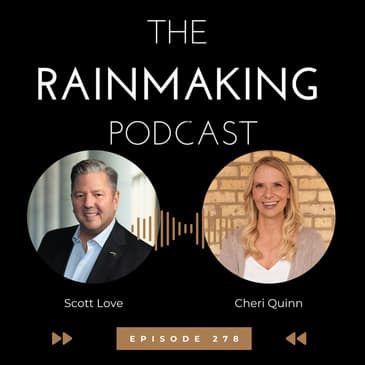
In this episode of The Rainmaking Podcast, Scott Love welcomes brand strategist Cheri Quinn, Director of Brand Strategy at Mercury Creative Group, to discuss “Finding Focus in a Crowded Space.” Cheri explains that today’s marketplace is more crowded than ever—not just because of competition, but because clients are constantly flooded with information. To cut through the noise, professionals must clearly define their primary audience—the people they serve best—and communicate with authenticity and focus.
Cheri shares her “dartboard” analogy for targeting ideal clients: those in the bullseye deliver the greatest results, while trying to appeal to everyone leads to “missing the mark.” She walks listeners through exercises to identify their favorite clients, understand their motivations, communication styles, and values, and align their firm’s brand strategy accordingly. By clarifying audience, message, and brand alignment, professionals can stand out in a crowded market and attract the right opportunities.
Visit: https://therainmakingpodcast.com/
YouTube: https://youtu.be/pNZU13CEz9I
----------------------------------------
📖 Subscribe to The Rainmaking Magazine
For the intellectually-driven and results-focused professional who wants to grow their book of business. Visit www.therainmakingmagazine.com to chart your course to greater rainmaking success.
----------------------------------------
This podcast is sponsored by:
SurePoint Legal Insights (formerly known as Leopard Solutions) –turning legal intelligence into opportunity Link: https://www.leopardsolutions.com/index.php/request-a-demo/
----------------------------------------
Cheri Quinn is a brand and marketing strategist who specializes in asking open and honest questions and listening with an open heart and mind. As the Director of Brand Strategy at Mercury Creative Group, Cheri is a master at discovering and communicating an organization’s essential value. With a wealth of experience in brand strategy, strategic planning, marketing, and communications, she has helped numerous organizations discover their unique value and voice.
Links:
cheri@mercurycreativegroup.com
https://www.linkedin.com/in/cheriquinn
https://mercurycreativegroup.com
Learn more about your ad choices. Visit megaphone.fm/adchoices
[00:00:10] You're listening to The Rainmaking Podcast, hosted by high stakes headhunter, author, and professional speaker, Scott Love. You're listening to The Rainmaking Podcast, and my name is Scott Love. Thanks for joining me on the show. If you're a professional services provider that finds that your space has become a little bit more crowded, then this episode is going to help you.
[00:00:36] Our topic title is Finding Focus in a Crowded Space, and our expert today is Cheri Quinn. Cheri is a brand and marketing strategist who specializes in asking open and honest questions and listening with an open heart and mind. She's the director of brand strategy at Mercury Creative Group. She's a master at discovering and communicating an organization's essential value. I think you're going to get some great ideas from our show today.
[00:01:02] Make sure you connect with Cheri on the show notes. We've got her LinkedIn and also her company's link there directly. As always, this show is sponsored by SurePoint Legal Insights, formerly known as Leopard Solutions, turning legal intelligence into opportunity. Also, this show is sponsored by The Rainmaking Magazine for the intellectually driven and results-focused professional who wants to grow their book of business.
[00:01:27] Visit therainmakingmagazine.com to chart your course to greater rainmaking success. Thanks for listening. If you get some ideas from today's show that help you, please go to Apple Podcasts and write us a nice five-star review. I'd appreciate that very much. Thanks so much for listening, and I hope you get some great ideas from my conversation with Cheri Quinn today.
[00:01:50] Hey, this is Scott Love with The Rainmaking Podcast. Our guest today is Cheri Quinn, and our topic is finding focus in a crowded space. Cheri, thanks for joining me on the show today. Yes, thank you for having me, Scott. It's nice to be here. And I like this topic title, do you think the marketplace in business has become more crowded since COVID? Do you think that's a fact, or does it just seem that way? Oh, that's a great question to kick us off. I think both, honestly.
[00:02:19] I know that's an answer that most consultants will give to clients, but let me describe what both means to me. I do think it's more crowded, but I think it's more crowded for a reason that has existed because of the way that we receive communications and the way that we receive information over time.
[00:02:41] So if you think back 20, even 25 years ago, it was all about potential clients didn't have information about us until we went out and gave it to them. Right. And really now we are flooded with information all the time and our primary clients, our prospects, they can find out lots of stuff about us before they ever meet us, before they ever meet anyone from our team.
[00:03:08] So it's twofold. I think there is more crowded space because there's just more content in the world for people to have access to. That makes sense. And where should we start with this? If we're looking to find focus in a crowded space, what are some of the first steps we need to think about? The first step that I take with my clients from a brand strategy perspective is identifying who you serve best. So identifying really dialing in on your primary client or your ideal client.
[00:03:38] And what does that mean exactly? How do we define those people? Sure. So your ideal client is the person that you want to duplicate. So you want to think about them as who's your favorites. And if you could duplicate them and have 50 more of them walk through your door and ask for your services, that would be a big win. The people that are going to be the best opportunity for growth for your firm, for your job, for your industry. That's the overall way to describe it.
[00:04:08] Also, the person that you're going to put at the center of your messaging and your communications. Hmm. So let me ask you this. Let's just say there's professional service provider. Then he might say my primary clients are manufacturing. But if we narrowed it down, we could say privately owned manufacturing companies in the Midwest that have revenue between 50 to 100 million with 50 to 100 employees. I mean, are we getting that granular in identifying that kind of primary client?
[00:04:37] What do you think about that? You know what? I would take it a little different direction. Well, tell me about this. So a couple of things. The demographics are important to some degree, but less important than aligning from a culture perspective. So really putting your authenticity out into the world and allowing your prospective clients to self-identify that you're the place for them. So the other point is it's not about working with a business.
[00:05:06] We don't do business with businesses. We do business with people. So instead of identifying, oh, my best clients are manufacturing firms. It's more important to say my best clients are the decision maker within that firm who happens to be the project manager that fits these demographics as well as this buying behavior.
[00:05:31] This motivation has these types of anticipated issues in the world that I can help solve. And then knowing as much as you can about them, about their life, even outside of work, so that you can dial in and speak to them directly. So this is something I've never heard before. And I believe and I agree with you that we're not selling to organizations. We're selling to people.
[00:05:54] But I've never heard anybody say, look at the organization in terms of how would you call it, like an avatar, what your ideal looks like, but never really the individual. So let's just say kind of going to the manufacturing company issue.
[00:06:09] Let's say it's an attorney that does corporate M&A within manufacturing, but their ideal client could be a 55 year old founder with older children that is approaching retirement and is starting to take longer vacations. And I have a friend that's an investment banker and I asked him, I said, what's one of the attributes of where you know a deal is going to happen? He says, when the founder starts taking longer vacations, then they were starting to ready to think it. So what do you think? I mean, kind of drilling it down on that level.
[00:06:38] Is that what you're talking about, Sherry? Yes, that's what I'm talking about. So I tell this story to my clients. It's when we're digging into really trying to identify your ideal client or your primary client. I call it the dark board story. So I'd love to share that with you. Yeah, tell me. It's an analogy. And it came out of just an analogy that I pair with a story about my childhood.
[00:07:06] So when I was a kid, I grew up in a small town in the Midwest and I'm talking like a two bars, five churches, one post office kind of a place. So tiny town in the Midwest. And my dad owned one of the competing bars in town. So every day after school, my brothers and sister and I, getting out of grade school, we would walk up to the bar where he was getting ready for the evening. And we would sit in the booths and do homework until my mom got off work to pick up that.
[00:07:35] So if we got our homework done in time, my dad would let us throw darts. More to keep us out of his hair than anything. But here's what I know about playing darts in a bar as it pertains to identifying your ideal audience. And that is every time you hit the bullseye, you get the most points the fastest. So if you take and put your ideal client in the center of that dartboard, you're going to get the most points the fastest. You're going to make the most money the fastest.
[00:08:04] You're going to get the most attention the fastest. You're going to get the most followers and engagement the fastest. So that's what we're trying to identify is who goes in the center of your messaging. Who can you speak to directly? Now, here's what else I know about playing darts in a bar. Is that if your dart lands in one of those outside rings around the bullseye, you still get points. Right? So if depending on how many points you need or what game you're playing, you still get points.
[00:08:34] And that's to say that if you have other audiences that you serve outside of that primary audience in the center, that's okay. You can still take their money. You can still serve them. You could still help them. They might still engage with you. They might even be joint venture partners that refer you. So that's okay. They can still listen to your messaging and will still identify with you.
[00:08:58] Now, the final thing and probably the most important thing about playing darts in a bar is if your dart lands on the wall that the dartboard's hanging on, you never get any points. You've missed the mark. It's too big. It's too expansive. You're not honing in. So if you're trying to be all things to all people that might possibly buy from you, nobody's listening. The space is too crowded. There's too much content.
[00:09:25] So your best opportunity for growth is honing in on who's in the center. Do you think people are afraid they're going to miss out on opportunities when they do that? Yes, I do. I do think people are afraid, but it really works backwards from that. You really relay your authenticity when you're talking to the person that you serve the best. People, there's too much noise in our space right now.
[00:09:49] All of us, regardless of who we are, are discerning what content we pay attention to and what really captures our attention and aligns with us. We are always self-identifying what's best for us. And we don't know that if we can't clarify and understand the message from the places that we purchase from. So let's say I'm a professional. I'm listening to this. This is really good. I like that. I'm doing M&A for manufacturing companies.
[00:10:17] If you were coaching that person, how would you coach that person to really get to this level of focus? And then what would you call that? Are you calling it the personal avatar? Do you call it anything? Is there anything that you call it when you help people do this, Sherry? Sure. Overarching, we call it primary audience. Primary audience. Okay. So I work for Mercury Creative Group. If you look at our website, you will find language around identifying your primary audience.
[00:10:43] When I'm working with a client one-on-one, we drill that in a little further. So I work a lot with professional services firms, and they might really want to hone in on that, what we'll call their ideal client. Right. I also work with member-based associations and executive directors and teams of professional services organizations. So they're association for the industry.
[00:11:10] And in that case, we'd call it their ideal member because that's the person they're trying to attract. Sometimes I'll work with a client that really is needing to focus on recruiting and recruiting staff. And in that case, we might call it the ideal team member. Absolutely right. It's your audience. Yeah. That's right. And I've noticed that when I'm talking to audiences about recruiting, so I'll do some speaking on that, brain-making and recruiting, it's identifying who is it that you really want. It's the exact same thing that you're talking about.
[00:11:38] And then even coaching them to ask questions such as, what problems do you solve? How will your organization improve their condition on a personal and an emotional level? Yeah. Not just professionally. Because when you can get to that, then you've got a chance. Because as you know, and we'll probably get into this, people make decisions based on emotion, whether they're buying decisions or joining. So we're kind of in the same business here, Sherry. Exactly. You got it.
[00:12:04] So you're coaching your client to identify this primary audience, an ideal prospective client. What are the variables that you're coaching one of your clients to think through when you're identifying this primary audience type person? Yes. So the first thing we do is I walk through an exercise that I call the favorite client exercise. So normally I'm not working necessarily one-on-one with one person or one founder.
[00:12:32] Sometimes I am, but usually it's a team of people that are all answering and giving their insight. So I'll ask the team to think about who is your favorite client. Who is your current favorite client that you want to duplicate? And that person might not be the person that they make the most money off of. In fact, oftentimes it's not. But it's the person that they love working with and they have specific reasons for why they love working with them. Oh, yeah.
[00:13:00] So we go through a list of, I'll have them just on the fly, think about that favorite client, and then I'll ask these questions. Start with their name because what I don't want to hear is what company they work for. So we start with a name. Then I want to know their age range to get an idea of their experience in the world. Like you said, one of the deciding factors is when they're getting ready to semi-retire or take more vacations. So I want to know about their lifestyle.
[00:13:29] I want to know their age. I ultimately want to know what employer industry they work in. I want to know their professional role. So which seat do they sit in within that industry? Because they may not be the buyer that signs the check, but they might be the influencer. That really is the decision maker. Then I want to know what's their buying behavior and what's their motivation. What is their motivation for needing you? I also want to know their communication style.
[00:13:57] Are they direct? Are they, do they like more relationship building before they talk about business? Do they like email? Do they need you to pick up the phone and want to hear your voice to voice? Do they like in-person meetings? I want to know about their communication style. And then I also want to know their values, their personal values. So sometimes people can anticipate what those might be or guess at what those might be.
[00:14:21] But ultimately, you know, and what I'm looking for is how do they align with your company's values? Because that will make alignment out in the world. So I take that, we tell that story about that person. And then I ask each member of the team to share that information about their favorite client. What happens from there is, I call it Frankensteining. We pull all these people together to create one ideal client.
[00:14:50] And the way that we do that is we answer those questions. We find the common threads through each of those stories. What is the overarching themes here? Usually it's age range. It's a specific industry. It's also a specific role within that industry that is similar. And then they have similar motivations and communication styles and values that all equate back to alignment with the company. Wow. That's a lot of information, right?
[00:15:20] It is a lot of information, but it's important. It really helps, like I said, drill into who is that primary audience that you're going to put in the center of your messaging. So knowing them that well, not just their demographics, not just where they are and their age range and their gender. And because a lot of that stuff sometimes doesn't matter as much as their buying motivation, their communication style, their values, their lifestyle, really understanding their need.
[00:15:49] So what has surprised you when you've worked with one of your clients? You're doing this exercise, something. Wow. I just wouldn't have anticipated that. What's an example of that, Sherry? A lot of times I'll get questions at the beginning. They will say, a team will say, oh, you'll never be able to figure this out for us because we serve so many different sectors or segments of clients. And that is the surprise, maybe not for me.
[00:16:17] I've done this so many times with so many different types of clients that I have to set anything I'm anticipating aside. I have my method for doing it, but ultimately I need to let it play out as per the client. Again, I'm not building their brand for them. Their brand already exists in their hearts and minds. I'm just helping them uncover it and distill it down.
[00:16:41] So oftentimes the client is surprised by, oh my gosh, there is commonality even across client segments. And I can see that this is even beyond brand alignment and a lot about strategy. What do you think about that? Oh, absolutely. So I'm officially a brand strategist. And really applying strategy first. So our point of view at Mercury Creative Group is we're a strategy first company.
[00:17:08] A lot of times our clients might come to us or first engage with us because they think about brand as the visuals, the logo, the name, the tagline, the colors. And really we take them back to a strategic approach, identifying who they serve best, the value they provide. So who they are, what they do, who they do it for. Before we get into design and marketing, because that's the foundation of their business. Yeah.
[00:17:38] So tell me about an organization you worked with. And you don't have to mention them by name. But you were working with them and they're like, waste of time. We're here because they're making us be here. We're never going to solve this problem. We're never going to come up with anything. We know who we are. But then you see a big change and everybody's surprised. And it makes it more clear they can find that focus in a crowded space because of that work. Tell me that story, Sherry. Sure.
[00:18:03] Gosh, I have so many audiences swimming through my mind right now. I think one specifically I can talk about is an attorney firm. Group of attorneys, very successful in the Minneapolis area. But really wanted to start aligning their internal team around their brand foundation. So yes, one aspect of that was to get stronger external messaging.
[00:18:33] But the other, and even more importantly, their operations vice president came to us and said, we have been a bit on hiring frenzy on growing our team. And the surprise was, just like I started to explain before, they had attorneys and team members that were working in their family law practice. They had a business law as well. So they had these different segments of their business.
[00:19:03] And really the teams started becoming more siloed. So instead of feeling like they were working for the same firm under the same brand umbrella, depending on who you talk to, it almost sounded like they worked for different places because they worked in different practice areas. So that really came together and bringing them together in one room to describe their favorite clients,
[00:19:29] regardless of the practice area that they were talking about, was really enlightening to have them go, oh, we do have commonality because we work for the same brand for the same firm. And we can describe that in a stronger way because we're approaching it from a foundational level, not from just our practice area. How do you think that helped them over time? So the thing that we provided to them was clarity and alignment.
[00:19:58] So when I talk about clarity and alignment, that is really for your internal team first, getting everybody on the same page with messaging and promoting your brand. The way that that helps you is consistency is important. So consistency is one of the key elements in promotion of any kind and in building a brand and communicating about a brand. And it needs to start from the inside out.
[00:20:26] So getting your team, your leadership and your team saying the same thing at the same time about your company, about your firm is key to helping everyone along the way self-identify whether or not you're right for them. So we start inside out. We start with the people closest to the brand that was working on your team. From there, once that's consistent, then we bring in those joint venture partners,
[00:20:55] anybody that refers you and needs to really know a little bit deeper about what you do, and then out into your client base and then out into your industry so that everybody that knows about your brand or touches it is hearing the same thing at the same time about your value. That's great, Sherry. And so as we bring our conversation to a close, if you could summarize three action steps for our listeners, what are three action steps they could take to implement some of these ideas that you shared with us today? Sure.
[00:21:22] The first thing I would do is think about who your current favorite clients are, your current favorite audience. And when I say client, again, that might be a member, that might be a recruit, depending on the path of growth that you're looking for for your organization. But for the purpose of this, let's talk about favorite client. The first step, I would say go to the Mercury Creative Group website. We have some tools there. One of those tools is three simple steps to discover your primary audience. Well, that's great.
[00:21:52] And we're going to mention that link. We'll put that on the show notes. Everybody listening, go to the show notes and you'll be able to get that link directly. Yes, great. So that is a great guide. It explains the exercise that I kind of talked through about how you want to approach thinking about your favorite client. And then from there, the second step, you want to think about what they need.
[00:22:13] So once you have that person identified clearly, you want to take some steps that really think about what do they need in the world, both within the job that they do and within the life that they're living and how you're a solution for them. That's great. And then the third step is going to be how do you take that information, that strategic foundational information and apply it to messaging for your business.
[00:22:40] The thing, the third step I would say is, yes, think about that as messaging. We have this great tool in the world now called AI that can really help you distill and synthesize all of this information. I am currently putting the finishing touches on a workshop tool that I would love for your listeners to watch for.
[00:23:03] It's coming out the end of this summer and it walks through this process step by step and then synthesizes that information into relevant content. So we're even talking about, we're a strategy first company and that's even strategy first, AI second.
[00:23:20] So those of us in the world that are using AI on its own without incorporating your brand foundational information, you'll get some good overarching pieces of messaging and content. But when you really tell that resource who you are, what you do and who you serve best, then your messaging starts to speak directly to your primary audience. That's great, Sherry. And tell us about your company. What do you have and what do you do that you'd like our listeners to know about? Sure.
[00:23:50] So again, I work for Mercury Creative Group. We're a brand strategy and design firm. So we start with just the things I've been talking about today. We start with brand strategy, setting your foundational elements. We work with teams that are looking to redefine that. Sometimes teams will come to us because they've had a leadership change. They're going through a merger or acquisition process. So they have more team members that they need to provide clarity to.
[00:24:20] Or there might be some other shift in their universe. They might be moving into different markets and need clearer messaging for those new markets. Or they might be like the one I talked about where they were growing and needed to recruit more and understand who those team members are. So setting that brand foundation is what we do. And then we take that information and help with their visual elements. We have designers on staff as well. So we move into logo, color, brand, voice design as needed.
[00:24:49] So we'll update external facing messaging like website content. And then we like to remain close to our clients and be their marketing partner on an ongoing basis. Super. Well, thank you, Sherry, for sharing all of your wisdom with us today. I learned some great ideas. I know our listeners have also. And I'd love to have you back on the show in the future. Great job today in sharing all of your wisdom with us, Sherry. Yeah, thank you so much. Thank you for listening to The Rainmaking Podcast.
[00:25:19] For more information about our recruiting services for international law firms, visit our website at attorneysearchgroup.com. To inquire about having Scott speak at your next convention, conference, sales meeting, or executive retreat, visit theraanmakingpodcast.com.