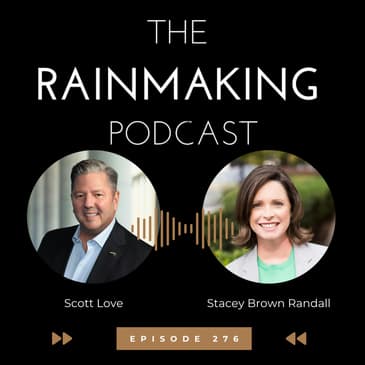
In this episode of The Rainmaking Podcast, Scott Love welcomes back Stacey Brown Randall, author of The Referable Client Experience: A Proven Method to Generate Referrals Without Asking. Stacey shares her science-based framework for creating client experiences that naturally generate referrals—without the awkwardness of asking. She explains that client experience is not just about doing great work; it’s about how clients feel when working with you. Professionals who intentionally design their client journey to include both excellent results and meaningful relationship-building touchpoints create the emotional connection that makes them truly referable.
Stacey outlines her three-stage model—New, Active, and Alumni—and shows how to tailor communication and touchpoints at each phase to build trust and loyalty. She also discusses “referral hot zones,” those key moments when clients are most likely to refer, and how to identify and leverage them strategically. By focusing on both client emotions and relationship touchpoints, professionals can bridge the gap between being referable and receiving consistent, high-quality referrals.
Visit: https://therainmakingpodcast.com/
YouTube: https://youtu.be/lWTNQlQ3RMA
----------------------------------------
📖 Subscribe to The Rainmaking Magazine
If you’re serious about growing your book of business, you’ll want to check out The Rainmaking Magazine — a monthly digital publication packed with insights, strategies, and real-world advice for professionals in law, consulting, recruiting, and beyond.
💡 Created for results-driven rainmakers who value credibility and substance.
💥 Now live — subscribe today www.therainmakingmagazine.com
----------------------------------------
This show is sponsored by Leopard Solutions Legal Intelligence Suite of products, Firmscape, and Leopard BI. Push ahead of the pack with the power of Leopard. For a free demo, visit this link:https://www.leopardsolutions.com/index.php/request-a-demo/
----------------------------------------
Stacey Brown Randall is the multiple award-winning author of Generating Business Referrals Without Asking, host of the Roadmap to Grow Your Business podcast and national speaker.
She has had the privilege of helping well-known corporations and franchises but her focus is on small business owners and solopreneurs including HM Properties, O’Connor Insurance Associates, Keller Williams Real Estate, Farris Cooke CPA, Tyra Law Firm, Nicole Odom Coaching, Slater Interiors, HF Financial, Kintsugi Home Staging, Financial Symmetry, Rae Images, CAJA Bookkeeping, and hundreds more.
Stacey has been featured in national publications like Entrepreneur magazine, Investor Business Daily, Forbes, CEO World, Fox News, Cheddar TV Network and more.
She received her Master’s in Organizational Communication and is married with three kids.
Links:
www.StaceyBrownRandall.com www.referralquiz.com
http://www.referableclientexperience.com
Learn more about your ad choices. Visit megaphone.fm/adchoices
[00:00:10] You're listening to The Rainmaking Podcast, hosted by high stakes headhunter, author, and professional speaker, Scott Love. You're listening to The Rainmaking Podcast, and my name is Scott Love. Thanks for joining me on the show. I'm excited about this guest and this episode today because of the potential it's going to give you in helping you get more referrals. Isn't that what every professional services provider wants more of?
[00:00:39] Our guest is Stacey Brown Randall. She's been a guest on the show before. She's an expert in the area of helping professionals get more referrals, and we're digging into her book, The Referable Client Experience, A Proven Method to Generate Referrals Without Asking. So we've had almost 300 guests on this show. Half of them are authors. I've read all of their books, literally, because I want to be ready to dig into these for you so that this is a useful experience for you.
[00:01:09] And her book, I would say it's in the top 1%. This is a book you need to get and you need to study it because there's so much in that. I hope that you connect with Stacey. Go to the show notes. You'll be able to order the book directly from there as well as connect with her and learn more about her. This is going to be a useful episode for you. And if you get a chance, go to Apple Podcasts or wherever you listen to the show and give us a nice five-star review and mention Stacey by name if you get something from this. I know she'd appreciate that.
[00:01:37] This podcast, as always, is sponsored by SharePoint Legal Insights, formerly known as Leopard Solutions, turning legal intelligence into opportunity. It's also sponsored by The Rainmaking Magazine for intellectually driven professionals who are also results-focused and want to grow their book of business. Visit therainmakingmagazine.com to chart your course to greater rainmaking success. Thanks for listening, and I hope you get a lot out of today's show.
[00:02:08] Hey, this is Scott Love with The Rainmaking Podcast. I'm really excited about this show today. We've got a repeat guest. Stacey Brown-Randall is with us again. Even to this day, people talk about her previous interview I did with her before, so I'm going to put that link in the show notes. But the topic for today is the Referrable Client Experience with Stacey Brown-Randall. Stacey, thank you for joining me on the show again. Scott, thanks so much for having me back. I really appreciate it. That's right. And with your book, I read your book. I've marked it up.
[00:02:36] I had audibly said the word wow at least once or twice in reading this because I think you talk about something that nobody really talks about. Our show, we've had almost 300 guests. Half of them are authors. I've read all their books. Your book is in the top 1%. And I think you nailed it when you talk about CX, the client experience. And so let's kind of talk about that. What's the definition of the client experience? And then we'll go to how we can get what we want, which are more referrals from that.
[00:03:05] Yeah. So the client experience, this is interesting. When I first started writing this book, I'm embarrassed to say five years ago, it took that long. I use COVID as a really long excuse to not finish it and get it published. This book should have been out in 2022 and it wasn't.
[00:03:20] It's now out in 2025. But it was interesting because obviously the earlier chapters I had written, like back in like 2019, 2020, and there wasn't a lot of research and there wasn't a lot of like definitive answers on how do we define client experience. Most organizations or marketing companies, they had their own definitions and there were just multiple definitions.
[00:03:42] In the last five years, everyone's kind of settled in on and it's the definition I've always used with my clients over the last 12 years I've been doing this about what client experience is. And I would say if you go Google client experience today, this is probably the main definition you'll hear. But five years ago, this was not the case. But the main definition that people use today that I've been using that I believe really encapsulates what our client experience is, it's how your clients feel when they're doing business with you.
[00:04:12] And feeling, right, those emotions, that's a lot of things. Most people feel like, oh, it's me doing great work. That is not your client experience. That is part of your client experience, right? I have a lot of people say, oh, yeah, when people have a problem, we have somebody on our team that takes care of that. Like customer service is our client experience. I'm like, no, that's a part of your client experience. It is like the whole umbrella of how your clients feel.
[00:04:36] And most people focus on the work they do, the results they give, the transformation they help their clients drive. And it's more than that. It's not just the work you do. It's also the relationship you build because that's where those feelings and emotions really lie. And that's what you have to be paying attention to. Yeah, that's right. And what I like about your book, how you articulate that. And this book is a must read for any professional services provider, especially if you've been doing it for a while.
[00:05:03] Because it causes you to look at what you actually do all day and the different types of touch points. You categorize those into different segments. I mean, you break it down in a wonderful, simple way. So let's kind of dig into it a little bit. But if my goal is to create the kind of experience so that my clients eagerly give me referrals, what are the things I should keep top of mind? And I like how you talk. It starts with the emotional context of it. And we can't get away from that.
[00:05:31] Where else should we kind of look at solutions in this area? Yeah, so one of the things I want people to understand is, you know, most of the strategies that I teach my clients, they have one objective, right? You know, it's like we're taught like one call to action when you're writing an email. Like it's like one thing, one objective. The strategies that I typically teach my clients have one objective, except for this one. This strategy has two objectives and they are equally important. And the first one is, is having a client experience that makes you referable.
[00:06:00] The second piece is then bridging the gap to referrals. Because just being referable will not unleash a river of referrals from your clients. And so we first need to focus on making sure that we're referable. And then we can look at bridging the gap. So that's always what I want people to understand. People usually just want to jump to the section of like, okay, just tell me what I need to say that people will give me referrals. And I'm like, yeah, but if you're not referable and you're not leaning into the emotions of how they feel,
[00:06:26] it doesn't matter the tactics that I teach you about what to say and when to say it and how to do it and look for your referral hot zones. And none of that matters if you don't actually have a referable client experience or client experience that's worthy of being referred. And so that's the first place we start. And so what people have to understand is, is that we break this down into stages. There's lots of books out there that will talk about the client experience. And they'll talk about the seven stages your clients go through or the six stages your clients go through. And you can look at any format of the client experience that you want.
[00:06:55] I do it in three because I have found with my clients, the more simple I keep it, the more likely they are to like, got it, I can implement, right? And my goal is not just to give you information. It is to get you to implement on that information as well. And so we look at three stages, new, active, alumni. Unless you work with your clients forever, say like a CPA that wants to file your taxes every year. And so your clients don't move to alumni. They stay in that active stage and that active stage becomes ongoing.
[00:07:23] But the new client stage and the active stage and the alumni stage, there are moments within those stages where you have the ability to not only do your great work, but also deliver on relationship building touch points. And it's those two things that make up the formula of the client experience, which is the work you do plus the relationship you build. And both are delivered to what we call touch points. And it's not like for every work output you do, you need to have a relationship building touch point. Like that's not necessary, but you have some.
[00:07:53] And can you talk about, I know you talk about the different types of touch points. What does that mean? And what are the different types of professional services providers should be mindful of? Yeah, so every stage has different types of touch points. In the new client stage, when someone's brand new working with you and you determine how long your new client stage is new. Some people are like 30 days. Some people are like until they get to this milestone. You determine that. But in the new client stage, where you're going to do your relationship building touch points is where you're overcoming concerns that your client has.
[00:08:23] And that's what I call the quiet voice, right? That's the quiet voice of them. It's all the things they're thinking that they're not saying to you that they're concerned about or they're questioning or they're worried about. It's like buyer's remorse, but it kind of permeates that entire new stage. And we want to overcome that. So most people, I'll give you this example. Most people will write like a welcome card to their client. I'm so glad you're a client or thanks becoming a client. We're excited to work with you. That's nice, but it's not great. It's nice and it really works for you.
[00:08:51] It doesn't work for the benefit of the client and it doesn't overcome the quiet voice. So one of the things I talk about in the book and the language I tell folks to consider is meet them where they are. When a client hires you, figure out, you should know if you've been doing this a while, but you should understand what their number one emotion is. Is it concern that they just spent a lot of money and they're like, oh gosh, did I pick the right person? Is there a concern that this is going to cause me to do a lot of work? And I don't know if I want to do all this work, but I know I need to do this work, right? What is it that's heavy for them?
[00:09:21] And acknowledge that in the note. Acknowledge that in the welcome note. Be like, hey, when I was a productivity coach, I used to say, hey, we both know this journey is going to stretch and challenge you and you're not always going to love me through it, right? But you're not alone. I am your co-pilot and I will be with you every step of the way. So addressing that quiet voice, it's still in a work way, but it's done in a way that really is focusing on the relationship. So that's just an example for the new stage, right?
[00:09:46] Well, then when you move into the active stage and the alumni stage, your client has moved into different emotional states. And so you want to pay attention to those states, right? And make sure you're feeding not just the great work you're doing, but also the relationship moments as well. So let me ask you this. Let me get back to the quiet voice because that's a brilliant way to articulate what I think every professional services provider kind of senses that they might have with their clients and prospective clients.
[00:10:10] How do you think we can find out what that quiet voice is with our current and past and even prospective clients? Yeah. So I think in some cases, you've probably heard your clients say things after the fact, right? Like once things are going well, they may confide in you. It's like, oh, I was really worried when I said yes to this because it's such a huge investment, right? So some of it's just paying attention and listening. You can also ask, right? It's like asking for feedback from your clients, right?
[00:10:37] Like I know when clients come into my programs to work with me, depending on what level they come in at, they're not inexpensive. Yeah. So I know automatically, no matter like how, you know, revenue rich their business is, they're like making a massive chunk of an investment. And I know to speak to that. The other thing that I know they want to know that I need to speak to is the results. And so some of this happens when they're in the buyer's journey, right?
[00:11:03] So some of that, how you talk to your prospects before they say yes to being a client matters. And it kind of helps solve some of these problems as they come in. But the other thing is I always tell my clients, I'm really, really open and upfront with them. Like if you don't do the work, there'll be nothing happening. And that won't be on me. Yeah. Right? So sometimes it's just knowing what it takes, like watching your clients who are successful and figuring out what made them different from those that maybe weren't as successful or weren't as successful as fast. Yeah, yeah. Right?
[00:11:33] So for me, I know it's the doing of the work. And I know you, depending on how you work with me, there's, you may come in at a VIP level and I may do most of the work, but you still have to implement. Yeah. Right? Or you come in at a different level and you're actually going to watch the trainings and then you got to implement. And so it's just always recognizing what that looks like. Sometimes you just know based on what you do. Right? Like if you're an estate planning attorney and you just know that because you've probably been doing this so long that your clients show up and they're like, we have to make really hard decisions.
[00:12:02] And we have to make, I mean, we've done this twice in our lives. So it's like, I know like we have to make really hard decisions about our children. And you know, that's going to force us to question everything. And so that's an important thing is like just paying attention to what, you know, their fears are. Sometimes it's the fears they say when they're in a buyer's journey and they're a prospect. Sometimes it's what they tell you after the fact. And if you don't know, just ask them, hey, don't ask a brand new client.
[00:12:25] I would say ask somebody who's like a little further along working with you and be like, hey, when you first signed on the dotted line to say yes to working with me, what was like your biggest concern? Right. Right. I like that. I like that idea. So let's kind of dig a little bit more into having a client experience that makes you referable that I want to talk about bridging the gap to referrals. What do you think is another significant component of that first section? A clear client experience makes you referable. What do you think other top of mind variables are that we should consider with that? Oh, yeah.
[00:12:54] So it really depends on what stage you're in. If you're in the active stage, you need to pay attention to does the work you do become routine or do your clients find themselves in a long waiting game while they're waiting for you behind the scenes? You're working hard, but they're not seeing anything. It's making sure you have a relationship, one or two relationship touch points infused in that long waiting game. And so just understanding and recognizing, like, if you put yourself in your client's shoes, what exactly does it feel like to work with you?
[00:13:24] And paying attention to that. And, you know, some things you'll tweak over time. You won't nail it all in the very beginning, but like just putting things in place. Like, usually when I have changed something in my client experience, because let's be honest, writing a book about it, even though I live it and I've been teaching it, then you write a book about it and you're like, hmm, we're going to tighten up some things in our own client experience. Right? Like, you can't not do that. But for me, I am listening for that feedback.
[00:13:47] And when I start hearing clients say, like in our onboarding new client stage, I start hearing clients say, wow, that's really locked and loaded. I totally get it. That messaging is on point. And I'm like, yeah, and I've said it seven times. And now they're telling me they get it. I'm like, okay, that was the right move. Right? It's the same thing with the active stage. Right? Now that you're just doing the work, you feel like you're doing stuff for them. They may not see it necessarily.
[00:14:09] So what do you do to bridge in terms of that idea of like the waiting game or the fact that this stuff is happening and I don't really hear from you as much? Can you infuse a relationship-based touchpoint in that moment? Sometimes you can tie a relationship touchpoint to a work touchpoint. Right? So let's say you're a website designer and you're providing somebody with their newly created website and you're done technically. Right? There's like one round of changes, but you're showing them the website and you're done.
[00:14:35] And you can infuse a relationship touchpoint with maybe mailing like a small single serving bottle of champagne. Right? And just be like, hey, let's just celebrate. Right? Here you go. Like, here's your website. I know we're not done. I know we got a round of changes to do. You also then reiterate what the expectation is. But I'm just so excited to share this with you. I'm so excited for you to experience this new website. Thank you for allowing us to work with you on it. Something like that. Right? So it's looking for the moments where you kind of create, it's like a small wow factor.
[00:15:03] Do you have to send a bottle of champagne when they're unveiling the new website? No. But what happens when you do? And that's the question you need to be asking. You're probably going to love the website the same, but they're going to love you more if there's a relationship building there and they feel better taken care of. And I like the fact that you break that all down in your book. And it forced me to think about my own practice with clients and with candidates to where I'm working on a search. They don't see I'm doing anything. I'm doing a lot, Mr. Client. I'm doing a lot. But you might not see it.
[00:15:31] So I need to think about infusing a relationship touchpoint in that process. So thank you for that, Stacey, for that idea. I mean, great ideas here. Let's just say that now we want to go to bridging the gap to referrals within that strategy. What do you think we should be mindful of as we pursue that? Yeah. Big thing here is that there's three kind of opportunities within your client experience to generate referrals. The first one is the right people. The right people, though, are really hard to identify until they refer you.
[00:16:00] Sometimes you'll just bring a client on board and then they just start referring you. And you're like, that's amazing. And you didn't necessarily do anything specific for that. But the right people can't be identified until they reveal themselves. Right. And then, of course, they then should get a referral experience on top of their client experience because they're referring you. So that's a little bit different. So first is the right people. Like, they're a blessing and we should take care of them differently and better because they're referring.
[00:16:26] But we can't just look at them and reproduce them or just know a client's going to be that way when they walk in. So that's a little hard. You can't put strategies around that because those just reveal themselves. But it is one to pay attention to. The second one is what I call your hot zones, your referral hot zones. And it's really important for you to understand if you're receiving referrals from your clients, understanding when that client is giving you those referrals based on their stage in your client experience.
[00:16:56] Do you get most of your referrals when a client is more new? Are you getting them when the work is done and they're at the alumni stage? Right. So it's understanding, like, do we have hot zones? Do we even know what our hot zones are? And, you know, in the book, we map out exactly like three different ways to identify your hot zones based on if you want, like, I'm not going to do a lot of work. So give me the easy one versus I'm going to dig in deep for this and show me how to be a master at really understanding my referral hot zones. And then the third one is the right moments.
[00:17:25] When things are said by your clients or you're in that moment where it's just the right moment and they're saying things or there's an opportunity. For you to plant a referral seed. It's like, you know what to say because it's a part of your vocabulary. It's a part of what you've memorized and it's a part of what you say. And so they're the right people, referral hot zones, and then the right referral moments. And you really need to understand all three of them from that perspective. That's great.
[00:17:51] So people need to sit through, maybe talk with their colleagues or if they're in a firm, talk with people that get involved in marketing and business development and kind of really parse out what these are. And really kind of create a systematic formula. So then you can replicate that. You can see those opportunities and execute on them when all those things align that you mentioned, Stacey. I think that's a brilliant way to explain it. Tell me about someone that you've worked with. You don't have to mention their name, of course, but maybe a professional services provider that really wanted to set a goal to get referrals.
[00:18:21] That's the goal. They became referable with their clients. And what were the things that you saw they needed to do? What actions did they take? And what were the results with that, Stacey? Yeah, the big thing that I see when people feel like they get the feedback from their clients that they've really hit the nail on the head and then they're starting to see referrals come in is really when they show up in a way that their clients don't expect.
[00:18:45] Your ability for your clients to say after working with you or while working with you is, wow, I just didn't expect that from Scott, my recruiter. Right? Wow. I just didn't expect that from Catherine, my attorney. Wow. I just didn't expect that from Bob, my CPA. You know, whatever it is. When they hear, when you get your client to a point where they're like, whoa, wow, that's different. You just landed in a different place of their psyche and of their memory runway.
[00:19:13] Like you've just landed in a different place and you're going to, they're going to see different opportunities and you've already built that desire for referrals to happen. So most of the time, what I find with my clients is when they add in some of those relationship building touch points and they trust the process, just let it run as a repeatable process. It doesn't have to, you don't have to get a feedback or a referral from the very first time you do it. Like that's not how it's going to work. Like it's like when they just, that's how they build their practice. Like that's how they run their client experience.
[00:19:42] And then it's almost as if they look back and they're like, wait, we've gotten more referrals from our clients in the last six months. And that's the moment when they realize it is the small little things that we're doing outside of the great work that we're delivering. That's really allowing us to build out and receive those referrals. I remember I was talking with a business coach and one main thing when he came to my coaching program, he wanted to do is he wanted to build in his client experience to get referrals. And I remember him telling me, he was like, I got my first referral.
[00:20:09] Like after he put it into place and he was starting to run it and then it happened and he got his first referral and it wasn't from a right person necessarily. It was actually from a, I think it was a hot zone. I don't think it was a right moment. And it was like, in that moment he was like, oh, I see it. I'm showing up different. Does that mean every client who hits every stage of your client experience, who also has this bridging of gaps for referrals to you is going to turn around and refer you? No. And I do, I try to do a really good job in the book of managing expectations.
[00:20:37] This takes time to grow and it doesn't matter how amazing you are. Not all your clients will refer you, even if they can. Some just don't think like that and it doesn't matter what you do. But you can definitely move a good portion of your clients to the place where they are more likely to refer. And let's be honest, once a client refers, it's way easier to get them to refer again. Absolutely right. And that's the easiest type of business you can get. And I like the fact that this is a thing. You can do more of it. You just have to learn how. And you gave us the book that shows us how to do that, Stacey. So congratulations.
[00:21:08] And as we summarize this in three action steps, what would be three action steps? Somebody, their goal, I want to get more referrals. I have to have a referable client experience. If you could kind of simplify it, what are the three first steps they should take to get started on that? What would you recommend, Stacey? Yeah, so the first thing I would recommend is that you need to map out your client experience to know what you're doing now and look for gaps of where you probably could infuse a relationship-based touchpoint.
[00:21:35] So we map this out in chapter two of the book of how to go through that process of what it looks like to map out what your client experience is, right? And what you're doing now and where your gaps are to maybe make it better. So that's the first thing. The second thing I would say, and we didn't talk about it, but it's in the book. And it's one of my favorite things for people to do. And I always tell folks, like, I want you to do everything in the book. But if you really do nothing else and you're just like, give me the one thing, then I would say the second thing I would say is build out your expectation map. You probably remember reading about that.
[00:22:05] You probably remember seeing the visuals right in the book where we talked about the expectation maps. It's giving a visual to your prospects and also to your clients of what it looks like to work with you. What can you expect in working with me? It provides so much clarity to someone to where they start seeing you differently. And it gives you opportunities to plant referral seeds just within that expectation map. So that's the second thing I would do. And the third thing I would do is I would spend time, and that's the third part of this book,
[00:22:31] really understanding where your referral hot zones are and mapping out that based on data, not recency bias or what you think is happening, but really paying attention. When we've gotten referrals from our clients, what stage was that client in when they referred us? And looking back, and you may go back a couple of years and get some really firm data and then be very, very specific about the relationship building touchpoint you infuse there
[00:22:57] with the right relationship or with the right referral seed language to go along with that relationship touchpoint. But those would be the three things that I would do. There are three big things, but there are three really important things. This is great, Stacey. This is fantastic advice. Thank you for being a guest on the show. Tell us about your offerings, your services. What do you have? What do you do? And we're going to put Stacey's links to everybody listening in the show notes as well as the link to order her book. But tell us more about that, Stacey. Yeah, so a big fundamental difference about how I teach referrals than I would say most of the folks out there
[00:23:26] who teach referrals is that I teach referrals based on the science of referrals. You'll learn a little bit more about that when you read the book. But the science of referrals means that you don't ask for referrals. You don't pay for them. You're not promotional and gimmicky, and you don't have to network all the time to receive them. But that also means with not having to do any of those things you don't want to do to generate referrals, you do have to look at referrals differently. And I teach that referrals live in an ecosystem within your business. So the way that I work with clients is we are going to look at the ecosystem of your business.
[00:23:56] And of the 20 different strategies that I teach, the Referrable Client Experience, the book we've been talking about, is just one of the 20 that I teach. Most of them are much smaller. That's one of our foundational ones. You're going to learn of my 20 strategies what your business needs. And so that's one thing I always tell folks when they come into work with me. Referrals are not a nail and everything you have is a hammer to solve it. You're going to have a fully loaded toolbox to be able to generate referrals in your business. And it's not just about getting more of them.
[00:24:23] It's about getting the right quality and the closing ratio and all the things. It's having the right processes in place when you receive them. And so I teach referrals in an ecosystem. However you work with me, you're going to get what you need out of those 20 strategies. That's one thing that's different about how I work with folks, whether you're a VIP, you're in my accelerator, or you're in my coaching program. You're going to have access to those and we're going to customize and build what you need to generate more referrals because they should be coming from more than just one place. You should be getting referrals from more than just your clients.
[00:24:52] There are other people who could be referring you to, and you want a totality of that. But it all exists on my website of the programs of how I work with clients. That's great. Stacey, thank you so much for being here again on the show. And I'd love to have you back on. We can dig into this maybe later in the next few months or so. Yeah, that'd be wonderful. Thank you. Great job today. Thank you again, Stacey. Thanks. Thank you for listening to The Rainmaking Podcast.
[00:25:19] For more information about our recruiting services for international law firms, visit our website at attorneysearchgroup.com. To inquire about having Scott speak at your next convention, conference, sales meeting, or executive retreat, visit theraanmakingpodcast.com.