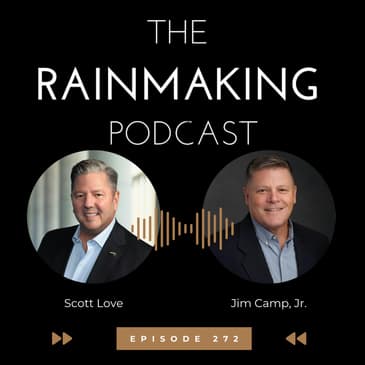
In this episode of The Rainmaking Podcast, Scott Love interviews Jim Camp Jr., retired Air Force Major General, author of Lead From No, and principal at the Camp Negotiation Institute. Jim shares his systematic approach to negotiation, which combines mindset, structure, and behavior to help professionals achieve stronger outcomes without unnecessary compromise. He explains why most people mistakenly equate negotiation with giving something up, and instead reframes it as “the effort to bring about an agreement with all parties having the right to say no.”
Jim outlines practical tools like the negotiation checklist and journal, emphasizing preparation, emotional control, and asking the right questions to uncover an opponent’s true concerns, vision, and decision-making process. He highlights how avoiding pressure and welcoming “no” builds trust, lowers tension, and leads to more durable agreements. With stories from both business and military contexts, Jim demonstrates how negotiation skills are essential across professional services, leadership, and even everyday life.
Visit: https://therainmakingpodcast.com/
YouTube: https://youtu.be/rVMKH3ZBKCc
----------------------------------------
This show is sponsored by Leopard Solutions Legal Intelligence Suite of products, Firmscape, and Leopard BI. Push ahead of the pack with the power of Leopard. For a free demo, visit this link:https://www.leopardsolutions.com/index.php/request-a-demo/
----------------------------------------
Jim, recently retired as a Major General in the United States Air Force (Jim Camp Jr.’s bio), rejoined the Camp Negotiations team after serving many years as the Commander of the Ohio Air National Guard, and National Guard Assistant to the Commander of the US Transportation Command. Prior to dedicating his full-time efforts to military service, Jim helped build Camp Negotiations from 2000-2007 as a coach and contributor to “No, The Only System of Negotiation You Need For Work and Home.” Serving at the National strategic level, Jim was personally responsible for negotiating the largest pay increase in history for thousands of Air National Guard Instructor Pilots. Jim credits his military success to the Camp System of Negotiation. “If you lead people, you negotiate every day.” Despite Jim's long military career, he’s remained an owner of Camp Negotiations and is now fully re-engaged as a coach.
His diverse leadership background, education, and military experiences bring a welcomed perspective to the Camp Negotiations Team. In fact, Jim Camp Jr. recently published his new book, Lead from No: A Systematic Approach to Leadership Negotiation. His new work is highly acclaimed and considered to be a long-awaited sequel to his father’s book, Start with No. His combination of business and leadership coaching stories makes a strong case that the Camp Negotiation system is highly effective and time-tested.
Links: https://www.linkedin.com/in/jim-camp-jr-2a8ab79/
https://campnegotiations.com/lead-rom-no-book-jim-camp-jr
https://campnegotiations.com/coaches
Learn more about your ad choices. Visit megaphone.fm/adchoices
[00:00:10] You're listening to The Rainmaking Podcast, hosted by high-stakes headhunter, author, and professional speaker, Scott Love. You're listening to The Rainmaking Podcast, and my name is Scott Love. Thank you for joining me on the show. I'm excited about this episode because of its usefulness to you as a professional services provider, as a rainmaker.
[00:00:35] Let me ask you this question. How important is it that you are effective at negotiating? Well, if you're an attorney doing deals, you've got people on the other side of the table. If you're a litigator, well, you certainly have to negotiate to a positive conclusion to serve your clients. If you own a small business, you get the picture. You have to negotiate everything, including compensation of new hires.
[00:00:58] Well, our guest today is Jim Camp, Jr. He is the author of Lead from No, A Systematic Approach to Leadership Negotiation. Now, Jim isn't like most of the experts we've had here on the show. For one, he's a retired Air Force major general. That's pretty impressive. But he's also written the book on negotiating. He's part of the Camp Negotiation Institute.
[00:01:20] And by the way, we're going to put all of Jim's information on the show notes as well as the link to order his book, as well as the link for his company's site. So you can connect with him directly. I've read the book. I'd highly recommend it. There's some innovative ideas and, dare I say, contrarian perspectives that will challenge you and even help you in your effectiveness to negotiate. As always, this show is sponsored by Leopard Solutions, legal intelligence suite of products, Firmscape and Leopard BI.
[00:01:50] Push ahead of the pack with the power of Leopard. And now here's my conversation with Jim Camp. Thanks for listening. Hey, this is Scott Love with the Rainmaking Podcast. Our guest today is Jim Camp, Jr. And our topic is a systematic approach to negotiation. Jim, thanks for joining me on the show today. Hey, Scott. Thanks for having me. Yeah. Thanks for your service. Yeah. Likewise, sir. Major General. Likewise, Jim. Thank you for yours in the Air Force and the Air National Guard.
[00:02:19] It's always great to meet other veterans, especially you and I both graduated class of 89. Right. Six months later, after he graduated, the Berlin Wall fell. You're welcome, everyone. So let's talk about real, really important things in business and in business and negotiation. The way I look at it is a mutual satisfaction of needs between two people, getting to them to that point in my work in terms of making good long term placements. Let me ask you this, Jim, kind of starting with the definition.
[00:02:49] How would you define a successful negotiation for our listeners today? OK, well, I think, you know, obviously reaching an agreement is the foundation, right? I mean, that's that's a successful outcome. The key is, is what's what's built in that agreement and how you approach the process itself. One of the first things we do and probably one of the most challenging when we're advising folks on real negotiations, that's what our company does.
[00:03:15] And when we're working with those folks, it probably the hardest thing is to get them really aligned on on what they want, what their successful outcome looks like. It's not what we typically see is there's people will like to aim high to their mind. They'll say to themselves, well, as long as I can secure this, you know, these few things in this agreement, I'll be happy. And unfortunately, when people negotiate, depending on how they see the word and I'll get to the definition in a second.
[00:03:42] But depending on how people approach a negotiation, you know, when it gets tough, we typically see people cave and they start to give things away unnecessarily. We start to see unnecessary compromise, meaning they they feel the pressure on the deal. They feel it slipping away. Maybe their opponent is expressing some discontent with a part of the agreement and they they start to feel that pressure and that pressure is natural.
[00:04:07] And they'll start to kind of fall back to their their fixed mindset around negotiation, which most people believe in order to reach a mutually beneficial agreement. We have to give something up. And that's not the case. A lot of times, a lot of times, you know, if if I were to put 50 folks in the room, if I put 50 of your listeners in the room and I were to say, how would you define negotiation? What comes to mind? We hear things like win-win, mutually beneficial, give and take.
[00:04:34] It all stems from collective bargaining and labor law from a long time ago. You know, people were told you better bargain in good faith and come up with a deal or I'll do it for you. Right. Binding arbitration from a judge. So most people feel that there's a level of compromise that's required. The reality is our definition is it's the effort. It's the effort to bring about an agreement with two or more parties, with all parties having the right to veto.
[00:04:59] So really, when it gets down to it, both sides have the ability to say no. And that is our foundation for our system. That's the way we approach it. We're not afraid of the word no. Yeah, that's interesting. So how do we look at this then as a systematic approach to negotiation? Okay, so first thing, there's a system, first of all. There's three things we have to focus on. First is our mindset.
[00:05:24] We have to, not only do we hopefully have an open mind, right, or we have a growth mindset, but we have to take a hard look at really what our past experiences are in negotiation. You know, that's where people learn. You know, they have a reference in the back of their mind. Well, this, I remember on this deal and this deal, you know, here's, this went well, this didn't go well. So first thing we do before we start applying a system is we develop a mindset.
[00:05:50] And the mindset for us is really falling back on the definition that, you know, nowhere in the definition of negotiation is the word compromise, but yet it happens prematurely all the time. So once we get our mind around, okay, this is the right mindset. And that's one of the first things we work on with our clients or when we're, when we're training people, helping them develop the right mindset. The second step is putting together the structure.
[00:06:15] A system requires a structure that when it's all aligned properly and it's based on laws and rules and principles of, in this case, human behavior, once you have that structure aligned, that allows you to prepare systematically. So in other words, every deal we go into, we start with the first steps in our checklist. And these are things that our clients commit to memory. So when they can, you know, if they're driving in a car and they're going to a meeting and all of a sudden, you know, the deal changes and they have to prepare quickly, they can pull out a notepad
[00:06:44] and build a checklist to prepare for that meeting. That preparation is what gives them a little bit more of an emotional edge. They have more emotional control. And then the third component to the system is actually when we're executing, what is our behavior? What behaviors can we manage? How can we control our behavior? What questions are we going to ask? What's our posture? Right. And so once we get the mindset, we apply the structure to preparation.
[00:07:12] We then help our clients focus on how they behave. We all have different strengths and weaknesses. My strength is intensity. It also has become my greatest weakness at times in my life. So that's right. So really, it's no different than teaching somebody how to fly an airplane. They have a base amount of knowledge of flying probably when they get to flight school, but then they're taught the military way. OK, here's the process, the steps we follow. And then we debrief. Right.
[00:07:39] So part of our structure is debriefing what just happened and where do we go next? What's our next step based on what we discovered during that iteration? Right. So a system kind of combines all three mindset, structure and behavior. This is great, Jim. And I hear a couple of things that you talk about in your book, Lead from No, a systematic approach to leadership negotiation. One of the comments that you just said, your strength can also be a weakness, too. I remember reading that in your book. So let me kind of unpack these a little bit on the mindset.
[00:08:08] What are some of the main pitfalls related to the mindset that professionals need to watch out for as they're going into a negotiation? Let me kind of talk about that for a little bit, please. OK, so mindset. The first thing is, what is a negotiation? We have a definition for negotiation. We really reinforce that, that when you give somebody the right to say no and you mean it and you acknowledge that in person, it builds a lot of trust and respect with the person you're negotiating with.
[00:08:37] It lowers the appearance that, you know, you need the deal. We never want to appear needy or desperate and we never want to apply pressure because that's actually a sign of weakness. And, you know, trying to use power and leverage and those types of things to, you know, take it or leave it type of an approach. Typically, you better not be bluffing, right? You better mean it. Because if you give somebody the right to say no and they say no, our mindset then shifts to, OK, we know there's only four reasons why people say no. So we've studied this.
[00:09:07] There's four things that hold people back from moving forward. So what we do with our mindset is we kind of prosecute that list. We say, OK, we've hit a no or we've hit an impasse where we're not moving forward. What's the real problem? So when you can approach a deal with that and understand that once you get a decision like the word no or if it's a maybe, you know, they're just not there yet, you start to run through and figure out what are we missing. And it's usually one of four things.
[00:09:36] Either one, they lack the vision of benefit of what you're putting forward. They just don't see it. They say, well, this isn't that important to me. I really don't need I don't think it's a good idea to merge our companies at this time. I just don't see the vision of benefit. The second reason people say no, and this, again, is a part of our mindset, is, you know, where's the data to support my decision? People have a lot of fear when they make decisions. Am I getting a good deal? Is there data to support it?
[00:10:05] We see this all the time in venture-backed startups, right? They're trying to take a product to market. We're coaching them, but they maybe they haven't sold a lot of units of what they're really putting out on the market. So there's no data to support that that's a good decision for somebody to buy their product. The third reason that people say no is that they don't have the authority to say yes. Right. Maybe we're missing something on their decision-making process.
[00:10:32] They don't have the right people present or there's something, a stakeholder perhaps, that's kind of behind the scenes that they have to answer to. Again, we see that a lot in companies. You know, privately held companies have, you know, a PE group that's overseeing the company and then they have a board. And then they have, you know, if it's publicly traded, they might have investors, things they have to answer to. So the lack of authority is a third reason that just can't do it on their own. And then the fourth is they're bluffing. You talk about that in your book.
[00:11:02] I'm surprised to see that one. Yeah. We don't see bluffing that often, but, you know, a lot of times people will say no just to see how you react. Yeah. See if they can get more. It's called the flinch, right? Sure. The wince. Yeah. What if I say, if I say no to a car dealer, no, I'm not interested at that price. And I pull my chair out and start to walk away. What are they going to do? That's right. Right. What's their first action? Most of the time it's, well, hey, let me knock a little bit of price off here.
[00:11:31] And so people use that as a tactic to try to flush out the sincerity of the person they're negotiating with. We don't see it that often, but we're aware of it. And I like how you set this up. There's four reasons why it kind of encapsulates all of them. They don't see the vision of the benefit. They don't have the data. They don't have the authority. And boy, haven't we all been there? And then finally the bluff. I like that. How do you think we, if we're in a negotiation, can really find out where, and would you call that person our opponent? What would you call the person you're negotiating with?
[00:12:01] What's your format for that? Well, Jim Sr., when he wrote Start With No, used the word adversary. Adversary, right. Adversary. You know, he was old school and, you know, that word doesn't bother me because when you look up the definition of adversary, it says respected opponent. Right. Right. So I'll be honest. I mean, if you're negotiating and trying to reach an agreement, we refer to them as our opponent and they're responsible. Okay. Okay. Right. So we can say the person on the other side of the table, our business partner, you know, partnership is a big thing.
[00:12:30] Oh boy, you're going to damage our relationship. If you don't sign this deal, you know, you're asking for too much. It's not fair. You're going to damage our relationship. So that's used a lot, right. To try to, I guess, impact the way we approach a deal. And I think it also depends on what type of negotiation it is. So for example, you have a litigator that literally has an adversarial opponent and they have to negotiate something so that they don't go to court and everybody's okay with it compared
[00:12:57] to a corporate transactional partner that's acquiring another company that's going to be part of the portfolio and there's going to be more spinoff business off of that. So I think it also depends on what people do and what that negotiation and the context of it means. So let me ask you this then, how can we get into the mindset of our partner or opponent, depending on what we are trying to accomplish in this negotiation? Well, that's a, that's a great point. So one of the first things we do after we, when we're preparing for a deal, one of the first
[00:13:27] things we do is we, we prepare a purpose for that negotiation, a mission and purpose. A mission and a purpose. So do you actually write it out then? Yeah. You actually write it out. A simple way to do this. I'll give you an example. If I have, if I'm selling a product and I have, you know, a number of features and benefits of what that product brings to my opponent or the person I'm negotiating with, if I'm doing that and I can identify how my opponent benefits, right? It has to be written to their benefit.
[00:13:56] Then that serves as my foundation for the entire negotiation, because I'm trying to help them see and discover that by reaching the agreement that I'm putting in front of them, it's actually going to benefit them as a person or their organization, whatever the case may be. I'm trying to help them see something. Yeah. The trick to getting into your opponent's world with a valid, once you have a mission and purpose is you, you turn off your assumptions and you start understanding their vision.
[00:14:26] You start asking questions, you get into, especially when you lay the groundwork, Scott, where you say, look, I'm not sure if we're going to be able to reach an agreement here today. You can tell me no at any point. And we've actually had our clients put the mission and purpose in front of their opponent and say, this is what we're trying to accomplish. Here's how we think, you know, this deal can benefit you. But immediately we transition to their world and try to understand what they see from their side of the table. So we kind of have a rule.
[00:14:53] We say, look, when you're negotiating, the person that's talking less is probably winning. So in other words, what you say is what you say is not near as important as what you hear. So we try to teach our folks to talk less, ask questions, and really try to get on the other side of the table without fear, without fear of losing the deal to say, okay, talk to me about this. What are they trying to solve? What problems do they face?
[00:15:19] So that's our first step is to transition to the world of our opponent, understand what they see, understand their vision, the challenges they're trying to overcome. We have to understand their decision-making process. We want to understand their budget, if there's going to be money involved. And we really, really want to pay close attention to their level of emotion. What are we seeing as being displayed from their behavior on the other side? Why is that important?
[00:15:46] Well, if we see that they're upset, if anybody's upset, or if we see that they're too excited, even any range of emotion can impact their decision-making. And here's why. Jim Sr. A long time ago, I remember he was adamant about this. He said, decision-making is emotional. And then once we make a decision, we justify it with intellect. The problem is, if you're emotional, if there's any level of emotion when it comes to making a decision, it's very difficult.
[00:16:13] Daniel Kahneman, right, who's an economist, he basically dove into this intellect versus emotion on decision-making. And he proved, he actually got a Nobel Prize for this. He proved that most of our decisions are made on the emotional side. So if somebody's upset, it's going to be hard for them to make a decision that they're comfortable with. They may even make a decision and then reverse course. If they're too excited, that's a little scary too, because everybody's, I'm sure, I mean,
[00:16:42] I could show you a picture of something I bought in my backyard, my boat. I was super excited when I bought it. But I just didn't understand, you know, what was going to be involved to maintain it. That was an emotional excitement decision. And if you're too excited, you can have buyer's remorse where you say, boy, did I cave too quickly? Did I really get a good deal? So we try to keep our clients, our clients at an even keel. But more importantly, we want to understand our opponent's emotion.
[00:17:10] And if we see that they're negative, positive, we try to get them to a more neutral state. And we have behaviors that we use to do that. Interesting. So let me ask you this, then this kind of transitions into the structure. Have you seen teams, we're negotiating, we've got this meeting set next week. Do they huddle together? Do they come together in a meeting and try to ascertain all the things that you mentioned just now in the mind of their opponent? Yes.
[00:17:35] In fact, I have a client right now in Hawaii and they are negotiating a pretty big deal and there's three of them. And the huddle that you mentioned, we huddle together before we go in. We're very clear on our structure, on our preparation, on our checklist. Everybody's aligned on what a successful outcome looks like. That's a process in and of itself. And then when they negotiate, somebody is taking notes.
[00:18:02] They're very delegated on what their roles are in the meeting. That's important because, you know, you cringe, but it happens all the time where, you know, they'll be close to a deal and then somebody will say something that's not that it's irrelevant, but they'll go a different direction and, you know, it kind of derails things. So we keep very clearly defined roles. And then we debrief as a team. What did you see? And then, you know, we break it down into something that, again, you have to be able to do it from memory. There's three things we want to uncover.
[00:18:31] We want to uncover our opponent's vision. What is it that, you know, they communicated with us? What are their concerns, challenges? What are they trying to solve? And then we want to understand, obviously, their emotions. We want to understand their budget. The more time, energy, money, and emotion somebody puts into a decision, into a deal, the closer we're getting to an ultimate decision. Yeah, that's great. And we want to pay close attention to their budget. And we also want to focus on their decision-making process.
[00:18:58] So those three things we go through and we figure out, what did we learn during this negotiation, this meeting? What did we take away from it? Okay, now what's our next steps? What did we uncover? Hopefully, we uncovered problems. And what's interesting, Scott, is when you look through some of these longer deals that we've advised and coached, there are multiple decisions that are made on both sides of the table. So when you're looking to achieve a big, lasting, long-term agreement or a successful outcome, a mutually beneficial outcome,
[00:19:28] there's probably dozens, maybe even hundreds of decisions, miniature agreements along the way that are leading to that ultimate outcome. So we pay very close to all the decisions that are communicated, and we're not afraid of the word no. And the other interesting thing I wanted to add is when we're getting to the definition of negotiation, if I said, well, tell me some different types of negotiation, everybody's mind immediately goes towards, well, you know,
[00:19:57] business negotiation, procurement, sales, merger, acquisition. And what we've discovered is that there are many forms of negotiation. And that's kind of the angle I took or the approach I took is that if you think of the definition of an agreement between two or more parties with all parties having the right to veto, that exists in any organization right now between a leader and a follower. The follower can leave at any time. Absolutely right. Even in the military, you can't force somebody to keep the uniform on.
[00:20:25] If they want to leave, they're going to leave. So we start looking at negotiation through a bunch of different lenses and realize that I negotiate with my grandchildren. They're the best negotiators in the world. They're five and six years old. They're relentless. No doesn't phase them. So negotiation is around us all day, every day. And to me, it's one of the most critical competencies anybody can have, regardless of the business that they're in. I think you're absolutely right. And I think it's something that really deserves more study.
[00:20:55] And I like the way you gave us a lot of systematic ways that we can take all these parts and put them into some structure. And speaking of structure, let me go into the second point you mentioned, mindset, structure, execution. In the structure of the negotiation in your book, you talk about a negotiation. I think you talk about a negotiation checklist. What does that mean exactly? And then you even talk about a negotiation journal. Maybe you can talk about that too. Yeah, so the checklist is what we use to prepare.
[00:21:22] So if I'm going to prepare and I can hopefully, or if you study it, you can do it on the fly. So right away, here are the components to a checklist that I use in any deal. It doesn't matter what the circumstances are. My first thing is, okay, what critical research have I done? What do I know about the person I'm negotiating with? What do I know about their organization? Any research we can do is very, very important. So we research.
[00:21:50] It's no different I can compare to going to fly an airplane in the military. One of the first things I do is, okay, was the aircraft okay? Are there problems with the aircraft I need to be aware of? What's the weather, right? What's going to impact our mission before we go? So critical research is our first step. The next step after we do that is we build our mission and purpose. What for this meeting or for this negotiation, what is it that I'm really trying to help my opponents see and discover?
[00:22:20] I can't tell them directly. If we present and get too aggressive and try to just, I guess, you know, plead our case, so to speak, and put everything out front right away, we're running the risk that it's not their discovery. It's us telling them and people don't want to be told. But if we can build questions around our mission and purpose that help them, they go, oh, wow, this is a possibility for me. It becomes their idea, not you simply telling them. So we build a mission and purpose as number two.
[00:22:49] The next thing we do is we address the problems. We identify problems. Problems are solved by making decisions. And a lot of times people are afraid to say, well, I don't want to bring that up. That may derail our negotiation. Well, if you think it's there and you don't put it on the table, you're running the risk that it will derail you. So let's put the problems up front. As we're evaluating problems, we look at emotional baggage. So is there anything we carry into the deal that is very difficult for us to put down emotionally?
[00:23:17] Is there anything that they bring to the deal? Maybe the previous agreement didn't go so well. Maybe we failed to deliver our product on time with our last shipment. Who knows? But we want to put that up front and at least be aware of it. And then we move right into what we want as far as decisions. There are decisions that we want our opponent to make and there are decisions that we want to communicate. So decisions are the key. Decisions are what move the negotiation forward.
[00:23:43] And then after we address our decisions and we have a better idea of where we stand, we always want to make sure we clarify exactly what happens next. What happens next are negotiated future actions. Because too many times, I see this all the time with clients. Man, that was a great meeting. We had a great negotiation today. Things are going well. Okay, well, that's awesome. What's next? Did you talk about what's next? Because we want to be able to hold each other accountable to the decisions that we communicate
[00:24:13] when we're negotiating. So critical research, mission and purpose, problems, baggage, if there is any decisions we want to communicate and what happens next. Those are the main components of a checklist. That's fantastic. And it's something you can commit to memory. And then with regards to a journal, we call it a lock. And anybody that's been in aviation or in the military, especially, my father designed this 30 years ago and it's worked forever. It's simple.
[00:24:41] But a checklist is what we use to operate an aircraft. And a log is what we use to debrief what just happened. Where did I fall short? What mistakes did I make? What did we learn from this mission? Because we're going to come back and fly again another day. So the checklist is very simple. The log is very simple. What's the vision? Or you can use the word pain. What opportunity do we see? How did they communicate that to us?
[00:25:09] And then how much time, energy, money and emotion? What's their budget on this deal? And then decision making. So it sounds really, really simple. And it's meant to be because you want to be able to remember it under duress. Absolutely right. Yeah, that's good. I mean, that's good training, right? And let me ask you this because I want to come back to one of the concepts you mentioned. But in terms of training professionals, do you think this is something that we should train people on? And because you're in the middle of a heated situation, you don't have time to think. You just react. What do you think about that?
[00:25:39] And I want to talk more about what your company does, Jim. But do you think organizations should really invest in training on these things? Well, first, I'll say this. There's a lot of really talented people out there in the negotiation world. So I don't want to come across as ours is, you know, our training is better than others. But I will say this. Be careful if you're going to invest in training and negotiation because a one-day event, you
[00:26:05] know, a seminar, those types of things, it's not going to change behavior, right? Changing human behavior takes a lot of work. And one of the first things we do is we take all the aspects of our system, our mindset, our structure, and our behaviors, and we present that to our client to try to get their feedback and to watch how they interact with us around some of these things that we know that works.
[00:26:33] If they don't see it or they're struggling, we have to help them adapt to how do I apply this to the world that they're working in? So training is important. You have to understand the components of any system and you have to understand why you're doing what you're doing. And so there is a training component to it. But where we really see a difference is when we start applying our system to real world situations and get into their world of what they're dealing with on a day-to-day basis.
[00:27:00] And we want to understand, you know, what are their behaviors? What are their strengths and weaknesses? How do they see things? I mean, we see people that, you know, they're probably like me. They talk too much. And we have to help them control that. So training is great, but training without reinforcement into a real world situation isn't as effective. Ours is a little bit more comprehensive. I mean, you can pick up a book and read how to fly an aircraft.
[00:27:27] But until you touch the aircraft, get in it and fly it and really see what that experience is like, it's really hard to, you know, I mean, it takes the Air Force a year. The same with the Navy to put wings on somebody. It's a long, grueling year of practice, debrief, execution. I mean, you just back and forth. So training is important. And you can take away small things here and there. Like, I can give a couple of takeaways to any group, even if it's just an hour, that will help them.
[00:27:56] But, you know, the impact to change behavior requires a little bit more reinforcement. And that's what Jim Sr. discovered years ago. And that's why he developed negotiation coaching. He is the original. I have to say that. He's a guy that trained Chris Voss, who wrote Never Split the Difference. So we've been doing this for three decades. And training is hard if it's not reinforced on real deals. Absolutely right, Jim. And what I'd like to do is invite you back on the show to kind of go deeper into some of these other concepts.
[00:28:26] Just in the interest of time, I wanted to go deeper, especially on the checklist and some of the other components of that and the significance of those. So let me kind of ask you this from what we've talked about today. If you could summarize and give our listeners three action steps. What are three action steps they can take to start implementing these ideas? Okay. The first action step is, number one, just right away. And you can do this in a low risk setting. It doesn't have to be an important deal.
[00:28:55] But give somebody the right to say no and watch what happens. If you're trying to reach an agreement and you say, and there's a million ways you can do it, you can even just say, hey, look, I don't want you to feel any pressure here. You can, of course, you can tell me no at any point. It's okay. So giving somebody the right to say no, what that does immediately is it lowers their emotion, right? They become more relaxed. We did this with a massive car dealership where we trained their whole team that when that client walks through that door and you have your first interaction, put them at ease.
[00:29:25] Don't be aggressive. Say, hey, look, you can tell me no. It's okay. I'm not going to chase you. I'm not going to beat you up. So giving somebody the right to say no right away, if you do that a couple of times, I think you'll start to see, wow, people actually react pretty well to that. It demonstrates respect. Number two, I think something you can do right away is if you don't prepare, and I don't care if you use our system.
[00:29:52] I don't care if you use other folks that have written great stuff on negotiation. I mean, it's a huge, huge sector. There's a lot of work done out there. If you haven't prepared or you don't prepare, try writing down what you're actually going to try to do and pay real close attention to that, how you prepare. Because most people don't have the discipline to do it, especially if they've been doing it for a long time. They shoot from the hip.
[00:30:17] And what they realize is they're not capturing that ability to sit down and really think deeply before they enter into any negotiation. Even with a family member. If I have a kid that says, Dad, I'm going to drop out of college, I can guarantee you I'm going to spend time preparing to have that conversation, to have that negotiation. I'm not just going to wing it when I'm emotional. So give people the right to say no and take the time to prepare.
[00:30:44] Get yourself ready, especially emotionally, for what you really want to try to accomplish. The third thing they can do immediately is ask the right kind of questions. I'll give you an example. If I say, Scott, are you having a good day? Right? I'm going to get three different answers. You might say yes. Eh, it's okay. Maybe. Or you'll say no.
[00:31:08] If I change that verb-led question because a verb-led question actually forces the brain to make a decision instantaneously, that drives emotion. When we're negotiating, take those verb-led is this, can you, will you, do you see yourself leaving today in this vehicle? That's a verb-led question that we hear all the time in a cart dealership, for example, that puts pressure. But if you say, where are we at this point? Help me understand how your day is going, Scott.
[00:31:38] What challenges do you see moving forward? How would this impact, you know, your business operations? When we ask interrogative-led or open-ended questions, we get our opponent talking. And that's exactly what we want. We want to see what they see. So we get much more information from those types of questions versus, you know, we're driving for the yes, right? We're trying to get a kite on something. We have a rule, never close, right? We're never trying to close the deal.
[00:32:06] We're trying to get to the point where we say, well, where do we go from here? If we've asked the right questions and handled ourselves properly, we're going to get a decision without having to apply pressure. And that decision will stick much more effectively than if we're pushing people to try to reach an agreement. So these are great ideas, Jim. Yeah. So those three, I think, are immediate. These are fantastic. And tell us about your company. What do you do? What do you have that you'd like our listeners to know?
[00:32:33] And for everybody listening, we're going to put Jim's contact information all to the link where you can order his book, Lead From Know, A Systematic Approach to Leadership Negotiation, which I've read. I'd highly recommend it. But tell us a little bit about what your company does, Jim. Okay. So Jim Camp Sr. a long time ago started the company. He wrote the book, Start With Know. And Start With Know was you either loved it or hated it at the time. That book is still going strong.
[00:33:00] In fact, I think it's actually accelerating in sales 20-some years later. But he developed the negotiation coaching business, advising people on real deals and actually staying with them the whole time. And believe it or not, our company has done that since the late 90s. And we're still moving forward. So we have a team of coaches right now. Myself and my brother, Todd, are the two principals in the company. But we're training coaches.
[00:33:25] And we have kind of a cadre of folks with different backgrounds where we go into an organization, really understand their challenges. Hopefully, their negotiations are important enough to them so they'll see a good return on investment for hiring us. But we go in and we teach them everything we know about our system. We help them apply it to real deals. And we stick with them, in some cases, for years because they start to see the return on investment.
[00:33:52] They realize, okay, it's a constant process of getting better and improving. Negotiation is like a human performance event. You know, I'm a terrible golfer, but I know that if I swing the club more, I'm going to get better, especially if I have somebody looking over my shoulder. Absolutely right. Telling me what I'm doing wrong because I can't see it. So really helping people avoid unnecessary compromise. But more importantly, giving them something where if they grab onto a system and they believe in it and they decide, okay, guys, thanks for the coaching.
[00:34:22] I'm going on my own now. Appreciate the help. When they adapt to a system, it gives them emotional control and they begin coaching themselves based on, you know, what they know about what they should be doing, what should be happening. So it's a behavior change. It's a mindset shift. It's a habit pattern that we help people take away. And we've been doing it for 30 years. And a lot of people talk about negotiation, but very few do what we do. This is great, Jim.
[00:34:51] I'm really glad that you came on the show and you gave us such a useful interview. I know people will benefit from this. So for everybody listening, like I mentioned, we're going to put all of Jim's contact info on the show notes. So go there where you listen to this podcast and connect with him right away. Jim, thank you so much for being on the show. And like I said, let's have you back on here in the next couple of months. I'd love to come back, Scott. I've enjoyed it. Thank you for listening to the Rainmaking Podcast.
[00:35:18] For more information about our recruiting services for international law firms, visit our website at attorneysearchgroup.com. To inquire about having Scott speak at your next convention, conference, sales meeting, or executive retreat, visit therainmakingpodcast.com.