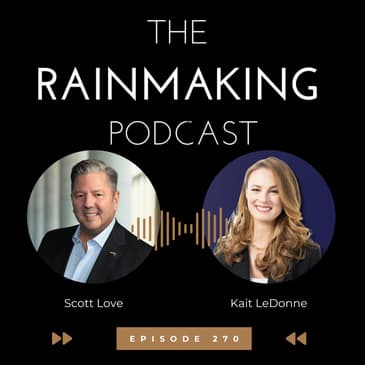
In this episode of The Rainmaking Podcast, Scott Love speaks with social media strategist and LinkedIn expert Kait LeDonne about the shifting landscape of LinkedIn. Kait traces how the platform has evolved—from being a digital résumé hub to today’s creator-driven space optimized for knowledge and advice. She explains why vulnerability posts surged during the pandemic, how LinkedIn adjusted its algorithm to emphasize value-driven content, and what professionals should focus on now: consistency, storytelling, and educational insights.
Kait also provides practical guidance for professional services providers who want to turn LinkedIn visibility into real business opportunities. She highlights the power of newsletters, personal branding, and using story as a bridge to credibility and trust. With actionable strategies—posting at least twice a week, engaging meaningfully with comments, and adding strategic connections daily—Kait shows how professionals can build influence, grow their networks, and convert visibility into revenue.
Visit: https://therainmakingpodcast.com/
YouTube: https://youtu.be/o_pgpKiGDu8
----------------------------------------
This show is sponsored by Leopard Solutions Legal Intelligence Suite of products, Firmscape, and Leopard BI. Push ahead of the pack with the power of Leopard. For a free demo, visit this link:https://www.leopardsolutions.com/index.php/request-a-demo/
----------------------------------------
Kait LeDonne is a personal branding expert who specializes in transforming professionals into industry leaders, forging powerful employee personal brands, and demystifying the essentials of impactful personal branding.
Links:
https://www.linkedin.com/in/kaitledonne-personalbrandingexpert/
https://www.kaitledonne.com/
Learn more about your ad choices. Visit megaphone.fm/adchoices
[00:00:10] You're listening to The Rainmaking Podcast, hosted by high stakes headhunter, author, and professional speaker, Scott Love. You're listening to The Rainmaking Podcast, and my name is Scott Love. Thanks for joining me on the show. Ladies and gentlemen, we have an exceptional guest today who's going to make a difference in you and how you're seen on the web.
[00:00:34] We have a real influencer and a credentialed expert in the area of social media today on our show. Her name is Kate LeDonne, and we're talking about the shifting landscape of LinkedIn. Now, if you're on LinkedIn, you've probably seen some of her content that she's created. You can learn a lot just by watching what she does. In fact, you can learn a lot just by going to her website where there's a ton of free resources that are going to help you.
[00:01:00] So make sure that where you listen to this podcast, go to the show notes, and you'll be able to connect with Kate directly, follow her on LinkedIn, and also get access to some of the other resources that she has on her website. I hope you get some really good ideas from my conversation with Kate today because we go deep into social media, personal branding, beyond the shifting landscape. So I hope that this gives you some really good value.
[00:01:23] As always, this show is sponsored by Leopard Solutions, legal intelligence suite of products, Firmscape, and Leopard BI. Push ahead of the pack with the power of Leopard. And now here's my conversation with our guest, Kate Ladon. Thanks for listening. Hey, this is Scott Love with the Rainmaking Podcast. Our special guest today is Kate Ladon, and we're talking about the shifting landscape of LinkedIn. Kate, thanks for joining me on the Rainmaking Podcast today. Scott, thanks for having me.
[00:01:52] It's a pleasure to be here. Absolutely right. And I'm a fan. I'm a follower. You have good content that always is not a waste of time. It's really useful, and I learned things from you. So I see you're active on LinkedIn, and you're obviously a credential expert in that area. And when you talk about a shifting landscape of LinkedIn, how is that shifting, Kate? Let's start with that question. How is this all moving for us? Any social media platform will see a number of different phases.
[00:02:20] And LinkedIn has been around for about 20 years. And if you have had the pleasure of being on the platform for even 10 of those, you've likely noticed different phases of the platform. 10 years ago, you could share a link to a Forbes article. You could share an inspirational quote. You did your job. It was mostly just a place to house your resume, follow up after a networking event. Then millennials started entering the workforce. We are chronic sharers.
[00:02:47] And so more original content started coming on the platform. LinkedIn introduced features like Pulse articles that allowed people to publish longer form content. Where we saw this really come to a head was in 2020 and the pandemic. All of a sudden, in-person went away. Online came in. And LinkedIn saw a surge of people. But the kind of content that really started happening then was very reflective of what was happening in everyone's lives.
[00:03:15] There was this lack of division between professional and personal life. And I call this the era of everybody's crying on LinkedIn. Very, very over the top in the sense of maybe oversharing to a personal brand risk degree. People were acting out vulnerability in some cases because they saw that they were getting engagement from that.
[00:03:40] And of course, any social media platform in LinkedIn is not susceptible to this, is going to play off of human emotions. So what LinkedIn did was then install a whole creator team. And basically what that means is we are going to have people here, we're going to have an editor at large, and it's going to sit very closely with the people who run the algorithm to jockey forth the type of content we want to see on this platform.
[00:04:08] And that is not viral influencer-y platform content that is a lot of people crying and oversharing. The value proposition of LinkedIn is to be the place where knowledge, advice can be shared. And so what that creator team and what the algorithm started doing is optimizing for knowledge and advice.
[00:04:31] Now we've kind of reached the sweet spot of that, where yes, personal stories are going to have their time in the sun because we are humans. But the platform and people are starting to look at knowledge and advice type posts and categorize them as such.
[00:04:47] So we are really at this phase where if you are creating original content, you are giving advice through experience sharing, personal or client anecdotes, you will see that you get a boost on the platform rather than suppression. But you have to be willing to do that and you have to have a good structure to do it. Yeah, so that means my cat photos are not going to get me top rankings on LinkedIn. Is that what you're really telling me, Kate?
[00:05:12] Your cat photos, if they're paired with a really good client experience share that delivers a lesson, might get good play on LinkedIn. Them alone and you just saying this is my office buddy Frank or whatever your cat's name is, is not going to get any kind of... Okay, good. I've got a chance. I've got a chance then. That's good. I can make it a story about client development. So let me ask you this. You talked about vulnerability and I do remember when COVID hit, I remember calling people to recruit them and we wouldn't even talk about that.
[00:05:42] We'd say, how are you? Are you doing okay? Do you feel safe? Remember that? Do you feel safe? Yeah. And, you know, a guy's talking to me and his kids are crawling all over during our phone call and that became the new normal. And so you think that's when kind of LinkedIn changed or when social media posts became more about vulnerability, you think? Is that when that happened?
[00:05:58] LinkedIn definitely saw a climactic influx of what most people identify as being Facebook type content on the platform throughout the years of 2020 to about 2022. It started shifting its algorithm and doubling down on its creator team to make sure that didn't become the future of the platform in late 2022, early 2023.
[00:06:25] Yeah. Interesting. And so what do you think today within recent years or even this year would have been some of the big shifts that you've seen with LinkedIn? Is it that or are there other things that we should be mind-love? It is that, but it's also the way that they're embedding these creator type. And let me take a step back because I want to define the word creator as it exists to LinkedIn.
[00:06:49] Creator is a term, the creator economy, creators at large has culturally been representative for big household names like Mr. Beast, if you all have kids that are into that. I don't follow that channel, but a lot of people do. It's a creator, right? Their sole job is creating content and getting paid for it, whether that's through advertisers or creating products off the back of their content. Miss Rachel, I have a nine-month-old, so that's a good example right there. Every baby is obsessed with Miss Rachel.
[00:07:18] She's, at the end of the day, a content creator for young children. Creator, as it applies to business professionals in the world of LinkedIn, and the way I'm going to use it in this conversation going forward, Scott, is people who are committed to creating original content on the platform to educate their audience.
[00:07:40] So what the creator team did to really incentivize this type of content on the platform is start baking in tools for you to use that will allow you to create content more. So before, only a few people were given access to start a LinkedIn newsletter, long-form, episodic newsletters. Now, anybody can start a LinkedIn newsletter. Same thing with things like LinkedIn Live.
[00:08:08] You used to have to get bestowed that tool or turn it on or meet a certain threshold. Now anybody can. Having said that, these tools should be used with the purpose of providing knowledge and advice content to your audience. So that is the name of the game now.
[00:08:28] But the bubblegum penicillin of it all for the algorithm to swallow and your audience to swallow is to always be able to infuse story throughout that. So even if we're talking about highly technical things, you want and you will excel when you share that through the lens of story, which in LinkedIn's world is going to hit both of those categories, knowledge and advice, because the advice is coming from an experience. Right, right. Let me ask you this kind of with a bigger picture.
[00:08:57] Somebody that's listening to this professional services provider that has a goal, they want to get visibility or they want to get people to connect with them. Should they look at different tools in the tool belt LinkedIn has and be intentional about, I want to do LinkedIn Live. I want to do a post on regular LinkedIn posting. And then you mentioned something about articles because I remember a couple of years ago, I'd post an article on LinkedIn and three people saw it. And so it just wasn't, I wasn't really sure.
[00:09:25] What do you think are the different tools in the tool belt somebody should be aware of with LinkedIn? Well, there's so many of them. And that's the interesting thing, Scott. Every platform now is really four platforms in one because you could do way different strategies with all the different tools that they offer, which is why now just coming up with content and dispersing it across six social media feeds is not going to do anything for you. Every platform now is like four platforms in ones.
[00:09:51] So here is my general advice for anybody who's looking to do this well. You should be posting at least two to three times a week. And when I say posting, I mean a short form post. You don't need to do a long newsletter. A short form post will get you there. Now, one of those posts every other week can be a newsletter. And I would encourage all of you to look at LinkedIn newsletters for the following reason.
[00:10:17] Green rate climbs every single year, but the supply of the newsletters don't change measurably from year to year. So just following an economic model there, there is more demand than there is supply on the platform. So you will get an outsized share of voice if you have a LinkedIn newsletter. Now, the difference between an article and a newsletter is that you commit to posting out an article within that newsletter quite frequently.
[00:10:44] Statistically, if you do that every other week or two times a month, it's going to perform really well. But the good thing about a LinkedIn newsletter and where actually most of the views of my LinkedIn newsletter happen is actually off platform. They email it out to people who subscribe. So a heavy number of eyeballs to the long form content I'm writing on my newsletter are not even happening on LinkedIn. It isn't predicated upon you, Scott, logging into LinkedIn and needing to see my newsletter.
[00:11:09] You're going to get it through your email, which is really great because now I'm showing up in a few different places through the vehicle of LinkedIn, but not on the platform of LinkedIn. So you take your article, you post it on LinkedIn newsletters. Is that what it's actually called? It's called LinkedIn newsletters? LinkedIn newsletters. You need to give your newsletter a name. Mine is called Build a Brand. Yours might be, you know, Rainmaker Digest. They give you so few characters to do this and you have to own the IP.
[00:11:34] But then you publish the article directly onto LinkedIn, much like you would a Substack or Medium or any of these other tools. Got it. Okay, good. That's interesting. And so how do you think, you know, how do we turn this into revenue? How do we turn this into connection, into opportunities? When people see something, what have you noticed is the normal flow of how that goes with professional services provider turning that initial engagement into revenue? Yes.
[00:12:01] Well, let's say you're a, just for hypothetical standpoint here in professional services, let's say you're a divorce attorney, okay? And your whole LinkedIn newsletter is, you know, about divorce. I was trying to think of a name on the fly, but my creativity eludes me at the moment. We call it something like family law matters, right? Okay, something like that. Yeah, right. Family law matters. Maybe your, one of your newsletters is documenting, right?
[00:12:30] This is a good timely thing at the time we're recording, the prenup between Taylor Swift and Travis Kelsey or what you think that prenup should be. This does a lot of things. Number one, slips into the cultural zeitgeist, which is great. Number two, it shows you applying your skill in a way that isn't giving up any client details, right? You're just, you're applying this to a case that a lot of people know about. At the end of that newsletter, what I always tell my students to do is three things.
[00:13:00] Number one, have a short clip about the author. Never assume anybody knows who you are as the writer. So you would do a horizontal line and then say, let's say you're the author here, Scott, about Scott Love. Scott is a sought after family law and divorce attorney based in blah, blah, blah. He's worked on X many of divorces and frequently writes about X, Y, and Z. And then below that, I would say, when you're ready, here are three ways I can help you. Three ways.
[00:13:29] And the when you're ready makes it way less sales heavy and way more just conversational and conversion friendly. So for me, when you're ready, here are three ways I can help you. I have a 30-day LinkedIn program that is designed to measurably increase your impressions in 30 days. I can come in and teach your team how to build personal brands. Or you can hire me to speak at a conference. And I put that at the bottom of every newsletter. And it drums up leads.
[00:13:59] So they're getting value. They're getting value. They understand a little bit more about who I am and why I'm credentialed in this area. And then when they're ready and they see that enough, they will be ready. Sales is all about timing, right? When they're ready and if they're ready, they can choose one of those three things to engage me. That's great. That's a smart way to do it because there's no pressure and you're leading them. I mean, they're qualifying themselves based on what level that they want. And either regardless of what it is, you've got something that can help them if they see that in your content.
[00:14:25] And that's something I've seen firsthand where people have reached out to me based on things I've written, based on our podcast. I want to leave my firm. I want to merge my firm. I've actually gotten inbound inquiries so I know that it works in a professional services environment. If somebody's hesitating, if they've never done this before, because I know people that have hired you one-on-one and I've seen the results and I've heard good things about your work with them personally that you've done, Kate. But if someone is just overwhelmed, you know, I'm part of a big law firm. We should have marketing people doing this. I'm so busy.
[00:14:55] But I know that there's thousands of people like me out there and there's a couple hundred in my firm. I want to get some visibility and some attention. I know I need to do something, but I'm just not sure what I need to do. Where do you think that person should start, Kate? Well, definitely starting to post twice a week. I'm laughing because my husband is a part of a huge firm and I follow them on LinkedIn. I don't name names.
[00:15:19] They do a great job from a corporate standpoint, but it doesn't translate into personal branding and drumming up your book of business as an individual contributor, as a partner, as an associate, whatever. And so the posting twice a week, huge. But the thing with any of this, Scott, is the following. Consistency is key and that's so trite to say, but I see people burn out very quickly because they hit it hot and heavy for three months and then they run out of things to say. That is not the aim here.
[00:15:48] You should understand what your core content pillars are. Let's go back to family law. Content bucket number one is all about things that have to do with family law. Prenups, divorces, custody, etc., etc. You should be posting an educational experience share post about that once a week.
[00:16:10] The other time, if we're just doing a simple matter of two a week, the other time you want to post something that shares a little bit more about who you are. Because at the end of the day, we still do business with people that we have shared values with, we like and trust. And so that pillar for you is going to be your personal origin story, how you got to where you are, lessons you've learned along the way, reflections that you have, things of that nature.
[00:16:36] And so for me, mind you, I publish seven times a week, but one of those posts are reliably my story of how I grew my business and moved to New York. And I hit that drum over and over and over again. And you'd be amazed, got two years into this, people are like, oh, I finally know what you did and where you got from. Because you have to hit it like a politician. There's a reason that they say the same stump speeches and origin stories over and over and over again. And so you just want to say it in a few different ways.
[00:17:06] And then you're bolstering your knowledge and advice with likability. And you're going to meet that intersection that really plays well from a human perspective and an algorithmic perspective. That's great. And you mentioned this before, vulnerability. And that's something that I wouldn't say I've struggled with being vulnerable. I just don't want to. I don't want to show too much. There are some things like I posted on mental health. How do I manage that? I'm an artist. I paint with watercolors, oils, and acrylics.
[00:17:34] And I'll have my paintings and talk about that. You know, how far should people go in this area of vulnerability, Kate? What do you think about that? A good rule of thumb that I always give to clients is never share from your scars, not an open wound. If you're going through something right now, you're way too close to it to talk about it. And honestly, Scott, if people just follow this advice at large on social media, the world would be in a much better place. We're in this weird echo chamber where anything happens in the world.
[00:18:02] All of us think we need to issue a press statement about it, right? That's the nasty side of social media. But most of this can be solved with the gift of time. So I'm never going to... Two years ago, I had an agency. I grew up past a million dollars. I had a lot of employees. And I was wiped. I mean, I just didn't have it in me anymore to do it. So I made the hardest decision ever. I closed down the agency. I transitioned out my employees. And I altered my business model.
[00:18:28] I would have never created content about how hard that was while I was going through it. Your content is not catharsis, okay? It's not supposed to be a public diary. Now, Scott, however, I'm two years out. My employees are happy. I'm in touch with all of them. My former employees, I transitioned them well. And I have a good perspective to see why that business model reached the demise that it did, why I didn't think about it as much as I should have. And now I frequently share about it. I have perspective.
[00:18:57] I'm sharing from a scar, not from an open wound. It would have played so horribly and overly performative and vulnerable if while I was doing it, I had to do something really hard today and let go of all my employees. Like, that is so... I'm sorry. It's gross. It really is not the purpose of social media. It's not doing you any favors. And it's really not doing your audience any favors. You don't have lessons from it yet to impart upon them. This is... That's very profound.
[00:19:26] And I love the way you encapsulate sharing from a scar, not an open wound. What about the humble brags? I'm humbled and proud to announce that I got elected the best looking legal recruiter in the world. Whatever it is. What do you think? What do you think? How do you do the humble brags? Or is that even appropriate? What do you think about that? Yes. Honored and humbled and all that stuff is... At the end of the day, I think people can see through it.
[00:19:53] I think everything, if it's done with a lens of servitude, is great. So for example, I recently got cast in a CNBC program. And I teach personal branding for CNBC. And people... It's so funny. I didn't know there was going to be advertisements for it. And so people will call me and say, I saw you in between Shark Tank. Like, it was news to me. And I'm not saying this as a humble brag. I'm saying a literal example that this just happened. So I was thinking, how am I going to announce this?
[00:20:22] And I knew exactly how I was going to announce it. I was going to share it from a perspective of what my audience can learn from this experience. And so what I did was, in 2020, I was still operating in DC. I had a very safe business. But I knew I wanted to move to New York. And I wanted to move to New York for bigger opportunities. I moved in the middle of the pandemic, not knowing anything and anyone. And through the power of personal branding, I built my brand to a point where I can happily say now, I'm teaching personal branding for CNBC.
[00:20:49] That's the magic of what happens when you build your personal brand. And so in that way, it wasn't, I was humbled that CNBC tapped me. Or, you know, I'm so great. Here's my CNBC course. I'm still using the announcement to help my audience learn a lesson. So that's usually the great service forward version of doing it. That isn't faux. I'm honored and excited and humbled. That's great. I love that. That's great.
[00:21:17] I remember in 2021, I went to a National Speakers Association conference because I used to do a lot of speaking. I do a little bit still, but that was going to be my thing. And the speaker on the stage talked about when you share your stories, make it about your reader. Ask a question. How would you do this? You know, and so that's what I did today on my post with my watercolor. And it was basically a 34 second video of me painting something from start to finish. And like a little chickadee. And I talk about mental health.
[00:21:46] How do you, you know, I say art and chocolate are the same. It's all about enjoyment. And how I didn't realize I was pursuing mental health when I was at the Naval Academy because that's an environment of structured adversity. And I would sketch a lot. And I go to art galleries on the weekend. And so I use that story. And then I ask the audience, how do you pursue serenity and growth and recovery? Yeah. And it was nice to see people are engaging. I mean, I guess that's what we want. We want to get engagement in what we're doing. Is that correct? Is that, what do you think about that strategy? It is.
[00:22:15] And what you just said is really the whole underpinning of all of this, which is you hear the word personal brand, which is what I teach people to do. And you immediately and rightfully but inaccurately assume it has everything to do with you. But the best personal brands in the world have everything to do with your audience. The word personal really throws us there. And building a personal brand, if it is all about you, is exhausting. You run out of material very quickly.
[00:22:44] You know, how much can I say about myself? It feels a little narcissistic, blah, blah, blah. But if you root it in what lessons does the me of two years ago, who's probably most of my audience, the me of five years ago need to know? And how can I keep pushing that forward and teaching at scale and learning out loud? You will find that your personal brand far eclipses anyone else.
[00:23:09] And content creation becomes much easier because then you don't have this very exhaustive thing of coming up with material about yourself. You are just the vehicle to provide value. And when you do that, your personal brand grows. That's great, Kate. Well, let me ask you, as we bring this to a close, if you could kind of give us three action steps listeners can take to start implementing these ideas. What would those three action steps be, Kate? Number one, commit to posting. Just start small. If you're not doing it at all, once a week.
[00:23:39] I'm married to a lawyer. He would rather run a marathon than post once a week on LinkedIn. I don't know what it is, but it's just like so close to the chest on these things. And I get it. Not to stereotype, but it's a very logical field. And it's a left brain kind of thing. So putting yourself out there in a right brained way feels a little something. But if there's one step I could have you take, it's first just commit to posting once a week. Number two, engage.
[00:24:09] You don't have to post actually 30. It's 10. 10 meaningful comments a day. Your comments on the platform will actually outperform a lot of your posts in the sense of impressions. So engagement is a really great backdoor to build your personal brand. And through your commenting, you'll see what resonates with people. And then you can just expand those comments into posts because you kind of have gotten the feedback already from the comment section.
[00:24:36] And then number three, I, to this day, and I've been building my personal brand for over a decade, add five people to my network who I think are either a great strategic partner, someone who's five steps ahead of me, or someone I think is going to be a great prospect. Because the beauty of LinkedIn is you can reverse engineer your audience to be exactly who needs to hear your message. We just don't take that proactive standpoint. That's great, Kate.
[00:25:04] And I think even that third step you mentioned, I'd love to have you back on the show. And we can talk about that in itself as another episode in the future. I'd love to have you back here. Absolutely. And you did a great job. Thank you for sharing all of your wisdom with us. I learned a lot. Tell us about your offerings, your solutions. What do you have? What do you do that you'd like people to know about you? When you're ready. Now, you see how I tried it all back then. These are three options. When you're ready, here's the three things I would tell you to do.
[00:25:29] No, regardless of if you're ready, actually, the very first thing you can do is I do a deep dive playbook of all of this and more every Saturday. I was telling Scott before we started recording, I made a commitment to myself and my team. If we are seriously going to build this business and put time and energy into content creation, it better be worth people's time. So it is, and Scott will tell you, very actionable. It is not high theory. It is do X, do Y, and do Z. And we send that out every Saturday.
[00:25:57] So you can join that newsletter just by going to katelyn.com. I mean, it is meaty in the things that I say there. And then from that, you'll hear and see everything else that you can do. We regularly do 30-day programs to grow your following on LinkedIn. And of course, you can reach out to me there. But I would say the easiest place to start is the newsletter, which is called Start Small Brand Big. Small actions that will give you outsized results for your personal brand. That's great.
[00:26:26] And we're going to put all your information, including your LinkedIn profile, on the other website you mentioned, Kate. We're going to put that on the show notes. So wherever you're listening to this podcast, go to the show notes and you'll connect with Kate directly. Kate, thank you for being here. Great job. I can't wait to have you back on the show. Thank you so much. Thank you for listening to The Rainmaking Podcast. For more information about our recruiting services for international law firms, visit our website at attorneysearchgroup.com.
[00:26:55] To inquire about having Scott speak at your next convention, conference, sales meeting, or executive retreat, visit therainmakingpodcast.com.