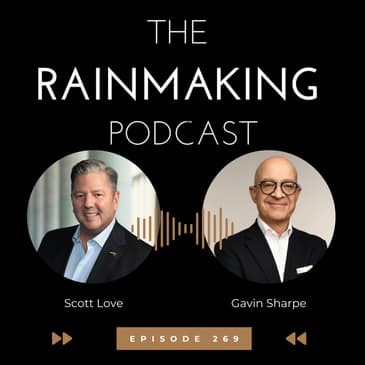
In this episode of The Rainmaking Podcast, Scott Love interviews Gavin Sharpe, former lawyer, global legal search firm CEO, and now performance and leadership coach, to discuss the blind spots of rainmakers. Gavin explains that blind spots are unconscious behaviors others see but we often miss—like interrupting, failing to delegate, or hiding vulnerability. Left unchecked, these blind spots create limiting assumptions such as “I’m not a natural rainmaker” or “asking for help is weakness,” which can undermine success and stall growth.
Gavin shares how lawyers’ personalities and the pressures of perfectionism often reinforce these blind spots, creating a cycle of stress and missed opportunities. He offers strategies for uncovering and challenging limiting beliefs, from seeking peer and client feedback to reframing outdated stories we tell ourselves. By identifying, examining, and dismantling these beliefs, professionals can unlock untapped potential, build stronger teams, and become more effective rainmakers. Gavin closes with actionable steps to help listeners start recognizing and addressing their own blind spots.
Visit: https://therainmakingpodcast.com/
YouTube: https://youtu.be/8rGE3jRwZTM
----------------------------------------
This show is sponsored by Leopard Solutions Legal Intelligence Suite of products, Firmscape, and Leopard BI. Push ahead of the pack with the power of Leopard. For a free demo, visit this link:https://www.leopardsolutions.com/index.php/request-a-demo/
----------------------------------------
About Gavin Sharpe:
“I blend coaching, business, and psychology, to facilitate ambitious leaders achieve their full potential. With a strong focus on the legal sector, I empower lawyers to cut through the noise, lead with purpose, and become great rainmakers.”
Links:
Ditch The Pitch: Rethinking Sales in Law
Managing Law Firm Talent in 2025: My Top Three Tips
Lawyers Are the Biggest Imposters of Them All. I Should Know: I Am One of Them. Partners Are From Mars, Associates Are From Venus: The Real War for Talent Rainmakers Are Not The Answer To Law Firm Transformational Growth. Here Is Why
What the Monaco Grand Prix Teaches Us About Performance
Are You A Workaholic? Gavin Sharpe on Riviera Radio, Sept 2024
"Gavin Sharpe: Becoming a Rainmaker Starts with Mindset" Podcast
Learn more about your ad choices. Visit megaphone.fm/adchoices
[00:00:10] You're listening to The Rainmaking Podcast, hosted by high stakes headhunter, author, and professional speaker, Scott Love. You're listening to The Rainmaking Podcast, and my name is Scott Love. Thank you for joining me on the show. Are you someone that has a blind spot? Well, every rainmaker, no matter how successful, no matter how smart they are, they've got issues.
[00:00:37] They've got blind spots that they need to watch out for. And our topic today is Blind Spots of Rainmakers. And our special guest is Gavin Sharpe. Now, you may have heard of Gavin, especially if you're in the legal industry. Gavin has a successful career in legal. He's a former lawyer, a former co-CEO of a legal recruitment firm. And now he works as an executive coach with those in the legal profession and CEOs and other people who are high performers.
[00:01:03] He blends coaching, business, and psychology to facilitate ambitious leaders to help them achieve their full potential. This is going to be a useful interview for you, and I want you to make sure you check out Gavin's information in the show notes. We've put several other resources that he's given us in those show notes that you can check out. They're absolutely free. And by the way, he has a webinar coming up that you can go to the show notes, click on the link, and learn more about that talk.
[00:01:32] He's calling it the Rainmaker Playbook, Attracting and Activating Top Performers. I hope this show gives you some great ideas. If you get something from it, go to Apple Podcasts and give us a nice five-star review. And mention Gavin by name. I know he'd appreciate that also. As always, this show is sponsored by Leopard Solutions, Legal Intelligence, Suite of Products, Firmscape, and Leopard BI. Push ahead of the pack with the power of Leopard.
[00:02:00] And now here's my conversation with our guest, Gavin Sharp. Thanks for listening. Hey, this is Scott Love with the Rainmaking Podcast. Our guest today is Gavin Sharp, and our topic is blind spots of rainmakers. Gavin, thank you for joining me on the show today. Thank you so much for inviting me. Now, let me ask you this. Let's kind of get into blind spots here. When you say that, how would we define what a blind spot of a rainmaker is?
[00:02:27] So a blind spot is there is a pattern of behavior or an impact. That's something I'm doing that I'm unaware of, but other people can see. So maybe I keep interrupting in this podcast. Every time you got to ask me a question, I interrupt you. You get it, because you're saying, what is it with this guy? But I'm not aware of it.
[00:02:52] And so there is something that I'm doing where I am unintentionally undermining my behavior. So it's unconscious. And for me, what's interesting about blind spots, which I will come on to, is how they impact behavior. Because then they impact something which is called limiting assumptions. But blind spot, I'm unaware of something. I don't see it. You do. So can we segment those?
[00:03:21] Are there different categories of blind spots? Like you mentioned interrupting people like in terms of behavior. Are there other areas that the blind spots would be categorized in? It's a good question. I think of it mostly in terms of behaviors, because it's something I'm doing. But it is also going to impact my way of thinking. Because somewhere there, there must be a reason. This is why I was talking about limiting assumptions. There must be a reason why I'm interrupting you. Why am I doing that? Am I anxious?
[00:03:50] Am I worried that you might ask me a question I can't answer? Did I learn somewhere that, hey, this is what macho males do. We keep the conversation going. Somewhere there will be a reason for my behavior. And as a coach, I want to know why is that rainmaker behaving in that way? What is the blind spot? And how is that blind spot stopping them building a better, bigger practice? Right.
[00:04:20] What do you think are the more common blind spots that you've seen in your career, Gavin? I think for lawyers, the blind spots, well, the blind spots, I think, move on to limiting assumptions. So there's something I don't see, which affects my behavior. And what happens, Scott, is I start to tell myself a story. And the stories that I tell myself will be things like, I'm a partner now.
[00:04:47] And if I don't have all the answers, I'm going to lose credibility. Now, the blind spot is I don't see how I'm then going about in the office being a bit of an ass, because I'm actually worried that I don't know everything. That's the blind spot. But the stories that I'm telling myself are things like, to be a leader, I need to be in control. Let's look at rainmaking, which is why we're here.
[00:05:15] I'm not a natural rainmaker. That is the most common limiting assumption. And I will sit in a room full of some of the most successful partners on this planet. But I'm not a natural rainmaker. Rainmaking is about charisma. And I don't have that. Then we get into things like, if I delegate my work won't be done properly. So the blind spot is, I don't delegate.
[00:05:43] I'm burning out because I won't give anybody any bloody work. Excuse my French. Because I've told myself that my work won't get done properly. I'll give you one more. Asking for help is weak. That's the story I've created. So I've become a very isolated partner that nobody wants to work with. I don't know I'm doing that. Because somewhere along the line, I learned that asking for help is weak.
[00:06:13] Showing emotions. I'm throwing one more in. Showing emotions is weakness. So I have this very controlled persona at work. And that's going to impact how I am with my team. That's going to impact how I am with my clients and the clients I want to win. So if I just summarize what I'm hopefully trying to say, we have these blind spots. We have these behaviors that we are not aware of.
[00:06:42] And from these blind spots, we start to think and behave a certain way. And if we don't know, because these are all conscious or semi-conscious, how are we ever going to change our performance? Right. Who do you think sees these blind spots? Is it other attorneys that are peers? Is it associate attorneys, staff, clients? Who do you think sees these the most? Everybody that we come into contact with. They all know that.
[00:07:08] If I was to say to any of the people in your team, tell me about Scott. Some of the stuff, depending on how self-aware you are, you'll say, yeah, I knew that. I knew that anyway. But I bet you there'd be one or two things that, oh, that's interesting. I didn't realize they see me that way. That's a blind spot.
[00:07:28] So, and that's why in coaching environment, it's so powerful when we go into a team and we do things like, you know, we do peer appraisal and we get feedback from colleagues and something we don't do enough, get feedback from clients. After a deal, we just make an assumption. The final fee notes gone in. But how often does the phone go back and say, what was the experience like of working with me, working with us?
[00:07:58] What is it that I could have done differently? What would you have liked more of? What would you have liked less of? Lawyers are not great at asking for feedback. We're great at saying, I'm always open for feedback. My door's always open. But that's so passive. That is not the same as saying, Scott, at the end of this podcast, I'd like you to tell me what was helpful and what wasn't helpful. That's specific. That's great.
[00:08:28] Let me ask you more about this peer appraisal. What is that exactly? And how does that work? Well, often I do a lot of work with teams. So very often it's we have a high performing team in our firm, but we think they could be performing at a higher level. And so one of the things I'm interested to understand, some of it might be about processes. Some of it might be about the goals aren't clear. Some of it might be about the comp, but there will certainly be a part of it that's about the relationships.
[00:08:58] And as lawyers, we don't do that well talking about touchy feely stuff relationships. So I want to know, I'll create a safe and confidential space. I'd better do it one to one in a forum like this, or I'll do it online. But I want to know, let's say you're the team leader. I want to know what's it like working with Scott? What are his edges? What would enable you to have a more productive relationship with Scott?
[00:09:27] And I'm going to ask you the same question about Fred and about Mary, because what I want to end up with is a very clear assessment of this is the dynamic of the team. This is what it looks like, because I cannot tell you how often that comes as a surprise to the protagonists. And most of us, we want to be like, we want to get on. We don't because they're blind spots.
[00:09:52] We had no idea that we kept interrupting or that we weren't showing an interest in our colleagues because I learned don't show any emotions. This comes up a lot. But I don't feel valued in my team. And I, you know, I've given, I went and sat in on a team meeting once with a very, very old school type partner. And because sometimes I actually want to sit in and I want to see what's going on. So I sit in the back.
[00:10:19] And of course, it's a little artificial because everyone knows I'm sat at the back. And when we left the meeting, I said to the partner, you know, some of the feedback from your team is you're not interested in them. And he said, well, that's a nonsense. I asked everybody how they're feeling. And I said, no, you didn't. You walked into the room and what you said was, right. How's everybody? Fred, are you good? Mary, good. Everybody good. Right. Good. Let's get started. I said, you did. You didn't actually say, you know what?
[00:10:48] Should we take a moment and go around the room and actually just say, how are you feeling? Now, I know I get to lose half the audience with this wishy-washy, wait a minute, wait a minute. If we're going to start going around talking about woke feelings and, but the reality is particularly the younger generation. They want a brief moment to be seen and validated. And so do our clients.
[00:11:12] They want to know that that rainmakers, partners, senior associates, the relationship is real. You're not just in it for the money. And so if we don't start bringing some, we're going on to another topic, but if we don't start bringing some of our humanity and our emotion into the workplace, we're not going to win those new clients. We're not going to keep retaining the staff. You know this. So let me ask you this.
[00:11:39] What are the impediments that exist in a firm that keep these ideas in peer appraisals from really coming front and center where they can be dealt with? That's a great question. And I think it's a combination of the nature of the job and the nature of the lawyer personality. So there's some wonderful research by Dr. Larry Richard. He's an American. I'm sure you've come across his work like me, former therapist and psychologist coach.
[00:12:05] And he has actually identified that there are certain attributes where lawyers are different to the general population. So we are much more argumentative. We're much more cynical. We are poor listeners. We jump to conclusions. So that's it's so common that, you know, mid ranking associate goes into partner's office and is starting to talk. And I've heard a partner say, let me finish that sentence for you.
[00:12:34] You know, we're also very, I say we, because, you know, I trained as a lawyer. It wasn't my finest hour, but I trained as a lawyer. We were not the most resilient in this world. So if you firstly say, OK, well, it's the the personality trait of the lawyer is such that we are what makes us a great lawyer may not make me a great rain maker. There was a time when just being a technically proficient, brilliant lawyer was enough. Not today.
[00:13:04] So, number one, it's the nature of the lawyer. And that's what Dr. Larry's research, I think, is so fascinating about. And number two, it's the job, because the job says don't screw up. The job says you better be perfect. The job says that the stakes are high. So all of that feeds into lawyers becoming perfectionists, lawyers procrastinating.
[00:13:28] So when you put these two things together and this kind of chicken and egg, which comes first, does the job make the lawyers like this or other lawyers like this? But either way, whatever the answer is, doesn't matter. Put those two things together. And that creates a very challenging dynamic in the work environment. And the last thing I just say, if I'm skeptical and cynical and argumentative because the job's made me that because it's part of my DNA.
[00:13:55] How is that going to shape me as a rainmaker when I go out and try to win new clients? Right. All that's going to happen, someone's going to say, I don't want to work with Gavin. The guy's got a massive ego. All he does is interrupt me and jump to conclusions. And he's a control freak. And so these attributes are going to impact my ability to be a star rainmaker. Absolutely right. That's well said. And I think that's insightful.
[00:14:21] And I think part of it also might be you mentioned the nature of the job and think of the appropriate client facing persona of a partner, which is I have all the answers. I know what to do. I can solve that problem. I can help you because I know everything within my area of specialization. And they should. But I think they take that same client facing persona and it permeates all other areas of their professional life where they don't have all the answers. Right.
[00:14:47] And I don't think they know how to really let that guard down, so to speak. But what do you think about that, Gavin? I agree that completely. They don't want to let the guard down because the fear is if I'm telling myself I need to be perfect and I'll lose credibility, they're either going to be very unconvincing with that client at that client. And if they're not in a client meeting because they're blustering or because they're fishing for the answer, you can just tell from the body language.
[00:15:15] And actually what the client really wants from the lawyers to say, I don't have the answer to that. Let me look into it. It's an interesting question. Can I get back to you by X date? And I think it would be really unusual for clients to then to realize why don't you have the answer right now in this meeting at this moment? We just don't do that. The expectations. It's like you may ask me a question, I think, and I might say to you, I haven't got the answer. But there was a time, I'm guilty like everybody else, when I would do these things.
[00:15:44] I used to have my own radio, Wellbeing Radio Show, and people would write in. And it would cause me a lot of angst because I told myself I should know the answer to any wellbeing question that comes through. Otherwise, what kind of a coach and therapist am I? And then I end up comparing myself. And this is the issue, I think, a lot with lawyers. We compare ourselves to this non-existent ideal. So, for example, because all of it was on wellbeing, and my comparison was that Sigmund Freud would know the answer to this.
[00:16:14] Gavin, where did you get this what thinking from? Well, firstly, you know, why is the benchmark Sigmund Freud and not another therapist or coach? So, I think I'm guilty too, and I got better allowing myself to say, I don't know, maybe I should have known it, but I don't know, and, you know, I'll get back to you. So, how do you think people can improve in this?
[00:16:40] So, for example, tell me a story where you worked with a partner or maybe a group of partners and you helped them really get past these blind spots. How did it go? What did they do to actually push through that? Well, I think I worked with a partner who had a very good practice, had every single year always build on time, but had so much anxiety that he next year would be the year when his practice would fall off a cliff.
[00:17:10] And he was one also fell into the camp of not being a natural ray maker. So, the first thing we do is, where does this come from? Where did you learn that you need to be perfect? And this is the brief kind of, you know, where my therapy background comes in. And I'm not going to process it with him, by the way. If he wants to process this, where it comes from, he needs to take it to therapy.
[00:17:33] But for me, what's interesting was, what he shared was, when he was growing up, he scored very highly with his exams. But because it was never 100%, dad was always disappointed in him. So, he would say, Dad, I did really well. I came third in class today in math. And dad would say, but why not first? Why didn't you get 100%? So, these limiting assumptions, they start really early in life and we carry them through with us.
[00:18:02] So, the first piece of work was, do you know where it comes from? Yes, I think we've identified it. And by the way, very often that in itself is like an a-ha moment. Oh my God, I had no idea. Right. Impact. And his father loved him. There was no question about that. And his father thought he was driving him hard for good reason. So, this is not, let's blame the parents. It's just, where did you learn this? So, he learned that. And the second thing was, okay, how can you reframe this? What would be another way that you could look at this?
[00:18:31] And is it true 100% of the time that you're not a natural rainmaker? Or that, let's look at the anxiety. Let's, you know, what would be another way to reframe the story that you're telling yourself? In his case, I'm not good enough, I'm not a natural rainmaker. So, we kind of begin to reframe where it comes from. What would be a more appropriate story to tell yourself?
[00:18:56] And there's always one question I ask, which is usually the killer question to remove someone's blind spot and limiting assumption. And it's so simple. You just reverse the limiting assumption. So, when I said to him, let me ask you a question, Colin, Fred. If you were a natural rainmaker, what would you do differently? Well, if I was a natural rainmaker, I would probably accept a couple of the invitations to those networking events.
[00:19:23] I would be a bit more confident reaching out on LinkedIn. And I would probably, you know, go on and do a podcast. And okay, you do realize you've just told me the very things that are holding you back from being the rainmaker that you could be.
[00:19:38] And it's just somehow just it unlocked his, you're right, what's stopping me other than these really old, out of date beliefs, which in his case was a mixture of anxiety, not being good enough, and this belief that he's not a natural rainmaker. That's interesting. That's interesting. And that's powerful. And how does that help somebody?
[00:20:01] What have you seen them actually accomplish once they resolve and understand that limiting assumption, they reverse it, and they're able to really overcome that blind spot? How have you seen people break through certain things, Gavin? Because I've seen them then start to bring in clients. And, you know, we don't, it's being realistic about it. I don't then expect him to take his practice. I can't remember now, it was something like a 5 million book of business, but it's not going to suddenly become a 20 million book of business.
[00:20:29] But usually, and this is where, you know, for me, coaching is so powerful. What's the smallest step that you can take that will begin to make a difference? Because we build mountains and we think to be a full equity partner, I've got to have a practice of X. I'm never going to have that practice. Look where I am now. And it's like, okay, take a step back. What's the smallest thing that you could do that would make a difference now that you've identified the narrative? And then it's okay, I think I'm going to go to those two networking events. Great. Stop there.
[00:20:58] That's enough. Now, when we meet next time, I'd like to know that you went to the event and let's talk about it. And inevitably what you start to see is people begin to break through. They win clients. They win business. I worked with a partner who was so nervous. There was someone who they'd been trying to win over.
[00:21:19] She'd been trying to win this client, this general counsel who was in the same, the general counsel was in the same, their child was in the same crash as her child. And we spent ages and she was telling herself that she would lose credibility if she actually approached the general counsel in that context. And then we talk about everything, talk about the weather, their jobs, and what shifted for her when she realized that this was something that came from school.
[00:21:47] And why don't you just ask the general counsel? You know what? We'd love to do your work. Why are you giving your work to this law firm? When do we get to have a crack at it? And so I said, and she found her own vocabulary. She didn't use those were my words. But she found her own words. And guess what? A month later, meeting with the general counsel, the firm is now instructed. But she had told herself that that's not appropriate behavior. Lawyers shouldn't do that. You shouldn't be pushy. That's what she learned at school. That's what she learned in a family of origin.
[00:22:16] And there was something gender-based about women who were pushy. And why don't you just throw that out the window? Just go and ask for the work. As you're talking about these limiting assumptions, that's the secret. How can we find those limiting assumptions in our own lives, Gavin? I think we, most of us, my guess is most of us know what they are. If we just take a moment, we may not know how to remove them.
[00:22:39] But if I say to you, what are the stories that you tell yourself that stop you from getting further ahead, achieving your dreams? Tell me what it is that you tell yourself that might hold you back or have held you back. I'm pretty sure that as people are listening to this podcast, there will be things that they say, well, I'm not that good. I've had this one too. I won't be a partner. I'm not analytical enough. Where did that come from?
[00:23:06] Well, it came from the fact that they had a sibling who was brilliant at math. Absolutely brilliant. And what the parents said is, you're good at languages and you're good at arts. Your sister, she's the one that's good at maths. So often there is an element, there's a grain of truth in these where they come from. Her sister was brilliant at math. But again, she carried it around.
[00:23:27] So when we just sit down and we put pen to paper, we say, okay, what's the story that I'm telling myself as that might be stopping me moving forward? Just, you know, allow yourself just, I was going to say blue sky thinking. It's such an overused. I hate that phrase. I cringe when I say it, but I use it sometimes. So blue sky thinking, write down the things that you think stand in the way about you.
[00:23:52] And usually we will very quickly say things like, I need to have the perfect answer before I speak. I must always be busy to be valuable. I know we won't come up with them. And then we really got to look at those and really begin to test them. Because as I said, the tricky thing is there'll be some truth in them. There might be something there that at some point was true. And now it's a real block. Yeah.
[00:24:21] Well, Kevin, this is really helpful. This is very deep and insightful. As we bring things to a close, for people listening, if they want to begin this journey of self-discovery, to find what those blind spots are and those limiting assumptions, if you could kind of encapsulate it in three action steps, something to get people started. And I like the idea of what you said. What's the smallest step you can take to accomplish this goal?
[00:24:45] What are three small steps you'd recommend people take to really get started understanding what those blind spots and limiting assumptions are? So I think step number one is identifying. I'm going to call it one A and B. Identifying the limiting belief. So what's the belief that's holding you back right now? What's a story that you tell yourself that stops you from moving forward?
[00:25:13] Something like I'm no good at marketing. And one B is okay. And also explore where it comes from. When did you first start believing this? What experiences have reinforced this belief? So that's the first part. I'm going to identify and explore the belief. And then two, think about how this affects and has affected your life, your actions.
[00:25:41] What opportunities might you have missed because of this belief? So really think about the impact of the belief. And then the last step is now rip it to pieces. Challenge that belief. Is it always been true that you're no good at marketing? Was there ever a time ever that suggests this is not 100% true?
[00:26:07] Well, I remember actually early on as a mid ranking associate, I did. Okay. So we actually know that the statement's not 100% true. Any other examples? So begin to challenge, you know, what would a close friend say about you? Because once we do that, that third step of challenging the belief, it begins to lose its power over us. Being realistic, it's always going to be there.
[00:26:33] If I've spent 20 years telling myself I'm not good at math, I'm not good at marketing, it's always going to be there. But my work is if I chip away at it, I'm going to unlock my potential. And that's the business that I'm in. How do I help someone unlock their potential? Gavin, this is fantastic. I want to thank you for being here and for going deep and helping us to really grow in our lives, which will obviously reflect on our professional careers.
[00:27:03] But tell us about you. What do you do? What do you have? What would you like our listeners to know about? And for everybody listening, check the show notes. You'll be able to find ways to reach back out to Gavin directly. Gavin, thank you. So I'm a performance leadership coach. So I started life as a lawyer. Then I went into similar field to you. I spent 15 years running a what became a global legal search company.
[00:27:27] And then when I was almost at burnout, that took me into this part of my career, which is I did multiple trainings. I did a master's in psychotherapy. I started coaching. And now I bring all of that together. Someone said to me, your career is so well planned. And I'm like, you're kidding me? It's just an accident. But what I do is bring it all together because, you know, you said we've gone deep. It for me, it's about I want to be able to understand the person in front of me.
[00:27:53] I want to understand their story because if I understand their story, where this stuff came from, then I can do the other stuff, which how do you move forward? How do you become the best lawyer that you can be? And I think all of us have so much untapped potential. And I'm a firm believer that what gets in the way of the blind spots and the stories that we tell ourselves. So we need to tell ourselves new stories.
[00:28:21] Kevin, thank you so much for sharing your wisdom with us today and for being on the show. I really appreciate that. Thank you so much. And thanks for inviting me. It's an honor because I look at your guest list. I listen to the show. So I'm really delighted to be part of it, Scott. Thank you. Thank you so much, Kevin. Thank you for listening to the Rainmaking Podcast. For more information about our recruiting services for international law firms, visit our website at attorney.com.
[00:28:51] www.thebrainmakingpodcast.com. To inquire about having Scott speak at your next convention, conference, sales meeting, or executive retreat, visit thebrainmakingpodcast.com. Thank you.