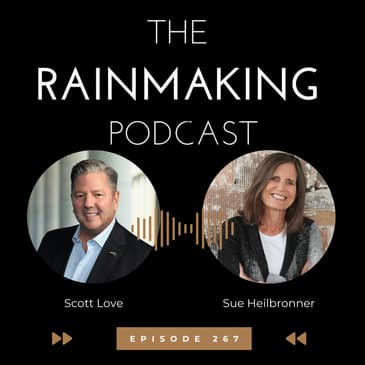
In this episode of The Rainmaking Podcast, Scott Love interviews Sue Heilbronner, executive coach, speaker, and author of Never Ask for the Sale: Supercharge Your Business with the Power of Passionate Ambivalence. Sue explains why many professional services providers resist selling themselves and how to shift that mindset by embracing authenticity and confidence. She introduces the concept of passionate ambivalence—the ability to be genuinely excited about opportunities while remaining unattached to the outcome. This approach helps professionals appear more credible, command higher fees, and attract long-term clients.
Sue also addresses common challenges such as imposter syndrome, over-eagerness, and desperation in sales. She emphasizes qualifying prospects, presenting yourself as the product, and building thought leadership through strong digital presence and meaningful contributions. With practical strategies for pricing, follow-up, and conference networking, Sue provides actionable insights for professionals looking to transform their approach to business development and rainmaking.
Visit: https://therainmakingpodcast.com/
YouTube: https://youtu.be/va71ZBSew5s
----------------------------------------
This show is sponsored by Leopard Solutions Legal Intelligence Suite of products, Firmscape, and Leopard BI. Push ahead of the pack with the power of Leopard. For a free demo, visit this link:https://www.leopardsolutions.com/index.php/request-a-demo/
----------------------------------------
Sue is a sought-after speaker, startup CEO, mentor, adjunct professor of entrepreneurship, facilitator, strategic advisor, Conscious Leadership coach, co-founder of the MergeLane investment fund, creator of the Leadership Camp training program for high-potential leaders, former federal prosecutor, and a direct and fearless catalyst for change.
Sue has the privilege of bringing her speaking, TED and TEDx-style speaker coaching, facilitation, coaching, Conscious Leadership, and consulting expertise to companies around the world. She’s worked with teams and leaders from Facebook, G2, Salesforce, Gainsight, Kiva, Uptake, Oracle, and more.
Sue has been a CEO and CRO for digital marketing, technology, and e-commerce companies since the earliest days of the Internet. She began her career as an attorney – last as a federal prosecutor with the United States Department of Justice Civil Rights Division. She transitioned to business by founding an online baby gift company in 1999, which she later sold when she joined Discovery Communications, the parent company of Discovery Channel and 15 other international networks.
Sue went on to lead companies in the interactive travel, digital publishing, e-commerce, home maintenance, and online education sectors. Sue serves as a mentor with Techstars and an adjunct professor of law and entrepreneurship at the University of Colorado Law School. Sue is a powerful presence who inspires audiences with her authenticity, directness, quick mind, and humor. Sue earned a BA from Oberlin College and a JD and Master of Public Policy from Duke University. She lives in Boulder and Chicago.
Links:
https://www.heysue.com/
https://www.heysue.com/never-ask-for-the-sale
https://www.linkedin.com/in/sueheilbronner/
Learn more about your ad choices. Visit megaphone.fm/adchoices
[00:00:10] You're listening to The Rainmaking Podcast, hosted by high stakes headhunter, author, and professional speaker, Scott Love
[00:00:21] You're listening to The Rainmaking Podcast, and my name is Scott Love. Thank you for joining me on the show. I'm really excited about this episode. And if you're the type of professional services provider where sometimes you kind of hesitate, you have an aversion to really asking for the business, well, we're going to cover that topic today with our guest, Sue Heilbronner.
[00:00:43] Now, this is a really interesting person that has deep credentials and expertise. Let me tell you a little bit about Sue. She's a former lawyer. She founded a venture capital fund. She's an adjunct professor of entrepreneurship at the University of Colorado. And she's an executive coach, facilitator, speaker, and author. And she's also the author of the book, Never Ask for the Sale. Supercharge your business with the power of passionate ambivalence.
[00:01:11] I've read that book. It's a meaty book with a lot of substance. So I'd highly recommend that. In fact, we put all of Sue's contact information, including the link for her book, in the show notes. So wherever you listen to the podcast, connect with Sue directly on the show notes.
[00:01:26] As always, this show is sponsored by Leopard Solutions' legal intelligence suite of products, Firmscape and Leopard BI. Push ahead of the pack with the power of leopard. And now here's my conversation with our guest, Sue Heilbronner. Thanks for listening. Hey, this is Scott Love with the Rainmaking Podcast. Our special guest today is Sue Heilbronner, and she's the author of Never Ask for the Sale. Sue, thanks for joining me on the show today.
[00:01:55] Oh, Scott, thanks so much for having me. And thanks for all you're doing and professional services and helping get this point across. I just love the thread of your podcast. Thank you. And let me start with this. The listeners of our show, these are people that are intellectually engaged, that pursue action, that gets results. And that's why I'd like to start first with a promotion of your book, Never Ask for the Sale. Supercharge Your Business with the Power of Passionate Ambivalence. I've never heard that before. That's good.
[00:02:24] There's a lot of depth in your book, and I like that it's not one of these fluffy sales books that says the same thing that you've already heard of. So thank you for writing your book. And let's talk about the issue of professional services providers and the aversion that they have to selling their services. Let's kind of talk about that. Thanks, Scott. You know that I was a lawyer. I began my career as a lawyer at a school and was in two law firms.
[00:02:50] So got to know the issue, at least from that one professional services context. And now I function primarily as a consultant and an executive coach. And a lot of this book is about how I've grown that business. That's also a professional services context, but a little bit different. And that's after a bunch of years in tech to build up some credibility to do that.
[00:03:09] So one reason I wrote this book is that I kept running into people, including professional services providers and, say, startup founders and sellers in certain kinds of categories, who, when I said something like, how do you think about a sale when you're selling yourself, made a face that was like, I don't know if you know what Malort liquor is.
[00:03:37] It's a really disgusting liquor that everybody in Chicago makes you drink once and then you never drink it again. They made that face. It's like the selling yourself face. And one thing you said before we jumped on this podcast is you said that you've heard professional services people say, hey, I didn't go to law school to be a salesperson.
[00:03:55] And I get that. And a huge part of my focus in this book is embracing selling yourself at the center of your sale, regardless of what you're selling. And the reason is, let's say you're a defense firm that's focused on environmental defense litigation.
[00:04:16] Even if you are selling your prowess on environmental defense litigation and all the work you've done for all these chemical companies and how great your associates are at due diligence, even if you're doing that, in order for the next company, your next prospect to believe in your firm, they have to believe in you.
[00:04:35] You have to put yourself at the center. And so what I'm encouraging people to do through this book and for most of my life is thinking about yourself as a product and getting zen with that. Why do you think people might avoid that? What do you think would be keeping them from looking at themselves as the product?
[00:04:57] I think it's incredibly vulnerable. So I think there are certain kinds of people who think it's just, look, if I'm selling peanut butter, right? I mean, let's say I made the peanut butter. I made the peanut butter. It's some recipe I came up with, whatever, and I'm selling peanut butter. At least I can talk about the merits of the peanut butter. And it might be a little personal because I made the peanut butter and I branded the peanut butter and all that stuff, but it feels separate from me.
[00:05:22] So if you don't like my peanut butter, if you'd rather eat Justin's than Sue's peanut butter, no big deal. Like I respect that you have a difference in taste. I think selling is more, when it is more personal, is more like, well, if they reject my law firm and I've put myself at the center of the sale, they are rejecting me. And by the way, it's true. They are. But that doesn't mean you can run away from it if you want to be a rainmaker.
[00:05:48] Absolutely right. One of the things that you talk about is quieting your imposter voice in your book. And tell me about that. How do you think people, I mean, what is that? How do you think they can overcome that imposter syndrome, so to speak, that voice in their head? Great question. So I want to point out that I think there are at least two categories of people who are engaged in rainmaking or selling. One group is people who, I use this term because there's a writer named Terry Reel who writes great relationship books who use this term.
[00:06:18] There's a group of people I'll call one-up people. And those are the people who, when they walk into a room, they feel like they are better than, smarter than, richer than, higher status than everyone else in the room. And that's how they're working that room. That's their context. Okay. We'll call those one-up people. Then there are people who are one-down people and they're walking into that cocktail party and they're thinking, that person is richer than I am. That person has a better job. That person's law firm is bigger than my law firm is.
[00:06:45] They have more experience. They're putting themselves below the other people. The imposter voice issue comes in mostly with people who are typically one-downing themselves in comparison to other people. They're finding all of the reasons they are not as good as the other people for whatever it is they're marketing or trying to sell or position. For those people, my suggestion is think about that imposter voice.
[00:07:12] And instead of just doing a power pose, you know, standing there like Wonder Woman, actually get to know your imposter voice. What is your imposter voice there for? How are they serving you? What are they trying to give you as a benefit? Usually what your imposter voice is trying to do is protect you from heartbreak, disappointment, vulnerability. Yeah, I can't get hurt if I break up with them before they break up with me.
[00:07:37] Exactly. I think selling and dating, by the way, especially in the current age of dating apps, is like basically, it's basically the best metaphor for professional services selling is dating. So we can talk about that. So that's that imposter issue. Now, for this other group, and I recommend that people who have that issue really get familiar with their imposter voice so that they can use it when it's helpful, like when they might get too arrogant or ahead of their skis, but let it go when it's not.
[00:08:04] For the other group, the one-up group, their imposter voice is not that persistent for them. They're already thinking they're the smartest person in the room. And those people as rainmakers are using traditional sales tools like pushing, urging, pressuring, emailing constantly, leveraging other contacts, being relentless because that's the school they were trained in. This book also speaks to that group because passionate ambivalence is actually selling without selling.
[00:08:33] It is an incredibly soft, unattached sale. So let's kind of go down that path because I like what you said so far. It makes sense as we're going into more of the actions that we take to sell our services. Talk more about what does passionate ambivalence mean and how can we use that to our advantage? Thanks. So passionate ambivalence is intended to be a dichotomy that doesn't make any sense. It's intended to feel oxymoronic.
[00:09:02] The title of my book, Never Asked for the Sale, is intended to feel like an oxymoron. Everybody from the age of two is taught, always ask for the sale, get in there and ask again and then ask again. And Glenn Gary, Glenn Ross, the film, you know, just always be closing, always be selling. Passion and ambivalence is a different take. And the idea is you as a seller, professional services seller is just the perfect use case for this concept, can be as excited as you are about a new piece of work.
[00:09:31] You have a new client. It's a huge brand. It's an issue you really care about and you want to get it because the brand will look great on your website and it'll be super fun, challenging work. Awesome. You're allowed to be excited. And when it comes into the funnel of how you're marketing and selling to that prospect, I recommend you be ambivalent about whether that piece of business closes. You actually have to let go.
[00:09:58] And the reason you have to let go is not just to, like, make yourself happier and have more peace in your life and meditate a bunch. The reason I recommend letting go is if you do let go, you will be more attractive as a professional services partner. You will be able to charge more. You will get better clients with longer term sustainable relationships with your clients. So how do we get to that point? What advice have you given to people where I care too much, Sue, help me. What do I do? Yeah.
[00:10:27] Well, first of all, I have an add-on, a free giveaway associated with the book. And it's a discussion of passionate ambivalence at every stage in the marketing and sales funnel. And your listeners could get that just by jumping on to neveraskforthesale.com. And this is a high recommend. So the way you get there is you start to think about selling as a mutual conversation, just like this podcast. Yeah.
[00:10:53] And you start to think about yourself as on an equal footing with any prospect. And you start to position yourself as equal by suggesting that starting at the very first conversation about a possible piece of work, it is a mutual fit conversation. You give your prospects homework. You don't fold up the tent anytime somebody reaches out to you and says, hey, let's do a call to talk about this piece of work. You're going to, especially professional services people, right?
[00:11:23] I mean, time is money for most of these people. If you do that, not only will you be throwing away a bunch of money on unqualified prospects, but you will be creating an impression that your time isn't that valuable. And that will end up undermining your rates. That's interesting. What are some other things people have done in terms of showing this passionate ambivalence?
[00:11:42] One thing people do after they have, say, what I call a chemistry call or an initial fit call is they will take the position that in order to close that deal, they need to be, quote unquote, on top of it. So I once had someone who was talking to me about selling professional services say, you know, so what I did is I floated them a text every day or two.
[00:12:07] Floating a text every day or two to a busy person making an expensive decision on professional services? Yeah. Right. Yeah. I mean, that's just devastating. Always be annoying. Always be annoying. And every time you send that text, you're conveying messages like, I don't have enough work to do. You don't actually want me, so I've got to push you. The way I'm thinking about this is you're not trying to sell, you're actually trying to be bought. And that dynamic is different.
[00:12:36] So you're trying to do things to get them to want you and to get them to kind of close it, right? Yes. So give me the context of somebody that you've worked with that before you started working with them, they didn't understand these ideas of passion and ambivalence. And what changes did they make to really where they could see results from these concepts that you're sharing? It changes at every stage in the funnel. So they started qualifying their leads.
[00:13:05] What will happen is somebody will be at a wedding or a bar mitzvah and some random person will say they're looking for a lawyer or a CPA. And that person will call you and say, hey, I met this guy, Bob. He's looking for a lawyer or CPA. You should talk to him. I would never do that phone conversation. Unless the person who was at the wedding or bar mitzvah is an incredibly sophisticated judge of character and lead quality, I would qualify that lead.
[00:13:31] So I've had people who do that, who will make their schedule totally patent. You'll see it on LinkedIn. Schedule a time with me on LinkedIn with a CPA who has a lot of business. Who in the world would open up their calendar if they had actual business so that anyone could schedule a call with them? But that is foolhardy. So first, people have tightened the reins on whom they're willing to use time on.
[00:13:56] Second, when that initial conversation does happen, they're qualifying that prospect at every stage of that chemistry call. Is this work good enough for me? Is it meaty enough? Is it juicy enough? Does it offer enough revenue potential for me to distract myself or, you know, get involved, put attention on it? Then passionate ambivalence shows up in pricing.
[00:14:20] And I think a lot of professional services people, with due respect, I think there's an error here. Like, I recommend against billing hourly. I recommend billing or pricing based on projects. And I recommend pricing aggressively. Some lawyers will offset hourly billing. Lawyers and other services people will offset hourly billing by using retainers. And that's great. I mean, having a mandatory minimum per month as a retainer is smart.
[00:14:48] But what you want to be sure of when you're pricing is that you are helping that prospect understand that the value you will deliver in the first 20 to 30 hours of your engagement is worth probably 10 to 20x the value of the 20 hours at the end of the engagement. And I think pricing by projects sorts for that. So those are some examples. That's great. And so I think the prospects, they're making a decision based on all these variables, all these things that they're seeing.
[00:15:18] And whoever needs it, the least always wins, right? Exactly. Yes. And so how about somebody that's at the point where maybe it's a younger professional services provider. Maybe they're starting to get their book of business built and they want to go out there, sit on panels, write white papers, speak on panels and attend conferences, things like that. And how can they use these concepts as they're starting out to really attract clients to them? Yes. I'm so glad you asked.
[00:15:48] A couple things. I am a huge believer in what I call walking around town marketing. When you are doing that, my book talks at the very beginning about like, what does it mean to put yourself at the center of the sale? And one thing it means is every part of your digital life should be every bit as strong, Scott, as yours is. You are a great example of this.
[00:16:12] So that if I am at a conference and I meet you and we have five minutes together and then the next speech starts and I sit down at my table and I'm on my phone looking at LinkedIn to find out about Scott Love, you come across incredibly well. You are selling in everything you do at My Story. You are selling in everything you do online. And it's not for the top. It's just all it's doing is I'm an authoritative voice you can trust. Right. Right.
[00:16:39] So if somebody hasn't already done that homework and they're at the conference, they are wasting their time at the conference. I think you're right. I think people, they're going to check you out. They're going to go to LinkedIn. They're going to look and see. And that concept of other people think they're a big deal, so they must be a big deal. I think that all comes into play. I don't think it's ever too soon to start creating thought leadership. What do you think, Sue? Yeah, I totally agree with that. And another thing, I recommend this to college kids all the time.
[00:17:04] No matter what you're doing, you need to be great at it. So let's say you're at a conference and you are not on the stage just because you're not there yet. You're earlier in your career. You're there to learn. You're not there to speak. Or we just don't have that status yet. Fine. No problem. When you are walking around that room at that event, there are so many ways you can display excellence. You can be helpful to the organizers.
[00:17:31] You can connect online to the organizers so that next year when they're looking for speakers, they're thinking about you. I once, I have a mentee in my life. She was volunteering at TEDx Boulder, right? It's actually a huge event. A few thousand people come every year. It's a great event. And I walked into TEDx. I was a speech coach at that event. And I walked in and I saw her doing makeup for the speakers. I'm like, why is this startup entrepreneur doing makeup for the speakers? She was right out of school.
[00:18:02] I said, why are you doing this? And she said, well, the makeup person canceled. And I know a little bit about makeup. So I'm doing makeup. And this person has been in my life ever since because I thought, well, if she's going to be that awesome to solve a problem with really very little skin in the game, very little benefit that she knows about, that's the kind of person I want to be close to. Yeah, that's right. And I think you're absolutely right.
[00:18:26] When they see people involved, even if they're not on the board, but they're engaged, then the association is this is somebody that's making a difference. And those are the people, the givers are the ones people want to reach out to to ask for help in the future. I think that's a great idea. So what do you think as somebody starts to make this shift in their thinking, what are the big pitfalls they should avoid as starting to shift into this phase of passionate ambivalence? The first thing they need to avoid is lying.
[00:18:54] That's the main thing they need to avoid. So it needs to be true. You can't overplay your hand here. You can't say, well, I'm a little too busy to get to this work unless it's priced at X, unless that's true. Because if you're going to call back in a week and say, well, now we can price it at 80% of X. I just, my time just opened up. Then your authenticity is shot. You can't be a trusted resource and you will not be hired.
[00:19:24] So that's a huge, huge pitfall. The next thing is you need to be doing enough good work so that there, as you think about your flywheel, you're thinking about it not in two weeks, but in five years. So that that person who's been in conversation with you, that you're not haranguing because you're letting things fall where they fall. That person needs to hear from one or two other people that you work with by accident. And it happens all the time. I mean, think about LinkedIn.
[00:19:53] I just logged on and I was looking at your LinkedIn profile. We know a few significant people in common. I didn't know that we knew those people in common. That's happening everywhere. So people are investigating you. And if you're not being fantastic at the other work you're doing, you will fail. You can't overplay your hand that way either. Yeah, that's great. I like the fact that you have a real world perspective with this, Sue. Not just what you mentioned before, starting your career in law, but also starting, what was it, a hedge fund? Is that correct?
[00:20:22] And venture fund, venture capital. Venture fund, that's right. I mean, you've done interesting things in business, I think, that give you personally this perspective a lot of people don't have. Somebody that's been in the business of selling it, of delivering a service, and also being a buyer of that too. And so let me ask you this, if we could kind of give three action steps that people can take to really get started making that shift into these concepts that you have, what would those three action steps be? Okay, Scott, step one.
[00:20:49] I want people to clear the blockers to success. So we talked a little bit about imposter syndrome. I want them to think about their upper limit thoughts and their unconscious commitments to staying potentially smaller than they want to be. I give tactical exercises in my book on how to do that, and there are all sorts of ways. You can look at heysu.com and look at my blog to talk about that too.
[00:21:14] Number two, I want you aggressively to put yourself at the center of your sale, and I want you to own your place there. Not only do I want you to sharpen your digital presence and your walking around town marketing, I want you to be sure you have a one-sentence and two-minute bio that tells a story beyond just a chronological record of what you do and have done, because that's lousy. That's right. That's really helpful.
[00:21:40] And I think just right, that in itself, that's a whole thing we could talk about later on on the show. And then number three, think about passion and ambivalence. When you are at your most desperate, try to remind yourself that when you are being desperate, you are actually imagining that the more aggressive you are, the more control you will have. And that is not true. You actually have no control over the outcome of a sale. You can only position yourself well.
[00:22:08] When you start to look desperate and hungry, that's when you're going to either not close or close at way lower rates. So try to take a breath. That's great. That's really good advice. And before we hear more about your offerings and your services, I'm kind of curious, what's the story in terms of what motivated you to write the book and what's been your journey in writing this book, Sue? Thanks. I love selling. I love the law. I wanted to be a lawyer, and my goal was to be a lawyer at the Justice Department in the Civil Rights Division.
[00:22:38] And I needed to do some stuff to do that, including work at a couple of really good law firms, international law firms. When the internet started to emerge in the mid-90s, but for me in late, let's say, 1999, I decided to start a tech company. And when I started this at night, I was still being a lawyer at Justice by day and running this tech company at night. And what I loved about it was selling. I couldn't believe how I loved it so much that I gave up my dream job.
[00:23:08] And then the second thing is I've grown my own professional services business incredibly successfully, including feeding a lot of business to other people through my business. And I kept giving advice to people on how to do this. And I thought, well, this isn't scalable. If I write a book and they can get it for between $15 and $25, I can actually scale myself. That's way cheaper than it is to spend time with me. And that felt great. That's great. And you've done a good job. I enjoy the book.
[00:23:36] I like the fact, like what I mentioned before, it's intellectually deep. It's not just superficial. So thank you for that gift of sharing your wisdom with the world, Sue. Thanks. And tell us about your offerings. What do you have? What do you do? And we'll mention, we'll tell everybody right now, check out the show notes. You'll be able to connect with Sue. We'll put the other link that she mentioned there as well. But tell us more about what your business is, Sue. Sure. I am primarily an executive coach to fantastic leaders, including a bunch of general counsels, a general's counsel. That's the right way to say that.
[00:24:05] And also to teams, primarily in tech. I have focused mostly on that and mostly on being a venture capital investor for the last 10 to 15 years. The work I do centers around conscious leadership. And there is a lot of conscious selling written into this book. But that conscious leadership is about helping people get more aware of their unconscious patterns and develop more range and agency and how they react, particularly when they're triggered. That's great, Sue.
[00:24:34] And I'm curious, do you speak at conferences? Do you facilitate retreats? Things like that also? I do. Yeah. You can find out all about that at my site, heysue.com. That's the domain you have when you have a terrible last name. And yeah, find out everything I do there. That's great, Sue. Well, I'd love to have you back on the show. Some of the other things that we mentioned before. And thank you for being a great guest with us today. My pleasure. Thank you so much for having me, Scott.
[00:25:01] Thank you for listening to The Rainmaking Podcast. For more information about our recruiting services for international law firms, visit our website at attorneysearchgroup.com. To inquire about having Scott speak at your next convention, conference, sales meeting, or executive retreat, visit therainmakingpodcast.com. Thank you, Scott. Thanks,