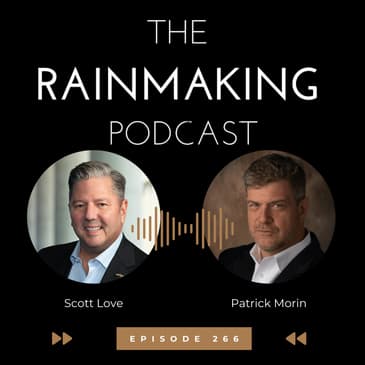
In this episode of The Rainmaking Podcast, Scott Love sits down with Patrick Morin, CEO of Transact Capital, to discuss how rainmakers can maximize their time at conferences. Patrick shares proven strategies that have generated millions in business, from doing research and segmenting attendees before arrival, to positioning yourself in the right places—like across from registration desks or in the front rows of sessions—to build meaningful connections. He emphasizes preparation, authenticity, and focusing on relationship-building rather than selling.
Patrick also highlights post-conference follow-up tactics that strengthen client development, such as sending short, thoughtful notes and sharing industry intelligence without expecting anything in return. He stresses the importance of speaking opportunities, attending offsite events, and maintaining high energy throughout the conference to create loyal connections. His practical insights show how professionals can turn conferences into powerful rainmaking opportunities.
Visit: https://therainmakingpodcast.com/
YouTube: https://youtu.be/m2BP_nXHcNI
----------------------------------------
This show is sponsored by Leopard Solutions Legal Intelligence Suite of products, Firmscape, and Leopard BI. Push ahead of the pack with the power of Leopard. For a free demo, visit this link:https://www.leopardsolutions.com/index.php/request-a-demo/
----------------------------------------
Patrick Morin is the CEO of Transact Capital Partners, an investment banking firm specializing in mergers and acquisitions of technology, Human Capital Management, industrials, and veteran-led companies.
Patrick has two professional roles:
1. Merger & Acquisition advisory to Staffing, EdTech, PropTech, and SaaS companies.
2. Professional speaker addressing conventions, conferences, and corporate & association meetings across the US and internationally on the subjects of M&A strategies and building high-performance corporate cultures.
Links: https://transactcapital.com
https://www.linkedin.com/in/patrickmorin/
Learn more about your ad choices. Visit megaphone.fm/adchoices
[00:00:10] You're listening to The Rainmaking Podcast, hosted by high-stakes headhunter, author, and professional speaker, Scott Love. You're listening to The Rainmaking Podcast, and my name is Scott Love. Thanks for joining me on the show. As we approach conference season, I thought it would be good for us to really spend some time studying what does a rainmaker do to really maximize the time spent at conferences.
[00:00:38] Our guest today is Patrick Morin, and our topic title is Leveraging Conferences for Rainmakers. Now, Patrick is a professional services provider. He's the CEO of Transact Capital, a successful investment banking firm. And I first met Patrick at a conference, and we'd had shared connections for a long time, and I finally got a chance to meet him in a conference, even though his office was a seven-iron shot away from my own.
[00:01:05] And I saw what he did during the conference, and it was truly impressive. And he came on the show today to share those ideas with you as someone just like you that's in a professional services business, and he's able to leverage his time spent at conferences. I hope you get some really good ideas from Patrick today. And if this makes a difference for you, please give us a nice five-star review on Apple Podcasts and wherever else you listen to the show.
[00:01:30] As always, this show is sponsored by Leopard Solutions Legal Intelligence Suite of Products, Firmscape, and Leopard BI. Push ahead of the pack with the power of Leopard. And now here's my conversation with my good friend, Patrick Morin. Thanks for listening. Hey, this is Scott Love with the Rainmaking Podcast. Our special guest today is a very good friend of mine, somebody I've known for some time, Patrick Morin, and we're talking about how to leverage conferences.
[00:02:01] Patrick, thanks for being on the show today. Thanks, Scott. I appreciate being invited, and I've been looking forward to this. It's been on my calendar. You know how you have it out there in the future? And like every day, it gets a little bit closer. So this is one that I was genuinely excited to join you on ever since we had talked out in Napa. That's right. I remember speaking at a conference, keynoting at a conference.
[00:02:22] You were in the audience, and I'd been following you for a long time because our offices were about, you know, like a seven-iron shot away from each other in Richmond, Virginia. And I learned a lot from you at that conference, and I thought that would be an appropriate conversation with us, leveraging conferences. This is conference season. And professionals in the business of getting business, they're attending, they're speaking, they're on panels.
[00:02:46] So tell me, what are some of the things that come top of mind that you've done that have helped you in building a brand with conferences? Scott, I'll just start off by saying that conferences are absolutely one of my best and favorite ways to be able to build a client base. I just find that client development is much stronger when you have a game plan going into conferences.
[00:03:07] And over the years, it's really started generating millions of dollars in business by being able to do them and to be able to do conferences well. Absolutely right. The funny thing is, is that I see a lot of people who don't do conferences well, right? And the thing is, is that it doesn't take a tremendous amount to be able to do it well. I think it just takes a couple of really good focus points.
[00:03:32] But I will also say is that it is a rare conference that I don't walk out with at least three or four solid clients, not prospects, clients. And it's because it's a high touch game going into it. So, you know, one of the first things that I would tell your audience, and I think I told it to you as well, is that when I go to a conference, I am fully prepped for that conference. Before I leave Richmond, I am ready.
[00:04:01] I have already looked up the people who are going to be attending. What do you do? Do you go to their LinkedIn profiles or their web pages? What do you do with that? I do. I do. I go to their LinkedIn and I look at their backgrounds. I'm looking at their titles. I'm looking at their histories because I want to know who is going to be in the room. At what level are they going to be? Are there certain people that I wanted to be able to talk to and meet? Are there certain people that I don't necessarily need to meet on this conference because I met them in a different one?
[00:04:29] But what you're ultimately looking for is commonality. Is there something in the person's background? Is there something in the person's educational background or their business background where you have some sense of commonality or you can actually add value to a conversation or add a way of thinking, a strategy? And a lot of that appears in your prep work to say, this is a really interesting person. I think I'd like to be able to meet this person. That's great.
[00:04:55] Now, do you segment them into prospect, existing client, referral partner, strategic alliance partner, maybe a vendor, somebody that might not be a prospect, but you want to get to know that vendor because you might do a webinar for them at some point? You know, things like that. Do you think it through that way? I do. And that's exactly the way that I do it. Almost exactly. You know, here could be a client company. Here could be a customer company. Here is a vendors. Here are influencers. Now that we have influencers in this space.
[00:05:23] And so I do segment them by those groups and to be able to say, well, this person's going to be speaking on stage and they also have, you know, 20,000 followers in the space, you know, in the industry. I definitely want to be able to get to know this person.
[00:06:08] And so I do. And there's certain times when I've done it and it's yielded great things. So for very high value potential clients, you know, I will say I am going to be attending this conference or I'm going to be speaking at this conference. Let's get together. It is a customized message individual to those folks. I do not ever send out blast emails to everybody who's going to be at a conference. It's just not effective. I hate that. Don't you hate that? Right.
[00:06:36] So, yes, I will say I'm going to be here and I'm trying to set up those meetings ahead of time. But it is decidedly not, I guess the best word would be salesy. You know, it's not. It's professional development. It's professional connection. And there's something there of value to offer. That's terrific. And so then you get to the conference and I learned something from you. And I'll let you talk about that. Where do you sit when you're at the show and it's starting and people are walking in?
[00:07:06] What do you usually do, Patrick? Yeah, this is an interesting thing. Because one of the things that I would say is if you're working a conference, get away from the trade show floor. Stay away from the trade show floor. So when I'm going into a conference, I am always in the educational sessions. Always. I'm listening to the keynote speaker. Ironically, years ago, that's how I met you, right? That's right. I was listening to your talk. You were on stage. You were the keynoter. And we talked immediately afterwards.
[00:07:35] But I am focusing in on typically the people who are usually towards the front because they're the ones who are going to be the most engaged. And I know if they're engaged in that topic, then I'm going to immediately have a commonality to be able to talk to them. And if you're going to a conference as a vendor, vendors almost never go into the educational sessions. They never go into the topics.
[00:08:03] They're always back out on the trade show floor on their phones or returning emails or other things like that. When, in fact, you are building a bond with your target by sitting in those educational sessions. They turn and they look at you and they know that you're there learning with them. And you know that all you have to do is make connection with the person in front of you, to the left of you, to the right of you, to the person right behind you. Just four people in each educational sessions.
[00:08:31] If you're going to a half a dozen educational sessions, you know, now you're up to 25 people in one conference and they have a higher degree of respect for you because you are listening to the speaker. You are learning about their industry. Wow, that's fantastic. So you can tell just by where they're sitting. You can kind of put a read on them, like what kind of person they're going to be, how engaged they are. Yes, absolutely.
[00:08:53] You know, and interestingly enough, too, the other, it's curious, sometimes the people who are aligning the back of the room, they got there late because of another meeting, but they were so interested in the topic that they're willing to stand for the entire session. Right? So their level of engagement is really, really high. And so it's a pretty good bet that topically they're going to have something in common with you as your meeting. That's great.
[00:09:23] So what about when the conference starts and people are coming into the registration desk earlier in the conference? Yeah, you were listening. You were listening very carefully on that one. That is something that, in fact, that I do do is that usually when the conference is just starting, I will position myself directly across from the registration desk because everybody has to funnel there to get their credentials.
[00:10:18] Everybody seems to want to talk to you. Well, it was just the fact that I had this location across from the registration desk and I got a chance to see everybody who was coming in. And it's a powerful thing to do early in the conference. That's great. So let me ask you this. Would you consider yourself an introvert or an extrovert when you go to these conferences? What do you think? So by nature, this is going to sound awful. By nature, I find myself to be a weekend introvert. Yeah. Okay.
[00:10:46] And on weekends, I want to go home and, you know, I'm not going to go to the block party for my neighbors. But when I go to these conferences, I am absolutely putting myself in harm's way. It is imperative that you're actually just talking to people. And it's not pitching. It's not talking about your firm or talking about your services. The best way for anyone to get the results out of conferences is to make a true human connection with the other person.
[00:11:17] Susan Rowan wrote a phenomenal book called How to Work a Room. And it is the subtitle on it is How to Successfully Manage the Mingling. And it is it is a guide or at least a lesson. I bought it back in 1991, 1992, right around there. And I'll tell you this, Scott, it is probably one of the most important books that framed up my entire career, How to Work a Room. And it's because I'm trying to make personal connections with people.
[00:11:46] Eventually, we'll get to business. Eventually, we'll get to client development. Eventually, we get into that rainmaker mode. But not you're not selling at these things. You're just trying to find the people to connect to. That's great. Susan's been on the show. I read her book, too. I even took her to dinner once at the Army Navy Club in downtown D.C. She's wonderful. And you're absolutely right, I think. And I liked how you said that. A weekend introvert. And I'm the same way. I'm an introvert while I'm on the weekends at home with my family.
[00:12:15] But when it's go time, flip the switch, put a shrimp on the plate. Where are you from? You know, what airport? How did you like the airport? You know, you just have that small talk and get to know each other. And then eventually, because you're at a business conference, you can get to business. You can talk about that. Yeah. And I also find that to be true. That is, a lot of times people will retreat to their hotel room or they'll retreat to somewhere else. And that is, from the moment you land to the moment you take off, sometimes you're paying $5,000, $6,000 to attend these things. Yeah.
[00:12:45] And if you look at it as a return on the minutes spent, that means that you have got to be active. And by the way, one of the ways to get super active at conferences is to make sure that you are getting invited to the off-site parties, to the off-site events, to the receptions. Those are critically important.
[00:13:06] And the way that you do that is by being able to understand other industry service providers and to be able to know who they are and what they're about and what they're achieving. Because if they know that you understand their model, they're going to invite you to their off-site events and you're going to be able to cross-promote. That's great. That's a really good tip. I think that's something that most people, they don't even think about that. And maybe they're just in a rush to get back to the hotel room to kind of shut the door and close out the world.
[00:13:36] But it's just a few hours out of the course of a year and put on the armor and do your best to push through that. It's pushing through it. It is, you know, the way that I've said it from the stage sometimes is leaders can't act the way they want to. Leaders have to act the way that is required. All right? Absolutely right. And in this case, you are the rainmaker for your firm. You're the rainmaker for your business.
[00:13:59] And that means that you have to step up in energy levels and do whatever it's going to take to carry a high level of energy throughout a two- or three-day conference. And what I like about that, I totally agree with you. What I like about that, when you're at the conference, there's a green light to meet everybody. It's kind of like you belong to a club, walk up to someone, start a conversation. You're at the conference, walk up, start a conversation. There's a green light. And you don't have to worry about that. It will never get easier.
[00:14:27] It will never get easier than at a conference because everybody is there to meet other people. Absolutely right. And that's kind of the idea behind it, which is, hey, you have an open invitation to talk to anybody at that conference. Because just by the nature that you're at that conference, you have something in common with them. Absolutely right. So let me ask you this, because you're an investment banker and you've got several key niche verticals that you and your colleagues focus on.
[00:14:52] And you're at a conference, whether it's staffing, government contracts, whatever, and you see someone that's ripe to sell their company. For you, that's a prime prospect. You bring it up at the conference. How do you kind of softly open up the door so that you can have that intimate conversation about one of the most important business decisions of their life? I find that just by having a conversation about the person themselves, they will actually introduce the topic on my behalf. Oh, yeah.
[00:15:22] Right. And they'll be like, you know, I've been coming to this conference for 20 years. And, you know, it's my favorite conference of the year. And, you know, I'm not sure how many more of these things I'm going to be attending. Boom. There it is right there. Or, you know, somebody will say to me, you know, how many kids do you have? And I've got three kids. They're all in college. They're ready to go out. You know, I think my husband and I are really ready to start traveling the world and start doing some other things. Boom. There's another opening.
[00:15:51] It's ham-handed to sit there and go, hi, I'm Patrick Moore from Transact Capital, and I would like to sell your company. Right? That's terrible. But people will, if you are having genuine conversations with people, they will present to you these on-ramps for the conversations that lead to your services. Whether it's legal services or CPA services, insurance services, it doesn't matter. It doesn't matter what kind of provider that you are. They will open the door to have that conversation. That's great.
[00:16:19] And so, what else have you done at conferences to really gain notoriety and distinction in your niche compared to other competitors? So, one of the things that you'll, if you have the capability, try to get on stage. Do everything that you can to get on stage. And it doesn't matter if it's a panel presentation or whether or not you're keynoting or you're doing a breakout session or any of those things.
[00:16:48] Trying to be a subject matter expert. When you're a subject matter expert, people will come up to you. I learned this 30 years ago when I was selling Dale Carnegie training. And I was spending an hour trying to convince somebody to take a Dale Carnegie course. And then one night, I was asked to give a talk to the JC's and the Junior Chamber of Commerce's. And I went up there and I gave this talk. And I thought it was a pretty decent talk. Well, it must have been because I had 14 people at the end of that talk come up to me and say to me,
[00:17:18] I want to sign up for a Dale Carnegie course. I'm like, wow, well, this is better. I spent the same one hour and I got 14. It ended up being a net nine. But I got net nine out of one hour versus one out of one hour. And so to the degree that you have, that you are a subject matter expert and that you have a genuine interest in being able to help the other people, if you can get on the stage one way or the other, your message goes out there and people will come up to you.
[00:17:48] And remember, Scott, the power lies with the person being called, which means the power lies with the person who's being approached. They're coming up to you and saying, hey, can I talk to you? Hey, I was thinking about selling my company. Hey, can we have a conversation? Yeah, that's great. So what do you do to follow up with people that might not be ready yet to reach out to you? Or maybe they are. How do you, like post-conference, what do you do at the end of the conference to stay in touch with people?
[00:18:16] The very first thing is I do a short one or two line email or text. Short, short, short. All right. It was great talking about this subject. Good to meet you. Whatever it is, it's really short. Okay. Most of the time that I see the errors that I see people making in conferences is that they go back to there and they write out these novellas of a sales pitch. Right. It was really lovely meeting you in Las Vegas at this particular conference. We learned these particular things.
[00:18:45] Remember, we talked about this particular thing. And remember that if you ever need these things, that my firm is the one to do this. And it's like, but I'm already sleeping. Right. Remember is that if you are truly connecting with people, you're connecting on a level. Such that you can take an entire conversation and make it into a shorthand. And when you make it into the shorthand, which is just, hey, it was really terrific meeting you. You know, I enjoyed our conversation.
[00:19:12] It was one of the better ones that I had at this conference because of this. And then, no, talk to you soon. None of that. Just hit send. Right. And have your name on it. They are going to respond. Okay. Now you've got them engaged post-conference. Now you've had two contacts. Then usually I'm hunting for data that's going to make them more competitive.
[00:19:35] So now I'm looking at the industry or I'm looking at their competitors or I'm looking at some piece of news or there's going to be something coming across the wire or there's some transaction that's happening. And I will send it to them, you know, when I see it. Sometimes that's a day or two later. Sometimes it's a week or two later, whatever else it is. What I have just done is I have said, I care enough about you that I am watching your space and your industry. And I have a piece of information that you should have that's going to make you more competitive.
[00:20:04] And I'm telling you, they absolutely come back every time and go, wow, thanks. I really appreciate that. That's brilliant. And that's a skill. Anybody can do that. Anybody could do this. Yeah. Anybody could do this. And it's not difficult at all. And or I saw this article and I thought you and it reminded me of, you know, your cupcake baking business. Right. And it's about the price of imported sugar because of tariffs. And I thought you might want to be able to see this.
[00:20:32] And whatever it is, you're doing a couple of things. You're educating them and you're telling them that you are thinking about them and their business and that you are a force multiplier for them. That you have got their back. And that is, it's not just endearing to people. It creates very loyal circles. And sophisticated people, they look for those force multipliers. They want to be around people that can really help them in a significant way. And they remember that. That's exactly it.
[00:21:03] And by the way, and there is no quid pro quo. This is the problem that I'm seeing with most people who are trying to do client development and trying to be the rainmakers for their firm. Is there's always this, I'm going to send you this, the expectation I'm going to get something back. If you send it with zero expectations of getting anything back, including the relationship with the sale, then chances are you're going to advance it a lot quicker, a lot more. That's great. One thing that you and I have the common through line in our careers is speaking.
[00:21:32] I was a professional speaker. You were a professional speaker, but also doing professional services. And then backing that off and realizing I can use that to promote my professional service. We really studied that as a craft. A lot of people listening to this, they might not have ever thought about being a speaker, but they see the potency of that short period of time and how much power that has. But they want to get better at that. What would you suggest for that person?
[00:21:58] If they want to get better at speaking at conferences, whether it's on a panel or a breakout, how would you recommend that they get better with that, Patrick? A couple of things. Let's talk on a very high level. The first thing is to remember this. When you are in front of the audience, you are the least important person in the room. You are the least important person in the room. The audience is everything. The speaker is nothing.
[00:22:22] And so it immediately evaporates any kind of fear that you might have because you're saying to yourself, well, I don't really matter in this particular case. So the only thing that matters is the message. Number two, it is now all about education. If you teach some part of your secret sauce to that audience, if you teach them, say, hey, like I can get up on stage and say, let me give you the five steps to selling your company. Okay. Here they are. One, two, three, four, five. And I let it rip.
[00:22:49] And I tell them exactly the secrets that no investment banker ever wants people to know. But I am spilling my guts on there. There will be people who come up afterwards and just say, God, that was great. You know what? I understood everything that you said, but I still want you to sell my company for me. Right. Happens all the time. So it's education. It's education. And when you're trying to get better and trying to get stronger at this, I think I told you at one time there, you have to be three things. You have to be funny. You have to be famous.
[00:23:18] And you have to be fractious. And what I mean by this is if you're able to weave humor into what you're doing, your audience is going to be far more receptive to you. Famous means doesn't mean world famous doesn't mean like Kardashians. It means that you are known within the group. You are known to either vendors or you're known to service providers or you're known to some client companies within that association. That's all famous means.
[00:23:46] It means that more than one person in the room actually knows who you are because they're going to whisper to the person next to him and say, oh, my God, he's so good. Right. Right. And by fractious, what I mean by that is things that come out of your mouth in your presentation have to defy conventional wisdom. That's what it means is that if you are saying the same thing that everybody else says, they chime out in the first two minutes of what you're doing. And so if you look at it and you say there's this phrase, always be closing. Right.
[00:24:16] I will stand up on the stage and I'll say, if any of you are still in that always be closing mode, that is completely wrong. That was back with Frank Boettcher and the 1950s and the 1960s. It's not about that right now. The rest of the audience, their bosses just went, oh, my God, I just told him today, always be closing. I am fractious in a non-offensive way because I am now going to give them a solution to being able to do that.
[00:24:43] And that's exactly to get better at presenting, to get better at speaking. Those are three things that you could do. That's great, Patrick. I want to thank you for being on the show today and tell us a little bit about what you do as an investment banker. And we'll put all your contact information on the show notes for everybody listening. If you want to reach out to Patrick for whatever reason, we'll make sure you'll be able to do that. Absolutely. So I am Patrick Warren. I'm based out of Richmond, Virginia. And if you Google me, I will come up just about everywhere.
[00:25:10] But my email address is patrickattransactcapital.com. Again, that's patrickattransactcapital.com. And I don't mind giving your audience my cell phone either. 804-402-2836. Again, that's 804-402-2836. And we are a fully licensed investment banking firm. And that is we help founders and CEOs in mergers and acquisitions, whether or not they're buying or they're selling companies,
[00:25:40] they're trying to recapitalize their companies. We help them get down the path to being able to lever their own growth strategy. Or a lot of times, in terms of exit strategies, we help founders find the best hands to put their companies in as they're trying to retire or move on to do something else. That's terrific. And you've done some pretty significant deals. What are some of the verticals that you focus in, Patrick? Yeah. So we've got four primary verticals.
[00:26:08] The first one is human capital management. Anything that touches staffing. And that also includes legal staffing. It's CPAs. Anything that touches human capital management from PERM, TEMP, RPOs, PEOs. If you know what those abbreviations are, the chances are we're probably talking. All right. But the second one is we are very deep in tech. I've got an entire team that does nothing but technology issues,
[00:26:35] including prop tech, ed tech, human capital management technology, and healthcare tech. And the great thing is, is most of our bankers here, senior bankers, have started, built, and sold companies even before they became investment bankers. So we know what it's like to sweat a payroll. There's a lot more empathy that goes there. Third is, in fact, healthcare. And we do a lot within the healthcare system. And then the last one is industrials.
[00:27:01] So anytime we're manufacturing, I've got five guys that focus in solely on anything that is created or made here in the States or even abroad. We do a lot of deals abroad as well. That's great, Patrick. I'm sure that some of our listeners might be reaching out to you because everybody wants to get to know people like you that know a lot of people. So thank you again for being on the show. And I really do appreciate sharing all the wisdom for people to make this a profitable conference season.
[00:27:28] Well, I'm a fan and a follower, and I'm grateful to have been invited. Thank you for listening to the Rainmaking Podcast. For more information about our recruiting services for international law firms, visit our website at attorneysearchgroup.com. To inquire about having Scott speak at your next convention, conference, sales meeting, or executive retreat, visit theraanmakingpodcast.com.