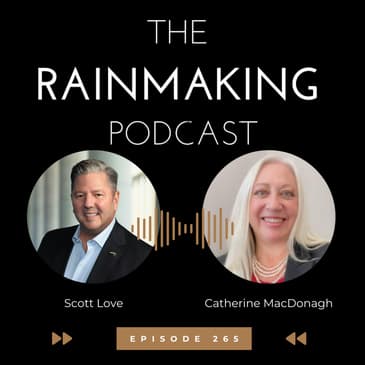
In this episode of The Rainmaking Podcast, Scott Love interviews Catherine MacDonagh, a legal industry consultant and author of Lean Six Sigma for Law. Catherine explains how process improvement—defined as analyzing and refining repeatable, describable steps to achieve better outcomes—can significantly enhance client service, profitability, and rainmaking. She notes that while lawyers often resist by saying every matter is unique, many steps in legal work and firm operations (like intake, billing, or onboarding) are recurring processes ripe for improvement. By using tools such as scorecards, impact/ease matrices, and stakeholder analysis, firms can identify high-impact areas, streamline workflows, and improve both client and employee experiences.
Catherine shares real-world success stories, including a global law department that collaborated with a law firm to reduce billing inefficiencies and deepen their relationship. She stresses the importance of involving cross-functional teams, listening to the “voice of the client,” and embedding change management into the process. Continuous improvement, she argues, is not just about efficiency—it’s about building stronger client partnerships and staying competitive. Catherine closes with three action steps: start by trying small improvements, commit to continuous learning, and build skills in Lean, Six Sigma, and related disciplines. Her message is clear: process improvement works in law, and adopting it can transform rainmaking efforts and client development.
Visit: https://therainmakingpodcast.com/
YouTube: https://youtu.be/Q36c2IBRpdc
---------------------------------------
🎧 Enjoying this episode? Take your recruiting game to the next level with The Scott Love Recruiting System — on-demand video training for recruiters who want real-world strategies that actually work.👉 Get full access at: https://bit.ly/45y7qD1
----------------------------------------
This show is sponsored by Leopard Solutions Legal Intelligence Suite of products, Firmscape, and Leopard BI. Push ahead of the pack with the power of Leopard. For a free demo, visit this link:https://www.leopardsolutions.com/index.php/request-a-demo/
----------------------------------------
A Legal Lean Sigma® Black Belt and a certified Six Sigma Green Belt, Catherine is the CEO and a Founder of the Legal Lean Sigma Institute, LLC. LLSI offers consulting and the first and only process improvement and project management certifications, courses, and workshops designed for the legal profession. Catherine created Legal Lean Sigma®, the award winning Legal WorkOut® and Legal Lean Sigma® Design Thinking.
Links: https://www.linkedin.com/in/catherinemacdonagh/
Learn more about your ad choices. Visit megaphone.fm/adchoices
[00:00:10] You're listening to The Rainmaking Podcast, hosted by high stakes headhunter, author and professional speaker, Scott Love. You're listening to The Rainmaking Podcast, and my name is Scott Love. Thank you for joining me on the show.
[00:00:28] I want you to know that this podcast exists to give you ideas, strategies, and even tactics on how to get business from prospective clients, build trust with existing clients, and overall to enrich your life. Because when your business is going well, I think, well, you know, that solves most of the world's problems. So I hope you take time to go through our website and just scroll down. We've restructured that in recent months.
[00:00:52] Just go to therainmakingpodcast.com, click on the link that says listen, and you can scroll through it. You'll see that every Thursday we release an episode that helps professionals and any professional services practice to grow their client base. On Tuesdays, not every Tuesday, but sometimes Tuesdays, we release legal-specific episodes where we have a thought leader that has content that only focuses on the legal industry.
[00:01:18] But most of the things we talk about and the shows that we produce every Thursday can help everybody. So I wanted to tell you that. Take some time and go through this site. Now, I'm excited about our guest today. Her name is Catherine McDonagh. Now, she is a consultant that specializes in the legal industry exclusively in the area of process improvement. Now, the content today can help anybody, even if you're in accounting or investment management or anything else.
[00:01:45] This is going to help you in terms of finding ways to improve your processes for your practice. Make sure you connect with Catherine directly. Go to her LinkedIn page, which we put on the show notes. And our topic today is process improvement to boost rainmaking skills. I hope you take time to connect with Catherine. And by the way, if this show is making a difference for you, if you listen to this fairly regularly, I wouldn't mind it if you went to Apple Podcasts and write a nice five-star review.
[00:02:13] And if there's a guest that said something that made a difference for you, just mention that guest's name in the show notes also. As always, this show is sponsored by Leopard Solutions, Legal Intelligence Suite of Products, Firmscape, and Leopard BI. Push ahead of the pack with the power of Leopard. And now here's my conversation with Catherine McDonagh. Thanks for listening. Hey, this is Scott Love with the Rainmaking Podcast. Our special guest today is Catherine McDonagh.
[00:02:40] And we're talking about process improvement to boost rainmaking skills. Catherine, thanks for joining me on the show today. Scott, thanks so much for having me. I'm delighted to be with you. Yeah, me too. I'm really excited about this particular topic because I'm a nerd when it comes to process improvement. I've cut my teeth on that when I was a young naval officer teaching that as a trainer in the Navy. And so in the legal world, let me ask you this question first. What is process improvement?
[00:03:06] And is that something that does really work in the legal environment? It's such a great way to start because that's what everybody wants to know. What is this? Does it work in legal? And then also, would it work for me? So basically what process improvement is, is just the way we figured out how to do things. So if you think about processes as repeatable, So if you think about process improvement, you know,
[00:03:36] Pretty much everything we do on a regular basis is a process from brushing your teeth to making your coffee to mergers and acquisitions work. Everything is a series of repeatable, And so process improvement just takes a look at the way we're currently doing and delivering our work and looks for issues, but also our best practices.
[00:04:04] What if we figured out how to do really well? We solve for the issues. We capture the things that work really well and deploy them across the organization. And once we fix the process or at least gone through our first round of improvements, we lock down the new process. And then we start all over again because it's about continuous improvement. That's interesting. That's the answer. I like that. And so have you ever had people in the legal industry kind of push back? Well, we're lawyers. We don't have to deal with that.
[00:04:34] Have you ever had that happen before? No, lawyers never push back on anything. My teammate, Kyla Sandwith, in her leadership coursework, suggests that the only thing that lawyers are not skeptical about is the fact that we're skeptical. So, yes, they push back and they say, Catherine, you don't understand. Every matter is different. Every case is different.
[00:05:04] Every client is different. Every jurisdiction or judge or whatever is different. And of course, I understand this because I happen to also be a lawyer. I'm a former corporate counsel, but also former business development executive inside of several law firms. So what I understand is that, yes, there's always going to be variation, which is a process term. That's right.
[00:05:29] And some degree of that, you know, we want to make sure we have enough flexibility in our processes to allow for that. That's what makes law exciting. What is not value add to anybody is to reinvent the wheel every single time. Like, I get that you're doing litigation defense or that your negotiation for this contract is going to be different depending on the variables.
[00:05:54] But the steps that you take are repeatable, describeable steps to generate an outcome every single time. Well, I want to dig into that a little bit deeper. But first, I want to start with who. Who are the people that can benefit from this? Is this only something where the law firm leaders need to be involved or the CEO or COO or CFO or on the practice level?
[00:06:18] Let's say there's a corporate capital markets practice group leader with three other partners and four associates and two counsel in the group. Could that person benefit from what we're talking about? Then we'll kind of dig into what they actually do. Yes, everybody, everywhere, all the time, but not necessarily all at once. Got it. So let's break it down. There are legal processes like such as you just described.
[00:06:44] Think about all the different kinds of legal work that are done by a corporate lawyer. That's a lot, right? But then there are also core business processes. There's intake, conflicts, timekeeping, onboarding. There's even lateral onboarding. The entire new hire process from recruiting, hiring, pre-hire, onboarding, integration.
[00:07:13] They're all processes. Right. Billing. And they can all benefit from improvement. However, it's not all done by the leaders. In fact, the way that we do our work, it must be done always by a cross-functional, diverse team. And more often, law firms are engaging in this effort with their clients.
[00:07:38] And certainly for the law departments, they're engaging in this work with both their internal business units, their internal clients, as well as their law firms. So there's a lot of opportunity for collaboration. The only way you cannot do this is with one leader. It takes a team. I get that. So where do we start? Let's say a practice group leader wants to improve the process. What does he or she have to do to break this down and get started on it?
[00:08:08] I would suggest the first thing is to come up with a little bit of a scorecard so that you can figure out not what you will decide to do, but how you will decide. And tell us about that. What's a scorecard exactly, Catherine? So think about things like what are your business drivers for improving your processes in the first place? Do you have existing clients, for example, with increasing demands or increasing work?
[00:08:37] Are you experiencing write-offs or write-downs or client attrition? Are you doing a white space or a green space analysis where you're trying to pursue clients, grow client relationships, grow a particular vertical market? All of those things are drivers, right? Are you losing business to a so-called alternative service provider? You know, where do you have business at risk?
[00:09:05] And so in that way is very much client development, business development, client insulation kind of inquiry that could be made. And I would argue should be made. But go look at where you have write-offs and write-downs. Where do you have work increasing or on the decline that you want to figure out? Where are you doing work on a fixed fee basis or have requests for that? Where you want to improve your profitability?
[00:09:32] Where do you want to get more value delivered to both yourself and the client with no trade-offs? Those are the kinds of questions. So let me ask you this question. And let's say somebody wants to make improvements in their practice. And you say start with the business drivers. And so are those goals that we have then? Like specific goals that we want to improve? Is that what we're shooting for first?
[00:09:54] I mean, ideally, the group will be willing to engage in some degree of planning and goal setting. And that will help us determine exactly where to start and what to work on and also the scope of those things. Because some of these processes can really, the magnitude of the problem can be so significant that it requires longer, kind of more robust projects.
[00:10:22] But then there are other things where, you know, we can spend a day in a workshop together and just get at the proverbial low-hanging fruit. Just get at the immediate improvements or even incremental improvements. As you know, they can really add up to a significant improvement over time. Like not everything needs to be a breakthrough innovation to be extremely effective. And so you mentioned the scorecard.
[00:10:51] Are these things that we're putting on the scorecard? Is that where we're starting then? I like to use, for those people who have some business background, I like to use an adaption of a weighted decision matrix. Where we're taking all of the strategic criteria, all of the strategic goals, and we're running all of the ideas through that scorecard.
[00:11:15] You know, how well does it help us achieve differentiation if we were to work on this? What about profitability goals and so forth? And then you rank out all the projects and, you know, it calculates for you. But another tool that I use a lot is the good old-fashioned pick chart or the impact ease matrix.
[00:11:36] We might decide, you know what, we're only going to work on things that are medium to easy degree of difficulty, but get us medium to high impact. And that's all we're going to work on right now. And so you mentioned different tools. Give us an example. Like, what are those? I'm not familiar with those. How would you describe those? I mean, I know that's controlled every day. Yeah, consultants. We love our charts and our quadrants and things like that.
[00:12:01] So the impact ease matrix is a great, very simple tool to use. You can use it for lots of things. I use it for planning and process improvement work, selecting ideas. And basically what you do along the horizontal axis is you decide if it's, you know, that's a continuum, right? Easy or difficult. And you can gauge anywhere, wherever it's going to be.
[00:12:30] So that's the horizontal. And then the vertical axis is low impact, medium or high. So easy, medium or difficult. Low, medium or high impact. And where does it fit in within those quadrants? So if it's easy to do, but it's low impact, yeah. If it's difficult to do and it's low impact, just like kill it right then and there. Yeah, yeah.
[00:12:57] So, you know, it depends on kind of what's the appetite for doing this. If we're just starting out, do we need to do more proof of concept? Is there some imperative to implement something more quickly? Or do we have an appetite for doing something more robust? That will be more difficult to do, but will yield a really significant return. So those are the inquiries, but it's a great tool to use for lots and lots of things.
[00:13:27] And so I know that there's different types of statistical process control, charts and graphs. You mentioned the impact ease. Let's say a starting point. We want to improve these. These are our drivers. And so what are some of the tools besides the impact ease matrix that you think we should use as we start making changes or really finding out what we need to change? Thank you for that question.
[00:13:52] I'm a big fan of listening to the voice of the client or the voice of the customer. And by that, I don't mean only the external end user client. I mean all of the stakeholders, the people who actually use the process, who are engaged in it.
[00:14:11] Because you mentioned Deming earlier and Dr. Deming would say, most people are pretty eager to contribute their knowledge and their experience. All we need to do is ask them what's working well and what could be improved. What are your frustration points? What are your pain points? And let's get at those. And what are your ideas for making this better?
[00:14:38] How could we relieve constraints so that things just flow a little more easily? How do we create a simpler, faster process? And so what a lot of firms and law departments are very wisely doing is, you know, listening to the talented people that they hired. Because the employee experience is directly related to a great client experience.
[00:15:05] And this is one thing I've learned, because for those of you listening, I used to be a management consultant when I was 24 in the Navy after my Cedar detour. My shore detour was doing Deming management methods, teaching the fleet statistical process control. Because at that time, there are big changes being made. And what we learned was that the solutions come from the line level. Those people that are in the boiler room, you know, they see where the problems are, so to speak.
[00:15:32] And you need to drive out fear to bring those solutions to the top, which is a big change for the Navy because the Navy is based on a fear-based leadership system. If they don't know what you say, you throw them in the brig. And so I found when people don't have an equity stake, there's still an amount of emotional equity that they have. You've got a high-level staff person or even a low-level or a medium-level staff person in a law firm that doesn't have an equity stake.
[00:15:59] They're not an equity partner, but there's an emotional equity stake that they have. They want to bring that contribution. How do you think law firm leaders can get staff to really bring those ideas to the forefront? What do you think about that, Catherine? Well, I think that leads me to another tool, which is simply doing a stakeholder analysis and thinking about all of the people who have an effect on the process,
[00:16:25] who participate in the process, who would be affected if and when changes are made. This is why in law especially, when changes are made, we usually experience what I call massive passive resistance because we don't have the same chain of command.
[00:16:46] We have partners who will smile and nod at you and then proceed as though they have no responsibility to follow the new process. Right? So you have to get the people who are going to be affected involved throughout, which is one of the reasons process improvement itself is so effective.
[00:17:07] It has change management built right into it from the way that we assemble our team and make sure that at least the priority stakeholders are represented to engaging with stakeholders throughout the delivery of a process improvement project. We get a lot of people's fingerprints on it. We benefit from a lot of experience and that investment that people are willing to make. And so as a result, the successes speak for themselves.
[00:17:37] So let me ask you about that then. Tell me a story of a firm that you worked with and you don't have to mention their name, of course, but what were the problems that they had? What were the things that you all worked on and what was the result of that? So one of the case studies that we talk about a lot and point to a lot is from Aon's Global Law Department,
[00:17:59] where they worked with one of their primary law firms and they got together and we facilitated a legal workout style workshops and they chose four different processes to work on, two business processes, one quasi legal and business and one business process. So I'll give you an example of what we were just talking about.
[00:18:24] The people working on the billing process was not only a cross-functional team, it was a cross-organizational team. So members from the law department and the law firm sat at a table together. It wasn't just the lawyers speaking to one another. And one of the things that surfaced very early as a problem is that the bills were not getting pushed through.
[00:18:53] They were getting rejected. And so when we asked the billing person and the finance person from the law department and the law firm, which, by the way, they had never met each other and they were a little intimidated at first sitting at a table with the higher ups. But we asked them, why are invoices getting rejected? They could tell us immediately. Oh, well, a lot of them are being rejected because they have the wrong matter ID.
[00:19:22] Why else? Oh, there's wrong timekeeper setup. So let's just pause and think about that. This is a firm. It's an excellent firm. The work product is stellar. Everybody is very happy with this relationship. But the firm is not getting paid quickly or fully for work that it has done. And we have a very satisfied client because they can't get the basics right.
[00:19:52] And we never would have known that if we didn't have everybody focused on this sitting at a table together just for one day. So this is something that benefits the firm. We were able to achieve overall reduction of almost 50%, about 75% reduction in the wrong matter ID just because we could start to surface these things.
[00:20:17] Because we listen to the experts, people who do this all day. So this is good for the firm. They get paid more quickly, more fully, and it's great for the law department who is under excruciating pressure to manage its budget and its outside resources, all of its vendors, of which law firms are one, you know, right from the top. So this is a huge win-win for everybody. The relationship deepens.
[00:20:46] They had really good conversations that they needed to have, they wanted to have, but just were never going to have without being in a facilitated environment. So that's one good story. And by the way, Aon won multiple awards for their work in the four areas, including a Master Value Award. They were shortlisted by Financial Times as an innovative law department. So this is a really great, great partnership.
[00:21:15] And collaboration is the name of the game. If you want to get into competitive client development, this is a great way to do it. That's fantastic. And I'd be willing to bet there's no end to this rabbit hole in terms of- No, there isn't. No, there isn't. They're just ready to move on to the next round of things to work on together. Yeah. And so tell me about the attitudes behind this.
[00:21:37] How important is it that a law firm partner, law firm leader has this attitude of adopting continuous improvement as kind of a model of doing work? It certainly helps. This was primarily driven by the client. And so what I would say is for any of the law firms that are listening, please do yourselves a favor. Don't wait to be asked.
[00:22:02] Because the law departments, especially if you have clients that are in manufacturing, they speak the language of business. I mean, every law department is speaking the language of business all day, every day. They know all about Lean. They know all about Six Sigma. They are employing project management. They're using design thinking.
[00:22:27] And at least law firms, I beg you, please at least be able to speak the language of business. Because that's what every client wants. Be my partner. Help me achieve my business goals. So let me ask you this then, Catherine. What we've done here, we've kind of set the table and I bet we've wet the whistle of people that want to learn more. How can they dig into this? If we could summarize three action steps that people can take to get started learning about process improvement, what would those three action steps be?
[00:22:56] Well, I want to borrow from Deming's model of plan, do, check, act. So first, I would say, try some things. Yeah. Try it. There's almost, you cannot go wrong. The only wrong thing that you could do is not try anything. Second thing is learn both from the things that you try, but also develop your skill sets.
[00:23:22] So hopefully, you know, people will have their interest piqued and they'll want to join us for one of our certificate or certification programs. We have a lot of free recordings and programs that we offer to people. Well, that's great. So please come and learn. But be in a state of continuous learning. Become a learning organization. I like that. Plan, do, check. Yeah. And act. An act. An act, yeah. Absolutely. The second step is learn. Third is develop skill sets.
[00:23:52] And thank you for sharing everything that you did today, Catherine. And tell us about your company. What do you do? What do you have that you'd like our listeners to know about? And then also talk about your book. I'd like to hear about that. Oh, thank you. Well, I'm really proud of both. We have a great team of people that engage in continuous improvement and continuous learning ourselves. So we have a team of scholars. We could be called experts. We most certainly are. But we call ourselves scholars.
[00:24:21] And we both teach and provide certificate and certification courses that are both publicly offered and privately delivered. Each one is designed for the client and tailored. And then, of course, we also offer consulting services that range from organizational design and development to project support and facilitation, helping people build their continuous improvement programs.
[00:24:51] We are the first and remain the only certifying body that focuses on legal and that employs both process improvement and project management together. That's fantastic. Together. And we're going to, for everybody listening, we're going to put Catherine's contact information. We're going to put the link for your book. And I want to hear about that, too. And then also we'll put the link for some of the free things as well. You mentioned that free recording. Free things. Promo codes. Absolutely right.
[00:25:20] We'll put all that on the show notes. So if you're listening to the show right now, check the show notes wherever you hear the show. And then tell us a little bit about your book, Catherine. Thank you. I'm both proud and relieved that it is out. It's the second edition. The first edition was Lean Six Sigma for Law Firms. The second edition is Lean Six Sigma for Law. For sure, half of our work is done in law departments. But this book is a little bit.
[00:25:47] But this book also expands to legal aid offices, military and government offices, as well as, of course, law firms. And so it's really about how to use the toolkits of Lean Six Sigma. Change management. Change management. Project management. And design thinking for everybody in law.
[00:26:09] So hopefully all the legal and business professionals that have curiosity about this will want to dive into it. And I would love to hear from people. It has many case studies in there from law departments, law firms. So hopefully it'll give you not only a good introduction to the topics, but a little bit of the case of the me-toos. Because if they can do it, you can do it too. So we're full circle in the conversation.
[00:26:39] The audience are, yes, it works. It works in law. And it will most certainly work for you too. In fact, once you start to see the world in this way, you can never look at it the same way again. Exactly right. Well, Catherine, thank you for being here on the show. I really appreciate it. Thank you so much for having me. I've been looking forward to this and spending the time with you since I saw your fabulous keynote at the Legal Sales and Service Organization's Reindance Conference.
[00:27:06] And certainly on behalf of our entire board, we want to thank you again for joining us for that. It was flat out fantastic. Thank you, Catherine. I appreciate that also. Thanks for being a guest today, Catherine. Thanks so much. I look forward to speaking with you again soon. And everybody, please reach out. Thank you for listening to The Rainmaking Podcast.
[00:27:29] For more information about our recruiting services for international law firms, visit our website at attorneysearchgroup.com. To inquire about having Scott speak at your next convention, conference, sales meeting, or executive retreat, visit theraanmakingpodcast.com.