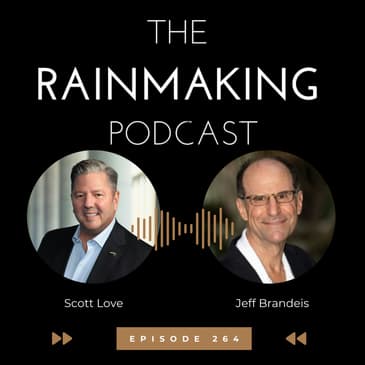
In this episode of The Rainmaking Podcast, Scott Love speaks with Jeff Brandeis about how professionals can use webinars as a powerful tool for rainmaking. Jeff explains that too many webinars fall flat because they are one-sided PowerPoint presentations that disengage audiences. Instead, he emphasizes creating interactive experiences—adding music, visuals, polls, and live engagement to keep participants interested. By building rapport with attendees—just as one would in a networking conversation—presenters can foster the know-like-trust factor essential for winning new business. Jeff also highlights the importance of asking the right questions, adapting content based on audience responses, and using storytelling to create authentic connections.
The discussion also touches on practical strategies to elevate webinars into true business development platforms. Jeff advises presenters to avoid “death by PowerPoint” by limiting slides to a few bullet points and keeping themselves on screen to maintain presence. He underscores the importance of a clear call to action—whether scheduling a consultation, downloading a guide, or visiting a website—and suggests using QR codes to streamline engagement. Finally, Jeff offers three action steps: audit your past webinars to assess engagement, reduce reliance on slides in favor of conversation, and integrate polls, questions, and interactive elements throughout. By doing so, rainmakers can transform webinars from passive lectures into dynamic business-generating conversations.
Visit: https://therainmakingpodcast.com/
YouTube: https://youtu.be/OVMKVK0eNmg
---------------------------------------
🎧 Enjoying this episode? Take your recruiting game to the next level with The Scott Love Recruiting System — on-demand video training for recruiters who want real-world strategies that actually work.👉 Get full access at: https://bit.ly/45y7qD1
----------------------------------------
This show is sponsored by Leopard Solutions Legal Intelligence Suite of products, Firmscape, and Leopard BI. Push ahead of the pack with the power of Leopard. For a free demo, visit this link:https://www.leopardsolutions.com/index.php/request-a-demo/
----------------------------------------
Are you ready to elevate your webinar game and captivate your audience like never before? Welcome to Engaging Webinars, where we specialize in helping professionals create dynamic and interactive virtual presentations that drive engagement and boost sales.
Our Mission: To empower you with the tools and strategies needed to deliver compelling webinars that not only inform but also inspire and engage your audience.
Links:
https://www.linkedin.com/in/jeffbrandeis/
Learn more about your ad choices. Visit megaphone.fm/adchoices
[00:00:10] You're listening to The Rainmaking Podcast, hosted by high-stakes headhunter, author, and professional speaker, Scott Love. You're listening to The Rainmaking Podcast, and my name is Scott Love. Thanks for joining me on the show. Let me start this episode off with a rainmaking tip. One of the most effective ways you can develop trust with prospective clients is to do a webinar.
[00:00:37] Here's what I mean. Think of that specialized niche that you have. Reach out to the Trade Association, where your prospective clients and clients attend that association's meetings and other functions. Offer to do a webinar for free on a topic that you know that your clients and prospective clients would think is important and helpful. By doing that, three things happen. Number one, they see that you are a credentialed expert. You know what you're talking about.
[00:01:03] Secondly, they feel like they know you because they have heard you talk, they've seen you speak. And third, you provide a reason for them to call you and a way that they can reach out to you. So, how do you get good at delivering these webinars? Well, you start by listening to our guest today, Jeff Brandeis. Jeff helps professionals become more effective at delivering webinars. That's what he does. Our topic for today is Rainmaking through engaging webinars.
[00:01:30] Make sure you connect with Jeff on LinkedIn and also look at his website. We put the links for those on the show notes. No matter where you listen to the show, go there and you'll be able to connect with Jeff directly. As always, this show is sponsored by Leopard Solutions, Legal Intelligence suite of products, Firmscape, and Leopard BI. Push ahead of the pack with the power of Leopard. And now, here's my conversation with Jeff Brandeis. Thanks for listening. Hey, this is Scott Love with the Rainmaking Podcast.
[00:01:59] Our guest today is Jeff Brandeis, and our topic is rainmaking through engaging webinars. Jeff, thank you for joining me on the show today. Hi, my pleasure, Scott. Thanks for having me here today. Absolutely. And I'd be willing to bet everybody listening to this has sat through a webinar or endured a webinar or actually tried to give a webinar as a way to get business. Let's kind of start with the goal of why a rainmaker should do webinars. What's your general philosophy about that, Jeff?
[00:02:28] So my philosophy on webinars is it's great to get a bunch of people together. So, therefore, you're talking to many as opposed to talking on a one-to-one basis. Right. So you're maximizing your time because you don't really weed out, if you would, or funnel through your messaging based upon the interest level. And really, instead of spending an hour with someone determining, yep, not a fit. At least if you're doing the webinar, many people will hear your presentation.
[00:02:58] And then actually from there, you basically have, you know, you'll be able to qualify those that are one that likely to become clients. Yeah, that's great. And have you seen a certain theme or format that a rainmaker, successful rainmaker, somebody that gets the call after these, is there any sort of format that they follow and how they do their presentations? The format that people need to begin to follow is really to be an engaging web presentation. Okay.
[00:03:28] One of the challenges that we see out there right now, Scott, and we've all been there, we've all experienced that, including myself. I've done it until I started developing a different methodology. 99% of the webinars, they're all the same. Forget about the product, forget about the person. You know, they start off. Hi, I'm Jeff. Welcome to my webinar. Can you hear me? Raise your hand. Okay, great. So my sound works. Good. All right. The next question they typically ask is where, where in the world are calling in from? Go into chat. Okay.
[00:03:59] Fantastic. Good people from blah, blah, blah, blah, blah, blah, blah. And then they go to the famous. All right. I'm going to share my slides now. Let me know when you see my slides. And raise your hand. And then they go off screen and then it becomes just a PowerPoint presentation. And then people are starting to check their email during the presentation and eventually lose interest. Exactly. So how can we get this to be engaging?
[00:04:27] What have you learned or good ways that somebody can do that? So what we've done here is create a more engaging atmosphere, not only for the presenter to make life easier, but also to get the audience totally engaged. So for example, you know, we typically will play a little music up front to get the people, you know, animated thing thinking. Okay. This is a little different. The curtains will open. You know, the company's logo would be there.
[00:04:54] And again, then they would be able to go to a live screen and you would be there to greet everyone to say, hey, welcome to my webinar. And then when we ask that question, where are you calling in from? We have a globe that begins to spin as people start entering, you know, Chicago, New York, Florida, London. And it becomes a lot more visual for people to begin to see that, hey, we have a global audience. That's really cool. Okay.
[00:05:23] And then the third thing that happens is when we go to our slide deck, you'll never hear me say, I'm going to share my slides. Can you see them? Okay. So I go to my slide deck. I know you can see him because I am on my left of my slides and my slides are right next to me. I never go off camera. So that also begins to build out, know, like and trust. Everybody wants to know because I don't become a Hollywood square.
[00:05:51] And they join the bleacher seats, as I like to phrase it too. I'm always going to be right in front of everyone. And what we've developed here is a push button technology to make life easier for the presenter to navigate their presentations. That's great. And I want to hear more about your solution here in a little bit, because that's really interesting to me. But tell me, how do you think somebody that's giving a webinar, do they engage through questions, through surveys, through quizzes, stories?
[00:06:21] How have you seen people to really engage with them the most effectively? So yes to all of that. So yes. You know, telling your personal story of how we got here today kind of brings that sense of reality that you could, you know, people who are on your webinar can relate to you. So that's also kind of build up, know, like and trust aspect of things. But every three minutes to five minutes, you want to be able to engage your audience, whether it's with a poll.
[00:06:48] Your poll question comes right up on screen. So people just basically can put A, B, C, D as they answer that poll question. And the responses are immediate and they start to see the responses. And you'll be able to also understand your audience makeup at that point. So, you know, part of a webinar or a presentation, I like to phrase it, you're an edu trainer. Okay. You're here to educate the audience about your product, your services. Okay.
[00:07:18] And you're training them a little bit on something new and exciting that you're offering. But the other aspect of this is to get information back from your audience. And many presenters forget to do that or they don't do that. And you do that by engaging, by asking questions, by getting them to respond to a poll question or to a survey. What's an example of that? What kind of information have you seen people get from their audiences on a webinar? So, for example, if you're, you know, we're talking about lawyers.
[00:07:46] So have you, yes or no, have you do have currently have a trust or a trust in place? Put the yes into chat or no into that. Or maybe which of the following are, do you not currently have a will in case they did a medical agreement? And you start to provide people different options. And then as the percentages start to show up, how your audience answers the questions.
[00:08:10] Now, if you 99% of the people have wills, me as a lawyer, I'm not going to stop talking about wills. Okay. Yeah. Yeah. Because that, my audience already has them. They'll just zone out and they're gone. So I look at that, the question that has the least amount of answers to what people really need. And then I would focus on that aspect of my webinar. And that might actually be a little shift that the presenter needs to make.
[00:08:37] But it's a, it's a shift that they have to make because otherwise they just stay on the wills. They already have it done. And maybe they don't have it correctly, but you can focus a little bit on that. But then once you start talking about wills, I'm done. I'm good. Thank you. And they're gone. So how do you get people to ask questions? Let's say you want to build the engagement. You did a survey, maybe half the people responded, half the people didn't. But you want to get them to engage with you even more.
[00:09:06] Is it, and okay, are there any questions? And nobody's typing in anything. What's your best idea in terms of how to get people to write questions in the chat box? A lot of people know there's a chat box. Some people don't even know how to access the chat box, believe it or not. So we typically show a little video and remind people that the chat box is down there in Zoom to click it and bring it up. And we also really encourage people to turn their cameras on to do the same thing. Because, you know, my camera's on.
[00:09:35] I'd love to get to know you folks, put a name with a face. So please turn your cameras on. And in case you don't know how, you know, there's a little button there and bring up a little video showing how to turn that camera on. Then what I would do is someone in the audience, do me a favor. Just ask me a question. You know, where do I live? What's the weather like? What's that foreign accent that you have, Jeff? Okay. Just to get someone, give me a general question. Okay. Just to get that going.
[00:10:04] Because then what I can do is I can actually bring that question right on screen. Okay. Then people start to visualize that question. And again, that makes it a lot more engaging to get the audience there. And when people start going, wow, that question's right on the screen. That's awesome. And that begins to get the power of that engagement going and just asking them a simple question. Okay. I didn't ask them anything complicated. I said, hey, just ask me a question. That's a good question.
[00:10:32] Non-offensive, non-informational, really. Just get them to do something for you. That's great. I mean, it's almost like you have to build rapport with an audience just by getting them to talk about the weather or something like that. And then you can go into deeper things. Is that kind of the arc of how that goes? That's exactly what the audience is. It's, you know, it's no different. I must hate to say it this way, but you know, you walk into a bar and you see someone where they're younger days you want to go talk to. So, hi, how are you doing?
[00:11:01] And you build that rapport and you break things down and you hopefully find a common ground to build that conversation and build a relationship. So you can do that, know, like, and trust really at the end of the day. And that's what you're trying to do. And really for that webinar is for the break that, get that rapport going, get them to talk to you and get you to be responsive. You know what you've mentioned, because I've done literally hundreds of webinars for both the legal industry and the recruiting industry over the years.
[00:11:30] And I've never thought about building a rapport with the audience. I've never considered that before. It's always here I am. I'm going to do my presentation. Are there any questions? Crickets. I like this. I'm actually going to take what you've mentioned in my next sessions. And I'm going to look at my audience as call it a prospect or whatever you want, but trying to build that rapport. Because what you said, you've said this several times, people buy from those they know, like, and trust. And that's what you're trying to do is build that trust level on these webinars. I think that's an interesting concept.
[00:12:00] If I'm looking at the goal of my webinar, it's to build trust. Well, how do we build trust? We build rapport. How do we build rapport? By talking about things we have in common, like the weather or things that they might mention, oh, somebody else has a problem in that area also. Where have you seen people that are really good at this, at building a book, at building a practice? Where have they really done well in webinars? Is it delivering the presentation or is it following up with them?
[00:12:29] What part of that do you think they really shine the brightest? Now, I've seen some really fantastic presentations, great PowerPoint slides, but the delivery isn't there. They're not building that, having that conversation. Because really at the end of the day, we've got to stop presenting to our audiences. And try to have a conversation with your audience.
[00:12:54] That flips the script tremendously from the way we've gone to these virtual presentations because we all got thrown in here at the same time. Yeah. And it's just one of those things that no one's taken Zoom or trained anyone on how to do more effective presentations. Yeah. I haven't seen it before too. And it's so important, isn't it? So, this is good. We think about developing a relationship with our prospects as we're doing this Zoom session. And it's a one way.
[00:13:23] They can see us, but they can't see us. Do you think it's ever appropriate to ask certain people to come on camera? Have you seen that before during presentations? Yes. I've definitely seen people bring camera, bring people on stage, so to speak, or spotlight them as they say in Zoom world. And there's nothing wrong with that. And sometimes, you know, I'll say something that might be a little unorthodox here, but I'm just going to say it because it's an effective methodology to use.
[00:13:53] We typically know who's coming to our webinars, okay, because they typically sign up in advance. And maybe you want to have a call out to someone and say, hey, look, you know, you mind if you volunteer to be a spotlight on me so I can have a conversation with you? So, the concept of planting what I'll call a seed, a plant out there, there's nothing wrong with it. I mean, it's done knowingly or unknowingly, and a very effective way to also get that other
[00:14:22] people to engage when someone raises their hand and they put the first step in. Because that first person to raise their hand to go spotlight, that is usually the hardest thing for anyone to get to. Because everyone's afraid to be the first. Well, I've been the first. Wow. That's brilliant. I've never thought about that before. And how easy it is to see you've got, oh, these are people that are presenting. One of them is an existing client who's also a good friend.
[00:14:50] Hey, Jerry, do you mind asking a question on a webinar just to kind of break the ice? That's so good. That's a great idea. Yeah. And once you get that first question, you'd be surprised at how that, that ice now is broken. Yeah. And how the questions will sort of flow. And then you'll get into that conversation of what I was just talking about before. And sometimes if you really do this effectively, you may not even cover all your slides, but
[00:15:15] I guarantee you, you'll have a better results or ROI out of that webinar because you shifted and it wasn't really, oh, gee, I got to get through my slides. So I'm not going to take any questions. I'm not going to ask anything to people. I'm determined and I'm just, you know, tunnel visioned in to get my slides. Forget the slides. Build out reports. What do you think the main pitfalls are that people fall into that they can't avoid, that they should watch out for as they try to deliver webinars?
[00:15:45] So a lot of people do a lot on their PowerPoints. Okay. Sometimes it's not bullets, it's paragraphs and it's just too much on the slide to present. And because they feel that their audience with all due respect, don't know how to read or can't read, they read the slide to them. I've seen it happen way, way too many times, or they pull up this convoluted graph that has,
[00:16:12] you know, 25 boxes and 20 different flows or just something so complex that it's, it's just, you know, as soon as you put it up on the PowerPoint, the mind goes, oh my God. You know, a slide in my mind, or if you're using PowerPoint, which you should, should be bullets. Should be three bullets, four bullets, tops on the slide. They should be short and succinct and to record. They're there for two purposes. One is for your audience and read them.
[00:16:41] But the other one is just to provide you content of what you want to be able to talk about. Yeah. You have to spell it all out. They're bullets. You expand upon your bullets. They remind you of what, what topic or what bullet you want to discuss. That's the purpose of this line. Yeah. And what do you think if we were to categorize these webinars, are there different ways we should look at them? Like this is going to be a deep learning one. That's going to be an hour. This one's going to be a 15 minute one covering a topic.
[00:17:10] And I'm hoping people reach out to me. How have you seen that structure? So I've seen very many different ways of doing webinars. I mean, I've seen masterminds, obviously that go three days and you're, you know, you're trying to get people to do things. You know, I've seen the hour long or the half hour of webinars. You know, to me, it's really just a question of what is your goal about presentation? And I wouldn't call it a webinar because at the end of the day, it's a presentation.
[00:17:37] What could be a presentation to your peers, could be an internal presentation to your employees, or it could be obviously a, you know, a way to generate some revenue or building that Raymielder philosophy to get more clients. So there's not really a hard and fast rule, but you know, 10, 15 minute webinar, I haven't really seen that so much as a norm. That's usually, you know, I'm not going to invest by time.
[00:18:04] It's going to be 45 minutes or I would tell them it's an hour of webinar. End early, end at 45 minutes, 50 minutes. We'll leave some time for some questions in case they didn't come through. You're, people are always happier when you're taking up less time. But if you're going an hour or 10 and you're going to pass that hour mark, they already have another appointment booked. So you've, you've lost them one of the likely because whatever your call to action was, because you went long, they got off the webinar.
[00:18:33] So tell me about the call to action. What does that mean exactly? So the webinar is geared or the presentation is geared to get somebody to do something. Okay. Well, for some people it's to book a call with me at the end of my presentation. Maybe it's also to download a PDF from my, my website, which you can sprinkle in also during your webinar, or maybe if depending on what you're doing, it's a, it's a buy now link.
[00:19:01] You know, you would like to schedule or would like to purchase a will review, you know, for $99 or whatever the dollar amount is, here's the link to purchase it. Or here's my calendar link to be able to schedule some time on my calendar. You must end with a call to action. Okay. It's not just, Hey, thanks for attending everyone. Have a great day. And I've seen that way too many times too. What do you think a really soft call to action would be?
[00:19:27] Where let's say they're dealing with C-suite executives and they're selling a sophisticated service. Maybe it's an attorney that does deals or intellectual property litigation and they want to get connected with those prospects, but they don't want to be too overt. They don't want to be outside of what's comfortable for people. What are some things you've seen that they can at least give to ask for, or for like a call to action? So there's two I really like to be able to use.
[00:19:57] One is, Hey, visit my website. There's a, you know, a guide that everyone on this webinar would find of interest. I'll put the link, you know, in chat or, you know, say now what you also should be using is the QR codes. Okay. People have the cameras or the phones. Okay. They get their phone. Hey, here's the link. Take the picture of, and it'll take them directly to the download site.
[00:20:25] And what you also should have on that site is a way to capture their name and their email. Okay. So this becomes a way for you to generate some, some leads and follow up afterwards, the webinar as well of who actually went there. So that's one methodology. And the other one would just be, Hey, you know, I'd love to learn more about you. You know, let's spend 20 minutes on the call. Here's my calendar link. Again, you can have a QR code or put the link in chat.
[00:20:54] And, you know, just get a very simple call to action. Those to me are the quick, quick and easier wins. And, you know, honestly, the other thing I sometimes do when I stop my webinars, I'll go, everyone, put your credit cards away. There's nothing to buy in this webinar. Okay. Oh, because everyone thinks at the end, Oh, that he's going to sell me. So it's going to cost me for being there. So in the beginning of my opening, well, my webinar, let me just tell you one thing where I am from.
[00:21:24] Put that credit card away. We're not taking anything over. I'm not buying anything today. That's great. That's a great idea. So let's say somebody wants to implement these ideas. They want to get better at building engagement with their webinars. If we could summarize it into three action steps they could take, Jeff, what would those three action steps be? I would do, I would suggest you do your own webinar audit. Okay. I know you're not accountants, but just listen to one of your webinars that you've recorded
[00:21:52] and see what you've done from an engagement perspective. Okay. Did I ask questions? Did I encourage people to chat with me? What was my call to action? Did I provide anything to them? Was I just totally on off camera and I just focused on PowerPoint slides? And we've all heard the phrase with all due respect, death by PowerPoint. That's right. We have to stop it. Okay. You got to stop it.
[00:22:18] You got to be able to talk a slide, get off a slide, engage the audience, pull up a poll question. You got to be able to navigate your presentation in a different fashion, in a different format. So review one of your presentations, listen to what we just talked about and, you know, see what you can change and what you can improve upon. And it will make you a better presenter. That's great, Jeff. I love it. That's pretty simple. And thank you for being here today. And then tell us about your offerings, your services. What do you have?
[00:22:48] What do you do that you'd like our listeners to know about? And for everybody listening, we'll put all of Jeff's contact info on the show notes wherever you listen to the podcast. So thank you for asking that. So go to my website, www.engagingwebinars.com. And you can download the guide on how to master engaging webinars. And there's tips and tricks on how to do that as well. If you'd like to have a consultation, you know, it's free. Let's just kind of learn a little bit more about each other and where we can help.
[00:23:15] Just go to speakwithjeff.com and my calendar link will show up there. What we do is we elevate your presentations. And how we do that is we also create a, what we call a push button presentation for you. Okay. And we will implement, we'll train you and we'll elevate your style of presentations. So I promise you, no one really has seen what we do.
[00:23:42] So from bringing a chat up on screen, bringing a question right on screen, bringing your polls right on screen, having the results on screen, having animation, switching over to my iPad. We turned all this into a push button presentation. That's makes it fun to present. It gets interactive. We have animations as well from, you know, money coming down, going into a drain. Because if you're not engaging your audience, you're throwing money down the drain folks. Yeah.
[00:24:12] You're spending money to get them there. You're spending time and money to create your presentations. So get them engaged. That's great. Well, Jeff, thank you for being here on the show. I learned a lot. I can't wait to incorporate these ideas. My next webinar and for everybody listening, like I said, make sure you connect with Jeff, go to the show notes. Jeff, thanks for being a guest here today. And I really appreciate you sharing your wisdom with us. My pleasure, Scott. Thank you so much. Appreciate you for having me. Thank you for listening to the Rainmaking Podcast.
[00:24:41] For more information about our recruiting services for international law firms, visit our website at attorneysearchgroup.com. To inquire about having Scott speak at your next convention, conference, sales meeting, or executive retreat, visit therainmakingpodcast.com.