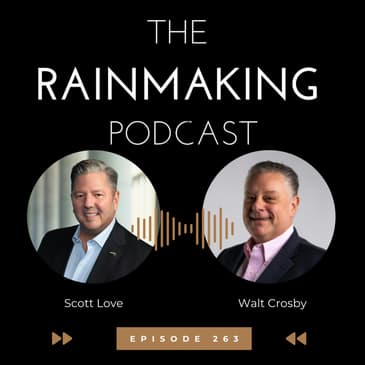
In this episode of The Rainmaking Podcast, Scott Love interviews sales performance expert and coach Walt Crosby about how introverts can excel in business development. Walt explains why introverts often have an advantage: their natural tendency toward active listening allows them to truly understand client needs, peel back the layers to uncover the emotional drivers behind decisions, and build deeper connections. He stresses the importance of mirroring tone and cadence, setting upfront agreements to control meetings, and using curiosity and empathy to create trust. Walt also outlines how skepticism—politely pushing back for clarity—can strengthen credibility and uncover real issues.
The conversation explores practical strategies for networking and client engagement, especially for introverts who may feel uncomfortable initiating contact. Walt encourages professionals to develop a clear picture of their ideal client, focus on learning about others before sharing their own story, and have clear next steps after every interaction. By combining curiosity, empathy, and targeted energy, introverts can leverage their strengths to become powerful rainmakers. The episode closes with three actionable steps: define your ideal client with precision, use skepticism to clarify and avoid assumptions, and establish concrete follow-up actions after each conversation.
Visit: https://therainmakingpodcast.com/
YouTube: https://youtu.be/VNT8k8ILO4U
---------------------------------------
🎧 Enjoying this episode? Take your recruiting game to the next level with The Scott Love Recruiting System — on-demand video training for recruiters who want real-world strategies that actually work.👉 Get full access at: https://bit.ly/45y7qD1
----------------------------------------
This show is sponsored by Leopard Solutions Legal Intelligence Suite of products, Firmscape, and Leopard BI. Push ahead of the pack with the power of Leopard. For a free demo, visit this link:https://www.leopardsolutions.com/index.php/request-a-demo/
----------------------------------------
Walter is on a mission to help Visionary leaders build a high-performance sale organization with a consistently reliable revenue forecast to double revenue.
As CEO of Helix Sales Development, he only engages with growth-minded entrepreneurs who are frustrated with underperformance, and have the desire & commitment to build a performance-based sales culture. His clients say the journey can be challenging; however, the results are transformative and produce repeatable revenue growth with margin integrity.
Walter is a proud alum of the University of Michigan and holds an advanced degree from the School of Hard-Won Wisdom. He spent the majority of his career as a salesman who was frequently promoted to sales manager. He’s sold a variety of products with complex B2B sales cycles including LED luminaries, commercial signage, financial services, synchronized clocks systems, and commercial fire alarm systems.
Frustrated by the lack of training each time he was promoted to sales management roles, he sought training and mentors to help him grow as a leader. This led to the creation of his own firm, Helix, to hire, train, and influence successful sales teams. He has formed strategic relationships to augment the sales coaching services he provides. Walter is a certified partner with the Objective Management Group, an award-winning provider of evidence-based sales evaluation and assessment tools. Helix’s technology partner is Membrain.
Those that know him best often find him reflecting over a fine cigar in his private cigar lounge. In fact, he speaks regularly about his two favorite passions as host of his podcast called Sales and Cigars.
Links: https://www.linkedin.com/in/walterlcrosby/
https://helixsalesdevelopment.com/
Order Walt Crosby’s book Scale Your Sales here:
https://www.amazon.com/Scale-Your-Sales-Critical-Mistakes/dp/1959911252
Learn more about your ad choices. Visit megaphone.fm/adchoices
[00:00:10] You're listening to The Rainmaking Podcast, hosted by high stakes headhunter, author, and professional speaker, Scott Love. You're listening to The Rainmaking Podcast, and my name is Scott Love. Thank you for joining me on the show. As you know, we've had some recent developments in some of our content.
[00:00:34] Every Thursday, we continue to bring you content that benefits everybody in professional services who's focused on getting business. On Tuesdays, not every Tuesday, but sometimes Tuesdays, we have legal specific episodes. So if you're a partner or an associate at a law firm, check out our Tuesday's shows. You can go to the site, therainmakingpodcast.com and look at the teal color code, and you'll be able to find those quite easily right there.
[00:01:00] Let me tell you about our guest today. His name is Walt Crosby, and he's a sales performance expert and a sales coach. And we're talking about introverted rainmakers. This is something that I see and is a theme among many people that I talk to in my practice of recruiting attorneys, and then also talking with other sales coaches and those that work with professionals that feel maybe a little bit uncomfortable. They don't want to be that guy in terms of the life of the party, but they know they've got to get out there,
[00:01:28] and they've got to really pitch the work and get the business. So how do you manage that? Walt's going to answer that question and several others. So take a listen. I'd highly recommend connecting with Walt as well. Go to the show notes wherever you hear the podcast and connect with him directly. Go to his LinkedIn page and also his website where you'll find some other resources that I think could help you. Also, I put the order link so that you can get Walt's book, Scale Your Sales, Avoid the Seven Critical Mistakes CEOs Make.
[00:01:57] It's a book that I've read, and I'd highly recommend it. As always, this show is sponsored by Leopard Solutions, Legal Intelligence Suite of Products, Firmscape, and Leopard BI. Push ahead of the pack with the power of Leopard. And now here's my conversation with Walt Crosby. Thanks for listening. Hey, this is Scott Love. Our guest today is Walter Crosby, and we're talking about introverted rainmakers. Walter, thank you for joining me on the show today.
[00:02:26] I appreciate the opportunity to have a chat. Yeah, absolutely right. And I'd be willing to bet a lot of people that are listening to this will say, you know, I'm an introvert. I'd rather not have to make that call, go to that meeting, because for whatever reason. So let me start with this question for you, Walter. Do you think introverts are at an advantage or disadvantage in a business development role? What do you think about that, Walter?
[00:02:51] In a business development role or a traditional sales role, right, where you're doing both account management and development, it's a huge advantage. There's a few, but the big one to me is the thing that salespeople don't do well is active listening. Right.
[00:03:09] So, and the way I explain that is if you've ever watched a football game and the coach is running off the field and the sideline reporter sticks a microphone in front of the coach's face and asks a question. They ask three questions. They have a certain amount of time. The producer's in their ear. They're not listening to the answer. They're just waiting to talk, right, to get that next question out, to give the audience some semblance of what's going on in the coach's mind.
[00:03:39] That is what salespeople typically do. They talk too much. They don't listen. And how do we ask questions if we haven't really paid attention to what the buyer's saying? Right. That's an interesting way to describe it. I know exactly what you mean when you said it that way. So, when you say active listening, to me, that implies that that's a thing. But how would you define that? What does that mean exactly, active listening?
[00:04:05] That when you hear what somebody says, you're able to articulate it and give it back to them using language that is not mirroring, but it's the same language that they use to use the same hand gestures. People talk about mirroring, but it goes beyond that.
[00:04:26] If somebody is auditory, your buyer's auditory, and you say something differently than they do in a different cadence or different words, they're like, no, no, you're not getting it. Right? So, we want to be able to listen to what they're saying, make sure we're understanding, ask those questions. And sometimes a question is, hmm, really? Interesting. Right?
[00:04:53] These are the little words that get that buyer to keep talking about that thing. So, active listening is sort of a participatory part of the conversation, but it's getting that buyer, that prospect, that spouse, that friend, whatever the situation, we want them to be sharing their information and digging in. Salespeople typically just kind of hang out at the surface. Oh, I got this little nugget. That's all I need. No.
[00:05:22] You really need to peel that onion back and get to the core and really understand. So, you can't do that unless you're really actively listening to your buyer. And tell me this then, get to the core. Why is that so important? Because we don't, I don't care what you sell. You're really selling feelings. I don't care how commoditized it is or whatever. Whatever.
[00:05:48] Amazon may be a little bit different, but you see something there that causes you to pull the trigger on the transaction. But a typical B2B or B2C larger sale, we need to engage on an emotional level. And if we haven't actively listened to what they're saying and peeled that back to get to the core,
[00:06:10] and that core is them sharing something that is either a desire, significant, compelling, has urgency to it, or a fear. Like, I really, you know, I'm afraid I'm going to lose my job. Really? Why? Well, you know, because if I don't solve this problem, we're losing $50,000 a month and we can't sustain that. Oh, well, tell me more. And then you get that conversation going where you really, truly understand what's going on in their head.
[00:06:40] So when you get to that real issue, some people call it pain. Some people call it emotion. But to me, it's this feeling that is what's going to drive their behavior to do something different. Because what's the safest thing for a buyer to do? Status quo. And just kind of navigate a little left and right. But if we want to do something that's going to transform them, to transform the situation, they got to be emotionally brought in because that's how they make decisions to buy.
[00:07:10] The justification comes later. And that's all logical. The other side of their brain. But we want, that's why salespeople are easy marks when it comes to salespeople. Because we're just there emotionally raw and we go right to the, we understand what, you know, what it is we're looking for. So active listening, getting to that core is really what's important. Let me kind of talk about that in a second. I want to go back to what you said with mirroring. What does that mean? How would we define that? And what are examples of that? And why is that important?
[00:07:40] You mentioned cadence, tone of voice. Give me some examples on that, please. Well, our tone is one of the biggest parts of communication. How quickly we speak. So if we're paying attention to our buyer, somebody from, I lived in New York City for almost eight years. And the speech pattern in New York is, what do you want? Why are we here? Right? We're talking at about 175 words a minute.
[00:08:07] And I left New York to kind of take a break and went to Atlanta. And boy, did I have, I had to downshift. Like second gear from fifth gear. Because everybody's a little slower. They want to like get to know you a little bit. The pace, your tone, it's a little softer. Right? So you have to match where that is with your buyer to get them comfortable. It's part of the rapport part. So mirroring is a piece of it, but it goes much deeper than that.
[00:08:35] Because we're trying to understand, is this person, do they think about things visually? Or do they think about things, you know, from an auditory perspective? Right? And how do we know that? Well, we pay attention to what they're saying. We're actively listening. And are they using words like, I see what you're saying? Right? Or what I hear is. Right? So those are examples of visual and auditory people.
[00:09:02] So we need to explain, when we get to the point where we're going to explain our solution, we have to be talking about it in the language that matches them with how they process information. And, you know, is that too deep for some salespeople? I don't know. We want to be successful. Maybe we should pay attention to that. Yeah, that's right. I think so. That's what I've seen in my work also, whether I'm selling to a law firm or recruiting a sophisticated partner.
[00:09:30] Understanding how can I have that rapport with them by having similar cadence and the tone like you talked about. Let me ask you this. In terms of peeling back that onion skin, let's say a professional is on a meeting with the client where the goal is to really have a conversation about solving that problem. And selling their offering or their work, their solution, whatever it is, or doing legal services or whatever sort of services. There's a problem. We have to find out what that is.
[00:09:59] Is there any sort of framework that you've advised people to use to really get to that issue, that pain of the emotion? Yeah, there's a framework for a conversation. I think there's something that salespeople should be thinking about doing before we bring the framework into place. First, is that is making sure that we're on the same page about what we're trying to achieve today. You know, I call it an upfront agreement. So, Scott, we're going to spend about 30 minutes today talking about A, B, and C.
[00:10:29] Is that still the same? Has anything changed? Right? No. Is there anything you want to add to that? Okay. Where would you like to start? Now, I rushed through that, but I took control of the meeting. And we set the agenda. And that was already set when we set the appointment. So, we want to make sure that we're clear, we're professional, and we're taking that, literally, that control. Now, what we're going to do is give that back.
[00:10:56] It's going to be perceived to the buyer that they have control because we're going to get them talking. And that's the goal. When somebody's talking, they're not really in control of the meeting. But the other person is there listening. So, you know, you have that active listening we've talked about. I think a skill set that can be developed with a salesperson is, you know, that go back to being the four-year-old. Be curious. Try to understand.
[00:11:24] Now, we don't want to be a pain in the ass, you know, four-year-old. Like, why, why, why, why, why, why? Right? We have to be a little bit more intelligent about, you know, tell me a little bit more about that. Why are you doing it that way? How did you get there? Right? So, that curiosity is the driver because what we're doing is getting that buyer to speak. We're getting them to share their thoughts and we're learning. If we're listening, we're learning. And then the other piece to this is skepticism.
[00:11:53] And salespeople have trouble with this, usually. And when somebody, when a buyer says something that just doesn't make sense or, you know, kind of is a little bit off, we get to say, hold on, I'm confused. Why are you doing it that way? Right? Or do you mind if I push back a little bit on that idea? Right? Depending upon where you are in the conversation. And so, just ask him. Do you mind if I push back on that? Yeah. Absolutely.
[00:12:19] Because it's polite and it's to the point and the other person is going to be like, no. And then they're going to be, more than likely, they're going to be open to listening to what it is that you're saying because it gives them a chance to speak again and explain. Right? So, they continue to talk. Right? And we get a better understanding of why they're doing whatever it is that we're skeptical about. I think the other piece is being empathetic. It's not sympathy. It's empathy.
[00:12:49] So, as a salesperson, if we're a top salesperson, if we're good at our craft, we can't use our skills as a weapon. Yeah. We need to be empathetic about the person's problem. We need to acknowledge that it's a problem. We need to acknowledge that it hurts a little bit. Right? So, we can't just roll over that. Like, man, what are you going to do? How is that affecting your life? How does it affect your home life? I mean, professionally, what is that doing? Right?
[00:13:18] You know, so there's a tone to empathy. And I like it to, you know, when a friend calls you up and says, hey, Scott, Walter, I really need to go have a drink tonight and have a conversation. I got something on my mind. Right? Right? When that tone and that type of conversation happens, you're like, and you're a friend. Yeah, let's get together. And you go. What are you going to do? You're going to be listening to what the person's saying. You're going to be a little skeptical about, like, you said what? Why would you do that?
[00:13:48] Right? As a friend. But you're going to hit all of those things. You're going to be empathetic. You're going to be curious. You're going to be somewhat skeptical. And you're going to be, you know, curious about why this is happening. So, the context is different, but it works. And it's just a way, if we're being a human and we really care about other people, it ties back to the basic principle that sales is really helping somebody. And if you can't, you've got to call it.
[00:14:18] That's fantastic. Everything you said is gold, Walter. And I know you might say, well, that's just common sense. It's obvious. But I think a lot of people that haven't really studied the profession of sales like you have, that might be a new concept for them or it's kind of fuzzy. But when they see, oh, all these things make sense. Empathy, helping them. This is really helping them.
[00:14:38] I think it makes them take the selfishness outside of them where my value, I'm serving my client, prospect, by bringing my expertise to solve that problem. It's not a selfish thing. I'm serving them. So, I think that's going to help a lot of people, the way you phrased that, Walter. Let me ask you this. What are the pitfalls you've seen introverts kind of stumble into that keep them from reaching their full potential in sales or client development?
[00:15:06] Well, introverts, and I consider myself an introvert. And we talked a little bit about this in three shows that my coaches, my mentors are introverts. And they're older than me. And the thing that I've learned from them is that we can't overcook it. And we can't undercook the energy we bring to the conversation.
[00:15:32] So, as an introvert, it's not our natural tendency to just go have a conversation with somebody, walk into a cocktail party and be like, oh, he looks interesting. I'm going to go talk to him. That's not our normal style. That's not how we're comfortable. But in sales, we can learn to bring that energy. And some people might call it acting. It's not acting because I'm literally trying to get to know this person to help them.
[00:16:00] But it requires a level of energy to bring to that that we don't normally have when we're engaging with other people. We got to get there. And we got to recognize that that's something, if we're going to be in sales, we have to do. And I've said this many times over the years. Our success, our growth is on the other side of uncomfortable. We got to push through that uncomfortableness.
[00:16:25] And once we get there and start having this conversation, that becomes easier because we just drop into what we know and what we've been trained. So, picking up the phone to make the call. Okay, that's scary for everybody. But what's the worst that can happen? Click. Hang up on us. They could tell us, I'm not interested. Go away. It's not a bad thing. No becomes our second favorite answer. Can we move on to the next?
[00:16:56] I had a, when I lived in New York and I was making 400 dials a day, I had a little card, three by five card on my, the wall in front of my phone. And it just said next. I had on, I had that probably for 10 years. Somehow I lost it in a move. It's all ratty, right? But that was the principle. Next, right? Because it was, you got to get past that, that, that level of being uncomfortable. And then it just becomes a habit.
[00:17:25] But what I see is that they don't bring enough energy or they bring too much. And then they sound like that super happy, excited, used car salesman, right? That dialed that back a little bit. One thing that's helped me, and I want to hear what you think about this. When I'm going to a business conference, I know that we're there to do business. As I'm putting a shrimp on my plate, I can turn to someone and say, what do you do? What do you, where are you from? Oh, I do this. What do you do? I do, I recruit corporate and finance partners. Oh, we should talk.
[00:17:54] And it can go that quick. And it's almost like replaying past scenarios gives me a good confidence level that I can do this because I've done it before. What do you think about that? What are some of the psychological tips that you think can help people kind of get over that side of uncomfortable? Well, part of it is having a plan, right? You talked about you're going there and you're going to know that you're going to have these engagements, right? So you have a plan.
[00:18:22] So how many people do you want to talk to? Is there anybody specific that you want to speak to? I have a goal of like, I need to talk to three people that are potential prospects or influencers or an opportunity. So one of the things I tell people, everything I do is like, if our competition is due, let's do something different, right? Because it's, we want to sound different.
[00:18:46] So at a networking function or at a conference, and I went to a couple of them last week, like, you know, somebody comes up and says, hey, what do you do? Yeah, you know what? Nobody cares what I do. Well, tell me what you do. And they're just going to start telling me what they wanted to do anyway. They want to talk about what they do. And what happens is that I don't have any pressure. I get to ask, you know, questions about what it is they do. But most importantly, I figure out, is this person somebody that I want to continue to talk to or not?
[00:19:15] And I can move around the room much quicker, right? And sometimes when I say, yeah, nobody cares what I do. What do you do? I get a laugh. Sometimes I get like, oh, okay. And then they just go right into their spiel. I find that it saves time. But having that plan of what you want to accomplish allows you to know if you are successful or not in the event. That's a great idea. And you're not necessarily looking for a customer.
[00:19:43] Maybe you're looking for somebody who knows your customer that can introduce you to other people, your customers. That person's gold, right? If I know a lawyer or a tax person who knows business owners, that person knows my customer. And well, what do I look for when, you know, to find out who's your customer? What am I listening for?
[00:20:08] Ah, well, if they're upset about something with their sales teams, they're not hitting revenue numbers, they can't have accountability, right? I give them the buzzwords. That's a great thing to look for at a conference or networking event. That's great, Walter. You know, one thing I want to highlight, you said curiosity earlier on our show. And when I started this podcast after COVID five years ago, I can't believe it was five years ago as of this recording. It feels like it was two weeks and 20 years ago at the same time, right?
[00:20:37] But I ask people, what is the one thing that you've learned the most about what works in client development after COVID? And I don't think it's changed. The number one word I heard was just be curious. Curiosity. Don't have an intention to close or sell, but just be curious. And I found that you brought that up to our conversation today talking about with introverts. I think that takes the pressure off where I don't have to close people. I just want to make three friends at this conference today.
[00:21:07] And if I do that, I can check the box and I fulfill my goal. And maybe they'll lead to things, maybe they won't. But I think just what you said, being curious. I think that's something people need to be mindful of, Walter. And so what do you think about that? Is there anything else in that regard that's on your mind about curiosity? I think it's a great perspective to have because it does let the air out of the balloon. I'm just trying to learn a little bit. I mean, curiosity and learning kind of come together. Go back to the four-year-old.
[00:21:36] They're asking why and they're just kind of looking around because that's how they're learning. Right. And once we become an adult, if we lose that curiosity, we lose that desire to learn, then we become stagnant and uninteresting. And, you know, it's just you're not going to be successful in sales. Exactly right. You're not trying to learn. Right.
[00:22:01] And, Walter, as we bring this to a close, if you could summarize or give three action steps people can take to really push through any hesitation they have being an introvert and really use that introverted state to help them grow, what would those three action steps be? I think from a sales perspective and you're a producer and you're trying to do development work, be crystal clear about who it is that you help. The smallest viable audience, the individual.
[00:22:32] Think about the individual. Make that picture clear. I mean, it might be a guy, it might be a gal, right? But get really clear about what that is and what they do, what they care about. Having a really clear picture of your ideal client, right? What that looks like. And that avatar that you create in your mind will help you navigate this because now you know what you're looking for. And you know if you find it, right?
[00:22:59] And the idea that I shared about the networking piece, I don't care about what I do, what do you do? Then you know if you're talking to the right type of person. That's great. And that skepticism piece, really important. Being able to push back on a buyer when they say something that doesn't make sense or more importantly, you don't understand. Right? Dig into it. Make sure you're clear. Don't walk away with assumptions. When we assume things, right?
[00:23:27] We, that old adage, you know, it makes an ass of you and me. But I think it goes much deeper than that. That we walk away with the wrong perspective on what it is we need to do next. Right. And that's really the last thing is be clear about a next step. Right? Even at the networking event. So, you know, we're here until Tuesday. You know, we have this conference. We'll get back on Wednesday. You know what I'll do? I'll shoot you a note on Friday.
[00:23:56] See if we can have a bigger conversation the following week. This is great. Think about what you're going to do and what they're going to do. I love that. And so I'm going to summarize this. Three action steps. Number one, be clear, crystal clear about who you help. Think about the individual. Step two, be able to push back to a buyer. Skepticism. Dig into it. Don't walk away with just assumption. And to number three, be clear about next steps. And Walter, tell us about what you do, what you have that you'd like our listeners to know about.
[00:24:24] I started my business doing fractional sales management for smaller teams, for companies. And that's just sort of evolved with, I've taken this approach that Seth Godin talks about. Don't build a product and go look for your customer. Find the customer and figure out what they need and give them what they need. And my offerings are a result of that. So, you know, I help business owners and entrepreneurs integrate their sales team into their organization.
[00:24:53] In an effective and meaningful way. Salespeople, and I'm one, I can say this, we're a little crazy. We're a little different than everybody else. And we need to manage that differently. So every offering I have, whether it be messaging, hiring salespeople, or, you know, just coaching programs, is designed to solve the problem that that buyer has. That's great. And Walter, we're going to put all of your links and the links to your book
[00:25:23] and your LinkedIn profile link on the show notes. So everybody listening, if you want to connect with Walter directly, go to the show notes wherever you hear this podcast. And Walter, thank you for being here on the show. I'd love to have you back on again soon. We can dig deeper into some of these other topics. And thank you for sharing your wisdom with us today. I appreciate you calling it wisdom. Thanks. Thank you for listening to the Rainmaking Podcast. For more information about our recruiting services for international law firms,
[00:25:52] visit our website at attorneysearchgroup.com. To inquire about having Scott speak at your next convention, conference, sales meeting, or executive retreat, visit therainmakingpodcast.com. Thank you. Thank you.