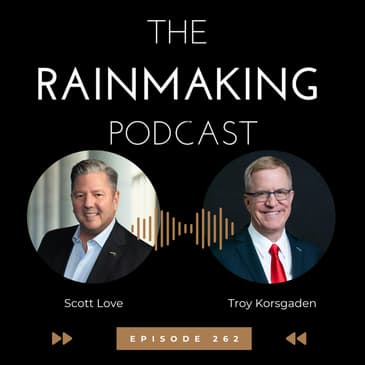
In this episode of The Rainmaking Podcast, host Scott Love speaks with Troy Korsgaden, insurance industry consultant and business development expert, about how professionals can avoid common pitfalls in client development. Troy emphasizes that the biggest mistake professionals make is failing to be intentional. He shares how building habits—like stopping for brief, purposeful introductions during daily routines—can generate long-term business success without requiring large time investments. His “stacking” method, combined with calendaring time for outreach, ensures that business development becomes a natural part of the day, not an afterthought. The conversation also explores the importance of follow-up, with Troy reinforcing that consistent communication is more impactful than any one-time pitch.
Troy also introduces the concept of being a “discussion partner”—someone clients turn to not just for services, but for strategic conversations and trusted advice. He encourages professionals, including introverted lawyers, to shift their mindset away from sales toward authentic, service-first relationship building. By being a reliable resource and showing curiosity, professionals can earn trust and grow business organically. The episode closes with three action steps: adopt the “law of 72” to act on new ideas quickly, schedule time for strategic thinking, and never remove critical follow-up items from the calendar.
Visit: https://therainmakingpodcast.com/
YouTube: https://youtu.be/t_g-mzKSI4M
---------------------------------------
🎧 Enjoying this episode? Take your recruiting game to the next level with The Scott Love Recruiting System — on-demand video training for recruiters who want real-world strategies that actually work.👉 Get full access at: https://bit.ly/45y7qD1
----------------------------------------
This show is sponsored by Leopard Solutions Legal Intelligence Suite of products, Firmscape, and Leopard BI. Push ahead of the pack with the power of Leopard. For a free demo, visit this link:https://www.leopardsolutions.com/index.php/request-a-demo/
----------------------------------------
Troy Korsgaden is a highly sought-after insurance and financial services consultant. He is the principal of Korsgaden International which specializes in global marketing, distribution, agency building and technology strategies for many of the world’s largest insurance carriers and financial services companies.
As a consultant, speaker and author of seven books, Korsgaden’s mission is to help the insurance industry and its representatives wake up to the radical transformation taking place in the industry and create the necessary tools and roadmaps to best navigate and build success in the rapidly changing insurance and financial services landscape. A widely-respected expert in personal distribution and other methods, Korsgaden trains corporate insurance and financial services leaders on customer service, change management and transformational work, among many other critical issues impacting insurance carriers and financial services companies.
Korsgaden helps those in the industry learn how to better communicate with their teams and consumers so that consumers develop a higher appreciation for the value of insurance products and their insurance advisor relationships. Korsgaden International provides turn-key approaches using leading technologies and management tools which create fluency and seamlessness in product delivery and customer service.
Hundreds of thousands of insurance and financial services executives, agents, brokers and staff members have been inspired and empowered by Korsgaden's seminars and guidance for over 30 years.
Link:
https://www.linkedin.com/in/troykorsgaden/
Learn more about your ad choices. Visit megaphone.fm/adchoices
[00:00:10] You're listening to The Rainmaking Podcast, hosted by high-stakes headhunter, author, and professional speaker, Scott Love. You're listening to The Rainmaking Podcast, and my name is Scott Love. Thanks for joining me on the show. I'm really excited about what you're going to learn today in my interview with Troy Korsgaden. And our topic title today is called How to Avoid Pitfalls of Client Development.
[00:00:38] Now, Troy works in the insurance industry. He actually consults to insurance carriers. He's worked in it for some time. But the concepts that he shares with us today, I promise, will apply to you directly. We're talking about things like how to become intentional, how to become a serve-first professional, and other things that you're going to hear that I really believe are going to make a difference for you. So listen in to Troy. And as always, this show is sponsored by Leopard Solutions' Legal Intelligence suite of products,
[00:01:07] Firmscape, and Leopard BI. Push ahead of the pack with the power of Leopard. And now here's my conversation with Troy Korsgaden. Thanks for listening. Hey, this is Scott Love with The Rainmaking Podcast. Our guest today is Troy Korsgaden. And we're talking about how to avoid pitfalls of client development. Troy, thanks for being on the show today. I'm excited to be here, Scott. Thanks for having me.
[00:01:33] Yeah, I'm excited to have you here also. And I just can't wait to dig in and really kind of take some of your wisdom about pitfalls of client development. And let me kind of start with some of the more obvious areas where you've seen professionals stumble in terms of building a book, building trust, things like that. What do you think is the most glaring and the most obvious pitfall that you've seen professionals stumble into?
[00:01:57] Yeah, not being intentional. It's a great question because everybody gets into business to make more money, to have more fun and to have less stress. But they get caught up in business, right? And so the things we need to be doing, we get sidetracked on. And so I like to make an appointment with myself. I literally put it on my calendar. It could be 15 minutes for a phone call. It could be a half an hour to stop by and introduce myself to somebody.
[00:02:24] But by not being intentional, they just get caught up in the minutiae of the day. And so they don't get done what needs to be done. So how do we get into that level of intentionality? How do you do that? So in the insurance and financial services world, which relates to any type of business that you're in, it's really looking at fitting in something that's important into your day so it's natural.
[00:02:50] So I'll give you an example of how I might do this for somebody that's in insurance in a local community. It could be 3,000 people. It could be 300,000 people. It could be 3 million. But I got to go to work, right? So on my way to work, I'm going to stop off and introduce myself to somebody. It could be a big firm. It could be a couple of people in a little shop, right? But I got to go to work. And it only takes me two minutes to introduce myself. And it's scripted, believe it or not.
[00:03:18] And I give them a little kind of a goody, if you will, tchotchke or a cookie or something, a piece of candy. But I'm always coming in to introduce myself not to sell something. And then I'm back in my car and going to work. I do the same thing when I go to lunch. I do the same thing when I come back from lunch. I do the same thing when I go home. Because all four of those things I do every day and I got to do it. I just take an extra two minutes to stop. And literally, it's two minutes. It doesn't take me a half an hour.
[00:03:47] And so I'm introducing myself. It's scripted. And there's a workflow, a process behind it. Now, you can do the same thing on the phone. You can do the same thing twice a day. But however you get your workflow, you want it to become a way of life. Yeah. How do you think professionals listening to this can make that more of a way of life? Yeah. So I use a method called stacking. I had somebody teach this to me a long time ago.
[00:04:14] You know, as the philosopher says, there's no new antiques, right? So I'm always looking for ideas like your podcast is, you know, full of ideas, right? But ideas are awesome. But unless you execute them, they're just useless. They're delusion. And so here's the way I would do it. I would look at my day and I would stack onto something else I'm doing right now. And I would make sure that I created a habit. But again, I'm a real big guy on making an appointment with myself.
[00:04:44] I calendar it. That's the key to success. If I have an appointment, I'm going to do it. If it's in my mind and I've got options, I'm always getting fooled or faked out by whatever drama is going on in life. Absolutely right. I like that idea. And I've done that before, too. And I found even setting an appointment for strategy, even a half hour or an hour where I'm actually just thinking about my business once a week for 30 minutes. Looking at my targets and goals for next week. What are the things I'm working on?
[00:05:13] But also, where am I falling short and making subtle changes over time? 100%. I love it. Now, one thing you mentioned I wanted to dig into before. You talked about you might stop and meet with people and you're not there to sell anything. But come on. We're all in, let's call the S word, sales. Oh, gosh, he said it. I've got to make it an explicit rating now. We're all in business development. We're all in trying to get someone to buy something from us. What do you think should be going on in our mind when we're just meeting people? Like you said, you're dropping by.
[00:05:43] You're not there to sell anything. We want to get the sale. We want to get that lead. We want to get that account. What do you think about that? Yeah. So you need to be different than everybody. Hey, the last 10 years in life, you know, pre-COVID, COVID, after, is really all the big companies out there telling us, sell our product. If you're selling somebody else's product or even your own, here's your coverage, here's your price. Here's the product, here's the price. You want to be different.
[00:06:09] So we teach people the way we train them is flip the model upside down. It works. It works for big companies. It works for big firms. But to the individual, it doesn't work as well, right? Because the numbers game keeps shrinking down to the individual. So on a macro level, it's great. But on a micro level, it's not as satisfying.
[00:06:30] We believe in a serve-first culture where you serve so great and you position yourself so great that they're wanting more from you, even when you're higher with your product. And really today, you know, everything's so price-driven that you've got to stand out. But to your point, I like the way you frame this question. Hey, man, if we don't sell anything, the firm doesn't turn the lights on. The individual can't feed their family.
[00:06:58] And so you can't just serve and then don't follow up. The key to success in sales, really, to me, if I had to boil it down, is appointments under the right conditions and then follow up. It's all about follow up. In real estate, we all know it's location, right? You're going to sell if you got location. But in sales in general, it's really about follow up, follow up, follow up, follow up. Absolutely right.
[00:07:24] I actually host a community for recruiters and we had one of our guests every month. We have a different author expert talking about how we can get better at our craft. And I interviewed my realtor that sold me my house because I still think about that guy, even though it's been six years. And why is that? Because he has this campaign every month. Here's something. Oh, what did Shannon send me now? Oh, it's a listing of all the information of other houses in my neighbor that had been sold over the holidays. Here's Christmas recipes, things like that.
[00:07:52] And we might think, oh, come on, that's B to C. But I think that concept of keeping ourselves top of mind, here's a helpful resource just to stay memorable with people. What do you think about that on the professional services side of client development, Troy? A hundred percent. I have the same experience with my realtor. And he just was so great about everything, keeping me up to date. I believe that in business, communication is so important.
[00:08:22] Communication, not just on a big level, but right down to the person, right? The language we use, the cadence we use. All of those things are so important. So I love the realtor concept. I'm going to take us in a little bit different direction. I love how you use the realtor because we both had a great experience. But we use the dentist's office as a great way to model success. The dentist knows that, you know what? They don't make money cleaning teeth. They just don't.
[00:08:52] They got to pay the hygienist to do it. But if they get enough people in the chair under the right conditions to clean their teeth, X amount of them got a root canal. X amount of them got to have a tooth pulled. X amount of them are referral to a dentist or orthodontist or a periodontist. You get the idea. It's a numbers game. And so part of development, a lot of people don't get it right because they just don't have enough.
[00:09:16] They set the bar too low and they don't have workflows and systems and processes to manage it correctly. And it's really a lot easier than what people think. Absolutely right. I like that. And by the way, I've got my dentist cleaning next week. I'll keep that in mind. But I think you're right. They have a touch point with their clients. And if they have enough of them, they're going to find those high margin opportunities where they really can drill down on that, so to speak. Yes. Back to your realtor, though, right?
[00:09:45] The guy sends you or she sends you a listing, right, of everything that's going on in your neighborhood. And you look at that list and you go, man, maybe I should be thinking about more real estate in my portfolio. You know, this triggers something in your head. And really, the one with the most information wins. And so it's giving the information, but also making it something that really is impactful and meaningful to the end user. Yep. Yep.
[00:10:14] You know, something you mentioned before, I thought about what happened after COVID, which is when I started the show back in 2020. Yeah, 2020. And I interviewed a lot of guests on the show, and some of them were BD experts. And I talked about what it was like to connect with people during COVID. Mm-hmm. And during that time, I remember, and you remember this, calling people. We don't know each other, but I wanted to talk to you about business. But by the way, how are you? And the walls came down pretty quickly during COVID.
[00:10:43] And we got comfortable telling strangers, I'm not doing okay. And I think the world kind of bonded because we went through something, a big event at the same time. But the thing I got out of that from a lot of my guests was, what's on your mind when you're calling prospects during this critically awful time? What are you trying to do? And they just said, they're just approaching people with curiosity. Yeah. They're not there to close. Yeah. But just being curious.
[00:11:09] And I found, and personally, I've taken that same theme into how I reach out to people now. For example, I talked to a partner today. She was put on my calendar by a colleague. She said, I'm happy. I'm not looking. I said, well, I'm a realtor with an open house. I've got some cookies, and we're going to talk and get to know each other. And maybe we can be connected in the future. But what do you think about that in terms of being a helpful resource and just being curious with people when you make contact with them, Troy? A hundred percent.
[00:11:35] If I'm out recruiting, as an example, and I'm looking for somebody, I go to the person that's the best. They're not going to move, not right away. But I'm going, hey, I really value your opinion. You're well-respected in this community, in this field, right? And so I'm asking them and saying, how's it going? What are you doing? What's working? What's not working? And they start to value you as a discussion partner.
[00:12:04] You want to be seen as somebody that people value as a discussion partner. Number one, they may want to come work with you and your opportunity and your firm, right? Or they just become a great discussion partner, and that leads to different areas that maybe you don't have a reach into. And so it just really, again, you have to be intentional. I'm going to kind of land it back down on this serve first culture. Because if you do a great job, if you do say, how are you doing?
[00:12:34] And they say, well, I'm not so good. And you're truly listening. You truly care. They go, I like that person. I trust that person. And if you take it to a recruiting level, trust is everything. I trust this person to make me successful. I'm not going to leave a job making a lot of money and hop and go backwards a little bit to go forward. If I don't trust that person. That's right. I like that. I like what you said. Be seen as a discussion partner.
[00:13:02] Kind of looking back at pitfalls again, Troy, what do you think are some other significant pitfalls we need to avoid in our client development work? Yeah, so managing it and then getting faked out by thinking it's too big to manage or you're just in the moment. So let's just talk about business in general right now, and especially in the insurance and financial services world. I meet with people every day that are, we call them distributors or their principals, agency owners. Some are big, big firms. Some are smaller.
[00:13:32] But everybody's reacting because the marketplace for insurance, as you know, even though you're not in it, it's wild, right? The capacity to buy insurance, to get insurance. The rates are going through the roof. And, you know, over the last 10, 20 years, you know, it's just been pretty steady, Freddy. Now every client's going, what's happening, right? And so they feel this deluge coming to them.
[00:13:57] But they need to be still and just go, okay, this is a time when people need us most. How do I attack my clients and my prospective clients? How do I manage that and not get it out into chaos, right? And part of that is just being intentional with the number of contacts you make each day. And they're not making the right ones. They're on the defense. And they're not on the offense. One last comment on it.
[00:14:25] When I'm doing a seminar or I'm on a live show or whatever, I often will say, most people in our business feel like they're gymnasticating all over the place. And I'll see people writing down, gymnasticating. I go, you don't need to write that down. It's not a word. But you understood it because you're letting your day control you instead of being intentional and being on the offense and controlling your own day, your own calendar.
[00:14:54] So what are some examples of people that are defensive or offensive in this area? What do you mean by that? Yeah. So somebody calls up and look, and everybody on here that's not in insurance can relate to what I'm talking about. You get your bill for your three cars today. And over the last year, year and a half, homeowners rates, as an example, have almost doubled in the last five years. Doubled. Okay.
[00:15:20] What took an entire industry to get there, it doubled. Think about the enormity of that. Then they get their car bill. And it's the same thing because of the high cost to repair a car because of the way they're made today, because of inflation, the cost to buy stuff, and then the capacity to even get insurance. I live out in California. I just bought a new home. And I literally was in a lottery to get a homeowner's policy.
[00:15:51] Oh, wow. And while I think about this, right? So everybody listening goes, yeah, I can relate. This is my kids are going on to the policy. So all day long, these advisors, we call them, they either own the firm or they work in the firm. They've got licenses. And all day long, people are going, I just got my bill. It went up $50. It went up $500. It went up $5,000. And you ruined the mile of life. That's how the conversation starts, right?
[00:16:19] Well, we didn't ruin their life. It's just the cost to repair and replace has gone through the rough right over the last three, four years. Now, is it going to calm down? And the answer is yes, because we help consumers and we help firms and we help carriers. It's calming down. But I'm telling you right now, people are not going to forget the last couple of years. They're not going to think, hey, I'm just going to do this. I want to know what I'm paying for.
[00:16:48] So you're not getting one or two customers, clients, we call them. You're getting everybody calling. So you just have to be a good time manager. You've got to, as a philosopher says, Scott, don't get through the day. Get from the day. That's great. And the only way to do that is to be intentional. And I think everybody listening can relate, whether you're in real estate or whether you're
[00:17:16] in law or whether you're in insurance and financial services or you own a sewing shop. We can all relate to that. Absolutely right. I like the through line of the themes that you're talking about and how they kind of string together. I really like that. And I want to come back to what you mentioned before. I've never heard this phrase before, a discussion part. Yeah. And I kind of know what that means. But I want to get better at that. For somebody listening, if they want to become better as a discussion partner. And here's an example.
[00:17:44] There's a lot of lawyers that listen to this because I recruit in legal, I recruit corporate and finance people and do law for a merger. So I target that. And I get a lot of feedback from people. And they're just kind of introverted. And they really struggle going to conferences. And as they're putting a shrimp on a plate, talking to somebody who's a stranger, that's kind of a safe place. I mean, that's kind of the persona of the person I see listening to this, where they've always said, I don't want to be in sales. I just want to be a good lawyer. But they have to be a good business developer.
[00:18:13] And they have to be looking for opportunities. And they have to take actions to put those opportunities in front of them. And they have to sell their service. So I like the idea of being a good discussion partner. That takes the pressure off, you know? So if I wanted to get better as a discussion partner, how could I do that? Well, we could do a whole show on it. But let me encapsulate it. It's the language we use and then the knowledge that we have. So now I'm talking to the lawyers that are listening.
[00:18:42] And this relates to everybody. But I did this in insurance. But it's the same thing. Nobody wants to be a salesman. Nobody, you know, no, he's a salesman or she's a salesperson. Okay, you want to be known as the expert. And the only way to do that is to constantly be a learner. Never stop learning. To up your game all the time. You're never going to give them all the information you know. But when they have a question regarding law, they start with you.
[00:19:12] That's it. Now, you could be a lawyer that just does BI. That's it. Or you could be somebody who does wills and estates. And that's all you do. Or you could be somebody that does defense. I don't care what you do. But you have a client base already. It could be 200 people. It could be 2,000. You could be working by yourself in a solo practice. Or you could have 200 lawyers working under you. I don't care. You have a reason to meet with people.
[00:19:41] Because their lives change every year. So I'm going to use the estate planner as the easiest one. Okay, man. My life changed over the last couple of years. I've got my grandkids living with me, right? And that brings a whole new set for a 60-year-old plus guy. That brings a whole new set of issues, right? I've got a 17-year-old daughter. I've got the kids that are in their 30s or late 30s, a son and a daughter.
[00:20:11] And everything's changed. The properties that we've had, the investments that we've all made. I need to meet with my estate planner every year. Hey, but while we're at it, I'm having a problem with one of the properties. And, well, you know, the lawyer says, I don't do real estate law, but I do have an expertise partner. Or there's somebody who's a specialist in my firm. And I'd like to partner you together. And I'm going to be in on the conference.
[00:20:39] I'm not going to just send you over to somebody. You are the gateway to all things legal. Now, when they inherit $20 million or $50 million or whatever it is, now we've got more estate planning. If they get into a bad car accident and they need some defense or they need a BI attorney, they always come to you to discuss. And then you'll tell them honestly, hey, you don't always need a lawsuit. You just don't.
[00:21:07] But if you do, here's the way that I would do this. So you get the idea. It's a constant contact at least once a year minimum. And in my world, because of so many different insurance products, it's a minimum of seven touches, not seven meetings, seven touches. But one meeting never fail with every client in person, not over virtual. The other meetings, if we need them, can be done like you and I are doing, Scott.
[00:21:36] Sorry for the long answer. But that's really good. Troy, this is great. This is really great advice. And I appreciate you coming on the show to share this with us today. If you could kind of give us three action steps somebody can do to really start doing the things that you mentioned, like to have a service, a serve first culture, to be intentional, to be seen as discussion partner, somebody that can also manage their day effectively, like you talked about. If we could kind of summarize that in three action steps, what would those be, Troy? I like that.
[00:22:06] We use the same thought process, Scott. So number one is to adopt a new way of thinking, which is called the law of 72. I learned this from somebody else. This is over 35 years ago. I learned this when I was doing something in Pittsburgh. The guy leaned over and he says, kid, we are going to get a lot of great information today. But if you don't do something within 72 hours with that information, you're never going to. It's the law of the universe. So that's number one.
[00:22:35] Adopt that philosophy. You're listening to this podcast and subsequent podcasts within 72 hours of taking notes from Scott. You want to go, I'm going to do these things. And then so number two, go to your calendar every time you've got an idea or a strategy that you need to think about and put it on the calendar. Make a date with yourself on that specific item.
[00:23:04] And then number three would be follow up. If it's important, it never comes off your calendar if it's important. And that means like reading in the morning if that's important to me. It's always on there. It's what I've got blocked time for. If it's following up with a client and it's a never-ending need, it never comes off the calendar. It just, it's not, don't be like a lot of people. Don't put every Tuesday, I'm going to have this on my calendar.
[00:23:32] That's a waste of time. Make a date with yourself that you're going to keep and then execute. To Scott's idea, I take three good ideas and then I start to execute them, move forward. Start to execute it, I move forward. And it's just total growth through iteration. Yeah. That's great, Troy. That's really motivating to hear too. I like that. And I'm going to put all of your contact info on the show notes.
[00:23:58] Everybody listening, if you want to connect with Troy, go to the show notes where you hear this podcast. And I know, Troy, you've written books. We'll put the links so that people can look at those. But tell us a little bit about what you do, what you have that you'd like our listeners to know about you. Yeah, we do a lot. Let me just tell you, we've got a great magazine. It's called The Insights. It's definitely for the insurance and financial services world. But we bring in other professionals like yourself, Scott, or folks that run companies.
[00:24:25] Not necessarily insurance, but it's driven towards the insurance folks. And then on coresgodden.com, we have a community. And that community serves people in our industry. And it helps them with tools that they need for their small business. So we're more focused. Sales is an important piece of the puzzle. But so is business development. So it's recruiting people like you are such an expert on.
[00:24:52] You know, recruiting today in my world is one of the most important things. So, yeah, get a hold of us on coresgodden.com. We'd love to meet with you. Thank you, Troy. I really appreciate you being on the show. Thanks for sharing your wisdom today. Thanks, Scott. I really enjoyed the conversation. Thanks. Thank you for listening to The Rainmaking Podcast.
[00:25:14] For more information about our recruiting services for international law firms, visit our website at attorneysearchgroup.com. To inquire about having Scott speak at your next convention, conference, sales meeting, or executive retreat, visit therainmakingpodcast.com.