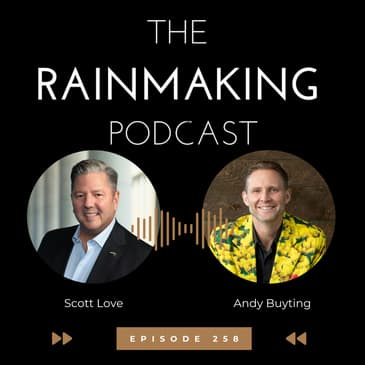
In this episode of The Rainmaking Podcast, Scott Love speaks with Andy Buyting, author of Double Sales, Zero Salespeople, about how professionals in service industries can gain a competitive edge by strategically researching the competition. Andy breaks down a detailed, data-driven approach using platforms like SEMrush to analyze traffic sources, keyword effectiveness, and competitor performance—distinguishing between direct and aspirational competitors. He emphasizes the value of identifying non-branded keywords (those not tied to a specific company name) to capture inbound traffic from prospects searching for solutions to existing problems.
Andy also shares compelling examples of companies that unlocked untapped markets by targeting overlooked search terms, such as “landlord insurance” or “how to write an RFP for a firetruck.” He encourages professionals to think like their prospects and align website messaging with customer fears and motivations. Key action steps include analyzing competitors, getting creative with keyword strategy (even bidding on competitor names), and refining website content to convert traffic effectively. The episode concludes with an introduction to Andy’s firm, Tulip Media, which offers digital marketing and custom publishing services for professional firms.
Visit: https://therainmakingpodcast.com/
YouTube: https://youtu.be/z__ttxX8JZU
---------------------------------------
🎧 Enjoying this episode? Take your recruiting game to the next level with The Scott Love Recruiting System — on-demand video training for recruiters who want real-world strategies that actually work.👉 Get full access at: https://bit.ly/45y7qD1
----------------------------------------
This show is sponsored by Leopard Solutions Legal Intelligence Suite of products, Firmscape, and Leopard BI. Push ahead of the pack with the power of Leopard. For a free demo, visit this link:https://www.leopardsolutions.com/index.php/request-a-demo/
----------------------------------------
Andy Buyting is a leader in thought leadership and content marketing. His “integrated content” strategy has served both himself and his clients exceedingly well. Andy’s thought leadership journey started when he published his first business book in 2007 and started publishing his first magazines in 2009. Since that time, he has leveraged his integrated approach to print, digital and interactive marketing strategies to establish himself as a thought leader in print marketing and brand positioning. Andy’s 2nd book, How to Win Clients & Influence People, is now in its 2nd edition and is an International Bestseller on Amazon. In 2021, Andy co-authored Double Sales/ Zero Salespeople: Optimize Your Sales and Marketing Into One Business Development Strategy That Works! Through Tulip Media Group, his team helps to fuel revenue growth for their Client-Partners through effective marketing that works.
Links: https://andybuyting.com/
https://andybuyting.com/how-to-win-clients/
Learn more about your ad choices. Visit megaphone.fm/adchoices
[00:00:10] You're listening to The Rainmaking Podcast, hosted by high stakes headhunter, author, and professional speaker, Scott Love. You're listening to The Rainmaking Podcast, and my name is Scott Love. Thanks for joining me on the show. Our guest today is Andy Buyting. He's a professional speaker, author, coach in the areas of marketing and sales development.
[00:00:35] He's the author of the book, Double Sales, Zero Sales People. And I read that book and I'd highly recommend it. Andy is going to talk with us today about researching the competition. I think you're going to get some great ideas into a concept that just isn't new, but a lot of people don't think that way anymore. So this is something that's going to help you regardless of what industry you work in. As always, this show is sponsored by Leopard Solutions, legal intelligence suite of products, Firmscape, and Leopard BI.
[00:01:03] Push ahead of the pack with the power of Leopard. And now here's my conversation with Andy Buyting. Thanks for listening. Hey, this is Scott Love with The Rainmaking Podcast. Our special guest today is Andy Buyting. And our topic is researching the competition. Andy, thank you for joining me on The Rainmaking Podcast today. I'm excited to be here. I am too. I've read your book called Double Sales, Zero Sales People.
[00:01:30] And what can I say? I'm a fan. There's some really innovative ideas in this book. It's like, wow, look at that. I've never thought about that. I mean, really, like, wow. I'd highly recommend it to everybody listening. We put the link for the book in the show notes, but let's get right to the content, which is research. Researching the competition on page 63 of your book. You talk about that, and that was really interesting to me.
[00:01:53] So tell me, where do we start? Where should somebody who's professional services, rainmaker, let's say they own a small firm or they're with a big firm, where should they start in terms of researching the competition? Well, I'll tell you. So when we start to work with a new client partner on a digital program, one of the things that we always do is we do a competitive analysis. And what we look at is we always ask, okay, you know, we want your URL, you know, your website.
[00:02:20] We'll research that like a lot of people do, and that's very, very common. But the other thing we'll ask is give us the name of who are your two competitors that you run into most often. So your two direct competitors that you run into most often, and then give me two what you consider to be aspirational competitors, meaning people that are in your industry that you feel are doing a really good job with their marketing.
[00:02:46] And I want to know, you know, who they are from your opinion, who you aspire to be someday, you know, in your marketing. And then what we do is we actually do a competitive analysis where we leverage in, you know, as an agency, it's, we leverage SEMrush, S-E-M-R-U-S-H.com. And we use, we leverage their platform. It's not inexpensive. It's quite, it's quite expensive to do, but as an agency, you know, we, we can do it for a number of our client partners and it works out well.
[00:03:15] And what we do is we analyze you and those four other companies. And what's interesting, because first of all, we go on to, we analyze your own website and we figure out what are the keywords or the keyword phrases that are driving traffic to your website? What does your traffic look like? What's bringing people to your website? What are the, the branded and the non-branded keywords?
[00:03:39] And we're more interested in the non-branded, meaning if, you know, I'm writing or sorry, if I'm running, you know, as Andy Biting, I'm running, you know, Andy Biting law firm, you know, somebody who searches my name, my company's name specifically, that's a branded search. But the ones that are searching law firm near me or law firm in, you know, St. Louis or whatever, those are non-branded searches. Okay.
[00:04:06] And we want to understand, you know, what does the traffic look like going to your website? And then we do the same thing for your competitors. And we want to know what's the volume of traffic that goes to your competitors. And we can, you can do that. A platform like Sumrush will give you that insight. And we look at your aspirational competitors as well as your direct ones.
[00:04:28] We find out for you, you know, how many people go to their website, how many people find them on Google and, or other search engines. And what brings people to their websites, which is always really fascinating. So let me ask you this, if I could interrupt you for a second.
[00:04:47] So when you say, I wanted to get clarity, aspirational competitor, is that kind of like, if I open up a single site hamburger restaurant and my aspirational competitor is McDonald's? Is that what you're talking about? Yeah. Yeah, it could be. We prefer to look at from an aspirational competitor, instead of a large multinational or really large firm. What is the one firm in your area that is doing really, really well? And I'll give you an example. We do a lot of work with law firms. We do a lot of work with insurance agencies.
[00:05:18] And, you know, we had an insurance agency that said, you know, okay, the two we run into most often is, you know, ABC Corp and XYZ Company. However, in our marketplace, in our state, this company seems to nail it. I see them all over social media. They're getting a lot of traction. I see their ads online. They just seem to really know what they're doing.
[00:05:40] And when we research that competitor, we see, actually, one thing was, you know, we found all kinds of different findings. But this one that I'm thinking of, you know, I said, here's what the traffic is. And she's, that's really interesting. I knew they were good. I didn't know they were that good because the traffic that went to their website was like much, much larger than this client of ours expected.
[00:06:05] So I'd rather have an aspirational competitor being somebody that is a little bit more relatable. So maybe it's not McDonald's. Maybe it's the local hamburger shop at one place, but they're just, the parking lot is always packed. Or it's that small regional chain that has eight restaurants or something like that. I'd rather do that than like a McDonald's. That makes sense. You're not going to learn a lot there.
[00:06:28] And so you're looking for using SEMrush, S-E-M-R-U-S-H, you're able to see what traffic is going to our site, what traffic is going to our competitors, how many, and what brings people to them. Is that right? That's correct. And then SEMrush will give you insight into the keyword phrases as well. And we filter out, you know, what's the percentage of all the traffic that goes to their website? Maybe, you know, make the math easy.
[00:06:56] There's a thousand people that go to their website. How many of them are organics or are branded searches and how many of them are non-branded searches? And the non-branded searches is what we really want to focus on because if somebody is searching, you know, Scott Love law firm, you know, even though you might be a competitor of mine, I'm not going to intervene or I'm not going to, it's going to be hard for me to intercept the person that's looking for you directly.
[00:07:22] But if people are looking for, you know, commercial law in my marketplace and they're going to your website, I want to know why they're going to your website and not mine. And I figured that out. And then we use a combination of, you know, it's very common for our marketing specialists or digital marketing specialists to have SEMrush up on one screen and Google Ad Planner on another.
[00:07:48] And they're constantly looking back and forth and finding those opportunities where people are going to maybe a competitor's website with a keyword phrase that is, does not have a lot of competition. Yeah. And we start to dig into that because, you know, in the insurance space, searching commercial insurance in my area might be, you know, might garner a lot of, you know, a lot of searches, but it might be highly competitive. I tell you, it might pretty much every market.
[00:08:18] It is very competitive. So it's very expensive to get those clicks. But if you start ratcheting it down and then we start asking, okay, what are they, what are the areas that you specialize in? Well, I specialize in small business commercial law or I specialize in, you know, traffic violations or, you know, thinking about law firms or with insurance. You know, I specialize, I remember one, one of our client partners saying, you know, we do a lot with apartment buildings. So, you know, multi-residential real estate insurance. Okay.
[00:08:47] Let's look at that. And then we start to figure out where are those opportunities in there? And I remember this one, she said, you know, let's look at multi-residential real estate. Insurance. So we looked at that. There's not a lot of people in your market that search for that. Okay. Well, how about, you know, and we went through different terms, apartment insurance, you know, apartment building insurance, all these different things. And what we found was, you know what? There's actually, there's a significant number of people that are searching for landlord insurance.
[00:09:17] And she said, oh, we don't use that term. Yeah, but your customers do. That's interesting. And there was nobody competing for landlord insurance. So we were able to buy all those clicks very easily or the vast majority of them very easily for a very small budget. So that's one example. You know, another one, a fellow in Minnesota said, we do a lot of contractor insurance. So we looked at contractor. We looked at, you know, development. We looked at building insurance.
[00:09:44] But if you searched carpenter insurance, carpentry insurance, it was actually searched a fair bit. Nobody was competing for it. So we went in and bought all those clicks or a vast majority of them. And now let me ask you this. Let me ask you, when you say we buy those clicks, tell me what that means. So when we buy those clicks, so what our company, we do some social media pay-per-click, but what we specialize in is Google pay-per-click.
[00:10:10] So when we're talking with a potential client partner to start off with, we want to understand, you know, their marketplace, how their customers are reaching them and finding them. And most importantly, like we need to be able to draw a map in our own minds to say that, okay, people where we can really make a difference.
[00:10:31] And what we specialize in is when your customers are going to the internet to do some research of some sort, because they're looking for a solution to a problem they already have. And what that means is when people are going online to search still, you know, with chat GPT and everything else going on, Google is by far the number one search engine.
[00:10:52] So we want to find, we can really help and where there's real opportunity is when your potential customer is going online or a segment or your customer base is going online to find a solution. They're searching for a solution to a problem they already have. So you don't have to invent a problem. You know, it's a whole lot easier to sell someone if they already have a problem, if you can be positioned as the potential solution.
[00:11:15] So when we buy clicks, we're using Google ads to put your website at the top. That's great. And that only works when there's not a lot of competition there because you can buy ads, you can buy ads to search anything. But if we can buy, you know, a keyword phrase of carpenter insurance that nobody else is doing, we can guarantee you'll be the first one that'll be seen probably the only sponsored ad.
[00:11:42] And it's still amazing how many people, you know, a lot of people will still just click whatever comes up at the top on Google. And you can really increase traffic quickly to your website if you're with that type of a strategy. That's great. What do you think the pitfalls are professional service providers will face if they try to do this? What are the mistakes they really need to try to avoid as they're trying to research the competition?
[00:12:07] As they're trying to research the competition, I would say not looking at it through different angles. Like we look at it and, you know, no holds barred. You know, if you had carp launch, like how would you look at this and attack this to try to, because our goal is to get traffic that would otherwise maybe land on your website onto ours, right? Onto a competitor's website, onto our clients. And we look at it from different angles. So we even go so far, and this works very, actually quite well.
[00:12:37] A lot of people don't necessarily agree or like the strategy, but it does work is that we'll buy for our client partners, we'll buy their competitors' names as a keyword strategy. Oh, wow. So even, you know, ourselves and our own company, you know, I don't mind saying that, you know, a lot of our keywords that we are buying are actually the names of our competitors. So we'll actually rank higher because that's another thing. Whatever you do, make sure you're buying your own keyword.
[00:13:06] So, you know, somebody Googles Tulip Media, we want to rank above a competitor. But it's amazing how many people don't do that. So, you know, N2 Publishing is a competitor of ours. We buy that keyword. So we actually, you Google that, will actually appear higher than them. So tell me this, then, when you say buy that keyword, what does that mean exactly? So that means using Google Ads, you set a budget.
[00:13:31] And Google Ads, actually, there's, you know, they'll help you navigate through the complexities, because it is quite complex. But they'll help you understand and how to, you actually buy, you put in keywords or keyword phrases that you want to purchase with a budget beside each one or a budget as a whole. There's different ways you can do it. But when you're leveraging Google Ads, you know, that's where you put in the keywords, the specific keywords that you want to go after.
[00:14:01] And the goal, so this is a popular mistake that's done. And it's a common mistake is that the goal is not to buy the most popular keywords. You know, oh, I'm going to use, I'm going to buy commercial insurance because it has, you know, a thousand researches a month versus carpenter insurance, which only has, you know, 40 searches a month. You know, that's tempting to do.
[00:14:24] But if two things will happen, you know, the more common, the more popular the keyword, the higher the competition, which means you're paying more per click is the first one. And secondly, you're probably being ranked there with three or four others. And there very well could be a multinational guy, you know, company in there or two that have deeper pockets that are putting up a bigger daily budget and so on. So out of the three ads, you're going to be ranked number three.
[00:14:53] You will appear, but you'll be ranked number three. The other two will get, and you'll pay a lot per click. And you won't get, you won't get as many clicks as you hope. And the ones that you do get, you'll chew up your budget with those. Right. So you're trying to get creative on this. You're trying to find that keyword that nobody else has that you can get 30 cents on the dollar compared to the other ones. Yeah. Kind of game it, right? Yeah. And sometimes it's, you know, Scott, it's not 30 cents on the dollar. It's two cents on the dollar.
[00:15:20] You know, it's really, really cheap if you get creative in how to, how you do that. But give me an example of a company you worked with where you went through this and you were able to find this word, this word, this word. And what were the results from that? Yeah. So I'll tell you. So what one company we work with is manufacturing company and they're kind of a poster child. It's been, it's worked really well.
[00:15:42] They came to us during COVID because they, all of a sudden they lost all their trade shows, all their way, the ways that they, all the conventions shut down every way that they were able to meet potential new customers. Now this is a manufacturing company that manufactures fire trucks. Yeah. So if you can imagine their average sale is three quarters of a million dollars. That's the average size sale. So they're big, they're big contracts.
[00:16:05] And when we started working with them, you know, we found out, we actually took a very different strategy where we said, you know, so number one step you need to do is you have to put yourself in the shoes of your potential client. So think about someone who's buying your law service or your insurance service, or in this case, manufacturing. It's a fire chief. They focus mainly on rural fire, you know, fire stations.
[00:16:35] And it's a fire chief that is managing two trucks. Every truck lasts for about 20 years. So they're buying a new truck every 10 years. So the fire chief, it's not something they do every day. So when I'm a fire chief, you put yourself in their mind, in their shoes and what they're thinking about. They have to do the research because they have to retrain themselves how to do this every time. And, you know, because they're only doing this once every 10 years. So every time they're doing it, they need to learn about the new technologies, the new features that are available.
[00:17:04] They have to almost reteach themselves how to write and submit an RFP so that they can get this quoted out. Because the last thing they want to do is spend a million dollars of their community's money and it'd be a bad decision. So in this case, you know, we looked at fire truck manufacturing. Well, there's big multinationals, you know, very competitive space, not by a lot of competitors, but by some big players.
[00:17:29] But what we found is when people searched how to write an RFP for a fire truck, nobody was competing for that phrase. So we went in and said, well, the number one fear of a fire chief is making the wrong decision. So why don't we put out some content, write some white papers, you know, create some how-to guides on how to create an RFP and let's advertise that. And, you know, they're almost the only one doing this.
[00:18:01] The keyword, you know, the cost, the competitiveness is very, very low. So the cost is very low. So their dollar can go a long way. And they're getting people from, you know, even outside the areas that we're targeting that are coming to them for these resources, you know, even beyond the markets that they can even serve. But they're becoming even through organic searches. But it started with paid searches. It's now because they've been doing it a long time.
[00:18:27] It's now transitioned to a lot of organic searches where they're not paying for the clicks, where fire chiefs are coming to them from fire stations across North America, across the world, even in England and Australia, and using them. And we're positioning them as a resource to teach fire chiefs how to buy a fire truck and make the right decision. But again, it's thinking of it creatively instead of most people would say, OK, fire chiefs need to buy a fire truck.
[00:18:52] You know, we want to buy the keyword, you know, fire engine, fire truck, fire truck manufacturing, all these things. Yeah. But when you really research it, how to write an RFP for a fire engine was actually searched almost as much as the other ones, but no competition. Wow. Because you're putting yourself in the mind of your potential customers. So think about what they're thinking.
[00:19:17] Try to figure out what they're thinking about and what's going on through their mind, you know, what they're looking for and what they what their worries are. If you get to the fears and you can address that, that takes away the fear of making a purchasing decision. What do you think about serving past customers, past clients? What do you think about that? Yeah, I think that gives you really good 100 percent agree that it's a good strategy and understanding.
[00:19:42] Oh, I love to ask, you know, in everyone, everyone in their sales, when you get a new call or new inquiry from a potential client, ask them, always ask them, how'd you hear about us? Yeah, great. Always find that out, because if you don't, that's a huge missed opportunity, because people will say it's fresh in their mind and they'll say, oh, I searched on Google and I saw, you know, I saw your name pop up. Well, what did you search? And just make a note of it. Keep track of that stuff.
[00:20:10] The challenge is with going back to past clients. I love the idea, but a lot of people will say, you know, if you ask them a month later or six months later, how'd you hear about us? I don't remember. I don't remember what I searched, but I think I searched online and I found you guys. I don't remember what I searched. But if you ask them right there in the moment and say, Scott, you know, great to meet you. My name is Andy. I'm with Tool Media. You know, before we get started, how'd you hear about us? How'd you find us?
[00:20:35] And that'll give you amazing insight because you can get specifics and you can learn some of the keywords that other people might be using. And we've learned for ourselves often, wow, okay, that's interesting. I didn't realize that people were even looking at it that way or thinking about it that way. That's interesting, Andy. And I appreciate you talking about that story with the fire engine company. I remember reading about that in your book. I thought it was pretty interesting that you mentioned that. Let me bring things to a close here.
[00:21:02] If we could summarize three action steps to give people to get started on what we talked about today, what would those three action steps be, Andy? Well, first, you do want to research the competition. You know, take the time to look at your competitors, look at their websites, you know, because we talked about ways to get people onto your website. There's a whole, the second half of that strategy is how do you get them to convert, meaning taking the action that you want them to take and reaching out to you.
[00:21:31] So, but research your competitors, look at their websites, look at how their websites flow, the messaging they're using, and then leveraging something like SEMrush or one of those online platforms or work with an agency to figure this out. But figure out it's not just enough to know why people are going onto your website or why they're not. You want to know why they're going onto your competitors and why they're not. And there's going to be some strategies you can implement. So research your competitors.
[00:22:00] Don't be afraid to think outside the box. Step number two, think of it from different angles, you know, and ask yourself, you know, if you had no limitations or, you know, there's no restrictions on you. How would you come at this from a different angle? You know, what are different terms you might want to search? What are, you know, do you want to buy your competitors' names as a keyword strategy? You know, and really think, just think outside the box.
[00:22:25] And then, Scott, step number three is one that, you know, we didn't, I know we didn't have time to dive into today, but when you get them on your website, you've got to, you have to have a good conversion strategy. So the messaging, you know, there, and there's whole process behind it. There's a bit of a science, but, you know, does your website pass a grunt test? Meaning in three seconds, if I land on your homepage, you either hook me to continue or I'm off.
[00:22:52] So in three seconds, do I know what you do and how you might be able to help me? And then, you know, do you touch on, you know, what the benefits are, what the fears are, or what the problem is that, you know, I might be facing. In other words, you know, the fire chief, you know, I'll tell you the number one white paper is really close at the top of their page on their, on their homepage is the six mistakes that fire chiefs make when purchasing a new fire engine. That has been downloaded tens of thousands of times.
[00:23:21] And so, you know, talk to the fears, but the other big mistake is, is just that a lot of digital marketers will say, we'll increase your website traffic by five times. My opinion, honestly, with Tulip Media, I don't care if our website traffic drops in half. What I care about is how many times their phone ring, how many people fill out an inquiry form and how many people book meetings in our calendars because they want to learn more about what we do. That's great, Andy. That conversion strategy on the website is really, really key. Make that your third step.
[00:23:51] Well, I appreciate you coming on here and sharing real substantive ideas and action steps that people can take. And I'd be willing to bet they'll see a big improvement. Tell us this, tell us about Tulip Media. What is it that you do? What is it that you can help people and things that you'd like our listeners to know about, Andy? Sure. Well, Tulip Media, it's about 10 years old and we've been, we've been working with client partners on two different streams.
[00:24:15] One is the digital marketing, like we talked about, which we, we start with, you know, putting together that, that proper, you know, online pay-per-click marketing program along with a conversion strategy for the website. So we don't build websites, but we will provide your website developer with the messaging and the flow. So we'll, we'll help folks with their, their digital marketing strategy. And then the other thing that we do, that's very unique. And it's actually one of our, it's still our biggest part of the business. We do custom publishing. We do custom magazines.
[00:24:45] Actually we do, I have one right in front of me here. Just happened to have one from a law firm, but we do customized publishing to really set yourself above your competitors in the marketplace. And, you know, raise your brand and your brand awareness in the marketplace. That's fantastic, Andy. We're going to put for everybody listening, the links to reach out to Andy, to learn more about him on the website. I'm also going to put the link to buy his book, double sales, zero salespeople, a book I'd highly recommend. Andy, thank you for being on the show.
[00:25:14] And I'd love to have you back on in the future. Great job today. Thank you for having me. Thank you for listening to the rainmaking podcast. For more information about our recruiting services for international law firms, visit our website at attorneysearchgroup.com. To inquire about having Scott speak at your next convention, conference, sales meeting, or executive retreat, visit therainmakingpodcast.com.