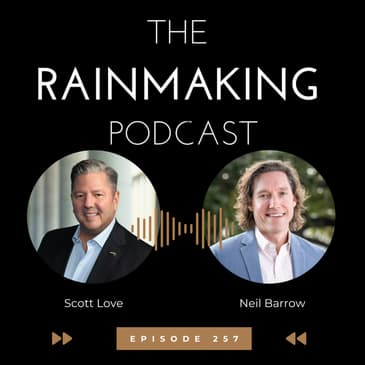
In this episode of The Rainmaking Podcast, host Scott Love speaks with Neil Barrow, a business development consultant for professional services firms, about how partners can generate more revenue through laser-focused relationship-building. Neil challenges the common notion that business development requires chasing every shiny new tool or tactic. Instead, he emphasizes the power of deepening relationships with a select group of key clients and referral sources. He introduces a practical “tiering” system to segment clients based on relationship strength and strategic value—encouraging professionals to identify their top 15–20 clients and focus on creating intentional, value-based conversations with them.
Neil also discusses how to apply the same tiering strategy to referral sources by identifying where past business came from and nurturing those relationships systematically. He walks listeners through actionable steps, including reviewing your book of business, categorizing contacts by relationship level (friend, collegial, professional), and scheduling consistent outreach. With insights on mindset, time management, and long-term strategy, this episode is a roadmap for professionals looking to grow their book of business through clarity, structure, and focus.
Visit: https://therainmakingpodcast.com/
YouTube: https://youtu.be/u0bi7AIL-A4
---------------------------------------
🎧 Enjoying this episode? Take your recruiting game to the next level with The Scott Love Recruiting System — on-demand video training for recruiters who want real-world strategies that actually work.👉 Get full access at: https://bit.ly/45y7qD1
----------------------------------------
This show is sponsored by Leopard Solutions Legal Intelligence Suite of products, Firmscape, and Leopard BI. Push ahead of the pack with the power of Leopard. For a free demo, visit this link:https://www.leopardsolutions.com/index.php/request-a-demo/
----------------------------------------
Neil Barrow is the founder of EnabledBD, helping professional services firms get BD cooking and UndergroundBD, an online community for business development professionals looking for clarity and community.
He’s a software sales guy that was (fortunately) talked into working in public accounting, leading origination efforts at 2 different firms for over 8 years. Since then, he’s worked with dozens of firms to build or enhance their business development function (spoiler: BD is not a soft skill). More importantly, he is a Certified Cicerone (beer sommelier) and loves connecting with friends and strangers to chat about business development and/or best beers to try. Most importantly, he lives in Fort Worth with his wife of over a decade and a kiddo who is dominating kindergarten.
Links:
Learn more about your ad choices. Visit megaphone.fm/adchoices
[00:00:10] You're listening to The Rainmaking Podcast, hosted by high-stakes headhunter, author, and professional speaker, Scott Love. You're listening to The Rainmaking Podcast, and my name is Scott Love. Thank you for joining me on the show. Have you ever been frustrated because you just don't seem to be getting anywhere in your client development efforts?
[00:00:34] Well, some of that might come from a lack of focus. We're going to talk about that today, and I think you're going to get some really interesting insights and action steps in my conversation with Neil Barrow. Our topic title is Laser Focus for Strong Business Development. Neil Barrow is a consultant who specializes in business development for professional services firms.
[00:00:55] Neil has a fresh perspective on concepts and things that you've probably already learned, but can bring those to you with a whole new way of looking at them in action steps that make a lot of sense. Neil Barrow is a great pleasure, and I think you're going to like the conversation that we have today. Make sure you connect with Neil directly on the show notes. You can go there and connect with him on LinkedIn. We also have his website where he's got information about his services. Like I said, you're going to get some solid ideas in my conversation with Neil Barrow today.
[00:01:25] As always, this show is sponsored by Leopard Solutions, Legal Intelligence Suite of Products, Firmscape, and Leopard BI. Push ahead of the pack with the power of Leopard. And now here's my conversation with our guest, Neil Barrow. Thanks for listening. Hey, this is Scott Love with the Rainmaking Podcast. Our guest today is Neil Barrow, and we're talking about laser focus for strong business development. Neil, thanks for joining me on the show today. Thanks, Scott. Appreciate being here.
[00:01:54] Absolutely right. And I'm excited about our topic, laser focus. I like the way that sounds. And let me ask you this, from a business development perspective, what do you mean when you say laser focus for partners in professional services organizations? Yeah, so good question, right? I think there's a lot of ambiguity and noise around what growth means or what business development actually means.
[00:02:19] We're inundated with tech, tools, AI, automation, outbound, lead gen. Like, there's so many things that we can do and so many shiny objects we can chase. But at its core, we have dozens to hundreds to thousands of relationships within our firms. And they already like us. They already trust us. They already know us. But we don't do a good job about being intentional about how we're generating conversations and adding value to those people.
[00:02:48] And so, I think of it, business development, simply as calling your damn clients. Yeah, right, right. That's what we got to do. So, let me ask you this. You mentioned we're not mindful about keeping in touch and adding value with them. My immediate reaction is some partners are going to say, gosh, you know, they're busy. I'm busy. I don't want to annoy them with, hey, it's me again. When you say adding value and reaching out to them, what does that mean exactly?
[00:03:16] Yeah, so that is another ambiguity around, we hear that phrase a lot, add value, stay in front of your clients. But my job, when I think about it as an advisor, if I truly want to be a trusted advisor to my clients, I can either think of it in a way, well, I do good work. And so, whenever they need something, they know what I do. So, they'll just call me and let me know, right?
[00:03:39] Or I can think about it in a proactive way where I'm thinking about them personally, professionally, and their business, and what some challenges that they might be dealing with. What clients that I might have helped with that are like them and some issues that we helped with. And how do I proactively ping them to say, hey, these are some things that you're probably thinking about. How are you dealing with them? Would you like to chat? Hey, here's something interesting about your industry that I saw. Just wanted to forward it along.
[00:04:08] Let me know if it's helpful. Those are some ideas. That's great. Great. So, should there be – so, the first question I have on this, and I want to talk about the structure with that, and then that actual reach out, where do we go from here? So, how do we structure? How does a busy partner really create a system or process to keep on the phone and talk to and engage people that they already know? What do you think? So, I think about business development from a capacity standpoint. And, you know, you touched on it. Like, hey, we're all busy.
[00:04:38] But, again, if I can say, hey, this is my core relationships that I need to make sure that I'm managing and proactively thinking about on a weekly basis, this is how I'm going to structure it. I'm going to pull my book of business. I'm going to tier out my clients. And I'm going to say these are my most valuable clients. These are the ones that I love working with. These are the industries I like serving. And so, there's some qualities of these clients that make them a top-tier client.
[00:05:07] And then I'm going to think about my relationship with them. I'm going to think of them. Are they a friend? Do I hang out with them outside of the work that I do? Am I collegial with them, which is more, well, we'll catch up outside of the work we do. Maybe they'll come to a firm event. Maybe they'll go to a baseball game with me. But I don't see them more than once a year. And then I'll have professional relationships where I just do the work for them.
[00:05:31] And the reason that's important to really reflect on the relationship strength of my top-tier clients is that will inform me of what type of activities would be a good idea. And so, if I've got a friend and I want to grow those type of companies as my clients, I'm going to ask my friend, hey, where do you go hang out? Where do you see your colleagues at? What conferences do you attend? What is valuable to you? Where do you get your information?
[00:05:59] If it's more of a professional relationship, I'm going to reach out and provide those kind of added value things that we talked about a little bit ago, which is, hey, I thought of your industry. I thought of what you might be dealing with. How are you handling them? And so, I'm going to approach it in more of a professional way. And so, that will help inform on what type of activities might be a good idea for my top-tier clients. I see that. I see. That's great. So, you said tier them out. So, we're basically segmenting them. And can you go over the different categories again?
[00:06:29] Of segments? That's right. Okay. So, when you look at tiering out your clients, partners may or may not have heard of this particular thing, but it's my top-tier clients are what are the most valuable clients to my firm and to me? Which ones do I really like working with? What industries are they in? Are there some commonalities around the industries that I'm serving? Are there commonalities around the size of clients that I'm doing? Is there commonalities in type of matters that I'm originating, right?
[00:06:59] So, the services that I'm providing. So, what might make them a top-tier client? When you look at the rest, that might be if I've got 40 clients, 50 clients, that could be 10. That could be 5, right? It could be a very small number in that top tier. And then when I look at the tier 2 clients, those are ones that have potential. They're in and around my industry or size or type of work that I like to do, but I might not be getting enough of their work.
[00:07:28] And so, is there some opportunities here that I could help kind of build those relationships, thinking about friend, collegial, and professional? That might move them up into tier 1. And then tier 3s are, should I even be, should they even be a client? Is it a family friend? Is it, right? So, should they be a client for me? Or should I really focus on them? But when you distill down that universe, that provides your laser focus. Because I might only have 15 or 20.
[00:07:56] And so, if I can start there as a busy partner, I'm going to be able to generate meaningful conversations that will lead to referrals, that will lead to more work, that will lead to introductions to the people that they like and trust. And so, that will help me expand my network. And so, there's some strategies to go about that, but that's at the base level what we need to do. This is great. I like that. Let me go back over tier 1. And I had some questions about that.
[00:08:22] These are your most valuable clients to your firm and to you professionally and personally. Which ones do you like working with? And then you mentioned other commonalities in industries and the size of those organizations. Why do you think those commonalities are important? What's the reason we need to think that way? Yeah, great question. So, ultimately, I've got to provide myself with focus. And so, if I can see these commonalities, then I know what problems that I solve for them.
[00:08:49] I know what they're probably dealing with because I do a lot of work for those types of clients. So, if I see those commonalities, then I can adjust my messaging about who I work with, who I want to work with. I can be a little bit more focused in some of the conversations internally to get referrals. I can be more focused in the conversations and the identification of my network, of the people that are in my network that refer me, other attorneys at other firms.
[00:09:15] And so, I can be a little bit more clear about exactly who I serve, why I serve them, and what I want. That's great. Do you think this is kind of the beginning of niche development in some ways? This is. You know, large firms probably have a lot of this niche built out, but it might not be related to my book of business. And so, if I can build my personal ideal client, that is going to help me. And how I do that is through my tier one clients.
[00:09:39] So, have you seen people as they're doing this and they take the time and they get the data and they say, I'm just going to carve 60 minutes out and just have a strategy session with myself and put pen on paper or just type it out on a Word document, however you get structured to it. Have you seen people all of a sudden find opportunities that they didn't realize existed just because they're doing this exercise? Every time, right? So, we see either a commonality that helps me with maybe where I want to head with my practice.
[00:10:09] There's some opportunities that I might be seeing where, like, why haven't I talked to them about this particular issue or asked them about this particular thing or followed up with them on something that I should have followed up with them before. So, it's a lot of these things that fall through the cracks because we're so busy and we're not focused on these people that can lead to these new matters originated to these referrals that I need.
[00:10:33] You know, for example, we did this with a self-proclaimed bad business development partner at one of my firms. And what they were able to do, we just focused on their tier one clients and then their tier one referral sources. So, we haven't really got into the referral source tiering out. But when I look at where my best clients came from, who sent them to me? So, internal or external and who is that person?
[00:11:01] Because I guarantee you if you go through that process and think about it, there's going to be people that have sent you really good matters, really good new clients that you haven't talked to in 12 plus months. And so, we went through this exercise. He went and called his best referral source, said, hey, I'd like to take you to lunch. It's been a while since we've caught up. They went to lunch, immediately got a new matter. I'm not saying that will happen, but that's the power of getting focused and then doing this activity.
[00:11:29] Because again, we think business development is going to happy hours to talk to people we don't want to talk to. That's not business development. Business development is generating the conversations that matter. And so, I need to get focused on who those people are that I need to generate conversations with. That's great. I think that really saves a lot of time. People might be saying, gosh, I'm too busy doing this. But in fact, this is something that will save people time. What do you think about that, Neil?
[00:11:55] This is the most efficient way at a foundational level to do business development. Yes, there are layers to that. Expanding your network. Going to conferences. Speaking, right? Right. It's all of those things that you can do when you think about the traditional rainmaker that's going out there and being the face of their practice or the firm or the services they provide.
[00:12:17] But at a base level, everybody can make time to call the people that matter to them and that care about them and that are paying them money. So, we can make time for that if it's that focus. Like imagine if your whole business development plan at a foundational level to then build upon is 20 people. Yeah. Right. How about that? I want to talk more about the referral tiering also because I'm really curious about that.
[00:12:43] But in terms of somebody scheduling this, how often should they do it? How much time should they block out? What should be like a cadence or ritual in terms of doing these sorts of things? What have you seen work best, Neil? So, I'm a practical person. And while there are best practices for this, it's not a best practice if you're not going to do it. Yes. So, let's start with where you're at.
[00:13:09] So, if you do not have BD time on your calendar, put 15 minutes on your calendar to think about one person in your tier one to send an email. Let's take a baby step into this because it's just like going to the gym. So, if I'm not going to the gym, I need to start with what's going to be the easiest for me to get started. Well, I've got to first have a plan. Like what's my goal? What am I doing? And then the second thing is what is the easiest way for me to get started?
[00:13:38] Maybe it's going before I get to the gym. Maybe I'll just start walking for 30 minutes in the morning. So, let's just start there. And then we can build on that. But again, we get overwhelmed with all the things that we could be doing and maybe need to be doing that. We just got to exercise some calmness to reduce the friction and frustration around building the muscle that we need to do. And I can speak for myself. I can speak for my clients.
[00:14:05] But like for myself, what that means is like specifically around LinkedIn. I wanted to get better at LinkedIn. And so, what I committed to doing that was easy for me is the first thing in the morning on a Thursday, posting one post. Once I started exercising that muscle, then the post became a lot easier for me to start writing. And then in a year, now I'm writing every business day and I'm posting every business day because I've exercised the muscle and it became a rhythm and it became easier for me to do. Yeah, that's great.
[00:14:34] I like that a lot, Neil. Now, let's kind of dig back into the tiering system with the referral partners. And how would you define a referral partner? What are examples and how would you tier them out? So, we know this, that most attorneys business comes from other attorneys, comes from colleagues, right? And so, my job is to first identify who has sent me good referrals in the past. So, do I know that? I might know it in my head, but is it down? Do I have a list?
[00:15:04] And then I'm thinking about just like I would with my clients, what are the commonalities between them? Are they at larger firms? Are they solos? Like where is my business? Are they college buddies, right? Did I go to law school with them? Like what are some commonalities between it? And then I start with making sure that those relationships are strong and active and I'm catching up with them and I'm telling them the work they're doing. I'm asking what work they're doing. And we're just making sure that our relationship is there and they know what each other does.
[00:15:34] And then I can start building upon that. Well, hey, if most of my referrals come from solo or small estate planning attorneys, then I need to meet more of those. So, where do they go hang out? So, where are they getting their information? And so, it's just the same thing as I would do with my tier one clients that I'm doing with my referral sources. That's great. And what's an example of somebody you've worked with where you help them do the tiering of their clients and the tiering of their referral sources?
[00:16:03] What was kind of the arc of their trajectory in really building a lot of business development focus doing this? So, the first thing that we start with is always their book of business and the tiering of clients. Because if we can get there and start with some of the activity there, then it becomes a little bit easier to do the referral sources, which could be a little bit more ambiguous and a little bit more daunting for folks. Because that's building my network.
[00:16:28] And so, if I can do that and then around my tier one and really interesting tier two clients, thinking about the external referrals. So, where are they coming from externally? And then that helps inform the start of the building of my referral source list. Yes. You're doing it all based on proof of concept. People that have actually done it. Yes. Yeah, that's good. Yes. Yes.
[00:16:52] So, tell me about somebody that you've coached where they weren't doing this before, you coached them, and you taught them how to do it, and how did it result in new business for them? So, when you think about business development and different types of partners, personalities, and their different willingness to commit to business development, some are at the very front end.
[00:17:14] And so, those are more focused around how do I create some accountability and some structure and some focus to get them comfortable with performing the activities that they need to do to generate these conversations. When I'm talking with someone who's maybe more of a rainmaker, it's more centered around here are the types of companies and organizations that I want to meet. How are we going to get in front of them?
[00:17:40] And so, when you think about their goals, it's really thinking about where you're at on your business development journey. And so, for a rainmaker, we're really talking about how to grow your book. We're talking numbers. When I'm talking with somebody who's just starting out, it's more about getting you comfortable and focused and doing the activity. And so, I will say that all of those are wins.
[00:18:02] If I can get you to commit and do the activity, you're going to see results, which is like I've got one partner that comes to mind who's in real estate litigation. And his book of business year over year has increased like 20% plus because we're focused on clients and referral sources and then one association where you can build your network with those types of people. And that didn't happen in two months.
[00:18:31] That's not a two-month, three-month, four-month process. It happens over the course of 12 to 18 months. And so, we've got to be – that's part of this whole muscle building is we've got to push this kind of snowball down the hill. And once it creates momentum, then we see this consistently over time that you're developing your book. So, you're the personal trainer for attorneys. Yeah. Building their rainmaking. You've got to do that. Yeah. So, what are the pitfalls?
[00:19:00] What have you seen where when people start on this, watch out for that because that's not going to work. What are the pitfalls that they need to be careful of with this? I think number one is you feel like you're not doing enough, but you're going from not doing anything. So, we feel like we need to go from zero to 10 and then see results immediately. And so, exercising that perspective of this is I'm building something for the long term. While I'm going to see some short-term gains, I'm really building this for the long-term consistency.
[00:19:29] So, exercising perspective around patience and that I'm building something here. Number two is biting off more than you can chew. Yeah. Is you have capacity constraints. You're busy. You've got personal life. You've got family maybe, right? So, like you've got all these things going on. It's what can I do practically to start generating the conversations that matter within this group of people? And I know that's going to pay off.
[00:19:56] I think another one is ignoring the internal piece. What's the problem is we think business development is all external. Well, if we look at where our best clients have come from, a lot of them are coming from internal referrals. Yeah. And so, how am I building my brand and my relationships with the right partners internally to make sure that we are exchanging services as well? That's great. And I like how you say it, your brand internally.
[00:20:25] Maybe, I don't think a lot of people really think of that. You've got a brand, not just client-facing to the industry that you're serving, but also internally. Is that correct, Neil? Yeah. No, absolutely. And we see that time and time again where a lot of partners are technical partners. And so, the majority of their opportunities and new clients and matters come from internal referrals. And so, I've got to make sure that I'm building the right relationships with them to make sure that I can help their clients.
[00:20:53] And so, because we get so wrapped up in this cross-selling phrase, right? Every firm is trying to figure out how to cross-sell. And it's building strong relationships and understanding what you do at a base level. I've worked with tons of firms all across professional services. And one of the exercises we typically have to do is get up in front of the partner group and share with what your ideal client is and what you do for them. Like, that's the base level that we're dealing with.
[00:21:23] And so, a lot of the things that I'm talking about might feel simple, but these are the foundational elements of business development that then we can build upon. But until we have that foundation, it's really tough to do. That's great, Neil. I mean, we're pretty much running out of time here on the show. I want to have you back on in the future to talk about other aspects related to this. But for now, somebody that's listening to this that says, this is great, but how do I wrap my arms around it? If you could set it up, three action steps people can take to implement these ideas.
[00:21:53] What are those three action steps, Neil? Well, you're booking business and have billings, realization, whatever that looks like as a metric, industry, add-in referral source. So, those really, and services that you provide, right? So, thinking about this and then viewing those client groups through a relationship lens. Like, how strong are my relationships with this? And then tiering them out. So, it really starts with your book of business.
[00:22:21] Then the second thing that I would do is thinking about the referral sources where those tier one clients came from. So, start a list of your best referral sources based on your tier ones, and you can add more if you have great relationships that you want to nurture that come to mind. But simplistically, it's where do your best clients come from? And so, now I've got a plan or I've got at least a list of people to build some activity plans around.
[00:22:47] And then the third thing is commit to putting time on your calendar to call them, to send them an email, to send them the article, to tell them you're thinking about them. What else could you help with? Those types of things. Because we're trying to do at the firm level when we think about a business development function, we're trying to solve for four things. New logo growth, client retention, cross-selling, and we've got to develop our professionals.
[00:23:16] And so, if you're doing this, it solves all four. That's great, Neil. Well, tell us about your offerings. What do you have? What do you do that you'd like our listeners to know about? Yeah. So, this is what I help firms think about as a structure for their firm. I don't coach one-on-one unless it's part of an engagement.
[00:23:37] But I come in and help them think about how can we support and enable all of our partners and our up-and-coming associates to think through these structures and to have themselves a personal plan. And then how do we, as a marketing or business development department, or even just leadership, support them and hold them accountable to doing what they know they need to do? Yeah.
[00:24:01] And so, I have a, my first offering is a business development sprint, which is a half-day whiteboard session where we iron all this out and get you a plan to go execute. That's great. I think I want to learn more about the accountability part of it because that's just really interesting to me. You know? Yeah. But, I mean, we're running out of time here, so maybe next time you come on the show, we can talk about how law firms, maybe not necessarily the leadership, but how partners can hold each other accountable by working as a peer group doing that. Yes. Peer groups. Yeah. Very strong.
[00:24:32] You hit it right there. That'll be the topic of our next presentation with Neil, ladies and gentlemen. Look for that in a few months. And Neil, thanks for sharing your wisdom with us today. And like I said, I'm looking forward to having you back on the show. Thanks, Scott. Appreciate you. Thank you for listening to The Rainmaking Podcast. For more information about our recruiting services for international law firms, visit our website at attorneysearchgroup.com.
[00:25:00] To inquire about having Scott speak at your next convention, conference, sales meeting, or executive retreat, visit therainmakingpodcast.com.