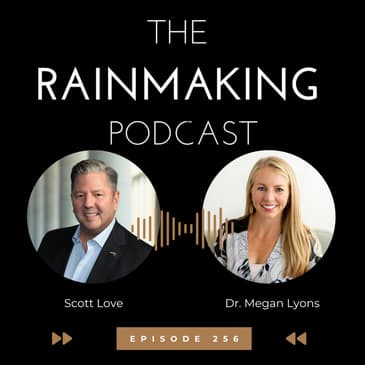
In this episode of The Rainmaking Podcast, host Scott Love speaks with Dr. Megan Lyons—Harvard grad, former consultant, and board-certified clinical nutritionist—about how high-performing professionals can optimize their health without sacrificing productivity. Dr. Lyons shares that the goal isn’t perfection, but performance with minimal health compromise. She identifies common obstacles faced by rainmakers, including adrenal dysregulation, poor nutrition habits, and the misconception that prioritizing health equals losing your edge. Using relatable examples, she explains how small changes—like eating 20–30 grams of protein at breakfast and avoiding “naked carbs”—can create immediate improvements in energy, focus, and long-term well-being.
Dr. Lyons provides tactical recommendations tailored for professionals under pressure: building nutrient-dense meals using her VVFP model (veggie, veggie, fat, protein), managing caffeine and sugar intake strategically, and planning meals like a crustless quiche to save time and boost nutrition. She also emphasizes the importance of short breaks, mindful eating, and limiting alcohol consumption without sacrificing the ritual of winding down. Whether you're aiming to avoid burnout or optimize your daily routine, this episode offers a science-backed, approachable strategy for achieving sustainable high performance through better health habits.
Visit: https://therainmakingpodcast.com/
YouTube: https://youtu.be/jSVh2QMPovY
---------------------------------------
🎧 Enjoying this episode? Take your recruiting game to the next level with The Scott Love Recruiting System — on-demand video training for recruiters who want real-world strategies that actually work.👉 Get full access at: https://bit.ly/45y7qD1
----------------------------------------
This show is sponsored by Leopard Solutions Legal Intelligence Suite of products, Firmscape, and Leopard BI. Push ahead of the pack with the power of Leopard. For a free demo, visit this link:https://www.leopardsolutions.com/index.php/request-a-demo/
----------------------------------------
Megan Lyons is a sought-after health & wellness expert who is deeply passionate about inspiring others to feel their healthiest and happiest. Megan is a Harvard graduate, MBA, and former management consultant who left the business world to follow her passion for wellness by opening The Lyons’ Share Wellness in 2014. Since then, she’s earned a Master's degree in Holistic Nutrition, and become Double Board Certified in Holistic Nutrition and Clinical Nutrition, and a Doctorate of Clinical Nutrition, and has amassed over 10,000 hours of 1-to-1 nutrition consulting with clients internationally. Megan runs a top podcast on health and wellness, “Wellness Your Way with Megan Lyons.” Her Revitalize Health Accelerator is a community of health-minded individuals looking to continuously uplevel their health and wellness.
Links:
Links: Dr. Megan Lyons Website: https://www.thelyonsshare.org/The Revitalize Health Accelerator: https://www.thelyonsshare.org/revitalize/
Podcast: https://www.thelyonsshare.org/wellness-your-way-podcast/
Instagram: https://www.instagram.com/thelyonsshare/
Facebook: https://www.facebook.com/TheLyonsShareWellness/
LinkedIn: https://www.linkedin.com/in/meganoharelyons
Learn more about your ad choices. Visit megaphone.fm/adchoices
[00:00:10] You're listening to The Rainmaking Podcast, hosted by high stakes headhunter, author, and professional speaker, Scott Love.
[00:00:23] You're listening to The Rainmaking Podcast, and my name is Scott Love. Thanks for joining me on the show. I'm really excited that you're here today because we've got a special treat, because you're probably somebody that is feeling a lot of stress all the time. You have to perform at a high level. You're a high performing achiever and a rainmaker, and you can't let anybody down.
[00:00:41] But you don't want to let yourself down in terms of how you manage your health. Don't make that be the last thing that you think about. I'm going to give you some tactical ideas here on how you can make your health a priority in my conversation with Dr. Megan Lyons. Our topic for today is high performance with good health habits. Now listen to Megan's background. I think you're going to be impressed. Megan is a sought after health and wellness expert who's deeply passionate about inspiring others to feel their healthiest and happiest.
[00:01:11] She's a Harvard grad, an MBA, a former management consultant who left the business world to follow her passion for wellness. Since then, she's earned a master's degree in holistic nutrition and become double board certified in holistic nutrition and clinical nutrition, and holds a doctorate of clinical nutrition.
[00:01:28] She's amassed over 10,000 hours of one-to-one nutrition consulting with clients internationally. Make sure you check out her top podcast on health and wellness called Wellness Your Way with Megan Lyons. Make sure you check the show notes so you can connect with her directly and find her podcast.
[00:01:47] As always, this show is sponsored by Leopard Solutions, Legal Intelligence Suite of Products, Firmscape, and Leopard BI. Push ahead of the pack with the power of leopard. And now here's my conversation with Dr. Megan Lyons. Thanks for listening. Hey, this is Scott Love with the Rainmaking Podcast. Our guest today is Dr. Megan Lyons, and our topic is high performance with good health habits. Megan, thanks for joining me on the show today.
[00:02:15] Thank you so much, Scott. I'm excited to be here. Me too. And I'm really excited about your niche in dealing with people that perform at a high level. Because as you know, people in partners and professional services firms, they're stressed out. There's a high degree or high percentage of substance abuse, all sorts of unhealthy things that happen when you're working that many hours and having to do so at a sustained level. And so let's kind of start with the goal.
[00:02:39] What do you think a goal should be for someone that's a high performer in a professional services firm in terms of their whole physical health? Well, anyone listening is that Rainmaker, is that high performer already. And so for someone to talk about nutrition and health, they probably think I'm going to say, We'll do eight hours of yoga per day and like meditate for three hours a day and all of that. And that's amazing for some people.
[00:03:06] But for your audience, I would say the goal is to perform as highly as possible while compromising your health as little as possible. Because we can burn, burn, burn, burn, burn ourselves into the ground. And then we have that crash, that diagnosis, that something. And no one wants that. But we want to keep the gas on without burning ourselves out. Yeah, that's right. And what do you think stands in the way from people that are performing at that level?
[00:03:34] What are those impediments that keep them from having a good, healthy life? I think there's a little bit of fear. And I'll definitely say I had this fear slash still manage this fear that if they let down at all, if they take care of their health, that means they're soft or they're taking their eye off the prize or they're going to lose their edge or something like that.
[00:03:59] And if given the choice between go, go, go or soft, they're going to choose go, go, go. So I definitely see that fear. I also see in high performers, people tend to gaslight themselves and say, oh, yeah, I've had brain fog this year, but it's fine. I can't sleep this year, but it's fine. I have diarrhea four times a day, but it's fine. And these things are not fine, but we brush it under the rug until it truly becomes an issue. Yeah, that's right. Why do you think they do that?
[00:04:29] Well, it takes work to slow down. It takes time to slow down and investigate. Oh, gosh, now I have to really unpack my sleep issue. So that sounds like a challenge. And I already have enough challenges on my plate. I'd rather just not deal with it. They're not comfortable. They're not ignoring the symptoms. They're just thinking, eh, don't have time to deal with it right now. And what happens then? What happens if nothing is fixed? What have you seen with people that you've worked with? A lot.
[00:04:58] The most common is what's called adrenal dysregulation, or people these days on social media have heard of cortisol. And cortisol is being very demonized. Cortisol is the stress hormone. The truth is, without cortisol, we would die. So it's not evil. But when our cortisol gets high and gets stuck in that high position, we're go, go, go. We're fight or flight constantly. Then all of our other hormones are impacted. So this turns into low libido.
[00:05:25] It turns into menstrual irregularities. It turns into prediabetes and type 2 diabetes and insulin resistance and fatty liver. All of these are governed by hormones. And hormones work in conjunction with each other. So the stress hormone cortisol has a direct impact in all of these other health conditions. So how do we manage that? Where should we be focusing our time and our attention in this? Is it, I know all health is diet, rest, and exercise.
[00:05:54] Is one more important than the other? Where do we go from here, Megan? Well, what's that quote about? To a hammer, everything looks like a nail or something like that. Most of my education is in nutrition. So I'm going to start there. And I will acknowledge that those other pillars you said are extremely important. I start with people balancing their blood sugar because most of the high achievers I know, they're, or at least the ones who come to me,
[00:06:21] they're riding through the morning on coffee. Maybe they grab a handful of M&Ms, but they're not really having a nourishing meal. And then maybe they go home, hopefully, and have a dinner with their family or friends or roommate or something. But throughout that whole day, when we monitor their blood sugar, it's crazy. They're riding that roller coaster. That leads directly to not only the health conditions we mentioned, but more relevant for people listening, the brain fog, the cravings, that extra belly fat
[00:06:51] that hasn't been there for the past 10 years and just popped up. All of this stuff can go away when we start managing blood sugar. So let me kind of go deeper into the blood sugar. What is that? How do you define that? And I'm going to assume that, I mean, I couldn't give a definition of it if anybody asked. But what is that? And why should that matter to us? Yes. So when we eat any kind of carbohydrates, whether that's a jelly bean or an apple or broccoli, all of those are carbohydrates.
[00:07:20] Our body digests them. A carbohydrate's a long chain of sugar. Our body digests them into short little molecules of sugar. That sugar is floating around in the bloodstream. And a hormone called insulin, I think of insulin like a Pac-Man. The insulin just grabs the sugar and shuttles it into the cell. And when the sugar goes into the cell, we use it for energy. That's good. I can't move my arm without a little bit of sugar. Our brain also runs on a lot of glucose.
[00:07:50] So sugar in the cell is fine. But when the sugar is floating around in the bloodstream, that's not so good. That can lead to all kinds of long-term conditions that we don't want to deal with. Now, why would the sugar be floating around in the bloodstream and not going into the cells? There are two main reasons. One is we're eating too many carbohydrates that are imbalanced. So I am not keto, paleo, South Beach, any dietary strategy.
[00:08:17] But the fact is that the average American is consuming too many refined carbohydrates and sugars. And then two is we get insulin resistance. So that Pac-Man just floats on by the sugar and doesn't pick it up and put it into the cell. And this is a precursor for things people have heard of like fatty liver, non-alcoholic fatty liver disease, type 2 diabetes, etc. So that blood sugar is just the carbohydrates that have been broken down that haven't been able to get into the cell.
[00:08:46] Got it. Okay, good. So no more pork rinds or potato chips is what you're saying. I'm going to surprise you here. I will not say the pork rind and potato chip diet is the healthiest diet ever. But pork rinds, for example, that's protein and fat. So we really don't get a lot of carbohydrates from pork rinds. The culprits here are the crackers, the muffins, the bagels, the candies, the frappuccinos. All of that kind of stuff are directly leading to the blood sugar imbalance. I see. I see.
[00:09:16] So is there any sort of way or any sort of recipe that we should look at or guide in general in terms of what we put in our mouths? What do you recommend in that regard? Yes. A couple of quick action steps. I'm going to recommend everyone listening have 20 to 30 grams of protein the first time they eat. So I consider the first time they eat breakfast, break the fast. Now everyone's going to get their panties up in a wad saying,
[00:09:46] well, I don't want to eat at 6 a.m. or intermittent fasting is great or whatever. The first time you eat in the day is breakfast. So whether that's 6 a.m. or 1 p.m. or whatever time, it's breakfast. And if we get 20 to 30 grams of protein at that time, our blood sugar is automatically more stable throughout the day. So for people who really just don't like to eat, that could be collagen in your coffee. For someone else, that could be like three eggs.
[00:10:13] It could be some breakfast sausage, some Greek yogurt if you handle dairy, a nice smoothie with some protein powder. It's not, unfortunately, the Pop-Tarts and bagels and pancakes that are our traditional breakfast. But just by making that one change, people feel noticeably better. And then the second action step I would say is no naked carbohydrates. So a naked carbohydrate is a carbohydrate that's not paired with protein, fat, or fiber.
[00:10:41] So I've used jelly beans as an example a few times. If I have a handful of jelly beans, my blood sugar skyrockets. If instead I have a hard-boiled egg and then the handful of jelly beans, which I know is a weird combination, but let's just go with it, my blood sugar is going to be like a hill instead of a mountain. And that's much better. When I pair those carbohydrates with protein, fat, or fiber, everything gets better.
[00:11:05] So two action steps there, 20 to 30 grams of protein with breakfast, whatever that means to you, and no naked carbs. That's great. So what are some of the breakfast options then? You mentioned three eggs could be one. What about oatmeal? What do you think about that? Like steel-cut oatmeal, what do you think? I think steel-cut oatmeal has amazing fiber, which is great for our LDL and our lipid panel. It's good for digestion. It's not great on its own for blood sugar.
[00:11:33] So if someone wants to eat oatmeal, which is great, let's add in some protein powder. Let's have a smoothie on the side. Let's add some chia seeds or almonds or walnuts or something to add some protein and fiber to it and not just have the plain oatmeal. Got it. Great. Good, good. And so should we regulate what we eat throughout the day? What do you think about that? Yes. And most of the high achievers that come to me, they're just munching.
[00:12:00] In fact, many of them will say, I'm gaining weight and I'm not even eating very much. Like I'm eating like a bird, but what are those munches? They're the pork rinds that you mentioned or the chips or whatever is around the office. And when we look, they're actually malnourished. They're not undercaloried, so they're not starving, but they don't have the nourishment, the true nutrition coming in. And so we really need to focus on those micronutrients.
[00:12:26] Those are all the vitamins and minerals, means vegetables, fruits. And already people I know are rolling their eyes. They're saying, I'm an attorney or I'm in this professional service. I don't have time to eat vegetables. But there are absolutely ways that we can do that. For example, since we talked about breakfast, I make breakfast one time per week. For me, it's on a Sunday. It could be any time else. And my most common breakfast is what I call a crustless quiche. So I'll get even like frozen vegetables.
[00:12:55] It doesn't have to be fancy. I'll put them in a casserole dish. I'll crack some eggs in there. If I'm feeling fancy, maybe I'll do ground turkey, some herbs, something like that. But otherwise, it's just vegetables and eggs, bake that. And then I just cut off a slice in the morning. That's super easy. There are tricks like that that we can use to get in those micronutrients. Any restaurant in the U.S. has that. In fact, there's one restaurant in the U.S., Whole Hog Cafe in Bentonville, Arkansas, that I've been to that had no vegetables.
[00:13:24] But every other restaurant has a vegetable. We just have to order that stuff. So it's prioritizing those little things that matter. So is this then a quiche that you're making that you eat breakfast throughout the week? Is that right? Yes, that's right. Wow, I never thought about that. I mean, so you can make your quiche Sundays and that's your breakfast rest. We just keep it in the fridge. That's right. Eat it cold or warm with quiche? I mean, let's be honest. I eat it cold about half the time just because of time.
[00:13:54] I'm not prioritizing that time to heat it up. And I think it's delicious cold, but it's even better, in my opinion, warm. So if you could take those extra couple of minutes, warm it up. That's great. So you're getting your vegetables with that first thing in the morning with your proteins. And then what about eating fruit with breakfast, like eating strawberries or grapes or blueberries or blackberries? What do you think about that? A lot of raspberries. Berries especially are some of the healthiest foods in the world. Very anti-inflammatory.
[00:14:22] Great for blood pressure. I find a lot of my high achieving clients have high blood pressure too. So berries are great there. They are another carbohydrate. So when you went back to oatmeal and berries, those are two amazing foods. They're both carbs. So we still need some protein or fat to balance that out. But if someone wants like a yogurt parfait with berries, or they want berries on the side of the crustless quiche, or anything like that, I'm a big fan of berries. That's great. Wow. This is really good.
[00:14:52] So we've had our breakfast. We're on our way to work. We're getting calls. We get to work. We're doing deals, whatever type of work we do. And what about coffee? Is that good? Is it bad? How many cups should we have? Should we switch to tea? What do you think about that? Coffee has so many health benefits. So hopefully, yes, now I get people to love me. I was waiting for it. There's a but though. I find many people are fine with their one or two cups of coffee,
[00:15:22] lots of health benefits. Many people have eased that up gradually to where they're now drinking eight to 10 cups of coffee per day. And if you're doing that regularly, that's a sign alone of adrenal dysregulation. That cortisol overdrive that we mentioned. So the fact that you're able to even function with 10 cups of coffee in your system tells us your adrenal system is off. In my perfect world,
[00:15:47] most people would hang out around 300 milligrams of caffeine or less per day. A normal cup of coffee is 85 to 100 milligrams of coffee. So all sources in, that's three cups of coffee. Now, I hate this next part that I'm going to say, but it's just true. So here we go. Unfortunately, women with hormonal fluctuations tend to do worse with coffee on an empty stomach. So if there are women listening in those perimenopausal years
[00:16:17] or they know they have thyroid imbalance, I'm going to say for you, coffee only after food. Have your breakfast, then coffee. But coffee is still for closers, right? Yes, there we go. Okay, good. I would be a liar if I said I don't drink coffee every day. So I just do it in moderation and I'm very happy with it. So what about tea? Is tea better than coffee? Worse? What do you think? Tea has a ton of health benefits.
[00:16:45] Now, coffee has lots of antioxidants. Those are anti-inflammatory. And so does tea. They're different antioxidants. There are herbal teas and caffeinated teas. So if you're drinking caffeinated tea, that goes in your same bucket of 300 milligrams. If you're drinking herbal tea, honestly, I think you can drink it all day. Just go for it. That's great. And then so we're getting into lunch. Yes. And what should we do about lunch? Should we have to eat lunch every day? Can we just eat a banana while we're working? Should we rest?
[00:17:14] I mean, what do you think we should do over lunch? Remember when I just won over the followers by saying they can have coffee? I'm going to get some eggs thrown at me with this next one. But I promise I've seen lots of high achievers implement this. If we can get away from our computer for five minutes in the middle of the day, it makes a noticeable difference. So my preferred option would be take your lunch outside, go eat there, even if it's five, 10 minutes, and don't look at your phone.
[00:17:44] Just eat with a friend by yourself, read a book, and then go back in. Maybe bonus points. You take a lap around your building. But a real break is very important. There is plenty of research to show that people who take small breaks periodically actually get more done. So it's not like you're losing those 10 minutes. You gain more time power by taking that break. Yeah, that's good. That's good. So in what type of lunch should we have? Should we have salads? Should we have soup? Sandwiches?
[00:18:14] What do you think? I like a lunch called VVFP. Now, we can think of that acronym as very, very filling plate or veggie, veggie fat protein. So veggie, veggie fat protein means two fist-sized servings of vegetables. That could come in the form of a salad, of a stir fry, of a soup. There are many different, of two sides of roasted vegetables, whatever. F for fat is at least a thumb size of healthy fat.
[00:18:42] That's olive oil, avocado, nuts, seeds, something like that. And then P, at least a palm size of protein, which is meat if people eat it, or beans, or dairy if they tolerate it, or tofu, or whatever else. So that's the foundation. Then you can add from there. As long as you get your VVFP, you can add what you want after that. That's great. Veggie, veggie fat protein. Two fist-sized servings of veggies, a thumb size of fat, of healthy fat,
[00:19:11] nuts, seeds, olive oil, and a palm size of a protein. That's great. You got it. Yeah, that's really good. And should we cut out the carbs? What if we have a sandwich with the bread? Where does that fit into all this? So I don't like to demonize carbohydrates because carbohydrates are awesome. Broccoli is a carb. I love broccoli. Apple's a carb. I love apples. For the refined carbohydrates, which are the breads, pastas, things like that,
[00:19:36] I think we use them to the extent that we're active during the day. So does a marathoner or an Ironman need tons of those carbohydrates? Yes. Does a person who's sedentary and hasn't exercised in 10 years need those? The answer is biologically no. There's no need. But I also don't think we need to act like robots, so you don't have to live in this perfect health bubble. I would just say if you are more on that sedentary side, moderate those.
[00:20:03] Go for one or two servings per day, meaning you don't have them with every meal. And then as you get more active, you can increase those grains, refined carbs, etc. Okay, great. And then so take us into the dinner. I mean, can you give your opinion on all of the health benefits of wine and gin? Or should we stay away from that? What do you think? You know, I've actually unpacked this in the research a lot.
[00:20:27] And there are many studies that show that those who drink one to two glasses of alcohol per night have some longevity benefit. So people may have heard of the blue zones, which are those areas of the world with the highest proportion of centenarians. And many of them do drink alcohol. And then there are tons of studies showing the detriment of alcohol, not just for your liver, but for diseases like cancer, etc.
[00:20:53] So the way I parse out the research is the benefit is that relaxation, that time with your community, that time with family, that time unwinding. The alcohol itself, I truly do not think is a benefit. I also don't think everyone needs to abstain completely unless that's more mentally healthy for them. Then of course, I would recommend that. But moderation is the key here. Just like with coffee, it's a slippery slope. And when I ask my clients, oh, are you drinking alcohol? Oh, not that much.
[00:21:24] Okay, will you tally your glasses this week for me? And then they come back and it's 24. That's too much for the average person. So I think extreme moderation here. The most important thing is that wind down ritual. So there are lots of cool craft mocktails these days. I have no relationship with any of these companies, but like Recess, Kawa, Lilo, all of these are
[00:21:49] companies that are making low sugar, non-alcoholic relaxation beverages. If we can try to get some of those at first and reduce the number of days we're drinking alcohol, but still keep that moment to connect with your family and wind down, I think we're winning. That's great. And then anything we should keep in mind about food portions or the type of foods that we have at dinnertime? It depends on how close to bedtime you're eating dinner.
[00:22:16] So I know most people listening have very full schedules and they've probably heard don't eat three hours before bed. If you can do that, that's amazing. But I know many people that just doesn't work into their schedule. So if you are eating close before bed, I would lower the fat content, meaning you don't want to have fried chicken and french fries or pasta alfredo or something like that right before bed. That can contribute to acid reflux.
[00:22:42] And then your digestive system has to really be in overdrive when you should be resting. So be aware of that spacing. And then unfortunately, the worst time of day to have sugar is at night. Now, if you give me, I love chocolate. I have chocolate almost every single day. But if you give me a square of chocolate at 9 a.m., I'm going to be like, great. Thank you, Scott. That chocolate was wonderful. And move on. If you give me a square of chocolate at 9 p.m., I'm going to want 25 more squares of chocolate.
[00:23:09] Our body is just more insulin resistant at night. So we do want to moderate sugar and hopefully choose some lower sugar options for our dessert, especially at night. This is great, Megan. So this is a really good, I think it's a good start to our conversation. And I'd love to have you back on the show and talk about other high performance aspects of health for those people listening to the show. But if you could summarize three action steps we can take to get started with our health
[00:23:38] with regards to what we eat, what would those three action steps be? I love doing this. And I think we could do six, but I'm going to do three since you asked. Okay, good. See, you're a high achiever. You want to give us three extra ones. So that's right. Great. I do. But no, I am also a rule follower. So here we are. Number one is going to be 20 to 30 grams of protein with the first time you eat. So whatever your breakfast is, get those 20 to 30 grams of protein.
[00:24:05] Number two is have that VVFP for lunch. And this is a bonus in the same number to take a break at least five minutes. So VVFP with a break is number two. And then number three, focus on those micronutrients however you can. So those are vitamins and minerals from vegetables and fruits. The more vegetables and fruits you can get, the better. That's great. Well, Megan, tell us about your business and your offerings. What do you have?
[00:24:34] What do you do that you'd like our listeners to know about? Yeah. So we have a small practice at the Lion's Share Wellness. We're all functional nutritionists. I started the company in 2014. And truly, it was just what do I want to do next with my life after management consulting? But it has grown into my absolute passion. We've seen many thousands of people, most of whom are high achievers, just like the audience listening. We do one-to-one functional nutrition consulting. So you'll see us.
[00:25:03] We'll do detailed lab work if that is the path that you choose. And then we'll help you reach your goals, whatever those are. If it's weight loss, if it's balancing your thyroid, if it's fertility, if it is anything else related to functional medicine and nutrition, we've got you covered. That's great. Well, Megan, thank you for being here on the show. I know you're the perfect fit for our audience because these are high achievers that want to grow and be a high achiever in their personal lives as well.
[00:25:30] So thank you for being here today and for giving us all of this great wisdom, Megan. Thank you, Scott. I had fun. Thank you for listening to The Rainmaking Podcast. For more information about our recruiting services for international law firms, visit our website at attorneysearchgroup.com. To inquire about having Scott speak at your next convention, conference, sales meeting,
[00:25:57] or executive retreat, visit theraanmakingpodcast.com.