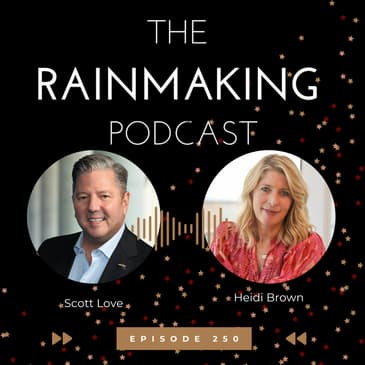
In this milestone 250th episode, Scott Love welcomes back Professor Heidi Brown for a candid conversation on the theme of reinvention. Heidi shares her personal journey of navigating multiple career shifts—from practicing attorney to academic and author—and how those transitions required introspection, courage, and authenticity. Drawing from her experiences as an introvert in extrovert-dominated spaces, Heidi explains how embracing her true self became the catalyst for her success as a rainmaker and thought leader.The episode covers practical advice for professionals undergoing change, including how to audit past experiences to identify transferable skills, reframe imposter syndrome, and harness personal energy through self-awareness tools like journaling and character strength assessments. Heidi also introduces her newest book, The Map I Draw, a travel memoir that explores personal growth through adventure. The discussion ends with actionable steps for those seeking to reinvent themselves: reflect, research, and apply a methodical, bite-sized approach to change.
Visit: https://therainmakingpodcast.com/
YouTube: https://youtu.be/UasBk8K2Kok
----------------------------------------
🎧 Enjoying this episode? Take your recruiting game to the next level with The Scott Love Recruiting System — on-demand video training for recruiters who want real-world strategies that actually work.👉 Get full access at: https://bit.ly/45y7qD1
----------------------------------------
This show is sponsored by Leopard Solutions Legal Intelligence Suite of products, Firmscape, and Leopard BI. Push ahead of the pack with the power of Leopard. For a free demo, visit this link:https://www.leopardsolutions.com/index.php/request-a-demo/
----------------------------------------
Professor Heidi K. Brown is Associate Dean for Upper Level Writing at New York Law School. A prolific scholar and author on the art and science of legal writing, she has published four books on predictive and persuasive legal writing and federal litigation, as well as numerous scholarly articles for law journals. She has written three books about well-being and thriving in the legal profession: The Introverted Lawyer: A Seven-Step Journey Toward Authentically Empowered Advocacy, Untangling Fear in Lawyering: A Four-Step Journey Toward Powerful Advocacy, and The Flourishing Lawyer: A Multi-Dimensional Approach to Performance and Well-Being.
Inspired by her own experience untangling fear of public speaking during her litigation career, she is passionate about helping law students and lawyers find their authentic lawyer voices and overcome anxiety about Socratic legal discourse and performance-based lawyering tasks. Professor Brown is a frequent public speaker on the national and international stage on topics of well-being and healthy performance.
Links:
Amazon link to The Map I Draw: The Map I Draw: A Memoir of Travel as a Passport to Self: Brown, Heidi K.: 9798992980707: Amazon.com: Books
www.instagram.com/introvertedlawyer
LinkedIn: https://www.linkedin.com/in/theintrovertedlawyerbook/
New York Law School: Heidi K. Brown - New York Law School
Learn more about your ad choices. Visit megaphone.fm/adchoices
[00:00:10] You're listening to The Rainmaking Podcast, hosted by high-stakes headhunter, author, and professional speaker, Scott Love. You're listening to The Rainmaking Podcast, and my name is Scott Love. Thank you for joining me on the show. You're a rainmaker with a professional services organization, and you're trying to build your practice, and you know that you need to make a change.
[00:00:36] Maybe it's a small shift in what you do. Maybe you need to go into a certain niche and go deeper in that, or maybe something totally different, or maybe you've realized that you've outgrown your platform and you need to find a different one. Either way, you have to reinvent yourself. And that is the topic that we're discussing today. Our topic title is Reinventing Oneself as a Rainmaker. And our special guest is Professor Heidi Brown,
[00:01:02] who is the Associate Dean for Upper Level Writing at New York Law School. Now, you may have heard of Heidi. She's been out there in all the legal media promoting previous books that she has written. One of my favorites is The Introverted Lawyer, and we've had her talk about that book and another one here on the show in the past. And today, she's actually going to be talking about your journey as a rainmaker and how you go through change when you have to reinvent yourself.
[00:01:28] She also has recently written the book and released it called The Map I Draw, A Memoir of Travel as a Passport to Self. I'd recommend that book. I've read it, and I think it'll make a difference for you. And I think our conversation today will make a difference for you as well. As always, this show is sponsored by Leopard Solutions, legal intelligence suite of products, Firmscape, and Leopard BI. Push ahead of the pack with the power of leopard.
[00:01:56] Also, this episode is our 250th episode of the Rainmaking Podcast. Thank you for listening and for being a part of that. What originally started as a post-COVID hobby has turned into a resource that's helped thousands of professionals learn how to earn trust with clients and grow their practices. Thank you for being a part of our journey. And now here's my conversation with our guest, Heidi Brown. Thanks for listening.
[00:02:24] Hey, this is Scott Love with the Rainmaking Podcast. Our special guest today is Heidi Brown, and we're talking about reinventing oneself as a rainmaker. Heidi, it's great to have you back on the show today. Thank you. I'm so happy to be here again. I'm excited to talk to you. Me too. And I always love following you on social media because you've got such great insight with a lot of heart.
[00:02:45] And I think that resonates, especially with high performing professionals in the world of legal, because these are people that like to do big things, but like to serve people and really have that heart. So I think that's a really good combination. And so we're talking about reinventing oneself and kind of give me some structure. What does that mean if an attorney wants to reinvent himself or herself?
[00:03:07] Well, I think, you know, when I got out of law school, we all at that time thought we were going to join one law firm and trudge up the partnership track and make partner and stay there for the rest of our careers. And that didn't happen for me. I sort of went through a lot of turmoil in my personal life. So I took myself off of that track and I moved to New York where I didn't know anybody and had to reinvent myself. And I thought that would be the last time I'd be doing that. But I've actually done that three times with three different firms. Now I'm an academic. I've taught at three different law schools.
[00:03:36] And as you know, from my my social media and those projects I work on, I've reinvented myself as an author as well. And so I think for all of us, we have these points in our lives and in our careers where we get these opportunities. They may seem scary at first, but they're really opportunities to reflect on everything that we've learned in those prior roles. And then sort of re-bundle, repackage those skills and see what we enjoy doing. And then reinvent ourselves as a rainmaker, as a networker, as a business developer.
[00:04:06] Well, this is great. I like the things when you talk about things that we enjoy, things that give us energy. I like that. But you also mentioned it might be kind of scary, but we need to look at that as an opportunity. So what have you seen are the pitfalls or even yourself when you've gone through these changes? What are the biggest pitfalls you think people need to watch out for as they go through some sort of change?
[00:04:28] For me, my experience has been the pitfalls that I've encountered have been listening to too many other people on what how I should act or how I should be as a rainmaker or a networker. You know, from our prior conversations, I'm an introvert. So but my mentors throughout three different law firms and also the law schools have always been extroverts. And so their approach to rainmaking or networking or developing business or cultivating a brand has always been from a very extroverted point of view. But mine is different.
[00:04:58] And so one of the pitfalls I had to sort of wade through was was finally realizing, wait a minute, I have a lot to bring to the table. But through my authentic personality, I think in our sort of American society and in certain industries, professions, there's such an emphasis on being loud or being aggressive. But introverts bring a lot to the table.
[00:05:19] And so I think resisting the urge, one of the pitfalls to your question is resisting the urge to really be like everybody else and instead take some time and reflect on who we are, get to know ourselves maybe for the first time. You know, letting go of past personas and reinventing ourselves. Yeah. So how did you do that? And I like you mentioned that you've got a lot to give, not you, you, but you are a listener. You've got a lot to give when you're making that transition. And you also talk about getting to know yourself.
[00:05:49] How did you do that when you made these significant transitions? How did exactly did you do that, Heidi? Oh, my gosh, it was hard. But I started with with writing. So one of the practices that I do a lot, I kind of needed to just from a mental health standpoint was journaling. So at the time that I was going through my first reinvention, I discovered a book by author Julia Cameron. She wrote The Artist's Way. And one of her practices is she calls them morning pages.
[00:06:14] And so every morning you get up, no matter what, it's non-negotiable, and you write three pages of handwritten, longhand journaling. I joke with people that I talk about this practice with that if this intimidates you, buy the smallest journal you can. But you have to fill three pages, not two, not four. It has to be three. So through that practice, I started discovering myself more and understanding what really, like we were talking about earlier, makes us happy, what inspires us, and also the things that drain energy out of us, etc.
[00:06:43] I joke with my law students that I was mad at Socrates for a solid 20 years for inventing the Socratic method that I unfortunately let intimidate me in law school. But Socrates' mantra or maxim is know thyself. And he didn't act like he knew everything. He went around, you know, the Agora in Athens asking questions so he could get to know other people, help them get to know themselves more, and so he could get to know himself more. So I started doing that.
[00:07:10] I started trying to understand what are the differences between introverts and extroverts. I grapple with a lot of fear, public speaking anxiety, performance anxiety as a lawyer, and I had to really start to study the science of that. Like, my fear, I have a robust blushing response. I think we've talked about that before. So I can't fake it till you make it. Everybody told me my whole life, fake it till you make it. I can't do that. It shows all over my face. I have the worst poker face.
[00:07:36] So instead, I had to kind of start treating myself like an athlete and understanding how our physicality interacts with our cognition as high-performing professionals and how our somatic intelligence, our bodies, interact with our emotions as well. Once I started doing all that, a total game changer for me in terms of how I relate to other people, which then fed into how I created business for myself or landed opportunities, business opportunities for myself.
[00:08:06] I finally stopped faking a different personality and just kind of leaning into being authentic, which sometimes is really vulnerable, and some people don't like that. It can freak some people out. But I've made that my persona now. And it really, really has worked. It took me, you know, I've hit some speed bumps and other pitfalls along the way, but now I really like how that all has kind of come together and helped me figure out my next moves. That's great, Heidi.
[00:08:35] I appreciate you sharing that. Let's say you're coaching somebody. Let's say you're coaching an attorney that says, you know, I've been doing general corporate, some M&A, some corporate regulatory work, but I see this opportunity in a certain niche. Maybe it's getting involved with private equity companies and doing M&A within their portfolio, client organizations. But I just, I feel like I'm an imposter. I feel like I've got that imposter syndrome, but I know I can do it. And they need to reinvent themselves. What advice would you give to that person?
[00:09:05] Like kind of take me through that. If they're going to make that change, what would you recommend to that person? I love this question because when I was, when I left my first law firm and I moved to New York, I needed a job. I had asked my firm to open a New York office and they were like, no, you're a 60-year associate. We're not opening an office for you. So I had to send out 100 resumes and every recruiter was sort of pigeonholing me as a litigator.
[00:09:26] What I realized was that I was actually also a transactional attorney, not by label, but because throughout my practice, I had written a ton of different contracts. I did construction law. I was a construction litigator. That's right. Many times the clients would come and say, hey, we know, you know, you've handled this litigation, but can you write this architect agreement or this engineering agreement or this subcontract or, you know, settlement agreement? So I actually was a transactional attorney.
[00:09:54] Just when people saw my resume, they didn't think I was. So what I would recommend is for people who really do want to enter a new niche, think about every experience that you've had that actually does align with that niche. Even if, you know, on paper or at an initial glance, people might in the industry pigeonhole you into a certain category. You've had those experiences that can parlay, you know, success in that arena. It's just the way that we write about it or package it or talk about it in a truthful manner.
[00:10:23] We don't want to misrepresent anything, but really reflect on the experiences that you've already had that align with that particular mission in a different genre, industry or category. Yeah, and kind of bring those front and center and build off of that. So let's say somebody is going through there. They're thinking about their career, what they've done. It's almost like they're auditing their career to pull out these high-level points that they can put front and center. And then they say, I want to do more of that.
[00:10:53] And they're getting through that imposter syndrome. They're doing their morning pages. They're really getting to know themselves. How do you think they can really develop confidence at that point to really take that to market? Yeah, awesome question. So another technique or tool that I've really leaned into, there's an assessment. So the Values in Action Institute on Character, the VIA, they have this assessment. It's free and confidential, but it's called the viacharacter.org is their website.
[00:11:21] This was also a game changer for me. So basically, 55 scientists got together and they chose 24 character strengths and they situated them within six virtues. And the reason why I'm telling you this is if you take this assessment, it ranks your strengths, your character strengths, because they chose strengths that really tie to our character. And if you take the assessment, it ranks your strengths that we all possess, but we possess them in different orders, different strength levels from one to 24.
[00:11:50] And when you read your top five, they're supposed to be what are called your signature strengths. Here's why this is important. The signature strengths satisfy what these experts call the three E's. They energize, excite, and come easily for you. So your top five energize you, they excite you and come easily for you. So just by way of anecdote, mine are perseverance, zest, creativity, curiosity, and love of learning, which is perfect because now I'm a teacher, right? So I'm curious, I'm creative, I love learning.
[00:12:19] I also persevere, I'm zesty. Right, right. You're a boxer, right? Aren't you a boxer? I've been to like 50 YouTube concerts. I've got a lot of zest. But when I looked at my bottom two strengths, they call them your lower strengths, not your weaknesses, but they're your lower strengths. At the time, at my other law school where I've left that job, I was leading a team of 10 professors. That was 90% of my job was leading a team. Guess what my bottom two strengths are? Leadership and teamwork.
[00:12:48] Which is, I was like, oh my gosh, am I terrible at my job? But then I reflected on the three E's, and it was so true. Like the days that I was creating and in the classroom and designing curricula and co-learning with my students, I was energized, excited, and that comes really easily for me. But leading my team, especially this is kind of as we were entering and living through the pandemic, it sapped all my energy out of me.
[00:13:12] So I find assessments like this for career changes are really helpful for gaining confidence, going back to your question, because we can realize, oh wait, these are the things that I'm really good at or I feel energized by. The awareness of the things that don't energize us are also good. Like I can't avoid leading my team, but I could stack my schedule better.
[00:13:33] So on the days that I had to really focus on sort of the minutiae of different issues that we were having or have a whole bunch of meetings that as an introvert, you know, drain my energy. I could be smarter about how I schedule my life as a professional in order to be able to really thrive and flourish in any new job armed with that awareness. So that's been really a life changer for me.
[00:13:58] And I make all my students, I suggest that all my students do it because it's really helpful to them going into interviews when they can talk concretely about their strengths and not just in sort of a vague manner. These are concrete character strengths that really matter. And what was that organization's name again? The Values Action Institute? It's called the VIA, the Values in Action Institute on Character, but their website is via, V-I-A, character.org. Good. Well, I'm going to put that link for everybody listening on the show notes. Just go to the show notes.
[00:14:27] You'll be able to get that link there. I'll make sure that's on there. And this is really interesting because I've been on similar journeys where recruiting is hyper competitive. In 2021, every lawyer that hated being a lawyer became a legal recruiter. And it was like the pool on the 4th of July. It's just not comfortable. It's so overcrowded. And I'm realizing nobody's calling me back. And so I had to do some soul searching like you talked about. And where am I really energized? Where do I really thrive? What am I good at? And it was dealing with corporate and finance partners.
[00:14:56] I've done placements with IP, litigators, regulatory, all that. But I found that from the range of the finance lawyers that spent too much time in the library to those corporate cowboys, I relate well with those people on the transactional practices. And so I did a beta test. I did some testing, found out what was the response, got a little bit deeper. And then finally worked with one firm really focused on finance on a very close basis. And wow, we've done really well in that.
[00:15:24] And I think that when people make this change, you're making a change, whether it's going into a niche or a big career change. Either way, it's going to add stress. And as you know, any change, if it's positive change, it can still be stressful. I always recommend testing it. Test it first. See what the results are. And then as you get proof of concept, now you can be more committed with that. What do you think about that concept, Heidi? I love that.
[00:15:50] Actually, someone I've been working with lately as I make a new sort of path for my life kind of compared that same scenario that you talked about to like building testing. Like when construction companies build a building, they stress test it for weather. And, you know, I don't know all the technical jargon behind it, but that's kind of what we're doing. We're like testing the structural integrity of our plan or idea before we take it prime time. And I think that's so important.
[00:16:18] And I wanted to kind of come back to the athlete analogy, too. That's why I think for us to treat each other like corporate athletes or lawyer athletes or whatever industry the listeners are in, treat ourselves like athletes or performers who have routines and rituals and systems and processes and people around them, like coaches and nutritionists, et cetera, to help them stress test different techniques and also to build.
[00:16:44] I think it's called prehabilitation where we build muscle around joints that we know are going to be vulnerable because of a stress that we know is going to happen. But we can engage in prehabilitation as well. You know, we all know about rehabilitation, which is looking backward on something that's already happened. But prehabilitation is intentionally building strength around the parts of ourselves that we know are going to encounter stress and vulnerability. That's a smart way to look at it, Heidi.
[00:17:13] So you mentioned other people around us. As somebody who's going through this transition, like I mentioned, whether it's niching in an area or I'm going to a different career or whatever it is, and you're reinventing yourself, how would we segment those people around us? And how do you think we can benefit by having them in our corner as we go through this change? Actually, it's just like, again, athletes and performers. They don't do it alone.
[00:17:36] Even if they're like the most famous rock star, the most famous golfer, the most famous boxer, they do it with people around them. But they have to choose wisely because we've all seen, you know, famous people that don't choose well with the people they have around them and things kind of fall apart. But we can do the same. But I think it also comes back to us knowing ourselves and who we work well with and who we maybe don't, like who can toggle us out of our optimal performance.
[00:18:02] There's this great Russian sports psychologist that has this term, Eyes Off, our individual zone of optimal functioning. And he did these studies on athletes and we're all, every individual is different as to what our zone of optimal functioning is. And I know personally that certain well-meaning mentors and coaches and even my parents, you know, haven't been so conducive to my optimal functioning.
[00:18:26] So I wouldn't choose them now if I'm making a big career change to be part of that sort of inner circle. So I think we really need to be careful. Well, it comes back to us knowing ourselves and being confident enough to express what we need in terms of coaching and mentoring and care and not just saying yes to everybody who offers it. Right. No, that's, I totally agree with that. And the expert you referenced, was he the author of Flow? No, that was, so yes.
[00:18:56] So Dr. Yuri Hannon was the one who coined the phrase Eyes Off, individual zone of optimal functioning. You're thinking of Dr. This is a really long name, Mihaly Csikszentmihalyi. His last name begins with CZ, but he wrote the book Flow. It's very combined. I mean, there's stuff overlaps, but the flow state is definitely something that Dr. Csikszentmihalyi studied with athletes and artists as well. I can hit a flow state in writing, but I can't hit a flow state in public speaking.
[00:19:25] So again, like Dr. Hannon's work, we are all very individual, even when it comes to when we can hit a flow state in our professional lives or in our personal lives. That's great. Well, Heidi, this is really good having you on the show again, talking about this. If we could kind of look at three action steps, maybe somebody is making a decision to make some changes. How could we kind of parse that out into step one, step two, step three? What would you advise to that person? Absolutely.
[00:19:51] I mean, this is what I do anytime I've got like a big challenge or opportunity I want to tackle and conquer. So I think my three steps would be like reflection, again, reflecting on who we are, what's worked well in the past, what hasn't worked, what energizes, excites and comes easily for us. So reflection is first and taking some time to do that, not rushing ahead. Second is research. I mean, for me right now, I'm about to launch a new book. So I'm researching every podcaster out there that focus on the specific niche of my book.
[00:20:20] So research. And then the third step would be coming up with a really methodical plan, but breaking it down into bite-sized pieces. So like every morning, after you do your morning pages, spend a half an hour following through on some methodical steps and then set it aside and go to your regular job. But for me, the reflection, the research and having a methodology has been the way I've approached really any major thing that I have that I'm excited about. But I don't really have anybody to do it for me.
[00:20:50] So, you know, we got to do it ourselves. So reflection, research and methodology. That's great, Heidi. Heidi, thank you for sharing that. And before we go, tell our listeners about what you have in terms of offerings of books and also your latest book. And we'll mention, I'll tell everybody right now, go to the show notes and you'll be able to order that book directly from Heidi directly. Yep. So coming back to our theme of reinvention, my last set of books were really well-being books for law students and lawyers.
[00:21:17] As I mentioned, I've grappled a lot with extreme public speaking anxiety and performance anxiety as a lawyer, even the early years of my professor life as well. So I wrote a book called The Introverted Lawyer, one called Untangling Fear in Lawyering, The Science of Fear. And then my most recent one in that genre was called The Flourishing Lawyer, how we can really treat ourselves like athletes and performers and flourish in the legal profession. And now I'm pivoting big time. I mean, I'm still going to teach law.
[00:21:45] I love my job and I love writing about well-being for lawyers, but I have had this passion project for the last five years. I wanted to write my debut travel memoir. So I wrote this book. It's called The Map I Draw. And the tagline is A Memoir of Travel as a Passport to Self. Basically, it's 10 trips. I do something scary in every trip and I don't die. And I really it's sort of a female empowerment story.
[00:22:13] It's a relationship trauma recovery story. It's it's really all the things that I've learned through my life as a law student who struggled, a lawyer who struggled, a professor and really somebody trying to figure out who I am at this age. I just turned 55 in March. So talk about reinvention. I am I got another, you know, four decades left in the book is this new genre and I'm I'm rainmaking. I'm trying to get myself out there with this book.
[00:22:40] And so I appreciate the opportunity to come on your show and talk about it as well. Thank you, Heidi. I'm excited about promoting this book to all of our listeners. And I'd love to have you back on again in the future. Thank you so much for sharing all this wisdom today, Heidi. Great job. Thank you so much. I appreciate it. Thank you for listening to The Rainmaking Podcast.
[00:23:01] For more information about our recruiting services for international law firms, visit our website at attorneysearchgroup.com. To inquire about having Scott speak at your next convention, conference, sales meeting or executive retreat, visit therainmakingpodcast.com.