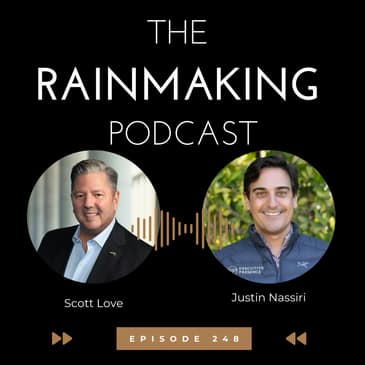
In this episode of The Rainmaking Podcast, host Scott Love speaks with Justin Nassiri, founder of Executive Presence, about how professionals can use LinkedIn as a high-leverage platform for building relationships and generating new business. Drawing from his experience helping executives create authentic, effective content, Justin explains that LinkedIn works best when used consistently to educate, not sell. He emphasizes the importance of optimizing your personal profile over company pages and shares a simple framework for creating posts that resonate: focus on industry insights, leadership stories, company updates, and personal anecdotes that are “dinner-party appropriate.”
Justin also breaks down tactical strategies to improve visibility and connection—such as commenting on the posts of high-visibility users, sending relevant posts directly to prospects, and showing up regularly with value-driven content. He encourages professionals to build a routine around content creation, noting that success comes from iteration, not perfection. Whether you’re new to LinkedIn or looking to elevate your presence, this episode offers a roadmap to position yourself as a trusted authority and rainmaker in your field.
Visit: https://therainmakingpodcast.com/
YouTube: https://youtu.be/4H_Dy8yutqQ
---------------------------------------- 🎧 Enjoying this episode?Take your recruiting game to the next level with The Scott Love Recruiting System — on-demand video training for recruiters who want real-world strategies that actually work.👉 Get full access at: https://bit.ly/45y7qD1
----------------------------------------
This show is sponsored by Leopard Solutions Legal Intelligence Suite of products, Firmscape, and Leopard BI. Push ahead of the pack with the power of Leopard. For a free demo, visit this link:
https://www.leopardsolutions.com/index.php/request-a-demo/
----------------------------------------
With a multi-faceted background, Justin Nassiri brings both vision and energy to Executive Presence. Justin is a serial entrepreneur with 15 years of experience building companies from the ground up. Before Executive Presence, Justin launched multiple successful startups that were eventually acquired.
He holds an MBA from the Stanford Graduate School of Business and a BS in Electrical Engineering from the United States Naval Academy. Justin’s earliest career days were spent at McKinsey & Company working for one of the world’s top business consulting firms.
Justin also served as a Navy officer aboard nuclear submarines, leading large crews on advanced naval missions. After his service, Justin dedicated himself to helping veterans transition into new careers. He built Beyond the Uniform into the #1 military career podcast and wrote Veterans in Consulting to provide guidance and support. Today, Justin is focused on scaling Executive Presence and collaborating with top global CEOs. He also actively contributes to the Forbes Business Council.
Links:
https://executivepresence.io/ebook/ceo-guide-to-linkedin/
https://www.linkedin.com/in/justinnassiri/
Learn more about your ad choices. Visit megaphone.fm/adchoices
[00:00:10] You're listening to The Rainmaking Podcast, hosted by high-stakes headhunter, author, and professional speaker, Scott Love. You're listening to The Rainmaking Podcast, and my name is Scott Love. Thanks for joining me on the show. Have you ever wanted to get more business through LinkedIn? Well, gosh, so many people are on it. Is it really worth it for you to spend time to do that? And does it really take that much time?
[00:00:39] And what do you do to get the most attention from the people that you already know? We're going to talk about that and go pretty deeply in our conversation with Justin Nassiri. His company is called Executive Presence, and our topic today is Rainmaking on LinkedIn. Justin's also a Naval Academy grad. He's been in the business of doing consulting to professional services for quite some time, and he's got a really interesting concept that I think can help you, plus some expert advice that can help you get more business from LinkedIn.
[00:01:09] As always, this show is sponsored by Leopard Solutions, legal intelligence suite of products, Firmscape, and Leopard BI. Push ahead of the pack with the power of Leopard. And now here's my conversation with our guest, Justin Nassiri. Thanks for listening. Hey, this is Scott Love with The Rainmaking Podcast. Our special guest today is Justin Nassiri, and we're talking about rainmaking on LinkedIn. Justin, thanks for joining me on the show.
[00:01:37] Thank you for having me, Scott. Now, I know that you're an expert on LinkedIn. I want to hear some specific ways that you've built your brand, but let me first ask the question of this, and I'll preface it this way. Our listeners are busy people. They're not in sales. They're professionals that do work, but they have to get business. Why should they spend time on LinkedIn? Let me ask that first question. Why should they do it?
[00:02:03] It is the single most efficient way for them to drive client acquisition for them as an individual, regardless of what they do. And it's because two specific reasons. One, they already have a network who knows them, likes them, trusts them, and wants to help them, but they're just not thinking about them.
[00:02:23] And so the first and foremost advantage of LinkedIn is gaining weekly or even better yet, daily relevance with your network who wants to help you. And the second thing is, if they're not currently in your network, every professional on earth is on LinkedIn, whether it's the person who's going to buy your company, invest in your company, become a customer, work for your company. Every single stakeholder is on LinkedIn.
[00:02:48] So it's the single platform where you can raise awareness for yourself and what you're doing. You know, that's really interesting because one of the primary principles and premises of business development is staying as close to you as you can to the warm, that warm network. Instead of a lawyer or somebody else cold calling for business, that's just not as effective, of course, as people that know you, people that already like you and trust you like you said, which is really the hallmark of client development.
[00:03:17] And I like the fact that you bring that front and center. A specific example, you and I both went to the Naval Academy and, you know, I had someone who was a year behind me. I had not spoken to him in legitimately 20 years. I'd not said a word, loved him, just didn't have a chance to talk to him. But he was connected to me on LinkedIn. He saw me posting every single day. Out of the blue, he reached out to me and said, hey, Justin, I understand what you do. My CEO should use you. Let me make an introduction.
[00:03:46] And they became a customer a week later. And I love that story because I would have never thought to reach out to him. I would have never known he was working for my ideal client persona, but he was in my network. He was aware of what I'm doing right now. And he came to me with a deal. That's great. I've seen things like that happen a lot, too. I had a merger deal I did. The founding partner reached out to me. How did you hear about me? Just because of the LinkedIn posting. Yeah. And the time was right. So I think that's one. That's the inbound.
[00:04:14] Let's say that somebody's tried this for a while. I've been posting things. Nobody's calling me. And they're ready to quit. What do you think they're doing wrong? What are the biggest mistakes most professionals make with LinkedIn? It is five things. And I talked just for context. I talked to about 700 professionals a year, and we've helped over 250 of them build a presence on LinkedIn. So the five most common mistakes, first and foremost, they put effort into their company page rather than their personal profile.
[00:04:44] And the thing to understand there is that LinkedIn is human-to-human connection. People are not on LinkedIn to connect with a faceless organization. The second thing is educate, don't sell. And most professionals, when they are on LinkedIn, they're saying, oh, I'm so humbled I was in Forbes. I'm so honored I got this award. Hey, my webinar is coming up. It's all about them. LinkedIn, 80% of your content should be generous. You should be educating.
[00:05:13] You should be teaching and adding value and making people's lives easier, just like Scott's doing on this podcast. He is adding value. That's why you listen to this podcast. Same principle for LinkedIn. Educate, don't sell. Third one is you have to actually be pretty active on LinkedIn to get noticed. So a lot of executives post one to two times per year. Our data suggests that you need to be posting one to five times per week.
[00:05:42] It is a lot of content, but there's a lot of noise out there. And not everyone is on LinkedIn every day. So to get noticed, you have to actually be very active on LinkedIn. Fourth one, you need to create original content. If you just take an article your company wrote and posted it, 85% fewer people look at that versus original content.
[00:06:07] If you repost someone else's posts, 90% fewer people will see that. LinkedIn's algorithm rewards when you write specifically for LinkedIn, not when you're reposting or posting articles. Those are the four actually biggest ones. I know I said five, but we'll stop there. That's good. Let's kind of go through those a little bit. What do you think people can do about LinkedIn video? Let me kind of start with that one. Yeah. I know people post.
[00:06:36] I think there's a couple ways. You can post something on your own. You can reshare a post somebody else made and comment on that. And you can also comment on somebody else's post. And then what about articles? Are people still posting articles? And I want to kind of get into video also, but let's start with articles. Are they actually doing that still? Or is that just not something people do that much anymore? Rare people that I've seen do it well, and it seems to work. LinkedIn claims that articles are not penalized.
[00:07:03] Our data across hundreds of clients shows that if you put an article or if you put specifically a link in your post, it's going to get less views. And our theory is that if you're driving people outside of the newsfeed, LinkedIn doesn't want that. They want people to stay in the newsfeed as long as possible. And so what we still do with our clients is we will link to the article in the comments.
[00:07:31] It seems like that doesn't impact it, but we won't put it in the body of the post. Got it. And what about writing an article on LinkedIn? I think they used to have a feature where you could actually write a full article, but I noticed that a lot of people weren't going there compared to just the regular feed and regular post. What do you think about that, Justin? I think if you're going to do long form content, which an article is, do a LinkedIn newsletter. But I'll give you some specific caveats there.
[00:07:57] LinkedIn allows you once in your lifetime to start a newsletter and they will notify everyone in your network that you started the newsletter. So when I'm working with someone, I usually say, hey man, until you have about 5,000 followers on LinkedIn, let's not worry about the newsletter because we want to make sure that when you launch your newsletter, you've got as big a network as possible to see that. And what I love about the newsletters is that first of all, when you launch it, they send
[00:08:27] a notification to everyone in your network, which is great. You're going to get a lot of subscribes right there. And then it seems like it doesn't get the algorithmic penalty that other forms do. So I post a newsletter on an email and on LinkedIn once a week. When I post it, it doesn't get a lot of love in the newsfeed, but I get a lot of reads within the newsletter. And I've gotten a lot of customers who would do that. And last thing I'll say on newsletters and articles, a LinkedIn post, it's like a nail.
[00:08:56] It's like one point, you just drive it home. There's no nuance. But the great thing about newsletters is you have a lot more length and you've got a lot more variety in the format of putting images in. You can take time to go deeper and more nuanced on an issue. So I love the one-two combo of posting on LinkedIn, short, straight, to the point, very, you know, one point, and then the newsletter where you can introduce more complexity and go deeper.
[00:09:26] So let me understand this correctly then. Is this actually a newsletter that's published within LinkedIn? Correct. Never heard of that. I mean, I don't know everything. That's why I have people like you on here to educate all of us. Yep. But how does one go about setting up a newsletter on LinkedIn? Is there a special spot on LinkedIn that you need to do? If you Google it, it will take you two minutes to do. And you basically need an image and you just need, you know, the copy for the newsletter.
[00:09:54] And I think that there are best practices. I think that it's great to do bottom line up front. And so my newsletter, I always start with the key takeaways, right? Executive summary right at the top. Then I go deeper at the end. I summarize it. I try to link to other related articles. But the great thing is it's two minutes or less to set up a newsletter. It's not a heavy lift. That's great. Well, that's a win. That's great. So tell me about video, people doing live video.
[00:10:22] Is that something still people do? Or what do you think about that? So I have a lot of thoughts on video. And why this is relevant is that LinkedIn appears to be experimenting heavily with video, especially on their mobile app. And specifically, there are people getting millions of views for their video. And so there is kind of like, it seems like we're in this period of time where video is in the spotlight.
[00:10:45] My first and foremost recommendation is I believe the formula for success on LinkedIn is great content published frequently. Great content is easy to understand. That's generous. That's educating. That's teaching with authority. But published frequently is that specific one, which for me is publishing content one to five times per week.
[00:11:10] Now, if you are listening and that's not realistic, what I would say is, what could you realistically do for the next 12 months? If you can realistically post once per month for the next year on LinkedIn, then great. Do once per month. That's better than nothing. If you could do every other week, do that. If you can do every week, do that. But the key is you want to have a consistent cadence. Now, why this relates to video is that for most people on the planet, video takes more time than writing.
[00:11:38] And the same amount of time that I could create one video, I could probably crank out three written posts. And so for the average human being, I say, look, man, don't worry about video. Instead, write three great posts. Even better, put a photo to go along with it. You'll get 115% more views if you have an original photo to go along with it. Just do text and text with image, but be consistent.
[00:12:05] Now, if you are really natural on video and maybe you can crank out a video faster than you could write, or maybe you can do that consistently, then I say, okay, if you're able to do once a week and you want to do video, then great. Do video. Here's my advice with video. First and foremost, the numbers might not be that great on video. You might not get that many impressions or likes or things like that compared to text.
[00:12:33] However, what we believe with video is it is a great way to create an emotional connection with your audience because they're seeing you and hearing your voice and seeing your gestures. So even if you don't get as many views, the brand enhancement and the quality of those views are better. One other thing that we found with video, I paid some company a bunch of money. They came to my office.
[00:12:58] We spent a couple hours and they cut together a bunch of professional videos with two different perspectives and cut editly. Great. We put those out. We put out the same videos that I did just recording them on my iPhone. No difference in performance. So I don't think it's worth investing a lot of money in video. I think if you're going to do it, just do it. And then one final, final thought on video.
[00:13:21] A lot of the videos that I see on LinkedIn's mobile app that get a lot of traction are not the type of video I would ever want to do or want my clients to do. And they're more of the influencer video that, to me, feel like an infomercial. Are you waking up at 3 a.m. with this problem? It's like I don't want to be perceived as that gimmicky. So I'm not chasing after the video game right now of getting all sorts of views.
[00:13:48] I think that some people are destroying their credibility, trying to fit into a mold that's not authentic. Yeah. And so what do you think somebody should do once they have that video out, they post it or an article in terms of taking that content and sending it to prospective clients that they already know, such as an employment litigator.
[00:14:11] I met a client at a conference two weeks ago, and I did a LinkedIn post on how to do this and mitigate your risk in this one area as a how-to. Like you mentioned, educate. Sending that to a prospective client. Cynthia, it was nice meeting you at the association conference two weeks ago. Here's a short video that I thought could add value and help you. And that's it. There's no ask. It's just giving content. Do you think we could use LinkedIn that way for people?
[00:14:38] First and foremost, I think that there's so much research, and you know this way better than me, but it's like the number of touches it takes to get a customer is pretty high and probably increasing. And so obviously, the extent to which you can reach out and add value and educate, great. That could be LinkedIn content or anything else. I love that as approach. What I love even more about just committing to LinkedIn as part of your business practice is that's the touch for you.
[00:15:06] You don't even have to reach out specifically to them. And so we can talk about different tactics here, but I'll give you an example of someone I sent a connection request to six months ago. And in my connection request, I would specifically say, hey, Scott, we both went to the Naval Academy, both run companies. I want to be connected. I promise I will never sell you anything. I'm overtly non-salesy because I know Scott's going to see my post six days a week. Now, what happened with this guy that I connected with six months ago is that I connected with him in that way.
[00:15:35] He saw my content, you know, not six times a week. He probably saw me every other week, but he got to know me through that way. He reached out six months later and it was, hey, Justin, I love what you're doing. We should work together. So I'm a big fan of playing the long game. I'm a big fan of just committing to the practice and trusting the process that people are going to be reminded of me, know what they do, and they're going to come to me. And last thing I'll say on this is that, like, we're really going for the shorthand here, right?
[00:16:04] I want Scott to be going to a dinner party four months from now next to a CEO who says something about LinkedIn. And I want him to be saying, oh, man, you got to talk to my buddy, Justin. He's the guy who helps CEOs on LinkedIn. That's the top of mind awareness I want for everyone in my network because I want them making intros. And that is proven true. People see what I do. They know what I do. They want to help and they make random connections and send them my way. Yeah, that's great.
[00:16:31] What types of topics do you think are appropriate and not appropriate on LinkedIn? For example, a couple of years ago, people would post about vulnerability. And I'm like, I'm never going to post anything about vulnerability. But then I did an experiment. I talked about I had this fear. I was able to overcome it. Wow. And people really commented on that. What do you think about that? What's your perspective on being vulnerable on social media, Justin? Well, first and foremost, my view is authenticity sells.
[00:17:01] And if you are listening to this podcast, there is something about you that attracts customers or employees or investors or whatever else. So, like, my premise is we want to make it as high fidelity as possible. We want it to be as authentic as possible. So there are people, like you said, that would never be vulnerable. They shouldn't be vulnerable on LinkedIn. That's not authentically who they are. It's not working in life for them. So don't try to do something else. So first and foremost, be authentic.
[00:17:29] I will tell you, second of all, we generally take an approach with clients where we want them posting on a couple different pillars. The first one is industry insights. That tends to be the biggest pillar. That's the educational piece. And the shorthand here, picture the Venn diagram. What could you speak about with authority? And what does your target audience care about? And that intersection is where you live.
[00:17:55] I may not love outdoors and camping, but if my target customer doesn't care about camping, why on earth would I talk about that? So that's industry insights. The second piece of this pillar is career journey and leadership. So in Scott's case, I want him to share stories from the Navy and the Naval Academy and earlier jobs. I want him humanizing himself. Hey, when I got my first job, I made this mistake, but this is what I learned.
[00:18:20] It's a way of building credibility and connection, but it's also a way of educating people. The third pillar is obviously going to be company promotion. If you're doing this for your company or your business, like you want to promote that 20% or less, but we want it to be story driven. So for me, I want to talk about my team. I want to share stories about clients. I want to talk about things we're doing, origin stories, values, things like that.
[00:18:46] And then the last one, and this is always the hardest sell for an executive, personal posts. They always do the best. But for that, I always recommend using the dinner test rule. And that is, if I packed a dinner table with your target prospects, what would you talk about besides work? If you would talk about travel in that environment, great. Talk about travel on LinkedIn. If you would talk about religion or politics in that environment, great. Talk about it on LinkedIn. I sure wouldn't.
[00:19:15] I would talk about my kids at a dinner party with prospects. So I'll talk about my kids on LinkedIn. So that's kind of me, the litmus test for the personal stuff that you would talk about LinkedIn. If you wouldn't do it over dinner with one of your clients, don't do it on LinkedIn. Yeah, that's great advice, Justin. You mentioned different types of stories. You talked about origination story. Have you thought about any sort of systemized approach to looking at story building like that? Yeah, we just brought on a director of content.
[00:19:44] She came to us from Adweek, and she's really revolutionizing our approach to this. One is just realizing the value of emotion. And I think that it's funny because a lot of the clients that we start to work with, they're more intellect. It's more of like, I want to share all of this data about the technical specifications of our product. And it's like, no one comes to LinkedIn for that.
[00:20:03] But if you tell the story about how that product came to life, or the story of a challenge the team had bringing it to life, or a story of the insight that brought that product to life, stories really drive connection on LinkedIn. And if you can bring emotion into it, all the better. I'm personally a big fan of a format that's kind of like a flex with vulnerability.
[00:20:27] So Scott might say, hey, I'm obviously making this up, but I've helped place over a thousand different executives in great companies in the last 10 years. Here's one mistake that I've made. It's a great flex, followed by some vulnerability that pulls people in. It doesn't come across as humble brag. Hey, I grew my company from zero to $3 million in three years, bootstrapping it. Here's three things I wish I would have done differently. I think it's a good balance of like, look, I have authority here.
[00:20:56] I have a reason to say something worth listening to. But I'm also realistic about where I went wrong. I'm not just doing this to beat my chest and get attention. That's great, Justin. This is really good. I mean, I think we've just covered the tip of the surface here. So I want to have you back on the show to go a little bit deeper. Yeah, I'd love that. Yeah, summarize three action steps. People listening to this, professionals who are busy, who think, I'll just delegate marketing to the marketing people. No, they need to do this.
[00:21:24] If we could summarize that in three action steps, what would those three action steps be? Yeah. First and foremost, block 30 minutes and clean up your LinkedIn profile. Your LinkedIn profile is a sales funnel for your company. And every section should be selling you and your company. And I will get a link to Scott. It's called the CEO's Guide to LinkedIn. There is a whole section about how to clean up your LinkedIn profile. Just devote 30 minutes to it.
[00:21:52] You can do 30 minutes a year and it's the best 30 minutes, most productive 30 minutes you'll have. Second of all, comment on LinkedIn. It can take time to develop the courage to post. But commenting is a great way to get visibility. Specifically, if you find someone who has a similar customer set as you, but a larger audience, be one of the first persons to comment on their post and add value. I've gotten clients that way. Someone said, hey, I'm friends with so-and-so as well.
[00:22:21] I saw you comment on this post. It was really insightful. I saw your title. It was interesting. I went to your profile. It looked good. And then they became a customer. Let me ask you about this before we go to number three, because this is interesting. How do we get to be the first one to post on or comment on that person's post? I post every single day at 7 a.m. Mountain Standard Time without exception, except on Sundays. Right. And most people who take LinkedIn seriously post at the same time every day because they've trained their audience.
[00:22:51] That's when they post. They know that many people are going to be commenting on it and people will literally show up to comment at that set time. Like I have like three or five people who will show up every day and comment on my posts. Right. It's great for me. Great for them. So if you follow people, if you pay attention, they are likely posting at a very consistent time. And so just try to be one of the first people and put some thought into it. Don't just say great post, great job. Like add insight. Just send from it. Hey, I actually found this.
[00:23:20] Or hey, I love this. Let me summarize that. Or here's my anecdote. You want to kind of extend the idea. I don't know anyone who likes my post. I don't pay attention to that. I know who comments on my post. It's a way to build a relationship with the poster, but also with their audience. Wow. Great. So what's number what's step number three, Justin? Number three is don't wait. Like the enemy of what is it? The enemy of getting it done is perfection. Right. Like I talk to so many people who get so fired up and they're like, you know what?
[00:23:50] You're right, Justin. I want to post on LinkedIn. I just want to make sure it's right. I want to make sure it's a Pulitzer Prize winning post before I put it out there. Put it out there. Your LinkedIn post is going to be seen by a fraction of your network for less than 18 hours. Don't overthink this. The power of LinkedIn is iteration because what you're doing is every post, you're getting a little bit of feedback about does my audience value my insights on this topic?
[00:24:18] And so put it out there, learn, and put out the next one. It's like it's saving for retirement and exercising. The best time to start was 10 years ago. The second best time to start is today. Do not wait another second because LinkedIn is a compound game. It's a long-term strategy. The sooner you start, the better, even if it's imperfect. That's great, Justin. This is fantastic information that I know is going to benefit everybody listening.
[00:24:46] So I really appreciate you taking the time to share this wisdom and the generosity of that as well. And tell us about your company. What do you do? What do you have that you'd like our listeners to know about? And by the way, we'll put the other link you mentioned on the show notes. Go there and we'll put your other contact info there, Justin. So kind of tell us about that. I really appreciate that. So we work with executives and we help them raise awareness and credibility for their company on LinkedIn through their personal thought leadership.
[00:25:15] So we do that in three ways. We create their content strategy. We interview them each month to be able to create content and post it on their behalf. And then most importantly, we do the data analysis. So every three to four months, we look at all of the data and we revise that content strategy based on what is working and what is failing. So it's a very iterative approach. It's a done for you service. It takes an hour and 15 minutes of our client's time per month.
[00:25:44] And in exchange, they get daily or weekly posts on LinkedIn and ever expanding influence on LinkedIn. That's great. Do you direct them on certain topics, certain things to talk about? Yes, absolutely. Like I, you know, all of my content is because I show up with my team and they ask me questions. They say, hey, Justin, you just were at this event. What did you think? Hey, Justin, what's your thoughts on this? Hey, Justin, tell us about a time in the Navy when this happened. So I just show up. It's literally like being on a podcast.
[00:26:12] I just show up and kind of answer questions. And then they make me look smart on LinkedIn. That's great. Is it all done over video? Do they, and I don't want you to share your secret sauce, but somebody looking to do this with you, is it all video postings or content that you pull out of that? We still do. We still do text and text with photo primarily. We can do video if the client wants video, but the interview is done just like you and I are on Zoom right now. We do it over Zoom.
[00:26:39] The main difference is my team is ex-consultants from McKinsey, Bain, BCG, and Accenture. So you've got someone who's comfortable interrupting you, pushing back, reframing things. They're really a thought partner as you think through how you want to say something. That's great. Well, thank you for telling us about that, Justin, and thanks for being here on the show. And I'd love to have you back on in the future. I'd love to come back, Scott. Thank you. Thank you for listening to the Rainmaking Podcast.
[00:27:09] For more information about our recruiting services for international law firms, visit our website at attorneysearchgroup.com. To inquire about having Scott speak at your next convention, conference, sales meeting, or executive retreat, visit therainmakingpodcast.com.