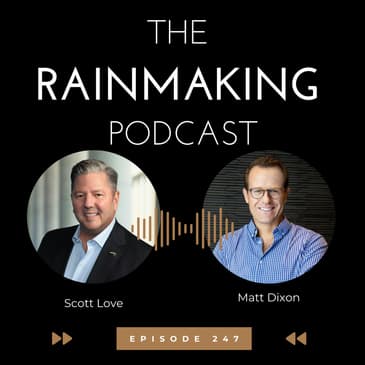
In this episode of The Rainmaking Podcast, host Scott Love speaks with Matt Dixon—bestselling author of The Challenger Sale and The Jolt Effect—about his latest research and book, The Activator Advantage: What Today’s Rainmakers Do Differently. Based on data from the Rainmaker Genome Project, Matt introduces five rainmaker profiles, highlighting the “Activator” as the most effective. Activators stand out by committing consistently to business development, building broad and deep networks, and proactively delivering value to clients before they even ask for it. Rather than relying on personality, Activators succeed through behavior—habits, systems, and deliberate outreach.
Matt explains that Activators aren’t just connectors; they transform insights and introductions into meaningful client engagements. They develop daily routines, use platforms like LinkedIn strategically, and focus on helping others as a way of building trust and generating future opportunities. This episode also breaks down three action steps for aspiring rainmakers: plan business development time weekly, expand and engage your network, and proactively share insights that clients didn’t know they needed. With data-driven insights and real-world examples, this conversation offers a powerful blueprint for professionals who want to become indispensable advisors.
Visit: https://therainmakingpodcast.com/
YouTube: https://youtu.be/jxIFBnWxZYU
----------------------------------------
This show is sponsored by Leopard Solutions Legal Intelligence Suite of products, Firmscape, and Leopard BI. Push ahead of the pack with the power of Leopard. For a free demo, visit this link:
https://www.leopardsolutions.com/index.php/request-a-demo/
----------------------------------------
Matt Dixon is a Founding Partner of DCM Insights—a boutique consulting and training firm that uses research-backed methods to help organizations to better attract, retain and grow their client relationships. A noted business researcher and writer, Matt is a sought-after advisor to leadership teams around the world.
He is best known as the co-author of several of the most important business books of the past twenty years, including The Challenger Sale, which has sold more than a million copies worldwide and was a #1 Amazon and Wall Street Journal bestseller. His most recent book is The JOLT Effect: How High Performers Overcome Customer Indecision, which was released in September 2022. His next book, The Activator Advantage: What Today’s Rainmakers Do Differently, will be released by Harvard Business Review Press in the spring of 2025.
In addition to his books, Matt is a frequent contributor to Harvard Business
Review on topics ranging from business development effectiveness to client experience.
He holds a Ph.D. from the University of Pittsburgh and currently resides in the Washington, DC area with his family.
Links:
https://www.dcminsights.com/activator-advantage
https://www.linkedin.com/in/matthewxdixon/
Learn more about your ad choices. Visit megaphone.fm/adchoices
[00:00:10] You're listening to The Rainmaking Podcast, hosted by high-stakes headhunter, author, and professional speaker, Scott Love. You're listening to The Rainmaking Podcast, and my name is Scott Love. Thank you for listening to the show. We've got a special guest for you today. His name is Matt Dixon. That may be a familiar name to you, especially if you read the book, The Challenger's Sail, as he's the author of that.
[00:00:39] Now, his latest book is called The Activator Advantage, What Todays Rainmakers Do Differently. Now, what's different about this particular book is that this is based on research from the Rainmaker Genome Project. We're going to go into that and my conversation with Matt today. But the bottom line is that he shares with you exactly what those people who are called activators do to build their books of business.
[00:01:03] If you're in professional services and you're responsible for getting clients, definitely order the book. I read it. I'd highly recommend it. It's one of these books that you want to keep on your shelf and refer to over and over again because there's so many good ideas in that. As always, this show is sponsored by Leopard Solutions, Legal Intelligence suite of products, Firmscape, and Leopard BI. Push ahead of the pack with the power of Leopard. And now here's my conversation with our guest, Matt Dixon. Thanks for listening.
[00:01:32] Hey, this is Scott Love with the Rainmaking Podcast. Our special guest today is bestselling author Matt Dixon. And our topic title is The Activator Advantage, What Today's Rainmakers Do Differently. Matt, thanks for joining me on the show today. Hey, Scott. It's great to be here. Thank you for inviting me. Absolutely right. And years ago, I remember reading about the Rainmaker Genome Project. And turns out that's your project. And so I wanted to kind of start with that.
[00:01:59] What was that project and how did that lead to the Activator Advantage? Yeah. So I might take a maybe half step back here, Scott, which is maybe to provide just a bit of, you know, how did we happen upon this space of studying rainmakers and professional services and law in particular? As you and I were talking before we started recording, my professional background is as a really a sales researcher.
[00:02:23] So I'm not a salesperson, but I've spent my entire career bringing research-based methods to understand what the very best salespeople do. One of the projects I was a part of was the Challenger Research, which I think many of the listeners here may be less familiar with. But if we were talking to B2B salespeople, they would all know this book. That book came out in 2011. And I, at the time, I spent a lot of my time, I know you do this too, but a lot of my time traveling around the world and speaking at sales kickoffs and at leadership retreats and things like that.
[00:02:50] And I got a phone call around 2012, maybe 2013, a couple of years after the book had come out from one of the big strategy consulting firms. I won't name them, but I think your listeners have like a one in three chance of guessing who it is because there are only three big ones. And so it was one of those guys. They called me, they wanted me to present this Challenger Research at their partner retreat. And I showed up. I never got a chance to talk to the managing partner or the group that the organizing committee that had hired me.
[00:03:16] I just kind of was given my time slot. They asked for my slides. I showed up and I started speaking. And the managing partner stands up 45 minutes into my 60 minutes of planned remarks and starts waving his hands. This is in a ballroom of 400 partners. Everyone's staring at this guy. I'm thinking, what is going on? This is the weirdest. It's never happened to me. Scott, I don't think it's ever happened to you as a professional speaker. It's never happened to me before. And I was very on my back foot there. And he waves for a hand mic to be brought over to him.
[00:03:46] And when the mic comes over, he says, you know, Dr. Dixon, I appreciate this research. It's very interesting stuff. I'm sure our clients would find it fascinating. But what you need to understand is that none of us in this ballroom are salespeople. You've been talking about sales now for 45 minutes, and I just had to stop you. In fact, I got to point out, our firm doesn't actually sell anything. And so what I was thinking at the time, Scott, was what time is my flight home? And can I move it to an earlier flight?
[00:04:10] But what I said was, let's stipulate to the fact that there's a mysterious process by which the client's money ends up in your firm's bank account. And can we just call it sales for the next 15 minutes? Everyone laughed. He laughed too and said, very well, continue. Now, what I did after that meeting is I spent the next decade turning down every invitation to speak at a partner retreat. Because that taught me in an instant that this world of professional services doer sellers or seller doers, depending which term you like.
[00:04:37] But professionals is very different from B2B sales where I'd spent my entire career. And I parked it in the back of my mind that at some point, I'd love to go and understand how sales, and I know that can be a dirty word in the professions, but how sales is different when the product you're selling is you, right? When you're selling advice and expertise to your client. And so you fast forward to, I guess it was early 2022, when we finally got a chance to do that.
[00:05:07] And we launched a large global study with the sponsorship of Intap, who I think many of your listeners will know, big software provider in the financial and professional services space. A big study to understand how has rainmaking changed in today's more competitive client buying environment. It took about two years, but we collected data from 3,000 partners from about 41 different firms. Published that research first in Harvard Business Review at the end of 2023 in an article called What Today's Rainmakers Do Differently.
[00:05:37] I lost numerous arm wrestling matches with the editors there about all this stuff I wanted to include in the article that they said I couldn't. And they said, well, how about a book? It sounds like you have enough content for a book. And so that was a big mistake because then I spent the next year writing this book. But we're very excited to say it's now done. So, right. And I'm excited to promote this book for you, Matt, because it's solid. And I like the substance that you put in here. Thank you. And it's real. And I like the fact that you put people into five different categories.
[00:06:07] And for everybody that hasn't read the book, it's fantastic. I'd recommend you get that and understand what the activator does. And tell me about, we don't need to go into the other categories, but tell me about the activator category. Sure. What does that mean? And who is that person? Sure. And just to be clear, so this data that we collected, we get a lot of questions about this. I find that if I were presenting to a sales audience, they might not care as much about the methodology. But partners, as you know, Scott, are skeptical people. They're analytical people.
[00:06:36] And so, when I present this content, we spend a lot of time. As you know, we spend a lot of time in the book talking about where this data came from and the methodology and some more statistics probably that people want to care about. Although the editors maybe put a bunch of that into the appendix. But what I'll tell you is those five profiles, that was a statistical method we use. And what we know is that those 3,000 partners, every single one of them spikes in one of those five. Now, of course, if you want to learn more, check it out in the book or that HBR article I mentioned.
[00:07:02] But at a very high level, you've got experts, confidants, debaters, realists, and activators. And as you said, and as the title of the book suggests, I think I'm an okay storyteller, not a great one because everyone knows who the winner is. But it's the activator, as you said, Scott. And they are the ones who outperform. So, when you look at business development effectiveness as determined by the firms that these partners work for, activators outperform all of the other profiles. Just to be clear, you can be a top performer, right, in any of these categories.
[00:07:31] And we all, when you read the book and you learn more about these five profiles, people come away saying, I know colleagues, other partners I've worked with in other firms or in my current firm who fall into each of those five profiles. But statistically, your best chance of success is to be an activator. An activator is just at the highest level. I'd describe them this way, Scott. They're super connectors. They are very, very active on LinkedIn.
[00:07:54] They build and manage their professional network as if it were arguably their most important strategic asset when it comes to business development. They're very active in events. So, whether it's a firm-sponsored event, it's an industry conference, these are the people who kind of work the room, right? They go in, not, they don't clump with their colleagues in the corner waiting for a client to approach them. They go with a target list of, here's who's coming, here's who I want to have coffee or dinner or lunch with, here's who I want to grab a business card from.
[00:08:20] And some people have asked, well, why didn't you just call them connectors because it kind of sounds like what they're doing? But it undersells what happens next. So, it's not that they're just in the game of collecting LinkedIn contacts or business cards at events. They try to turn those connections into paying client relationships. And the way that they do that is really unique. They really focus on proactively bringing new ideas to clients before clients realize they have a need.
[00:08:45] So, in law, think about an opportunity to mitigate risk or to avoid getting blindsided by some market event that's befalling competitors. That kind of insight, bringing it proactively to your client before your client realizes there's a need and then starts reaching out to service providers. So, interestingly, when they do that, they're not looking to charge clients for that time. They're looking to pay it forward.
[00:09:08] As one activator told us, you know, and we're all wary, I think, of giving away too much free work, right, because we're in a billable hours world here. But as one activator told us during the interviews, look, my paid work, my billable hours pay my bonus this year. It's a lot of the free advice and the pay it forward work that pays my bonus next year and the year after, providing that value. And the last thing I'll tell you, Scott, about the activator, this makes them very unique amongst those five profiles, is some of them, especially the confidant profile, they have very sharp elbows. They box their colleagues out.
[00:09:38] They don't collaborate. They live in fear of the bad things that might happen if a colleague comes into their client account and does something wrong and rocks the boat. So they don't put notes in the CRM system. They get very upset when that unsuspecting associate phones into their client without their permission. But activators do the opposite. They're looking to bring colleagues into their client accounts. And the reason they do that is because they know that in today's market, client loyalty is much harder to come by.
[00:10:05] Clients are much less likely to automatically go back to the same firms over and over again, despite the value they provided in the past. And so if client relationships are more easy come, easy go in today's market, the better path to creating a sticky and lasting client relationship is to establish multiple points of connection into the client organization. How do I don't let's ship the locus of loyalty, not from me, but to the we of our firm, which is a relationship.
[00:10:30] The client then thinks twice before they, you know, rip up the pull the tent stakes up and move on to a competitor. I love the fact that you and the way I understand it and the way I see it, just because I've talked with thousands of successful rainmakers in the legal community. Number one, they're really good about their focus and their niched area, their area of expertise. Number two, like you said, it's a core competency that they're a connector. There's a lot of introverts I've found also that are really good at that. Absolutely. Yeah.
[00:10:58] Even though they're not going to be the life of the party, they're very methodical, deliberate. And some of the words that I remember reading in your book, which I thought was fantastic, you're talking about having a rhythm. You're talking about having habits. You're talking about having a cadence and rituals like it's an automatic, regular thing. Talk about that from what activators do in that regard. Yeah, I think you've pointed out something very important, which is this is not about personalities, right? So you mentioned introverts.
[00:11:28] And this is actually one of the first questions I get when I present at a partner retreat. There's a hand that goes up and somebody says, can introverts be activators? Because it doesn't seem like they could be. But we didn't study in this research personality. We studied behaviors, time spent characteristics, routines, habits, how we use tools and resources, whether we collaborate or not, how we pitch our services to clients. Basically, the stuff that all of us can get better at. So it's not who you are. It's more about what you do.
[00:11:55] And to your point, we met many introverted activators during the course of the research. In fact, one that I spoke to towards the tail end of the project had a $30 million book of business, a top brain maker from a big New York-based firm. And she said, look, I am a dyed-in-the-wool introvert. This did not come naturally to me to learn how to work the room, to learn how to manage my network, to put myself out there. But the way I did it, Scott, is exactly what you're saying, which is I started small and I started building these habits that I then could layer on top of.
[00:12:25] And I had quite a lot of resiliency because, as you know, in business development, you get more no's than you get yeses. But you can figure out how to, no pun intended, but activate some of that extra version, even if you are naturally an introvert. So this idea of creating habits and routines and rhythm and cadence is absolutely critical. Lawyers like to point out that saying that those partners, activators, who commit to business development and do the most business development generate the most business.
[00:12:51] And that is admittedly a tautology, but in professional services, it's kind of not because most of the professionals we studied across the 3,000 in the data set did not carve out and protect time to do business development. They had no routine. They did business development when the well ran dry, when their current engagement was over and they needed to go scrounge around for additional work or when they lose a client. Activators do the opposite. They know that, again, in today's world where clients are less loyal, it's a much more competitive market.
[00:13:19] You've got to build and manage a pipeline. You've got to have a backup plan. And again, they start small. It's the analogy I would give for somebody who's going from zero, right? If you're one of those partners where you let BD get crowded out by client work, whatever matter you're working on, firm initiatives, maybe because you just don't like doing it, right? And you find any excuse not to do it, and you're going to aggressively wait for the phone to ring and wait for that client out there to find you and ask for your help. You know, the way you start is a little bit like if you're trying to get in shape.
[00:13:49] You don't go to the gym trying to lift the heaviest weight. You start small. You start with the small weights, right? You don't want to injure yourself. And that builds that habit and that routine. The habit experts, habit formation experts like James Clear and Charles Duhigg. Yeah, you mentioned that in the book. I remember that. Yeah. Yeah, and they're very clear that what makes the habits form and stick is when they are small, they're very specific, and they're very actionable. So it's not carving out an hour of BD time when you're coming from nothing.
[00:14:13] It's carving out 10 minutes or 15 minutes and just working your LinkedIn, checking your LinkedIn inbox, following a couple of the firms that you're interested in doing some work with, a couple of the clients you've met recently, right? Sending an outreach with an insight and then getting back to legal matters. And then the next time around, maybe it's 20 minutes, right? And we've got to be mindful that our time is limited because we've got to build our requirement, of course, as lawyers or as professionals. And so we've always got to do that balancing act.
[00:14:41] But we can't afford to let it get crowded out. We've got to carve out and protect that time. That's absolutely right. I liked how you segmented the different types of people they should connect with in the book. You talk about clients and client prospects. You talk about those people in the organization that might be in a position to influence those advocates for you. And then also experts. Yeah. Talk about those three buckets, so to speak, Matt. Can you elaborate on those? Yes, for sure.
[00:15:09] So I think obviously when you dissect an activator's network, I think there's one point I would make, which is there is a limit to how many close contacts they have. And this is not because they all got together and decided, hey, let's have X number of close contacts. It's because of human physiology, actually.
[00:15:26] And we talk a lot about something called the Dunbar number in the book, which was discovered by an anthropologist named Robin Dunbar, an Oxford-based primate anthropologist, who discovered that social networks have constraints, natural constraints. There's just only so many people that you can have a close relationship with. The Dunbar number is actually 150. Now, it varies, and technology can help us kind of push the dimensions. Extroverts have slightly larger networks. Women, it turns out, have slightly larger networks than men. But it's around 150 for all of us.
[00:15:56] Like, if you look at your holiday card mailing list, it's probably about 150, right? You look at, if you listed out everyone from really close friends to, you know, acquaintances, what Dunbar would say, the kind of people that you'd meet on the street and not feel awkward asking if they want to grab a beer or go grab lunch, it's probably about 150. Now, the other point is, not only is there a limit, but two, there's stratification and structure to that network, which you're talking about here. So we have the really close-in client relationships.
[00:16:22] These are the clients who are going to text you on a weekend just to check in and pick your brain, right? And then you've got the ones that are farther out who might be occasional acquaintances. We met at a firm-sponsored event a few months ago. We've been in touch a little bit. But we've actually, other than that first time, we've never met live. But that's different from a LinkedIn contact you've never spoken with before and just, you know, you accepted the invite request or you sent one out and it's just, that's the other 5,000 people you're connected with. But the top tier has structure.
[00:16:49] Now, when you look at it, what you find is, yes, of course, there are clients and prospective clients in there. So everyone from the GC, the CFO, the AGC, the more junior members of the team, et cetera. Then you've got internal contacts. And this is really interesting. When we study this with data, we find is most partners don't actually have that many connections with other partners in their own firm. Even if they've been there for a long time, it's kind of surprising. I thought that was interesting when you mentioned that in the book. Yeah, activators do.
[00:17:18] I mean, their networks are, they have a heavy dose of internal colleagues. Because again, think of this, activators don't think of themselves as the sole source of expertise. They think of themselves as general contractors for expertise. So I may not have the answers, but I know that I have talented colleagues in my own firm or perhaps more broadly in my network who I can put in touch with you. The other folks, the other experts. So these are, if I'm a lawyer, these might be investment bankers. Let's say if I'm in the transactions or M&A group, right?
[00:17:47] If I am an IP group, IP litigation group, and I focus on biotech and pharma, I might have experts who are more scientists, right? Now, that's obviously nothing that our firm does, but that creates very powerful connections in a few ways. One, they can be sources of referrals, as you know very well. And I know you talk about it in your podcast. Be very, very powerful for Rainmaker to have a very well-established referral network.
[00:18:10] People outside of the legal industry that we can go and refer work to and who will refer work into us can be phenomenal in terms of building our book of business. And I think, secondly, it helps us establish, again, that breadth of expertise to deliver value to our clients, even if we are not personally the ones delivering that value. It is so valuable for our lawyer, the partner we work with, to be able to say, we work with this investment bank. We have tremendous experiences with them. Or here's a tax advisor you might want to talk to.
[00:18:39] We don't do that work, but I can highly recommend them. Getting that kind of trusted recommendation from a source you trust, right, is just an incredible source of value to deliver to clients. And it pays back over time. Absolutely right. So to kind of summarize what an activator is, this is someone, I mean, they're really someone that's building and working that network. That's right. It's not like, I mean, I think that's 80% of it, right? Yeah, I think the network is a huge part.
[00:19:04] The way I describe it, I use a metaphor in the book of, think about, at the highest level, there are three things activators do. The first is we talk about they commit to business development. The second one is they connect broadly and deeply inside and outside their firm, right? So they're network builders and managers, as you just said. And then the third thing I mentioned earlier, which is they proactively create value. So I don't wait for the phone to ring. I bring those ideas to my client, right? Whether it's something I can help them with or it's something a colleague can help them with,
[00:19:31] or it's an opportunity for somebody in my network to deliver value to you, even though you've not asked. I'm going to proactively offer that to you because it's a posture of thoughtfulness and helpfulness. We're paying it forward. Now, the metaphor I've used is sort of think of it like the human circulatory system. So the network, obviously, is all the veins and arteries. I'm not a medical doctor. You'll deal with those. It's the tunnels through which all the goodness flows. The value is the nutrients and the oxygen and the blood, right? It's feeding different parts of the network.
[00:20:02] And then the commit, that routine and that cadence and that rhythm business development is the beating heart. It just keeps everything moving all the time. And we never let up. We never, ever get complacent. And we never stop or the whole thing kind of breaks down. So I think it's a helpful way for us to think about how do we build a book of business in today's client buying environment. I think that's great, Matt. So kind of as we're bringing this to a close, if somebody is reading the book, you know, I'm an introvert.
[00:20:28] I've never taken a sales class and I don't want to see myself as a salesperson because, number one, it used to be illegal for lawyers to sell. Yes, that's right. It's a recent phenomenon. That's right. But business development, they can be a rainmaker. And I can't tell you how many times I've heard law firm leaders and practice group leaders tell me we want a rainmaker in my recruiting practice. Of course. That's the magic word that everybody wants.
[00:20:52] But if someone says, I've got deep expertise within my narrow area of specialization and I know I can solve my client's problems. And I hear this a lot, too. I just don't have a book of business. Yeah. And somebody's an introvert. I'm just not naturally inclined to do that. Does that person have hope, Matt? Do you think they can? Okay, good. So there's no doubt in your mind. Not only do they, we've seen it, right?
[00:21:15] So we've seen when we're out there working with partners and senior associates who are on the cusp of making partner and teaching them how to be activators. I would say that a huge percentage of them are introverts, right? These are like green eye shade, like heads down in the books. Like they really like working legal matters for clients. In the basement. Yeah. Yeah. I mean, just, you know. And it is amazing to see that when you teach them these techniques, I mean, they'll leave at the coffee break and come back and say, holy cow, it worked.
[00:21:43] Like I never, you know, and I know it requires a little bit of putting yourself out there, right? And getting comfortable with that. It also requires a mindset shift that sales is not a dirty word. And it's a different way of helping our clients. Think about this idea of like the insight that you might have that you could bring to your client and that how helpful that is to them. You're not selling. I think lawyers oftentimes feel like sales is a dirty word because when you sell, you're trying to get somebody to do something they otherwise wouldn't do. Like Wolf of Wall Street. Yeah. Exactly right.
[00:22:11] And I think we can thank Hollywood for a lot of the pejorative images of salespeople. You know, I watched Glenn Gary, Glenn Ross again for like the 10th time last week. And I get it. I get why people don't like salespeople. Coffee is for closers, man. Coffee is for closers. Where are the good leads, Scott? But, you know, when we change our posture and we think about, okay, why did we get into the law? Why did we choose this as a profession? It was to help people solve complicated problems that require expertise. This is just a different way of helping, right?
[00:22:37] And I think one of the foundational concepts around this activator work is when we deliver most, I think most partners think about a relationship with a client as something that happens after the client hires you for work. So once they solicit your help for a paid legal matter and you start working them, you can form a relationship over time. Activators kind of flip that around. They focus on building the relationship first, delivering value first. And then paid work is just the natural evolution of that relationship, right?
[00:23:07] It's the thing that comes after the value is delivered, not before the value is delivered. That's great. So how can we set this up in three action steps? Somebody listening to this and I'll even give you a step before step one, two, three, get the book and read it. I'd highly recommend it. Action step number one. How much does this book cost? What's the book cost? So I think the book is, I think the going rate for hardcover books is like 30 bucks these days. When my first book was like 20 bucks. So I think it's, it tells you how old I am. Oh, $35.
[00:23:37] I mean, $35. That's the price of a martini at the Oyster Bar in Grand Central, right? So for the price of a martini. There you go. For two cups of coffee, you can get secrets of the universe to building a book of business. So if we could, let's say they get the book and we can kind of set this up step one, step two, step three. Where should somebody start? Okay. Let me, let me give you three steps that align to those three big behaviors. Committing to BD, connecting broadly, deeply, and creating value practically.
[00:24:05] So the first thing we're going to do, step one, is it's not put time on your calendar to do business development. You should do that. But here's what I want you to do. I want you to actually put some time on your calendar Sunday night or Monday morning before the phone starts ringing, the email box starts getting full and people show up to the office. Put some BD planning time on your calendar. So even 15 minutes. Why do we do that? Because if what we do is we start by saying, okay, on Thursday, I put 20 minutes on my calendar to do business development.
[00:24:33] And you've not put any forethought into what you're going to do when that reminder pops up on your screen. If you haven't put any forethought into it, it's going to pop up and you're going to be deer in the headlights and you're going to go right back to that client matter you were working on before and say, well, I'll get to that later. So instead, just take a little bit of time to think about when that pops up on my calendar on Wednesday or Thursday, what am I going to do? Am I going to go check out on my LinkedIn network? Who are some GCs that have switched roles recently? Are there some news events? Is there an insight I can bring to people?
[00:25:01] But what are you going to do with that time when it pops up? That's step number one. Okay, great. Step number two. So let's talk about connecting broadly and deeply. And this one I mentioned before, activators are, I don't want to mislead people into making them think that they're kind of LinkedIn influencers. There certainly are some who do fall into that category, but they treat LinkedIn like the world's biggest conference, right? It's less about the speaking and the sharing insights. They do post, but it's more how they engage with people.
[00:25:28] And one of the things that activators do and what I want everyone to go do is look at all the clients you've met with over the past few months. Go to your Outlook calendar, your Google calendar. Then look at all the clients you're meeting with and prospective clients and their team members over the next three months. And I want you to send a personalized LinkedIn connection request to each of those individuals. Now, the first thing I get a lot of reaction from lawyers is many of whom don't even have pictures on their LinkedIn profiles is, I don't think my client wants that kind of relationship with me.
[00:25:55] And I'm telling you, we've interviewed thousands of clients and they absolutely do. Not just do they, are they okay with it? They expect that kind of relationship. Here's why you do it though strategically is once you connect with those clients, once you follow their firms, once you follow their CEOs or other senior executives, maybe even those you haven't met, you are training LinkedIn's algorithm to start feeding you things that those people care about. What do they post on? What do they comment on? What do they like? What do they repost? Now you're in the flow of information.
[00:26:24] And here's the real reason to do it, Scott, is that if you don't do it and your competitor does do it, then don't be surprised when the competitor spots an opportunity to serve a client on a need based on something they saw on LinkedIn and you never even knew that business was up for grabs. This happens all the time to partners. Okay, third step. Here's what I want you to do. Creating value proactively.
[00:26:45] Think, it's a simple question, but think about what is the risk or the opportunity that you've helped clients with that you wish every client knew about, right? And bring that idea to them. You know, it could be a regulatory change. It could be a way to approach the M&A market, right? Any number of things. I know our subject matter expertise and our areas of focus are very different for anybody listening to the show. But think about what is the thing you know that clients need to know?
[00:27:14] And then I want you to bring it to them. I want you to send them a LinkedIn note. I want you to text them. I want you to call them. I want you to send them an email. And I find that partners get very nervous about that because they don't want to be a bother to their clients. And their mindset is if the client has a need, they'll find me and they'll ask for my help. But here's the thing. Again, when we talk to clients, their biggest complaint about partners is I don't hear from them often enough. And that surprises the heck out of partners because partners are like, I don't want to bother them.
[00:27:40] But what clients say is, look, I am heads down executing on my strategy, on my company's priorities, on my department's kind of goals and initiatives. You're going to talk to more people in a week than I'm going to talk to in a year who are just like me. So bring the things that they're working on to me. If they're cognizant of an issue or they're working on something in an innovative way with your firm, I want to know about it because I don't know what I don't know. And you're a window into the outside market. So, again, it's not just something they'll make time for. It's something they expect of today's service providers.
[00:28:10] That's mind-blowing. And that's counterintuitive, if I would think, that most people, like you said, they just don't expect that. But the data shows. The data shows. So this is great, Matt. I want to thank you for being here today. Thanks, Scott. And also, I want to invite you back in the next few weeks to come on for part two. I'd love to. Yeah. I'd love to. This is fun. So everybody listening, check back in a few weeks and we'll have Matt back on here talking about part two of the Activator Advantage because there's so much to it.
[00:28:36] But I want you to tell our listeners now, what is it that your company does? What do you have? What do you do that you'd like our listeners to know about? Yeah. So my company is DCM Insights. And you can visit us at DCMinsights.com. And what we do is we provide training to associates and partners at professional services firms. I'd say our business is about half law. The other half is accounting, consulting, search, and PR. Some other areas of the professions.
[00:29:03] And it's all training based on the Activator research. So we deliver a behavior change program. And it's been amazing. We've been doing this for a few years ever since this research first came out in the Rainmaker Genome Project that we talked about earlier. And it's just been phenomenal to see the changes take place with these partners. Many of them who come into this program saying, I don't want to sell. I don't like doing it. I'm being made to go to this.
[00:29:28] And they leave with a completely different mindset about what it means to engage clients commercially and what it means to develop really great, sticky, lasting client relationships. So it's been a phenomenal journey working with some of the biggest firms in the world, but as well some more smaller boutique firms as well who want to hop on this Activator journey. That's great, Matt. Thank you so much for being on the show.
[00:29:50] And for everybody listening, go to the show notes where you hear this podcast and you'll be able to get Matt's contact information as well as order his book, The Activator Advantage. Matt, thanks for being on the show today. Thanks for having me, Scott. Thank you for listening to The Rainmaking Podcast. For more information about our recruiting services for international law firms, visit our website at attorneysearchgroup.com.
[00:30:18] To inquire about having Scott speak at your next convention, conference, sales meeting, or executive retreat, visit therainmakingpodcast.com.