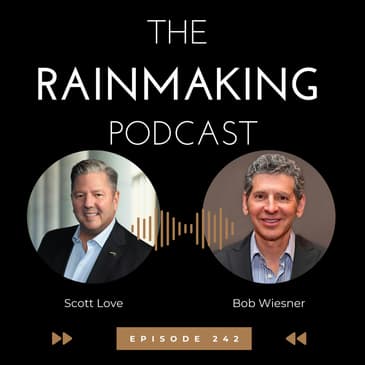
In this episode of The Rainmaking Podcast, host Scott Love speaks with Bob Wiesner—author of Winning is Better and partner at The Artemis Partnership—about how professionals can use strategic business development positioning to win more consistently. Known as “The Pitch Doctor,” Bob breaks down his five-part framework for effective positioning: defining the client’s problem, offering unique insight, presenting a tailored solution, providing measurable results, and articulating the broader impact. He explains that while most professionals focus on their credentials and solutions, what truly sets them apart is their ability to reframe their value from the client’s perspective.
Bob emphasizes that rainmakers must lead with empathy and relevance—starting conversations with the client’s pain points rather than their own qualifications. He walks through how to uncover insights, develop client-specific messaging, and communicate tangible business outcomes that differentiate your firm. For professionals seeking a step-by-step roadmap to build credibility and earn trust in a crowded market, this episode delivers a masterclass in persuasive business development.
Visit: https://therainmakingpodcast.com/
Watch our video interview: https://youtu.be/hvztbsQ02JQ
----------------------------------------
This show is sponsored by Leopard Solutions Legal Intelligence Suite of products, Firmscape, and Leopard BI. Push ahead of the pack with the power of Leopard. For a free demo, visit this link:
https://www.leopardsolutions.com/index.php/request-a-demo/
----------------------------------------
Bob Wiesner is known as the ‘pitch doctor’ because of his approach to winning pitches. He’s advised on over 400 transactions in the last 25 years and his clients include companies like KPMG, Deloitte and JP Morgan Chase, and top firms in advertising, accounting, architecture, engineering, consulting, law and investment banking.
Bob Wiesner's book: Winning is Better: The Journey to New Business Success https://www.amazon.com/Winning-Better-Journey-Business-Success/dp/B09NRD7H6Y
Bob Wiesner on LinkedIn https://www.linkedin.com/in/bobwiesner/
Learn more about your ad choices. Visit megaphone.fm/adchoices
[00:00:10] [SPEAKER_00] You're listening to The Rainmaking Podcast, hosted by high-stakes headhunter, author, and professional speaker, Scott Love.
[00:00:23] [SPEAKER_01] You're listening to The Rainmaking Podcast, and my name is Scott Love. Thank you for joining me on the show. I'm excited about our guest today and the topic that we're talking about. His name is Bob Wiesner, and the topic is the Business Development Positioning. Now, before I tell you about Bob, let me tell you about his book. It's called Winning is Better, The Journey to New Business Success. I read that book, and I learned a lot, and I'd highly recommend it.
[00:00:48] [SPEAKER_01] If you're looking for ideas to really perfect your strategy as a professional services provider as it comes to rainmaking, definitely order Bob's book. You can get that from the link in the show notes directly. Now, Bob is known as the pitch doctor because of his approach to winning pitches.
[00:01:03] [SPEAKER_01] He's advised on over 400 transactions in the last 25 years, and his clients include companies like KPMG, Deloitte, and JPMorgan Chase, and top firms in advertising, accounting, architecture, engineering, consulting, investment banking, and even the legal industry. As always, this show is sponsored by Leopard Solutions, legal intelligence suite of products, Firmscape, and Leopard BI. Push ahead of the pack with the power of Leopard.
[00:01:32] [SPEAKER_01] And now here's my conversation with our guest, Bob Wiesner. Thanks for listening. Hey, this is Scott Love with the Rainmaking Podcast. Our guest today is Bob Wiesner, and our topic is the business development positioning. Bob, thank you for joining me on the Rainmaking Podcast today. It's a pleasure, Scott. Thanks for having me. Absolutely right. And first and foremost, I want to talk about your book, Winning is Better. What a great title. Who doesn't love to win, right? And I've read your book, and I'd highly recommend it.
[00:02:01] [SPEAKER_01] And for everybody listening, we've got links on the show notes where you can get Bob's book, and I'd recommend it. I like when you talk about, on page 34, the business development positioning. And before we talk about this, the things that you've shared in your book, I've never heard them articulated in quite that way. I understood it to be real, but when you wrote that, it became top of mind. And I know I'm going to win more business as a result of reading your book. So thank you for doing that, Bob. Thanks for those kind words. Absolutely right.
[00:02:30] [SPEAKER_01] So tell us, you talk about in your book, there are five components to an effective business development positioning. What does that mean exactly, Bob?
[00:02:38] [SPEAKER_02] Well, first let's define what a business development positioning is and why you need it. And then we can go into what those five components are. The reason why their business development positioning needs to exist is because you have to put yourself in the minds of the people that you're trying to reach, the people you're trying to meet. Why would they want to meet with you? Why would they want to give a second thought, even a first thought, to giving their money to you when, in fact, there's probably others that they might even be giving their money to right now?
[00:03:08] [SPEAKER_02] Absolutely right. Now, many professionals, whether they're in law, architecture, accounting, believe that the reason we deserve your business is because we're very capable of doing what we do. These are our credentials. This is our experience. This is the education background we had. Maybe this is our client list.
[00:03:28] [SPEAKER_02] Now, that's all true, but it by itself just puts you among a massive number of similar firms that offer similar sorts of credentials. A business development positioning twists that around and restates it from the perspective of what the prospect might be looking for and what do prospects want. Why would they hire a lawyer, an accountant, an architect, an advertising agency?
[00:03:56] [SPEAKER_02] They would do it, Scott, because they have a problem that needs to be solved that they believe is not currently – the solution is not currently available from whatever resources they now have. Or perhaps a better solution might be available from a different resource. So, if that's where the decision maker is coming from, the business development positioning should start there.
[00:04:23] [SPEAKER_02] What is the problem that we, my firm, is exceptionally good at solving? So, that's number one, right? Oh, yeah. That's absolutely number one. And sometimes it takes a really hard introspection on the part of the firm to really think about it from that perspective because we think about our credentials and our capabilities, our education. We don't always think about the problems that we solve. But that's what's going to get their attention.
[00:04:49] [SPEAKER_01] And let me ask you this. Do you think it's become even more important in recent years to really think of it this way?
[00:04:54] [SPEAKER_02] I think it's more important in recent weeks to even think about it this way. We are faced with a very dynamic, volatile background. You know from your military experience that the term VUCA, the acronym VUCA, has always been true in many different aspects of life. But it's even more true now in the business world. We live in a volatile, uncertain, complex, ambiguous world.
[00:05:21] [SPEAKER_02] And decision makers on the corporate side, on the commercial side, on the private industry side, even on the government side, are waking up every morning wrestling with a number of different problems and uncertainties around those.
[00:05:35] [SPEAKER_02] So the opportunity for them to meet with a provider, a law firm, for example, that has expertise in dealing with that problem ought to be appealing enough for them to want to take a 30-minute meeting and get to know you. So that's certainly a trend that's not going to diminish over time. And it's one that the knowledgeable firm can really leverage.
[00:06:04] [SPEAKER_01] Let me ask you this question. What is the problem you solve? That's a pretty simple question. Let's say somebody is listening to this and they're like, come on, that's just too simplistic. We're a law firm. Of course we know what problems we solve. How would you respond to that person that kind of gives a little bit of pushback on this idea?
[00:06:19] [SPEAKER_02] It's great that you solve problems. That's ultimately why you exist and how you earn revenue. The question here is, are you leading with that? Are you challenging the prospect to be thinking about problems that they have or might anticipate or should anticipate having that will require a solution? It comes back to kind of transferring your experience and credentials into something much more tangible.
[00:06:48] [SPEAKER_02] And by tangible, I mean something that the decision maker can actually relate to. Yep. I have that problem or that's going to be an issue for me. I haven't even realized it's going to be an issue for me, they might say.
[00:07:02] [SPEAKER_02] But as soon as that realization hits, you, the lawyer or the architect or the accountant, you become very interesting to them because they'll really want to know more about your understanding of that problem and how you might go about solving it and why you can be considered to be a trusted source of that solution.
[00:07:24] [SPEAKER_01] Do you think this is better to look at it from a larger perspective as a firm overall or to a practice perspective or down to I'm a partner, I've got a client prospect, whether I'm white collar, whether I'm M&A, kind of bring it down to that level. What do you think? Or can it transcend all those different strata of an organization?
[00:07:45] [SPEAKER_02] It definitely transcends or bridges all the different strata. The way you really should be or could be thinking about it is a little bit differently. It's less so from the perspective of what the firm does or what you do, but more the perspective of what the prospect needs. So in a typical business development campaign or business development effort, what we would see by typical, I really mean a good one, a best practices one.
[00:08:13] [SPEAKER_02] What we would want to see is kind of a hierarchy established. You're first determining that you have expertise in understanding and solving a problem that a sector would have. That might be an industry sector, automotive, energy, real estate.
[00:08:32] [SPEAKER_02] It might be a type of client within a sector, small to medium-sized businesses, startups, family-owned, IPO-driven. But you can start on a broad basis by defining that, let's call it that sector. Then as you identify specific companies or individuals you want to talk to, you make that problem, that may be a sector problem, you make it more relevant for that company.
[00:09:00] [SPEAKER_02] So if I know I'm going into company XYZ, which resides within a sector that I have expertise in, then I should be able to create a communication that would be seen by company XYZ as being very relevant to their situation. So start from a broader industry or sector basis and then fine-tune it down to the individual company, even the individual decision-maker that you might be speaking with.
[00:09:29] [SPEAKER_01] This is interesting. In your experience, have you found that intuitively people get to this? Or do you find that you're dealing with sharp, sophisticated professionals? You actually have to teach them how to think this way.
[00:09:39] [SPEAKER_02] You really have to teach them how to think this way. It's not alien to them. It's just not intentional on their part. Especially the homework required to understand the connection of your problem-solving ability to that individual company. We might think more easily about it as being industry-wide or sector-wide or, let's say, expertise-wide because I'm an M&A guy, so I know how M&A is done.
[00:10:10] [SPEAKER_02] But to ask them to now do that homework for specific companies is a leap for them. Right. But once they get there, they always see better outcomes. That's great. So take us to number two. What's number two, Bob? Well, you can establish a connection because you understand a problem that the client has. Now the client or prospect wants to know, why should I, the client, believe that you can solve it?
[00:10:40] [SPEAKER_02] Yes, you know what it is, but why should I believe you can solve it? So the second part we call the insight. The insight is what do you know about the problem or the industry or the regulatory environment that you can leverage to help your clients solve the problem. So it isn't just your credentials or your expertise.
[00:11:03] [SPEAKER_02] It's something that you have uncovered or researched or realized through experience is a key to opening the door to a solution. So the insight is the beginning of building confidence on the part of the client that you actually have the capability of solving the problem.
[00:11:25] [SPEAKER_01] That's great. Is this something that you have found is articulated both in the proposal presentation or conversation with the client prospect or an existing client about more work? Or is this part of the whole overarching marketing strategy?
[00:11:42] [SPEAKER_02] Well, it should be articulated when you begin to go to market. So before you're actually having conversations, you should be equipped with these two, in fact, all five of the elements of the business development positioning.
[00:11:57] [SPEAKER_02] As you then are in communication with the prospect, whether it's through a cold email that you've sent or an introduction that's created through networking, an initial meeting on through to a proposal, you are continually reinforcing and even refining all five of these elements. That's great. That's great. So take us to number three, Bob. What's number three? Number three now is it's time for you to talk about your solution. We understand the problem.
[00:12:25] [SPEAKER_02] We have an insight that can lead us to a great solution. Now, what exactly is that solution going to be? What do we do and how do we do it? What's our process for doing it that we will bring to bear for you, the client, if you retain us? This is probably the easiest thing for all of our firms to talk about because traditionally that's pretty much been 80 to 90 to 100% of their business development communication anyway.
[00:12:54] [SPEAKER_02] They talk about what we do. We advise on mergers. We help deals. We design buildings. We do advertising campaigns. We'd like a little bit more specificity, a little bit more reality to it. But it's certainly an important place to go and an easier place to start for the firm.
[00:13:14] [SPEAKER_01] Yeah, good. Do you think that if I take my solution and my competitor's solution and what we do, we could interchange them? Is there too much of a difference or should we highlight differences in actually what we do at this point? Or does it not really matter? What do you think?
[00:13:29] [SPEAKER_02] I think anything of that is possible. A lot of solutions will look alike. But the differentiation and more importantly, the relevance of it, which is actually in our lingo a better term than differentiation, the relevance or persuasion of it will be more the case when you've connected it to your insight and to your problem. So keep in mind that we've got a through line here that makes this all hang together and makes it effective.
[00:13:56] [SPEAKER_02] And I know I'm repeating myself, Scott, so forgive me. But we're saying that because you have this problem, you need support. We have an insight into the problem, the nature of the problem, the way to solve the problem that has been effective. And that leads us to this sort of a solution.
[00:14:16] [SPEAKER_02] Connecting these three pieces makes your solution, even though it might be similar to another firm, it makes it more compelling because it now becomes a single story that you're telling.
[00:14:29] [SPEAKER_01] That's great. What do you think out of these three steps before we go to the next one, which one is the one that gives people more of a hang up or a problem to really get their arms around? Probably the insight.
[00:14:42] [SPEAKER_02] Yeah. I think that with a couple of slices of pizza and maybe a beer, you'll be able to identify the problems that you solve. And you certainly know the solutions that you have. But this idea of insights is something that you do do, but you've never, in many cases, articulated it as a compelling piece of information, as a leading part of marketing communication.
[00:15:08] [SPEAKER_02] Many firms, as you know, pride themselves on their thought leadership. Now, when you think about what should be the components of thought leadership, and you think about it in these terms, you should be thinking about insights. That's your thought leadership. That's what you know about a business or about a problem or about a segment that you use on behalf of your clients.
[00:15:34] [SPEAKER_02] So if we phrase it that way, we can eventually help our clients get to the insights that are compelling and effective.
[00:15:46] [SPEAKER_01] Indeed. Indeed. And I think that second one, the insights, that's one where you can really bring your creativity to play more than the others, where you can look at what's different about us. What have we done? How much have we done? So, for example, when I talk to a partner that's thinking about moving, I'll say, I've met with 70 law firms. So I know, you know, I've done my homework. I've got a brand within legal. I've done things differently than my competitors. So that's the insight. How do you think someone can really find out what that insight is?
[00:16:14] [SPEAKER_01] Are there any exercises you've given people to do as a team or consulting assignments you've given them to really kind of creatively find some ways that they can express that insight, Bob?
[00:16:23] [SPEAKER_02] We like to start with the, well, the answer is yes. And we like to start with a definition of what an insight is so that you can begin thinking about what you've got or what you've done. In our world of business development, an insight is a truth that can be leveraged on behalf of the client to solve a problem.
[00:16:43] [SPEAKER_02] So what do you know about a category, an industry, a user group, end user group, a regulatory environment, a organizational or structural environment? What do you know that if applied to the problem will help solve it? For example, and I talk about this in the book.
[00:17:13] [SPEAKER_02] If a university has a problem getting, wants more applicants to their medical school, and there's an architectural firm that is aware that at some point this university is going to have to build a new medical school library, a truth that they might have is that innovative design in medical school libraries is now driving applications.
[00:17:39] [SPEAKER_02] And if we design a medical school differently than anyone else has, if we use innovation in that building design, we can help you solve the problem of lower applications or diminishing applications. So I'm articulating the insight and doing it in a way that connects it to the problem. It's a truth that connects to the problem and leads to a solution. That's a great example. So tell us then, what's number four, Bob?
[00:18:07] [SPEAKER_02] Number four is what every business leader really wants, and that's why they hire firms. They want results. They want to know and they want you to tell them that when you engage with a client who has a similar problem and you use your insights to develop this kind of a solution, here is a measurable outcome that we've achieved for our clients.
[00:18:34] [SPEAKER_02] So it's an objective number that a firm should be able to aggregate from its work that's already done, that it makes sure is part of that business development positioning and communication. That's great. At what point should we tell our clients about that? You can really think of these five parts of the positioning as almost a single document.
[00:18:59] [SPEAKER_02] If I could, I would love to be able to send every one of my targets a piece of communication with all five of these parts in it. There's reasons which we might cover in another discussion as to why you might not want to do all of that in one communication, but you don't want to hold back. You want to make sure that your clients and your prospects are able to connect these points to each other reasonably quickly to give you a really strong foothold and opportunity for their business.
[00:19:28] [SPEAKER_01] Yeah, that's great. This is a really good format, by the way. I mean, it's logical and it makes a lot of sense. And I like the way you clearly relayed this to us. What's our last one? What's number five, Bob?
[00:19:39] [SPEAKER_02] Number five is often left out. But when we talk to decision makers and ask them why they picked one firm over another, number five is almost always articulated by them as something that made a difference. We call that the impact or the broader impact of your solution. It's you showing that if we help our clients solve this problem,
[00:20:03] [SPEAKER_02] not only do they come out on the positive side of the issue or of the matter, which is the result, but by coming out on the positive side in this way, here's the impact it will have on your broader business condition. The impact on your people, the impact on your shareholders or stakeholders, the impact on your marketing abilities over the next one to five years, the impact on retention of talent,
[00:20:32] [SPEAKER_02] the impact on reputation. Now, these may not necessarily be areas that the law firm has directly addressed, but because the lawyer has been able to show an understanding of how a specific legal matter impacts the broader business, it sets that law firm apart as not just engineers or operators, but as consultants and partners.
[00:21:01] [SPEAKER_02] And that will be something that we'll register on a conscious level as decision makers are reviewing their options.
[00:21:08] [SPEAKER_01] Right. So this is great. Let's say somebody is listening to this and they're like, they're a partner. I've got a, I'm part of a big firm, but I work in a real specialized area. I like this. I'm having trouble with number five. How do you think that person can get some ideas to really convey the broader impact of those outcomes to their future prospects?
[00:21:27] [SPEAKER_02] Wow. That's a really important question to ask, Scott. There's a few different things and I would ask them to start with some conversations over a cup of coffee with some of their stronger clients, some of their tighter relationships, and just ask the question, when this was solved for you, what effect does this have on the rest of your company? You can also ask, even in the business development part of the process,
[00:21:52] [SPEAKER_02] if this were solved for you, what impact would this have on the rest of your company? Sometimes just asking the question separates you from the competition. That's great. Yeah. So look at it. So ask questions, accumulate information, and you'll find that you'll have the answers.
[00:22:10] [SPEAKER_01] Well, Bob, I want to thank you for sharing this wisdom. And ladies and gentlemen, this is one half page from Bob's 210 page book. So Bob, I think we're going to have you back on the show to talk about other concepts that you've shared in your fantastic book. This is going to be life-changing for a lot of people listening in terms of how they present themselves to future prospects for work. So let's say somebody wants to get started, implementing this idea. If you could summarize three steps,
[00:22:38] [SPEAKER_01] three action steps they can take to really take this business development positioning concept to the forefront of their business, what would those three action steps be?
[00:22:46] [SPEAKER_02] First thing would be to take an audit of what your current business development activities are. What are you doing now? You'll probably find that the activities themselves are only providing you with pieces of the positioning steps or even smaller pieces of the entire business development journey, as described in the book. The second step would be to determine if we make a change, what would give us the biggest impact?
[00:23:17] [SPEAKER_02] Most professional services firms in the cold light of day may need to change a lot of things, but you don't have the resources, the manpower, or the intestinal fortitude to make all those changes. So where's the first place I want to start? And step three, which ties into step two, is consider as a starting place for making change, how much do you actually think about the buyer, the decision maker,
[00:23:45] [SPEAKER_02] as you, in all your business development activities? And I don't mean the company that you're pitching to, but the individual decision makers. You're probably going to find opportunities to do more homework about decision makers that will give you more of this information that can inform all aspects and improve all aspects of your business development activities. So I would start with an audit. I would look for information.
[00:24:14] [SPEAKER_02] I would consider how much of that information is directed at the decision makers and consider that might be a good place to start.
[00:24:22] [SPEAKER_01] That's great. Well, Bob, thank you for being here. And before we go, tell us about your services, your offerings. What do you do? What do you have that you'd like our listeners to know about?
[00:24:31] [SPEAKER_02] Well, thanks for that opportunity, Scott. I work with a firm called ChangeForce. We are consultants that help our clients get through what we call critical junctures. These might be points of friction where you're stuck. For example, in revenue growth, which is my practice area, or an inflection point. Things are going well. You plateaued. You have 50 lawyers. Now you'd like to have 100 lawyers. Which way do we go to get from 50 to 100? We come in.
[00:24:59] [SPEAKER_02] We do usually two to four month projects. And we provide both advice as well as consulting shoulder to shoulder to make sure that the right moves are made by the right people. That's true. So for me personally, as I said, it's the revenue growth area. And if your listeners have any questions or any interest in understanding how we might impact revenue growth, we'd be delighted to have that conversation.
[00:25:28] [SPEAKER_01] That's terrific, Bob. And for everybody listening, go to the show notes. We're going to put Bob's contact info, his LinkedIn link, and his company website page on there. And Bob, thank you for being on the show. And like I said, I'd love to have you back on in the future as a guest once again. It was fun. It'd be a pleasure, Scott. Thank you so much for the opportunity.
[00:25:48] [SPEAKER_00] Thank you for listening to The Rainmaking Podcast. For more information about our recruiting services for international law firms, visit our website at attorneysearchgroup.com. To inquire about having Scott speak at your next convention, conference, sales meeting, or executive retreat, visit therainmakingpodcast.com.