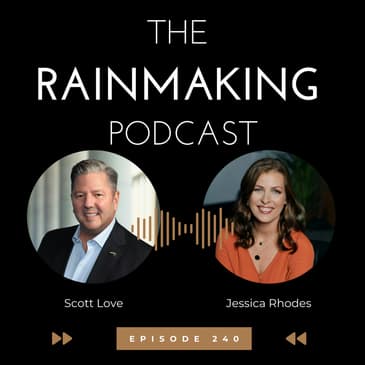
In this episode of The Rainmaking Podcast, host Scott Love speaks with Jessica Rhodes, founder of Interview Connections, about how professionals can leverage podcast guest appearances to boost visibility, build credibility, and attract more clients. Jessica explains why guesting on podcasts is one of the most scalable, evergreen ways for professionals to share their expertise and develop trust with prospective clients. Unlike one-time events or short-form posts, podcast interviews allow audiences to hear your voice, connect emotionally, and consume your content over time—often leading to deeper engagement and qualified leads.
Jessica outlines the steps to get started, including creating a compelling one-sheet, identifying shows that reach your ideal audience, and delivering value without being overly promotional. She also shares how to repurpose podcast content for email, social media, and outreach to prospects and clients. For rainmakers and service professionals looking for a high-impact visibility strategy, this episode offers a roadmap to becoming a sought-after podcast guest.
Visit: https://therainmakingpodcast.com/
----------------------------------------
This show is sponsored by Leopard Solutions Legal Intelligence Suite of products, Firmscape, and Leopard BI. Push ahead of the pack with the power of Leopard. For a free demo, visit this link:
https://www.leopardsolutions.com/index.php/request-a-demo/
----------------------------------------
Jessica Rhodes founded Interview Connections, the world’s first and leading podcast booking agency in 2013, back when no other agencies like it existed. Since its founding, Interview Connections has booked over 30,000 podcast interviews for over 800 clients! Jessica is passionate about helping entrepreneurs who feel like the best-kept secret grow their business online through genuine, human-to-human connection. The podcast interviews Jessica and her team have booked have helped their clients generate millions of dollars in sales, sell thousands of books, and transform countless lives.
Links:
https://interviewconnections.com/prep-checklist/
https://www.instagram.com/interviewconnections/
https://www.linkedin.com/in/jessica-rhodes-9a291020/
https://www.facebook.com/profile.php?id=8227848
Learn more about your ad choices. Visit megaphone.fm/adchoices
[00:00:10] You're listening to The Rainmaking Podcast, hosted by high-stakes headhunter, author, and professional speaker, Scott Love. You're listening to The Rainmaking Podcast, and my name is Scott Love, your host. Thank you for joining me on the show. Just like you, I'm a practitioner in professional services. We have to do work, but we also have to get clients. Here's the secret. Look for leverageable and scalable opportunities.
[00:00:40] In other words, do the work once and benefit from that over and over and over again. Don't focus on one-offs. Focus on opportunities that can be scaled and leveraged over time among large groups of people. For example, you write a white paper once, send it to a trade association, hundreds of people will read it. Send it to another trade association and another one. You've done the work once, but you can scale and leverage that resource of thought leadership.
[00:01:05] The exact same thing can be done in terms of podcasting. We're going to explore that today with one of the leading experts in that industry. Now, personally, I've been podcasting since 2008. Yes, I was actually ahead of the curve for once in my life. Usually, I'm so far behind that I end up ahead, but I've been doing it that long, and I've learned a lot from that. And our guest today, Jessica Rhodes, she's the founder of Interview Connections.
[00:01:30] That was the world's first and its leading booking agency in 2013 when she founded that, back when no other agencies like it existed. She's going to show you how you can take your thought leadership and, through podcasting, put that out into the market so that way your clients and prospective clients can hear you and build a relationship with you and decide that you're the one that can solve their problem. Go to the show notes to connect directly with Jessica.
[00:01:59] And as always, this show is sponsored by Leopard Solutions' legal intelligence suite of products, Firmscape and Leopard BI. Push ahead of the pack with the power of Leopard. And now, here's my conversation with our guest, Jessica Rhodes. Thanks for listening. Hey, this is Scott Love with the Rainmaking Podcast. Our special guest today is Jessica Rhodes, and we're talking about visibility through guesting on podcasts. Jessica, thank you for joining me on the show today.
[00:02:29] Oh, I'm so grateful to be here. Thanks for having me. Absolutely right. You are eminently qualified as an expert on this topic, as I mentioned in your introduction. And so, the first question I have with our guests being rainmakers and professional services firms, why do you think they should try to pursue visibility through guesting on other podcasts? Well, I actually did a live stream today to my audience, and I said, you know, no matter how much you grow your business,
[00:02:56] there's always going to be stresses, there's going to be issues, but everything is easier when you have lots of leads and sales coming in. Exactly right. Yeah. It's all, you can solve most problems as long as there's enough leads and there's enough sales closing. And that's what visibility contributes to. The more visible you are, the easier it is for dream clients to find you, the more credibility you have, the more strategic partnerships you can network with and harness.
[00:03:22] And so, visibility is the key to getting all of that, and it makes any type of business challenge just so much easier. And podcast guesting is a way to get visible that is very easy and very natural for business owners that don't feel like they know how to market well. You know, our clients are often like, I'm not great at marketing. I don't know how to market. I don't get it. I don't know how to navigate social media. But if they just get on a conversation with somebody in their industry and they're asked questions,
[00:03:50] they're like, oh, I could do that all day. Absolutely right. Right. So, somebody listening is, you know, I write white papers. I do special reports. I'm quoted in the media. I sit on panels at conferences. Sometimes I'll lead a breakout session at a conference. What's the difference? Why would a podcast be better compared to that visibility? So, a couple of the things that you mentioned there, I want to make sure that everyone sees the distinction between owned media and the things on your platform that you can use to nurture your audience,
[00:04:19] like your own LinkedIn post, your own blog, your email list. That's all your platform. That's what you're doing to nurture your audience. Of course, when you go out on a panel, you're speaking at an event, you're being quoted in the media, that's visibility. But with a panel, for example, or you go to an event, it's one time. Whoever is in that room at that moment, it's not evergreen. So, it's kind of a flash in the pan. You got to travel and all that stuff. But podcasts are where people can find you for months, if not years, in the future.
[00:04:48] It's evergreen content, and it is the future. More and more people are listening to podcasts to find information and to vet people to know how quality is this person? How much of an expert are they? Are they relevant? It is the platform to show that you are relevant in your industry today. Absolutely right. I think it's not a lowbrow sort of thing. It's not like we're putting our photo and phone number on the side of a bus. It's something that professionals listen to.
[00:05:16] One of the things I've noticed, because I recruit partners, and whenever I talk to a partner, they don't want to move. I say, let me give you something. Here's my show on client development over 220 episodes. Everybody's like, wow, thank you. And you have super smart people that see podcasts as a way, as a channel of information. And some of them are audio, some of them are video. And I think that when you have the voice, there's an emotional context compared to just reading something. What do you think about that? I agree completely.
[00:05:44] People make investment decisions because of how they feel. All right. There's the logic. I know everyone listening to this show probably has a lot of logic. You're thinking about things. You're analyzing it. You're looking at the data. You're looking at what the ROI is. But ultimately, when you choose to make an investment, it's because you feel there's some trust there. You feel like you relate to that person. They get you. They understand your problem. That is an emotional decision. It's not 100% emotional, but it has to have some emotion there. And people can hear you when they hear you speak. They do trust you so much more because anyone can write something.
[00:06:14] And now it's 2025. AI can write most content. So when people read your marketing, they're reading your blogs, their social media posts, most of us know that AI probably helped to generate it, which disappears the emotional connection from that content. Yeah, that's right. That's right. So this is good. So let's start with, before we talk about how to get booked on a show, let's talk about the show is out. How can we take that information?
[00:06:43] How can we repopulate that? How can we get that in front of clients to support our relationship and our expertise? How can we get that in front of prospects? What have you seen people do with this content that they've created through a podcast? Yeah. So number one, Scott, one of my biggest tips, you already shared it. You send it to your prospects. You send it to your clients. Hey, listen to this podcast that I did on this topic. That is probably one of the most overlooked, most valuable things you can do with a podcast.
[00:07:12] A podcast appearance, a podcast episode that you are on. Actually share it with your prospect. Share it with your clients. Say, hey, listen to this. Because the other thing I'll tell you is that most people listen to podcasts that they were referred to. Somebody said, hey, you should listen to this episode. That's how people find podcasts. It was referred to them. It was recommended to them. So recommend it directly to your clients and your leads. Use it in your marketing. You know you need to email your list. You know you need to post on LinkedIn, but you're not sure what to post. Post your podcast. I use a tool.
[00:07:42] It's an AI tool called Opus Clip, Opus Pro. And I plug in an episode of a podcast from YouTube. And then it creates clips, short clips from the interview that then I can post on social media. It's not just, hey, go listen to this episode. But it's actually a piece of content that was created from the full interview. So those are just a few ways you can leverage these interviews. Wow, that is really interesting. That is really interesting. What are some of the more creative ways you think people have used podcasts?
[00:08:12] Things that just might not be obvious. Yeah. You know, we talked about some of them, like, you know, repurposing it with the videos, sharing it to your audience. I've seen clients really leverage podcast appearances to land speaking opportunities. So if you are still going out and speaking on stages and you're working to land those opportunities, you can show these podcast interviews to the people that would be booking you to speak because they want to hear you speak before they actually book you on the stage.
[00:08:37] So anyone that you need to see your expertise and your authority and your credibility, send it out to them so they can hear you. Put it on your website. Put it on your press page. I'm using it to populate blog posts on my website. So there's just so many ways that you can use it. And I think another thing kind of along the lines of what you said, send it to your prospects. This is something I do with every partner that isn't going to make a move. Like I mentioned, I'll tell them about the show.
[00:09:03] But then a few months later, I've got my channel, my pipeline. They told me no. Now they've probably heard some of the shows. Relationships are built on frequency of contact. If I talk to someone 10 times, they're going to have a different response than if I just call them cold. But after they have listened to three or four episodes, I then call them, oh, I recognize your voice. I know we haven't talked, but that first time several months ago.
[00:09:29] But now that I've heard you over and over again, I feel like I have some trust there. Let me close my door. Let me tell you what's really going on. That's something I've used is that relationships are built on frequency of contact. And you don't actually have to physically contact them. They're listening to the show. They feel like they've heard you time and time again. What do you think about that, Jessica? I love that. I actually was just speaking on a panel last week for female founders. And one of the other speakers, her name is Eleanor Beaton.
[00:09:55] She was referencing a study that showed that most of buyers don't enter your sales process until they're about 80% sure that they want to work with you. You know, there's this trust recession she talked about. And so a lot of buyers need to consume about seven hours of your content before they have that trust and that decision. And because they're not entering the sales process until they're 80% sure they want to work with you, it's so important that you have a lot of content out there publicly.
[00:10:23] And if all you have is some written posts and content that take two minutes to read, it's going to take a long time for people to reach that seven-hour threshold. So by having podcast interviews, it doesn't take that long for them to spend seven hours with you. This is great. I mean, already in just about, what, nine minutes, we've gotten real substantive ideas that can really move the needle in terms of someone getting a new client. So I think this is really very creative work. And so let me ask you this. Let's kind of, that's the end. Let's kind of go to the beginning.
[00:10:53] Oh my goodness. This is so overwhelming. This just sounds like a project. I don't know if I have time for it. How can we kind of break that into bite-sized pieces for people to really get started on this? What do you think, Jessica? Absolutely. Let's do it. So I'm all about the action steps and the how-tos. So I'll walk you through just a couple of the steps to actually getting booked and kind of how to do that. So podcast hosts want to interview guests who have value for their audience.
[00:11:19] So getting booked is about communicating what value you can share with their audience. Because you know, Scott, you have a podcast. You want your listeners to come back and listen to the next episode and next week's episode. And so the only way they're going to come back is if they got value from today's episode. And so you want to communicate to the podcast host the value you have. The easiest way to do that is through a podcast one sheet. It's a one-pager that gives your bio.
[00:11:45] It shows a few topics you could be interviewed about, a few questions that the host can ask you. You know, you can see someone's one sheet and pretty quickly say yes or no, or I want to read more, or I want to see one of their podcast appearances. But having a one sheet is a really effective tool to getting noticed by the podcast host that you would want to be interviewed by. So once you have the podcast one sheet, that's going to be the asset that really moves the needle with the pitches.
[00:12:11] For those listening to this show, I don't recommend spending a ton of time doing this yourself because you're a busy professional. There are services that can get you booked, but I do want to demystify what the actual steps are so you can kind of see what ultimately you should probably delegate to somebody else. Sure, sure. And so once you have that, what's the next step? Yeah. So the next step is actually finding the shows. And so there are over 3 million podcasts out there. There's a lot, right? They're not all interview-based.
[00:12:40] They're not all actively publishing. They're not all in your target market. So it is about sifting and finding the shows that have your target audience listening, finding the podcasts that are relevant to your business and what your expertise is, because there's so many different shows. You want to be on podcasts that are going to be the right fit for you. And there's some really great directories like Listen Notes is a great website. Rephonic, there's a lot of different tools out there where you can do some creative searches and find podcasts that would be relevant for you.
[00:13:09] Then it's about reaching out to the hosts and showing them your one sheet and yeah, getting booked. Yeah, right. And then once you have a few of those, then you can put that in the link also, and they can listen to it. So let's say, okay, now you're booked. Let's say we've got a corporate partner that found a private equity related podcast talking about how to close a deal and what variables to look at to mitigate the risk of a deal not closing, whatever the topic is. And we've got the topic down.
[00:13:38] We've got the date and time. What do we do now? We're getting ready to be interviewed. What do you think we should be thinking about as we're about ready to be a guest on a show? Yeah. So this is where your preparation comes in. You want to show up to your interviews prepared and focused and present and knowing what the host is looking for. So a lot of great podcast hosts like yourself will have an information sheet, a part of their website that is for podcast guests to know, here are the questions I'm going to be asking.
[00:14:06] I'm going to be asking you for this, this, and this. This is what you can expect. So read any of the information that the host sends to you so that you're prepared. Take a listen to their podcast, you know, maybe check out one of their most recent episodes to get a feel for their style, have a microphone. This is a really important show up with good sound quality. Know if it's going to be video or audio. I always come ready for video, even if it's audio only, you know, sometimes the video will be used on YouTube.
[00:14:34] So come with a good setup with a good microphone. And then when you're in the green room with the host, it's this time where you're chit-chatting with the host before they start interviewing you, be present, like get the information that you need. Who's your audience? Like you proactively told me a lot of the questions that I would ask, like, tell me again, like who's your target audience? What types of, I could gather from the information you shared with me that your audience like actionable steps. So that's, do you like actions? Do they like, you know, tips or do they like stories?
[00:15:04] What is your, how can I make this a great episode for you? Yeah. How long are most podcasts that you find Jessica? Anywhere from like 25 to 45 minutes, you know, 20 minutes on the shorter end up to an hour on the longer end. Yeah. I had one guy 90 minutes and I should have asked prior to saying yes. I didn't think about that, but it went like quick, but man, I needed to lay down and take a nap after that. So, yeah. So then we're on the show.
[00:15:32] What if the guests asked us something that's just totally not relevant to what we're talking about? Should we say something? What do you think? To be honest, in 11 years of podcast guesting, I've never been thrown off like in that way. Sometimes you kind of know, like I was on a podcast called from here to there and it was like kind of that 90 minute, like life journey. Like literally he walked through my life story. I was like, wow, this is like, this is like therapy. Like let's go back to childhood, you know? So sometimes that will happen.
[00:15:59] But for the most part, if you're kind of beyond a podcast, it's just really industry specific, relevant to your business. The hosts are going to ask questions on your one sheet. They're likely going to ask the questions there. I have been asked questions where I'm like, okay. And it's just, there's a little skill there in direct, like redirecting, like great question. And this is something else I want to bring to your audience. So you can kind of like bring it back. Yeah. Good, good, good. That's great. Yeah. Should we, as a guest, should we turn this into a commercial? What do you think?
[00:16:29] Start with, here I am. Operators are standing by. The phone call is free. I mean, should we be overly salesy? What do you think about that in the show? Yeah. I think you're kind of leading the witness here. I'm going to say, no, you should not be overly salesy. But yeah, it's tempting, right? You're getting visibility. You want to grow your business. It's a marketing investment in your time and resources. But if it's counterintuitive to you, just go with me here. You do not want to be salesy. I have seen podcast hosts not publish an episode because the guest was too salesy.
[00:16:58] They won't put it out if it's not going to serve their audience. And it's also cringy. The listeners are not going to trust you if it looks like you're just trying to get something from them. Yeah. And what I've found, whether it's this, a guest on a podcast, speaking at a conference, give away your best ideas because they're going to say, you're the expert. That's a great idea. I'm just too busy to do that. But I know who to call. What do you think about that? Yeah. I mean, like pull back the curtain. I always say like, I'm going to answer all of your questions.
[00:17:25] I'm going to tell you as much as I can in the time that we have here. And I mean, we're all service providers. We're professional service providers. At the end of the day, people are going to call you because they don't want to do it themselves. So I have people sometimes say to me like, oh, I know you're probably not going to tell me your pitch strategy. I'm like, no, I'll tell it to you. You probably aren't going to want to do it, but that's, I'll still tell it to you. And so once the show is done, then what do we do? Do we wait for them to put it on the web? Yeah.
[00:17:53] So what I always do in the green room chat after the interview is I will ask the host, hey, when do you plan on publishing it? If they haven't already told me proactively, just so I can get a sense. I always keep track of all of my interviews. So I make a note so that way I can go back. And if a show that I recorded six months ago has never aired, I can go back to the host and say, hey, like what's going on here? Are you going to publish the episode? But I always ask when they're going to air it and just say, let me know when it goes live, like tag me, send me an email so that I can share it because then when it is posted,
[00:18:20] share the post, put it on your page, like get it out there, put it into your content marketing rotation. That's great. That's great. I love that. Keep track of the interviews. So when we're guesting and we're reaching out to shows for them to book us, should we present us as, okay, there's three different things I can talk about or just one? This is my narrow lane. What do you think? Does it depend on the provider, their service provider? What are your thoughts about that, Jessica? Yeah, I think it really depends.
[00:18:50] There's different strategies to securing an interview and you kind of have to decide like, what does that host seem most interested in your one sheet is going to have multiple topics. So ultimately they can look at that and see multiple topics, but you may, you could say in your pitch, my one sheet attached to this email has a few different topics that I could be interviewed about the topic I think would be most valuable to your audiences, you know, enlist one of them or say one of them in the email, but would love to hop on a call
[00:19:18] and see, you know, what do you feel like your audience would receive the most value from? Right, right, right. So, so as you have helped a lot of people become guests on podcasts, I'm going to talk about your business in a second. What do you think the biggest pitfalls are that people should watch out for as they're trying to be a guest on a show? So one of the biggest pitfalls that I see is people try to only be a guest on the biggest podcast, or they think that a podcast is not valuable or not worth their time if it doesn't
[00:19:47] look really big or if it doesn't have a huge audience. For us in business, B2B service providers, professional service providers, you know, the shows that make the most sense for our companies are not going to be the famous, huge podcasts. Joe Rogan. No, they're not going to be Joe Rogan. Give up that dream. And yeah, like a top 10% podcast probably has about 400 listeners. Like these are pretty niche audiences, but they have a very high concentration of a potential client for you within the room.
[00:20:15] So yeah, don't try to just be on shows that have huge audience or huge ratings or huge followings. Like really focus on who is the host of that show. Would that be a good person for you to connect with? Yeah, that's great. And one thing we've done with our show, we get thousands of downloads. I stopped looking at that probably about two years ago. How many people listen to your show? If it's 12 of the right people, I'm happy with that, right? It's just real niched. And I found that those podcasts that have a very clear focus, there have been some like
[00:20:44] business success, kind of broad. You know, I think the ones that have a very specific problem that they solve for their listeners, those are the ones that get a lot more loyalty. So those of your guests that you have seen asked to be guests again on repeat shows, they've done a good job because I like to have people back on some podcast guests. They only have people one and done. That's it. But I'm like, listen, if you're a good last year, you're going to be good next year. And we'll find another topic.
[00:21:10] What do you think the common theme is of those people who get asked to be a guest again on the same shows? Oh, that's such a great question. I would say they share stories and they give a ton of value and they're not trying to get something from the opportunity because your mindset and your energy in that interview, if you're like, am I going to get what I want? Am I going to get the leads and sales that I want? That is a total turnoff. Even if you're not saying it explicitly, hosts can feel that when you're totally present in
[00:21:37] the conversation and you really demonstrate through your attitude that you're there to fully give, like you can tell when someone's present in a call and when their mind is elsewhere. So when you're really present, the hosts are going to want to spend more time with you. That's great. One of my favorite guests, one of my favorite people in the world is Mary Kelly. She's a professional speaker and author. She was also my second class midshipman when I was a plebe at the Naval Academy back in 1985. So we go way back. And so we reconnected professionally and she's done very well as a speaker.
[00:22:07] When she was on my show, I was asking her a question. She said, that's really interesting. In fact, I gave a speech two weeks ago to a group like this. And this is what I talked about. I'm like realizing, oh, she's promoting her speaking. She's telling a story. And it was really, it was just a very good, wise way to be able to promote. This is what I do by telling a story without saying, call me. Operators are standing by. You're promoting your expertise by telling a story. So somebody who's a lawyer could say, I had a client that had a merger and we had a pitfall and I was able to solve it.
[00:22:36] And this is what I do. You're telling a story that gets people to say, oh, that's the attorney I should call when I'm looking to sell my company. So I could have you back on the show talking about how do you tell good stories on podcasts? There's probably a whole lot we could talk about in that regard, right? One hundred percent. Yeah. Dropping people into a moment, demonstrating the problem you solve through a story and not just saying, I do this, but there's this great saying, right? Facts tell, stories sell. Yeah. Stories sell. I love that.
[00:23:03] She planted a seed expertly because now anyone that wants to book a speaker for their next event and they heard this podcast, she's going to be top of mind. Absolutely right. And that is going to be our next topic when we have you back here on our show, Jessica, talking about telling stories on podcasts. But until then, let's kind of bring this to a close. And if you could share three action steps people can take to get booked as a guest on podcasts, what do you think those first three action steps could be? So the first action step is going to be creating your podcast one sheet.
[00:23:32] And within that, I'm going to give you a couple of action steps. Number one, write out some topics that you can be interviewed on that aren't self-serving about how to sell what you do, but that communicate your value to the audience. So write out some topics and questions for your podcast one sheet. Start writing out what are the types of podcasts that I would want to be a guest on? Who is my target audience? So you're getting really clear on what you want to be interviewed about, who you want to be interviewed by, what types of shows, and then make a plan to actually get booked. Is that you pitching yourself?
[00:24:02] Is that a team member? Is that reaching out to, you know, interview connections or a different company? But those are the first three steps. Lay the groundwork and then start taking action to get booked. Super. One, two, three. Easy peasy. Perfect. So tell us then about your company, Jessica. What is it that you do that you have that you'd like our listeners to know about? Yeah. So we are the leading podcast booking agency. We've been in business for 11 years and we were actually the first podcast booking agency in the world.
[00:24:30] Nobody else was offering this very niche service when I started the company. Yeah. In 2013. So if you want to get booked on podcasts, this is something you want to take action on. This is something we can take off your plate. So everything that I just told you to do, we can do it for you if you would like. So just go to interview connections.com. I do have a free gift if your listeners just kind of want some of those steps on how to prepare and we can put the link in the show notes, but it's a preparation checklist. So it's a podcast prep checklist and the link will be in the episode description.
[00:25:00] I love it. I can't wait to download that also. And like Jessica said, check the link for the show notes and you'll be able to get that information directly. And we'll put Jessica's contact information there as well. And also I can testify, testify, give a testimonial, testify, objection, your honor. I can give a testimonial for you that you've brought us some really great guests and they're all very professional. So thank you for helping us in that regard also. And thank you for being here, Jessica. You did a great job.
[00:25:29] I can't wait to have you on in the future. Thanks so much for sharing your wisdom today. Thanks for having me, Scott. This was a pleasure. Thank you for listening to the Rainmaking Podcast. For more information about our recruiting services for international law firms, visit our website at attorneysearchgroup.com. To inquire about having Scott speak at your next convention, conference, sales meeting,
[00:25:56] or executive retreat, visit therainmakingpodcast.com. Thank you.