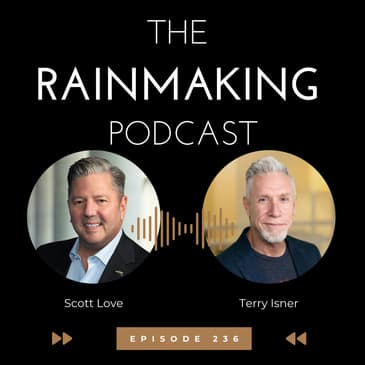
In this episode of The Rainmaking Podcast, host Scott Love speaks with Terry Isner, founder of Jaffe PR, about how professionals can stand out in high-stakes pitch meetings and beauty contests. Terry shares insights on why traditional sales pitches fail and explains that buyers already know a firm’s expertise before the meeting. Instead of focusing on credentials, firms should prioritize building connections, demonstrating authenticity, and showing why they’re the best fit for a long-term partnership. He emphasizes that engagement, creativity, and emotional connection are key factors that set winning firms apart.
Key topics include how to structure a pitch for engagement, ensuring that every team member has a voice rather than relying on a single partner to lead the meeting. Terry also discusses the importance of storytelling in pitches, using real-life client success stories to create memorable, relatable, and impactful presentations. He shares strategies for making pitches interactive and dynamic, avoiding static PowerPoint slides, and leaving prospects with a lasting impression through creative branding elements. Additionally, Terry introduces the concept of emotional marketing, explaining how personal stories, humor, and vulnerability help build trust and differentiate a firm from competitors. This episode provides practical strategies for professionals looking to transform their approach to pitching and dramatically improve their win rates.
----------------------------------------
This show is sponsored by Leopard Solutions Legal Intelligence Suite of products, Firmscape, and Leopard BI. Push ahead of the pack with the power of Leopard. For a free demo, visit this link:
https://www.leopardsolutions.com/index.php/request-a-demo/
----------------------------------------
A marketing philosopher, brand consultant and dynamic speaker for the legal industry, Terry M. Isner is known as “the empathy man” because of his humanistic approach to business strategy. Whereas many business professionals overlook compassion as part of the branding equation, Terry believes humanism is essential to a firm's success in today’s socially conscious environment. As Terry says, “If humanity gets left out of the board room, nobody wins.”
In the world of legal marketing, Terry fulfills a niche as a business strategist with an extensive background as an award-winning creative director and artist. This unique mix of creative and analytical thinking makes him more likely to set trends than follow them. In fact, Terry often draws inspiration from other industries to formulate new approaches to legal marketing, PR and branding. He also stays current on the latest trends in technology to devise ways to leverage innovation to advance brands.
Terry’s philosophical approach to business is just that – a philosophy. Bringing concepts such as creativity, inclusion and compassion into corporate culture is a reflection of the world we live in. Firms that fail to be cognizant of such issues risk damage to their reputations and devaluation of their brands. Terry helps preserve brand equity by helping firms adapt to these changing times and sharing their unique stories in creative ways across multiple channels, including print, digital and social media. He also uses his passion and expertise to empower marketers to be effective agents of change within their own organizations and help drive their firm’s sales, branding and culture.
Increasingly, employees desire an employer that emphasizes a culture of diversity and compassion. This trend is accelerating as significant generational shifts ignite change in the workplace. Terry specializes in helping firms maintain a cohesive culture and navigate generational change through creative internal campaigns, unique team-building activities and community engagement opportunities that foster camaraderie at all levels.
Links:
https://www.jaffepr.com/our-team/terry-m-isner
https://www.linkedin.com/in/sharingtmi/
Learn more about your ad choices. Visit megaphone.fm/adchoices
[00:00:10] You're listening to The Rainmaking Podcast, hosted by high stakes headhunter, author, and professional speaker, Scott Love. You're listening to The Rainmaking Podcast, and this is Scott Love. Thanks for joining me on the show. Have you ever been in a pitch, a beauty contest where you're in front of your client prospect, telling your story, showcasing your expertise, why you're the one to solve their problem?
[00:00:38] And maybe you didn't get the work. Maybe there's two or three other firms right behind you that did get the work, and you didn't. How can you tilt the balance in your favor? How can you be prepared for these types of meetings? How can you be creative and different so that they get the message that you're the one to solve their problems? We're going to answer those questions and more in our conversation with our guest today, Terry Isner. Now, Terry is with Jaffe PR. He's the founder of that company. He's a marketing philosopher, a brand consultant, and a dynamic speaker for the
[00:01:08] legal industry. Listen to Terry's expert advice that can help you during your next pitch. And if you like what you hear, make sure you connect with him. Visit our show notes and you'll be able to connect with him directly. As always, this show is sponsored by Leopard Solutions, Legal Intelligence Suite of Products, Firmscape, and Leopard BI. Push ahead of the pack with the power of Leopard. And now here's my conversation with our guest, Terry Isner. Thanks for listening.
[00:01:37] Hey, this is Scott Love with the Rainmaking Podcast, and our guest is Terry Isner. And we're talking about Pitch Perfect, how to win the beauty contest. Terry, thanks for joining me on the show today. It's so great to be here, Scott. Thanks for having me. I really agree. Yeah, absolutely. This is great. And I love the topic. How can an attorney or any other professional and professional services, you're sitting in front of that panel and you're selling your firm's opportunity to solve their problem.
[00:02:05] Tell me about that. What do you think should be on somebody's mind before, during, and after that sort of meeting? What are your initial thoughts about that, Terry? You know, when you think about the pitch these days, the idea of going in and selling, you know, the firm, we had so many different ways in which we went about marketing or doing our business development. And when you're dealing with the professional services industry, in most cases, they're going to be as buttoned up, in most cases, as boring as you can imagine them to be.
[00:02:34] But the world has changed so much with technology that a lot of the businesses that are interested in your services or interested in your attorneys or your accountants or whoever it is that they're, you know, they're working with the time. They've done their due diligence, right? So they already know professionally what you can bring to the table.
[00:02:51] But so many times the attorneys or the accountants or those that are behind the pitch themselves really feel that they need to continually sell their expertise and or the firm's expertise and don't really give credit to the idea that you're at the table because they already recognize what you've done. What they're really looking for at that point is to really understand who you are as a person. Can we work with you? Do we have the same values?
[00:03:18] Can I trust that what you've articulated from a marketing standpoint actually is the way that we'll work together and what you would provide to me in general? Yeah, yeah. And how long are these pitches usually? You know, a pitch shouldn't probably be any more than 15 to 20 minutes. I think there's a time frame as human beings that we begin to lose sight of what's, you know, being talked about or the educational process or whatever that is.
[00:03:46] So I'm always a big component of trying to keep things short and leave it open to the ability to have dialogue, to create relationship. And I think if you're just going through slide and you're going through stats and you're articulating things that they can find on your website, you pretty much lost them early on. Yeah, that's right. That's right. I like the fact that you just addressed that issue. They already know who you are. They already know your firm. They already know that there's a level of expertise where you can solve their problem. That's why you're in the room.
[00:04:14] Are these pitch meetings, is it usually you're there, that's it, and you're done? Or is it, okay, next, and there's another one after you? What have you seen usually on pitch meetings? Actually, both. Sometimes they'll have a pitch and you'll have one day, maybe even one week to one firm that they've decided to interview. Or they can be back-to-back, and a lot of firms do the back-to-back. And sometimes you can see who's actually coming in next behind you.
[00:04:37] But I think the important part of that really, it doesn't really matter your time slot or how much time they're giving you. What they are looking for is engagement. They don't want to be preached at. They don't want to be sold to. Nobody wants to be sold to. Nobody wants to feel like a client. Nobody wants to feel like a quota. So you're really in there to build a relationship. And that's what they're looking for. Do you have the ability to build a relationship with me, one that I can trust? Yeah, that's great.
[00:05:04] So how does that partner, what is he or she, what should that person be thinking about or saying during that meeting to really build that engagement? What do you think? What have you seen that works? Well, I'll tell you right now, you asked the right question. What should that partner do? That's right there, number one failure. It shouldn't be one partner. Today, it's about teams. And they want to experience your team.
[00:05:28] So if you're coming in and you're going to be that lead attorney that's going to sell this, that's becoming pretty outdated, especially in the legal industry, accounting industry, other industries where it's team dynamics and we're looking for team. Why? Because, yes, there is DE&I and other things that are coming towards us that we have to stay focused on.
[00:05:45] But if we think about the diversity with even in generations and the ability for us to think so differently within those generations and solving problems, whether they're through technology, whether through old traditional means in which we build relationships or solve problems, they're looking for those levels of dynamics, right? We're not going in and it's not a 60-year-old man talking to a 60-year-old man anymore. And that used to be the case.
[00:06:12] You have a huge group of people who are interested in working with a larger group of people, and they want to understand all of those people in there. So if you're going in as this lead, I'm going to handle this presentation and it's my way, you've already set yourself up for failure number one. Wow, that's interesting. I wouldn't have guessed that. So what should that partner do? The partner is with this team. Maybe there's another partner. What about associates, counsel? Should they come on the pitch too? 100%.
[00:06:40] So a lot of times we heard inside counsel say, we appreciate that you've put up the yearbook style photo of your team. We really want to meet your team. And we don't want you to give us one minute per person on your team. We want to understand why they do what they do and how they feel they could help us and what it would be like to work with them in general. Every single person on the team should be given an opportunity to speak. And that's what they're looking for. That's great.
[00:07:10] So how do we prep our team? We're having a meeting. We've got my five people. We're meeting with big company with their five to 10 people in two weeks. And we've got 30 minutes slotted. We know there's going to be three firms after us and two firms before us. We're having our huddle meeting before to really talk about this. If I'm the leader of that team, what should I be focusing on with my team and how we prepare for that?
[00:07:33] So because there's a lot of activity and a lot of noise and related to the idea of the choices they'll make in hiring their professional service provider. You need to leave them with sticky things. Things that they can really remember you and gravitate to. So here's a good story. I was able to sit into one of these pitch reviews with one of my clients.
[00:07:57] And I designed my client's pitch based on the creativity and the brand story that I wanted to tell, the story I wanted them to tell, and what I felt that I already realized that inside counsel or general counsel was looking for. And it was a pretty cool pitch. She is a pilot. She only became a lawyer because she wanted to buy her own airplane and fly. And she realized that's where she would make the money. She has this incredible story, these great videos, really terrific person.
[00:08:26] And I love bringing the airplane into her brand. It's a big part of what she does. And we called her whole team, the flight crew. And, you know, we got very clever and very creative with the way that we presented it. Because again, we wanted them to hold on to something and leave. She stripped the proposal down to little parts of the creativity, but really, really took out a lot of the creative that we put into place. And the general counsel said at the end, this is a wonderful story.
[00:08:56] We wanted so much more. We really wanted you to dive in hard to being the pilot and the airplane. And we wanted to see more. And we wanted to learn more about your flight crew. And she said, my marketing guy told me I should have done all that. And they said, you should have listened to your marketing. Oh, gosh. Oh, no. Was she able to save it, do you think? Oh, absolutely. She still did a great job. She's somebody that you really, you know, she's a small firm. She had two, three other people up there with her. She really gave them an opportunity to speak.
[00:09:26] What it did for them was really showcase the diversity. You know, a woman-owned company. But like a lot of professional service lawyers, accountants, you know, equity partners, they just, they don't see the side of creativity. They don't see the side of humanity. They don't see that side of sharing and opening up as much. And they go in a bit more concerned about this is professionally what we can do. But the beauty was they wanted to feel like I'm being brought into your world.
[00:09:55] I want to experience what you're telling me more so than you're giving. You know, what's interesting, I had a thought. Out of those, let's say there's four firms pitching for that same opportunity, I'd be willing to bet they're all pretty much just as smart as each other. They've all got really good experience. Any one of them, they could kind of throw darts against the wall. And whoever they hit, that's what they're going to work with. We can just assume that.
[00:10:20] So what I think just by having to talk to, you know, thousands of smart people like lawyers, they like interesting people. And what I would say when you said the flight crew, I think that's a theme. I think if you could kind of wrap that around, you know, what's the theme that's interesting or that's interesting to other people about your team? What do you think about that? Calling it a theme. What do you think about that, Terry? No, I think a theme is fine.
[00:10:46] And I think what happens when we call something a theme that you actually kind of make it, you make it that thing that kind of is a trend a bit more so. This isn't. To me, a brand comes from inside. This is a woman who wants to be a pilot. She admired an astronaut and she found a way in which she could live her life the way she wants to live it. Her airplane and her Airstream are all inside of her airport hangar.
[00:11:13] And I've had meetings there with her, you know, that's the brand, right? That's not a trend in any way. That's not a theme. That is like it. And I think themes get identified too fast as a gimmick or just a marketing campaign. And for me, this isn't. This is real. And this is where it's really sometimes you get to the lawyer and you have to say, this is the authentic you. This is the story. This is what they're going to want more of. And they're going to eat it up.
[00:11:42] And every time I tell this story and every time I show her videos at any conference I'm speaking to, everybody comes up and loves the story of this firm. Because we're able to tell that really authentic, organic story that us as humans want more of. That's great. So I think people should think about what's the brand? What's unique about them? What's that interesting story and kind of wrap their group around that, so to speak.
[00:12:10] Scott, here's something really interesting about that. You know, professional industries has a lot of ego. Okay. And when you have a lot of ego, sometimes you don't have the ability to look past that. So you don't see the uniqueness in your team.
[00:12:24] So you might have a woman who came to the U.S., was not born here, didn't even grow up here, but came here for the American dream, wanted to become a lawyer, wanted to become a lawyer to do international work, and tells her story of coming over here and going to law school and becoming a lawyer and why it matters so much to her and her family and the practice area in which she's focused on.
[00:12:51] And you just look at the room with their mouth opening and wanted to hear more. And the story is sad. And so you can almost see the tears. You got them. Like, you got them. Like, they want to work more with you because you allowed emotion in. And emotional marketing is such a powerful tool, but the professional industry and others are kind of afraid of it, right? Oh, my God, I have to be vulnerable? Yes. Yes, you do.
[00:13:17] Because the law firms and the lawyers and the accountants and the accounting firms and the professional services, finance firms, they're a dime a dozen. Sorry, but you're a dime a dozen. Legal is one of the most saturated industries. So if you are in that, what are you doing to connect? And when you said that back-to-back law firms could look very similar, I often say I could peel the logo off of one firm and stick it on another firm, and they would be exactly the same firm.
[00:13:48] You're absolutely right. That's kind of where our business is the same. But I like what you said about emotion. The emotional marketing, I've never heard it put right that way. Could you put some clarity into that? How would you define emotional marketing, Terry? So emotional marketing really is creating a way in which you connect on different levels. So at one, it's what keeps my client up at night, right? Knowing that. What makes them happy? What's their family situation?
[00:14:17] What's their stress situations at work? What's the last vacation they went on? All this sounds like, okay, yeah, but that starts to build the emotional relationship. I'm tattooed all over with underwater sea life. I'm a scuba diver. So when I sit into a room and I have my suit on and my shirt on, and I watch everybody pick their phones up and kind of get bored with my pitch, I take my jacket off. I stand up and I roll my sleeves up. And then they realize, wait, that guy's fully tattooed.
[00:14:46] That guy's kind of cool. We're talking marketing and creative. I'm going to put my phone down for a minute because I kind of liked his idea. Now I want to talk to him because he's a scuba diver. I started to connect differently and change the room dynamic because a little bit of me come out a little bit more and I controlled the room through emotion, through the idea of I can connect with him in some way. You tell a story that makes somebody just slightly tear up, you've won them over.
[00:15:16] You tell a story of empathy. You tell a story of lifting somebody up. You've started to bring in an interest to who you are. And we don't tap into emotion so much, but think about it. Ninety-nine percent of the decisions we make are emotion-driven, right? So if I have no emotion and you tell me in a logo design, what color do you want? Do you want green? Do you want purple? Do you want blue? I don't care. Oh, God, I hate this logo. It's blue, right?
[00:15:44] So the idea of letting your emotions help drive some of the things that we do to make those connections is actually more powerful to me than any of the professional expertise that we have because people can go toe-to-toe with you there. But they can't go toe-to-toe with who you are and the emotional connections and relationships in which you're vulnerable enough and comfortable enough to give. Wow, that's great.
[00:16:10] And there it is, ladies and gentlemen, the mic drop moment of the episode. That's great, Terry. This is really good. I mean, everything you say, my business is similar. I'm professional services. I'm selling. I'm recruiting. I'm selling to candidates. So I see a lot of similarities here. I've done a few pitches. And you're right. I remember the first time I ever did that. Chairman of a large 100 firm. He's looking forward to meeting with you. And you got 30 minutes. And I realized, oh, he didn't come here to meet me. He's meeting me and four others right after me. I didn't even know that.
[00:16:40] Fortunately, I won that account. So let me ask you this then. What do you think the biggest mistakes and pitfalls attorneys make in these types of meetings? So the biggest mistake is repeating your website in your pitch. Absolutely the worst thing you can do. Just going and pulling all of the information they've already seen. So ideally, what you have to say to myself is, what is this journey? I need to articulate what we do and what we do best.
[00:17:06] They already know it, but I need to make sure everybody in the room completely understand this as we move forward. I need to introduce my team. I need to allow my team to introduce themselves and to create a relationship with them. I need to better explain how our team dynamic works. I do need to show our accolades. Badges are great. You know, win, super lawyers, super accountant, chambers. All these things are important to them. They want to know that their rankings. So don't shy away from them, but don't spend too much time on them.
[00:17:34] You want to get into the storytelling. If you are there at the table, that means you have experience in doing what they need. Tell them a story. Tell them a situation. Have a slide that literally just has a photograph of a situation and sit back for a minute and let your team tell a story. Let them all together share. Basically bring case studies, real-life case studies, and feel very comfortable to articulate them.
[00:17:59] Not recite them, but articulate them in a way that you can say, I see ourselves in that same situation. We were experiencing that same thing with our other attorneys, and this is one reason why we're looking. I like the way that you all went about solving that problem. Wow. That's great. Terry, this is fantastic information. I don't want to stop. I know we're kind of running out of time here. Let me ask you this.
[00:18:23] Before we go, tell me about a law firm you worked with where everything you shared with them was new. They never considered this. What were some of the challenges they went through? What were some of the big changes they made, and how did it result for them? And you don't have to mention the firm's name, of course. I'll tell you another firm that went through the process with us and what we did because they kind of had to suck a lot up and go, okay, I'm going to follow you on this one, and we're going to do it.
[00:18:51] And a lot of it also for me was really trying to get leadership to understand the importance of those things I just shared, the idea of collaboration, the idea that those that are looking to hire you are very interested in that collaboration, the diversity of that, the way that you act as a leader, the way that you come into that meeting acting as a leader, all these things they're measuring you on.
[00:19:14] And the one, there were two partners, and one of them was very open and honest with me that, you know, he's a hard ass, and he thinks he scares a lot of the associates, and, you know, he just needs to change his dynamic. And he saw one of my presentations about being an empathetic leader, and he told me it changed his life. And it changed him in a way that changed the way that we presented them. So what the dynamic was, they're big sports guys. And I said, let's take a sports analogy. And they talked about being in the New York court system, and they love basketball.
[00:19:44] So I said, all right, let's play off the courts, the idea of a court. And so we did, and we created a team dynamic. And we treated the associates almost like rookies, and we gave them stats. And we treated everything that we did almost like you would if you were fully invested into, you know, sports and the understanding about sports. And again, we talked about member being memorable. You have four people in line are coming right behind you and coming right behind you and coming right behind you.
[00:20:12] So we went through this whole process of really talking about how they're changing the court systems, especially through their idea of being very diverse within the court systems and how well they knew them. But we played it from the idea of a basketball court. We gave everybody sweatbands at the end of the presentation with the... Like the client prospects? Oh, yeah. The other one we talked about with the airplane, also, you know, what airplane? You know, with the one you threw as a kid?
[00:20:41] These are critical. You leave the room. You could have 10 others. But when you get up and leave and grab that sweatband, you're going to remember the story of basketball. You're going to remember the story of this firm, the way that he changed himself as a coach. And now they have one of the greatest associate growth programs I have seen in the last year. They have so much work and so much growth, they don't need me anymore, which kind of sucks. But that's great, Terry. Wow, that's interesting.
[00:21:10] So if somebody wants to implement these ideas, they want to start making some changes in how they make that pitch. If we could summarize it in three action steps they could take, what would those three action steps be? Number one, understand that they already know who you are and what you bring to the table as a professional. So come in and summarize that. But really focus a bit more on connecting and relating as a human, human to human. People do not want to purchase a brand.
[00:21:39] They want to align with other people to help them solve their problems. That's great. So that's number one. What's number two? Number two, make sure that you bring in a team and a group of people. Make sure that you let that team and group of people have their time. Do not try to control that. Allow it. You do not know where the connection is going to be made emotionally. We cannot dictate that. So you have to create opportunities where emotion can connect in multiple different places.
[00:22:06] You as the lead might not be who they want to work with, but the rest of your team, they just might want to work with all of them. And that could end up getting the sale. That's great. And what's number three, Terry? Number three, be creative. If you do not come in with the idea of allowing yourself to give a chuckle, to blow their mind uniquely, to leave something behind that they say, that was a lot of fun and we really enjoyed working with this firm. And I have this sitting on my desk and I keep thinking about them.
[00:22:35] That's what you want to do. Stay top of mind. Always be on the short list. And to do that, you have to break through that noise. And to break through the noise for me, it's being really creative and unique. Wow, that's great, Terry. Thank you so much for sharing this with us today. This is really important information that I know people are going to apply and see a difference from that. And tell us about your company. What do you all do? What do you have? The services and offerings that you'd like our listeners to know about. Sure.
[00:23:02] So Jaffe is a marketing and PR agency that was conceived when the Supreme Court told lawyers that they were allowed to market themselves. So we like to think that we wrote the book on legal marketing. So, and our tagline is adapt to change. And a lot of things that you're talking about today is exactly that, right? We just need to constantly adapt to change. And a lot of change has been thrown at us. And a lot of change is thrown at us right now as we start to enter into a whole new administration again.
[00:23:29] So we have to learn to adapt to these changes so much faster and so much easier than we have in the past. That's great, Terry. We're going to put your LinkedIn profile and also your company website on the show notes. So everybody listening, if you want to connect with Terry and his colleagues, go to the show notes and you'll find all that information there. Terry, thanks so much for being here today. Great job. And I'd love to have you back on the show in the future. I would love it, Scott. Thank you so much for having me.
[00:23:57] Thank you for listening to The Rainmaking Podcast. For more information about our recruiting services for international law firms, visit our website at attorneysearchgroup.com. To inquire about having Scott speak at your next convention, conference, sales meeting, or executive retreat, visit therainmakingpodcast.com.