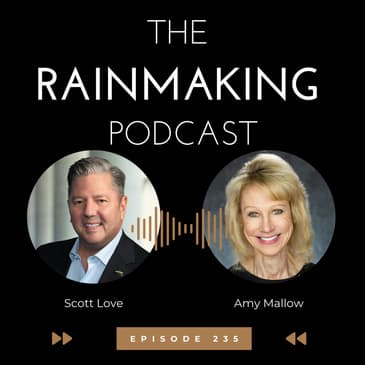
[00:00:10] You're listening to The Rainmaking Podcast, hosted by high-stakes headhunter, author, and professional speaker, Scott Love. You're listening to The Rainmaking Podcast, and my name is Scott Love. Thanks so much for joining me on the show today. Our topic for today is navigating your career with clarity, courage, and confidence.
[00:00:36] Everybody listening to the show can benefit from this, especially if you're at an inflection point in your life and you're trying to make decisions about where you should go in your career. Our guest is Amy Mallow. Amy is a professional-certified coach that helps professionals in transition and in other areas. What's different about her is that she's seen it all. She's worked in large global law firms as an internal recruiting manager, somebody I've worked with personally, and also worked as a third-party legal recruiter.
[00:01:05] So she's got a full spectrum of experiences and deep wisdom and insights that she shares with you today. As always, this show is sponsored by Leopard Solutions, legal intelligence suite of products, Firmscape, and Leopard BI. Push ahead of the pack with the power of Leopard. And now here's my interview with my guest and good friend, Amy Mallow. Thanks for listening. Hey, this is Scott Love with The Rainmaking Podcast. Our special guest today is a good friend of mine, Amy Mallow,
[00:01:34] and we're talking about navigating your career with clarity, courage, and confidence. Amy, thanks for joining us on the show today. My pleasure. I'm glad to be here. Yes. So let me start from this perspective. And as people know, you've got really good credentials and depth of experience in this area. What do you think the big pitfalls are that people have made that you've seen and how they've managed their career? Let's just kind of start with that.
[00:01:59] So I think what I've seen most commonly are people not taking necessarily charge of directing their career and maybe taking a direction that either is something they felt was expected or maybe something that was an opportunity that came to them or maybe something that, you know, they thought they were supposed to do.
[00:02:24] And so what I find, and sometimes that works out great and it may work out for a while. And then people start reflecting on whether it actually does align with their current values, priorities and goals. Right, right. So give me an example. When you say they thought they were supposed to do it, they felt it was expected of them. What do you mean by that exactly? So when I've talked to some people, for example, a client that may have felt family pressure.
[00:02:51] And so they went and joined a big firm. They were at first gen. They felt that that was expected to do that when their real passion was doing another area of law that may not have commanded the same amount of compensation. Right. Those might have been a lower rate type of a practice like education law or somewhere that really fulfilled their passion and their background.
[00:03:17] But they felt pressure to meet expectations of family or societal. Yeah, that's interesting. That's interesting. And so what should people do? Should they take an assessment of what their interests are and what they want to do? And if so, when should they do that in their career? And I know everybody's at a different point, but what have you seen are the best ways that somebody can manage that? That's a really great question. That's a really great question.
[00:03:41] And actually, what I think is important is for people to know that there are different points in their career where they meet these inflection points. And it doesn't mean that what you've done was not maybe even the right thing at the time or something else. So there's nothing wrong with doing these assessments at different points in your life when your values change, your priority changes, your lifestyle changes.
[00:04:07] Right. And so that's where I think doing assessments at various points in your career and what I usually like to do with my clients is kind of give them this is when they're at this inflection point is to give them a comprehensive assessment where we really look at their core values,
[00:04:26] their key skills and the expertise, their ideal work environment, looking at the must haves, the don't want to haves and the nice to haves, and then the potential barriers and challenges. And then we come up with an action plan. And I also like to have them take this time to see what they've been able to fulfill and achieve in their current role, where they still see they could continue to develop or apply skills, strengths,
[00:04:55] values that they haven't. And then we align that new direction with that as sort of the North Star. Yeah. It sounds like you're writing a business plan, Amy. Exactly. Yeah. How about that? What if we thought of this as a business plan, a career plan, like a business plan, right? Very much so, because you're looking at what you've done and where you're going to go. Yeah. Right. So you mentioned inflection points. How would you define that? What exactly is an inflection point?
[00:05:25] So I think an inflection point is where you start feeling inconsistent with where you are. You start getting that little voice telling you, hmm, I'm having a little anxiety or something's not feeling consistent. I'm not sure that I'm doing what I want to do right now.
[00:05:46] And it's scary. So we hear that voice and we often rationalize it or maybe I'm having a bad day or somebody said something or the case when, you know, south or whatever it is. And then the voice starts speaking louder. And then you start finding it hard. This is really key is that a lot of the high achieving professionals are in very demanding jobs.
[00:06:13] And so it's not one where you can just say, oh, I'm going to sail through. It really takes a lot of dedication and motivation and going the extra mile. And when you start losing your what I call your what for for doing it where you are, it becomes harder and harder to sustain that level of energy that's necessary. And that is when the voice starts talking very loudly. And I call that the inflection point.
[00:06:42] It's interesting. So so when you talked about when you start losing your what for what does that mean exactly? So it means that let's say you join. Let's just take a law firm and you're what for maybe when you start it is you want to get some good experience. You want to go to a big law firm to get the salary and you're what for maybe because you want to establish yourself financially, whether it's paying off your loans or something else.
[00:07:10] So at that point, you're what for maybe I'm doing this financially. I want to get the training. And then at some point that what for is not the driving force. And so then you're asking yourself, well, wait, why am I putting in all these hours or why am I doing this? And what I love to do with clients is to make them view whatever they're doing as a choice. So you may say, yeah, you know what?
[00:07:37] I don't love doing all these hours, but I'm choosing this because I really like the benefits. So anytime I get that voice telling me I'm not sure I'm in the right space, we can look back and say, OK, but you're making the choice to stay here. So anytime that that voice is talking to you, you're going to go back and say, well, this is why I'm choosing to stay here now. But if you can't have that what for at that time, that's the time then where you should be exploring something different.
[00:08:04] I love what you said. That's brilliant. Make whatever you're doing as a choice. I think that gives people a sense of control, doesn't it? Absolutely. And a lot of clients I've worked with, sometimes they say, oh, you know, I feel trapped. And then as they feel guilty, they feel trapped. You know, I should be grateful. I'm in a job. I have great salary. I generally like the people, but I'm feeling trapped. And sometimes I'll say to them, but you're not trapped.
[00:08:32] You could actually choose to leave tomorrow. You really could. You may not want to. And when we look at all the motivating factors one way or the other, that may not be your choice, but you're not trapped. And so I think that exactly what you said, it really gives them power. And they can view it in a different way rather than as passively accepting something, as actively choosing something. That's right. They have agency. They can control it. I love that.
[00:09:02] I think that makes life less stressful when you feel like you're choosing it. And we can't control everything, but we can control how we respond to certain things. And especially in careers, when people are going through change, for example, with all the government layoffs, that's catastrophic. That's adding a lot of stress. And people, I think by looking at, okay, how can I take this as a choice in terms of what I do now, in terms of how I respond and what action steps I take?
[00:09:28] So I find that your advice is really insightful and helpful, Amy. Let me ask you this about other inflection points. Could an inflection point be when a firm merges with another firm or a firm shuts down an office? Or even personally, you have a kid that leaves home, things like that. What have you seen in that regard? Yes, absolutely. And what I see then is sometimes what I was focusing on is the internal messaging you're getting.
[00:09:55] But sometimes there are external circumstances that cause people to have another inflection point. Maybe the leadership at your firm has changed and you're not exactly sure you're in line with the direction. Maybe the firm has merged and you're not exactly sure how your practice, and I'm going, you know, analogizing this to the legal field. You're not sure how your practice is going to continue to thrive, whether there's going to be more conflicts, whether there's going to be more competition. So that might be a catalyst.
[00:10:25] There could be an outside circumstance that's a catalyst. Or to your point, it's a life change. And that goes back to maybe your priorities have changed. At some point, your priority may have been to have a different type of lifestyle. But maybe with some freedom, you can look at things differently and expand your horizon. So absolutely. And I think when we get those outside circumstances, and to your point, sometimes we don't choose those circumstances.
[00:10:51] But we do choose how we then decide to go forward from there. That's right. Have you seen someone where they've gone through, let's call it a catastrophic situation, a firm shuts down an office? What did you see that they did to where they actually were able to use that to their benefit and come out on top? Tell me about that. What have you seen in that way, Amy? Yes.
[00:11:15] So I've recently, I've seen a couple different things where, let's say, the firm was shutting down. And then there was an opportunity to either go with a group or to go explore other options. And again, that is the point of inflection where you then say, what's best for me now? Do I stay with this group that I've known? Do I go as a better opportunity?
[00:11:43] Do I try to go with the group and see if that's going to work? So I do see some of the things that happen with that. Or we also see sometimes where firms may decide to deprioritize a certain practice group. And then they say, oh, well, I'm not sure right now that I'm going to get the support that I traditionally had. So that is then an inflection point to say, OK, you know, I may love the people and all this, but I'm not sure that my practice is going to be best supported here anymore.
[00:12:12] So that, again, is another inflection point of exploring other things that might present a platform that would be of better value to you at that point in time. Right. That's great advice, Amy. So let's say you're coaching someone and they've made a decision that they need to leave their law firm and they don't want to go in-house and they want to go to another law firm. How would you coach them to make the decision of which firm is the best option for them?
[00:12:40] So first, we would want to look at what their priorities are and what their reasons are for considering the move. So what we want to do then is see maybe again where they're not getting what they need to thrive and move forward where they are so that we can really identify what are those critical key areas that we should be focusing on going forward.
[00:13:07] Then it's also an excellent time to look at the type of environment they want to go into. And this is where we do the must-haves, the nice-to-haves, and the don't-wants. One of my favorite things I love to say to my clients is you never step into the same river twice. Why is that? Because you're always changing and evolving and life is flowing.
[00:13:29] So the hindsight you get from the experience you had, the insight you now have, and the foresight you have, is going to then drive you to make the right decision for that next chapter. So it's looking really at what is their motivations for wanting to make that change in the first place and then making sure, looking at the other elements of what they'd like to see, that that new platform is going to help fulfill that.
[00:13:58] Nothing's 100%, but it doesn't quite. You have that ability to evaluate. And this is the right time to do this, not to put a Band-Aid on it, but to make sure that you're aligning this next job with where you actually want to be. That's great advice, Amy. Let's say somebody left, is deciding to leave their firm, and they get an offer, and it's a good offer, and that firm could work, but they get second slots and they think, well, I think I'm going to take that counteroffer my firm gave me for me to stay here.
[00:14:27] It's more money. Oh, they made me an equity partner. And, you know, maybe it's just not that bad. What would your career advice be for that person, Amy? What do you think about that? Well, I think that oftentimes we want to stay in our, what we call a comfort zone, but we have to remember that our reason for wanting to explore something in the first place was because our comfort zone was not working for us.
[00:14:57] And we are always, the fear always creeps in. What I love to say to people too is things are not going to be zero, 100. So you might like the firm where you are and something's worked and now they're giving you this. So it's not going to be like, oh, I'm 100% sure that I'm going to make this move and zero percent that I would stay.
[00:15:24] It's that we look at where are you on that continuum? So yeah, maybe it's 70% that you think this new platform is going to be better for you. There's going to be that 30%. They offer me more money. It's comfortable. But as you and I both know, and I've done recruiting as well as my coaching, is that you settle back in and some of the same things that were
[00:15:51] talking to you with that voice come back. Right. I like what you said about never going the same river twice. It's kind of the same thing with this also. If you decided to leave them for certain reasons, the money isn't going to really solve those problems, is it? Unless your what for is strictly about the money. That's great. And that's a good anchor point, I think. How do you help people find out what that what for is? How have you done that?
[00:16:20] Well, this is where we really look at their assessment of their values, of where they are now, what their motivations are, where their strengths are that they want to continue to develop and use, but also really is where do they want to be?
[00:16:42] Their what for is, what is it that's going to inspire them to continue to grow, motivate, and thrive? And so the what for has to be that something that you can come back to. You're a North Star. So we really unpack that and we try to look at that. So again, if you're telling me the North Star,
[00:17:08] you know, I've got three kids in private school and my North Star right now is simply the money. Okay, then. When you get those feelings by staying where you are because of the money, you have to remember that's your North Star. Is that what you call it? The North Star? That's I like to call it a North Star because I like it to be what people's guiding light is. Yeah. So they know what it is that's keeping them thriving, motivated, and fulfilled.
[00:17:38] Amy, I think you've just nailed it on the head here, articulating it in a way that I'd never heard it expressed before. And I think it's brilliant. That North Star, the what for? And I think people listening to this need to ask themselves, where are you in your career today? One thing I ask people in my work of recruiting corporate and finance partners, I ask them, are there any goals you have that you can't reach in your firm? And what's amazing, Amy, is when people say, gosh, that's a good question. And I'm thinking, you should ask that question to yourself 10 years ago, right?
[00:18:07] But people, I think we just get caught up in the grind of the day-to-day. And some of us, I think, we can stuff that what for? The North Star, we can stuff it. We don't need to think about that. But after a while, life becomes stressful, and there's going to be some sort of, I wouldn't call it a breaking point, but a bending point, where now there is an inflection point. And now we realize, oh, I didn't really pay attention to that. So I think your coaching advice is salient. I think it's definitely impactful to people.
[00:18:36] I mean, and let me ask you this as we're bringing this to a close. I usually end these with three action steps. But let's say there's three action steps or three concepts that you think people need to keep top of mind as they manage their career. What are those top three suggestions you'd have for people? So the first is pay attention. Pay attention to what you're being told internally. So start by paying attention. When you get that feeling, you may or may not want to listen to it.
[00:19:05] But when it gets that loud, listen to it. Because it's telling you that there may be something else for you. Right. Once you pay attention to that, then it's start to really explore what that is. And that's where I think having a coach or somebody, or whether it's a recruiter that's working with you, can really help you sort that out and really see what is behind that. What is the motivating factor?
[00:19:34] So once you do that, you're paying attention. You're exploring it further. Once you identify that and you can explore it, then you put together an action plan to help what I want to say, respond to all of that that you just uncovered. And then the last thing I'm going to say, and this is my favorite book, there's always going to be fear and change. There's always going to be discomfort and change.
[00:20:03] But the book by Susan Jeffers, Feel the Fear and Do It Anyway. Because if we let the fear stop us, we're letting it prevent us from a more joyful and fulfilling career and life. Amy, that's brilliant. I want to thank you for sharing that and just going deep on our show today. I know everybody listening to this, everybody can benefit from the advice you've shared. And so tell us about what you do. What are your offerings? What are your services? What do you have that you'd like for people to know about?
[00:20:32] And we'll certainly include all of the links in the show notes. So no matter where you hear this show, go to the show notes and you'll be able to connect with Amy directly. So thank you, Scott, for this opportunity. So I am a credential coach with the International Coaching Federation. Had, as you know, a lot of experience primarily in the legal field, working with lawyers and legal professionals, whether that would be COOs, CFOs, professional development. So I work with people throughout primarily the legal field,
[00:21:02] and I help them navigate their careers with clarity, courage, and confidence. And the areas that I focus on are career exploration and transitions. So if people are thinking about a move, or they may have been asked, you know, to be starting to look elsewhere, I help them work through that performance maximization, whether, you know, if they're in their current job and they want a little help in confidence building, communication, business development, leadership development,
[00:21:31] navigating a difficult situation or a challenge or a complex situation at work, transitioning to the next level, right? If they're, let's say they're an associate going to a senior associate, they're a junior partner, and now they're starting to take on other types of responsibilities. And then the other place I really support people is when people are making lateral moves. And sometimes firms have wonderful integration teams and support, but oftentimes when people are making a move,
[00:21:59] they can use some additional support in how to navigate culture, time management, and building internal and external relationships, all of that that comes with it. That's great, Amy. Thank you so much for being on the show. And I'd love to have you on the show here in the future as a guest again. And I really do appreciate you sharing this wisdom with us today, Amy. Thank you, Scott. Thank you for the opportunity. Thank you for listening to The Rainmaking Podcast.
[00:22:26] For more information about our recruiting services for international law firms, visit our website at attorneysearchgroup.com. To inquire about having Scott speak at your next convention, conference, sales meeting, or executive retreat, visit therainmakingpodcast.com.