This show is sponsored by Leopard Solutions Legal Intelligence Suite of products, Firmscape, and Leopard BI. Push ahead of the pack with the power of Leopard. For a free demo, visit this link:
https://www.leopardsolutions.com/index.php/request-a-demo/
----------------------------------------
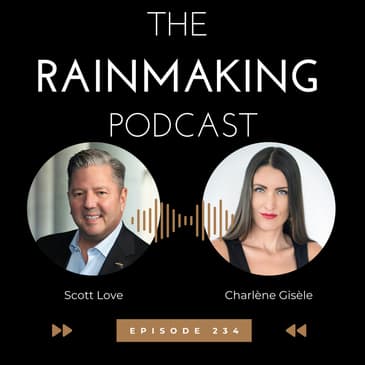
In this episode of The Rainmaking Podcast, host Scott Love speaks with Charlene Gisele, professional coach and burnout prevention expert, about how high-performing professionals—especially in the legal industry—can prevent burnout and thrive in their careers. Charlene shares her insights on recognizing the early warning signs of burnout, such as behavioral changes, strained relationships, and physical health issues, emphasizing that burnout doesn't happen overnight but leaves "breadcrumbs" along the way. She explains that by noticing these subtle shifts early, professionals can take proactive steps to prevent burnout before it leads to serious health or personal consequences.
Key topics include identifying behavioral shifts like increased reliance on unhealthy coping mechanisms, the impact of burnout on relationships and team dynamics, and practical strategies for sustainable recovery. Charlene outlines adaptive behaviors such as prioritizing quality sleep, engaging in physical activities, and adopting mindful practices like meditation and self-hypnosis. She also highlights the importance of treating personal health like a business by tracking key health metrics and conducting regular behavioral audits. This episode offers actionable advice for rainmakers and high achievers looking to balance intense workloads with sustainable, healthy lifestyles.
Visit: https://therainmakingpodcast.com/
----------------------------------------
At Charlène Gisèle®, I partner with professionals and leading organisations to achieve sustainable high-performance and burnout prevention.
🔹 Our Approach: Using our unique and CPD accredited ‘Sustainable High Performance' method, clients achieve enhanced well-being and productivity, balancing personal and professional lives.
🔹 Experience-Driven: My background as a Big Law litigator, combined with Master certifications in NLP, Business, and Health Coaching, shapes our tailored guidance.
🔹 Recognition: Our methods have been featured in leading publications such as the The Financial Times, The Times, and BBC Radio.
Client Benefits:
✅ Burnout Prevention: Tailored strategies for industry-specific challenges.
✅ Leadership Growth: Unlocking leadership potential.
✅ Emotional Resilience: Strategies to maintain composure and performance in high-pressure environments.
✅ Speaking Engagements: Delivering Award-winning keynotes on well-being and performance.
Links:
https://www.linkedin.com/in/charl%C3%A8ne-gis%C3%A8le-bourliout/
Learn more about your ad choices. Visit megaphone.fm/adchoices
[00:00:10] You're listening to The Rainmaking Podcast, hosted by high-stakes headhunter, author, and professional speaker, Scott Love. You're listening to The Rainmaking Podcast, and this is Scott Love. Thanks for joining me on the show. As I always say, my goal is to help you get ideas right away that will make a difference in your life as a rainmaker. And we're going to look at that from a different perspective today in terms of mental health.
[00:00:38] Specifically, our topic is burnout prevention for rainmakers. And our guest is Charlène Gisèle. Charlène is a professional coach and her niche is coaching high performers, especially in the legal industry, on how they can thrive and avoid burnout. And we're going to give you some great ideas on how you can see what those indications are, what changes you can make. How will this affect you? It'll increase your zest for life. It'll help you in terms of the quality work you do.
[00:01:07] And overall, I think you're going to be a happier person. As always, this show is sponsored by Leopard Solutions' legal intelligence suite of products, Firmscape and Leopard BI. Push ahead of the pack with the power of leopard. And now here's my conversation with our guest, Charlène Gisèle. Thanks for listening. Hey, this is Scott Love with The Rainmaking Podcast. Our guest today is Charlène Gisèle. And we're talking about burnout prevention for rainmakers.
[00:01:37] Charlène, thanks for being on the show today. Thanks for having me, Scott. I'm delighted to be here. Yeah, I am too, to have you here. And I'm excited to learn from you today because I've looked at some of your videos online and I've looked at your credentials. And you absolutely have earned my trust already in talking about this important topic for those in high stakes professions like legal, hedge funds, other areas like that. So let me get some working definitions here.
[00:02:03] If we were to summarize what burnout is, I know we have all faced it at some point in time. How would you give us a definition on what burnout is? Burnout is when we accumulate so much work pressure, but we don't have adaptive way to release that pressure. In other words, instead of behaving in a way that helps us to release that pressure adaptively.
[00:02:30] So for example, going for a walk or relaxing or eating well, we do the polar opposite. So we're going to have more and more coffee, have more and more alcohol, pile on the moments where you have this anger outburst. You're going to have toxic relationship, negative interactions. So actually really the stress gets fueled by more stress and more stress.
[00:02:56] And it could get to a point where one day you are hit with a medical diagnosis or your spouse is turning around and telling you they want to divorce. Or you even face with the fact that you can't quite work the way you used to because your mental ability has suffered. Absolutely right. And those are things I've heard people tell me and things that you've seen also with the people that you coach. So it's not something that people can just kind of hit a stick at and say, I think it'll be okay.
[00:03:24] They need to spend some time dedicating on resolving burnout, but then also preventing that. And so what are some of the indications that attorneys, other high performing professionals, they need to be aware of before they even get to that point of burnout? This is a great question, Scott. And I think it's important to notice the early signs. You know, there is a saying, success leaves clue. In my world, I say burnout leaves traces.
[00:03:53] So you can follow the breadcrumbs and you can usually look at the signs and symptoms. The first one I would love to point out is the behavior. So when you start to do things that you didn't used to do in the name of work. So you justify habits and behavior that you didn't use to do. And you say, but I'm so busy. I'm doing this because.
[00:04:19] So for example, you used to love taking some time to cook a nice meal and now you press delivery and you don't move out of your chair, out of your desk to save time because you're so busy. You used to eat nutritionally and now you're basically relying on junk food. You didn't use to stress eat and now you're snacking on muffins and crisps. You didn't use to soothe at night with whiskey and now it's three glasses.
[00:04:48] You didn't use to drink alone. And now at night after a conference, you open up a bottle. So those are big behavior change. Another one to look out for is the quality of your overall relationship. So I call that, is there a relationship decline? So it could be that although you adore your children on a Saturday morning, you're so depleted, you have no energy, no patience that you snap at them. And you never used to do that.
[00:05:17] And then on a Monday morning, even though you love your team, you're really angry and you're really pissed off with them. And you're going to snap at them too. So this is a clear shift. Have you seen that some of these just might not be obvious to people and all of a sudden it sneaks up on them? And then they look back. Gee, I should have been aware. Have you seen that happen before? Loads. And I'll tell you how it happens, Scott.
[00:05:40] It's actually a bit morbid, but it can be a very, very serious medical diagnosis. So I've had clients call me because they were just told that they're type two diabetic or they had their first stroke or they just recovered from a heart attack or they've had another metabolic condition that is actually threatening their life. And that's a moment of realization.
[00:06:09] And they think back and they go, oh yes, for the past decades, my health has been declining and my body has been sending me signal. But guess what I did, Scott, was those signals. I ignore them because that's what I do best because it's inconvenient because all I want to do is work and I want to work harder. Right? So what you do is you normalize and justify the fact that, yes, your back is aching, but your back always hurts. So you pop a few pills.
[00:06:38] Yes, your shoulder's bad, but that's okay. You're going to go and see the chiropractor. So you don't need to address the root cause. And yes, you can't sleep, but that's okay because you're going to medicate. And yeah, you're cranky and that's all right because you're going to drink. Right? So what you do is you're not looking holistically at the reason why you're in pain or you're hurt or you're struggling or you're anxious.
[00:07:01] Instead, you look for quick fixes externally, be it medication, be it painkillers, be it drugs, be it substance, be it alcohol. So walk me through this recovery. And what do you call it? Do you call it, we're going to try to prevent burnout, but let's say somebody's in that space already. The things that you're saying, they're like, yep, check that box, that one, that one. I think I've got a problem. I think I need to make changes. Where do you think that person should start?
[00:07:29] Well, first start with the concept that you don't need to throw in the towel. And I think that's important to hear. And I'll tell you why, Scott, because very often what happens is I see folks that have seen a therapist or have seen a doctor who's not a burnout specialist and they put those people on sick leave. You know what happens to them? Within two months, these guys are depressed. Why? Because we're talking about super high performers here.
[00:07:57] We're talking about rock stars, rainmakers of our world. These are not candidates for sitting at home being on sick leave, right? So if you pull the plug too quickly and you go from you're running a team globally and you're billing 70 hour plus and you're working 95 hours a week and now you're on sick leave, that's not going to go down very well.
[00:08:23] So I've seen the dark side of burnout in the sense that you go from burnout to being on sick leave to then being clinically depressed. Right. What I would say is actually don't throw in the towel. When I work with folks that have the initial signs and symptoms, my measure of success is how can I continue to get you to do what you love to do, but in a way that is sustainable?
[00:08:47] So the end goal is not to put you on leave, to say let's get you to stop, is to think about micro measures, little tweaks and little habits that we can integrate and shift day to day so that you can continue to do what you love in a way that doesn't make you sick. That's great. I love it. And I liked what you said. Sustainable is key. Yes. Let me ask you this. You work a lot with lawyers.
[00:09:16] Do you work with a lot of partners or associates or in-house? Where's kind of your focus? Mostly partners, particularly when they transition from salary partner into equity partnership and or senior associates that transition into partnership. So typically what I would call transition phases is really my area of expertise because with all transition, there is also difficulties and challenges.
[00:09:41] And I also work with partners that want to transition into retirement or into the next season of their lives because that also comes with a lot of mental discipline to the what do I do now? What do I do next? And who do I become? And how do I redefine my life and my raison d'être when I'm not working? So those transition phases is typically where I do most of the work. That's interesting.
[00:10:09] And I'm sure that transition, those all sound like really good things. Getting a promotion, phasing out to retire. That's stressful though, isn't it? Hugely stressful. I've seen some amazing hours that some partners have told me because whenever my work as a legal recruiter, I transition partners from one firm to another. So I get to see their whole business plan, their client list, the number of hours that they bill. And I've seen some that are just shocking and I don't think they're sustainable.
[00:10:34] What have you seen is a good realistic number that somebody should not go above in terms of hours working a week? Or is that something that you think you could even answer? That I'm going to maybe be a bit controversial here and play devil's advocate, but I'm actually going to answer that. I don't believe that it's about the hours. I believe it's about the hours that you don't recover or the hours that you do recover.
[00:11:02] So I've seen partners thrive, even though they had busier schedule than partners who had less billing targets, but had really maladaptive habits. So if you work super hard, but you recover really hard too, you can sustain the distance. Why do I say that? I burned out when I was in big law as a litigator.
[00:11:28] And although it may seem surprising, I work more now than I did as a litigator in big law. I know that's hard to believe, but that's true. You know, now I manage a team. I travel around the world. I'm a keynote speaker. I'm a podcaster. I'm a full-time coach. I'm a clinical hypnotherapist. I wear about five to six hats in any given day. And many of my own clients turn around and say, hold on, how are you not burning out? I've seen you yesterday in New York. Next week, you're in Sydney.
[00:11:58] The week before that, you were at a conference in Paris. Then you're at arbitration week. And the truth is, I treat myself like an athlete. That's what I do. I have an immense workload. And so I recover really, really hard, which is what I didn't do back when I was in big law as a litigator. I did not prioritize the quality of my sleep. Instead, I stayed up late and I would binge watch series.
[00:12:26] You know, I remember numbing my mind after clocking out from a 2 a.m. call and just watching series for another two hours in the hope to fall asleep. That's not a good strategy. A few years of that and I became an insomniac. What I do now instead, even if I had a late work and a late meeting, I'm going to do a 10-minute self-hypnosis. I'm going to relax in front of red light therapy. I'm going to do a nice quick meditation.
[00:12:55] And I am going to sleep like a baby for those hours in a way that is really restorative so that I feel very operational the next day and I can handle a very busy workload. A typical other example is back in the days when I was a litigator, if I had three hours free at the weekend,
[00:13:16] I would feel lazy and be on my sofa and feel like I don't want to move, I don't want to do anything because I'm recovering, I'm exhausted. Now I go for a run. So I've maintained a level of fitness and a multidiscipline aspect of my life that actually fuels my energy instead of depleting my energy. When I'm physically fitter, I'm mentally fitter. And I didn't know that. That's insightful.
[00:13:45] Let me pick some of the things out of that that you shared that I want to kind of talk more about. I liked you talked about recovery. And you mentioned that. And that's something I've seen in my own life. I'm an artist. I started with watercolors. I took oil lessons. I'm doing oil and acrylic. And I found that if I paint in the morning, I get so many good ideas. What are some other things that people can do to recover? Things that we can kind of pull from your playbook that they can use to really help build that recovery.
[00:14:14] And by the way, Scott, I just want to give you kudos here because what you're doing when you're painting in the morning is you're having an adaptive behavior. So well done. That's a prime example. That's great. I like that. Yes. There you go. So other adaptive behaviors to recover. So there is the intellectual recovery phase. So being creative, for example, there is sports.
[00:14:41] So physical fitness is really important because very often when I work with rainmakers in different industries, there is a disconnect between the mind and the body whereby the mind is overly stimulated. So intellectually, they're constantly doing, doing, doing, but their bodies is actually under stimulated.
[00:15:04] So that's a little bit of a dissociation whereby the mind is too busy and the body is too sedentary. So what happens then is at night, you're what I call completely wired, but unable to fall asleep. So wired, but tired and not able to fall asleep. That's because your body is not physically tired enough and your mind is overly stretched.
[00:15:33] So a good way to reset that is to actually use your body more. And if you're telling me you can't because you have a really packed schedule, you can. You can do it creatively. Walk and talk meeting is one of my favorite tools. So you take your team, you put them in your pockets, you put your headphones on and you do the strategy call. And instead of being sat down for two hours, you're walking with them for two hours.
[00:16:00] It's a really good way to get your steps and to get your strategy going. And you're more creative when you're on your feet rather than when you're sat down as well. Wow. Those are all great ideas, Charlene. Tell me about somebody that you worked with. You don't have to mention them by name, of course, but what were they like when you started working with them? What was the main inflection point in their change and how did it make an improvement in their life? Yeah. So typically when I work with folks, they have hit one of the three Ds.
[00:16:30] So that's divorce, diagnosis or death. So I've had clients that have all three happen at the same time. So be it a partner whose wife is so fed up. She said that if you don't change your ways of working and living, I will go.
[00:16:48] Be it a woman that has had three miscarriages in a row and is being told that hormonally she can't conceive and give birth because of thyroid issues, cortisol issues, and all other kind of biomarkers that indicate that stress played a huge role.
[00:17:11] So what I do is make sure that I downregulate the nervous system by offering them strategy to be in their parasympathetic nervous system, meaning rest, digest and reproduce more than in fight and flight, which is when you're hyperreactive.
[00:17:31] So what does that mean? It can mean simply having a three minute strategy at the end of a very stressful meeting where you release the stress by doing a deep breath. It can mean putting boundaries around a day to dedicate it to your family, to your spouse, to your wife, to your husband and be really present. So even setting ground rules like not having your work phone at the dinner table can make your wife feel heard and valued and loved,
[00:18:02] especially if she's worked really hard at, you know, creating this beautiful family space where she worked really hard to cook a dinner for you. And then you're on your phone taking your email and saying, sorry, sweetie, I need to be on a Zoom call. That can be really hard when it happens systematically. So little things like that, it's not a huge tweak, but it has a massive impact. These are great, Sherlyn. Let me ask you this then. I've noticed just the trend in the world. People have become more vulnerable.
[00:18:31] Do you think, is there any downside to telling people close to you, I think I'm feeling burned out? Or is that something that has a stigma? How do you think we should manage that in terms of our peer group and our colleagues? That's a really good question. I'll tell you, perhaps I'll flip it. I'll tell you that a boss who's burnt out is more likely to burn his or her team out. So take it wherever you want, but that's something I'm absolutely certain of.
[00:19:00] Now, I don't know that there is a huge amount of benefit for the boss to then flag, hey, I'm burnt out. I actually think that's a bit too late. What I'm most passionate about is saying to that person, be proactive about it. If you're starting to feel the signs and symptoms, act proactively to make sure you don't cross the line of the burnout equation and you don't go deep into the burnout phase.
[00:19:25] Because what I know for sure is if you're burnt out as the team leader, you're going to burn your team out as well. I'm yet to see any team where their leader is burnt out and the team is thriving. I don't believe that exists. That's interesting. That's a whole other subject. We'll have to talk about it at some point. Let me ask you this. If we kind of bring this to a close, if people are listening to this and they say, this is really interesting. I need to really take action and make some changes.
[00:19:54] What are three action steps you would want people to follow to really start implementing these ideas that you've shared with us today, Charlene? So first one would be, I want you to treat your health like a business. In other words, I want you to have a health KPI. I know you have measures of success. If you're a lawyer, it's your billing target. If you're a trader, it's your trade. So what is the return on your investment vis-a-vis your health?
[00:20:22] What are your health targets for the year? And I want you to have a couple of health targets. If you haven't done blood work, do blood work. If you don't have a step bank account, how many steps you work every day, open up a step account. Have little targets for your health. Measure it and track it. Remember, if you don't track it, you won't know whether or not you succeeded at it. So that's number one. Number two, I really want you to have a behavioral audit.
[00:20:51] What does that mean? I want you to actually have a candid conversation with yourself. And you don't need to share that with anyone. And look at how you behaved five years ago, 10 years ago, or five months ago before you used to feel X, Y, or Z. X, Y, and Z being hurt, tired, sad, pissed off, angry, burnt out, whatever the case might be. And look at those behavior. And now look at your current behavior. And I want you to notice the difference between A and B.
[00:21:20] What's shifted? Has this shifted for the positive? Or has it slipped in a way that it's quite negative and toxic? Because self-awareness is the first step to making actually big, systematic changes. And then the final question is, are you disregarding advice or words of wisdom from your trusted advisor?
[00:21:47] We all have one, two, three people in our lives that we know we can trust, have the best intention, and are benevolent, and wants what's best for us. If that person has been telling you for the past few months, the past few years, I'm worried about you. I've seen you've changed. Are you okay? And what you do is you don't answer the phone. You don't pick up. You ignore them. You think they're over-caring. They're becoming a burden.
[00:22:18] Or they don't understand. Maybe they do. And maybe you're not being honest with yourself. So if you trust them, you know they love you, and they want the best for you, and you keep ignoring that phone call, I want you to take a moment and pick it up and listen to what they have to say. Well, Charlene, this is very powerful, and I hope it makes a big difference to those people listening to us. And could you elaborate more, please, on your offerings and your services? I'd like for everybody to know what you do in terms of your coaching and the work that you do, Charlene.
[00:22:47] Thank you, Scott. I do one-to-one coaching and clinical hypnotherapy to help folks with sleep, anxiety management, stress, but also confidence to show up being the best version of themselves for an interview, for a new role, for a promotion, for a partnership. And I also offer workshops within organizations to do burnout prevention at a cultural level and at an organization level.
[00:23:15] And then, finally, I'm the host of the Charlene Giselle Show, and I would love to invite you to listen to it if you're looking for free tips on burnout prevention. That's great. And for everybody listening, go to the show notes where you hear this podcast, and we'll put all of Charlene's links there. You can connect with her directly, go to her website, and also we'll put her podcast link there on our show notes as well. And, Charlene, thank you for sharing your insights. This has made a difference for me, so thank you for that.
[00:23:42] And I'm sure it's made a difference for our listeners, and I'd love to have you back on the show in the future. Thanks for being here today, Charlene. Thanks, Scott. Thank you for listening to The Rainmaking Podcast. For more information about our recruiting services for international law firms, visit our website at attorneysearchgroup.com.
[00:24:05] To inquire about having Scott speak at your next convention, conference, sales meeting, or executive retreat, visit therainmakingpodcast.com.