This show is sponsored by Leopard Solutions Legal Intelligence Suite of products, Firmscape, and Leopard BI. Push ahead of the pack with the power of Leopard. For a free demo, visit this link:
https://www.leopardsolutions.com/index.php/request-a-demo/
----------------------------------------
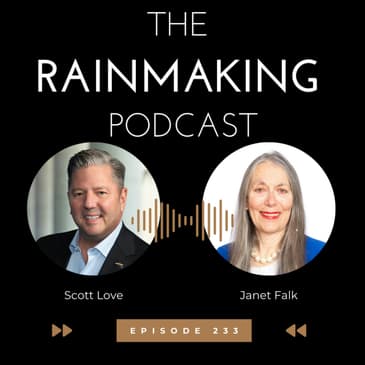
In this episode of The Rainmaking Podcast, host Scott Love speaks with Janet Falk, founder of Falk Communications, about how professionals can maximize their time and networking opportunities at conferences. Janet shares expert strategies for preparing before an event, engaging effectively during the conference, and following up afterward to build lasting business relationships. She emphasizes that conferences are not just about attending sessions but about making meaningful connections that can lead to new business and valuable referrals.
Key topics include how to research and reach out to key attendees and speakers in advance, using LinkedIn and membership directories to set up meetings, and leveraging informal networking opportunities such as coffee breaks, meals, and receptions. Janet also shares practical tips on asking insightful questions during panel discussions, strategically using business cards and branded materials, and following up with personalized messages to maintain relationships after the event. This episode provides a comprehensive framework for professionals looking to turn conferences into powerful business development opportunities.
Visit: https://therainmakingpodcast.com/
----------------------------------------
Janet Falk, Ph.D., is a Communications professional with more than 30 years of experience in-house, as a consultant and at public relations agencies. As Chief Strategist at Falk Communications and Research (www.JanetLFalk.com), she advises attorneys at small law firms and with a solo practice on Media Relations and Marketing Communications to: attract new clients, remain top of mind with prior clients, keep in touch with referral sources, help recruit associates, generate a news story about litigation that puts pressure on opposing counsel and achieve business goals. Janet leads workshops on these topics and advises on media relations, website, LinkedIn profile, articles in non-legal industry trade publications and client newsletters, among other areas. She has published articles on Media Relations and Marketing in The New York Law Journal, The New Jersey Law Journal and Marketing the Law Firm and is a frequent speaker on webinars and podcasts about Public Relations, Networking and Legal Marketing. Speak with her for a complimentary Strategic Communication Session (30-minute consultation) to assess your Communications activity and online presence. She guarantees TWO IDEAS.
Links:
Website: https://www.Janetlfalk.com
Subscribe to monthly newsletter: https://bit.ly/2MNB11W
http://www.linkedin.com/in/janetlfalk
Learn more about your ad choices. Visit megaphone.fm/adchoices
[00:00:10] You're listening to The Rainmaking Podcast, hosted by high stakes headhunter, author, and professional speaker, Scott Love. You're listening to The Rainmaking Podcast, and my name is Scott Love. Thanks for joining me on the show. Our guest today is Janet Falk. She's the founder of Falk Communications, where she works as a consultant to help law firms and attorneys grow in media, public relations, and marketing.
[00:00:40] Our topic today is going to be very helpful for you if you ever attend conferences. As you know, speaking at conferences is great. Attending them is really good as well. If you can't get on a panel or speak at a conference, go to a conference. And how do you maximize your time and get a high return on your investment? Well, we're going to answer that question and more in our podcast interview with Janet today. Make sure that you connect with Janet. How do you do that?
[00:01:06] Go to the show notes wherever you hear this podcast. Connect with her on LinkedIn. We put her website link also on there. And we've got a special document that she wrote, 25 Tips to Connect at Your Next Bar Association Meeting or Conference. Make sure you go there and download that because that's going to be a useful reference. As always, this show is sponsored by Leopard Communications, legal intelligence suite of products, Firmscape and Leopard BI. Push ahead of the pack with the power of Leopard.
[00:01:34] And now here's my interview with Janet Falk. Thanks for listening. Hey, this is Scott Love with the Rainmaking Podcast. Our special guest today is Janet Falk. And we're talking about how to connect at conferences. Janet, thank you for joining me on the show today. I'm so excited to be here, Scott. Thank you for inviting me. You bet. The professionals that listen to the show, they're rainmakers, which means they're out there.
[00:02:02] They're visible. Sometimes they're speaking on panels or giving presentations at conferences. And a lot of times they're just going to conferences. Let me ask you this. When people have a conference that they're planning to go to, what should be their goals? Let's start with the goals that they should have when they attend conferences. Sure. Let's consider that you're an attorney and you're going to a bar association event.
[00:02:26] Of course, you're thinking about earning CLE, continuing legal education credit. But honestly, Scott, you could do that just as easily at home in the comfort of your living room, wearing your pajamas. So what you want to be focusing on instead is the personal interaction that you're going to have with the people who are attending the event. And as an attorney, think about who those people are.
[00:02:54] They are your colleagues from the Chicago office. They are the people that you might have clerked with, people that you might have worked with at a previous firm, people who were on the other side of the transaction or the other side of the litigation, people who served with you on a bar association committee and so on. Now, if you're going to an industry conference, then those are going to be your current clients that you want to get FaceTime with them.
[00:03:23] They could be your labs clients that you want to connect with. And they could be your referral sources and your potential clients. So when you're going to a conference, you want to prepare in advance by thinking about your goals. It's not only to get the state of the industry from the speakers at an industry conference.
[00:03:46] It's not only to get the CLE credit at a bar association meeting, but it's to have that face to face contact with people that you already know and people that you would like to know. Yeah. And that face to face contact from a business perspective, the context of client development, it adds so much more value to that relationship, doesn't it? Exactly. So I like the fact that you structure this before, during and after.
[00:04:16] Tell me a little bit about that as we're planning to go to this conference. What should we do in the before section? Then we'll kind of move into the during and the after. Okay. Since we're talking about interaction with the other attendees, what I recommend is looking first at the membership directory. If you're a member of the industry association or you're a member of the bar association, the directory is probably online. And who should you be looking for in this directory?
[00:04:45] Well, of course you want to connect with people that you already know, but you want to meet people who have a practice that is similar to yours or aligned with yours. So say for example, you work in intellectual property. Then you want to be meeting with attorneys whose practice is focused on technology or biopharma or startups,
[00:05:08] because they are the ones most likely to need your assistance in helping their clients with their IP. So that's a great way to educate. Now, another way of looking at this is to look at the directory biographies of the members who are listed there. Find people who come from your same town or from your same state. If you're going to be going out of state, find people who have, you know, your same law school alumni status.
[00:05:38] There's a reason why you want to establish some commonality with these people. And that is to get them interested in meeting you. You can probably find their email address right there in the directory. And if not, it's probably listed on their firm's website so that you can address these people and say, I'm planning to go to the such and such conference in Chicago on this date.
[00:06:08] I see you're also a member. You know, we're both interested in X topic. We both worked at X firm. We both graduated from X law school. You know, perhaps we can plan to meet. Now, if you're on the receiving end of this, then you're going to think, well, this is an opportunity for me to get together with someone with whom I share this common interest.
[00:06:30] So I think that the online directory is an underutilized resource for you to already be building the opportunity to connect with others at the conference. I got this idea from vendors, vendors who are exhibiting at the conference. They get a list of the attendees in advance. Right. And why do they get that list?
[00:06:55] Because they're paying for it because they want people to stop by their booth and book an appointment with them. So take a tip from the vendors and exhibitors. Reach out to the people who you see listed in the membership directory with whom you share a common interest. And you can find your way to booking a meeting with them at the actual conference. That's such a great idea. Let me ask you this.
[00:07:21] Do you think we should do the same thing with potential speakers that we see or people sitting on panels? Absolutely. One thing that you can do with the speaker is to get in touch with them and say, I'm so interested in your speech about topic A. Are you going to address aspect B of this situation? And now you're giving the speaker advanced feedback of what it is that the attendees at the event want to hear.
[00:07:51] So that will help them in shaping their presentation so that it will be, in fact, responsive to the audience. And here's the second thing that you can do. You can say to the speaker, would you like me to ask you a question during the Q&A segment? That's a great tip. And the reason you do that is because many times there's only so much time that a person can allocate in their presentation to raising a certain point of view.
[00:08:21] But when they respond to a question in the audience, then they can go on at more extended length and present their perspective. And I have an anecdote about this, if you think. Yeah, tell me about that, Janet. Now, I learned this tip from Arthur Levitt, who you may remember was the chairman of the SEC in the mid 90s.
[00:08:43] And he would ask my company, which arranged conferences, to plant a question with a reporter in the audience. Now, Levitt would talk about topic A, but Wall Street was really interested in topic B. So a reporter would ask Levitt a question about topic B and Levitt would score two points in this way.
[00:09:07] First, he would show Wall Street that he was aware of their interest in topic B. And second, because a reporter asked the question, it certainly would be noted in the reporter's news story about attending the conference. Wow.
[00:09:26] Now, what happens when you plant a question in the audience and then the person afterwards, when everybody rushes up to the panel to get FaceTime with the speaker and give them their business card? Sure. So the audience member sits back and at the very end goes up to the speaker and says, thank you so much. And I was so glad you were able to address this question about topic B.
[00:09:52] And then the speaker says, oh, no, Scott, thank you so much for asking me that question. I really was appreciative that I was able to to share my point of view on that issue. So you gain additional points with the speaker having planted the question for the entire group. And one thing I'd like to add, something I experienced where here's a speaker that's speaking to a group. I know a lot about the group.
[00:10:18] I'll reach out to them and say, if you want ideas on what's important to us, because I was on the board of a group. And even after I rolled off the board, I would still do that because I want it to be a really good presentation for our group. If you want to talk to me offline at some point prior to presenting, I'd be happy to share with you what other speakers have done to really went over the audience and add value. And sure enough, they all took me up on that. And guess what? I didn't even plan on this, but they would mention me from the stage. And so now you build kind of that brand among the whole audience if that happens.
[00:10:48] Have you ever seen that happen before, Janet? No. And I think that's brilliant. I think, you know, that goes along with the idea of, you know, planting the question and, you know, offering them a preview so that they can be better attuned to the audience's interests. I really like that idea. Yeah. And I think, I mean, just in reading your e-book and I attend a lot of conferences, probably half the things you listed I hadn't thought of.
[00:11:12] And the other half I'd done it wrong. And so I really appreciate just the detail and the real specific action steps that you give people in your e-book. Let me ask you this. What about things related to staying at the hotel? Should you stay at the conference hotel or should you go to hotels.com and save 50 cents on the dollar and go to one that's three blocks away? What do you think about that?
[00:11:33] I think you should stay at the conference hotel because there are a lot of opportunities where informally you can run into people, whether at the coffee shop in the morning or at the bar, riding the elevator. Everybody's wearing the conference badge. And I have a comment about that. We can talk about that later. But everyone's wearing the conference badge so you can have these informal conversations.
[00:11:56] And I look at it this way. It's not an expense. It's an investment. How many clients would you have to get to make that hotel stay worthwhile? Think of it that way. Absolutely right. I like that. I like the fact that this is an operation. We need to plan for this and we need to put the odds in our favor by being prepared for it. By reaching out to those people that we see, looking at the whole attendee list, maybe there's a couple of speakers.
[00:12:23] Maybe that person could be a future referral partner or somebody that I could be useful for to mutual benefit. It might be good for me to at least start a relationship by asking them like what you said. Are you going to be talking about this? And even offering to be of service. If you're OK with me asking a question, let me know. And you're absolutely right. I think that when you're reaching out to people who are in a position of influence, your personal brand, everything grows.
[00:12:49] Your ability to be seen as someone who is helpful. Absolutely. That grows, too. Tell me about this. When we're preparing to go to the conference, we're not even at the conference yet. What are some things that we need to bring with us? Do people still use business cards? Are there other things we should bring? What do you think we should prepare for in that regard? Yeah, people definitely still bring business cards. I mean, I know people who like to connect automatically on LinkedIn using their phone and, you know, that's fine if that's your practice.
[00:13:19] But I think it's important to bring business cards because, one, after you have the conversation, you're able to write a note to yourself and remember what it is that you talked about. So that, too, when you go back to the office and you've got this stack of 15 business cards, you can remember that you promised to follow up with this person. And now you have the opportunity to do so. Now, I have a client who taught me this trick that I'm going to share with you, Scott.
[00:13:49] And that is when she's in a conversation with someone and she gets their business card, she takes a picture of it with her phone. And then by text or email, she sends it to her assistant. And she says, please send Scott the client alert, the presentation deck, the podcast link, you know, the article, the name of the contact, whatever.
[00:14:14] So now in the background, the assistant is taking care of this request. And that night, Scott, you go back to your hotel room and you're checking your email and you see that you got the client alert, the podcast link, the name of the contact. And the next day, you're going to go over to the person and say, thank you so much for sending me that information. Right. Now, if you're an attorney at a larger firm, then you have an assistant to help you.
[00:14:43] But if you're an attorney at a smaller firm or you're solo and you don't have an assistant, you can hire a virtual assistant for just two hours a day to do this follow up activity for you. And this is going to build relationships with the people that you meet. So I think it's very important to bring a business card because it works in the moment for the person to, you know, remember who you are and what you talked about.
[00:15:11] And then it works in the follow up. I consider business cards to be a paper partner. So that's one thing that you can bring. The second thing that you can bring is some branded item from your firm. We all have a pen. We all need a pen. But the problem with a pen, even though you need it and use it all the time, is you have so many. And there's not a whole lot of room on a pen. Right.
[00:15:40] All you can basically have is your name, your phone number, your website, maybe your URL. We'll fit in there. Maybe some reference to the work that you do in intellectual property or M&A or startups, what have you. So I recommend something else. I have a business card sized item and it has four panels.
[00:16:04] And the idea is that you can take this small paper business card sized item and keep it in your wallet or keep it on your desk. And the subject is five best tips to maximize a media interview. So on one side, it has information about myself and my firm. And on the back, it has a QR code to subscribe to my newsletter, my phone number, my email. But inside are the five fast tips.
[00:16:34] So this is something that not only is a gift to you, but it showcases my expertise and my ability to deliver to you valuable information. So if you focus on, say, intellectual property for startups and tech or biopharma, then you might have, you know, three essential tips for, you know, whatever people need to do to protect their intellectual property.
[00:17:03] And this is something that will testify to your excellence as an attorney serving that sector. So bring a business card, yes, because it's useful in the moment and in the follow up and bring something else small that you can give away. It could be a pen or it could be, as I say, a business card sized item that a person can keep handy.
[00:17:29] And that way they will remember you and it will give testimony to your background and experience. That's great. And you're showcasing your expertise. And I'm actually looking at the one you gave in your e-book, which I think is brilliant, where you're giving really good, simple ideas that make a difference for the people that you're within their circle, where you're networking with people that you have a service, you want to offer it to them. You're dangling that lure of content. Oh, that's a good idea.
[00:17:57] I bet Janet knows other things that can help me out in terms of media marketing, things like that. That's really good. I think that's really the heart of networking. We all know you give to get, right? If you are the person who is giving ideas and giving insights and giving introductions, then that's what's going to cement the relationship. And it will inevitably become mutual. You will get things back from that person.
[00:18:24] And it may be a client relationship or it may be a referral relationship. That's great. So these are all the things we've talked about so far before the conference. Let's say we're at the conference. What do you think some of the high points are that we should keep in mind as we're attending the conference? Look for opportunities for informal conversation while you're at the event. Before the conference starts, you're sitting at the breakfast.
[00:18:52] And that's an opportunity to catch up with the people you already know, right? Because everybody comes to breakfast very quickly. They want to get their coffee in their Danish and then move on to the main event. So that's a good opportunity to meet people that you already know. You don't need to have much of a conversation with them. But some people like to sit at a table where they don't know anybody else. Now, during the actual panel sessions, turn to the person next to you and say, that was so interesting. What did you think?
[00:19:22] How does that apply to your practice? How does that apply to your clientele? Right? What are you going to do with the insight that was shared with the speaker? Now, in between sessions, when the panel is going up to the dais and coming down from the dais, that's when you can be having that conversation. But what if somebody walks into the room and sits down next to you? They were at a different session. Ask them, what did you talk about in your session? What did you learn?
[00:19:51] Do you think it was helpful? And then you can share what happened in the session that they did not attend, right? And of course, there are the coffee breaks and there are the lunch meetings, right? Because at lunch, you're seated at a table and there's a lot more time to have a conversation with the people that are joining you there. And finally, there's the end of the day cocktail networking, right? There, everybody knows how to behave.
[00:20:20] So look for those in-between moments when people are gathering or there's a shift between the different speakers that are taking the stage and, of course, the mealtimes. And you'll be able to find ways to initiate a conversation simply by asking, you know, where are you from? What did you think of the speaker? What did you learn? Does it apply to your firm, your practice, your clients, and so on? Those are great ideas, Janet.
[00:20:48] As we're kind of coming to a close here, let me ask you about one more idea, which I think is really good. And by the way, I'd love to have you back on the show to really talk more about this and even other topics that you've shared with me through your content. One of them I liked was your elevator pitch. I like the idea that you give about how to prep for that within your PDF book. But tell me about the power of snapping selfies and group photos. Tell me about that. Why is that something we should do? And what are some ideas you have in that regard?
[00:21:18] Well, I think it's pretty obvious. When you take a picture of someone and yourself, then you're going to send a picture to that person, right? And so then you have to have their business card so that you'll be able to follow up and send them that information. I think if you're able to manage a photo with one of the speakers, then you can talk about what it is that the speaker discussed at the particular panel. And then you can post that and share that on LinkedIn.
[00:21:46] And when you do share something like that on LinkedIn, then you notify the person, not only through the LinkedIn mechanism that does that automatically, but you notify the person directly and tell them how much you enjoyed their presentation, what you learned from it, what you're going to do with it. Oh, and by the way, here's the photo that I took of our conversation. What about posting those on LinkedIn or other social media? Well, I think that's part of the process.
[00:22:14] You don't have to post every photo that you took with two or three people. I think you have to decide who are the people who are most going to resonate with your contacts on LinkedIn and who they're going to be interested in seeing. That's great. But saying I had a conversation with Scott, Mary and Barry, you know, it really doesn't tell you very much unless there's some substance there. And you say, we talked about the hot issue of X, right?
[00:22:44] And here's how we're going to apply this to our practices. Or here's how we're going to discuss this with our clients. That's great, Janet. Janet, these are some fantastic ideas. As we're coming to a close in our conversation, what are three action steps people can take to be better prepared for attending conferences? Things that they can really take action on to really implement some of these ideas that you share.
[00:23:06] I think the focus that I gave initially of going through the membership directory and contacting the speakers in advance are really innovative. Hardly anybody does this. And so when you reach out to the other members that you want to meet or when you reach out to the speakers, then you will be very distinctive and they will want to meet you.
[00:23:30] Something that I do occasionally, and as a woman in public relations, I can get away with this. Maybe you can't. But I wear a distinctive colored jacket. So in my communication, I say I will be wearing a royal blue jacket or I will be wearing a bright pink jacket so that people can actually find me at the event. Now, as an attorney, a person might not be able to do that.
[00:23:55] Or as a senior executive, they can wear a different colored tie, like green or orange, or they can have a red colored pocket square. So in reaching out to people in advance, as we've discussed, you know, see if you can weave in mention of a distinctive article of clothing so that they will be able to find you. That's a great idea. Yeah. Yeah. Now, as for, you know, during the event itself, this is a tip that I learned from Ari Kaplan.
[00:24:25] And he always leaves the seat next to the aisle vacant. So he sits in the second seat because there's always someone who's coming in and running in late and they want to be able to grab a seat. So by leaving that seat vacant, then he gets an opportunity to talk to that person, whoever that random person is going to be.
[00:24:47] And as for a third tip in terms of your follow-up, when you come back to your office, you're going to have a pile of work that accumulated while you were away. And you're going to want to respond to all the people that you met.
[00:25:04] And what I suggest you do is when you set up your out of office automatic reply, add an extra day so that whatever day the conference ends on Wednesday, you're still out of the office on Thursday.
[00:25:18] And that will give you the time that you need to catch up on what has happened in the interim with your colleagues and also to follow up with the people that you met, whose cards you exchanged and with the speaker and with the photos and what we have been talking about. Now, I want to point out, Scott, that when other people get back to the office, guess what? They're doing the same thing.
[00:25:44] They have a boatload of work that accumulated while they were out of the office and they're writing to you and all the other people that they met. So by giving yourself that extra day, you will have time to accomplish that. Not only that, what you're going to do is you're going to set a reminder so that two weeks from the end of the conference, you're going to go back to those people and say, now that I've had a chance to reflect on our conversation. You know, I want to go over something with you.
[00:26:13] I have a question about this. Or I looked at your website. I saw this article that you published recently. I want to ask you about that. So it's not just responding to them in the moment by taking a picture of their business card and asking your assistant to send them the client alert or the article or whatever you promised them. And it's not just going back to the office to continue the conversation immediately after the conference.
[00:26:39] But it's two or three weeks later when your business card resurfaced. And I was reminded of our conversation. I looked at your website. I listened to your podcast. I have a question for you. Can we discuss this further? So I would say those are the three tips about the initial follow-up. You know, leave a space next to you for informal conversation during the conference. And then reach out immediately after with an extra day delay on your out of office.
[00:27:08] And then two or three weeks later, a second follow-up. I can't wait to attend my next conference now. These are great ideas, Janet. And the conferences are fun. But now it's a mission. I've got a mission. I've got a goal. I've got specific action steps. And I'm really excited about this. So thank you for being here. I'm excited about having you here on our show, Janet. I'd love to have you on in the future because I know there's a lot more that you can share with our listeners. But tell us about your offerings. What do you do? What do you have that you'd like our listeners to know about? Certainly.
[00:27:38] Thank you, Scott, for the opportunity. One thing that people ask me often is how they can get in the news, whether it's business news, industry news and their clients' industry or, you know, in legal publications. So what I do is I interview my contacts. And I say, you know, what are the things that you see happening in the industry? Because reporters know what already happened. They want to know what's going to happen.
[00:28:05] And then I introduce them to reporters using a tool I call a media profile. And anyone who visits my website can look in the resources section for the sample media profile and request a conversation with me. And I'll go over with the worksheet that they've completed how they can be introduced to reporters. But before you speak to a reporter, they're going to check you out. They're going to look at your LinkedIn profile. They're going to look at your website.
[00:28:35] And they want to know, do you have the goods? Are you really an authority? Do you have your finger on the pulse of what's happening in the industry or in the law? And what I do is I help my clients polish their website content and their LinkedIn profile so that it is commensurate with their background and experience and will give them that authoritative patina so that reporters will want to talk with them.
[00:29:05] And I have a lot of resources available on my website. And I have a monthly newsletter where I share these tips and so on. In fact, these 25 tips that I have in my e-book, they were, once upon a time, a two-part newsletter. This is great, Janet. Thank you for being here and sharing your wisdom. I've checked out a lot of your content. I learn things. I think people listening to the show will do the same. So I'd highly recommend everybody check out Janet's information. And we're going to put that on the show notes.
[00:29:34] No matter where you listen to the podcast, go to the show notes and we'll put all the information in ways that you can connect with Janet directly. Janet, thank you for being here. Like I said, I can't wait to have you back on the show and we'll talk again next time. It was my pleasure, Scott. Thank you so much. Thank you for listening to the Rainmaking Podcast.
[00:29:56] For more information about our recruiting services for international law firms, visit our website at attorneysearchgroup.com. To inquire about having Scott speak at your next convention, conference, sales meeting, or executive retreat, visit theraingmakingpodcast.com.