This show is sponsored by Leopard Solutions Legal Intelligence Suite of products, Firmscape, and Leopard BI. Push ahead of the pack with the power of Leopard. For a free demo, visit this link:
https://www.leopardsolutions.com/index.php/request-a-demo/
----------------------------------------
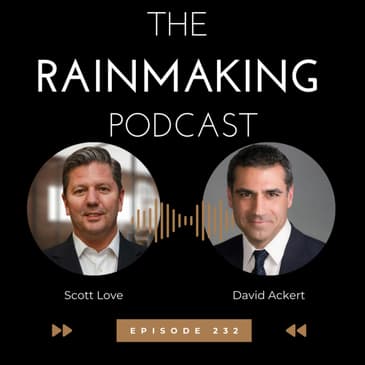
In this episode of The Rainmaking Podcast, host Scott Love speaks with David Ackert, business development expert and author of The Short List, about how professionals can focus on high-value relationships to grow their book of business. David explains the concept of applying the Pareto Principle (80/20 rule) to networking, where 80% of results come from just 20% of relationships. By identifying and nurturing a select group of key clients, referral sources, and prospects, professionals can maximize their impact without wasting time on low-yield connections.
Key topics include defining a "short list" of 9 to 35 key relationships, strategically engaging with those contacts to drive business opportunities, and using data-backed insights to optimize networking efforts. David shares practical steps on how to track and maintain these relationships, ensuring consistent follow-up and meaningful engagement. He also highlights the importance of relationship-building over transactional networking and explains how to create authentic connections that lead to long-term success. This episode provides a clear, structured approach to business development for professionals looking to streamline their efforts and see measurable results.
----------------------------------------
David is Co-Founder and CEO of Ackert, Inc. and its subsidiary, PipelinePlus. He is a highly regarded business development thought leader. Over the past two decades, David has pioneered revenue acceleration programs for hundreds of professional services firms around the globe.
He is the founder of several groundbreaking ventures in the industry, including Legal Lift, the MLR100, the MLR200, BDI, numerous Managing Partner Roundtables, and the PipelinePlus software suite. His programs have won “Your Honor Awards” in both the U.S. and Canada, and his software has been featured in NLJ’s “Technologies on the Rise.” David regularly keynotes at partner retreats and speaks at industry conferences. He also serves as a guest lecturer at USC’s Marshall School of Business, Carnegie Mellon University, and at the UCLA School of Law.
David is the author of The Short List: How to Drive Business Development by Focusing on the People who Matter Most, published by Greenleaf. He has contributed quotes and articles to numerous media including the Los Angeles Times, the National Review, the Daily Journal, the Wall Street Journal, Above the Law, Attorney at Work, Law.com, The Recorder, and the Los Angeles Business Journal. His Market Leaders Podcast has won several JD Supra Reader’s Choice Awards.
David volunteers as a Big Brother with the Big Brothers and Sisters program in Los Angeles. He is also the co-founder of Voices in Harmony, a mentoring organization that has worked with at-risk youth around the globe. He co-produced and appeared in the documentary film, “After Kony: Staging Hope,” chronicling mentoring programs he helped to design and facilitate for former child soldiers in Northern Uganda. The film was used as part of an awareness-raising campaign that raised millions of dollars for health and education in underserved Ugandan communities. David’s charitable work earned the “Difference Maker” award from one of his alma maters, Ithaca College.
David holds a master’s in psychology and is a Fellow at the College of Law Practice Management.
Links:
Order The Short List here: https://pipelineplus.com/theshortlist/
https://www.linkedin.com/in/davidackert/
Learn more about your ad choices. Visit megaphone.fm/adchoices
[00:00:10] You're listening to The Rainmaking Podcast, hosted by high stakes headhunter, author, and professional speaker, Scott Love. You're listening to The Rainmaking Podcast, and my name is Scott Love. Thanks for listening to the show. Now, if you're a new listener, let me tell you a little bit about my whole philosophy of the show. When I bring guests on, we get right to the point. We don't say, tell me your life story. We get right to the point.
[00:00:39] And we dig deep. And I want to give you value, because I don't want to waste your time. Just today, I was listening to another podcast. We went three minutes into it, and I got nothing. And I had to find something else. And I'm never going back there again, because there's nothing there. My goal for you is to get solid advice, things that can help you grow your book of business. And in fact, listen to some of the past shows. Our guest today is someone that has been a past guest at least twice. His name is David Ackert. And we're talking about The Short List.
[00:01:08] Now, David is a management consultant specializing in helping law firms and professional service organizations grow their practices. I've gotten to know him pretty well. I've spoken at some of his managing partner retreats, and he knows what he's talking about. I've introduced him to my clients, and I know he does a really good job in helping people grow their practices. Make sure that you check out the show notes. I'd highly recommend ordering David's new book called The Short List. I've read a lot of books. I've read a lot of books.
[00:01:37] And this is one of my favorites because it doesn't just tell you what to do. It tells you how to do it and why. And it gives you structure and format. Even if you're busy, don't worry about that. Listen to this podcast episode, and you'll get a head start. Make sure you connect with David. Go to the show notes. Connect with him. And all of his information is there. And we even put the link where you can order David's book today on the show notes as well. As always, this show is sponsored by Leopard Solutions, legal intelligence suite of products.
[00:02:06] Firmscape and Leopard BI. Push ahead of the pack with the power of leopard. And now here's my interview with my good friend, David Ackert. Thanks for listening. Hey, this is Scott Love with the Rainmaking Podcast. Our special guest today is a repeat guest, someone you're probably familiar with, David Ackert. And our topic title is The Short List. David, thanks for joining us on the show today. Scott, I so appreciate being asked to come back. It's great to be here. Absolutely right.
[00:02:35] And I'm a fan of your book. I'd highly recommend it. And we're going to talk about what the short list is right now. And so, David, tell us what the definition is. What does that mean, the short list? Sure. So the short list really looks at your network and asks you to apply the 80-20 rule or the law of the vital few. Who are the most important relationships at the bottom of your funnel, if you're familiar with that sales concept, right?
[00:03:02] The people who have the most influence when it comes to getting your goals to come to fruition. Right. So they'd probably be your key clients. They'd be proven referral sources. They might be prospects who are going to ultimately be in that caliber of clientele that match your ideal. That's great. Let me ask you this. When you say the 80-20 rule, I'm familiar with that. What was his name? Vila Fado Pareto? Pareto? Yes, that's Pareto. Yeah. Tell us about that.
[00:03:30] What is that and why is that concept significant? Sure. So the Pareto principle basically posits that 80% of your outcomes are going to be a function of 20% of your efforts. In other words, the things that you are doing that are most effective, most efficient, are going to account for 80% of the results that you get.
[00:03:55] So if you can focus on that 20% that is the highest quality, best use of your time, best use of your effort, you're going to find that it yields the best outcome for you. That's great. Right. And we can take that same concept and apply that to 80-20 of our relationships. Is that correct? That's exactly right. So in most people's networks, if you're familiar with Dunbar's number, Dunbar was an evolutionary psychologist who did a number of different studies, both in terms of tribal societies and modern societies.
[00:04:24] And he looked at email traffic and a whole bunch of other sort of things to come up with this number. And what he identified was that most of us can retain about 150 names in our heads. That is to say, if you were walking down the street and you randomly ran into somebody who you know, you would remember their name in about 150 instances. Once it reaches more than 150 people, then you're like, ah, hey, buddy. Right. And you're sort of, you're kind of improvising a little bit there.
[00:04:51] But, you know, we can keep track of about 150 people, obviously our family, our friends, some work colleagues, some people who we consider, you know, relatively closer to our inner circle. But once we get beyond that 150 number, it becomes a struggle. And if you look at that 150 number and you apply the Pareto principle, the 80-20 rule, you're left with about 30. These are 30 of the most valuable relationships from a business perspective that most of us can manage.
[00:05:19] So we've been working, you know, with professional services firms for a couple of decades now when we've had a tool called Pipeline Plus. It's an app that we've developed in the marketplace. And lawyers use this app to keep track of their most important relationships. And what we found when we've looked at the subset of users who report a growth in their book of business while using the app,
[00:05:42] we find that those lawyers tend to track about between nine and 35 relationships in Pipeline Plus. So the lawyers who have fewer than nine relationships in the app, they tend not to grow their books of business. They just have too few at-bats, too few opportunities. And the lawyers who have more than 35 relationships in their app have a hard time keeping up with all of those, right?
[00:06:06] If you consider all the billable hours and how busy these lawyers are, they really can't take that many people out to lunch and do that many site visits and that much customized thought leadership. It just gets to be too much. So a manageable number is right there between nine and 35, which aligns with Dunbar's number with the Pareto principle applied. That's great. That really, I think, synthesizes that whole concept and brings it right front and center.
[00:06:33] And I think I remember you talking about in the book, you said when law firm offices get to be more than 150 people, they kind of don't have the potency that they do compared to that number. Is that right? Well, yeah, that's another indicator of this Dunbar number, right? So Dunbar looked at things like thousands of emails go out over sort of a cross-section of people who were studied. How many people actually respond to those emails or how many of those emails get responded to?
[00:06:59] And what he found was, in fact, we have about 150 people where there's that mutual relationship. A lot of the other emails just go into nothing, right? Go into the void. When you look at professional services firms like law firms, if you have a single office firm, once you get to about 150 people on the headcount, that's right around where there's this tipping point where you're going to find that, you know,
[00:07:21] a small group of lawyers sort of fraction off and start their own firm or it starts to create another office opportunity or it gets acquired or what have you. That's usually the size of a single office regional firm at its peak. Yeah. And I like the fact that this concept is not based on theory. Based on my experience, this is what I've seen, which is a lot of people, that's how they do it. Yours is based on Pipeline Plus, based on the math, mathematically.
[00:07:50] We know with certainty this works based on what we've seen. Is that an accurate statement? Yeah. Everything in the book, I either was able to back up with research that other people have done or pulling from the statistics that we've seen with the app in a marketplace, you know, for over 14 years. We've had millions of data points at this point because so many lawyers have used this app either independently or part of the business development coaching programs that we've administered for them.
[00:08:17] That's great. So why is this shortlist concept more important now than ever, David? Well, I'll tell you, you know, you and I grew up in an era, we're roughly the same age, where business development was really a matter of going to networking organizations and going to conferences and getting on planes and, you know, pressing the flesh. And a lot of these more sort of how to win friends and influence people kinds of principles that we all grew up with. Right.
[00:08:44] And then the pandemic happened. And now we also have multiple generations in the workplace with different mindsets and different approaches to life balance. So I think that when you look at the younger generations today and even people of our generation who experienced COVID and kind of adapted our lives to this more work from home or at least hybrid mentality,
[00:09:07] it's more important than ever to be smarter, not working harder when it comes to managing relationships. This is no longer a random acts of networking, high volume. People just don't have the bandwidth or the psychological bandwidth for that. So you really need to start thinking about who are those select few that I'm going to double down on, because frankly, that's that's all I have time for.
[00:09:32] That's all I have patience for. And when you look at the younger generations that are coming into law firms now who also are expected to build books of business, they're simply not going to do a networking breakfast, a networking lunch, a happy hour and then get on a plane and go to a conference and kill a weekend away from family.
[00:09:50] They're not doing that. So they're going to need to especially think a lot more strategically about who are those people they're going to double down on so that they can build multimillion dollar books of business without all of that upfront effort. Right. And so I appreciate that. And if we could segment these people into different categories, who are they? Kind of give me some context on that, David. Sure. So your shortlist is going to consist at least in professional services and in three categories are going to have your key clients.
[00:10:20] You're going to have your proven referral sources and you're going to have your prospects or prospective clients. Now, when I say key clients, I mean clients with expansion potential, because ultimately the objective is to nurture the people on your shortlist, nurture those relationships through being helpful, through finding commonalities, through adding value to those relationships so that the that sort of capital, that that emotional capital that you're investing converts into business.
[00:10:49] But it's not a transaction, right? It's you have to earn that. You have to earn that business from them through the relationships that you build. So you have to make sure that you're focused on clients where there's meaningful expansion potential so that you're sufficiently motivated to put that effort in. You want to make sure it's proven referral sources, not someone on paper. Oh, they should be able to send me a referral from time to time because they're at another firm that's sort of adjacent to what we do.
[00:11:14] And no, there are actually characteristics that you look for in a proven referral source. One of those is have they tried to refer work to you in the past? But another is, you know, what is their character? Is this someone who you respect enough to want to hang out with and build that relationship year over year? Is it someone who is collaborative in their mindset? In other words, are they a giver too? Or is this a relationship where you're going to be the giver, they're going to be the taker, and they're not really a referral source at all. They're more of a resource. Yeah.
[00:11:43] Is this someone where there's meaningful commerce potential? In other words, they have access to the kinds of opportunities that you are looking for. And then the last thing you want to look for is their capabilities. Are they capable themselves as professionals? Because if not, you're going to hesitate before you refer something to them. So those are the four C's that you look for when you qualify a referral source for your shortlist. That's great. And then the final category is your prospects, right? Those are the people who are prospective buyers of your services.
[00:12:12] But even there, there are characteristics you want to look for. Are they responsive when you send them an email? Hey, it's been a while. Let's touch base. I'd love to hear what your needs are lately. If they're not going to be responsive to you, then you really are putting good effort after bad into someone who simply isn't going to give you the time of day. I appreciate you talking about that. And I also appreciate how simple you make this on page 36. And your book isn't just theory. It's all about action. Because things happen when people take action.
[00:12:41] And a busy attorney. I don't have time for this. Oh, well, let me create my shortlist. Three to five minutes. You put three to five minutes right here on page 36. And you talk about clients to add, prospects to add, connectors to add. And then you get started. I started on mine. I think you're number two on here already. Wow. So I've got on my, who are my connectors? And so what then should we do? We have our list. Where do we go from here after that? Yeah. So there's a few things to recognize about a shortlist.
[00:13:10] You already asked me the question, you know, who's on it? What are the three categories? I shared that with you. Then you want to start to appreciate what it's going to take to convert the people on your shortlist. So again, when we pull data from our Pipeline Plus tracker app, what we see is that those users who have converted relationships from first contact to first contract typically had about 14 interactions between those two moments. So if this is a, oh yeah, I'm going to take this person out to lunch or I'm going to have
[00:13:40] a good Zoom conversation with them and they're going to engage my services. It's that is an unrealistic expectation. It's going to take several interactions to build that trust for them to understand what you do. And then obviously for you to stay top of mind so that when they have the need, they think of you, they call you. So this is important to understand. And frankly, another reason why it's good to have a manageable shortlist, because if you're going to invest up to 14 interactions with each of them, it starts to add up. What is an interaction? How would you define that?
[00:14:10] An interaction is what we're having. It's a two-way conversation. So if I send somebody a newsletter, that's not an interaction. That's a one-way communication. But even if you and I exchange a back and forth on social media, right? I put out a LinkedIn post and you say, hey, this was really interesting. And I say, thanks, Scott, let's touch base. And I DM you. That's all part of an interaction, right? There's a back and forth there that counts toward building momentum in our relationship. But if you send me an email and I don't respond, or I place a call into you and you don't respond, that was a one-way.
[00:14:39] That's not an interaction yet. How can we shorten that? Or can we shorten that? And why do you think it takes 14? Why can't it be two or three? It can be two or three if they're really meaningful. And if those are thorough, you know, if we spend some time together on each interaction and really get to know each other, we find some commonalities. If we discover right off the bat that we both like the same sports team or we're both from the same hometown or, you know, we went to the same alma mater, like that can really accelerate things.
[00:15:05] The other thing that I find can be a meaningful accelerator is something called the gesture of extraordinary thoughtfulness. And I talk about it in the book. I, you know, I use the acronym, the GET. And the gesture of extraordinary thoughtfulness is something that you listen for when you're interacting with someone on your shortlist. So, you know, Scott, one of the things that I have learned about you over the course of our interactions is that you love to paint. You're a painter in your free time, right?
[00:15:31] So a gesture of extraordinary thoughtfulness might be that I send you a book on my favorite artist, my favorite painter, just because I know that that'll resonate for you. I see your face lighting up a bit as I say that to you. That's right, yeah. So if you and I had just met and you shared this hobby with me, or I shared with you that I really love reading fantasy novels and you sent me your favorite fantasy novel, that accelerates our relationship considerably to the point where we're going to want to do business with each other. We're going to want to look out for each other just as you and I, Scott, do.
[00:16:00] We look out for one another, right? We send referrals. You're having me on your show a second time. We really are on each other's shortlists and we have each other's best interests at heart. But we had to get there through a series of interactions. And if those interactions are high quality, it can truncate that number of 14 down to a much more manageable number. That's interesting. Do you think there's a point where it might be seen as too much? If you're in science fiction and I find a 1934 C.S.
[00:16:26] Lewis Perilandra novel at a bookstore and I send it to you, is that too much? What about an article that I saw about science fiction and the metaphors related to client development or whatever? I just made that up. No, I hear you. What do you think? Could something be perceived as too much? Ultimately, it depends on the love language of the person that you're sending the gift to. Not everyone has that language of appreciation around receiving gifts, right?
[00:16:52] So most people appreciate the gesture, even if receiving a gift isn't as meaningful to them just because of how they're wired. But you do want to think about those love languages, right? So receiving gifts is one. Words of encouragement or acknowledgement is another, right? There are some people where you give them a compliment and they eat it up. There are other people where you give them a compliment and they're like, oh, stop, stop, stop. I'm embarrassed. Yes? So you want to be kind of reading the room a little bit and appreciating your audience.
[00:17:22] But I really haven't seen a get backfire as long as it's appropriate. I did hear a story once about a lawyer who sent a spa certificate, like a massage certificate to a general counsel that he had just met. Turns out, you know, she's single. That was not appreciated. It was seen as a bit of an inappropriate move. So he really needed to think that one through a little bit more. But generally speaking, you know, if it's an appropriate gift and it's thoughtful and it
[00:17:50] resonates with something that's already a passion or an interest of theirs, they're going to appreciate the thought, if not the gift itself. Right. And one point I'll make to our listeners when David talked about the different languages, because I think I read that book, wasn't it? It was like a marriage book. The Love Languages. Was it Gary Smalley? Is that who wrote that? Yeah. So there's the love languages. The same author wrote the five languages of appreciation in the workplace. So the framework works in a professional context, just as it does a personal context.
[00:18:19] But I thought that was interesting that you referenced that author in this concept in client development. And that means this rabbit hole goes pretty deep when we can start thinking about not just what, you know, not just how we develop the shortlist, but how do we communicate with those people thinking about their language, so to speak. I thought that was very insightful. And I think that must have been on chapter two when you talk about that also. You know, here's what I will say is the essence of the book and the essence of the
[00:18:46] work that we've done over the last couple of decades with lawyers and other professionals. It really comes down to this. Measure twice. Cut once. If you are thoughtful about it, if you're considered about it, both in terms of who you're focused on and what you're doing with them, it becomes a lot easier and it becomes a lot more effective. If you don't slow down, take a beat and think about it, but you're just being reactive, right? Random acts of networking. Oh, so-and-so reached out to me. Have lunch. Fine. I'll have lunch. I guess you never know. Maybe they'll send me something.
[00:19:16] Or, oh, you know, I'm just going to, I have a free moment. Let me just reach out to whoever I thought of. As opposed to curating a list of people who I'm actually confident will lead to an intended outcome. You're going to see the difference. It's night and day in terms of that business development outcome. And I think a lot of the things that you talk about here, some people, they might have kind of done that. And now they see, oh, here's an intentional to deliberate strategy. Now I understand how and why those things work.
[00:19:43] And now that I know it's a strategy, I can be more intentional and tactical in what I do. So I thought that was another insight I took from your book, that these are things that work. I've seen them work. And so good job on writing such a book that really thoughtfully delivers such a potent message. Let me ask you this. What are some ways that you think we could actually nurture a relationship tactically with one of the people on our short list? Sure.
[00:20:09] So I have something in the book called the 40 actions matrix, where I list out 40 different things that you can do with someone on your short list to advance that relationship. Now you want to think about where you are in the relationship. So if you've just met them or you haven't even met them yet, you're trying to nurture a relationship with someone who's a, you know, a target, a stranger, they're a prospective client, and you're trying to create that initial contact, then you'd do things like maybe connect on social
[00:20:36] media or in your outreach email, point out some commonalities because you've done a little research and you learned that, you know, they, they follow the same influencer that you're excited about, or they mention a book that has been influential to them, or they've attended a conference on the, and then they talk about it on LinkedIn, right? Like these are things that are totally appropriate to reference when you're in the early stages of a relationship. But as, as you sort of move through the various stages, and I kind of break this down in the
[00:21:04] book, once you, let's say about a meeting with them, now you can do something like monitor job postings and help facilitate new hires. Hey, I noticed on LinkedIn that you're trying to fill such and such position. Let me introduce you to Scott. He can help with that. Or let me introduce you to my friend who's between jobs and might be a good fit. That's a weird thing to do if you've never met them, but it's completely appropriate if you've met them and you've gotten a sense of what their needs might be. And now you're just looking to be helpful. Yeah. Or if you know them super well, you might do something like offer a complimentary training
[00:21:34] or offer to mentor a junior person on their team. Again, that's creepy if you've never met them, but if you've gotten to know them pretty well, that's a really nice thing for someone to offer is here, let me volunteer some of my expertise in a way to have some, a relationship that's pretty solid become even more so. Yeah. Yeah. So, so this is, this is really helpful. These are really good ideas, but someone listening right now might say, I like it. I appreciate it.
[00:22:02] If I only had the time, how am I supposed to efficiently and effectively nurture these relationships on my plate, given it is a time consuming endeavor? What would your answer be to that person, David? I am always really skeptical when I hear the, I don't have time pushback. Cause here's the thing. We all have the same number of hours in the day and we don't have time. It's a veiled way of saying, this is not a priority for me. If my wife calls me, no matter what meeting I'm in the middle of and says, I need you
[00:22:31] now, I've got time for her. If you call me Scott, unless my wife needs me, I'm going to break away and I'm going to make time for you. Right. Because you're a relationship who's important to me, not as important to my wife. I do want to flag. Right. But, you know, at the end of the day, we make time for the things that we're willing to prioritize. Right. So it doesn't matter how brilliant the book is. It doesn't matter how cool the business development strategy is. If you constantly don't have time for these things and you're looking for some magic
[00:22:58] bullet hack, really what I have to do here is point out that business development isn't enough of a priority for you to even take the moment to develop a considered approach so that you can save time. Right. It's the old, I don't have time to sharpen the SAR. I don't have time to change the tire. I'm just going to keep driving on the flat one. It's just not very smart and ultimately doesn't serve your best interests. So I would say make some time. Not a lot of time. You know, the book is short.
[00:23:26] You can read the book or just flip to one of these 40 actions matrix recommendations and try one. That'll take two minutes. If you don't have two minutes, what are we even doing here? Right. What do you think the pitfalls are that people need to avoid as they're starting to take these actions to really focus on the short list? Well, I think one of the pitfalls is not having a short list to begin with or trying to sort of dive into the middle of the process without starting at the beginning of the process. So the very first chapter, I talk about your SMART goals.
[00:23:56] SMART, of course, the acronym of specific, measurable, achievable, realistic time bound. Right. So first and foremost, what are you trying to accomplish? Where do you want to be next year or five years from now or whatever it is? Have a clear goal in mind. Now that you know the what, like what you're trying to accomplish, you can think about the who. This is your short list. Who are the people on my short list that will help me accomplish those SMART goals? Again, both of these examinations shouldn't take any more than a few minutes. You're jotting down some things. You're making lists.
[00:24:26] And now that you've got your short list, you can start to apply some of the best practices that I recommended, you know, make sure you've got three categories. Make sure that you've got the right characteristics of the people on that list. If your short list is too short, there are recommendations on where you can go to add new candidates to your short list. And then you're just curating the list and adding value to these people, again, with those SMART goals in mind so that every time you're taking an action, it's intentional, it's purposeful,
[00:24:53] and it's leading you just a little bit closer to where you want to be. That's great, David. I want to appreciate you for being on the show today and for sharing your ideas with us. Let me ask you this. If we could kind of summarize, let's call them three starting steps, three action steps people can take to start building this short list. What would those three action steps be? The first one is write down your SMART goals, write down the goals. It could just be one, just one goal.
[00:25:18] I want to increase my book of business by 30% or I want to land one marquee client that looks like X, Y, Z. So what is that goal? And the second thing is create a list of nine to 35 people who can help you accomplish that goal. By the way, some of those could be people internal to your firm. They could be mentors. They could be people that you can cross sell with. They could be people who you admire and have built books of business who you just want to sit down and pick their brain and learn from them.
[00:25:43] But ultimately, it should include people out external to your firm who are either existing clients you can expand, referral sources who are proven, and prospects that align with the kinds of clients you want to bring in. So that's step number two is you've written down your short list. And then step three is use some tracking mechanism to make sure that you return to your short list regularly. Now, obviously, we've developed an app for that. This Pipeline Plus Tracker app is designed specifically for that.
[00:26:11] But you don't have to use our app. Use an Excel spreadsheet or use a CRM tool or some sort of mechanism that's going to remind you occasionally to go back to the short list and ensure that you're taking an action on each of those people. Otherwise, you don't have a short list. You have a wish list. And it's just sitting there. It's static. And it's not motivating you to take action. That's great, David. I love it. That's great. Tell us about what you do. What do you do? What do you have that you'd like our listeners to know about? Sure.
[00:26:38] Well, in addition to the Pipeline Plus Tracker app, which we tend to bundle with our coaching services because we find that it's really helpful, especially for lawyers, to talk to someone about their strategy, think through their concerns or whatever objections they might have so that they can find a clear path forward. So between the coaching and the app, that's really a good combination of reminders and things that they can manage as well as that relationship that helps to manage their efforts.
[00:27:05] So those coaching and training offerings are a big part of our business. We also have executive roundtables for managing partners, COOs at law firms, CMOs at law firms. And those are just great opportunities to create peer forums where firms can learn from one another and find sort of the best in breed and best in class of strategies. And those are very helpful sessions for people listening. If you're a law firm leader, reach out to David. I've seen firsthand. There's a lot of great insight that's shared in those roundtables.
[00:27:34] We've had great speakers like you at our roundtables. Thank you. Thank you. Well, David, thank you for being on the show. Everybody listening, I'd highly recommend getting and reading and not just reading, but working the shortlist. You can visit it at the links that are on the show notes, wherever you listen to this podcast, then you can connect with David there as well. David, thank you for being on the show again. And I'd love to have you back on in the future. Scott, thanks so much.
[00:27:59] Thank you for listening to The Rainmaking Podcast. For more information about our recruiting services for international law firms, visit our website at attorneysearchgroup.com. To inquire about having Scott speak at your next convention, conference, sales meeting, or executive retreat, visit therainmakingpodcast.com.