This show is sponsored by Leopard Solutions Legal Intelligence Suite of products, Firmscape, and Leopard BI. Push ahead of the pack with the power of Leopard. For a free demo, visit this link:
https://www.leopardsolutions.com/index.php/request-a-demo/
----------------------------------------
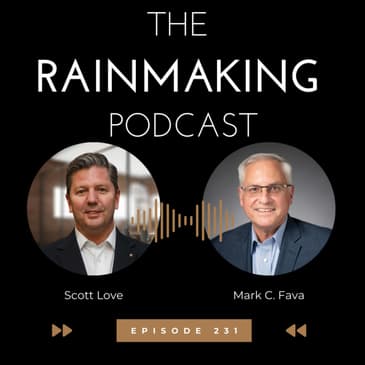
In this episode of The Rainmaking Podcast, host Scott Love speaks with Mark C. Fava, a seasoned aviation lawyer, retired Navy captain, and author of Lessons from the Admiral, about how to build a thriving legal practice from the ground up. Mark shares the story of how he pivoted from being Delta Airlines' chief operations attorney during 9/11 to returning to private practice in South Carolina—where he had to start over and build his book of business from scratch.
Mark outlines the deliberate strategies he used to position himself as the go-to aviation lawyer in his region, including writing targeted articles, speaking at niche conferences, and becoming a visible and reliable contributor in key legal associations. He explains how volunteering for the least desirable job (like fundraising for an ABA section) helped fast-track his leadership credibility and ultimately led to speaking engagements and board positions. He also discusses how publishing thought leadership—no matter how small the outlet—boosted his visibility and credibility over time, attracting both clients and media.
Mark emphasizes the importance of aligning your brand with your passions, targeting specific niches where you can own mindshare, and focusing on long-term relationship-building over short-term gains. He shares tactical advice for new rainmakers, including how to leverage Google search visibility, create a content calendar, and cultivate media relationships through punchy, quotable commentary.
Visit: https://therainmakingpodcast.com/
----------------------------------------
Mark C. Fava is a career aviation lawyer and retired naval flight officer. He is a prolific writer and entertaining speaker. Mark retired from the US Navy as a captain, having commanded three units, including an aviation squadron. He has been a law firm partner and a corporate executive lawyer. As a law school adjunct professor, he has also taught aviation law and legal writing.
Mark was the chief operations attorney at Delta Air Lines on 9/11 and spent years in the Navy’s P-3 Orion chasing Soviet submarines. He has practiced law for over thirty years and is currently a vice president at the world’s largest aerospace company.
He lives in his hometown of Charleston, South Carolina, with his wife and three daughters. When not working, reading, or writing, Mark enjoys life in the low country and appreciates a cold glass of sweet tea in the summer and a good oyster roast in the fall.
His first book, “Lessons from the Admiral, Naval Wisdom and Sea Stories for Leaders” was an Amazon New Release Bestseller in January of 2025.
Links:
https://www.linkedin.com/in/markcfava/
Order Mark’s book, Lessons from the Admiral, here: https://a.co/d/bg9tc6Q
Learn more about your ad choices. Visit megaphone.fm/adchoices
[00:00:10] You're listening to The Rainmaking Podcast, hosted by high-stakes headhunter, author, and professional speaker, Scott Love. You're listening to The Rainmaking Podcast, and this is Scott Love. Thanks for joining me on the show. My friends, we have a really interesting speaker today, and our topic is building a book from the ground up.
[00:00:35] If you're a rainmaker or even a potential rainmaker, this is an interesting story that has some significant lessons for you. Mark C. Fava, our guest today, he's a career aviation lawyer and also a retired naval flight officer. He's a prolific writer and entertaining speaker, and he retired from the U.S. Navy as a captain, commanding three units, including an aviation squadron.
[00:00:59] He's been a law firm partner and a corporate executive lawyer, and even as a law school adjunct professor, he taught aviation law and legal writing. What's interesting about Mark is that he was the chief operations attorney at Delta Airlines on 9-11, and he also spent years in the Navy's P-3 Orion chasing Soviet submarines. Also, Mark is the author of Lessons from the Admiral, Naval Wisdom and Sea Stories for Leaders.
[00:01:27] I read that book, and I'd highly recommend it. In fact, we put the links in the show notes to get Mark's book and also Mark's bio links, so make sure you connect with him directly. And I hope you get some great ideas from my conversation with Mark. Mark, I think he tells a great story and a story of how you can become a significant rainmaker. Thanks for listening. And as always, this show is sponsored by Leopard Solutions, legal intelligence suite of products, Firmscape, and Leopard BI. Push ahead of the pack with the power of leopard.
[00:01:57] And now here's my conversation with Mark Fava. Thanks for listening. Hi, this is Scott Love with the Rainmaking Podcast. Our guest today is Mark Fava, and our topic is a rainmaker's journey, building a book from the ground up. Mark, thank you for joining me on the show today. Scott, thank you so much for having me. It's great to be here. Yeah, you bet. And I love hearing about your naval career. And first, I wanted to start off with the promotion of your book, Lessons from the Admiral, Naval Wisdom and Sea Stories for Leaders.
[00:02:27] And the concept here applied to any sort of organization because people are people. I love the context of the naval sea stories that you share. And so we're going to put the links to get the book on the show notes. I'd highly recommend this. It's a really interesting read. And so thank you for writing this, Mark. And thank you for being here on the show. Well, thank you. And so tell us then your journey when you started in law.
[00:02:51] You had a series of events that kind of led for you to really develop some depth of expertise in your field. Tell us kind of from the beginning, where were you when you started your journey in becoming a rainmaker? Yeah. You know, I was I was like you. I spent the first few years of post college graduate school in the Navy. I was ROTC graduate, came back to South Carolina, went to South Carolina law school, was working at a law firm and really wanted to break into aviation law. And I was just having a hard time doing it at the time in South Carolina.
[00:03:19] And a great friend of mine who was a Naval Academy graduate who actually was at Delta Airlines at the time, called me up and said, hey, Mark, you know, you ought to come work for the law department at Delta. I went back to my wife and said, we ought to go do this. And she said, absolutely not. I don't want to go to Atlanta. And needless to say, 30 days later, I talked her into it and we took the risk. And I left Charleston and we went left my home of Charleston. And we went to Atlanta to work for Delta Airlines. Yeah. And what happened there? Yeah, it was fascinating.
[00:03:47] 41 days later, 9-11 happened. So everything I promised my wife about, about, you know, quality of life, nine to five corporate job, travel benefits, different home work life balance. It was all turned on its head. But, you know, fascinating time because I was the chief operations attorney at one of the world's largest airlines in the middle of the biggest crisis in history. Wow. Wow. What was going on during that time in the legal department there, Mark? It was fascinating.
[00:04:13] I mean, you know, we all remember those of us old enough to know exactly where we were when it happened. I was actually with the general counsel at a conference. We were at the Renaissance Hotel right there on the runway. We were talking to our corporate security managers. And back then, you know, we didn't have cell phones. Everybody had pagers. Everybody's pagers started going off. And I got to tell you, we knew then something wasn't right.
[00:04:36] And the next year or two, it was just a tremendous amount of work for the law department across every profile that we handled. You know, you can remember that there was no TSA back then. Right, Scott? That's right. That's right. Wow. That's back in the day. And so you were in a critical inflection point in your life and in your career. And then what led up to wanting you to go back to the firm that you were with before? Yeah, you know, I had gotten out of the Navy and gone into the reserves to return home to Charleston.
[00:05:06] So my family was in Charleston. Three years later, my wife said, hey, I'd really like to go to Charleston, go back. And I promised her if it doesn't, you know, if it doesn't take in Atlanta, we'll go back. And that's exactly what we did. So I picked up the phone. This is the don't burn bridges lesson. I called the managing partner and said, hey, I'd love to come back. Do you remember me? And he said, sure, we remember you. He said, I never will forget this. He said, but we don't have any work for you. So if you want to come back and you want to work here, you've got to build your own practice. Yeah. I like that.
[00:05:34] You mentioned never burn bridges because you never know what's going to happen. Right. Yeah, absolutely not. Yeah. So you went back. You'd already earned trust because you were working with people there before. But you had to start from zero. What was your plan? You started what went through your mind and what was the plan that you had to really start building your practice? Yeah. So I figured, you know, I could leverage all the people I met. We'd all gone through 9-11 together. So I knew all the lawyers in house and all the other air carriers.
[00:06:01] I knew all the lawyers at the major insurers in New York City. And I also knew that there wasn't any other bread and butter aviation attorney in South Carolina. So I tried to map out a plan. How do I market myself as the aviation lawyer in South Carolina? How do I get to the point that if you Google aviation lawyer, South Carolina, my name comes up. Right. You know, writing, speaking at conferences, doing a bunch of non billable stuff and maintaining those relationships to create that image. Let me kind of break that down then. Did you have a written plan?
[00:06:30] Did you have like a written business plan when you started all this? I did. I sort of mapped out. I always was thinking, OK, where do I want to be five or 10 years from now? So, you know, how do I get there? And it would be publish a couple articles a year and then go go to the conferences and figure out how I could speak. And, you know, the first time you show up at a conference, Scott, you're not going to speak. It might be the third or fourth time you show up there. Yeah. So that's how I eventually started to do it. I targeted the major major aviation law conferences and I went there with a purpose. That's great.
[00:06:59] So you targeted them. You had a real clear plan of which conferences you're going to go to. And you knew you might have to go to attend before you can sit on the panel or speak at those. And tell me about this. I personally think that what you just said, that's the golden secret that a lot of people don't do, which is go to the show, go to the conference. I've got a friend of mine who's an expert witness consultant and he'll go. He'll find out where the conferences are for his niche. And many times he won't go to the conference.
[00:07:26] He'll just sit in the bar, you know, and he'll just chat up and have conversations with the people. That's the low budget way to do it, too. I guess that works also. Absolutely. Yeah. So what happened at these meetings before you were selected to speak at those? What did you do during these meetings to really accomplish your goal? Well, a couple of things. Always get the list of attendees before you go. So, man, you actually target the people you want to meet, right? And everybody's wearing a name tag.
[00:07:54] Everybody has a picture back then, even still on LinkedIn or on their on their web page and figure out who are the people you want to meet when you're there. So it's very purposeful. But then volunteer once you're there to help it next time. And I never will forget, I was on the American Bar Association Air and Space Law Forum. That was where the people were that liked airplanes. And I said, how can I help? And they said, we'd love you to help. Next year, we need somebody to be the donor solicitor. You know, the person who asked calls up everybody asked for money. Absolutely. Worst job. Right. But you know what I said? Sure, I'll do that.
[00:08:24] Absolutely. And how did that shift? How did that change the equilibrium in that organization? I had a real good friend recently remind me of this, and that was the formula. Give first before you ask. So I was giving. I got to know the people. I did a great job at the worst job. I got, you know, every single donor renewed. They came in at higher levels. They could depend on me. And within three years, I was on the board of the ABA for Space Law Forum.
[00:08:53] That's a short period of time, isn't it, Mark? Yeah. Yeah. It was phenomenal. And then the fourth year I'm speaking. And the first time I spoke, get a load of this. It's Friday afternoon at three o'clock. But that's okay, right? Because I'm speaking. And that's great. And then you can tell everybody you spoke at that conference. You put it on your website, press release, et cetera. Yeah. Absolutely. So this is interesting. I appreciate you going into the detail on there because I think there's several lessons where identify which groups have the people you want to connect with.
[00:09:20] Were these groups, were the client prospects, did they come to these conferences also? Yeah, it was a mix of both. It was a mix of practitioners who did the same thing I did. So potentially competitors, but that's fine. You know that in our market or in any market, right? Sometimes your competitors are your biggest source of referral business. Yeah. But then also the aviation insurers who would give you the business. And then even more importantly, I was meeting a governmental agency. So on the board with me was the head lawyer of the TSA at the time, Francine Kerner.
[00:09:49] So, and quite honestly, the irony of all of that, the head governmental relations lawyer for my current employer was also on the board. Wow. That's great. What a great network, you know? And I love the fact that you jumped in. I'll take the hardest job that nobody wants. You do a good job with it. I mean, anything that connects to bringing revenue in, people really like. And so I think that's a, that was a smart way to do that.
[00:10:14] Was there any inflection point in that life cycle of your involvement in the association that you think, oh, that was a pivotal moment? Was it, was it actually doing that work of the fundraising? But what, what do you think? Yeah. You know, I think it was just a, just, you know, you said it earlier, Scott. I think the most important thing is find the people that like the same thing you do and, and, and hang out with them. And then once you feel comfortable, the first, same thing, the first time I went to the conference, you know, six or seven o'clock, the first day, everybody's going out to dinner and they all have
[00:10:44] preexisting meetings with each other. And I didn't. So I was like, how do I get to the point where even before I get there, people are calling me to go out to dinner. And when you get to that point, you know, you've got the relationships and you don't even have to ask for the business. At that point they say, Hey, I know the guy in South Carolina. That's the aviation lawyer. We'll just give them a call. Yeah, that's great. I like the fact that your goal was to be number one in this certain region too, where, you know, where that lane is that you're working to.
[00:11:09] One thing I also think with conferences, like you talked about, when people go to conferences, they go to do business where you can be putting a shrimp on your plate and see some, what do you do? Oh, I work in the aviation. Oh really? You know what we're looking for somebody we should talk. I mean, it can go that quick. At conferences I've seen there, there was one prospective client where she'd been dodging me for months and months and months on LinkedIn. And then all of a sudden we're at a conference and our eyes connect and she looks at me. Oh, I've been meaning to talk to you. Let's talk while we're here.
[00:11:38] I mean, it was that quick. So I really think that's a smart idea to really look at that. Now, now let me ask you this about your writing, which is the other component of building that thought leadership. Tell me about that. What were, what were your goals when you started writing? What were your goals in that regard? The goal was to make myself an expert. In other words, like you just said, same thing for the conference agenda. You know, once you're on the conference, if somebody Googles your name, there you show up on the agenda, right? The writing was the same thing.
[00:12:08] So the first article I wrote, I never will forget this. I just wrote for the South Carolina Lawyer Magazine, the magazine put out by the bar. And it was something entitled, you know, post 9-11 TSA regulations and how air travel is going to change. Scott, it was maybe a five page article. And that was it. And that, you know, from there, I just kept writing, moving to bigger publications and better publications, but all along trying to build up those Google hits and that image as the person in South Carolina they would want to go to.
[00:12:34] I mean, so I think some people think I'm going to write an article and I'm going to get a call. And I don't think sometimes it can go that quick. What are the other benefits of writing for thought leadership? Yeah, I just think you do get the call eventually, but it's like you said, it's amazing how many people, it's the same thing as LinkedIn these days, right? It's amazing how many people see you and never say anything. But when they meet you, they know, oh, you wrote the book. Oh, you're the aviation guy.
[00:13:00] And then once I figured out I had South Carolina, I started marketing as the Southeastern Aviation Law Practice Group because I knew I couldn't compete in DC and I wasn't going to compete in New York, but I surely could compete in North Carolina. South Carolina, Georgia and South Carolina where my firm had offices. Yeah, that's great. That's a really smart way to do it, I think. And just in terms of strategy. So I've noticed with writing articles, because a lot of people, I'm too busy. And if you just make the time and you put time on your calendar, let's say it's the beginning
[00:13:29] of the month, you're going to allocate three 30 minute sections of time once one week for just sit down for half an hour. Now, you're actually going to end up in an hour working on it. But when you put a half hour in your calendar, you can do that. You can't commit to a whole hour. You'll end up doing a whole hour. And so that's kind of how I fake myself out by making myself do that. But what I found, because I've written a lot too, is that it's not just something that's going to be read by a prospective client, but it's something that's read by current clients
[00:13:58] and by people that already know me or people that are just starting to get to know me. And I believe that relationships are built on frequency of contact. And a contact can be somebody reading you an article that you wrote. That's a contact. That's a connection. Hearing you on a podcast. That's another arrow in the quiver in terms of building that relationship. And so if somebody is struggling with writing, what should I do? Let's say they're a professional. They've got a very narrow niche. Where do you think they should start? Should they start with writing something?
[00:14:28] Should they start with where they're going to get it published? Where do you think they should start in terms of their writing journey, so to speak? Yeah, I would just start with the publications that are of interest to you. And it doesn't have to be the number one, the world's number one premier law journal or the best journal for your profession. It can be anything small. It can be just an op-ed on somebody's blog and just send it to them and see, you know, say, hey, I like how you know what you're publishing. I'd love to get published. Here's my concept. And I can turn this into an article in such a time.
[00:14:56] And then if they say yes, you meet the deadlines and you deliver on a product, right? You're on time. And boy, that takes up a lot of their worry if you deliver a professional product. Yeah. And they've got something to publish. Yeah, that's right. And the thing about writing is that you write it once. It can be reshared over and over again. You write it for the state chapter of the American Widget Manufacturers Association of South Carolina. And guess what?
[00:15:22] You can send that same piece to the North Carolina chapter, the Georgia chapter, the Tennessee chapter, Virginia chapter. You do the work once and make money over and over again was kind of how I explained it to people. Yeah. So we've got the speaking. We've got the writing. I also think in between all that is you're networking. You're doing things for people. You're giving referrals. You're a contributor.
[00:15:45] Are there any other components of thought leadership that you've really seen as important for a Rainmaker to really focus on? I think what I said earlier, you know, be known as a giver rather than a taker, right? Yeah. How can I help you? Especially the people who are behind you. How can I help you in your career? Anybody that's ever worked for me, it's been my priority to make sure that I take care of them. And if they work hard and they deliver, they have a quality of life and they're promoted.
[00:16:13] And I think that brings you tremendous value as you move along through your career. Because ultimately, and Scott, we've seen this in our careers, some of those people are going to bypass you and ultimately might even become your boss, right? So help the people below you. And it creates a wonderful atmosphere. Yeah, absolutely right. So Mark, what was the time in your life where you realized I've got critical mass in my practice? How did you know that you're really starting to get somewhere in building your book? Yeah. Yeah.
[00:16:42] Again, I never forget it. I had gone to a legal marketing, again, just always learning from others, right? Several years I had gone and gotten very close to my billable hour goal, but maybe missed my collection goal. So I'm investing in myself and maybe missing the end of your bonus. It's that time of the year. I remember December, they'd come around and Mark, you missed it by a little bit. That's because I was doing so much non-billable marketing. The next year I started hitting my target. I started feeding work to other people. But when I really knew it happened, Scott, is I had been pinging this.
[00:17:10] The guy who covered the aviation beat for my local paper, he was also picked up by the AP a lot. And I would just send him emails. Hey, I saw this coming to town, blah, blah, blah. I'd be happy to be quoted on it. I sent him probably five or six emails and he never responded. I sent him a seventh one. And one day I'm driving on the interstate to work and he calls and it's just like he's my friend. Hey, Mark, this is John down at the Post and Courier. I got your email on X, Y and Z. I'd love to get a quote from you. I was like, wow.
[00:17:38] You know, so the next day I appear in the newspaper as aviation expert lawyer Mark Favos said. And that was it, man. I would I'd finally made it. That's great. That's a great story. What did you do with that? Did you just look at it and do it and say that's nice. Or what did you do with that content after he quoted you? No, you know, I guess you got to be diplomatic and careful with how you do it. Right. Because at the time I was still at the law firm and I was still representing major clients there. But I did let other people know.
[00:18:07] And, you know, I did send it to clients just saying, hey, you know, you might have seen that I was just recently quoted in whatever. And it might have been the last byline. Right. Here's an oh, by the way, just so you know, have a happy holiday. And I was just recently quoted in this. Right. Yeah. Because to your point, Scott, they like that. They say, OK, the person's got got some credibility here. Yeah, that's great. Did you have a group of editors or reporters that you would regularly ping and reach out to from time to time? I can't say that I did.
[00:18:36] But the good news is once one of them gets you on their list, they're going to come back to you all the time. So anytime anything happened aviation wise, even if it wasn't in South Carolina, anytime anything happened related to a plane or an accident somewhere, he would call me and more than half the time I could I could quote. And then, you know, the most important thing is, especially for lawyers, we're used to giving these real long quotes and explanations.
[00:18:59] And again, the marketing CLE that I went to said short, punchy five or six words that can go right in and meet their deadline. So sometimes I would just say, what's your deadline? Let me give you a call back, you know, right before the deadline. And then I'd sit in the car, sit in their office, write down a sentence, edit it, make it shorter, shorter, shorter and punchy, and then call back and say, here's what I think. And that exact quote would appear in the paper. That's great. Do you think reporters read articles that other reporters in their same area are writing? Absolutely. Yeah. Yeah, absolutely.
[00:19:29] So if you give a good quote for one, it's like you're giving a good quote for all the others. You're showing the others that I can be a good source, right? Sure. And again, it all goes. The first thing we do every time we get somebody's name, what do we do? We Google them, right? And other reporters are doing the same thing. What about taking your content and repurposing that in other areas? How have you done that in the past? Well, you just mentioned it. You know, ironically, this morning on LinkedIn, I talked about just going to the federal court party.
[00:19:55] And I included in the comments an article that I'd written two years ago about everything I'd learned as a federal judicial law clerk, you know? And guess what? I published that two years ago. But it's still relevant today to your point, Scott. You can always repurpose that stuff. Yeah, that's great. What do you think the pitfalls are that most people fall into where they really need to avoid stepping into them in terms of client developing that brand of client expertise? Yeah, I think especially if you're at the firm and even in the corporate world, you've got to be mindful of what you're saying, right?
[00:20:25] You can't willy-nilly say a bunch of stuff. I mean, the plaintiffs can be a little bit more vocal than a defense bar or corporate lawyer. So you have to be mindful of what you're saying and the topic you're being asked to speak on because sometimes you just have to say, I really can't talk about that. Yeah, right, right. I get that. I get that. So as we bring our time to a close, Mark, let's say you're coaching someone on client development, on building that brand of expertise, becoming a rainmaker, building a book.
[00:20:51] What would be three action steps you think they should start with to really start implementing the ideas that you shared with us today? Yeah, yeah. In summary, I would just say, look, follow your passion. For me, it was aviation law, right? So even though I went to a firm first and it didn't have an aviation law book of business, I took a risk. So that's leaving Charleston and going to Atlanta. Lo and behold, 9-11 happens. The second thing we've talked about, find the people who share your passion, right?
[00:21:18] So find the associations who share your passion for whatever topical area you want to work in. For me, go to the aviation law seminars. Sometimes I would do it out of pocket at my own expense, but it makes work fun because it's the same people that are telling the same stories that you like. And then the third thing is just make yourself an expert. It's not up to anybody else. You know, the firm marketing budget might help you, but, you know, you're writing on your own time that you talked about. You're speaking a lot on your own time. Not unbillable time, but you're investing in yourself.
[00:21:47] And I think for me, that was the most important thing because at the end of the day, it got me where I am today. Yeah, that's great, Mark. Well, thank you for being here on the show. I really appreciate you sharing your wisdom and I'd love to have you back on in the future. And hopefully we can stay connected, Mark. Thank you so much for being here today. Thank you. Thank you for listening to The Rainmaking Podcast.
[00:22:08] For more information about our recruiting services for international law firms, visit our website at attorneysearchgroup.com. To inquire about having Scott speak at your next convention, conference, sales meeting, or executive retreat, visit therainmakingpodcast.com. Thank you. Thank you.