This show is sponsored by Leopard Solutions Legal Intelligence Suite of products, Firmscape, and Leopard BI. Push ahead of the pack with the power of Leopard. For a free demo, visit this link:
https://www.leopardsolutions.com/index.php/request-a-demo/
----------------------------------------
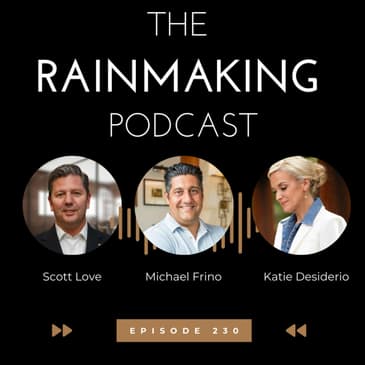
In this episode of The Rainmaking Podcast, host Scott Love speaks with Michael Frino and Katie Desiderio, co-authors of The Beekeeper: Pollinating Your Organization for Transformative Growth, about how leaders can cultivate a high-performance culture within their organizations. Drawing insights from their research on beekeeping, they explore how leaders can optimize their "hives" by fostering collaboration, self-awareness, and meaningful work. They emphasize that culture starts with leadership and requires humility, self-reflection, and a commitment to unlearning old habits.
Key topics include the importance of self-awareness in leadership, replacing the golden rule with the platinum rule (treating others as they want to be treated), and making challenging decisions to maintain a healthy organizational environment. Michael and Katie also highlight the concept of "pollinating" an organization by prioritizing growth and learning at all levels and creating psychologically safe environments where individuals can thrive. This episode offers practical strategies for leaders who want to build stronger, more cohesive teams and drive transformative growth in their organizations.
Visit: https://therainmakingpodcast.com/
----------------------------------------
Michael G. Frino always was told he was creative and had a vivid imagination during his childhood. He parlayed this feedback by finding a passion for writing and storytelling. He published his first poem in 1993 entitled The Human Tree and is the author of Welcome to Waycool School (2010) and Waycool School Takes the Bus (2011) children’s book series. In addition to writing, Michael has over twenty years professional experience working for Fortune 500 companies in sales, leadership and organizational development across the payroll/human resources, pharmaceutical, and med-tech industries. Michael finds his flow state today from helping organizations transform their culture with a focus on the growth and development of human beings.
Katie P. Desiderio counts her blessings starting with the people in her life, which guides her approach to work where her focus is on every organization's most important asset – you! Her personality and behavioral attributes emphasize collaboration and all things that keep human beings in focus, which fuels her intrapreneurial spirit.
As the mama of two extraordinary girls, she is committed to the development of rising leaders, namely in the spirit of leading from any seat. Along with her work as a tenured faculty member at Moravian University, Desiderio is Principal Partner in Learning of Proximal Development, LLC, an authorized DiSC partner, specializing in leadership development and the advancement of performance through learning.
Upon completion of her doctorate in Organizational Learning and Leadership, Katie has been co-authoring scholar-practitioner journal articles, conference proceedings, and now this book with her learning partner and friend. Join them on this journey to inspire how you will pollinate the world!
Links:
Book 📕: The Beekeeper: Pollinating Your Organization for Transformative Growth
Website: www.leadershipfables.com
Learn more about your ad choices. Visit megaphone.fm/adchoices
[00:00:10] You're listening to The Rainmaking Podcast, hosted by high stakes headhunter, author, and professional speaker, Scott Love. You're listening to The Rainmaking Podcast, and my name is Scott Love. Thanks for joining me on the show. Let's say you lead a team, whether it's a big team or a small team, you still have people that you're responsible for overseeing, mentoring, developing.
[00:00:36] What would it be like if your organization had a high performance where people were doing meaningful work together and they were all pulling in the same direction? We're going to talk about that today in our conversation with Michael Frino and Katie Desiderio. Now, these are people that have studied organizations. In fact, they wrote a book called The Beekeeper, Pollinating Your Organization for Transformative Growth. It brings a fresh perspective to developing your organization.
[00:01:06] We're going to put bio links and also links for that book on the show notes. No matter where you listen to the show, go to the show notes. You'll be able to connect with them directly and buy their book, and I'd highly recommend it. As always, this show is sponsored by Leopard Solutions, Legal Intelligence, Suite of Products, Firmscape, and Leopard BI. Push ahead of the pack with the power of Leopard. And now here's my conversation with Michael Frino and Katie Desiderio. Thanks for listening.
[00:01:36] Hey, this is Scott Love with the Rainmaking Podcast. Our special guests today are Michael Frino and Katie Desiderio. And today our topic is be a culture builder. Katie, Michael, thank you for joining me on the show here. Thanks for having us. It's so great to be here. Yeah, this is great. I'm really excited to have you. You've got great credentials. I'm excited about digging into some of the books that you've written. And I want to find out more about being a culture builder and the significance of that. And keep in mind, we have people that are in professional services on the show.
[00:02:06] So culture is it. That's what they have. So let me ask you this in terms of like a working definition. What does that mean to be a culture builder? How do we get our arms around that? Yeah. So I think there's so many probably great definitions of building culture. You know, Katie and I talk a lot about this, but really it's starts with you, like turning the mirror on kind of looking at yourself and who you are as a human being and how you show up each and every day. You know, you can't really effectively create a great culture unless people who are leading
[00:02:35] that charge kind of have an understanding of, you know, how they may be perceived within the organization and what kind of environment they're creating. So it sounds like self-awareness is a big part of that. Oh, certainly. Yeah. I think that's a big piece of it. Man, that's a tough place to start the conversation. Let's just go deep, shall we? So let me ask you this. That was pretty deep, yeah. Yeah, right, right. And so we've got powerful, smart, fancy people that are in high profile professional services
[00:03:04] and they're living in a glass house because everybody sees what they do. How do you think somebody can actually get to that point to build self-awareness? I mean, let me kind of start the conversation in that point. What do you think about that, Katie? Yeah, it's such a great question, Scott. And I love that you gave the analogy of thinking about it like living in a glass house. And so I think the first thing we do is we try to shatter at glass. And really, there's a sense of humility in culture building, right?
[00:03:30] So, you know, to Mike's point of how we're thinking about self-reflection, people aren't going to come along with you or buy into your vision, right? If they don't believe that there's a place for them, right? That there's a room for them in the house or that there's a spot for them to contribute. And so I think there's a thread there as we think about meaningful work, right? More and more, this is a topic of people saying, you know, I want to be part of something, right? Where I'm contributing meaningfully, where I'm doing something purposeful.
[00:04:00] And so as we think about that, you know, turning the mirror, there's high returns for, you know, these high profile people to think about, well, if I'm putting energy and effort into this and nobody's coming along, nobody's buying in. How do I do what's harder for adults than learning? And that's unlearning. We can't do it that way anymore. Maybe you have to look at it a different from a different perspective. We hear a lot about vulnerability in leadership now, right?
[00:04:29] In the sense of courage that it takes to say, you know what, I'm a human too, right? And as I lead with humility to think about how I'm pulling people in instead of unintentionally pushing them away, we start to see the returns of creating other culture builders around us. I like that. Pulling people in instead of pushing them away. That requires risk though, doesn't it? Well, there's risk in both ways that you look at it. Right?
[00:04:56] There's risk in escalating commitment, right? To continue to unintentionally push people away. Yeah. And right. There's risk in unlearning and thinking about the opportunities of, well, maybe I'm not looking at this from a perspective of, you know, how people feel after an interaction with me or how people are perceived, right? Based on the work they're doing. And so Mike and I talk a lot about unlearning the golden rule.
[00:05:23] When we think about things like culture work, right? And the golden rule says, treat others as you want to be treated. But people aren't the same as you. And people certainly don't receive information the same way you do. And they're not motivated the way you are. And so we ask listeners to replace the golden rule with the platinum rule, which is to treat others as they want to be treated. Oh, yeah. And so the extension of the self-reflection work is then to start to look at others, right? With an open mind to say, I could probably learn from you, right? Let me listen to understand.
[00:05:54] Let's take this to a different level. So I'm curious about the work that you all did to understand these concepts from an academic perspective. Because some of the things you're telling me, I've heard people that are therapists that say these same things that have gotten into management consulting. Tell me about what you've done academically to really kind of gain these insights to show us that without a doubt, we've proven it. This is the formula. Tell me a little bit about that.
[00:06:20] Yeah, so Katie and I have been doing academic research for over a decade. And we've been publishing in the performance improvement space, whether you're talking about flow or getting in the zone or just kind of helping organizations identify how to better align. There's a whole host of research out there on this. And Katie and I kind of specialize in performance improvement space. It's, you know, one of the things that's interesting is that we kind of moved away from our traditional academic writing.
[00:06:48] Because, you know, sometimes you don't really know how many people read those journals, frankly. And they're in these performance journals, your volume 50 of, you know, page 32 to 20, you know, 41 or whatever. And it's interesting because we decided, you know, to write it in more of a book format this time through the use of a leadership fable to really make sure that the message resonates with a lot more people.
[00:07:12] And you mentioned earlier in the beginning of your podcast that there's a lot of individuals that probably could benefit from just understanding what it takes to build culture and is the academic journal the best place to reach that audience. And so, you know, we did a lot of work in trying to understand how beekeepers and so our book, the beekeeper piloting your organization for transformative growth is all about how do you create an environment where, you know, your organization can thrive.
[00:07:38] And we really thought that the beekeeper is a great example of this because they have to optimize their hive. And so we did a lot of research in the field with beekeepers to learn what they do. How do they make sure that their hives are successful? How do they make sure that all the different roles within the organization are collaborating effectively together to create kind of this environment where we can optimize output and performance of the hive?
[00:08:01] And so these beekeepers have such great insight on just the care and the nurturing that they need to have, but also, you know, really what they need to do to make decisions for the betterment of the hive and how quick those decisions need to be made. And Katie, I don't know if you want to share the story, but... Yeah, I loved where you're going with it. To Mike's point, in our field research, working with beekeepers, we went out to one of the beekeepers who became a mentor to us through this field research and writing the book.
[00:08:30] And, you know, the book hit Wall Street Journal bestseller. We wanted to go out and thank, write them, give them copies, get pictures, you know, and she said to us, why don't you come out and visit my girls? That's what she calls her bees, right? And she's like, let's just go out while you're here. And so we went out to one of the hives and she started opening the panels and she was kind of frantically looking through the panels and she's like, interesting, I don't see the queen. And more than that, it looks like the queen is not really producing or like, tell us more about that.
[00:09:00] And she's like, well, I don't see any eggs. And so this is a little bit of a concern to me. And so she kept going through the panel. She got to the last panel of the hive and she found the queen. And she said, oh, there she is. And she held up the panel, picked the queen up off the panel, squished the queen and dropped her to the bottom of the hive. And Mike and I were like, we had this anticipation, right?
[00:09:23] Because like as you're doing this research, it's like exciting to see the queen and watch the production of growth and just to see what's happening in something that seemingly looks like chaos. But it's like everyone's doing their job, right, to help the hive grow. And we were like, what just happened? And she said, oh, the queen wasn't producing.
[00:09:44] And because we're going into the fall, if I would have left her in there and left my hive through the winter, all of my bees would be dead by the time winter was over. And so this is the cost, right, of me preserving thousands of other bees for the one that's not producing.
[00:10:02] And so what I need to do now is I need to combine hives and move this hive over to a hive that's thriving so that they could merge, right, and help create that thriving hive. And Mike and I like walked away. We were like, first of all, took us back, right? But to Mike's point, it was like those quick decisions that without thinking, she was like, if I don't make this decision, this hard decision right now, it costs me, right, a lot more.
[00:10:30] And so there's something there as we think about, right, the challenging decisions that are associated with creating a healthy culture. Sometimes that means we have people who aren't producing, right? And so we're not saying that we're going to cut people off, but we may need to remove them, right, from the hive to sustain the overall health of everyone else. That's such a great story. And I think those people that are in a leadership role listening to this need to think of their group as a collective.
[00:10:59] It's not about one person, right? And we've seen that in organizations where we've got this rainmaker, he's billing, he's bringing in the work, but he's toxic. And it's costing the organization. Nobody wants to work for him. When he interviews people, they don't want to come to our firm. Let me ask you, how does a leader deal with that person? What have you seen where you have somebody that's toxic that is negatively impacting the culture of the organization? How should that person deal with that, that individual? What do you think?
[00:11:28] Yeah, so I've done a lot of culture work over the last few years in this space of, you know, really thinking about every contributor. And some work that's been really successful is in the space of DISC, Agile EQ. And so for listeners, right, DISC is a personality and behavioral assessment, kind of looking at, you know, where people fall.
[00:11:51] But the emotional intelligence component that goes with it has a space of, right, you look at the five tenets of emotional intelligence. Starts with self-awareness. It's where Mike opened, right? The second one is internal motivation. It's the one we can't train. And so to your point, Scott, right, how are we, you know, elevating the rainmaker? Or, right, looking at the behaviors that we want to see more of, right?
[00:12:16] And so many companies that I work with have, you know, shared eye statements of how we're going to show up, right? What kind of that should look like in our culture? And that's the place of everyone kind of turning the mirror to say, like, well, am I showing up that way, right? Or am I just producing the number, right? Am I railroading people? Am I making people want to leave? Am I, you know, kind of pushing people away from, you know, everything that I'm trying to do? That only goes so far, right? And then it goes into self-regulation, right?
[00:12:45] The thoughts that we're having, right? The thought, I want to keep this person because they're producing and they're, you know, it's so great right now. But what's the long-term cost? Are we thinking about those things? We then go into the fourth, which is social awareness. That's about checking in on the pulse of everyone else, right? Maybe those silent producers who are actually the health, right, of the organization that nobody's paying attention to because they're always keeping their head down. They're not puffing out their chest, you know, to say, look at me and look what I'm producing, right?
[00:13:14] But there's a health of sustainability of how people are contributing. And then the fifth is, you know, looking at empathy. And that's the space of how we show up to listen to understand instead of listening to respond. And so in a lot of this work, there's a space of are people self-reflecting? Are they internally motivated to say, oh, probably not getting that right, right? Let me look at this from a different perspective. Let me listen to what everybody's saying, right? Listen to understand instead of listen to respond of like, hey, let that person alone.
[00:13:44] Because we do have to look at long-term ROI. Absolutely. Scott, Mike, I don't know if you want to weigh in too. No, I think that was very well said. I mean, I think the use of the DISC assessments is very helpful to kind of give people that understanding of self-awareness and how they show up. And sometimes you got to teach them how to demonstrate a little more connectivity. So when someone is interviewing and they may be the person that's interviewing and someone's like, I don't want to, I don't know if I really like that person.
[00:14:12] It doesn't mean that they're not a good person. It just means that maybe they don't have the awareness to demonstrate a little more human connection, which is that person might require during the interview process. Yeah, that's great. I think you have to know what your team's all about. What have you seen the big challenges and pitfalls are? If a leader says, I want to grow in my skills, like you talked about, Katie, emotional awareness, all those things like that. I want to be a culture builder.
[00:14:38] How do you think or what are some of the big pitfalls they should avoid as they start looking to strengthen the culture of their organization? You know, I'll just chime in here and then Katie, you know, obviously certainly your thoughts on this. But I think one of the pitfalls leaders do is that they kind of establish some norms and some values up front, which are really good. But the reason that's a pitfall sometimes is because they're not really personalized as much as they should be.
[00:15:05] I mean, what ends up happening is, you know, they kind of find some leadership values that they seem are really important. Maybe they're not really true to who they are. Or, and then when that starts manifesting and, hey, you know, you say these are important to you, but you're not really enacting these values, then that becomes really troubling for that leader, right? Because they're saying these values are important to me and then they're not demonstrating them. And then people can see right through that sometimes. But if you stay true to your values and go through that work of really saying like, hey, this is who I am,
[00:15:35] then I think that's always a very positive sign, especially if you can demonstrate those each and every day. So Katie, I don't know if you have anything to add. Yeah, I would add, I love what Mike just said is, you know, ensuring that there's alignment, right? Closing any disparities in what we say and what we do. I also think there's an undertone there that goes back to something we talked about earlier is a pitfall of doing it the way we've always done it. And so in that space of, you know, how are we looking at the climate impulse of where we are?
[00:16:05] This is the first time that we have five generations working in the workforce. And so in the spirit of that, when we're thinking about culture builders and bringing everyone in, leading from any seat, we have to really look at the pulse of, right, what meaningful looks like, what meaningful work looks like to all generations, right? As we're succession planning and we're looking, right, to bring people along to what the future us looks like, we can't do things the way we've always done it.
[00:16:32] And so that's going to require some unlearning and replacement of new habits. So I like that. And let me ask you this. Another wrinkle is virtual organizations. And in the legal community, most firms, they're back in a couple of days a week. Some firms are still completely virtual. Other organizations have their own hybrid setups as well. How do you think you can continue to build that culture and be a culture builder virtually?
[00:16:58] What do you think, or what have you seen organizations do well in that regard? You know, it's making me kind of chuckle because I'm guilty of this sometimes. You know, we kind of fill our calendars with these virtual meetings, right? And we've got 30-minute blocks and, you know, 45-minute blocks of time, hour blocks of time. And, you know, when we talk about styles, you know, sometimes people want to be productive during that time, right? And they want to get, you know, I'm here for this meeting. This is kind of my initial, this is my goals of the meeting.
[00:17:27] I want to be productive during this one hour. And you kind of get right to the business side of things. And when we're trying to create culture, as Katie mentioned earlier and we've been talking about, is that you can't lose sight of, like, there's another human being on the other end of the, you know, screen. And if we always kind of just go right to the work side of the business and don't ask about, you know, hey, how was your weekend? How's your family doing? And take that few minutes to just kind of make that connection.
[00:17:55] Then, you know, it could come across as, like, insincere or it's just all business. And I think that impacts culture, right? And so I think always people have to be mindful of how are they using their time and making sure that they're treating others as they want to be treated for the platinum role. And I will comment that if you do have somebody who, like, only cares about the business and just wants to get right down to business, you know, going into the personal side for too long could frustrate them and impact culture on the other end.
[00:18:23] So I think knowing your audience and treating people the way they want to be treated is really important, especially in the virtual world, to help make sure that culture is like, hey, this person gets me. Like, I feel supported here. I feel included here. And I think that's one aspect. That's great. What do you mean in your subtitle? Subtitle, and I like the subtitle of your book, Pollinating Your Organization. What does that mean? How does one pollinate their organization? Yeah, so Mike and I talk a lot about, you know, bee mindsets in the book.
[00:18:51] And so there's a little play on words there as we learn from bees. But as leaders, we get to choose who and how we want to be. And so when we think about pollinating your organization, one of our bee mindsets that's central to our work is bee proximal. And proximal means closest to the heart, right? Closest to the center. And so when we think about pollination, it's about growth. And effective leaders are thinking about ongoing learning and growth.
[00:19:17] And so in that bee mindset of bee proximal, it's how we keep learning and growth at the heart of everything we do. That's both for ourselves and for the people that we work with and through. That's great. What do you think about that, Michael? What are things that you've seen that help us to pollinate the organization? Yeah, I mean, I echo what Katie said, but I think that everybody has to believe that they can be a pollinator, right?
[00:19:39] And when we take the hierarchy of some organizations where you're considered a leader or you're a manager, people forget that, you know, pollination can start at every level, right? And it can pollinate upwards and downwards, just as the bee does, right? It travels flower to flower to pollinate. And you don't have to look to our leaders to be the pollinators.
[00:20:01] You know, we can each and every day be someone who, you know, make sure that other people feel supported, make sure that, you know, they understand kind of what they need to grow and just kind of create that environment where everybody is helping one another grow. So that's great. Yeah. And I've seen that from a recruiting perspective, because I've talked to literally tens of thousands of professionals. I've been in recruiting since 95. And there's always an emotional context. When someone says, I'm never going to leave, I always ask them why.
[00:20:30] And it's usually an emotional thing. I love the people here. I feel like this is my team. And the same thing when someone says, let me close my door. I want to talk to you. I don't feel safe here. I don't feel like I can trust my colleagues. I don't think I can trust the leadership. There's always an emotional context. Even when we're talking to super smart people that don't want to have emotional decisions influence their business life, you just can't help it because we're people.
[00:20:57] So I think your book is very, it's probably going to be one of those books that's going to be around forever, 20 years from now, still on the Wall Street Journal bestseller list. So let me ask you this. And for everybody else listening, we're going to put on the show notes the link where you can get the book and also connect with Michael and Katie. But let me ask you this as we bring it to a close. If we could summarize three action steps, somebody listening today can take three steps to start being a culture builder. What would those three action steps be?
[00:21:28] I'll start. And Mike, feel free to weigh in. I'd say first, you know, take agency over your life, right? We always say be an active consumer in your life. Don't be a passive consumer. And that means you're choosing your be mindsets, right? You get to choose who and how you want to be. You get to choose. And so if you don't like, right, the pages that you've written for the past few chapters, you get to turn the page and say, I'm going to author, right, these pages a little different as I go forward.
[00:21:54] Second, I think, you know, this notion of being proximal, that means that we're learning and unlearning always, right? We're keeping learning and growth central at the heart of everything we do. And to Mike's point, we're leading from any seat. And so there's a place for listeners to think about, right, what am I going to take away from this time that I'm with Scott right now? What am I going to learn? What can I unlearn, right? And so as we go into, you know, Mike and I often say what you give your time and energy to grows.
[00:22:23] And so in those places, right, be proximal, right? Just keep learning and growth just at the heart of everything you do. And then third, you know, I would say that, you know, there's an opportunity for all of us to think about the environment. So when we think about culture and culture builders, we've talked a lot about the safety of the environment, right? The is the environment right for people to grow? Is it psychologically safe? And every single one of us contribute to that environment.
[00:22:52] We can't point our finger and say it's his fault or her fault or right their fault. It's all of us contribute to the environment. And so we need to think about going back to leading from every seat. Every person has the opportunity to positively contribute to the environment. Mike, do you want to add anything? No, I so well said. Those would be my top three. But, you know, just to comment if I would identify some stuff that we talked about on the call today, you know, that self-awareness piece is really important.
[00:23:21] So one action I would do is, like, if you don't know how you show up each and every day, like, if you don't know your natural tendencies and style that are deep-rooted in kind of that, you know, your personality and your value system, go find that out, right? Go do one of the personality assessments and go explore and get that self-awareness to say, you know, who am I and how do I show up? And then communicate that out. The second piece is values. Like, do you have a value system? And if you don't have your values written down and know what they are, write them down and make sure that, you know, you're sharing those with people.
[00:23:50] So, you know, most issues occur in team dynamics when values get compromised. And I think if you don't share your values, sometimes it's hard for people to know, you know, what they need to be mindful of. And then also, I think the last piece is really just focusing on that environment that Katie said and really just building that environment that's conducive for people to speak up and, you know, just share and be themselves. That helps with culture. Thank you for that, Michael. Thank you, Katie.
[00:24:20] And tell us about your offerings, your services. What are the things that you all do that you would like for our listeners to know about? Yeah, thank you, Scott. First of all, invite listeners to visit our website, which is leadershipfables.com. On our website, you'll find information about our first book, The Beekeeper, Pollinating Your Organization for Transformative Growth.
[00:24:41] We also have like free resource guides for our readers on there to do things at the individual team and organizational level. And so those are free for anyone who joins our website. And then there's also information on there about our second book that's coming out. It will be on shelves in March of 2025. That's called The Stargazer. And The Stargazer is about how we build brighter teams.
[00:25:08] And so we build on the concepts that we learn from The Beekeeper to thread into our second book. That's great. Michael, anything you'd like to add? No, well said. I think visit our website. There's plenty of resources on there and, you know, excited for the opportunity to, you know, be on the show. That's great. And for our listeners, we're going to put that website on our show notes. So no matter wherever you listen to the show, go there. You'll be able to connect with them. We'll put the link for your book also and then as well as your LinkedIn links as well.
[00:25:38] And thank you both for being here, Michael and Katie. Thank you for sharing your insights. I know our listeners got a lot out of this. I did as well. And I'd love to have you back on the show in the future. Thank you, Scott. Thank you so much. Thank you for listening to The Rainmaking Podcast. For more information about our recruiting services for international law firms, visit our website at attorneysearchgroup.com.
[00:26:05] To inquire about having Scott speak at your next convention, conference, sales meeting or executive retreat, visit therainmakingpodcast.com.