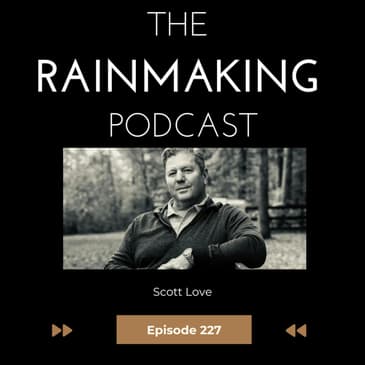
Scott Love is the founder of The Attorney Search Group, a legal recruiting firm. His practice focuses on partner transitions and law firm mergers, with specialized expertise in recruiting for global law firms in the areas of corporate, finance, private equity, and related practices.
This business experience brings credibility and legitimacy to his speaking presentations at business, association, and legal conferences on the topics of rainmaking and client development. Scott's easy going presence from the stage, his clean humor, and storytelling style make him a popular speaker at conventions, conferences, and executive retreats.
Scott is the author of Why They Follow: How to Lead with Positive Influence, the co-author of Rainmaker Confidential, and has been quoted in The Wall Street Journal, Forbes, Bloomberg, The American Lawyer, Above the Law, The Huffington Post, Selling Power Magazine, Business Insider, and many more.
Scott produces the popular show "The Rainmaking Podcast" which is a top 2 percent podcast.
Scott is a graduate of the United States Naval Academy in Annapolis, Maryland, and is a former Surface Warfare Officer.
Seven Strategy Questions with Scott Love
1. What were the impediments that kept you from reaching your goals?
2. What were your three greatest achievements?
3. What was the single greatest missed opportunity?
4. How can you learn from this?
5. What trends did you observe that can help you next year?
6. How can you create synergy and leverage in your area of expertise?
7. Who are the people who can benefit by knowing you? Look for synergistic strategic alliances.
----------------------------------------
This show is sponsored by Leopard Solutions Legal Intelligence Suite of products, Firmscape, and Leopard BI. Push ahead of the pack with the power of Leopard. For a free demo, visit this link:
https://www.leopardsolutions.com/index.php/request-a-demo/
Learn more about your ad choices. Visit megaphone.fm/adchoices
[00:00:10] You're listening to The Rainmaking Podcast, hosted by high stakes headhunter, author, and professional speaker, Scott Love.
[00:00:23] You're listening to The Rainmaking Podcast, and my name is Scott Love, your host. Thank you for joining me on the show.
[00:00:29] As we bring 2024 to a close, I'm going to share seven questions with you today that can help you to identify strategic opportunities for 2025.
[00:00:41] I'm going to share this with you because this is something that I've done every year.
[00:00:44] In fact, I'd recommend coming up with certain habits on a daily basis that can give you information.
[00:00:50] And I'll get to that in a second. But first, a shout out to our sponsor, Leopard Solutions, and my friends over there, Laura Leopard, Phil, Flora, and all the others.
[00:01:00] Leopard Solutions is a data tool for the legal industry.
[00:01:03] Now, this show is not necessarily a legal podcast. It's general business development for professional services.
[00:01:11] But Leopard Solutions is a sponsor of this podcast, and I appreciate that very much.
[00:01:15] So that's a shout out to Leopard Solutions and their data solutions.
[00:01:18] So the topic for today is called Seven Strategy Questions for 2025.
[00:01:24] When I was at the Naval Academy, we learned a concept of navigation called dead reckoning, where we would look at our course, our direction, and our speed, the velocity of the ship.
[00:01:35] And we would be able to kind of predict where we're going to be based on where we've been from.
[00:01:39] And I think a lot of times from our business navigation, we can look at past success and look for opportunities and trends to determine where we should go.
[00:01:48] Now, one thing I've been doing pretty much every day since 2017 is at the end of the day on an Excel spreadsheet, I'll write down, number one, what was my greatest achievement for the day?
[00:02:00] As a legal recruiter, did I get a submission or send out? Did I obtain the trust of a candidate?
[00:02:07] What was that great achievement? And I document that on an Excel spreadsheet.
[00:02:12] The other column, and listen to this, my lessons learned.
[00:02:16] What was one thing that I learned for the day?
[00:02:19] I found by being attentive to, I've got to learn something today.
[00:02:25] I will find things that I will learn.
[00:02:27] And guess what? Usually they're my mistakes.
[00:02:29] And I'll write that down in the next column.
[00:02:31] And the other two columns are metrics for my practice.
[00:02:33] But when you write down what your greatest achievements are, you validate your success, you grow in strength.
[00:02:40] When you write down what your lessons were for the day, you develop data.
[00:02:45] Yeah. That's a lot of information.
[00:02:47] And usually the lessons learned, like I said, they're mistakes I make.
[00:02:50] And what I do about once a quarter, I'll go back over those columns and I'll pay more close attention to the lessons learned.
[00:02:57] And I look for trends.
[00:02:59] I look for mistakes that I made.
[00:03:01] Usually that's what my lessons are, like I said.
[00:03:03] And, oh, I'm making the same mistake over and over again.
[00:03:06] When I'd see that, then I would pay attention to what changes I need to make.
[00:03:11] And I would set a virtue goal for the month that would ameliorate that deficit.
[00:03:17] When you pay attention to what you're doing every day, you're going to get information that helps you with dead reckoning on where you're going to be.
[00:03:25] And you know what changes you need to make in terms of your strategy or your personal performance or whatever it is.
[00:03:32] So I'm going to share with you seven questions that can be journaling questions.
[00:03:36] And I've also put these in the show notes of this podcast.
[00:03:40] No matter where you listen to the show, go to the show notes and you can just copy and paste that.
[00:03:45] And over the holiday season, I'd recommend reflecting on 2024 and use these questions to help you determine where you want to go and how you can improve in 2025.
[00:03:57] So the first question is this.
[00:03:59] What were the impediments that kept you from reaching your goals this year?
[00:04:04] When you have a hard look at what didn't work and why it didn't work, then you can identify opportunities for change.
[00:04:14] Number two, for this year, what were your three greatest achievements?
[00:04:20] Think through that.
[00:04:21] It could not necessarily be the end result, but it could be the input.
[00:04:26] I was able to get my metrics to where my inputs were pretty good.
[00:04:30] And as a result, the outcome was great also.
[00:04:33] But what were the three single most greatest achievements in your professional life for this year?
[00:04:40] And write those down and spend some time really thinking about that.
[00:04:43] I think when you memorialize your success, you can come back to it and listen to it.
[00:04:48] And that reinforces that, yeah, I've got this.
[00:04:51] I can do this because we all have self-doubt at some point or another.
[00:04:56] Number three, what was the single greatest missed opportunity?
[00:05:02] I think when you see that and you feel that pang of remorse, I didn't follow up on that.
[00:05:08] I lost the account.
[00:05:09] Whatever it was, it kind of stings, doesn't it?
[00:05:13] And guess what?
[00:05:13] That's a learning tool.
[00:05:15] When our deals don't close and the things we want to have happen don't happen, well, we're not celebrating any wins.
[00:05:23] And what we tend to do when we're going through failure or disappointment, we tend to look and ask ourselves questions on how we can improve.
[00:05:32] I used to do a lot of coaching and consulting for the recruiting industry.
[00:05:35] I still do a little bit.
[00:05:36] So I've actually coached hundreds of people.
[00:05:40] And I found that when their deals don't close, they're more receptive to change.
[00:05:44] And I even came up with a tool called a deal autopsy tool that helps people look at why didn't the deal close?
[00:05:51] And here's some structured analysis on how you can pinpoint why.
[00:05:55] And guess what?
[00:05:57] You make changes to your protocols.
[00:05:59] I really think that when the deal came in and it didn't close, you've got the carcass.
[00:06:03] Pick it apart.
[00:06:04] Find ways that you can make improvements.
[00:06:06] So when you think through this year, what was your greatest missed opportunity?
[00:06:11] That disappointment is going to be a motivator on how you can change.
[00:06:15] When everything's working well, you're too busy popping champagne corks and rolling around in piles of $100 bills and you're not thinking about how you can get better.
[00:06:24] Number four, how can you learn from this?
[00:06:27] That means what changes do you need to make from that greatest missed opportunity?
[00:06:33] And I found in my own life when I put it down in action steps, step one, step two, step three, I've got real structure on where to grow.
[00:06:42] And you know what? This is where it gets really interesting and exciting.
[00:06:47] When you can see that using dead reckoning as a navigational tool, this didn't work, this didn't work.
[00:06:53] What are the trends? And you find out, how can I learn from this?
[00:06:57] Number five, speaking of trends, what trends did you observe that can help you next year?
[00:07:03] In my own practice, there are several key trends, probably about two or three of them,
[00:07:07] that I was able to capitalize on in the service of my clients and candidates that really put me at a whole new place.
[00:07:14] And that's something I'd recommend that you do as well.
[00:07:16] What are the trends that you observe that can help you next year?
[00:07:19] There was a legal recruiter I was coaching recently where there is a certain trend that he was able to capitalize on
[00:07:25] and it actually helped him earn the trust of candidates and clients that he didn't even know because of that trend.
[00:07:33] Number six, how can you create synergy and leverage in your area of expertise?
[00:07:43] I think a lot of that can come from leverageable events, such as maybe you were on a panel for a trade association conference.
[00:07:51] Well, guess what? You can write a press release talking about you sitting on that panel.
[00:07:56] You can take the recording of that panel if it was recorded, put it into social media posts.
[00:08:01] You can take that and turn that transcript into an article.
[00:08:05] You can reach out to the people that were on the panel with you and talk about doing a follow-up panel,
[00:08:09] even if it's not through a trade association, do it on a Zoom that you host.
[00:08:12] See what I'm saying?
[00:08:14] You're creating synergy and leverage in your area of expertise.
[00:08:17] That's been the whole basis of my whole business model.
[00:08:19] Not like I'm growing a search firm, but I look for leverage and I look for synergy.
[00:08:24] I try to create relationships that are scalable, meaning one to many.
[00:08:29] Who are the people that I can help in terms of strategic alliances?
[00:08:33] And I'm going to get to that in a second.
[00:08:34] But how you can create synergy and leverage, look for that.
[00:08:38] How can I take this one unit at a time and scale it so it serves other people?
[00:08:43] And finally, number seven, who are the people who can benefit by knowing you?
[00:08:48] What that means is look for those people that have access to the people you want to get to know and have already earned that trust.
[00:08:59] But it's not from the perspective of how can they help me?
[00:09:02] It's what can you do for them?
[00:09:04] How can you benefit those people that have access to the people you really want to get to know?
[00:09:09] And maybe there's some sort of a strategic or synergistic alliance, something that's not necessarily official, but it could be a referral source.
[00:09:18] Who are those people that know the people you really want to get to know?
[00:09:21] How can they benefit by knowing you?
[00:09:23] A book that I read was called Who Not What by Dan Sullivan and Benjamin Hardy.
[00:09:28] I'd highly recommend that where it really gives you the framework of thinking about getting leverage through relationships.
[00:09:35] That's a concept I started on my own years ago, and then I found out, wow, there's a book on it.
[00:09:40] So I'm kind of getting nerdy going deeper into that book, and it's fantastic, and I'd highly recommend that.
[00:09:46] My friend, thank you for listening to the podcast.
[00:09:49] Thank you for making this a top 2% show.
[00:09:51] If you get a minute, I'd appreciate writing a nice five-star review about the show on Apple Podcasts.
[00:09:57] It'll just take a minute.
[00:09:58] I'd really appreciate that.
[00:10:00] As always, check out our sponsor, Leopard Solutions, and I'll see you in 2025.
[00:10:04] We've got some fantastic shows coming up for next year.
[00:10:08] We're going to start the year hitting the deck plates running, and I hope it's going to be a great year for you.
[00:10:13] Take care, and thank you again for listening to this show.
[00:10:19] Thank you for listening to the Rainmaking Podcast.
[00:10:22] For more information about our recruiting services for international law firms, visit our website at attorneysearchgroup.com.
[00:10:31] To inquire about having Scott speak at your next convention, conference, sales meeting, or executive retreat, visit theraanmakingpodcast.com.