This show is sponsored by Leopard Solutions Legal Intelligence Suite of products, Firmscape, and Leopard BI. Push ahead of the pack with the power of Leopard. For a free demo, visit this link:
https://www.leopardsolutions.com/index.php/request-a-demo/
----------------------------------------
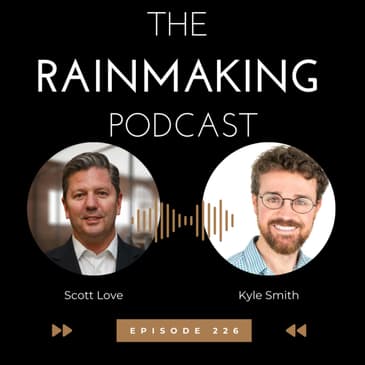
In this episode of The Rainmaking Podcast, host Scott Love speaks with Kyle Smith, an expert in leadership and business growth, about how professionals can develop a winning mindset and take control of their career trajectory. Kyle explains that success in business development isn’t just about skill—it’s about mindset, discipline, and intentional action. He emphasizes that the best rainmakers cultivate a growth-oriented attitude, take ownership of their goals, and implement daily habits that lead to long-term success.
Key topics include the power of self-discipline in business development, how to overcome self-doubt and limiting beliefs, and why successful professionals focus on long-term strategy rather than short-term wins. Kyle shares actionable strategies for building confidence, structuring time effectively, and using mental resilience to push through setbacks. He also discusses how leaders can inspire teams to adopt a results-driven mindset, create accountability systems, and leverage high-performance habits for sustainable business growth. This episode provides practical insights for professionals looking to improve their mindset, boost motivation, and achieve consistent success in business development.
Visit: https://therainmakingpodcast.com/
----------------------------------------
Kyle Smith, CPA, a finance graduate from UT McCombs School of Business, is deeply committed to helping small and medium-sized businesses thrive. He began his career in Austin, gaining experience as an accountant and Controller for various bar and restaurant groups. His passion for guiding SMBs led him to earn his CPA and specialize in cost management accounting as Director of Finance at Celis Brewery. Kyle’s journey continued at Scalefactor, a software development company, where he advised clients across various industries. His ultimate aspiration was realized when he became a co-partner at Strata Cloud Accountants. Kyle specializes in working with business owners to align personal and company goals and help teach businesses the financial acumen needed to hold themselves accountable to those goals. All with the mission to help businesses and business owners be more profitable.
Links:
https://www.linkedin.com/in/kyle-smith-cpa-9582038a/
kyle@stratacloudaccountants.com
Learn more about your ad choices. Visit megaphone.fm/adchoices
[00:00:10] You're listening to The Rainmaking Podcast, hosted by high stakes headhunter, author, and professional speaker, Scott Love.
[00:00:23] You're listening to The Rainmaking Podcast, and this is Scott Love. Thanks so much for joining me on the show.
[00:00:28] What I love about producing this show is that we get deep. Intellectual challenge is what motivates me and I know it motivates you also.
[00:00:35] And even if you've been in the professional services rainmaking role for a long time, there is factually still more that you don't know than what you do know.
[00:00:45] So good job on keeping on with the learning. And going with that, our guest today is Kyle Smith.
[00:00:52] Now, a lot of the guests I've had on the show, their coaches, their consultants, their sales book authors, they coach people and help them to get better in client development.
[00:01:02] Well, our guest is a little bit different. He's actually a rainmaker himself who's motivated just to share his story and some insights that will help you. And that's about it.
[00:01:10] And he is a highly regarded accountant and accounting firm owner in Austin, Texas, that is sharing with us consistent habits for high performing rainmakers.
[00:01:22] His name is Kyle Smith. Make sure you check the show notes. We put all of Kyle's contact info there.
[00:01:27] And by the way, if you get some good value out of this, go to Apple Podcasts and I'd appreciate it if you write a nice five-star review and mention Kyle by name.
[00:01:37] One other thing, if you're in the recruiting industry, and if you are motivated by intellectual challenge, check out theplacementclub.com.
[00:01:44] I created this free community because I enjoy teaching recruiters how to grow.
[00:01:49] There's over a thousand members. It's absolutely free to join and there's free resources, theplacementclub.com.
[00:01:55] Check out our recruiting mastermind every Monday.
[00:01:57] And as always, this show is sponsored by Leopard Solutions, Legal Intelligence, Suite of Products, Firmscape and Leopard BI.
[00:02:04] Not push ahead of the pack with the power of leopard.
[00:02:08] And now here's my conversation with Kyle Smith. Thanks for listening.
[00:02:14] Hey, this is Scott Love with the Rainmaking Podcast.
[00:02:17] Our guest today is Kyle Smith.
[00:02:19] And we're talking about consistent habits for high performing rainmakers.
[00:02:24] Kyle, thank you for joining me on the show.
[00:02:26] Super excited, Scott.
[00:02:27] Yeah, me too.
[00:02:28] This is interesting because I talk to a lot of people that, you know, I really should do more work in terms of client development.
[00:02:35] I'm just so busy.
[00:02:36] I don't find the time.
[00:02:38] But I really think, and I know you agree with this, consistency is key.
[00:02:42] If you're giving advice to someone on developing these consistent habits, where do you think they should start with that, Kyle?
[00:02:49] Yeah.
[00:02:49] And the first thing, too, I come from a background where I was not doing business development.
[00:02:54] So developing that over, you know, the time that we've had our business has been super challenging, but super rewarding.
[00:03:00] And I would say the first thing is, I admit that it's diminishing return, at least in my opinion.
[00:03:06] Meaning I understand where people are coming from when they say, I don't have the time to do it.
[00:03:10] You know, maybe it's not fruitful all the time.
[00:03:12] So it's hard for me to neglect client work and spend time here where the return isn't immediate.
[00:03:18] But what I'd say to that is, it is diminishing returns, but it's so, if you can spend five hours a week or an hour a day on developing business in different capacities that we can get into.
[00:03:29] But if you can spend that time consistently, that's the only way, in my opinion, that you have a very consistent pipeline.
[00:03:35] And otherwise, it takes so much time to rebuild those networks and that, you know, that relationship that you're building with people.
[00:03:43] It doesn't bear fruit in terms of a closed deal, maybe every day that you're doing it, but you have to be consistent.
[00:03:49] And you get the most bang for the buck just by spending that, you know, 30 minutes to an hour a day.
[00:03:56] And you've got to commit to it.
[00:03:57] I think that's great.
[00:03:59] Just like, you know, brushing and flossing, right?
[00:04:01] You know, other habits that we can relate to.
[00:04:03] Well, it's kind of, I'm kind of busy, but if I don't do it, I got to get my teeth fixed.
[00:04:08] So there's your smart metaphor for the day on how this is, let's call it rainmaking hygiene, I guess.
[00:04:14] So what are some ways that you have found to maintain consistent daily efforts, even though you've got competing time demands?
[00:04:23] How have you done that?
[00:04:24] I like to block time and that's critical.
[00:04:28] And this is, you know, things that I've, there's no free lunch.
[00:04:31] There's no, I always wanted to take the path of least resistance when it comes to business development.
[00:04:35] But unfortunately, if you're, if you're an introverted person, look at it as a learning experience.
[00:04:41] But there's no way you need to do the work and get in front of people.
[00:04:44] So I like to spend on Sundays, I spend 30 minutes just planning out my week.
[00:04:49] And I'll look at different networks that are going to be relative to me or relevant to me because it's super important for our business that I stand in front of people.
[00:04:56] And so I target that.
[00:04:59] Okay.
[00:04:59] So if it's super important for me to stand in front of people, calling is important too.
[00:05:02] But I like to meet people first and then call for our business.
[00:05:06] That's a lot better in terms of developing business.
[00:05:08] So plan out the event, you know, spend your time wisely, plan out the events that are going to work for me.
[00:05:13] I do that on a Sunday and then I hit those events about the week.
[00:05:17] And usually for me, it's, I want to go to one event a week that's targeted around where I am in Austin or, you know, client set or prospective client set.
[00:05:26] And then from there, that gives me the context that I need to then follow up by phone and then, you know, take the sales process from there.
[00:05:35] So basically I take it week by week and a good event that generates the leads.
[00:05:39] And then I follow up consistent on those leads because that's the other thing.
[00:05:42] If you go to an event, and I'm sure people have experience with this, I don't even bring a business card to an event anymore because nobody's ever called me from a business card that I gave them.
[00:05:51] When I go to an event, I meet you that might be a good fit for us.
[00:05:54] I need to follow up with them usually pretty consistently.
[00:05:57] They're not going to go out of their way because they've got busy schedules to follow back up.
[00:06:00] A lot of the time, usually those clients will be coming through referrals.
[00:06:03] So getting their contact and following up with them most of the time instead of you just giving a card and expecting them to call you back.
[00:06:10] Right.
[00:06:10] So let me, let me talk about these physical events that you go to.
[00:06:14] And then I want to come back to some of the other things related to scheduling and consistent habits.
[00:06:18] When you go to an event, do you set goals before you go?
[00:06:22] Do you have like, I want to have X number of connections or anything like that?
[00:06:25] What goes on in your mind when you go to these conferences and meetings and things?
[00:06:28] I set a goal, but it's more along the lines of, it's a mindset goal.
[00:06:33] Be passionate, be present and camp this person that I'm talking to.
[00:06:37] Or can they be a good referral partner for me?
[00:06:40] And remember to be thinking about that.
[00:06:44] So we have a framework that we've developed, which is, I stole it from a book called New Sales.
[00:06:51] It's called a power statement.
[00:06:52] And it's basically, why are we here?
[00:06:55] How can we help somebody?
[00:06:56] And I look at that as a framework before I go to those events.
[00:06:59] And then, you know, kind of focus on that message when I'm talking with people.
[00:07:03] So I don't have a goal like, hey, get this many people or this many when I'm actually at an event.
[00:07:07] I do set a goal of, hey, I want to hit four events a month as a minimum or one a week.
[00:07:11] But once I'm there, it's be present and listen and see if we can help.
[00:07:16] Because a lot of the time, maybe it's, I can't help this person directly, but I know someone that can help them.
[00:07:21] Or it might be a good client fit for us.
[00:07:23] But either way, not coming off sales, trying to be honest and see if we can actually help people.
[00:07:28] So it's more of a mindset once I'm there.
[00:07:31] Yeah, that's interesting.
[00:07:32] Now, from what you said, there's another thing I wanted to kind of go down this rabbit hole of rainmaking where you talked about maybe this is a referral partner.
[00:07:41] So let me kind of back up and kind of talk about that.
[00:07:44] What are the categories of people that you want to connect with at these meetings?
[00:07:49] How do we segment them into different categories?
[00:07:51] Yeah, so one obviously is a client, which for us is usually a small business that's doing between $2 million to $20 million in annual revenue.
[00:08:01] That's in one of our target industries, which are pretty wide, but so it's side-based.
[00:08:06] So usually if I'm talking to a business owner there, obviously that's exciting.
[00:08:09] I have a chance to help them directly.
[00:08:11] But cross-referral-wise, people that are around the industry.
[00:08:15] So I'm in consumer packaged goods as one of our verticals.
[00:08:18] And I talked with somebody who does vending machines that are for consumer packaged goods, as an example.
[00:08:24] So that is a really good cross-referral opportunity because they're talking with our prospective clients all the time.
[00:08:29] And I actually just made a referral to him, one of our folks that was looking for a new sales channel, made that referral.
[00:08:35] And so those are really powerful because now he's thinking about us because I've given him someone to talk to.
[00:08:42] Now all the businesses that he's to do, he may think of us.
[00:08:46] And honestly, I think that's the most, for our business, that's the most powerful thing is cross-referral partners.
[00:08:51] It's one that you have to do, you know, you have to call people, businesses, follow them.
[00:08:55] But the cross-referral partners, that's a network of now you're 10xing the people that you might be able to get in front of because they're getting in front of them for you if they can remember to think about you.
[00:09:05] Yeah, that's great.
[00:09:06] So the two categories, you have client prospects and then cross-referrals.
[00:09:09] And one thing I noticed, you were very clear on the type, pretty much this is the description of our sweet spot of a client.
[00:09:17] Two to 20 million in revenue, privately owned.
[00:09:19] And then I also noticed, you said, we also have a niche within packaging.
[00:09:24] And I think what I see here, you understand the scope of who you are and where your universe of prospects are that benefit the most from you.
[00:09:33] But then you also have a tight, sweet spot of packaging because you develop a niche.
[00:09:39] They know each other.
[00:09:40] You anticipate their problems.
[00:09:41] You know what's important to them even before you call them because you've seen this movie before dozens of times with similar people just like them.
[00:09:50] And because, oh, I'm in packaging.
[00:09:53] You work with packaging companies who you work with.
[00:09:55] I know that guy.
[00:09:55] I know that lady.
[00:09:56] I know that person.
[00:09:57] They're working with you.
[00:09:59] You earn instant credibility through borrowed trust, even if they just met you putting a shrimp on a plate at a cocktail party.
[00:10:07] You know?
[00:10:07] And so shawauza, there it is.
[00:10:10] That's secrets of the universe right here, ladies and gentlemen.
[00:10:13] Rain making.
[00:10:14] So let me kind of back up a little bit then.
[00:10:17] You talked about you know your vendors in that niche.
[00:10:21] Why do you think they would be good potential referral partners?
[00:10:25] Oh, the vendors?
[00:10:26] Yeah.
[00:10:27] Yeah.
[00:10:27] Yeah.
[00:10:27] Because, like I said, you're 10xing.
[00:10:30] You know, I'm only one person.
[00:10:31] But if you can really focus on building those relationships and show that I'm...
[00:10:35] For me, it's can I help them is a lot of the time because when I can help them, they can help me.
[00:10:40] And they're going to think of me.
[00:10:41] They have, you know, we do CFO services and accounting services.
[00:10:44] Vendors, they know five of me in terms of people that do what I do.
[00:10:49] So why are we different?
[00:10:49] Like you said, we niche.
[00:10:50] We can stay ahead and be proactive.
[00:10:52] So even when I'm talking with people preliminarily, I can start bringing things up that they might not expect and say, hey, these people are different.
[00:10:58] That's why it's so important to have a niche.
[00:11:00] And then if you're giving that to your cross-referral partners, out of the five people that they meet that are CEOs or accountants,
[00:11:07] they're going to remember me as, hey, I'm the expert in this space that can get ahead of certain things that might be problems to clients.
[00:11:14] And they're working with those clients.
[00:11:16] So they don't want to make a referral that doesn't work out.
[00:11:18] So be the person that they think of.
[00:11:20] So I like this.
[00:11:21] I like the depth of thought you've put into this.
[00:11:24] You've thought about who you are and what your client prospects look like and the sweet spot.
[00:11:29] And I like the fact that you know who those people are that can connect you with them.
[00:11:34] Let me kind of back it up a little bit then.
[00:11:36] When you talk about these events, what are the types of events that you like to go to?
[00:11:41] What are certain types that you think really work for you?
[00:11:45] We like to go in to out, like you said, in terms of narrow to wide because we're niche and we consider ourselves the Cadillac of accounting.
[00:11:56] We're the top-notch service.
[00:11:57] So we're super responsive.
[00:11:59] Businesses come to us when they're really frustrated a lot of the time or they're not getting the help to grow the business.
[00:12:04] Our whole mindset is that it's acceptable to have a non-responsive team or a team that's not helping you.
[00:12:09] So that means for us, I need to talk with people and build relationships.
[00:12:12] So I start narrow.
[00:12:14] So we'll go to specific CPG events, consumer package good events in Austin, in South Austin where I'm located.
[00:12:21] So I'm a member of the South Austin chapter of a few networking groups here.
[00:12:26] And then also working with folks in the consumer package good space in my area.
[00:12:32] And if you can start there, like I said, be those partners out, then those partners start going into different markets where I can't be all the time.
[00:12:40] So once again, it's build across referral partners, keep those relationships tight.
[00:12:44] And then in terms of networking events I go to, I like starting as niched as I can working out.
[00:12:50] Not to say that I won't go to like the Expo event, which is the big consumer package good event in Anaheim every year.
[00:12:56] But on the day-to-day and building those relationships, I start with going as close as I can to where I am.
[00:13:02] That's great.
[00:13:03] Now tell me about this big event.
[00:13:05] What was the name of that one again?
[00:13:06] It's called Expo West.
[00:13:08] Okay.
[00:13:08] How many people usually attend that event?
[00:13:10] And this is a really interesting point.
[00:13:12] Expo West is a great example.
[00:13:14] It's a huge event.
[00:13:15] Thousands of people, maybe tens of thousands of people right next to Disneyland at the Anaheim Convention Center.
[00:13:20] And it's all packaged.
[00:13:21] The way the event works, it's all packaged good folks.
[00:13:24] And they're looking to sign big deals with like Walmart or Target, you know, one of those big box deals.
[00:13:29] So you get a lot of people that we work with that are out there.
[00:13:32] And last year, I didn't even go into the event because we're, as a vendor, you know, as a supplier of services, I'm a dime a dozen out there.
[00:13:40] And they don't, they want to move me through the line if I'm at the actual event.
[00:13:44] And the event's purpose is to connect the consumer packaged good folks with the big retailers.
[00:13:51] So what I was looking for networking events around that event.
[00:13:55] It went to one that was, it was a two-hour coffee event and got 30 or 40 good conversations with business owners and cross-referral opportunities that I would have had to spend thousands of dollars on a ticket for the actual event.
[00:14:08] Was able to go to a free networking event around it.
[00:14:10] And probably for what we do, be 10 times more fruitful.
[00:14:14] So I would say if your eyes open for things like that, go to the event.
[00:14:17] And if it's really expensive, maybe it's not in your budget.
[00:14:20] Look for events or, you know, networking opportunities around it where lots of those business owners are looking, hey, I need to get a cup of coffee before I jump in for the day and be there.
[00:14:28] Yeah, that's great.
[00:14:29] I have a friend that's a consultant to the legal industry.
[00:14:32] He's an expert witness and he's real niched and he'll find out where those niched meetings are.
[00:14:36] Or he'll just hang out in the lounge and the hotel and meet people, hang out in the conference area, just hang out, go to the bar and pick up conversations with people.
[00:14:45] And so I think that's really interesting.
[00:14:46] So then tell me this then, and I want to kind of come back to some of the habits, which I think this is a habit because you're going regularly.
[00:14:53] You're making it a disciplined habit to find those people, know who you are, who benefits from you.
[00:14:58] What do you do after the event?
[00:15:00] What are the habits that you have after you've come back?
[00:15:03] Let's say it's a medium-sized event and you've made about five to 10 meaningful connections.
[00:15:08] What do you do when you come back and how do you manage those relationships?
[00:15:12] What do you do with all that, Kyle?
[00:15:14] Yeah, and I've learned this one the hard way.
[00:15:16] And now I'm a lot better at it.
[00:15:19] I still can improve, but triage is key.
[00:15:22] So that's the first thing I'll do is I'll get home as I can to the end of the event and go through and say, who should I spend my most time on right off the bat?
[00:15:30] So I'll pick two or three that I think these have the most potential, whether it's a cross-referral or a direct perspective client, and say, I want to focus on these first.
[00:15:38] I'll get them into our system first so I know I'm looking at them on a day-to-day and have their contact info, and I'll set a plan to start following up with them.
[00:15:47] And then just work my way through the rest of the list.
[00:15:49] There's some that maybe I thought that turned out to not be.
[00:15:53] It doesn't make sense to spend your time, equal amount of time on those folks when it comes to, like I said, if it's diminishing returns and you only have three to five hours a week, you've got to charge and spend your time on what you think is going to be the best opportunity, in my opinion.
[00:16:07] That's great.
[00:16:08] This is brilliant.
[00:16:09] I like it.
[00:16:10] And let me ask you, do you consider yourself an extrovert or an introvert, Kyle?
[00:16:14] Oh, I'm a big-time introvert.
[00:16:15] I'm a grinder by nature.
[00:16:17] This is a rat in a maze, you know, trying to find cheese for me where I had to—we knew that this had to be done.
[00:16:23] And it's been really rewarding and fun, but this was not—going out and doing these things is not my nature.
[00:16:29] Yeah, I know.
[00:16:30] I'm an introvert, too.
[00:16:32] I can turn the switch on when I go to meetings.
[00:16:34] And it's so funny, it's just like at the coffee hour after church, I'm going to go sit in a corner and just talk to somebody I know pretty well because it's just too much anxiety.
[00:16:45] What, coffee hour after church?
[00:16:46] Really?
[00:16:46] Yes, absolutely.
[00:16:47] Just being honest here.
[00:16:48] But when I go to a business meeting, I've got an economic need.
[00:16:51] I need to make this happen.
[00:16:53] And I found that that's enough, at least for me, to do that.
[00:16:56] What advice would you give to somebody if they're more of an introvert?
[00:16:58] I don't like going to these meetings.
[00:17:00] How would you help them kind of get over that hurdle?
[00:17:02] I would say, one, most of us who are introverts, we're also grinders and we're pretty disciplined people.
[00:17:07] Yeah.
[00:17:08] So I would take an approach of, hey, approach it like you would your work or your discipline and don't get overwhelmed.
[00:17:15] So if you said, hey, I don't have an hour's worth of extroverted business development time in me today, make it 15 minutes.
[00:17:22] Or I don't have an event in me this week, that's fine.
[00:17:25] Schedule one.
[00:17:26] Well, I do that all the time.
[00:17:27] I don't really go into an event this week, but I'm going to schedule one for next week.
[00:17:31] So now I know it's on the books and I need to go to it.
[00:17:34] So, yeah, just do what you can do and don't try to get overwhelmed from one day to the next or one minute to the next.
[00:17:40] I think this is motivating hearing you talk about this because we're talking about small steps.
[00:17:47] And I think somebody goes to one event and they're mindful, the way you said, I want to come back to this in a second.
[00:17:52] They're going to see immediate results.
[00:17:53] Even if it doesn't result in somebody signing on an agreement, it results in at least moving a relationship forward.
[00:17:59] And I think when you build momentum, there's, you know, hits of dopamine.
[00:18:04] When you start seeing things actually take place and build in front of you,
[00:18:09] and there's direct causal relationship between the actions you take to build a book of business and the size of the book that you have.
[00:18:16] But you got to do the work.
[00:18:17] And what you're talking about is not insurmountable.
[00:18:20] It's not overwhelming.
[00:18:21] And if you're an introvert, just look at it as being disciplined.
[00:18:25] I think another attitude is your future clients.
[00:18:29] And this is something I just interviewed somebody on mental health,
[00:18:33] where a partner in a big firm has competing time demands and they're so busy.
[00:18:39] How can they spend one extra hour for their own mental health?
[00:18:42] And I said, I think the perspective that's going to help people get their arms around that is
[00:18:46] you are serving your clients when you take time for yourself.
[00:18:50] Oh, good.
[00:18:51] Now I can do that.
[00:18:52] And so I think you are serving your future clients.
[00:18:56] You are solving their problems.
[00:18:58] The people that you don't know yet, you are serving them
[00:19:00] when you take time to do these business development exercises and habits like you talk about.
[00:19:06] And let me kind of go back to what you mentioned.
[00:19:09] And it was the power statement, why are we here?
[00:19:13] And how can we help somebody?
[00:19:15] Tell me again about the book that you read that gave you that idea.
[00:19:18] What was the name of it again?
[00:19:19] Yeah, it's called New Sales Simplified by Mike Weinstein.
[00:19:25] Got it.
[00:19:25] That's great.
[00:19:26] And so as we kind of bring things to a close here, Kyle,
[00:19:29] if there are three action steps people can take to really develop these habits that we're talking
[00:19:34] about, if they just haven't thought about, haven't really thought about rainmaking as
[00:19:38] needing habits, what are three steps you'd recommend to help them get started with these ideas that
[00:19:43] you shared?
[00:19:43] So one, like we said, block your calendar.
[00:19:47] Block that time.
[00:19:48] For an introvert like me, that makes it real.
[00:19:51] So that would be step one.
[00:19:53] Two is consistently network.
[00:19:55] So like we talked about, you don't have to be as good as you think you need to be when you go to
[00:19:59] a working event.
[00:19:59] People are ready to talk about themselves.
[00:20:01] You might get that high school lunchroom feel when you're there, but people are ready.
[00:20:07] I did.
[00:20:08] I certainly, I was standing there by myself when I first started going to them.
[00:20:10] And then I realized you can just butt into conversations.
[00:20:12] That's the whole point of it.
[00:20:13] Yeah, you're right.
[00:20:14] So you just listen.
[00:20:15] You don't have to be perfect by any means.
[00:20:17] So that's two is consistently network.
[00:20:21] And then three, follow up.
[00:20:23] So after the networking's over, it's on you to develop the business 99% of the time.
[00:20:29] You know, sometimes folks are going to reach out to you, but more often than not, in my
[00:20:33] experience with our industry, in the services industry, in the accounting industry that I'm
[00:20:38] in, you have to follow up and be proactive.
[00:20:41] I say that they're not interested.
[00:20:43] And so that's it.
[00:20:44] I love it.
[00:20:45] Number one, block that time.
[00:20:47] Number two, consistently network.
[00:20:48] Number three, follow up.
[00:20:50] That's brilliant.
[00:20:50] Thank you for sharing that.
[00:20:52] And thanks for being here, Kyle.
[00:20:53] And before we go, tell us about your offerings, your services, what do you do?
[00:20:57] And then for anybody who wants to connect with you, we'll put all of your info on the
[00:21:00] show notes.
[00:21:01] Awesome.
[00:21:02] Yeah.
[00:21:02] So we are full service bookkeeping, accounting, and CFOs, everything that's related to back
[00:21:07] office.
[00:21:08] So we are proactive and responsive.
[00:21:11] Like I said, so businesses come to us when they're frustrated with their current team or
[00:21:15] they're growing.
[00:21:16] Like I said, and they're in that niche, that $2 million niche, they're growing and they're
[00:21:20] spending more and more time on daily bookkeeping or managing the bookkeeping team instead of
[00:21:24] focusing on strategy and growing the business.
[00:21:26] And that's where we can come in and help both on the backward looking, making sure you're
[00:21:31] getting accurate numbers to make decisions on and for looking, budgeting, forecasting.
[00:21:36] What does it look like when I'm growing?
[00:21:38] How do I grow?
[00:21:38] How do I grow profitably?
[00:21:39] Does this make sense?
[00:21:40] All of those questions we can help answer on the CFO side as well.
[00:21:45] And like you said, a website, we'll link to it and would be happy if anybody needed those
[00:21:52] services.
[00:21:53] Yeah.
[00:21:53] We'll put that on the show notes and we'll put your LinkedIn link on there as well, Kyle.
[00:21:57] Thank you for sharing your wisdom today.
[00:22:00] This is really motivating because anybody listening can do this and you can do it starting next
[00:22:04] week.
[00:22:04] You can do it starting today.
[00:22:06] Thanks for being on here, Kyle.
[00:22:07] Great job.
[00:22:08] And I'd love to have you back on in the future talking about other rainmaking ideas.
[00:22:11] Awesome to chat, Scott.
[00:22:16] Thank you for listening to the Rainmaking Podcast.
[00:22:20] For more information about our recruiting services for international law firms, visit our website
[00:22:26] at attorneysearchgroup.com.
[00:22:29] To inquire about having Scott speak at your next convention, conference, sales meeting, or
[00:22:35] executive retreat, visit therainmakingpodcast.com.