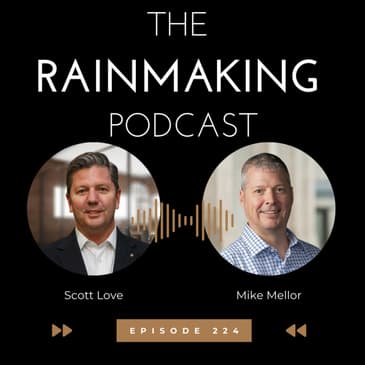
In this episode of The Rainmaking Podcast, host Scott Love speaks with Mike Mellor, business consultant and sales strategist, about how professionals can build authentic connections to drive long-term business success. Mike explains that building genuine relationships, rather than focusing on transactional sales, is the key to sustainable client development. He emphasizes that trust, empathy, and strategic follow-up are essential for keeping prospects engaged and converting them into long-term clients.
Key topics include how to structure a business development process that prioritizes relationships over quick sales, the importance of active listening to understand client pain points, and why personalization in outreach is critical for standing out. Mike shares strategies for leveraging CRM tools to track meaningful client interactions, maintaining consistency in follow-ups without being intrusive, and using storytelling to create deeper connections. He also discusses the psychology of decision-making in business development, explaining how professionals can subtly influence buying behavior by focusing on emotional engagement rather than just logical arguments. This episode provides practical strategies for professionals looking to elevate their rainmaking efforts, strengthen client relationships, and build a business development system rooted in authenticity and trust.
Visit: https://therainmakingpodcast.com/
----------------------------------------
I'm a rare consultant who thinks like an in-house CMO, not only ideating and developing processes and systems, but also implementing them within your cultural guardrails. Whether you prefer a "to-do" list as a project deliverable or want someone to build, design, and implement the entire solution for your business, I treat your valuable money and resources as though they were my own.
----------------------------------------
This show is sponsored by Leopard Solutions Legal Intelligence Suite of products, Firmscape, and Leopard BI. Push ahead of the pack with the power of Leopard. For a free demo, visit this link:
https://www.leopardsolutions.com/index.php/request-a-demo/
Links:
https://www.linkedin.com/in/michaelmellor/
Learn more about your ad choices. Visit megaphone.fm/adchoices
[00:00:10] You're listening to The Rainmaking Podcast, hosted by high stakes headhunter, author, and professional speaker, Scott Love.
[00:00:23] You're listening to The Rainmaking Podcast, and my name is Scott Love.
[00:00:27] Did you know that most of your prospective clients, when they're looking for a new service provider, they're 57% of the way through that process of choosing someone.
[00:00:38] And then you come along, what do you do? How do you manage that?
[00:00:40] We're going to talk about that and other lessons learned for Winning Business with our guest expert today, Mike Mellor.
[00:00:48] Mike Mellor is a consultant who thinks like an in-house chief marketing officer because he's done that before.
[00:00:54] He works with small to medium-sized law firms to help them in their business development processes and marketing strategies.
[00:01:01] Mike's got some great tangible ideas that will help you. Even if you're not in the legal industry, if you're in professional services, definitely listen to the show.
[00:01:09] There's going to be some significant insights that can help you that will make a difference. I promise you that.
[00:01:15] As always, this show is sponsored by Leopard Solutions, Legal Intelligence Suite of Products, Firmscape, and Leopard BI.
[00:01:23] Push ahead of the pack with the power of Leopard.
[00:01:25] Also, remember to check out the show notes for this podcast. Wherever you listen to it, you'll be able to connect with Mike Mellor directly.
[00:01:32] We've got his website and also his LinkedIn information directly.
[00:01:36] And if you have a moment, I'd always appreciate a nice five-star review on Apple Podcasts.
[00:01:42] Thanks for listening, and I hope you get some great ideas from my conversation with Mike Mellor today.
[00:01:49] Hey, this is Scott Love with the Rainmaking Podcast.
[00:01:52] Our special guest today is Mike Mellor, and today we're talking about lessons learned for winning business.
[00:01:58] Mike, thanks for joining me on the Rainmaking Podcast.
[00:02:01] Thanks so much for having me, Scott. Long-time listener, so appreciate it.
[00:02:04] Thank you, and I'm a fan of what you post on social media, which is why I asked you to be on the show,
[00:02:09] because I know you've got some insights that I think can help people.
[00:02:13] One statistic I want to start with is 57%.
[00:02:17] You mentioned to me that recently. Tell me about that.
[00:02:20] Why is that a significant number in terms of what we're talking about today?
[00:02:25] Yes, appreciate it. Yeah, it's a recent Gartner study, the consultancy, who noted that B2B buyers,
[00:02:32] including law firm buyers, are 57% of the way through the buying cycle.
[00:02:35] You're going to be able to significantly change sales cycle than 15 years ago, the last generation of lawyers.
[00:02:41] And so making sure that your online presence is literally your reflection, right?
[00:02:46] It's your front lawn, and so you've got to make sure you're mowing it and keeping it all up to speed there.
[00:02:52] So frequently just trying to build processes and systems that can help attorneys to either automate that process or otherwise streamline it,
[00:03:00] just to increase realization rates and just make happier folks all around.
[00:03:04] Right. I mean, that's a lot. That's a whole thing, right?
[00:03:07] And so what you mentioned, that 50% of the online buyers, or excuse me, they're 57% of the way through the buying process.
[00:03:17] That means they're pretty much close to making a decision.
[00:03:19] And they come across a professional services firm online, and that firm needs to insert themselves at that part of the buying process.
[00:03:29] What do you think potential clients for professional services, what are they looking for when they see content, when they see things online?
[00:03:37] What do you think, from their perspective, is important to them?
[00:03:40] Yeah. Well, they want to know you've done it before.
[00:03:42] I mean, experience really wins the day.
[00:03:44] And, you know, in a lot of firms that I see, there's not a really centralized way of organizing that, distributing that in the right places in the buyer journey,
[00:03:52] whether that's through a brochure or, you know, a follow-up or, you know, being prepped for an upcoming meeting.
[00:03:58] Or, you know, but folks go in, you know, another joke I kind of have is that a restaurateur doesn't care that,
[00:04:04] Scott, you form the company and I do the ADA work, right?
[00:04:07] They want to go back to cooking.
[00:04:09] And so, at the end of the day, are we thinking about how they're coming in and how they're thinking about it?
[00:04:14] So, you know, I think a lot of folks, you know, try to be the jack of all trades with industry knowledge.
[00:04:19] And I think they end up being the master of none there.
[00:04:22] It's just physically, intellectually impossible to be an expert in every industry in the world.
[00:04:27] So, you know, the riches are in the niches.
[00:04:29] And so, getting people to just be a little more focused there at that cycle because, you know, you're out of the game before you know you're in it.
[00:04:36] You might get five or six, you know, folks or names and you're going to research them online.
[00:04:41] And you might find two or three folks, oh my gosh, I'm a Sprinklr company.
[00:04:45] This person has done a $20 million acquisition, $100 million acquisition, a funding round, you know,
[00:04:51] and people who just put laundry lists of, hey, I did a bunch of 144As,
[00:04:55] I did a bunch of these and a bunch of these for every industry in the world.
[00:04:58] So, who's going to get their phone call?
[00:04:59] So, I mean, just a lot of that focus.
[00:05:01] So, let me take three things that you just talked about here just now.
[00:05:05] The first one, and these are the three things I wanted to kind of go down.
[00:05:08] You talked about experience wins the day.
[00:05:10] You even mentioned something called the buyer's journey, which I think we should talk about
[00:05:14] and also kind of developing that niched expertise.
[00:05:17] But talk first about experience wins the day.
[00:05:20] I kind of have an idea what that means, but how can we as professional service providers
[00:05:26] take our experience to showcase it to prospects that are looking for people like us?
[00:05:30] Tell me about that for a little bit.
[00:05:32] Sure.
[00:05:32] It's really about, you know, figuring out a centralized process, right?
[00:05:36] Is that going to be tied to your financials?
[00:05:38] Is it tied to your intake process?
[00:05:39] You're getting some data at that goalpost, right?
[00:05:42] Everyone needs to open a new matter.
[00:05:43] Everyone also needs to build a matter.
[00:05:45] So, are you taking those kind of, you know, steps and the information that's going to be
[00:05:50] required, that's going to be input that's being sent around, you know, outside to the
[00:05:54] client?
[00:05:55] Are you bringing that into marketing so that we can sort of sort and organize that?
[00:05:59] You know, we never know how a data or a pitch is going to come up.
[00:06:02] A request is going to come in.
[00:06:04] It might be, hey, listen, I want all of the big M&A deals.
[00:06:08] What have we done around the firm in the last two years that were over 500 million and,
[00:06:11] you know, had a PE element.
[00:06:12] And four seconds later, you might get a phone call that says, hey, what have we done in
[00:06:16] the life sciences space sort of across the transactional and litigation?
[00:06:21] And so, you don't really know how these things are there.
[00:06:24] So, you've got to develop an experience management system.
[00:06:26] There's a bunch of great off-the-shelf ones, but, you know, I'm focused, you know, really
[00:06:30] on the smaller and mid-sized firms who may not have the resources for a foundation or
[00:06:33] an NTAP or one of these, you know, sort of monster enterprise systems.
[00:06:37] So, you know, you can build something in Excel that says, hey, you know, here's the parties
[00:06:41] involved.
[00:06:41] Here's the date.
[00:06:42] Here's the lead partner.
[00:06:44] Here's the value.
[00:06:45] You know, kind of create a list of lists.
[00:06:46] I know that this is a fashion deal.
[00:06:48] It's trademark prosecution.
[00:06:50] It involved an M&A component.
[00:06:52] We've got licensing over here.
[00:06:53] And being able to sort of code those things so that, you know, you get a phone call and
[00:06:57] you're able to, you know, in a couple of minutes say, hey, you know what?
[00:06:59] Here's our Asia-based PE sponsor M&A deals.
[00:07:03] You know, and you don't think you need it until you do.
[00:07:05] And having that, you know, seven or eight deals that, you know, the firm has done and being
[00:07:09] able to speak to them intelligently, knowing who you can follow up with and having a system
[00:07:13] for that, that's going to improve your win rate significantly.
[00:07:17] Yeah, absolutely right.
[00:07:18] So this is interesting.
[00:07:19] I mean, a couple of things that you said, sometimes you're out of the, you don't find out you're
[00:07:22] out of the game and you never were in it before and you don't need it until you do.
[00:07:26] So an experience management system, what is that exactly?
[00:07:30] Sure.
[00:07:31] So, you know, they can come in different forms, but, you know, if you thought about a financial
[00:07:36] system, an Adderant or something like that, almost having a field in there that said,
[00:07:40] hey, you know, this is a, this particular, you know, the client name, you have that no matter
[00:07:45] number.
[00:07:45] Okay.
[00:07:45] We might have a general one, but no matter two might be a corporate deal.
[00:07:49] Okay.
[00:07:49] What does that, what is that exact?
[00:07:51] What does that mean?
[00:07:52] So having a description of that matter, typically that can be embedded into that financial services
[00:07:56] so that you can sort of code and understand hours and understand budget and all those types
[00:08:01] of things.
[00:08:02] That's perfect.
[00:08:03] But if you, if you don't have that, you know, even moving into an Excel doc, go, go
[00:08:07] back into every pitch you've ever done, every submission you've ever done, integrate all
[00:08:11] of that into sort of a central system, code, all that kind of create a consistent template
[00:08:17] for how those things are written and making sure that, you know, those are then consistent
[00:08:21] and all the partner bios and all your go-to-market pages on your issue pages, your industry pages
[00:08:27] so that folks, you're making it easy for them to say, hey, you know what?
[00:08:30] This firm has been there doing exactly what I've, you know, exactly the problem I'm trying
[00:08:35] to solve in the industry.
[00:08:36] I'm trying to solve it.
[00:08:37] So let's just say there is a small to midsize firm that's doing this and they're going
[00:08:41] through their data.
[00:08:42] Where have they pitched?
[00:08:44] Where have they won?
[00:08:44] Where have they lost?
[00:08:45] Who did they lose to?
[00:08:46] I assume that's something they should look at too, if they can find that out.
[00:08:49] How can that data be used to direct the focus of their niche development?
[00:08:54] Kind of talking about that other thing that you mentioned.
[00:08:56] Yeah.
[00:08:57] You know, I tell, you know, before anyone sits down to write a plan, I always say, you
[00:09:00] know, look backwards to look forwards, right?
[00:09:03] Go back into what are the cases you've worked on over the past two, three, five years, right?
[00:09:10] You integrate them and, you know, you may say, hey, you know what?
[00:09:12] I really focus on financial services.
[00:09:14] Well, you look back, you've done a bunch of different things.
[00:09:16] And, you know, you might find some sort of trends that are bubbling up.
[00:09:21] Hey, you know what?
[00:09:21] I didn't think about it this way.
[00:09:23] But if I'm not thinking about it by litigation topic, but instead by industry, I actually work
[00:09:27] a lot with financial services firms, whatever the case is, right?
[00:09:31] And that could really help to inform your strategy and to go forward, you know, to sort
[00:09:35] of look back.
[00:09:36] Hey, it also sort of spawns your memory there.
[00:09:39] What did you really like about working with that client?
[00:09:40] What did you not like?
[00:09:46] 30%, and maybe it's a real estate attorney who's doing 30% acquisition work, 30% leasing
[00:09:50] work.
[00:09:50] Okay.
[00:09:50] What does your utopia look like?
[00:09:52] Oh, it would be perfect if I could, you know, just work on, you know, retail landlord
[00:09:57] side leases.
[00:09:58] Okay.
[00:09:59] Well, everything you do should now be reflective of that.
[00:10:02] Right.
[00:10:02] I think that, you know, we talked earlier about you being, you know, intimately embedded
[00:10:06] with, you know, the partners you work with and their plans.
[00:10:09] Right.
[00:10:09] Yeah.
[00:10:10] Right.
[00:10:10] Yeah.
[00:10:10] Being able to sort of harness that, I think is great.
[00:10:14] That's great.
[00:10:14] So tell me this then, what is the buyer's journey?
[00:10:18] You talked about the buyer's journey.
[00:10:20] I've heard that phrase before, but how would you define that?
[00:10:22] What's a working definition for us on that?
[00:10:23] Sure.
[00:10:24] Sure.
[00:10:24] You know, I'm always thinking about, you know, how do clients interact with your firm?
[00:10:28] Right.
[00:10:29] You know, you may notice, you know, and again, you've got to kind of code these clients by
[00:10:33] industry, by practice, but, you know, understanding how do they come into the firm first?
[00:10:39] You know, they may come in, do a little bit of trademark work.
[00:10:42] And, you know, we're noticing that, you know, our fashion clients typically come in through
[00:10:45] that and maybe they're doing the funding after that.
[00:10:47] Maybe it's an M&A, you know, potential shareholder litigation or whatever, you know, those types
[00:10:51] of journeys are that can, you know, help you to really understand sort of the timing.
[00:10:55] Hey, you know what?
[00:10:55] Six months after we do an M&A, typically there's a litigation event.
[00:10:59] Okay, great.
[00:11:00] Well, you know, can we start to deliver just-in-time content there, you know, kind of based off
[00:11:04] what we're seeing in terms of those cycles of those clients?
[00:11:07] You know, secondarily, you know, you think about sort of correlation analysis, right?
[00:11:12] Noticing that 70% of our fashion clients who do X also do Y.
[00:11:17] Well, you know, that can help to inform some of your strategies as well.
[00:11:20] That's interesting.
[00:11:21] Hey, you know what?
[00:11:21] We work with Polo and they do this and this, but now this other company, they're not doing
[00:11:27] that.
[00:11:27] Why is that?
[00:11:28] Have we not introduced them?
[00:11:29] Did we miss a step along the way?
[00:11:31] Are they elsewhere?
[00:11:32] You know, let's just kind of, you know, should be giving you those different flags to kind of,
[00:11:36] you know, probe a little more.
[00:11:37] So with this correlation analysis, I've never heard that before.
[00:11:40] I kind of have an idea of what that means.
[00:11:43] Tell me a time where you worked with a firm and you did that correlation analysis.
[00:11:47] What were the variables that you looked at and how did that help them win more business?
[00:11:52] Sure.
[00:11:52] Well, just taking a quick step back that, you know, I like to refer to data in three I's.
[00:11:57] You've got industry data and that's, you know, looking at B law saying, hey, you know
[00:12:01] what, what are the trends we're seeing energy transition in Texas?
[00:12:05] That's coming big.
[00:12:06] You know, the Boston market's getting big with healthcare.
[00:12:09] That's those types of examples of industry analysis.
[00:12:12] You have individual analysis.
[00:12:13] I'll call that.
[00:12:14] And that's, you know, folks going on your site.
[00:12:16] What do they do?
[00:12:17] They go to the real estate litigation piece.
[00:12:19] They might download something.
[00:12:20] Do they forward that?
[00:12:22] What are they, what is Jenny Smith doing?
[00:12:24] And, you know, and kind of interacting with our email marketing campaigns, things like
[00:12:27] that.
[00:12:28] And then the third one where we're talking about this correlation analysis is the internal
[00:12:31] data.
[00:12:32] So that's, you know, understanding, you know, hey, when, you know, our T and E folks are
[00:12:37] opening a matter, what's the kind of secondary, you know, sort of affiliated practice area that
[00:12:43] might come up, you know, and we might be surprised.
[00:12:45] We actually found out that that was bankruptcy with a lot of the sort of high net worth folks
[00:12:51] that we worked with.
[00:12:52] Wouldn't have necessarily thought that, right?
[00:12:54] But hey, now we know that let's start to deliver some content and lead with value for those
[00:13:00] particular clients.
[00:13:01] You know, you can instantly point to that because, you know, that's what they're telling you.
[00:13:05] And you're just, you know, sort of packaging it in the way that they want it, you know,
[00:13:08] based off that data.
[00:13:09] So when it comes to correlation analysis, it really just helps us to kind of bucket maybe
[00:13:14] sort of like practices or like issues, you know, folks who have, you know, X issue
[00:13:19] might have Y issue.
[00:13:20] Okay, great.
[00:13:21] Well, you know, let's do something with that data.
[00:13:23] Yeah.
[00:13:23] Let's not just kind of use it as a nice to have, but, you know, help that to really inform
[00:13:28] our strategy.
[00:13:28] So that's sort of what I'm referring to.
[00:13:29] This is really interesting.
[00:13:30] I think this is also an argument for should lawyers be solo or be part of a team?
[00:13:35] If they're with the larger team, they've got the resources.
[00:13:38] They have people like you that work in that firm.
[00:13:40] They really have the expertise and knowledge to really understand how all the data sets
[00:13:45] interrelate with each other.
[00:13:46] And more importantly, what does that mean in terms of strategy?
[00:13:50] Have you worked with firms where they thought it was going to be all IP, but it ended up
[00:13:56] being bankruptcy, which is where the money was?
[00:13:59] I mean, have you seen what were some of the surprising things that you've seen with your
[00:14:02] clients?
[00:14:03] Yeah.
[00:14:03] I think, you know, we're seeing a big shift in the go-to-market strategies a little bit
[00:14:07] what I was talking about, the restaurateur example earlier, just in, you know, being
[00:14:12] really versed in all of the business issues that happen, right?
[00:14:15] Being able to help your clients see those things that are coming around the corner.
[00:14:18] So I think that industry plays are really big.
[00:14:22] I think issue plays.
[00:14:23] You know, when you talk about these big firms, something like COVID happens or, you know,
[00:14:27] might have cyber issues.
[00:14:28] Those are going to be sort of multidisciplinary, not sort of necessarily fitting into really
[00:14:33] sort of easy boxes.
[00:14:35] But those are the things that I find bring the most value because you've got, you know,
[00:14:40] kind of a big firm.
[00:14:41] It's a single issue, but folks looking at that prism sort of differently.
[00:14:44] And I think the clients really benefit from that.
[00:14:47] You know, when I was at Prior, my former role at Prior Cashman as a CMO there, we, you know,
[00:14:53] putting together different COVID events, right?
[00:14:55] We had force majeure issues.
[00:14:57] We had supply chain issues, all the issues that were prevalent, you know, labor issues
[00:15:02] that people being furloughed and all this different stuff.
[00:15:04] We were putting out these, you know, very sort of near time, you know, quick hits.
[00:15:09] And we ended up doing one just specifically focused on medical and healthcare providers
[00:15:15] and just bringing that in and just kind of that 5% customization of that.
[00:15:21] The amount of people who showed up at that, you know, dwarfed.
[00:15:24] And so it's a little bit of perception is reality, right?
[00:15:26] Folks saying, hey, you know what?
[00:15:28] I'm in that business and this isn't general.
[00:15:30] They're really talking to me.
[00:15:31] And, you know, the advice may not be incredibly different, but it's just an interesting sort
[00:15:36] of psychological thing that, you know, people really want that niche, really want that industry
[00:15:40] focused advice, really want somebody who, you know, they trust is going to be looking
[00:15:44] around the corners for them.
[00:15:45] So that's kind of the big surprise is the data, you know, and you think to yourself,
[00:15:50] maybe, hey, you know what?
[00:15:52] I want to be all things to all people because I don't want to really focus my bio because
[00:15:56] of people visiting.
[00:15:57] It's like, would you rather have a 50% chance of winning five deals or would you rather have
[00:16:00] a 5% chance of winning a hundred deals, right?
[00:16:03] So kind of getting folks to think like that and being able to point to that data.
[00:16:08] That's not just, you know, some talking head coming at them and saying, yeah, you need
[00:16:12] to do it this way.
[00:16:12] Let me tell you how to run your business, but one needs data.
[00:16:15] So I'm a big fan of it.
[00:16:16] This is complex and we're playing three-dimensional chess, aren't we?
[00:16:20] We've got all these different variables and have to understand how they interrelate with
[00:16:23] each other and then throw on top of it.
[00:16:25] Why do people buy and how do we put ourselves in their path when they're ready to make that
[00:16:31] decision?
[00:16:32] I like what you talked about industry plays and issue plays.
[00:16:36] Are there any other strategic plays along those lines that you think are really good strategies
[00:16:40] for firms to consider?
[00:16:42] So, yeah, you know, client plays, I think, or, you know, another client team plays, you
[00:16:47] know, anything that you can kind of use that's going to be very strategic, cause you to really
[00:16:51] think about that delivery as opposed to sort of the shotgun approaches is always what win
[00:16:57] this the day.
[00:16:58] You know, I always told my managers, you know, I don't want to ever really say no, but it
[00:17:02] is the most important word in vocabulary when you're talking about business plans, because
[00:17:06] when you can define what you're not, everything else is really easy, right?
[00:17:10] You know, you decide you're going to kind of figure out an industry.
[00:17:14] Okay, great.
[00:17:15] Okay.
[00:17:15] Other opportunities, speaking opportunities, those other things come.
[00:17:18] Is that in this industry?
[00:17:19] No, it's not.
[00:17:20] Okay.
[00:17:20] You can really keep your eye on the prize, you know, instead of that sort of shiny quarter
[00:17:23] approach, something hits your inbox.
[00:17:25] It seems like a cool idea and there's going to be a hundred people there.
[00:17:28] Okay, great.
[00:17:29] There's no strategy behind that.
[00:17:31] You're not sort of rolling that up into the content you're writing, people you're talking
[00:17:36] to, and really having these things sort of be a creative.
[00:17:39] So, you know, I'm just a huge fan of that sort of, you know, 80, 20 rule, right?
[00:17:44] Yeah.
[00:17:45] You got clients, you know, work really hard on introducing folks and bringing folks in and
[00:17:50] always lead with value.
[00:17:52] And so, you know, how do you lead with value?
[00:17:54] You create content and insights that, you know, are really applicable to your audience.
[00:17:59] And so, you know, again, it kind of keeps coming back to, you can only do that in one or
[00:18:03] two industries tops.
[00:18:04] So, you know, being really, really good in a single or, you know, or double industry,
[00:18:10] especially as we're seeing this buying cycle change and purchasers just getting a lot smarter
[00:18:15] before they're picking up the phone.
[00:18:16] You want to make sure you're in those conversations and in those rooms.
[00:18:19] I didn't mean to cut you off, Mike, but I think that applies across the board to any professional
[00:18:23] services industry.
[00:18:24] That's something I've learned in my own niche in recruiting, where I've done a lot of IP
[00:18:28] placements, litigation.
[00:18:29] I've done a white collar investigations, corporate, but then I realized it's a hyper competitive
[00:18:36] industry.
[00:18:37] Everybody's getting a call.
[00:18:38] So how do you create distinction and just niching corporate finance, private equity in
[00:18:42] that one lane, an ancillary benefit I learned when you develop that focus on that niche.
[00:18:47] Now, everything you think about, everything you read, every conversation you have is nuanced
[00:18:53] towards that niched population and you find insights that you wouldn't have come across just because
[00:19:00] you free up so much of your space in your head, I think.
[00:19:03] And that's exactly it.
[00:19:04] You got that single lens on, you know, and you're viewing those things.
[00:19:07] How am I going to help clients?
[00:19:09] How am I going to absolutely know it?
[00:19:11] Yep.
[00:19:11] Yeah.
[00:19:11] Yeah.
[00:19:12] And so let's say, let's say somebody's struggling and let's kind of, as we bring our conversation
[00:19:17] to a close and it's very insightful and I want to have you back on the show because
[00:19:20] I know there's a lot deeper ways, but we could talk about data.
[00:19:23] We could have a whole other show just on data, I'm sure.
[00:19:26] But let's say somebody is listening and they want to start implementing these ideas that
[00:19:30] you talked about.
[00:19:31] If there are three action steps you would give them to do so, what would those three
[00:19:34] steps be?
[00:19:36] Yeah.
[00:19:36] Thanks.
[00:19:37] The first would pick a niche and run with it, you know, work and healthcare, you know,
[00:19:42] and you do great.
[00:19:43] You can still say yes, but, you know, having a focus, maybe that's fashion or whatever
[00:19:47] it is and having everything through that lens, exactly what you talk about, you know,
[00:19:51] and just your win rates are going to increase exponentially.
[00:19:55] If you can, you can do that and build, build experience.
[00:19:58] The second one is, is taking care of that front lawn, taking care of your digital footprint.
[00:20:03] You know, again, the buying cycle changing folks coming in and looking at your bio, looking
[00:20:07] to see if you're solving the problems they have, you know, you're trying to be really
[00:20:11] general.
[00:20:12] You're not keeping that thing up to date.
[00:20:13] You should be looking at your bio probably once a month and your LinkedIn profile and
[00:20:16] getting on there, you know, probably daily, you know, if not weekly.
[00:20:20] So we've got picking a niche.
[00:20:23] We've got, you know, optimizing your digital footprint.
[00:20:25] And the third is be authentic.
[00:20:26] You know, what's going to work for Jenny across the hall isn't going to work for you.
[00:20:30] If you don't like to write, don't write, you know, go speak, do something that kind
[00:20:35] of speaks to you because it shows, you know, when you're authentic about something, you're
[00:20:39] engaged with it, you enjoy doing it.
[00:20:41] And people want to be around that.
[00:20:42] And so I think it's about being authentic and leading with value to be my third one.
[00:20:47] So that's great.
[00:20:48] Well, Mike, thank you for being here today.
[00:20:50] Before you go, tell us about your offerings, your services.
[00:20:52] What do you do?
[00:20:53] What do you have that you'd like our listeners to know about?
[00:20:55] Sure.
[00:20:56] You know, I basically help law firms, lawyers, and practice groups to do more with less.
[00:21:02] You know, how are you optimizing your spend, your time to see you can be most efficient,
[00:21:07] increase your realization rates, increase your partner value points, and
[00:21:10] increase your win rates, right?
[00:21:12] You know, you don't have to spend boatloads of money on different technologies.
[00:21:16] You know, you've got to build the right systems that work for your culture, and maybe technology
[00:21:20] can help you, right?
[00:21:21] So it doesn't have to be an expensive thing, but you've got to get a process in place.
[00:21:26] And then 742 Advisors is here to help you.
[00:21:28] So that's great, Mike.
[00:21:29] Well, we're going to put your LinkedIn link on the show notes and also your company's
[00:21:33] website link on the show notes.
[00:21:34] So everybody listening, go to the show notes wherever you hear this podcast, and you'll be
[00:21:38] able to connect with Mike directly.
[00:21:40] And Mike, I'd love to have you back on the show to go deeper onto some of these concepts
[00:21:43] that you talked about.
[00:21:44] Thanks so much for sharing your wisdom and for being a guest on the show today, Mike.
[00:21:48] Really appreciate it, Scott.
[00:21:49] Thanks so much.
[00:21:49] Thank you for listening to the Rainmaking Podcast.
[00:21:56] For more information about our recruiting services for international law firms, visit
[00:22:02] our website at attorneysearchgroup.com.
[00:22:05] To inquire about having Scott speak at your next convention, conference, sales meeting,
[00:22:11] or executive retreat, visit therainmakingpodcast.com.