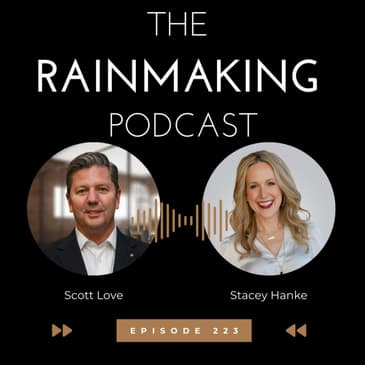
In this episode of The Rainmaking Podcast, host Scott Love speaks with Stacey Hanke, author of Influence Redefined, about how professionals can develop lasting influence and credibility in their client interactions. Stacey explains that influence isn’t about a one-time impression—it’s about consistency, trust, and intentional communication. She emphasizes that many professionals believe they are more influential than they actually are, which leads to gaps between how they perceive themselves and how they are truly perceived by clients and colleagues.
Key topics include the difference between influence and persuasion, why consistency in communication is critical, and how to eliminate credibility killers such as weak body language, lack of preparation, and ineffective listening. Stacey shares practical techniques for becoming a more engaging and persuasive communicator, including how to adjust tone and messaging for different audiences and how to gain immediate feedback on communication effectiveness. She also discusses the power of presence, the role of nonverbal cues in trust-building, and how professionals can improve influence by focusing on clarity, brevity, and confidence. This episode provides actionable steps for professionals looking to enhance their influence, build stronger relationships, and improve client engagement through intentional communication.
Visit: https://therainmakingpodcast.com/
----------------------------------------
Stacey Hanke is a leading expert in communication and influence. For over 20 years, she has empowered Fortune 500 leaders and teams to elevate their communication skills to build the trust and credibility needed to influence action. In addition to being a Hall of Fame speaker, executive coach, and business leader, Stacey is the author of three books. Her latest book, Influence Elevated, provides leaders with skills to manage employees and increase accountability in a hybrid work environment. Stacey is here to share insights on improving our ability to influence and inspire, Monday to Monday®.
----------------------------------------
This show is sponsored by Leopard Solutions Legal Intelligence Suite of products, Firmscape, and Leopard BI. Push ahead of the pack with the power of Leopard. For a free demo, visit this link:
https://www.leopardsolutions.com/index.php/request-a-demo/
Links:
Website: www.staceyhanke.com
Ordering Link: https://amzn.to/4drMy0A
Social Media Links and Handles:
LinkedIn: staceyhanke
Facebook: @staceyhankeinc
Instagram: @staceyhankeinc
YouTube: StaceyHanke
X: @staceyhankeinc
Learn more about your ad choices. Visit megaphone.fm/adchoices
[00:00:10] You're listening to The Rainmaking Podcast, hosted by high stakes headhunter, author, and professional speaker, Scott Love.
[00:00:23] Hi, this is Scott Love with The Rainmaking Podcast. Let me ask you a question. If you're a rainmaker, think of all the people that you have to influence. You've got your existing clients. Maybe they're giving you an idea and you need to push back on it. How do you influence them to do so by bringing them closer to you and building trust with them?
[00:00:42] Let's say you have a prospective client. Let's say that you want to talk to them about selling your services, but you don't want to be too pushy. What about your partners? How do you build influence with them? And then also, what about your subordinate colleagues? How do you build trust and influence them?
[00:00:58] Well, I would recommend starting with this question that you can ask yourself. How can I elevate my current level of influence to better achieve the goals, outcomes, and impact I want to have?
[00:01:10] Now, we're going to answer that question in our conversation because our guest today is an expert on the topic of influence. Her name is Stacey Honke. Now, Stacey's written two books on influence. I'm going to talk about the book that she wrote most recently, Influence Elevated.
[00:01:26] And I'd highly recommend that if you heard the question I asked, if that resonated with you, I'd recommend making the small investment in Stacey's book. And we put the links on the show notes. So let me just start with that. If you like what Stacey talks about, make sure that you go to the show notes, no matter where you listen to the podcast. Connect with her directly. Read her bio links. And let me tell you a little bit about Stacey.
[00:01:49] Stacey is a top-ranked professional speaker, author, and coach. She empowers professionals with the skills to communicate clearly, connect authentically, and influence action Monday to Monday. If this sounds like something that can help you, listen to my conversation with Stacey.
[00:02:07] As always, this show is sponsored by Leopard Solutions, Legal Intelligence, Suite of Products, Firmscape, and Leopard BI. Push ahead of the pack with the power of Leopard. And now here's my conversation with my friend, Stacey Honke. Thanks for listening.
[00:02:24] Hey, this is Scott Love. I'm with Stacey Honke. And today we're talking about influence elevated. Stacey, thanks for joining me on the Rain Making Podcast.
[00:02:33] Oh, I love this part of my day. So thank you. Thanks for trusting me with your followers.
[00:02:39] Absolutely. I've read your books. I like, I've been following you for a long time. I learned things from you. And let me get right to it in terms of definitions. Influence. What does that mean? That's kind of amorphous. How would you define that for those that are in positions where they have to earn influence and trust from their prospective clients and their current clients and even colleagues? How do we get some definitions around that?
[00:03:01] That's such a good place for us to start, Scott, because if we're all different when it comes to the definition of influence, none of this is going to value them. Influence is more than I turn it on for the high stakes conversation, the pitch, the boardroom conversation. Influence is not something you turn on and off. It's the body language and your messaging. They are consistent Monday to Monday.
[00:03:23] And I remember in your first book, didn't mean to cut you off. In your first book, Influence Redefined, you talk about that Monday to Monday. I mean, what about the weekends? What happens?
[00:03:34] Exactly. I was explaining this to a client earlier today and he was asking the same thing. He's like, well, what about Saturday, Sunday? You may not have to be perfect every day of the week. I'm like, no, no, no, no, no. It's making sure that you are consistent with how you show up, meaning your body language and messaging. They're always consistent, no matter if it's a Friday, it's a Saturday or Sunday, if you want to elevate your influence.
[00:03:56] We're talking about big notch here, like the higher level, especially for the rainmakers, right? That you're pulling in. Because if I am an example, if I am umming and eyeing, my eyes are darting all over the place. I'm multitasking, checking my emails on Friday or on Saturday and Sunday. And then I come back here, this happens to be a Monday with you. And I know filler words. I stay connected. There's no authenticity about that.
[00:04:23] And I want us to think like an athlete. If we truly want to elevate our influence, how you show up needs to be consistent every day of the week. Because the minute you start jeopardizing that and messing around with that lack of consistency, people, your clients, your customers, your family and friends, people start guessing who's going to show up.
[00:04:45] Yeah, because I remember that in your first book or in the book, Influence Redefined, you talk about consistency as being a big part of that.
[00:04:51] That's a big piece of definition. That's one side of the definition, Scott. There's one more.
[00:04:56] That influence means you have this ability to move people, to drive people, to take action long after the conversation has occurred.
[00:05:04] In your industry, you know that sometimes the relationship, the trust, the connection doesn't get built in one interaction.
[00:05:12] It's a series of time that you're interacting with someone that's consistent where people start trusting you.
[00:05:18] They start believing what you're saying and then they come to you, even if that day they don't have a need, but they think of you a week later, three months later, and they say, okay, I'm ready.
[00:05:27] But it's because you were always consistent with how you show up. That, to me, is elevating your influence.
[00:05:34] And what I see, what's interesting about what you're talking about is that it doesn't matter whether it's a client prospect, a subordinate employee, or a peer level colleague.
[00:05:44] It's pretty much all the same, right?
[00:05:46] Right. Because the minute we start messing with, well, I don't think about how I show up with my team member because it's not that important.
[00:05:56] They're not buying me.
[00:05:57] But when I have to present for the next client or I present to a high stakes conversation, then I have to use all these skills of really being polished.
[00:06:06] There's never, you're never going to accomplish that level of influence that I talk about.
[00:06:11] And it's, it's similar to an athlete.
[00:06:14] I was just at a college football game this past weekend.
[00:06:18] And I think about how ever they practice Monday through Friday is how they'll play the game on Saturday.
[00:06:25] Yeah. Right.
[00:06:26] And that's not too far from the truth from whatever your job is.
[00:06:31] It's how you are showing up every day is really going to create that personal brand.
[00:06:37] It's going to determine really the results you have, whether you're in sales, whether you're an engineer, whether you're a financial guru.
[00:06:45] It comes down to how people experience you, meaning your delivery, as well as your message.
[00:06:53] And the minute those two are not consistent with each other, people start guessing who's going to be.
[00:06:58] Absolutely right.
[00:06:59] And it's interesting when I was a naval officer, here you are, you went to the Naval Academy, you graduated as an officer in the Navy and you're leading sailors.
[00:07:08] And every sailor hates two things.
[00:07:09] They hate the officers and they hate the Navy.
[00:07:11] And so you had to learn how to lead to earn trust.
[00:07:14] And I saw that they would do the minimum because they respected the rank.
[00:07:20] But when they respected you, they would go further in their performance.
[00:07:24] How do you think we can take that into the workplace to build that trust so that they see who we are Monday to Monday?
[00:07:32] You always have to be thinking about how do people perceive you?
[00:07:37] And I'll give you an example.
[00:07:39] I work with a lot of CEOs and sometimes their executive team where I'll meet them in person and they're very polished.
[00:07:45] Or you can tell they're very thoughtful and focused of how they're communicating with you.
[00:07:50] Then sometimes I'll get them on Zoom and it's a totally different person.
[00:07:56] I'm like, okay, so now I'm guessing which Scott is the real Scott.
[00:08:00] And right, wrong or indifferent.
[00:08:03] And I know this isn't fair, but it's very much human behavior that we're going to rely on.
[00:08:09] The bad experience is what's going to stand out in our mind.
[00:08:13] Yeah.
[00:08:13] And bad news travels faster than good news.
[00:08:15] Bad news travels fast.
[00:08:16] One of my peers was telling me how she was trying to find a dentist.
[00:08:21] She wanted to find a new dentist.
[00:08:22] She said it came down to two dentists.
[00:08:25] Both same credentials, same offerings.
[00:08:29] But what made her final decision was the dentist that she felt more comfortable with.
[00:08:34] And when I wanted to dig through that and ask her, well, what did he or she do?
[00:08:38] What did they do?
[00:08:38] Said, oh, well, they looked me straight in the eyes.
[00:08:41] It was their handshake.
[00:08:43] It was how they were asking all these open-ended questions of what was important to me.
[00:08:46] And they took the time to really explain at a level of knowledge that I can understand it.
[00:08:54] And I'm like, well, that just all seems so common sense, doesn't it?
[00:08:58] But it's usually the common sense pieces of our communication and our delivery that are the most complicated.
[00:09:06] And it's what we don't do.
[00:09:08] We always think, well, my credentials and my years of experience in the field,
[00:09:13] that's what's going to get me the trust.
[00:09:15] I really would challenge that.
[00:09:18] And what I think also, when everybody else has those same credentials,
[00:09:22] and everybody else has that same pedigree,
[00:09:24] that's that influence that's going to close the sale or close the deal or earn the trust or get the referral.
[00:09:30] I think that's what it's all about.
[00:09:31] So let me ask you this then, comparing Influence Redefined to Influence Elevated.
[00:09:37] How many years has it been since you wrote this book and your new book?
[00:09:40] Oh, yes.
[00:09:42] Influence Redefined came out in 2017.
[00:09:46] Influence Elevated will come out this November.
[00:09:49] Influence Elevated is really the four years of research that my team and I have done of how influence has changed over the last four years.
[00:09:57] And we know everything that's gone on.
[00:09:59] Yeah.
[00:09:59] What does it really take now to influence, to elevate that?
[00:10:04] I look at this, Scott, as I've always talked about influence, right?
[00:10:09] And Influence Elevated is this whole other level that most people don't even know exists.
[00:10:15] And that's what I'm unpacking for them now.
[00:10:18] But tell me about that.
[00:10:19] What are the big rocks in the bucket, so to speak, with Influence Elevated?
[00:10:22] Yeah.
[00:10:23] So Influence Elevated, the first piece of how influence has changed is where the book starts, and it's all the noise.
[00:10:30] Think about how many Zoom calls you're going to have this week.
[00:10:33] Think about how many of the people you're trying to influence, how many interactions have they had, as well as how many distractions are coming to them.
[00:10:40] And it's because we have so many Zoom meetings, and then we've got to go in person, and then we've got all this stress in our life right now.
[00:10:47] I mean, let's face it, there's a lot going on right now.
[00:10:50] We have to break through that noise for our listener, and how you do that is what's in the book.
[00:10:56] And the three elements of that is you've got to be present to have executive presence.
[00:11:00] And I explain what all that means.
[00:11:02] You have to really connect.
[00:11:04] I'll explain what that means in the book and how do you do that.
[00:11:07] And the other element is momentum.
[00:11:10] The challenge with elevating your influence is you have to practice these skills by creating momentum behind that.
[00:11:19] And it's one of those things, Scott.
[00:11:21] I mean, just think about some of you, even if they're yourself or your peers, we don't think about necessarily how to practice how we show up every day.
[00:11:29] We just turn on Zoom, go through, if we're still all virtual, depending on what your world is, we just go through meeting after meeting.
[00:11:37] And we don't realize what happens here every time you turn your camera on.
[00:11:41] I mean, how many sales have your followers, if they're in sales and they're pitching, how many sales have they missed because they didn't have eye connection?
[00:11:52] How many meetings did their listeners get distracted and completely miss everything they said because they weren't using pauses to create brevity?
[00:12:01] And the answers to those questions, you'll never know if you're not thinking about these three elements of connection, momentum and presence.
[00:12:11] So when we talk about momentum, what are some examples that you've seen of people you've worked with?
[00:12:16] Where they're present, they're learning, they're connecting.
[00:12:20] What are examples of momentum?
[00:12:21] Because I believe that's a key concept that really bears fruit in a lot of ways.
[00:12:25] Yeah.
[00:12:26] Momentum is, once you go back, think like an athlete.
[00:12:30] Momentum is how you're taking advantage of every interaction you have, whether it's in person or Zoom.
[00:12:35] It's an opportunity to practice something about your skill.
[00:12:39] Are you practicing how you stay connected with your eyes?
[00:12:42] Are you practicing your word choice to make sure you're always adapting to what your listeners are saying?
[00:12:48] Momentum is you have an accountability partner.
[00:12:50] Maybe it's your family.
[00:12:51] I know you said you have a 12-year-old.
[00:12:52] Maybe it's she's coaching you, but it's someone coaching us and reminding us, hey, you're rambling.
[00:12:59] Oh, you're saying that didn't make sense.
[00:13:02] It's accountability and it's the type of practice that you're doing.
[00:13:06] So, for example, I'll start my day with a post-it note and it's three action steps I have to do this today.
[00:13:14] I can't carry them over tomorrow to help grow my business.
[00:13:17] And one action step is always something about my personal development.
[00:13:20] And it might be right now I'm trying to really practice brevity.
[00:13:25] I'm getting too long-winded in my conversations.
[00:13:27] And that might be my go-to.
[00:13:30] I meet with my, I just got off the phone with my presentation skills coach for a 90-minute rip-me-apart session.
[00:13:37] And I have accountability partners that I meet with on a regular basis, meaning several times a month.
[00:13:43] So, that's what I mean by momentum is you literally have in your day-to-day time where someone's giving you feedback, whether you hire someone or it's just your family and friends or peers in front of you.
[00:13:56] This is something we can't do by ourselves.
[00:13:58] I don't know how we do this by myself.
[00:14:00] So, momentum is you're constantly thinking about what can I do today to better the experience someone has with me.
[00:14:09] I love that.
[00:14:10] Let me ask you this.
[00:14:11] As we start learning how to be present, to have that executive presence as we're connecting, as we're building momentum,
[00:14:18] what are the indications that we should pay attention to that are telling us if we're on track or off track in building our influence?
[00:14:26] Let's break this down.
[00:14:27] Let's give at least three, right?
[00:14:29] No more than three.
[00:14:30] Yeah, right.
[00:14:30] The first is, say you're on Zoom, or even if you're in a boardroom and you're with others, when you see a lot of this, there's a good chance they're not taking notes.
[00:14:41] And so, if you're not seeing the video, if you're on audio, Stacy's looking at her phone.
[00:14:44] During our conversation, when people are on their phone, that's a tell.
[00:14:49] What does that tell us?
[00:14:50] They are either bored, you're totally losing them because their email, their text messages, their Facebook scrolling is more interesting than what is in front of them, which is maybe you.
[00:15:03] It's when people get really quiet.
[00:15:06] You're trying to incorporate interaction in your conversation, and it's like pulling teeth.
[00:15:11] They just are not giving you anything.
[00:15:14] It's watching the nonverbal cues.
[00:15:17] They're not giving you direct eye connection.
[00:15:19] You're not getting any responses, any head nods.
[00:15:22] That's a big piece.
[00:15:23] The second, when you're doing more of the talking.
[00:15:27] Can we go back to 80-20?
[00:15:30] My 80-20 is, I speak 20%, say on a client call, they speak 80.
[00:15:36] Now, you've got to get them there.
[00:15:38] And one way of doing that, Scott, is start the conversation with a very open-ended question.
[00:15:43] How are you doing is not the question to ask.
[00:15:46] So get them involved.
[00:15:48] Really ask them.
[00:15:49] One question that I use often when I get on a call with a potential new client is, what is happening right now in your company that led you to want to have a conversation with me today?
[00:16:00] Hmm.
[00:16:01] And you just let them fill in the blank.
[00:16:03] That's a good question.
[00:16:05] That's the kind of question anybody could use, let's say, their meeting with a prospective client.
[00:16:09] You know, what a good way to start that.
[00:16:12] You know, when you're at that point, right?
[00:16:14] That's deep.
[00:16:14] When they give you the answer, you're listening to the key points because their key points to your question should lead you to the next question.
[00:16:24] Yeah.
[00:16:25] And that's a big part where you can really determine then, are they still with you?
[00:16:31] Yeah.
[00:16:32] Make it about them.
[00:16:33] I know this is so common sense.
[00:16:35] It feels common sense, Scott.
[00:16:36] Even when I say it, it's just not common practice.
[00:16:39] Let your listener feed you.
[00:16:41] Let them tell you what they need.
[00:16:44] And now suddenly there's this warmth and empathy they get from you because they feel like, wow, you really care about why I'm here and why this topic is important to me, not to you.
[00:16:55] And it's their idea when they're telling you.
[00:16:58] Yeah.
[00:16:58] So let me ask you this.
[00:17:00] I want you to share with me, because I know you do a lot of coaching, some very successful people and significant roles of influence.
[00:17:08] Tell me about a time of someone that you worked with and you don't have to mention their name, of course.
[00:17:12] What were the challenges they were facing?
[00:17:15] How is their influence limiting their potential to build and to build trust?
[00:17:21] What were the things you advised them to do?
[00:17:24] What did they do?
[00:17:24] And what was the end result?
[00:17:26] Tell us about that arc, Stacey.
[00:17:28] Yeah.
[00:17:28] This happens often.
[00:17:30] There's one in particular.
[00:17:31] I'll receive a call from a client saying, this leader, we want them to be our next CEO.
[00:17:36] We want them to be our next CEO.
[00:17:38] However, and this is where Nick goes downhill.
[00:17:41] However, how they've communicated up to this point in their career will not work if they're in that position.
[00:17:48] That'll be the first request.
[00:17:50] Then we start asking, well, what's happening?
[00:17:53] They're not connecting.
[00:17:55] What do you mean?
[00:17:56] People don't trust them.
[00:17:58] So now that's telling me two things.
[00:18:00] It's their delivery, their content, or a combination of both.
[00:18:04] When I meet with them, it's usually their delivery.
[00:18:07] And the only skill that conveys connection to trust is what they do with their eyes.
[00:18:13] They're not looking directly at someone when they talk.
[00:18:16] I say a lot, Scott, only speak when you see eyes.
[00:18:20] No talk.
[00:18:21] Or no eyes, no talk.
[00:18:22] You can look away from people.
[00:18:24] You just don't want to have a conversation like I'm doing right now and looking away from you, but still talking.
[00:18:30] Yeah.
[00:18:30] That's one thing I'll teach.
[00:18:31] Then we start diving into their content.
[00:18:33] And it's similar to what we talked about, open-ended questions, really helping them structure clearly a conversation that still gets them to what they want this person to do, but on their listeners' terms.
[00:18:48] Yeah.
[00:18:49] So that means what do you have to say?
[00:18:52] What do they need, not what you need?
[00:18:54] There's a couple of steps I walk people through to make sure that every word does matter, that the words resonate with your listener, not with the direction you want.
[00:19:04] So how did it work out for your client?
[00:19:06] He got promoted.
[00:19:07] No, that doesn't always happen, right?
[00:19:08] In this situation, he got promoted.
[00:19:12] Even bigger picture, though, this was someone that was very cold, just did not, was not a favorable person, put it that way.
[00:19:23] And I debated taking the client on.
[00:19:26] Yeah, right.
[00:19:26] Because obviously, I only want the perfect fit, right?
[00:19:28] There was something about our initial pre-call that I thought, if I can change him, and I say that lightly, I don't change who he is, but change his behaviors.
[00:19:39] Change the way he connects and engages.
[00:19:41] This could be a really big win.
[00:19:42] We were in the first session about halfway through his mentoring session, and it was a tough one.
[00:19:47] And I finally said to him, I go, either you're in or you're out.
[00:19:50] I go, because I don't want to waste your time, and I know you don't want to waste your own time.
[00:19:54] So either you need to be all in here, or this will not work.
[00:19:58] Whatever that was, he started to see himself on these video playbacks that we did on his phone.
[00:20:04] I think that was the turning point.
[00:20:06] Because when he would watch the playbacks, he would always bring up, it's so different than the way I feel.
[00:20:12] When I watch the playback, I'm now seeing what everyone's been telling me that I'm cold.
[00:20:18] I'm a leader that doesn't connect.
[00:20:20] I'm seeing what's wrong.
[00:20:21] And that was a big turnaround, because I can tell you what I think, but that's just my opinion.
[00:20:28] That's part of my secret sauce.
[00:20:32] Call it a secret or not call it a secret.
[00:20:33] I have people watch themselves on playbacks.
[00:20:36] Because only you know, Scott.
[00:20:39] You know how you want to come across, how you don't want to come across.
[00:20:42] I can tell you.
[00:20:43] But once you see it, now you can start taking the steps to make the changes you're willing to commit to.
[00:20:51] I mean, this is tough change.
[00:20:53] This is hard for people, right?
[00:20:55] Yeah.
[00:20:55] Yeah.
[00:20:56] Isn't it interesting?
[00:20:57] And I think especially for high-level executives, because they've been going through life and being told how great they are.
[00:21:06] No one's ever really sat down and said, this specifically doesn't work, but this does work, because I also want to enhance their strengths.
[00:21:13] This isn't all about changing and correcting them.
[00:21:16] And then when you see yourself on playback, and there's a disconnect, even for myself, when I watch my playbacks, there's such a disconnect of how I felt during the conversation being recorded versus what I see and hear.
[00:21:29] And that hurts.
[00:21:30] That's some really hard, hits you in the gut feedback.
[00:21:35] Yeah.
[00:21:36] I mean, this is taking people to a spot where they've got to face things that they might not want to face.
[00:21:42] And if they push through it, if they make the change, then they're going to build that trust, build and expand their influence thanks to the wisdom that you provided them, Stacey.
[00:21:51] Oh, Scott.
[00:21:52] And I've never heard someone say at the very end, oh, that was such a waste of time.
[00:21:57] I wish we would have never done that.
[00:22:00] Instead, I hear during the mentoring until they've made that turning point of, I don't know about this.
[00:22:05] This is really hard.
[00:22:06] And I keep telling them, don't let feeling be your guide.
[00:22:09] Your body doesn't like to be uncomfortable.
[00:22:11] So your subconscious will fight with you.
[00:22:14] Therefore, the power of watch yourself on playbacks, just keep watching the playback because that's going to be your truth of what influence really needs to mean to you.
[00:22:24] That's interesting, Stacey.
[00:22:25] Well, let me ask you this.
[00:22:26] As we bring this conversation to a close, I always summarize everything with three action steps.
[00:22:31] What are three action steps somebody listening today can take to really get started on this journey of building their influence?
[00:22:38] The very first thing, it's a question I ask every audience, is when it comes to influence, what do you want?
[00:22:44] And the statement is simple.
[00:22:46] I want fill in the blank because that's going to identify your why.
[00:22:51] You need to be really clear on how you want to come across, what that means to you, right?
[00:22:54] Just start there.
[00:22:55] The second, and in this number two and three are not in any order, the second is ask for feedback, real feedback from family members, maybe coworkers that you trust are going to tell you the truth.
[00:23:10] Just ask them, how do I come across?
[00:23:12] Good, nice job.
[00:23:13] Don't accept that.
[00:23:15] Ask them, what works for me?
[00:23:17] Where do I come across trustworthy, credible, or where don't I?
[00:23:20] Again, you can't ask that until you figure out your want.
[00:23:23] Yeah.
[00:23:24] Number three is the big one that we're talking about, Scott.
[00:23:27] Audio.
[00:23:28] Audio record yourself so you can really listen to your voice.
[00:23:31] Then elevate that practice to video recording yourself.
[00:23:36] And it's so easy to do because when we are on Zoom as we are today, for all you know, I could be recording myself, right?
[00:23:43] I take my phone, I record it, I place my phone below the Zoom camera.
[00:23:48] No one knows I'm doing it.
[00:23:49] And if anyone's saying, well, it's very confidential, well, record the calls that aren't.
[00:23:54] Or not only that, you're recording yourself.
[00:23:56] And those three action steps, I think it's easy to say no to all three of them.
[00:24:03] Yeah.
[00:24:03] But what's the cost?
[00:24:05] I came across a quote.
[00:24:07] It's been real recent, so I don't remember who said it, but it's worth sharing here.
[00:24:12] And it was something to be said around the challenging part of making a change isn't as risky as the heartbreak of regret.
[00:24:23] And the heartbreak of regret is you just keep walking around life, doing what you're doing.
[00:24:28] Everyone's talking behind your back.
[00:24:30] And maybe you're not getting that extra sale.
[00:24:33] Maybe you're not building that relationship to the next level because of something you're doing or saying.
[00:24:38] But at this point, you just don't know.
[00:24:40] So you're going to keep losing out on those opportunities.
[00:24:43] Well, Stacey, this is really interesting, and I hate to cut our conversation to a close.
[00:24:48] I'd love to have you back on the show in the future.
[00:24:50] And I'm going to highly recommend everybody read Influence Elevated.
[00:24:54] We're going to put the purchase link on the show notes.
[00:24:57] We're going to put Stacey's contact info on there.
[00:24:59] But tell us about your offerings.
[00:25:01] What do you do?
[00:25:01] What do you have that you'd like our listeners to know about, Stacey?
[00:25:04] Yeah, the company really started 22 years ago off of keynoting.
[00:25:09] I speak at sales conferences, leadership conferences, and then my team.
[00:25:14] I have a team that does workshops, deep dive, immersions with groups.
[00:25:19] We also do a lot of mentoring.
[00:25:21] You heard a little bit of that here.
[00:25:22] The best part, if that's just not in your followers' wheelhouse, we are all over LinkedIn.
[00:25:28] And my goal there has always been to be a resource.
[00:25:31] You'll see a lot of resources on our website that are complimentary just to even be able to help you from afar, whatever you might need right now in your development.
[00:25:40] That's great, Stacey.
[00:25:42] Well, thank you so much for being here.
[00:25:44] Thank you for offering your wisdom.
[00:25:46] And I'd love to have you back on the show in the future.
[00:25:48] We'll have to come back.
[00:25:49] Thank you, Scott.
[00:25:50] Thank you for listening to The Rainmaking Podcast.
[00:25:57] For more information about our recruiting services for international law firms, visit our website at attorneysearchgroup.com.
[00:26:06] To inquire about having Scott speak at your next convention, conference, sales meeting, or executive retreat, visit therainmakingpodcast.com.