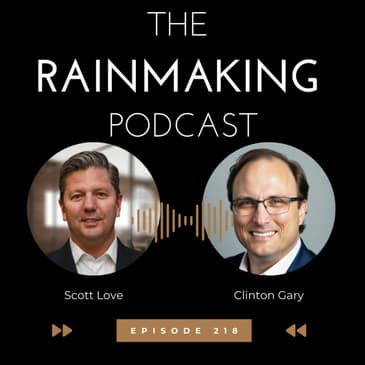
In this episode of The Rainmaking Podcast, host Scott Love speaks with Clinton Gary, founder of Credo Consulting, about how professional services firms can accelerate collaborative growth to maximize firm-wide success. Clinton explains that most law firms and consulting firms struggle to leverage their collective capabilities effectively, often operating in silos rather than as cohesive teams. He emphasizes that true collaboration isn’t accidental—it must be intentionally orchestrated by firm leadership through strategy, culture, and structure. By fostering an environment where professionals actively seek out and leverage firm-wide resources, organizations can create multiplicative value for clients, professionals, and the firm itself.
Key topics include the difference between collegiality and collaboration, why a firm’s culture must prioritize proactive teamwork over passive cooperation, and how leaders can structure incentives, processes, and technology to encourage collaboration. Clinton shares strategies for breaking down silos, improving internal knowledge-sharing, and creating a structured business development system that engages professionals at every level. He also discusses the role of leadership in orchestrating collaboration, how to implement practice group effectiveness initiatives, and why law firms that embrace collaboration are more successful in retaining talent and growing client relationships. This episode provides a practical roadmap for firm leaders looking to unlock the full potential of their teams through a structured, strategic approach to collaboration.
Visit: https://therainmakingpodcast.com/
----------------------------------------
Clinton Gary, Founder of CREDO Consulting, guides law firms and coaches' lawyers to achieve Collaborative Growth by growing strategically and collaborating effectively. With over 25 years of experience in strategy and business development at leading Am Law firms and global organizations, he is a recognized industry leader. Clinton’s expertise and award-winning approach drive sustainable success. Visit www.credocg.com
----------------------------------------
This show is sponsored by Leopard Solutions Legal Intelligence Suite of products, Firmscape, and Leopard BI. Push ahead of the pack with the power of Leopard. For a free demo, visit this link:
https://www.leopardsolutions.com/index.php/request-a-demo/
Links:
https://www.linkedin.com/in/clintongary/
Learn more about your ad choices. Visit megaphone.fm/adchoices
[00:00:10] You're listening to The Rainmaking Podcast, hosted by high stakes headhunter, author, and professional speaker, Scott Love.
[00:00:23] You're listening to The Rainmaking Podcast, and this is Scott Love. Thank you for joining me on the show.
[00:00:28] As many of you know, my business is recruiting partners for global law firms. I work with large law firms just in the areas of corporate finance, private equity. I've been doing that since 2009.
[00:00:39] I got into recruiting in 1995, so I've seen a lot. And the one thing I noticed when I got into legal was just there wasn't a lot of collaboration.
[00:00:50] You had these big, fantastic firms with some very smart people, but it was the people skills, the collaboration that really kept them from reaching their full potential.
[00:00:59] Our guest today, Clinton Gary, is an expert in solving that problem. Clinton Gary founded Credo, his consulting company, because too many professional services firms,
[00:01:09] mostly law firms, they were not fully leveraging their collective capabilities to create greater value for their firms, for their professionals, and for their clients.
[00:01:18] While they want to achieve this, the challenge often lies in knowing how to do so. And that is exactly Clinton's expertise.
[00:01:26] Even if you're not in the legal industry, you're going to get some great ideas from my conversation with Clinton today.
[00:01:31] And our topic for conversation is accelerating collaborative growth. Make sure you check out the show notes wherever you listen to this podcast. I put all of Clinton's contact information, his company's website link, and also his LinkedIn link on there.
[00:01:45] As always, this show is sponsored by Leopard Solutions, legal intelligence suite of products, Firmscape, and Leopard BI. Push ahead of the pack with the power of Leopard.
[00:01:54] And now here's my conversation with Clinton Gary.
[00:01:58] Hey, this is Scott Love with the Rainmaking Podcast. Our special guest today is Clinton Gary with Credo Consulting, and we're talking about accelerating collaborative growth.
[00:02:09] Clinton, thanks for joining me on the show today.
[00:02:11] Thanks, Scott. It is an absolute pleasure. I've been a big fan of all your podcasts and your work.
[00:02:16] Thank you so much. And it was nice meeting you at Rain Dance for the Legal Sales and Service Organization several months ago. What a great organization.
[00:02:23] It's a fantastic organization. We are definitely a tribe of folks that all get what you're preaching and what I'm preaching.
[00:02:30] Absolutely right. And I liked the fact that it's a group of mature executives that have seen it all. They're all within the legal marketing space, or most of them are.
[00:02:38] And I like the fact that your topic is something that applies pretty much to any professional services organization, accelerating collaborative growth.
[00:02:46] So let me kind of get some definitions here in your mind, because you've seen it all in all sorts of different types of legal organizations and even other consulting and accounting organizations.
[00:02:57] What's the definition of collaborative growth? What is it that we're trying to aspire to?
[00:03:02] Yeah. The definition is we want to maximize the collective capabilities of the firm.
[00:03:09] Yeah.
[00:03:10] We want to do it for the benefit of the client, but also for the benefit of the firm and the professional.
[00:03:17] Yeah.
[00:03:17] There has to be a win-win across all of those things, especially right now in this time of where individuals of multiple generations are looking for inspiration, looking for innovation, wanting to plug in, wanting to do more, wanting to be, want to do more and be part of something special.
[00:03:37] So it's a collaboration. Yes, we want to provide more value to the client for collaborative growth, but also we want to provide value to the individual professional and the firm reaps the benefits of both of those.
[00:03:48] Right. And something I remember reading that you wrote, I need one plus one plus one to equal five.
[00:03:54] And that's a similar phrase I've heard when I talk to partners and I try to recruit them and they say, well, I don't want to go to any other firm.
[00:04:00] I want to go to a firm where one plus one plus one equals five, where I can get some synergy out of that.
[00:04:04] In my mind, I'm thinking that for that to happen, who's responsible for that, Clinton?
[00:04:12] Is it people that are actually doing the work with the clients, the practitioners, or is it the leaders of those organizations?
[00:04:19] Where do you think we should start?
[00:04:20] It's a great question.
[00:04:21] It's the leaders of the organizations.
[00:04:24] When I use the word that you can't mandate collaboration, but you can orchestrate collaboration.
[00:04:32] And leaders are truly the air traffic control of their organizations that they need to set up cultures and strategies and systems.
[00:04:41] The people, processes and technologies of the organization to be able to orchestrate collaboration.
[00:04:46] Because if the collaboration is not easy and meaningful, people won't do it.
[00:04:51] So they're in the best position to change hearts and minds, but also strategies and structures to be able to facilitate greater collaboration for the benefit of everyone.
[00:05:00] So hearts, minds, strategies, and structures.
[00:05:05] That's right.
[00:05:06] Is that kind of a good building block to kind of talk about?
[00:05:08] It's a great building block to talk about because what I've seen and it plays into what I find is, because what are we dealing with?
[00:05:18] We're dealing with pain right now.
[00:05:19] That's why I talk about hearts and minds.
[00:05:22] We're dealing with pain, and that is most law firms, most professional services firms are dealing with growing pains.
[00:05:29] You know this better than anyone.
[00:05:31] In this talent fluctuation that has happened over the last five to ten years of mergers and acquisitions, most professional services firms have added capabilities, offices, new practices, maybe in new countries, definitely in new time zones.
[00:05:49] And they've also had individuals leave.
[00:05:52] So there's this transition period where not everybody knows everyone anymore.
[00:05:59] Not everybody knows the capabilities of the organization.
[00:06:03] And that also means there's not a common brand or culture for most firms because it's in transition.
[00:06:09] So collaboration is tough if you have such transition, which means that we have to have leaders in firms that have to actively manage to orchestrate collaboration in their firms,
[00:06:23] as opposed to in the past where you had stability of the same 50 or 500 attorneys and you went to an attorney retreat once a year.
[00:06:32] You broke bread, had a couple of drinks, gained a level of trust, and then there was collaboration.
[00:06:37] It's not as easy anymore.
[00:06:39] So leaders have to be intentional in the way they look at their organizations to be able to orchestrate collaboration now, given that talent and getting people to work together for greater value.
[00:06:51] And one thing to throw another wrinkle into this is that we're not dealing with normal people.
[00:06:56] We're dealing with lawyers that by nature and even by training have been taught to be skeptical.
[00:07:02] Oh, yeah.
[00:07:03] Why should I trust you?
[00:07:04] Yeah.
[00:07:04] I mean, that's what I see also.
[00:07:05] What do you think about that?
[00:07:06] You know, the unique nature of lawyers related to that.
[00:07:09] I'll put out my bullet point on this one.
[00:07:12] I am married to a lawyer.
[00:07:14] I have the ability to be or I have the unique perspective to be able to comment on this because I am around lawyers 24-7.
[00:07:23] And so I believe you are correct.
[00:07:25] The same strengths.
[00:07:27] You had a wonderful podcast with Mo Bunnell.
[00:07:31] Thanks.
[00:07:32] And that is the same strengths that help lawyers be so successful as lawyers can turn into disadvantages in the area of collaboration and growing and sustaining relationships.
[00:07:47] So, and Mo outlines that and I'm a champion of that one.
[00:07:51] And so where attorneys will spend 10,000 hours or 30 years skilling their trade of being good lawyers, leveraging that mindset that you just set up skepticism that makes them be such great lawyers.
[00:08:07] So, and that's what I mean by the way.
[00:08:16] Yeah, absolutely right.
[00:08:19] And those are the barriers to collaborative growth because we all want collaborative growth.
[00:08:23] It's one of the barriers that are preventing it.
[00:08:26] That's right.
[00:08:27] I think the price of this, here's an example.
[00:08:29] And I, this happens all the time.
[00:08:32] Recently, last week, a candidate, successful attorney with a good MLAW 100 firm and a successful practice that is fully portable told me, I feel I could do better at another firm.
[00:08:46] Why is that?
[00:08:46] I'm able to contribute and give a lot, but I just don't see a lot of return.
[00:08:50] And I know that there are other firms where they have that collaborative mindset.
[00:08:53] I mean, that is his motive to move.
[00:08:56] And it's not just, oh, you know, it's a couple of million we're losing.
[00:08:59] No, you're losing clients and you're losing the referrals that those clients could bring and all that other stuff.
[00:09:05] What do you think about that, Clinton?
[00:09:07] Scott, that is a beautiful comment.
[00:09:09] I'm glad you mentioned it because in my practice, I have the privilege to be able to work at the highest levels with managing partners on strategy, but also key accounts.
[00:09:21] Every firm wants to have those magical institutional clients that drive greater revenue and reputation.
[00:09:29] But I also coach individual professionals.
[00:09:33] And I had the pleasure for one client where I coach 25 diverse associates.
[00:09:37] And what I hear there is exactly what you said, which is the mismatch of professionals who know there's great things going on in the firm.
[00:09:50] That's why they joined it.
[00:09:51] They have great clients.
[00:09:53] They have great services.
[00:09:54] Things are great, but they don't feel like that they're plugged in or easily able to be found and given the opportunity to stretch their wings.
[00:10:03] Not to do what they've done 10 times in the past, but to do the one thing in the future that stretches them and gets them closer to shareholder or partnership.
[00:10:15] So we have that collaboration middle, that conundrum we have in the middle of collaboration that links us to the firm wants these larger clients.
[00:10:25] We know we want three relationships into those larger clients.
[00:10:28] So we become indispensable there, but we also have the problem of, and I'll use the military phrase of mobilizing access and mobilizing our collective capabilities at all levels, especially at that associate of counsel and new partner level to connect capability to opportunity.
[00:10:50] Yeah, that's great.
[00:10:51] And that's where collaboration falls.
[00:10:53] That's the glue.
[00:10:54] So, so let me kind of get back to what we talked about before.
[00:10:57] And I think if we looked at it in terms of three core areas, let's call it hearts and minds, strategies and structures.
[00:11:04] Tell me about the hearts and minds.
[00:11:06] What do you think are some of the pitfalls law firm leaders and any professional service provider running an organization?
[00:11:12] What are the pitfalls they should avoid to keep people from not having that emotional commitment and not having their heart and mind committed to collaborating with colleagues?
[00:11:21] Yeah, it is investing in the culture to make sure people understand that collaboration is important.
[00:11:29] That collaboration is a core foundation.
[00:11:31] I'll give you an example.
[00:11:33] In almost every strategy that I see with clients and across the professional services industry, one of the five values, those typical lists of values, one of those values always seems to be collaboration.
[00:11:45] The question is, how is that translated into the culture of the firm?
[00:11:50] Going back to leaders saying, if this is a value, what does it look like on a day-to-day basis?
[00:11:56] And are we helping our professionals as well as our leaders have collaborative conversations?
[00:12:03] And course correct if we're not being collaborative.
[00:12:07] Right?
[00:12:08] That's one of those things.
[00:12:09] I'll also add here from a hearts and minds standpoint of most firms that I see, and this is a growing pain, mistake a collegial culture for being a collaborative culture.
[00:12:23] For 50, 100 years or any firm I walk into, the foundational word that law firms like to say they have is, we have a collegial culture.
[00:12:32] And that's good.
[00:12:33] But a collegial culture is a, hey, I'll work with you when I can.
[00:12:38] Again, it's a very reactive culture.
[00:12:42] But a collegial culture is not a collaborative culture.
[00:12:45] Collaborative culture isn't always nice, but it's a proactive culture, making sure that people are taking one step into the organization when needed to be able to engage in, how can I engage this organization, utilize its best resources?
[00:13:01] So that heart and mindset is, what's the culture that you have?
[00:13:06] Do you have a passive collegial culture, which is, hey, I'll pick up the phone if you call me?
[00:13:11] Or do you have a collaborative culture, which is, I have a moment in time that can benefit this firm and individuals that I might not even know.
[00:13:17] Let me pick up the phone and step towards the organization.
[00:13:21] And it has to be easy to be able to do that.
[00:13:23] That's the hearts and minds.
[00:13:24] I'll have a couple things there, because I heard it also on a recent podcast you had, which is, I do assessments, collaborative assessments of firms.
[00:13:33] I've done many.
[00:13:34] And one of the 10 barriers to collaboration in an organization is rewards and comp, naturally.
[00:13:42] But I'll tell you this, in all the assessments I've ever done, comp has never been in the top five of a barrier to collaboration.
[00:13:52] Whenever I assessed directly from all the professionals in an organization, they've never listed.
[00:13:59] When I've given them the ability to list out the 10 in order of the challenges that the firm has in facilitating collaboration, comp has never been in the top five.
[00:14:08] So from a hearts and minds standpoint, that is not a system that is a barrier.
[00:14:15] It's a hearts and minds thing to say, do I understand it?
[00:14:19] Do I understand how I engage in the comp and reward system to be able to benefit myself and benefit my firm?
[00:14:27] It's an education issue with comp, not a systems issue with comp.
[00:14:32] Oh, that's interesting.
[00:14:33] Was that surprising to you, Clinton?
[00:14:35] Very surprising to me.
[00:14:37] I thought, because I'll tell you this, in all my interviews, comp is always mentioned first.
[00:14:43] But if you hold the feet to the fire and list the 10 in priority order of the barriers, it's not the top five.
[00:14:49] So people want to get it off their chest.
[00:14:51] It bothers them or they think it's a black box.
[00:14:54] But it's not really a barrier, if this makes sense.
[00:14:58] So I think the hearts and minds goes back to the culture.
[00:15:01] Are you educating people on how to leverage the compensation system to benefit themselves and the firm?
[00:15:07] Because almost every compensation system I see has some collaborative component to it.
[00:15:13] Yeah.
[00:15:13] Do you think that's an easy fix?
[00:15:15] I do think.
[00:15:16] I think it is a easy is a tough word, but I do think it's a fix.
[00:15:21] I think it's an education.
[00:15:23] And that goes back to the significant talent transition that we've had.
[00:15:28] And that is making sure there's a constant drumbeat of why the comp system is what it is, how it can benefit you, and allowing a person to know the levers of the firm.
[00:15:41] But then understand that the firm is orchestrating things to make it easy for you to collaborate so you can influence your comp.
[00:15:49] Comp is not a barrier.
[00:15:51] The organization is a barrier, not the compensation system.
[00:15:54] Boy, there's so much to this that I want to get into.
[00:15:57] I just know we don't have time to talk more about strategies and structures.
[00:16:01] But let me ask you this.
[00:16:01] Tell me a story of an organization you worked with where they were collegial, but they weren't collaborative.
[00:16:06] What was it like before you started working with them?
[00:16:09] And you don't have to mention their name, of course.
[00:16:10] What did you do with the leaders and everybody else?
[00:16:14] What changes did they make?
[00:16:15] And what was the result of that?
[00:16:17] Sure.
[00:16:17] You know, one of the beautiful things, like you said, about lawyers, which we kind of described.
[00:16:22] And as I mentioned, I'm married to one, so they're fantastic.
[00:16:25] She's magnificent.
[00:16:26] But lawyers are not bashful about telling you what they think are some of the issues that they're facing in a firm.
[00:16:32] So there's that slow mumble that managing partners and executives always hear about.
[00:16:37] Man, we need to fix this.
[00:16:38] We should be doing this.
[00:16:39] So when we heard the slow mumble in a client of this, this firm seems very siloed.
[00:16:45] It's each what you kill.
[00:16:46] I don't feel like I have access to all the opportunities I wanted here.
[00:16:50] We did an assessment ranking those 10 barriers.
[00:16:55] Because here's the hook.
[00:16:56] Every firm's top three barriers tend to be different.
[00:17:00] Yeah.
[00:17:01] So you have to understand what barrier you're trying to fix.
[00:17:04] What are the challenges that you're trying to fix?
[00:17:06] Because what I've noticed is most firms have a cafeteria menu of initiatives that each C-level person is trying to do something important in their area.
[00:17:18] But they're all not connected to solve a greater vision and create a greater set of values.
[00:17:25] So we go in.
[00:17:27] I go in and do that assessment to understand first, what are the challenges that are specific to this organization?
[00:17:34] And then what are the three to five initiatives that need to be put in place to address those barriers?
[00:17:40] And they're mutually reinforcing.
[00:17:43] They're not separate.
[00:17:44] They're mutually reinforcing to achieve the vision of being a highly collaborative firm.
[00:17:50] So that's the first step is that assessment.
[00:17:53] Now, then you play off of those.
[00:17:56] And sometimes it's a top down.
[00:17:59] And sometimes it's a bottom up.
[00:18:01] Give you an example with two clients.
[00:18:03] From those assessments, we found one was it was I don't understand what is important to other individuals within this firm.
[00:18:13] So how do I know who to contact?
[00:18:15] Meaning what's their target market?
[00:18:17] What's their top clients?
[00:18:18] What's the events that they go to?
[00:18:20] What what's the competency that they need to be able to build?
[00:18:23] It was I don't have enough knowledge about how we go to market and what my firm is to be able to collaborate.
[00:18:30] So from there, what we wound up doing was improving the annual planning and budgeting process so that at each level,
[00:18:38] both the firm, the practice group and the individual professional needed to reaffirm their top priorities.
[00:18:47] What's my priority of my practice?
[00:18:49] What's my priority of my industry?
[00:18:51] What are my priorities in my top few clients that I want to expand?
[00:18:55] And what's my priority as a reputation of where I want to go into the market to grow my reputation?
[00:19:00] And my top five relationships that I think will help me.
[00:19:05] So identifying those at each level allowed everybody and then the transparency of those things allowed a person to be able to say,
[00:19:14] I'm interested in improving to do more work in the electric vehicle space.
[00:19:20] It became easier than to find the other individuals that had that as the same priority in understanding if the firm dedicated that as one of its top five target markets for the to go to market.
[00:19:33] So the strategy, the planning, not strategy, but the planning and budgeting process to allow everybody to designate their priorities so people can find each other and go to market in PACs to collaborate from that standpoint.
[00:19:48] That took multiple phases, but it was a very important phase.
[00:19:52] Right.
[00:19:53] Or you can go bottom up, which is the individual attorneys in which we did a white space report and said specific to each individual partner, because this was a very partner driven firm.
[00:20:07] And we said, OK, let's do some analysis, not take completely your opinion of the top three clients that you believe you want to grow this year.
[00:20:14] But what are your top three and what does the analysis say are three clients that have high probability for growth?
[00:20:22] Right.
[00:20:23] Provide a six month coaching program to each of the partners to say, what would be one or two partners that you believe you should collaborate with in the firm based upon what we think are the needs of your client?
[00:20:37] So almost speed dating, facilitating collaborative relationships.
[00:20:42] So not not in this amorphous, hey, go and collaborate here.
[00:20:46] Let's do specific six month coaching where you collaborate and build relationships with two people to then expand and grow revenue in particular clients.
[00:20:55] That's a bottom up to to instigate collaboration.
[00:21:00] And there's a top down to orchestrate collaboration through transparency.
[00:21:05] This is great.
[00:21:06] Clint, this makes perfect sense.
[00:21:07] How long have you seen organizations?
[00:21:11] I wouldn't say they completely see the big change in the total picture.
[00:21:14] But when do they start seeing some signs of life in making changes?
[00:21:20] How long does that usually take?
[00:21:22] Fantastic.
[00:21:22] There are leading indicators and there's lagging indicators.
[00:21:27] The lagging indicators are three years.
[00:21:29] If you want to say, man, we improved revenue within the firm.
[00:21:32] We improved import exports from various practice groups.
[00:21:37] We improved staffing, diverse staffing on engagements.
[00:21:42] Those tend to be lagging indicators, especially on the financial side.
[00:21:47] But on the lead on the on the leading indicators.
[00:21:52] And I messed up on one of those on the leading indicators.
[00:21:54] It is how is the staffing model being improved where we're seeing multiple practice being staffed on an engagement or even, quite frankly, multiple offices that are staffed on an engagement?
[00:22:06] What are thought leadership pieces that are being created to tackle what we believe from a strategy perspective and a market driven perspective that are some of the key trends happening to some of our target markets?
[00:22:20] And are we having multiple practice groups come together to offer those perspectives to a solution that clients should be thinking of?
[00:22:27] That is something that can happen in the first two months of getting ideas created and ideas facilitate collaboration.
[00:22:36] So what I picked up from what you said is that within a firm today, there are probably key performance indicators that they can harvest data from that they might not even know, except for your help to tell them where the problems are and are we making progress along the way?
[00:22:52] Is that right?
[00:22:52] That's right.
[00:22:53] I call it I call it for lack of a better phrase.
[00:22:56] It's a collaboration index.
[00:22:57] How well are you collaborating within your firm that index breaks out into leading and lagging indicators?
[00:23:04] And it can be whatever level you want, just like executing on a team plan is a leading indicator.
[00:23:12] The lagging indicator is did you make any money executing on the plan?
[00:23:15] Right, right.
[00:23:16] So you have to give people inspiration to say you achieved this.
[00:23:22] And if you achieve more of these things, let me put it this way, if you execute the process consistently and at a high level, you are more likely then to get the outcome of the revenues.
[00:23:34] So the leading indicators are the process.
[00:23:38] The lagging indicators are the results.
[00:23:40] You know, one other idea I thought of just because this is my world, what you've described to me, if there's a lateral partner candidate or group leader that's looking at five different firms,
[00:23:51] because they'll look at five, six different firms.
[00:23:53] And one of the firms says, let us tell you a story of how we collaborate.
[00:23:57] This is what we measure.
[00:23:59] This is what we track.
[00:23:59] These are the results.
[00:24:00] These are the systems.
[00:24:01] These are the structures.
[00:24:03] These are the strategies we have that can help give you lift.
[00:24:07] Because if you come to a firm where you know it's certainty and a high degree of certainty that you will be able to have that one plus one plus one equals five, six, seven, eight, nine, then you're going to reach your potential.
[00:24:18] You can go to any other firm where you don't even know.
[00:24:20] You're throwing the dice.
[00:24:21] How do you know they're going to do this?
[00:24:22] We know that we can, and we've got the data to prove it.
[00:24:26] So we mitigate the risk of you having the chance you might not reach your goals.
[00:24:32] We mitigate that risk because of our collaborative structure.
[00:24:35] What do you think about that claim?
[00:24:36] Scott, spot on.
[00:24:37] When I was at Arthur Anderson and we had talked beforehand that Arthur Anderson, as it existed, was a top 10 organization in the world in managing its knowledge.
[00:24:48] That's in competition with pharmaceutical companies, IBM and everything.
[00:24:52] Top 10.
[00:24:53] One of the things that I used to do in my pitches to new associates or laterals that came in, and I would meet them on the first day, is I would say you have access in your first five minutes of being in this firm to the collective knowledge equally to a person who's been here 20 years.
[00:25:11] Because it is captured and codified in a way in which not only can you find knowledge, you can find people.
[00:25:20] People can find you.
[00:25:23] A lateral can easily plug in because you have a culture in a system that highly values knowledge.
[00:25:32] Not just experience, but the bigger, the bigger can that we can always get into that you can wind up then being found tomorrow if you are a lateral for opportunities to go do business development or consider it a pitch.
[00:25:47] As opposed to a firm that says, we have a six-month program for laterals.
[00:25:52] We're going to make sure that you meet the right 10 people over those six months.
[00:25:55] Have a couple of lunches and then you'll establish some relationships and get yourself going.
[00:26:00] But by the way, first we want you to bring over your clients.
[00:26:02] So spend all your time working on your clients.
[00:26:05] Yeah, while you're going after your clients to make sure they're coming over, make sure you're plugged into the big S system of the firm so who can be found for new opportunities on day one.
[00:26:17] That's where I get into a framework, and I'll mention briefly, which is the framework for collaboration.
[00:26:23] The foundation is a common purpose, common methodologies, and common knowledge.
[00:26:30] Those are the three.
[00:26:32] If you have those three in place, you have the foundation for, if those are your priorities, you have the foundation to orchestrate collaboration, quality collaboration, and allow people to plug in.
[00:26:44] Nobody's left behind if you have that.
[00:26:48] And I can always expand on each of those three because the common methodologies is very important.
[00:26:52] We've talked a lot about common knowledge, but common methodologies is critical.
[00:26:56] Well, Clinton, I think that is going to be your next episode on the Rainmaking Podcast.
[00:27:01] And so let me kind of stop right now and tell us if we could take what we talked about so far and summarize it in three action steps that people can take to get started implementing these ideas.
[00:27:12] What would those three action steps be?
[00:27:14] Yeah, three action steps.
[00:27:16] The first one is the assessment.
[00:27:18] The first one is the assessment of being, of course, there's a professional like myself that can assess it.
[00:27:24] But frankly, you could walk down the hallways and talk to the right 30 people and say, what is preventing you from doing more?
[00:27:31] What is preventing you from feeling like you're plugged into the opportunities of the firm, getting the full capabilities of this firm?
[00:27:37] The assessment to ensure that you're tackling the right problem is the first thing that you can do.
[00:27:43] That's great.
[00:27:44] What's our second step?
[00:27:45] Second step, critical voice are your practice group leaders.
[00:27:49] Going back to the military analogy, your unit has to be effective before the core could be effective.
[00:27:58] Each unit is the most important.
[00:28:00] So the building block of a law firm or any professional service or firm is the team that is your home, your practice group.
[00:28:07] Practice groups have to be effective.
[00:28:10] So evaluate and ask your practice group leaders.
[00:28:15] What are the barriers or what do you need from the firm to be a more effective practice group leader?
[00:28:22] And that means to get your team collaborating, get your team out to market and find the commonalities.
[00:28:29] So you connect practice groups and create.
[00:28:31] You don't want eight different practice groups doing eight different things.
[00:28:35] Ask your practice group leaders, find commonalities and then find what can you make consistent across your practice groups, which will help you collaborate across practice groups in the future.
[00:28:44] That's great.
[00:28:44] And that third step is really audit what I consider to be the core to a collaborative culture.
[00:28:53] And that is take a step back and say of the big five.
[00:28:56] And that is, how are you doing your annual planning and budgeting?
[00:29:01] Is it through one through five, thumbs up, thumbs down, A through F, whatever you want to do.
[00:29:06] Make a realistic judgment on your strategy and planning, your practice group effectiveness, your knowledge management.
[00:29:14] And I'll stick with training, training, training, training.
[00:29:17] You know, we talked about my dad is my dad was in the Marines and I asked him one time, I said, what facilitates great collaboration in the Marines?
[00:29:26] He looked at me in his curmudgeon Marine way and without blinking an eye, he goes basic training.
[00:29:32] He goes basic training.
[00:29:33] Everybody learns how to march and salute.
[00:29:36] Training is important and it never stops.
[00:29:38] So one of those big four or five is training.
[00:29:41] Judge in a realistic terms, how are you doing the big four or five things that facilitate collaboration?
[00:29:48] So those are really assessments.
[00:29:50] And then between those three things, you will be able to create a battle plan to be able to determine your limited time, your limited resources of your people and your limited money to be able to improve collaboration in your organization.
[00:30:03] Well, this is great, Clinton.
[00:30:04] I really appreciate you coming on the show and being generous with your wisdom.
[00:30:08] And I'm amazed at how much more there is to talk about still.
[00:30:12] Like I said, I'd love to have you back on.
[00:30:14] But tell us what you do.
[00:30:15] What are your offerings?
[00:30:17] What do you have that you'd like listeners to know?
[00:30:19] And of course, we'll put all of your contact information and websites and LinkedIn on the show notes.
[00:30:24] So anybody that's listening, go to the show notes.
[00:30:26] You'll be able to connect with Clinton directly.
[00:30:28] Outstanding.
[00:30:29] Thank you for the opportunity to mention this.
[00:30:31] I work with law firms and accounting firms and consulting firms, mostly law firms, in being able to offer what I call really three package solutions.
[00:30:41] One's called the collaborative firm.
[00:30:43] One's called the collaborative practice group.
[00:30:46] And one's called the collaborative professional.
[00:30:48] And all of those are grounded in growth.
[00:30:52] How are we driving growth in relationships, reputation and revenue at those three levels?
[00:30:59] And you can imagine what those look like.
[00:31:02] Collaborative firm is an assessment to understand the barriers and the initiatives that need to be put in place to orchestrate greater collaboration.
[00:31:09] Collaborative practice group is that annual planning and budgeting and ensuring that the team is collaborative, that all people have a role and understand that they are a unit and need to be cohesive.
[00:31:23] They're aligned and they go to market in an appropriate way.
[00:31:26] And then the collaborative professional is different from typical business development training where you're trying to get one person to be effective and go out to market.
[00:31:35] I provide that business development coaching to say, how are you as an individual going to market, leveraging the full capabilities of the firm?
[00:31:44] So you grow your revenue and you are backed and you understand how you could differentiate yourself in the market by truly utilizing the full capabilities of the firm.
[00:31:54] Not just selling yourself, selling the firm.
[00:31:56] Right.
[00:31:57] Those are the three package groups.
[00:31:58] And they tend to fall in.
[00:32:00] If you want to put it in traditional terms, you know what those look like.
[00:32:03] Strategy and planning.
[00:32:04] Industry teams.
[00:32:05] Key account teams.
[00:32:06] Practice group planning.
[00:32:08] Knowledge management.
[00:32:08] And then, of course, business development training.
[00:32:11] Those are those typical words you hear.
[00:32:13] But why do you do those?
[00:32:15] You do those for those three solutions that I mentioned.
[00:32:19] That's great, Clinton.
[00:32:19] I appreciate the depth of what you shared with us today.
[00:32:22] Thanks for being on the show.
[00:32:23] And like I said, I look forward to having you back on as a guest in the future, Clinton.
[00:32:27] It would absolutely be my pleasure.
[00:32:29] Thank you for the privilege of being here.
[00:32:35] Thank you for listening to The Rainmaking Podcast.
[00:32:38] For more information about our recruiting services for international law firms, visit our website at attorneysearchgroup.com.
[00:32:47] To inquire about having Scott speak at your next convention, conference, sales meeting, or executive retreat, visit therainmakingpodcast.com.